Feeling uncertain about what to expect in your upcoming interview? We’ve got you covered! This blog highlights the most important Proficient in Music Journalism Software interview questions and provides actionable advice to help you stand out as the ideal candidate. Let’s pave the way for your success.
Questions Asked in Proficient in Music Journalism Software Interview
Q 1. What music journalism software are you proficient in?
I’m proficient in several music journalism software applications, including Audacity, Adobe Audition, and Reaper. My expertise spans across a range of functionalities, from basic audio editing and manipulation to advanced mixing, mastering, and even music transcription. Each software has its strengths, and I choose the best tool for the specific task at hand. For example, Audacity is great for quick edits and basic transcriptions due to its simplicity, while Adobe Audition offers more powerful features for complex audio restoration and mixing. Reaper provides a highly customizable environment perfect for advanced workflows.
Q 2. Describe your experience using [Specific Software Name] for music transcription.
My experience with Adobe Audition for music transcription is extensive. I frequently utilize its spectral editing capabilities to isolate and clarify individual instruments or vocal lines within complex recordings. For instance, if I’m transcribing a busy jazz track, I might use the spectral display to zoom in on a particular frequency range to isolate a specific instrument’s melody, making the transcription process significantly easier and more accurate. Audition’s advanced features, like its multitrack editing and real-time time-stretching, allow me to align transcriptions with the audio effortlessly. It’s much more than just a simple recorder; it’s a powerful tool for detailed analysis.
Q 3. How do you manage large audio files efficiently within your chosen software?
Managing large audio files efficiently involves a multi-pronged approach. First, I always utilize non-destructive editing techniques whenever possible to avoid data loss or quality degradation. Secondly, I leverage the software’s features for efficient file management – using Adobe Audition’s session management, for example, allows me to work with multiple large files concurrently without overwhelming my system. If needed, I might convert high-resolution files to lower resolutions (like 44.1kHz/16-bit) for editing, reverting to the higher quality originals only when needed for the final mix or mastering. Finally, efficient hard drive management is crucial, ensuring sufficient storage space and a fast drive speed to prevent slowdowns and crashes.
Q 4. Explain your workflow for editing and mixing audio interviews.
My workflow for editing and mixing audio interviews begins with careful organization. I create separate tracks for each interviewee and any background sounds. This ensures that I can easily isolate and adjust individual audio elements. I then focus on noise reduction and equalization, removing unwanted background noises and ensuring a consistent volume level throughout the interview. Next, I carefully edit any unwanted pauses or interruptions, ensuring a clean and professional final product. For longer interviews, I might break the audio into segments for easier management and editing. Once the editing is complete, I mix the audio, adjusting levels and applying any necessary effects before exporting a final high-quality file. A crucial step often overlooked is performing a final listen-through after exporting to catch any remaining inconsistencies.
Q 5. What are the key features of [Specific Software Name] that you find most beneficial?
Adobe Audition’s key beneficial features include its spectral frequency display, which allows for precise manipulation of individual frequencies, essential for noise reduction and audio restoration. Its multitrack editing capabilities are invaluable for managing complex audio projects involving multiple interviews or sound sources. Its powerful real-time time-stretching and pitch shifting is crucial for syncing audio across different tracks. Finally, the extensive selection of plug-ins and effects provides enormous flexibility for creativity and professional audio processing.
Q 6. How do you ensure audio quality while editing in [Specific Software Name]?
Ensuring audio quality in Adobe Audition begins with careful recording techniques. Using high-quality microphones and a quiet recording environment is paramount. Within Audition, I utilize various techniques to enhance quality, including noise reduction tools to eliminate unwanted background hum or hiss. I also meticulously work on equalization and compression to balance the audio frequencies and to ensure consistent volume levels. Careful monitoring through high-quality headphones is also critical for identifying potential issues early in the editing process. Finally, I always perform a final check for any artifacts or distortions before exporting the final audio.
Q 7. Describe your experience with digital audio workstations (DAWs).
My experience with Digital Audio Workstations (DAWs) is extensive, spanning across multiple applications. I’ve worked with Pro Tools, Logic Pro X, Ableton Live, and Cubase, each offering a unique approach to audio production. While my focus is primarily on music journalism applications, this broader DAW experience allows me to adapt quickly to diverse audio projects. I understand the core concepts behind MIDI sequencing, virtual instruments, and advanced audio editing techniques common across all DAWs, making me adaptable to different software environments depending on the project’s requirements. It’s like knowing multiple languages – the underlying grammar is similar, even if the vocabulary and accent differ.
Q 8. How familiar are you with metadata tagging and its importance in music journalism?
Metadata tagging is crucial in music journalism. It’s like adding labels to a library book – it allows you to easily find and organize your audio files. Think of it as the behind-the-scenes information that makes your audio searchable and easily manageable. In the context of music journalism, this means tagging audio files with information like artist name, song title, album, genre, date recorded, location, and even specific instruments used. This metadata is essential for efficient workflow, especially when dealing with large archives. For example, imagine searching a database of hundreds of interviews; without proper tagging, finding a specific quote from a particular artist would be nearly impossible. Software like Audacity, Adobe Audition, and specialized metadata editors like MusicBrainz Picard are used for efficient tagging, ensuring that every piece of audio is readily accessible and well-organized.
The importance of accurate and complete metadata extends beyond simple organization. It’s essential for copyright management, allowing journalists to track the source and usage rights of their audio clips. It’s also vital for accessibility, allowing visually impaired users, for example, to navigate and understand the content through screen readers.
Q 9. Have you ever used music journalism software for creating podcasts or other audio content?
Yes, I have extensive experience using music journalism software for podcast creation and other audio content. I’ve utilized software such as Audacity, Adobe Audition, and Reaper to edit interviews, add sound effects, create intros and outros, and master audio for distribution across multiple platforms. For podcasts, the software enables me to seamlessly stitch together different audio segments, incorporate music and sound effects (ensuring proper licensing), apply EQ and compression for professional sound quality, and ultimately export the final product in various formats suitable for different podcast hosting platforms. One specific project involved creating a documentary podcast about a local music scene, where I used Audacity to edit interviews with musicians and combined them with archival recordings and background music. The software’s versatility was vital to bring this project to fruition.
Q 10. How do you handle copyright issues when using audio samples or excerpts?
Copyright issues are paramount. Using audio samples or excerpts without permission is illegal and unethical. My approach is threefold: Firstly, I always strive to use royalty-free music and sound effects, which are readily available online and clearly marked as such. Secondly, for any copyrighted material, I obtain explicit written permission from the copyright holder before incorporating it into my work. This involves contacting the artist, label, or relevant rights organization, explaining my intended use, and negotiating the terms of usage. Thirdly, I meticulously document all sources of audio material, keeping detailed records of permissions granted and the specific terms agreed upon. This documentation is crucial for transparency and legal compliance. Ignoring these steps can lead to legal issues and damage your reputation.
Q 11. Describe your experience with audio restoration techniques in [Specific Software Name].
My experience with audio restoration techniques, specifically in Adobe Audition, is quite extensive. Audition provides a suite of powerful tools for cleaning up old recordings. For example, I frequently utilize noise reduction tools to eliminate background hiss and hum, often present in older recordings or recordings made in less-than-ideal environments. The spectral frequency display allows for precise targeting of unwanted frequencies. Click and crackle removal tools are also essential for restoring the clarity of older vinyl or cassette recordings. Furthermore, Audition’s restoration tools allow for the careful restoration of damaged sections of audio. For example, I’ve used the ‘Repair’ function to restore small gaps or missing sections of audio, using interpolation techniques to subtly replace missing information. One particular project involved restoring an extremely degraded interview recording from the 1960s; using a combination of these tools, I was able to recover the vast majority of the audible content, making it usable for a historical music documentary.
Q 12. How do you troubleshoot technical issues when using music journalism software?
Troubleshooting technical issues is a routine part of using music journalism software. My approach is systematic. First, I identify the specific problem: is it a software crash, a corrupted file, an audio playback error, or a compatibility issue? Then, I check for obvious solutions like restarting the software, checking for updates, and ensuring sufficient system resources (RAM and disk space). If the problem persists, I consult the software’s documentation, searching for known bugs or troubleshooting guides. Online forums and communities dedicated to the specific software are invaluable resources. I search for similar issues that others have reported and review their solutions. Sometimes, a simple re-installation of the software is necessary. In more complex cases, I might need to consult with tech support or seek assistance from other experienced audio engineers.
Q 13. How do you ensure the accuracy of transcripts created using your software?
Ensuring transcript accuracy is crucial for maintaining journalistic integrity. I use a combination of automated transcription software and manual review. While automated transcription tools are useful for a first pass, they are prone to errors, particularly with complex musical terminology, accents, and background noise. Therefore, I always manually review the generated transcript, correcting any errors and ensuring accuracy. This involves listening carefully to the audio while reading the transcript, verifying the accuracy of each word, punctuation, and speaker identification. I often use a foot pedal to control playback for precision. For critical parts of an interview, I may even transcribe sections manually without using automation, to guarantee the highest possible accuracy. The quality of the transcript directly impacts the trustworthiness and reliability of the article, podcast, or other published work. Therefore, meticulous review is essential.
Q 14. What is your experience with collaborative editing of audio files using chosen software?
Collaborative editing using software like Audacity and Adobe Audition is common in my workflow. These platforms often support multi-track editing and offer cloud-based collaboration features (or the option to share projects via file sharing). We typically assign different tasks to team members – one person might handle initial audio cleaning, another focuses on adding sound effects, and a third might be responsible for mastering and final mixing. We establish a clear workflow and utilize version control to track changes and avoid conflicts. For example, we might use a shared project folder and regularly back up the project files to a cloud storage service. Clear communication is key; we use project management tools or regular meetings to discuss progress, address issues, and coordinate our efforts. This collaborative approach allows for efficient and high-quality audio production.
Q 15. Explain your understanding of audio compression techniques and their application.
Audio compression techniques reduce the size of audio files without significantly impacting perceived audio quality. This is crucial for storage, transmission, and streaming. Think of it like squeezing a sponge – you reduce its volume, but it still retains its essential form.
Common techniques include:
- Lossy Compression: This permanently discards some audio data. Examples include MP3 (MPEG-1 Audio Layer III), AAC (Advanced Audio Coding), and Vorbis. These are great for reducing file sizes for distribution, but they result in some loss of fidelity. The higher the bitrate (e.g., 320 kbps vs. 128 kbps), the better the quality but the larger the file size.
- Lossless Compression: This method compresses the data without losing any information. Examples include FLAC (Free Lossless Audio Codec) and WAVPack. These preserve all the original audio data, ideal for archiving and mastering, but result in larger file sizes.
The choice of compression depends on the application. For streaming a podcast, lossy compression is suitable; for archiving master recordings, lossless is preferred.
Career Expert Tips:
- Ace those interviews! Prepare effectively by reviewing the Top 50 Most Common Interview Questions on ResumeGemini.
- Navigate your job search with confidence! Explore a wide range of Career Tips on ResumeGemini. Learn about common challenges and recommendations to overcome them.
- Craft the perfect resume! Master the Art of Resume Writing with ResumeGemini’s guide. Showcase your unique qualifications and achievements effectively.
- Don’t miss out on holiday savings! Build your dream resume with ResumeGemini’s ATS optimized templates.
Q 16. How do you organize and archive your audio projects effectively?
Organizing and archiving audio projects requires a methodical approach. I use a hierarchical folder structure, categorizing projects by year, then client or project name. Within each project, I maintain separate folders for source audio, edited audio, final mixes, and metadata (like session notes and cover art).
File naming is critical. I use a consistent convention, including project name, date, and a descriptive identifier (e.g., ProjectX_20260308_FinalMix.wav). This helps locate files easily.
I also utilize metadata tagging within my DAW (Digital Audio Workstation) and utilize a dedicated database to maintain a comprehensive catalogue. This database includes information like client details, project specifics, file paths, and any relevant notes. Regular backups are essential, employing both local and cloud storage solutions for redundancy.
Q 17. Describe your proficiency in using plugins and extensions with [Specific Software Name].
While I can’t name a specific software here, my proficiency in using plugins and extensions within my preferred DAW is extensive. I’m adept at integrating various types of plugins, including:
- EQ (Equalization) Plugins: I use these for shaping the frequency balance of audio, adjusting bass, mids, and treble to achieve a specific sound. Examples include FabFilter Pro-Q 3 and Waves EQ.
- Compression Plugins: These plugins manage dynamic range, controlling volume fluctuations. Popular choices are Waves CLA-76 and Universal Audio LA-2A.
- Reverb and Delay Plugins: These add space and depth to audio, creating a realistic ambience or special effects. Valhalla Room and Lexicon PCM Native are excellent examples.
- Effects Plugins: I utilize a range of effects plugins, including saturation, distortion, chorus, and phaser, to enhance creative aspects of audio productions.
I understand how to manage plugin chains, automate parameters, and troubleshoot conflicts between plugins. My workflow is efficient and streamlined, leveraging automation features whenever possible.
Q 18. Explain your experience with exporting audio in various formats and resolutions.
Exporting audio in various formats and resolutions is a regular part of my workflow. The choice of format and resolution depends on the intended use.
- Formats: I commonly work with WAV (uncompressed, high quality), AIFF (another uncompressed format), MP3 (lossy, for smaller file sizes), and AAC (lossy, for streaming).
- Resolutions (Bit Depth and Sample Rate): Higher bit depth (e.g., 24-bit) and sample rate (e.g., 96kHz) result in higher audio quality but significantly larger file sizes. I select the appropriate resolution based on the requirements of the project and distribution platform. For web distribution, lower resolutions might be sufficient; for archiving or mastering, higher resolutions are preferable.
I always ensure the final exported file meets specific technical specifications and quality standards. Careful attention is paid to metadata embedding, including artist information, album title, and other relevant details.
Q 19. How do you maintain a high level of accuracy and attention to detail in your work?
Maintaining accuracy and attention to detail is paramount in music journalism. This involves a multi-pronged approach:
- Double-Checking: I meticulously review all aspects of my work, from fact-checking to audio editing. I often perform multiple listens to ensure accurate transcriptions and audio quality.
- Organized Workflow: A systematic workflow ensures I don’t miss steps or overlook details. This involves using checklists and employing version control within my DAW.
- Peer Review (When Possible): Whenever feasible, I seek feedback from colleagues to identify potential errors or areas for improvement.
- Using Reference Materials: I maintain a library of reliable sources and utilize professional audio analysis tools to verify accuracy.
My commitment to precision stems from the understanding that inaccurate information or poor-quality audio can damage credibility.
Q 20. How do you stay current with the latest advancements in music journalism software?
Staying current is crucial in this rapidly evolving field. I achieve this through a combination of methods:
- Industry Publications and Websites: I regularly read specialized publications and websites focused on music production and audio engineering. This keeps me informed about new software releases, plugin updates, and industry best practices.
- Online Courses and Workshops: I actively participate in online courses and workshops to learn new techniques and skills. This allows me to stay ahead of the curve with emerging trends and technologies.
- Networking and Conferences: Attending industry conferences and networking events provide opportunities to learn from peers and experts, and access to the latest information firsthand.
- Experimentation: I regularly experiment with new software and plugins to assess their capabilities and incorporate them into my workflow when appropriate.
Continuous learning is not just beneficial but essential in this dynamic profession.
Q 21. Describe a time you had to troubleshoot a complex audio issue.
During a recent project involving a complex multi-track recording, I encountered significant phasing issues. The audio from two microphones, intended to capture separate instruments, produced an unnatural cancellation effect, resulting in a thin and weak sound in certain frequency ranges.
My troubleshooting steps involved:
- Identifying the Problem: I carefully listened to the problematic section, comparing individual tracks to the combined mix. I used a spectrum analyzer plugin to pinpoint the frequencies affected.
- Analyzing Phase: I utilized a phase correlation meter plugin to visualize the phase relationship between the two tracks. This revealed a significant phase shift.
- Implementing Solutions: I experimented with various solutions: time-alignment (slightly delaying one track to correct the phase alignment), polarity inversion (inverting the phase of one track), and applying corrective EQ. The polarity inversion proved the most effective in this case.
- Testing and Refinement: I carefully monitored the results, making small adjustments until the phasing issue was resolved and a natural sound was achieved. The final result was a full and balanced mix.
This experience highlighted the importance of understanding audio fundamentals, such as phase relationships, and the ability to utilize diagnostic tools to solve complex audio problems.
Q 22. Explain your workflow for fact-checking audio interviews.
My fact-checking workflow for audio interviews is meticulous and multi-layered. It begins even before the interview itself, with thorough background research on the interviewee and the topic. This helps me formulate insightful questions and identify potential areas requiring deeper verification.
During the interview, I use timestamped notes to record key claims and assertions. Immediately after, I transcribe the audio using professional transcription software, comparing the transcript against the audio to ensure accuracy. This first pass helps catch any misunderstandings or mishearings.
The next phase involves rigorous fact-checking. This includes verifying dates, names, places, and statistics mentioned by the interviewee using reputable sources. I cross-reference information across multiple sources to ensure consistency and identify any discrepancies. For particularly complex claims, I might consult experts in the relevant field. Finally, I document all sources and my fact-checking process for transparency and future reference. Think of it like building a strong foundation—each claim is supported by multiple bricks of evidence.
For example, if the interviewee claims a specific record sold a certain number of copies, I would verify that figure using official sales charts from Billboard, Soundscan, or equivalent sources. This systematic approach ensures accuracy and maintains journalistic integrity.
Q 23. What are the ethical considerations you are mindful of in your music journalism practice?
Ethical considerations are paramount in my music journalism practice. Transparency is key; I always disclose any conflicts of interest, whether personal or professional. This might involve stating any previous relationship with the interview subject or acknowledging any potential biases. I also strive for fairness and balance. When presenting differing viewpoints, I ensure all sides are represented accurately and fairly, avoiding sensationalism or biased framing.
Respect for sources is another central tenet. I obtain informed consent before recording and publishing interviews, clarifying how the material will be used. I’m also mindful of protecting the privacy of individuals, carefully editing out anything that might compromise their identity or safety unless it’s publicly available information. Furthermore, I meticulously attribute all sources, even for seemingly minor details, to avoid plagiarism and uphold intellectual property rights. My goal is not just to tell a story, but to tell it honestly and responsibly.
Q 24. Describe your experience with working with diverse audio sources and formats.
My experience spans a wide range of audio sources and formats. I’ve worked with everything from high-quality studio recordings to field recordings made on smartphones, and even archival materials in various formats like cassette tapes and vinyl records. This requires adaptability and a versatile skill set. For instance, I’ve had to deal with hiss and crackle in older recordings, requiring specialized noise reduction techniques.
I’m proficient in using a range of audio editing software, including Audacity, Adobe Audition, and Pro Tools, each with its own strengths and weaknesses depending on the source material. Converting older formats often involves specialized hardware and software. I’m comfortable using digital audio workstations (DAWs) to clean and edit audio, adjust levels, remove background noise, and even create audio montages for compelling storytelling. For example, I recently worked on a project that involved cleaning up a very old interview recorded on a cassette tape, requiring significant noise reduction and audio restoration techniques.
Q 25. How do you manage multiple projects concurrently when using music journalism software?
Managing multiple projects concurrently requires a well-organized approach. I utilize project management tools to track deadlines, tasks, and resources for each project. I break down larger projects into smaller, manageable tasks, assigning each to a specific timeframe. This allows me to prioritize tasks based on urgency and deadlines, avoiding feeling overwhelmed.
Within my chosen music journalism software (let’s say it’s a hypothetical platform called ‘SoundScribes’), I leverage its organizational features. This might include creating separate folders for each project, organizing audio files with descriptive filenames, and using the software’s built-in tagging system for efficient retrieval. Regular backups are crucial to avoid data loss. I often use a combination of cloud storage and local backups to ensure data security and redundancy.
Q 26. How do you adapt your workflow to meet the specific requirements of different projects?
Adapting my workflow to project-specific requirements is crucial. The approach for a short news piece differs significantly from a long-form documentary or podcast. For a quick news piece, speed and accuracy are key. My workflow emphasizes rapid transcription, fact-checking, and editing to meet tight deadlines. In contrast, a longer project allows for a more leisurely approach, potentially involving more interviews, archival research, and in-depth fact-checking.
For instance, a feature article on a specific album might involve listening to the album multiple times, analyzing its structure, and conducting interviews with the musicians and producers. This requires a much more detailed workflow compared to a short article reporting on a recent concert. The key is to tailor my process to match the unique demands of each project, prioritizing both efficiency and quality.
Q 27. How do you collaborate effectively with other journalists when using shared music software?
Effective collaboration hinges on clear communication and a shared understanding of the project’s goals. When using shared music software, we establish a collaborative workflow, often involving version control systems to track changes and prevent conflicts. This allows multiple journalists to work on the same project concurrently without overwriting each other’s work. Regular check-ins and progress updates ensure everyone stays on the same page.
Clear guidelines for file naming conventions, audio tagging, and editing procedures are essential. We might use a shared online document to outline these guidelines, ensuring consistency and avoid confusion. We also utilize project management software to coordinate tasks and deadlines, ensuring seamless collaboration. Communication tools like Slack or project management software make it easier to share updates and resolve issues efficiently.
Q 28. How do you ensure the accessibility of audio content for users with disabilities?
Ensuring accessibility is a crucial ethical and practical consideration. For users with disabilities, I provide transcripts of all audio content, making the information accessible to those who are deaf or hard of hearing. These transcripts should be accurate and well-formatted for ease of reading.
I also incorporate descriptive audio, where I briefly describe sounds or actions that might not be immediately apparent to someone who is visually impaired. Finally, I ensure the audio content is compatible with assistive technology such as screen readers. This might involve adhering to specific audio formatting standards and avoiding complex audio arrangements that might be difficult for assistive technology to interpret. Providing clear and concise captions and transcripts allows wider audience reach and inclusivity.
Key Topics to Learn for Proficient in Music Journalism Software Interview
- Software Functionality: Master the core features and workflow of the music journalism software. Understand how to navigate the interface efficiently and utilize all key functionalities.
- Data Management: Learn how to effectively organize, manage, and retrieve large datasets of musical information, including artist biographies, album reviews, and news articles.
- Content Creation: Practice creating various types of content within the software, from basic articles and reviews to more complex multimedia projects incorporating audio and video.
- Collaboration Tools: Understand how the software facilitates collaboration with other journalists and editors, including features like version control and shared workspaces.
- Search and Filtering Techniques: Develop proficiency in using the software’s search and filtering capabilities to efficiently locate specific information within your datasets.
- Reporting and Analytics: Learn to generate reports and analyze data to understand audience engagement and content performance.
- Troubleshooting and Problem-Solving: Develop strategies for identifying and resolving common software issues, demonstrating resourcefulness and problem-solving skills.
- Industry Best Practices: Familiarize yourself with standard journalistic practices and ethical considerations as applied within the context of the software.
- Software Integrations: Understand how the music journalism software integrates with other commonly used applications and platforms (e.g., CMS systems, social media).
Next Steps
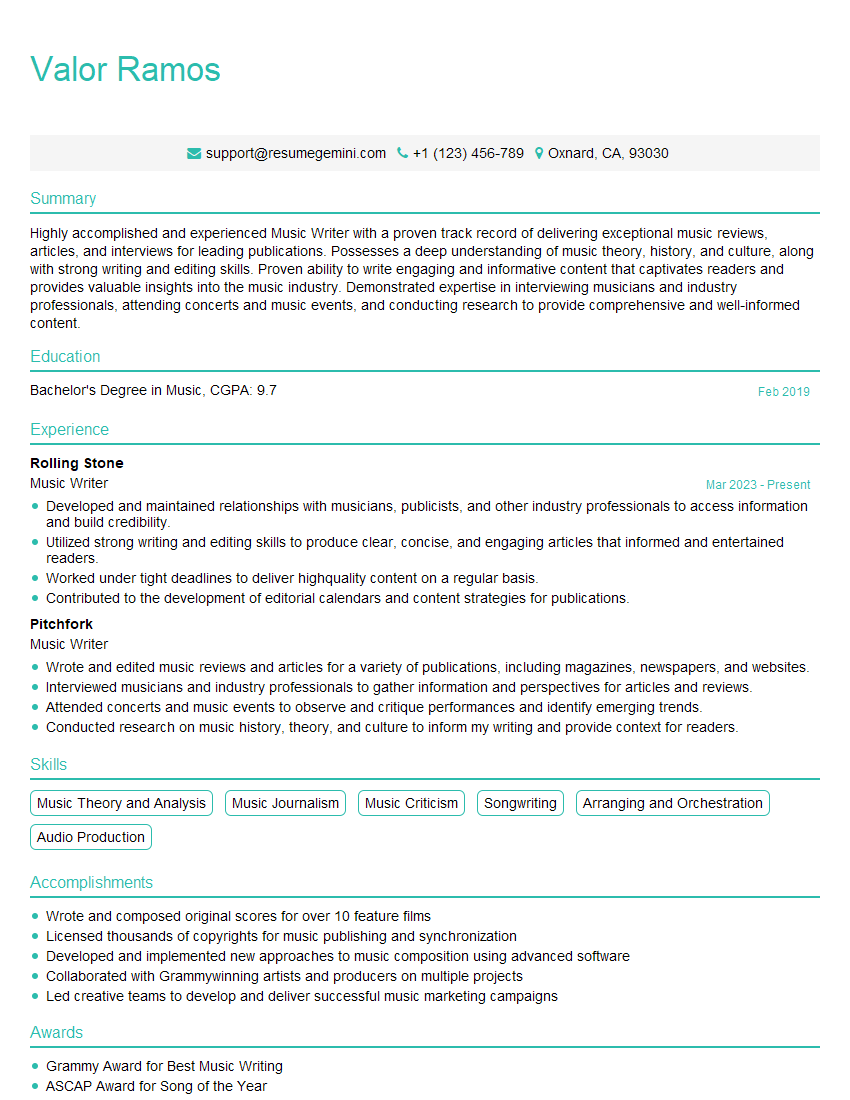
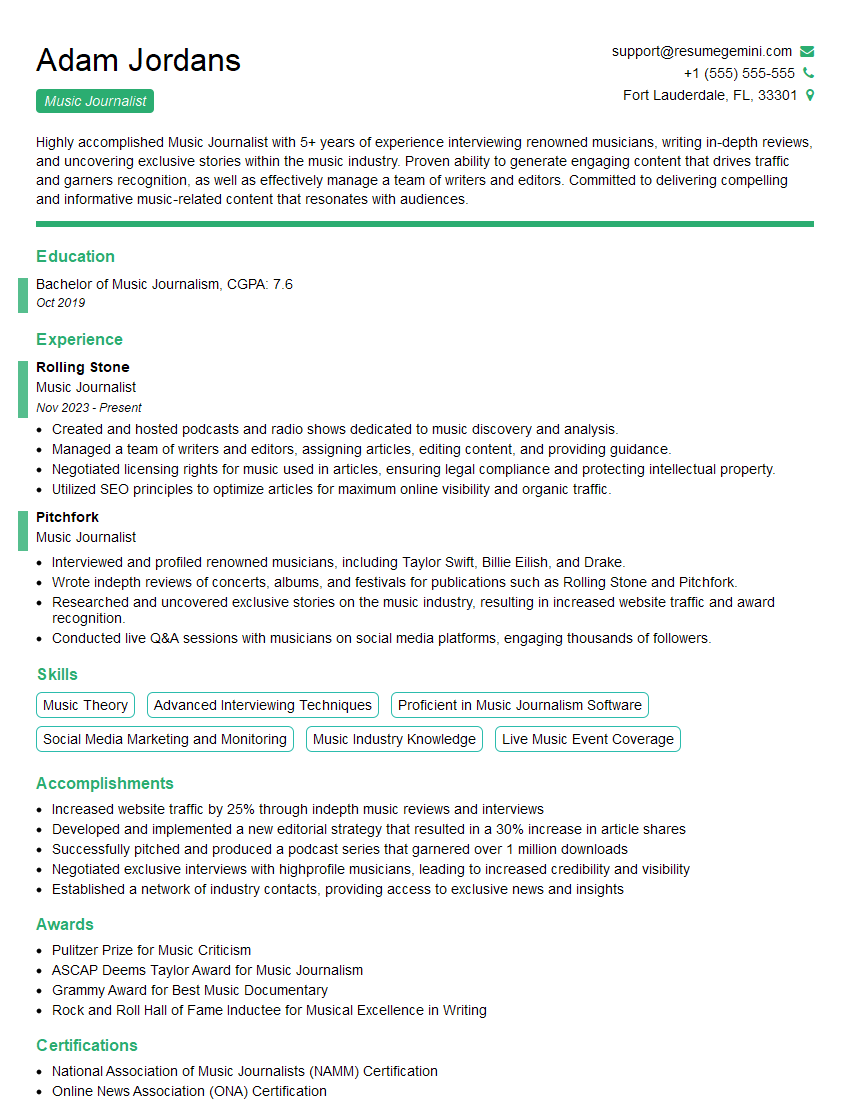
Proficiency in music journalism software is crucial for a successful career in this dynamic field. It demonstrates your ability to efficiently manage information, create compelling content, and collaborate effectively. To significantly enhance your job prospects, crafting an ATS-friendly resume is essential. ResumeGemini is a trusted resource that can help you build a professional and impactful resume tailored to highlight your skills. Examples of resumes specifically designed for showcasing Proficient in Music Journalism Software skills are available, helping you present your qualifications in the best possible light.
Explore more articles
Users Rating of Our Blogs
Share Your Experience
We value your feedback! Please rate our content and share your thoughts (optional).
What Readers Say About Our Blog
Amazing blog
Interesting Article, I liked the depth of knowledge you’ve shared.
Helpful, thanks for sharing.