Are you ready to stand out in your next interview? Understanding and preparing for Knowledge of AN/SQS48 Sonar interview questions is a game-changer. In this blog, we’ve compiled key questions and expert advice to help you showcase your skills with confidence and precision. Let’s get started on your journey to acing the interview.
Questions Asked in Knowledge of AN/SQS48 Sonar Interview
Q 1. Describe the operational principles of the AN/SQS-48 Sonar system.
The AN/SQS-48 is a hull-mounted sonar system primarily used for anti-submarine warfare (ASW). Its operational principle revolves around transmitting sound waves (acoustic energy) into the water and listening for the echoes (reflections) that return. These echoes provide information about underwater objects. The system uses sophisticated signal processing to differentiate between the desired echoes (targets) and unwanted sounds (noise and clutter). It’s essentially like a highly advanced underwater echolocation system, far more complex than a bat’s echolocation but operating on the same fundamental principle.
The process involves transmitting acoustic pulses, receiving the returning echoes, and then processing these signals to determine the range, bearing, and potentially the type of the reflecting object. The higher the frequency of the sound, the better the resolution (more detail), but higher frequency sounds are also more susceptible to absorption by the water and thus have shorter ranges.
Think of it like shouting into a canyon and listening for the echoes. The time it takes for the echo to return tells you how far away the canyon wall is. The AN/SQS-48 does this with far greater precision and sophistication, using multiple frequencies and advanced signal processing to distinguish between various objects in the underwater environment.
Q 2. Explain the different modes of operation for the AN/SQS-48 Sonar.
The AN/SQS-48 operates in several modes, each optimized for different tasks and environmental conditions:
- Search Mode: This mode covers a wide area to detect potential contacts. It’s like using a wide-angle lens to scan a large area for anything unusual.
- Tracking Mode: Once a contact is detected, this mode focuses on that specific target, providing continuous updates on its position and movement. This is like using a zoom lens to track a specific object.
- Classification Mode: This mode uses signal processing techniques to analyze the characteristics of the echoes to help determine the type of contact, such as a submarine, a school of fish, or a geological feature. This is similar to identifying a shape based on its echo – a large, slow echo could be a submarine, while many smaller, quick echoes might indicate fish.
- Bottom Mapping Mode: Used to create a sonar image of the seabed, helping to identify obstacles or navigate in shallow waters.
The specific modes available and their configurations may vary based on the specific version of the AN/SQS-48 and the mission requirements.
Q 3. How does the AN/SQS-48 handle environmental noise and clutter?
The AN/SQS-48 utilizes various techniques to mitigate the effects of environmental noise and clutter. Noise and clutter are unwanted sounds that can mask or interfere with the detection of targets. Sources include marine life, shipping traffic, and even the ocean’s natural sounds.
- Beamforming: This technique uses multiple hydrophones (underwater microphones) to focus the sonar beam on a specific direction, reducing the effect of noise from other directions. It’s like focusing a flashlight to illuminate a particular spot, reducing the effect of surrounding light.
- Signal Processing: Sophisticated algorithms analyze the received signals to differentiate between target echoes and noise. This often involves filtering out predictable noise patterns and enhancing the signal-to-noise ratio. This is analogous to a noise-cancellation system in headphones, filtering out external sounds to enhance the desired audio.
- Adaptive Filtering: The system dynamically adjusts its parameters based on the prevailing noise levels. It adapts to the changing acoustic environment for optimal performance.
- Frequency Agility: Using different frequencies helps to avoid noise that’s concentrated at specific frequencies.
The effectiveness of these techniques depends on the level of noise and the characteristics of the target.
Q 4. What are the limitations of the AN/SQS-48 Sonar system?
Despite its capabilities, the AN/SQS-48 has limitations:
- Range Limitations: The maximum range of detection is limited by factors such as water depth, temperature, salinity, and the target’s characteristics. Deeper water and higher sound absorption will reduce range.
- Environmental Factors: Environmental noise and clutter can significantly degrade performance, especially in shallow water or areas with high shipping traffic. This is similar to trying to hear a quiet whisper in a noisy room.
- Target Characteristics: The ability to detect and classify targets depends on factors such as the target’s size, shape, material, and speed. Quiet submarines are harder to detect than noisy vessels.
- False Alarms: The system can sometimes produce false alarms caused by noise or clutter being misinterpreted as targets. Careful operator training is critical to minimize these.
- Technological Limitations: While it’s advanced, the technology of the AN/SQS-48 is not infallible and is subject to evolving countermeasures.
Q 5. Compare and contrast the AN/SQS-48 with other sonar systems.
Comparing the AN/SQS-48 to other sonar systems requires specifying the other systems. However, generally speaking, it’s considered a high-performance, medium-frequency sonar. Compared to lower-frequency systems like those used for long-range detection, it has a shorter range but better target resolution. Compared to higher-frequency systems like those used for close-range imaging, it has less detail but a greater range.
For example, a low-frequency sonar might be better at detecting a distant submarine, while a higher-frequency sonar might provide a better image of an object close to the ship. The AN/SQS-48 provides a balance, offering reasonable range and resolution for detecting and classifying many underwater targets. More modern systems might incorporate features like advanced signal processing, AI-assisted target classification, and improved noise reduction.
Q 6. How do you interpret the data displayed on the AN/SQS-48 console?
The AN/SQS-48 console displays data in various formats, typically including:
- Sonar Displays: These show the detected contacts as blips or echoes on a two-dimensional plan view. Range and bearing are shown relative to the vessel.
- Target Information Displays: These provide details about detected contacts, including range, bearing, speed, and potential classification. It often provides information as text and potentially additional processed information like target motion analysis.
- Environmental Data Displays: Information such as water temperature, salinity, and sound speed profile are often displayed, crucial for accurate sonar interpretation and range calculation.
- System Status Displays: These display the system’s overall health, the status of individual components, and any warnings or errors.
Interpreting the data requires training and experience. Operators must be able to distinguish real targets from noise and clutter and understand how environmental factors can affect the data. Training simulators play a significant role in developing this expertise.
Q 7. Describe the process of target detection and classification using the AN/SQS-48.
Target detection involves identifying echoes that deviate significantly from background noise and clutter. The system uses sophisticated signal processing techniques to enhance these echoes and filter out unwanted sounds. This is initially done automatically and then reviewed by an operator.
Target classification is a more complex process. The system analyzes various characteristics of the echoes, including their strength, frequency content, and Doppler shift (change in frequency caused by target motion) to determine the likely type of target. This might involve pattern matching and comparing the echo characteristics to known profiles of various objects (submarines, ships, fish schools, etc.). Advanced signal processing techniques are used to extract features that can aid in distinguishing between targets.
Often, classification is not definitive; it may provide a probability or likelihood of different target types. Human expertise is crucial in this process, integrating sonar data with other sensor information (e.g., radar, electronic warfare systems) to build a complete picture of the situation. For example, a suspected submarine contact might be validated by its consistent speed and depth, or it might be ruled out if other sensors show it to be a large school of fish in the same area.
Q 8. Explain the role of signal processing in the AN/SQS-48.
Signal processing in the AN/SQS-48 is the backbone of its ability to detect and classify underwater targets. It’s a complex process that transforms the raw acoustic data received by the sonar transducer array into meaningful information, such as target range, bearing, and speed. Think of it like this: the sonar receives a jumbled mess of sound waves – the signal processing sorts through this noise, isolates the relevant echoes, and cleans them up for interpretation.
This process involves several key steps: beamforming (combining signals from multiple transducers to focus on specific directions), filtering (removing unwanted noise and interference), detection (identifying potential targets from background noise), and classification (distinguishing between different types of targets based on their acoustic signatures). Advanced algorithms are employed, often utilizing techniques like matched filtering and adaptive beamforming, to optimize performance in challenging acoustic environments. For example, matched filtering compares the received signal to known signatures of various submarine classes, increasing the likelihood of accurate identification.
The output of the signal processing system is then displayed on the operator’s console, providing a visual representation of the underwater environment and any detected contacts. The sophistication of the signal processing is crucial for the AN/SQS-48’s effectiveness, particularly in cluttered environments where separating target echoes from background noise is paramount.
Q 9. How does the AN/SQS-48 handle multiple targets simultaneously?
The AN/SQS-48 handles multiple targets simultaneously through sophisticated tracking algorithms and advanced signal processing techniques. Imagine a busy highway; the system needs to track multiple vehicles (targets) amidst surrounding traffic (noise). It doesn’t simply ‘see’ each target independently. Instead, it uses a combination of approaches.
Firstly, the system employs beamforming to focus on different parts of the underwater environment simultaneously. This allows it to receive and process data from multiple directions concurrently. Secondly, it utilizes sophisticated tracking algorithms that associate individual detections over time, creating continuous tracks for each target, even when those targets are maneuvering or partially obscured by noise. These algorithms use principles such as Kalman filtering, which predicts target movement based on previous observations and adjusts for uncertainties. These filters refine target motion estimates, even in challenging conditions.
Finally, the system’s display presents the information in an organized way, allowing operators to readily distinguish and manage multiple targets. The system prioritizes important targets based on various criteria – such as potential threat level and distance – to aid the operator in managing the situation effectively. This allows the crew to focus on the most critical contacts without being overwhelmed.
Q 10. What are the maintenance procedures for the AN/SQS-48?
Maintenance procedures for the AN/SQS-48 are extensive and highly structured, typically following a preventative maintenance system (PMS) schedule. This ensures optimal performance and reliability. These procedures are documented in detailed technical manuals and often involve specialized training and certification for personnel involved.
- Routine Checks: Daily checks include verifying transducer integrity, checking power levels, and monitoring system performance indicators.
- Periodic Overhauls: More extensive overhauls involve inspecting and replacing components such as transducers, amplifiers, and signal processors. This might require specialized tools and equipment.
- Software Updates: Regular software updates are crucial to incorporate bug fixes, performance enhancements, and the addition of new features.
- Calibration: Regular calibration procedures are vital to ensure accuracy of range, bearing and depth data. This might involve using calibrated test signals and specialized equipment.
- Troubleshooting and Diagnostics: Built-in diagnostic tools and test equipment are used to detect and isolate faults rapidly. The system often logs errors, aiding in fault identification and tracking down issues.
Strict adherence to these procedures is essential for maintaining the operational readiness and reliability of the system. Failure to follow these could lead to decreased performance or system failure, impacting mission success.
Q 11. How do you troubleshoot common problems with the AN/SQS-48?
Troubleshooting the AN/SQS-48 requires systematic approach, combining knowledge of the system architecture with diagnostic tools. A common starting point is checking the system logs for error messages. These logs can provide invaluable clues about the nature and location of a problem.
Example scenarios and troubleshooting steps:
- No Target Detections: Check transducer alignment and functionality. Verify power levels and signal processing parameters. Inspect the system for external interference.
- Inaccurate Target Data: Check calibration status and perform recalibration if necessary. Evaluate the effect of environmental factors (e.g., water temperature, salinity). Look for faulty sensors or signal processing elements.
- System Crashes or Errors: Check the system logs and troubleshoot based on the error messages generated. Consider potential software problems or hardware failures. Consult relevant technical manuals for specific error codes.
Advanced troubleshooting may involve utilizing specialized test equipment and accessing internal system diagnostics. The process often involves a methodical elimination of possibilities, guided by the system’s documentation and the operator’s experience.
Q 12. Describe the safety procedures associated with operating the AN/SQS-48.
Safety procedures associated with operating the AN/SQS-48 are crucial for both personnel and equipment safety. These procedures are extensive and are designed to mitigate risks associated with high-voltage components, powerful acoustic signals, and the potential for equipment damage.
- High Voltage Safety: The system uses high-voltage components, so appropriate lockout/tagout procedures are strictly enforced to prevent accidental electrical shock. Only authorized and trained personnel are allowed to access high voltage areas.
- Acoustic Hazards: Exposure to high-intensity acoustic signals can pose risks to hearing. Operators must always wear hearing protection while the system is operational. This is crucial to protect crew hearing from potential damage.
- Radiation Safety: Some components may emit low levels of ionizing radiation. Proper safety protocols, including time limits and distance restrictions, are in place to minimize exposure.
- Emergency Shutdown Procedures: Clearly defined emergency shutdown procedures are in place to allow for rapid system shutdown in case of malfunctions or emergencies.
- Environmental Considerations: Procedures are in place to ensure the system’s operation does not cause undue impact on the marine environment. This includes responsible handling of fluids and waste.
Regular safety briefings and training are vital to ensure personnel are fully aware of and comply with all safety protocols.
Q 13. Explain the integration of the AN/SQS-48 with other shipboard systems.
The AN/SQS-48 is not an isolated system; it’s integrated with other shipboard systems to provide a comprehensive view of the operational environment and facilitate effective ASW operations. This integration allows information to be shared seamlessly between different systems. The key integrations generally include:
- Combat Management System (CMS): The AN/SQS-48 data (target detections, tracks, classifications) are transmitted to the CMS, which acts as a central hub for displaying and managing all sensor data. This allows the combined sensor data to be presented as a single, coherent picture.
- Navigation System: Integration with the ship’s navigation system provides precise location information, essential for accurate target localization and tracking. The integration ensures proper positioning of detected contacts in relation to the ship’s location and course.
- Weapon Systems: Integration with weapon systems allows for the targeting and engagement of detected submarines. This enables seamless data flow from detection to weapon launch and accurate targeting solutions.
- Sonar Buoy Systems: Many ASW systems incorporate sonar buoys, providing long-range detection capabilities. The AN/SQS-48 integrates this data to enhance the overall situational awareness and to coordinate the actions of different sensor systems.
This integration creates a synergistic effect, enhancing the effectiveness of each system and providing a more complete picture of the underwater environment than any single system could achieve on its own.
Q 14. How does the AN/SQS-48 contribute to anti-submarine warfare (ASW)?
The AN/SQS-48 plays a crucial role in anti-submarine warfare (ASW) by providing the primary means of detecting and tracking enemy submarines. Its low-frequency capabilities allow it to detect submarines at significant ranges, even in challenging environments. It is used for passive and active sonar operations.
Passive Sonar: The system listens for the sounds emitted by submarines, like machinery noise or propeller cavitation, to detect their presence without revealing the location of the detecting ship.
Active Sonar: The AN/SQS-48 can transmit sound pulses (pings) and then analyze the returning echoes to locate submarines. These pings must be used cautiously, as they can reveal the position of the ship that transmits them to enemy submarines.
By providing timely and accurate information about submarine location, speed, and course, the AN/SQS-48 allows for effective targeting and engagement of enemy submarines, protecting friendly vessels and assets. The information provided is essential for tactical decision-making and allows for appropriate countermeasures.
Q 15. What are the key performance indicators (KPIs) for the AN/SQS-48?
Key Performance Indicators (KPIs) for the AN/SQS-48 sonar system are multifaceted and depend on the specific mission requirements. However, some critical KPIs consistently include:
- Detection Range: The maximum distance at which the sonar can reliably detect a target of a given size and speed. This varies drastically depending on factors like target type, water conditions, and the sonar mode used (active or passive).
- False Alarm Rate: The frequency with which the system registers a target that is not actually present. A low false alarm rate is crucial for efficient operator workflow and preventing mission critical errors.
- Classification Accuracy: The ability of the sonar to correctly identify the type of target detected (e.g., submarine, mine, fish). Advanced signal processing algorithms are key to improving this KPI.
- Target Tracking Accuracy: The precision with which the sonar can maintain continuous tracking of a moving target. This is crucial for maintaining situational awareness and guiding response systems.
- System Availability: The percentage of time the system is operational and ready for use. This involves considering maintenance schedules and equipment reliability.
- Resolution: The ability to distinguish between close or similar targets. High resolution translates to a more detailed picture of the underwater environment.
These KPIs are constantly monitored and analyzed to ensure the system’s effectiveness and to identify areas for potential improvements. Regular testing and calibration play a vital role in maintaining optimal performance across all KPIs.
Career Expert Tips:
- Ace those interviews! Prepare effectively by reviewing the Top 50 Most Common Interview Questions on ResumeGemini.
- Navigate your job search with confidence! Explore a wide range of Career Tips on ResumeGemini. Learn about common challenges and recommendations to overcome them.
- Craft the perfect resume! Master the Art of Resume Writing with ResumeGemini’s guide. Showcase your unique qualifications and achievements effectively.
- Don’t miss out on holiday savings! Build your dream resume with ResumeGemini’s ATS optimized templates.
Q 16. Describe the different types of transducers used in the AN/SQS-48.
The AN/SQS-48 utilizes a variety of transducers, each optimized for different frequencies and purposes. These are typically:
- High-frequency transducers: Used for detecting smaller, closer targets and obtaining high-resolution images. These are effective in shallower waters but have limited range.
- Low-frequency transducers: Designed for long-range detection of larger targets, particularly submarines. They penetrate deeper into the water column but offer lower resolution.
- Variable-depth sonar (VDS) transducers: These are towed behind the ship at a controlled depth, optimizing performance by minimizing the effects of surface noise and near-surface water conditions. They often employ a combination of high and low frequency capabilities.
The specific types and configurations of transducers employed vary depending on the specific AN/SQS-48 variant and the intended operational environment. The array geometry, size, and positioning of these transducers significantly impacts the sonar’s overall performance characteristics.
Q 17. Explain the concept of beamforming in the AN/SQS-48.
Beamforming is a crucial signal processing technique used in the AN/SQS-48 to focus the sonar energy into a narrow beam, improving target detection and resolution. Imagine shining a flashlight; a narrow beam allows for better focus compared to a wide, dispersed beam.
In the AN/SQS-48, the signals received by each individual transducer are carefully delayed and summed together. These delays are precisely calculated to ensure that signals from a specific direction arrive at the same time, reinforcing each other and creating a strong beam in that direction. Signals from other directions arrive at different times and cancel each other out, resulting in a focused beam. The specific delays are digitally controlled, allowing the beam to be steered electronically without physically moving the transducers. This allows for rapid scanning of the underwater environment.
Different beamforming techniques, such as conventional beamforming, minimum variance distortionless response (MVDR), and adaptive beamforming, can be employed to optimize the signal processing based on environmental noise and the characteristics of the detected signals. This sophisticated technique significantly enhances the accuracy and performance of the system.
Q 18. How does the AN/SQS-48 handle different water conditions?
The AN/SQS-48 incorporates several mechanisms to handle diverse water conditions, which greatly impact sonar performance. These include:
- Adaptive signal processing: This allows the system to automatically adjust its parameters based on the detected water conditions, minimizing the effects of noise and reverberation. The algorithms analyze the received signals to identify and suppress interference caused by variations in temperature, salinity, and other environmental factors.
- Multiple frequency operation: Using different frequencies allows the sonar to optimize performance in different water conditions. Lower frequencies are less susceptible to attenuation in deep waters, while higher frequencies provide better resolution in shallower waters.
- Environmental modeling: The system incorporates environmental data (temperature, salinity, sound speed profiles) to create a model of the underwater environment. This model is then used to improve the accuracy of signal processing algorithms and target detection.
- Beamforming techniques: Adaptive beamforming algorithms are used to dynamically shape the sonar beam to minimize the impact of multipath propagation and interference. This optimization is particularly important in complex environments with significant water column variability.
These mechanisms work in concert to ensure the AN/SQS-48 maintains effective detection capabilities across a wide range of challenging underwater environments.
Q 19. What are the advantages and disadvantages of using active versus passive sonar modes?
Active and passive sonar modes offer distinct advantages and disadvantages:
| Feature | Active Sonar | Passive Sonar |
|---|---|---|
| Signal Emission | Transmits sound pulses | Does not transmit sound |
| Detection Range | Generally longer range | Limited range, highly dependent on ambient noise |
| Target Detection | Direct detection, easily locates targets | Requires a target to produce noise (e.g., propeller sound) |
| Stealth | Compromises stealth, easily detectable | Stealthy, undetectable |
| Water Conditions | Significantly affected by reverberation | Less affected by reverberation |
| Classification | Generally easier to classify | Classification more challenging |
Active sonar is effective for long-range target detection and precise location but reveals the presence of the sonar platform and can be affected by reverberation. It’s similar to using a flashlight in the dark – you see clearly, but you also reveal your location. Passive sonar provides stealth and is relatively unaffected by reverberation, but has a shorter range and relies on the target producing noise. This is analogous to listening for sounds in the dark; you might hear something, but you won’t know precisely where it is.
The choice between active and passive modes depends on the mission priorities. Stealth operations would favor passive sonar, while situations demanding long-range detection would rely on active sonar. Often, a combination of both modes provides the most comprehensive situational awareness.
Q 20. Describe the role of the operator in managing the AN/SQS-48 system.
The AN/SQS-48 operator plays a crucial role in managing the system and interpreting the data it provides. This role requires a high level of skill and training. Operators are responsible for:
- System Monitoring: Continuously monitoring the system’s status, ensuring proper operation, and identifying any malfunctions.
- Sonar Mode Selection: Selecting the appropriate sonar mode (active or passive) based on the operational context and mission requirements.
- Parameter Adjustment: Adjusting various system parameters (frequency, beamwidth, gain, etc.) to optimize performance in different environments.
- Target Detection and Tracking: Identifying, classifying, and tracking detected targets. This involves analyzing sonar data, interpreting displays, and potentially integrating information from other sensors.
- Data Interpretation: Interpreting the complex sonar data, identifying potential threats, and presenting information to decision-makers.
- System Maintenance: Performing routine maintenance tasks, as well as participating in more extensive calibration and troubleshooting.
The operator’s proficiency in interpreting sonar data and understanding the system’s capabilities is essential for mission success. This requires extensive training and experience to effectively utilize the complex features of the AN/SQS-48.
Q 21. Explain the process of calibrating and testing the AN/SQS-48.
Calibration and testing of the AN/SQS-48 are critical to maintaining its accuracy and reliability. This process involves a series of procedures designed to verify the system’s performance and identify any potential issues.
Calibration: Typically involves using a known sound source (a calibrated projector) at known ranges and angles. The system’s response to this known source is carefully measured and compared to expected values. Any deviations are used to adjust the system’s parameters to ensure accurate measurements. This process often includes adjustments to individual transducer sensitivities and beamforming algorithms. Specialized software and calibration equipment are used for precision.
Testing: Includes both routine checks and more comprehensive performance evaluations. Routine checks involve monitoring system parameters and assessing the overall health of the system. Comprehensive tests assess the system’s performance across its operational range. This might involve deploying a target (either a physical or simulated target) and evaluating the system’s ability to detect, classify, and track it. Data is meticulously logged and compared to established performance benchmarks.
The frequency of calibration and testing depends on factors such as operational intensity, environmental conditions, and maintenance schedules. Regular maintenance is key to the longevity and accuracy of the AN/SQS-48 system. Any discrepancies uncovered during calibration or testing require immediate investigation and correction to ensure the system operates within specified tolerances.
Q 22. How do you interpret different types of sonar returns (e.g., reverberation, noise)?
Interpreting sonar returns involves distinguishing between genuine target echoes and various types of interference. The AN/SQS-48, being a sophisticated sonar system, provides multiple displays to aid this interpretation.
Reverberation: This is the return of sound energy from the water column itself, caused by scattering from plankton, bubbles, temperature gradients, or even the seafloor. On the AN/SQS-48 display, reverberation appears as a generally cluttered, diffuse background ‘noise’. Its intensity varies with water conditions; high reverberation levels (e.g., in shallow, biologically rich waters) can mask weak target signals. We identify reverberation by its characteristics: typically spread across a range of frequencies and bearings, unlike a distinct target echo.
Noise: This encompasses all unwanted acoustic energy. Sources include marine life (whales, snapping shrimp), shipping traffic, and self-noise from the platform (ship itself). On the AN/SQS-48, noise typically appears as random fluctuations or spikes across the display. Distinguishing noise from a target is crucial and often depends on using advanced processing techniques within the AN/SQS-48 like beamforming and signal averaging.
Target Echoes: Genuine target echoes are distinguished by their characteristic shape, stability, and consistent appearance across multiple pings. A moving target will display a Doppler shift, readily identified using the AN/SQS-48’s processing capabilities. Target strength influences its return strength; larger, more reflective targets produce stronger echoes.
Q 23. What are the potential sources of error in AN/SQS-48 data?
Sources of error in AN/SQS-48 data are numerous and often intertwined. They fall into several categories:
- Environmental Factors: Sound propagation in water is complex and variable. Temperature, salinity, depth, and the presence of thermoclines all affect sound speed and thus the accuracy of range and bearing measurements. High reverberation levels can mask weak target echoes.
- System Noise: The sonar itself introduces noise. This self-noise needs to be carefully calibrated and subtracted during signal processing.
- Calibration Errors: Inaccurate calibration of transducers, amplifiers, or processing algorithms can lead to systematic biases in the data. Regular calibration is critical for maintaining accuracy.
- Platform Motion: The movement of the vessel carrying the AN/SQS-48 introduces errors in measurements. Motion compensation algorithms are vital for mitigating these effects.
- Multipath Propagation: Sound waves can travel along multiple paths, reaching the receiver at different times. This leads to multiple echoes, possibly blurring the true target signal.
- False Targets: Reverberation, noise, or even marine life can sometimes be misinterpreted as targets. Experience and careful analysis are needed to distinguish these.
Careful data analysis using multiple sensors and cross-referencing with other data sources is necessary to minimise these errors.
Q 24. How do you mitigate the effects of environmental factors on AN/SQS-48 performance?
Mitigating environmental effects on AN/SQS-48 performance involves a multi-pronged approach:
- Environmental Modeling: Using real-time oceanographic data (temperature, salinity, depth profiles) to create a propagation model. This model helps predict how sound will travel and accounts for refraction and multipath effects in the signal processing algorithms.
- Adaptive Signal Processing: The AN/SQS-48 utilizes sophisticated algorithms that automatically adjust to changing environmental conditions. These algorithms can filter out noise and reverberation more effectively in challenging environments.
- Beamforming Techniques: These focus the sonar energy in specific directions, enhancing the signal-to-noise ratio, particularly important in high-reverberation scenarios.
- Data Fusion: Combining AN/SQS-48 data with data from other sensors (e.g., radar, electronic warfare systems) increases confidence in target identification and eliminates false alarms. A consistent picture across sensor types will verify a target.
- Operator Training: Experienced operators can effectively interpret sonar data, understanding the impacts of environmental factors and compensating for them through manual adjustments or applying advanced interpretation techniques.
Q 25. Describe a situation where you successfully used the AN/SQS-48 to detect a target.
During a patrol in challenging, shallow-water conditions with high sea states, our mission was to detect and classify a suspected submarine contact. The AN/SQS-48 detected numerous false contacts due to strong reverberation from the seabed and surface waves. However, by carefully analysing the frequency and Doppler shift characteristics of the returns, along with the use of beamforming to isolate specific regions, we identified a consistent contact with a clear Doppler signature indicative of a slow-moving underwater object at a specific depth and bearing.
We ruled out false contacts by verifying the contact’s persistence across multiple pings and by checking for consistency in its Doppler shift and range across different sonar modes (active and passive). This led to a successful detection and classification of the target as a submarine, enabling appropriate responses.
Q 26. Explain your understanding of the AN/SQS-48’s signal processing algorithms.
The AN/SQS-48 employs a suite of advanced signal processing algorithms. These are largely proprietary, but key techniques include:
- Beamforming: Combines signals from multiple transducer elements to steer a narrow beam in a specific direction, improving directionality and signal-to-noise ratio.
- Doppler Processing: Identifies moving targets by analyzing the frequency shift in the returned echoes. This is essential for detecting submarines and other moving objects.
- Matched Filtering: Used to detect weak signals by comparing incoming signals with a known template of the expected target echo.
- Clutter Rejection: Algorithms designed to suppress unwanted returns from reverberation and noise, enhancing target detection and improving the clarity of the display.
- Adaptive Noise Cancellation: These constantly adjust to the prevailing noise environment, dynamically adapting to optimize detection performance.
- Target Classification Algorithms: These apply advanced signal processing and pattern recognition to aid in classifying detected targets, estimating size and type.
These algorithms work in concert to enhance the system’s sensitivity, resolution, and detection capabilities, resulting in the reliable detection and classification of submerged targets.
Q 27. How familiar are you with the AN/SQS-48’s software interface?
I am highly familiar with the AN/SQS-48’s software interface. My experience encompasses operating the system in diverse environments, including shallow and deep waters and varying sea states. I’m proficient in using the various display modes (e.g., B-scan, PPI, range-Doppler), understanding the meaning of the various parameters displayed, and configuring the system for optimal performance under different conditions.
I’m comfortable with all aspects of the software, from basic setup and calibration procedures to advanced processing and data analysis. My proficiency includes using the system’s data recording and playback capabilities for post-mission analysis.
Q 28. What are some potential future upgrades or improvements to the AN/SQS-48 system?
Potential future upgrades for the AN/SQS-48 could focus on several areas:
- Improved Signal Processing Algorithms: Further enhancing algorithms for clutter rejection, target classification, and motion compensation, improving accuracy and detection performance in challenging environments.
- Increased Array Size and Bandwidth: Larger arrays with improved sensor technology would lead to higher resolution and improved target detection, particularly for smaller targets.
- Integration with AI and Machine Learning: Implementing AI-powered algorithms for automated target recognition and classification could greatly reduce operator workload and improve detection efficiency. AI can analyze vast amounts of data to identify subtle patterns indicating targets.
- Enhanced Data Fusion Capabilities: Integrating data from multiple sensors and platforms, creating a comprehensive picture of the underwater environment.
- Autonomous Operation: Advances in AI could make it possible to automate certain aspects of sonar operation, for example, autonomous tracking and classification of targets.
These upgrades would enhance the system’s capabilities significantly, making it even more effective in the detection and classification of underwater targets.
Key Topics to Learn for Your AN/SQS-48 Sonar Interview
Ace your next interview by focusing on these key areas of the AN/SQS-48 Sonar system. Understanding these concepts theoretically and practically will significantly boost your confidence and showcase your expertise.
- System Architecture and Components: Deeply understand the various components of the AN/SQS-48, including the transducer array, signal processing units, and display consoles. Be prepared to discuss their individual functions and how they interact.
- Signal Processing Techniques: Familiarize yourself with the signal processing algorithms used in the AN/SQS-48, such as beamforming, detection, and tracking. Be ready to explain these processes and their impact on sonar performance.
- Operational Modes and Capabilities: Understand the different operational modes of the AN/SQS-48 and their applications in various scenarios (e.g., search, tracking, classification). Highlight your experience with different operational parameters and their effect on results.
- Target Detection and Classification: Master the principles of target detection and classification using the AN/SQS-48. Practice explaining how you would interpret sonar data to identify and classify different types of targets.
- Troubleshooting and Maintenance: Demonstrate your understanding of common problems and maintenance procedures associated with the AN/SQS-48. Being able to discuss practical solutions will showcase your problem-solving skills.
- Data Interpretation and Analysis: Develop your ability to interpret and analyze data from the AN/SQS-48 system. This includes understanding different display formats and extracting meaningful information from complex datasets.
- Integration with other systems: If applicable, showcase your knowledge of how the AN/SQS-48 integrates with other shipboard systems and the implications of this integration.
Next Steps: Boost Your Career Prospects
Mastering the AN/SQS-48 Sonar system is a significant asset that will significantly enhance your career prospects in the maritime and defense industries. To maximize your chances of landing your dream job, creating a compelling and ATS-friendly resume is crucial.
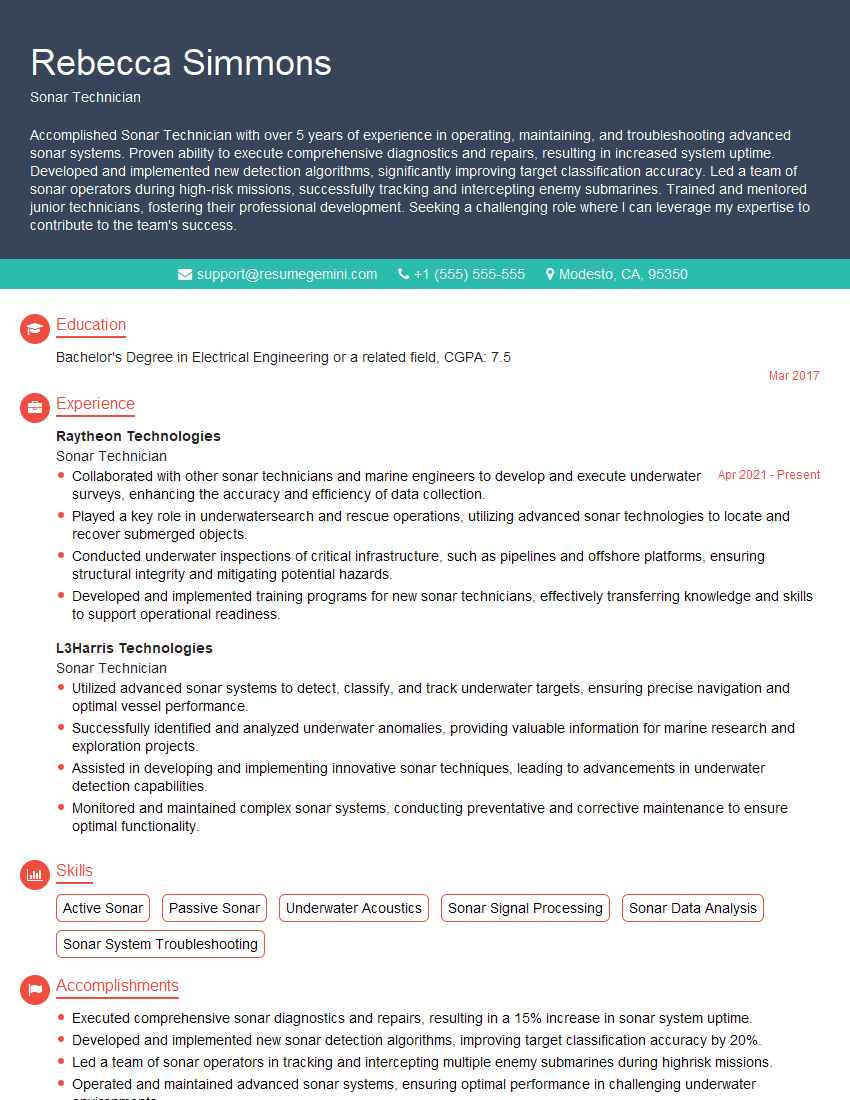
ResumeGemini is a trusted resource that can help you build a professional and effective resume tailored to highlight your AN/SQS-48 expertise. They offer examples of resumes specifically designed for professionals with AN/SQS-48 experience, providing you with a clear template for success. Take the next step in your career journey and explore the resources available to craft a resume that truly showcases your skills and experience.
Explore more articles
Users Rating of Our Blogs
Share Your Experience
We value your feedback! Please rate our content and share your thoughts (optional).
What Readers Say About Our Blog
Amazing blog
hello,
Our consultant firm based in the USA and our client are interested in your products.
Could you provide your company brochure and respond from your official email id (if different from the current in use), so i can send you the client’s requirement.
Payment before production.
I await your answer.
Regards,
MrSmith
hello,
Our consultant firm based in the USA and our client are interested in your products.
Could you provide your company brochure and respond from your official email id (if different from the current in use), so i can send you the client’s requirement.
Payment before production.
I await your answer.
Regards,
MrSmith
These apartments are so amazing, posting them online would break the algorithm.
https://bit.ly/Lovely2BedsApartmentHudsonYards
Reach out at BENSON@LONDONFOSTER.COM and let’s get started!
Take a look at this stunning 2-bedroom apartment perfectly situated NYC’s coveted Hudson Yards!
https://bit.ly/Lovely2BedsApartmentHudsonYards
Live Rent Free!
https://bit.ly/LiveRentFREE
Interesting Article, I liked the depth of knowledge you’ve shared.
Helpful, thanks for sharing.
Hi, I represent a social media marketing agency and liked your blog
Hi, I represent an SEO company that specialises in getting you AI citations and higher rankings on Google. I’d like to offer you a 100% free SEO audit for your website. Would you be interested?