Feeling uncertain about what to expect in your upcoming interview? We’ve got you covered! This blog highlights the most important Plastic Material Science interview questions and provides actionable advice to help you stand out as the ideal candidate. Let’s pave the way for your success.
Questions Asked in Plastic Material Science Interview
Q 1. Explain the difference between thermoplastic and thermosetting polymers.
The key difference between thermoplastic and thermosetting polymers lies in their response to heat. Thermoplastics are polymers that can be repeatedly softened by heating and solidified by cooling. Think of it like melting and solidifying wax – you can do it multiple times without fundamentally changing the wax’s structure. Their long chain molecules are entangled but not chemically linked, allowing for this reversible process. Common examples include polyethylene (PE), polypropylene (PP), and polyvinyl chloride (PVC), used in packaging, plastic bottles, and pipes respectively.
Thermosets, on the other hand, undergo irreversible chemical changes upon heating. Imagine baking a cake; once baked, you can’t easily unbake it. The process creates strong cross-links between polymer chains, forming a rigid, three-dimensional network. These cross-links make thermosets stronger and more heat-resistant but also less flexible and incapable of being melted and reshaped. Epoxy resins, used in adhesives and coatings, and vulcanized rubber, used in tires, are prime examples.
Q 2. Describe the glass transition temperature (Tg) and its significance.
The glass transition temperature (Tg) is the temperature at which an amorphous (non-crystalline) polymer transitions from a hard, glassy state to a more rubbery or viscous state. It’s not a melting point; the material doesn’t become liquid. Instead, its molecular mobility increases significantly. Imagine a window – below its Tg, it’s hard and brittle; above it, it becomes more flexible (though still solid). This transition is associated with a change in the polymer chains’ ability to move past each other.
The Tg’s significance lies in determining a polymer’s operational temperature range. Applications requiring rigidity and strength need to operate below Tg; those requiring flexibility and elasticity need to operate above Tg. For example, a plastic bottle needs to maintain its shape at room temperature (below its Tg), while a rubber band needs flexibility at room temperature (above its Tg).
Q 3. What are the common types of polymer degradation mechanisms?
Polymer degradation involves the breaking down of the polymer chains, leading to a loss of properties like strength, flexibility, and color. Several mechanisms contribute to this:
- Hydrolysis: Water molecules attack the polymer chains, breaking bonds, especially in polymers susceptible to moisture. This is common in polyesters and polyamides.
- Oxidation: Oxygen reacts with the polymer chains, forming weak points and causing chain scission. UV light often accelerates this process, leading to embrittlement and color changes.
- Thermal degradation: High temperatures break down the polymer chains, often producing volatile byproducts. This is why recycling certain plastics can be challenging due to the potential for thermal degradation during processing.
- Photodegradation: UV radiation from sunlight causes chain scission and crosslinking, leading to degradation. This is a major concern for outdoor applications of polymers.
- Biodegradation: Microorganisms break down the polymer chains. This is a desirable property for environmentally friendly plastics.
Understanding these mechanisms is critical for designing polymers with improved durability and longevity.
Q 4. Explain the concept of crystallinity in polymers and its impact on properties.
Crystallinity in polymers refers to the degree of structural order within the polymer material. A crystalline region consists of polymer chains arranged in a highly ordered, three-dimensional lattice structure, similar to crystals in inorganic materials. Amorphous regions, conversely, lack this long-range order, having a more random arrangement of chains. Most polymers have a mixture of both crystalline and amorphous regions.
Crystallinity significantly impacts polymer properties. Highly crystalline polymers tend to be stronger, stiffer, denser, more resistant to solvents, and have higher melting points than their amorphous counterparts. For example, high-density polyethylene (HDPE) has a high degree of crystallinity, resulting in its strength and stiffness (used in milk jugs), whereas low-density polyethylene (LDPE) is more amorphous, making it flexible (used in plastic bags).
Q 5. Discuss various polymer processing techniques, such as injection molding and extrusion.
Several polymer processing techniques exist, each suited for different applications and polymer types. Two common methods are:
- Injection Molding: Molten polymer is injected under high pressure into a mold cavity, where it cools and solidifies into the desired shape. This is a high-volume production method ideal for producing complex shapes with high precision. Examples include plastic bottle caps, toys, and car parts.
- Extrusion: Polymer is melted and continuously pushed through a die to create a consistent shape, such as a film, sheet, or pipe. Extrusion is versatile and used for producing various products, including plastic films for packaging, pipes for water distribution, and fibers for textiles.
Other techniques include blow molding (bottles), thermoforming (packaging), rotational molding (large hollow parts), and compression molding (thermosets).
Q 6. How do you determine the molecular weight of a polymer?
Determining the molecular weight of a polymer is crucial since it directly affects its properties. Several techniques are employed:
- Gel Permeation Chromatography (GPC) or Size Exclusion Chromatography (SEC): This separates polymers based on their size, allowing determination of the molecular weight distribution.
- Viscometry: Measures the solution viscosity, which is related to the polymer’s molecular weight. This is a simpler and faster method but provides less detailed information.
- Light Scattering: Measures the scattering of light by polymer solutions, providing information about the molecular weight and size.
- End-group analysis: Determines the molecular weight by analyzing the number of end groups in the polymer chain, suitable for polymers with well-defined end groups.
The choice of method depends on the polymer type, desired accuracy, and available resources.
Q 7. Explain the principles of rheology in relation to polymer processing.
Rheology studies the flow and deformation of materials under stress. In polymer processing, understanding rheology is essential because it dictates how a polymer will behave during processing. The rheological properties of a polymer, such as viscosity and elasticity, influence its processing parameters, such as temperature, pressure, and flow rate. A polymer’s viscosity, for example, determines the ease with which it can be pumped and molded. A high viscosity will require more processing power.
Rheological measurements, such as viscosity as a function of shear rate, help optimize processing parameters to achieve the desired product quality. For instance, rheological data helps determine the optimal melt temperature and pressure for injection molding to ensure complete filling of the mold cavity without defects.
Q 8. What are the common methods used for characterizing polymer morphology?
Characterizing polymer morphology, the study of a polymer’s internal structure, is crucial for understanding its properties and performance. We use several techniques, each offering unique insights:
- Microscopy: Techniques like Scanning Electron Microscopy (SEM) and Transmission Electron Microscopy (TEM) provide high-resolution images revealing surface features and internal structures. SEM is excellent for observing surface morphology, while TEM allows us to see the internal structure at a nanometer scale. For example, we can use SEM to analyze the surface roughness of a plastic film or use TEM to study the crystalline structure of a polymer.
- Diffraction Techniques: X-ray diffraction (XRD) and small-angle X-ray scattering (SAXS) reveal the crystalline and amorphous regions within a polymer. XRD helps us determine the degree of crystallinity and crystal structure, while SAXS provides information about the size and arrangement of larger-scale structures like lamellae in semicrystalline polymers. This is particularly useful for understanding the mechanical properties of materials like polyethylene.
- Thermal Analysis: Differential Scanning Calorimetry (DSC) and Thermogravimetric Analysis (TGA) are thermal techniques that investigate the polymer’s thermal transitions (like melting and glass transitions) and thermal stability. DSC is used to determine the glass transition temperature (Tg) and melting temperature (Tm), which are essential indicators of a polymer’s performance at different temperatures. TGA measures weight changes as a function of temperature, helpful for assessing the thermal stability and degradation behavior of polymers.
- Rheological Measurements: Rheometry studies the flow behavior of polymer melts under various conditions of shear rate and temperature. This provides information about molecular weight, chain entanglement, and viscoelastic properties. This data is vital in processing and manufacturing, guiding the selection of optimal processing parameters.
The choice of technique depends heavily on the specific polymer and the information sought. Often, a combination of techniques is employed for a comprehensive understanding.
Q 9. Describe different types of polymer additives and their functions.
Polymer additives are substances added to polymers to modify or enhance their properties. They are broadly categorized into:
- Plasticizers: These reduce the glass transition temperature (Tg), increasing flexibility and ductility. Phthalates were commonly used, but concerns regarding their toxicity have driven a shift towards alternatives like citrates and adipates. Think of the difference between a stiff PVC pipe and a flexible PVC shower curtain – the latter contains plasticizers.
- Fillers: These inexpensive materials are added to increase volume, reduce cost, and sometimes improve mechanical properties. Examples include talc, calcium carbonate, and glass fibers. Adding glass fibers to a polymer matrix increases its strength and stiffness, creating a composite material.
- Stabilizers: These protect polymers from degradation caused by heat, light, or oxidation. Antioxidants prevent chain scission and crosslinking, extending the material’s lifespan. UV stabilizers protect against UV degradation, preserving color and preventing material embrittlement. For example, UV stabilizers are crucial in outdoor applications like plastic siding.
- Flame Retardants: These additives increase the material’s resistance to combustion. Halogenated flame retardants were commonly used but environmental concerns have driven research into alternative, less-toxic options such as phosphorus-based compounds. These are essential for safety in electrical appliances and building materials.
- Colorants: Pigments and dyes impart color to the polymer. Pigments are insoluble and provide excellent opacity and weather resistance; dyes are soluble and provide vibrant colors but often have less weatherability. Colorants are essential in almost every application where aesthetics matter.
- Anti-static agents: These prevent the build-up of static electricity, commonly used in packaging for electronics to prevent electrostatic discharge (ESD).
The selection of additives depends on the application and the desired properties of the final product. A carefully balanced formulation is crucial for optimal performance.
Q 10. How do you select the appropriate plastic material for a specific application?
Selecting the right plastic for an application involves a systematic process. We must carefully consider the following factors:
- Required Properties: What are the critical mechanical, thermal, chemical, and electrical properties needed? Will the material need high strength, flexibility, heat resistance, chemical inertness, or electrical insulation? For example, a car bumper needs high impact resistance, while a food container needs to be chemically inert.
- Processing Method: How will the part be manufactured? Injection molding, extrusion, blow molding, thermoforming, etc., each have suitable material choices. Different polymers process differently and choosing a material incompatible with the chosen process will lead to problems.
- Cost: The material’s cost must be balanced against the desired properties and processing requirements. Some high-performance polymers are far more expensive than commodity plastics.
- Environmental Considerations: Sustainability is crucial. We should consider the material’s recyclability, biodegradability, and potential environmental impact throughout its lifecycle. For example, the shift towards bioplastics highlights the importance of this factor.
- Regulatory Compliance: The material must comply with relevant regulations, such as those concerning food contact, medical applications, or hazardous substances. Certain regulations exist for specific applications; food contact materials must meet stringent standards, for instance.
A materials selection chart or database can be a valuable tool, allowing engineers to filter options based on specific criteria. Experience and thorough testing are vital for final material validation. The process is iterative: we might start with a few candidate materials based on initial screening, then narrow down the choices through rigorous testing and prototyping.
Q 11. Explain the concept of stress-strain behavior in polymers.
Stress-strain behavior describes how a polymer responds to applied force. It’s typically represented by a stress-strain curve. Unlike metals, polymers exhibit viscoelastic behavior, meaning their response depends on both time and temperature.
The curve illustrates the relationship between stress (force per unit area) and strain (deformation). The initial linear region represents elastic deformation, where the material recovers its shape upon removal of the load. The slope of this region is the Young’s modulus (or modulus of elasticity), an indicator of material stiffness. Beyond the elastic limit, the material enters the plastic region, exhibiting permanent deformation. The yield strength represents the stress at which permanent deformation begins. Ultimate tensile strength is the maximum stress the material can withstand before breaking, and elongation at break is the percentage of elongation before failure.
The shape of the stress-strain curve varies significantly depending on polymer type, temperature, and processing conditions. Crystalline polymers often exhibit higher stiffness and strength but lower ductility compared to amorphous polymers. Temperature plays a significant role; increasing temperature generally reduces stiffness and increases ductility.
Understanding stress-strain behavior is essential for designing components that can withstand intended loads without failure. It informs decisions on material selection, component geometry, and safety factors.
Q 12. What are the common failure modes of plastic components?
Plastic components can fail in several ways:
- Yielding: Permanent deformation occurs beyond the yield point, resulting in loss of shape and dimensional stability.
- Fracture: Complete breakage of the material, which can be brittle (sudden failure with little deformation) or ductile (failure preceded by significant deformation).
- Creep: Gradual deformation under constant stress over time, often at elevated temperatures. This can lead to dimensional changes or eventual failure.
- Fatigue: Failure under repeated cyclical loading, even if the stress is below the yield strength. This is common in applications with vibration or fluctuating loads.
- Stress Cracking: Crack initiation and propagation caused by the combined action of tensile stress and an aggressive environment (e.g., chemicals or solvents).
- Environmental Stress Cracking (ESC): Similar to stress cracking, but the environmental agent is usually a liquid.
- Thermal Degradation: Decomposition or embrittlement due to excessive heat exposure, leading to loss of strength and functionality.
- Oxidation: Degradation due to reaction with oxygen, leading to embrittlement and discoloration.
- UV Degradation: Degradation due to exposure to ultraviolet light, resulting in loss of strength, discoloration, and embrittlement.
Understanding these failure modes is crucial for designing robust and reliable plastic components. Appropriate material selection, design optimization, and environmental protection measures can mitigate the risk of failure.
Q 13. Describe the principles of polymer blending and compatibilization.
Polymer blending combines two or more polymers to create a new material with properties different from the individual components. This can be cost-effective and allow for tailoring of properties to specific applications. However, many polymers are immiscible, meaning they don’t mix well on a molecular level, leading to phase separation and poor mechanical properties.
Compatibilization is the process of improving the interfacial adhesion between immiscible polymers. This is often achieved by adding a compatibilizer, which is a third component that interacts with both polymers, reducing interfacial tension and improving blend homogeneity. Compatibilizers often include block copolymers, which have segments that are compatible with each of the blend components. They act as a bridge, connecting the two polymer phases and improving their adhesion.
For example, blending polypropylene (PP) and polyethylene (PE) often results in a weak material due to their immiscibility. However, adding a compatibilizer, such as a maleic anhydride-grafted PP, improves adhesion between PP and PE, leading to a stronger and more homogenous blend.
The success of polymer blending hinges on careful selection of polymers and compatibilizers, as well as processing parameters such as mixing temperature and shear rate. Rheological testing is often used to optimize the blending process.
Q 14. Explain the effects of temperature and pressure on polymer properties.
Temperature and pressure significantly impact polymer properties. The effects are complex and interconnected:
- Temperature: Increasing temperature reduces stiffness and increases ductility. Above the glass transition temperature (Tg), amorphous polymers transition from a glassy to a rubbery state, exhibiting significant increases in flexibility and ductility. Crystalline polymers show a similar increase in flexibility, and above their melting temperature (Tm), they transition to a viscous melt. Low temperatures, conversely, lead to reduced ductility, increased brittleness, and potential cracking.
- Pressure: Pressure generally increases the density and stiffness of polymers, affecting their mechanical behavior. High pressure can induce structural changes and improve the crystallinity of some polymers, modifying their properties. This is especially significant in molding operations where high pressure is used to shape polymer melts.
The combined effects of temperature and pressure are important in polymer processing. For example, injection molding relies on precisely controlled temperature and pressure profiles to melt the polymer, inject it into a mold, and solidify it into the desired shape. In extrusion, carefully balanced temperature and pressure control is vital for producing consistent material quality. Extrusion creates long continuous profiles like pipes and films, whereas injection molding creates 3D solid parts.
Understanding the effects of temperature and pressure is critical for selecting appropriate processing parameters, predicting material performance in service, and ensuring product quality.
Q 15. Discuss different techniques for recycling plastics.
Plastic recycling involves several techniques, broadly categorized as mechanical and chemical recycling. Mechanical recycling is the most common, focusing on physically processing used plastics to create new products. This involves steps like collection, sorting, cleaning, and shredding the plastic waste before melting and re-forming it into new products. The quality of the recycled material often degrades with each cycle, leading to downcycling where the recycled plastic is used for lower-grade applications. For instance, PET bottles may be recycled into fleece fabric. Chemical recycling, on the other hand, breaks down the plastic polymers into their basic building blocks (monomers) or other chemicals, allowing for the creation of virgin-quality plastics. This is more energy-intensive but can handle mixed plastics and overcome the quality limitations of mechanical recycling. Examples of chemical recycling include pyrolysis (breaking down plastic using heat) and depolymerization (using chemicals to break down the polymer chains). A newer approach involves enzymatic depolymerization, using enzymes to break down plastics in a more environmentally friendly way. The choice of recycling method depends on factors like the type of plastic, cost, availability of infrastructure, and desired quality of the recycled product.
- Mechanical Recycling: Sorting, cleaning, shredding, melting, and re-forming.
- Chemical Recycling: Pyrolysis, depolymerization (chemical or enzymatic).
Career Expert Tips:
- Ace those interviews! Prepare effectively by reviewing the Top 50 Most Common Interview Questions on ResumeGemini.
- Navigate your job search with confidence! Explore a wide range of Career Tips on ResumeGemini. Learn about common challenges and recommendations to overcome them.
- Craft the perfect resume! Master the Art of Resume Writing with ResumeGemini’s guide. Showcase your unique qualifications and achievements effectively.
- Don’t miss out on holiday savings! Build your dream resume with ResumeGemini’s ATS optimized templates.
Q 16. How do you ensure the quality control of plastic products?
Quality control in plastic product manufacturing is crucial for ensuring product performance, safety, and meeting customer specifications. It involves a multi-stage approach starting from raw material inspection, throughout the manufacturing process, and finally, product testing. Raw materials are checked for purity, viscosity, and other relevant properties. During the manufacturing process, parameters like temperature, pressure, and processing time are meticulously monitored and controlled to ensure consistency. Statistical Process Control (SPC) techniques are often used to track and analyze process data, allowing for early detection and correction of deviations. After production, rigorous testing is conducted on a sample of products to verify they meet specified requirements. This may include mechanical tests (tensile strength, impact resistance), physical tests (density, dimensional accuracy), and chemical tests (composition, purity). Furthermore, visual inspection for defects like cracks, discoloration, and impurities is also carried out. Any non-conforming products are rejected, and corrective actions are taken to prevent future defects. Implementing a robust quality management system, such as ISO 9001, provides a framework for implementing and maintaining these quality control measures.
Q 17. Explain the role of additives in improving the performance of polymers.
Additives are essential in modifying the properties of polymers, enhancing their performance and tailoring them for specific applications. They’re added in small amounts during the polymer processing. Common types of additives include:
- Plasticizers: Increase flexibility and ductility (e.g., phthalates in PVC).
- Fillers: Reduce cost and improve mechanical properties, like stiffness or strength (e.g., talc, calcium carbonate).
- Stabilizers: Enhance resistance to degradation from heat, light, or oxidation (e.g., UV stabilizers, antioxidants).
- Colorants: Provide desired color or opacity (e.g., pigments, dyes).
- Flame retardants: Increase fire resistance (e.g., brominated flame retardants, organophosphates).
- Lubricants: Reduce friction during processing.
For example, adding a plasticizer to PVC makes it flexible enough for use in clothing and upholstery, while adding a flame retardant to polystyrene makes it suitable for applications near heat sources. The type and amount of additive used depend on the desired properties of the final product and its intended application. Careful consideration must be given to the potential environmental and health impacts of the additives used.
Q 18. Describe the impact of environmental factors on plastic properties.
Environmental factors significantly affect the properties of plastics. Exposure to sunlight (UV radiation) can cause photodegradation, leading to embrittlement, cracking, and discoloration. Temperature fluctuations can cause dimensional changes and affect the mechanical strength. Moisture absorption can also alter the properties, particularly for hydrophilic polymers. For example, prolonged exposure to sunlight can cause a plastic outdoor chair to become brittle and crack, while exposure to high temperatures can cause some plastics to deform or melt. The specific impact of environmental factors depends on the type of plastic, the intensity and duration of exposure, and other factors like the presence of chemicals in the environment. Understanding these effects is crucial for selecting appropriate plastics for various applications and predicting their lifespan. For instance, plastics used in outdoor applications need to be UV-stabilized to resist photodegradation.
Q 19. How do you design plastic components for optimal performance and durability?
Designing plastic components for optimal performance and durability involves considering several factors. First, the selection of the appropriate polymer is crucial, based on the required mechanical properties, chemical resistance, thermal stability, and cost. Finite Element Analysis (FEA) simulations can be used to predict the stress and strain distribution under various load conditions, allowing for optimization of the design for strength and stiffness. The design should also consider factors like part geometry, wall thickness, and the addition of reinforcements (e.g., fibers) to improve mechanical properties. Understanding the manufacturing process is also important, as it can impact the final part quality. For example, injection molding parameters can affect the crystallinity and orientation of the polymer, influencing mechanical properties. Careful consideration should also be given to potential failure modes such as stress cracking, fatigue, and creep, implementing design features to mitigate these risks. Finally, the design should be optimized to minimize material usage, reduce waste, and ensure ease of assembly.
Q 20. What are the common testing methods used for evaluating the mechanical properties of plastics?
Several standardized testing methods are used to evaluate the mechanical properties of plastics. These tests typically involve applying controlled forces or stresses to a specimen and measuring the resulting deformation or failure. Common tests include:
- Tensile testing: Measures tensile strength, yield strength, and elongation at break.
- Flexural testing: Measures flexural strength and modulus.
- Impact testing (Izod or Charpy): Measures impact resistance.
- Hardness testing (Shore, Rockwell): Measures resistance to indentation.
- Creep testing: Measures the deformation under sustained load over time.
- Fatigue testing: Measures the endurance limit under cyclic loading.
The specific test chosen depends on the intended application of the plastic and the properties of interest. These tests provide quantitative data that can be used to compare different materials and ensure that the material meets the required specifications. Standardized procedures, such as those outlined by ASTM International, are followed to ensure consistency and comparability of results.
Q 21. Explain the concept of polymer chain conformation and its influence on material properties.
Polymer chain conformation refers to the three-dimensional arrangement of polymer chains. This arrangement significantly influences the material’s properties. Polymers can exist in various conformations, ranging from highly ordered crystalline structures to completely disordered amorphous states. Crystalline regions have highly ordered chains packed together tightly, leading to higher strength, stiffness, and density. Amorphous regions have randomly oriented chains, resulting in greater flexibility, lower density, and increased transparency. The degree of crystallinity depends on factors like the polymer’s chemical structure, molecular weight, and processing conditions. For example, highly crystalline polyethylene (HDPE) is stronger and more opaque than its less crystalline counterpart (LDPE), which is more flexible and transparent. Chain conformation also impacts other properties like melting point, glass transition temperature, and permeability. Understanding polymer chain conformation is crucial for controlling and predicting the properties of polymeric materials, allowing for the design and manufacture of materials tailored to specific applications.
Q 22. Describe the different types of polymerizations (e.g., addition, condensation).
Polymerization is the process of combining many small molecules, called monomers, into a long chain-like molecule, called a polymer. There are two primary types: addition and condensation polymerization.
Addition Polymerization: This involves monomers adding to each other without the loss of any atoms. Think of it like linking train cars together – each car (monomer) adds directly to the end of the train (growing polymer chain). The reaction typically requires an initiator, which starts the chain reaction. Common examples of addition polymers include polyethylene (PE), polypropylene (PP), and polyvinyl chloride (PVC).
Condensation Polymerization: Here, monomers combine to form a polymer chain, but a small molecule, such as water or methanol, is released as a byproduct in each step. Imagine building with LEGOs where each connection releases a small part. Examples of condensation polymers include polyester (PET) and nylon.
The type of polymerization dictates the properties of the resulting polymer. Addition polymers often have simpler structures and are frequently more flexible, while condensation polymers can exhibit more complex structures and higher melting points.
Q 23. Discuss the various types of plastic packaging and their recyclability.
Plastic packaging encompasses a wide variety of materials, each with varying recyclability. Some common types include:
PET (Polyethylene Terephthalate): Widely used for beverage bottles and food containers. Generally recyclable, but the quality can degrade with each recycling cycle.
HDPE (High-Density Polyethylene): Used for milk jugs, detergent bottles, and some food containers. More readily recyclable than PET.
LDPE (Low-Density Polyethylene): Found in plastic films, bags, and flexible packaging. Recycling is more challenging due to its thin nature and contamination.
PP (Polypropylene): Used for yogurt containers, bottle caps, and some food packaging. Recyclability varies depending on local facilities.
PS (Polystyrene): Used in disposable cutlery, food containers, and packaging peanuts. Recycling rates are lower due to its potential for contamination and the energy-intensive process.
The recyclability of plastic packaging depends on factors such as the type of plastic, the presence of contaminants (food residue, labels), and the availability of appropriate recycling infrastructure. Many plastics are currently downcycled (converted to a lower-quality product), while others end up in landfills or the environment.
Q 24. Explain the challenges and opportunities in developing sustainable plastic materials.
Developing sustainable plastic materials presents significant challenges and exciting opportunities.
Challenges: The main hurdles include the need for biodegradable or compostable materials that perform as well as conventional plastics in terms of strength, durability, and cost-effectiveness. Scaling up production of sustainable alternatives while minimizing their environmental impact is also crucial. Furthermore, widespread adoption requires changes in consumer behavior and infrastructure.
Opportunities: Research into bio-based plastics derived from renewable resources like plants provides a pathway towards reducing reliance on fossil fuels. Advances in chemical recycling allow for the depolymerization of plastics into their monomers for reuse, offering a potential solution for end-of-life plastic waste. The development of innovative designs that reduce plastic use and improve recyclability offers a significant opportunity to minimize plastic pollution.
Ultimately, a multifaceted approach encompassing material science innovation, policy changes, and consumer awareness is essential to achieve a truly sustainable plastics industry.
Q 25. What are some common bioplastics and their applications?
Bioplastics are plastics derived from renewable biomass sources. Some common examples include:
PLA (Polylactic Acid): Made from fermented plant starch or sugarcane. It’s compostable in industrial composting facilities but not home composting systems. Used in food packaging, 3D printing filaments, and disposable tableware.
PHA (Polyhydroxyalkanoates): Produced by bacteria and are biodegradable in various environments. They offer properties comparable to conventional plastics and find applications in medical implants, packaging, and disposable items.
Starch-based plastics: These are often blended with other polymers to improve their properties. Applications include packaging films and disposable items.
It’s important to note that the ‘bio’ prefix does not automatically equate to sustainability. The entire life cycle of bioplastics, including their production and disposal, needs to be considered for a comprehensive assessment of their environmental impact.
Q 26. Describe your experience with specific plastics such as ABS, PP, or PE.
My experience encompasses working extensively with ABS, PP, and PE.
ABS (Acrylonitrile Butadiene Styrene): A tough, impact-resistant thermoplastic. I’ve worked with it in injection molding applications for creating durable housings for electronics and automotive parts. Its ability to be easily molded and its excellent mechanical properties make it a versatile material.
PP (Polypropylene): A lightweight, versatile thermoplastic with good chemical resistance. My experience involves using it in blow molding to create containers and in injection molding for creating reusable containers. It is commonly used due to its excellent resistance to fatigue and chemical solvents.
PE (Polyethylene): A widely used thermoplastic available in various densities (HDPE, LDPE, LLDPE). My experience spans its use in film extrusion for creating plastic bags and films, and also in injection molding for creating durable components. The different densities provide a wide range of properties for different applications.
In each case, I’ve been involved in material selection, processing optimization, and quality control to ensure the final products met the required specifications.
Q 27. How would you troubleshoot a problem encountered during polymer processing?
Troubleshooting polymer processing problems requires a systematic approach. I typically follow these steps:
Identify the problem: Precisely define the issue. Is it dimensional inaccuracies, poor surface finish, inconsistent mechanical properties, or something else?
Gather data: Collect information such as processing parameters (temperature, pressure, residence time), material properties (melt flow index, molecular weight distribution), and visual inspection of the product.
Analyze the data: Examine the relationships between processing parameters and the observed defects. Look for patterns and potential causes.
Develop hypotheses: Formulate possible explanations for the problem based on the analysis. This may involve considering issues like material degradation, equipment malfunction, or improper processing conditions.
Test hypotheses: Conduct experiments to validate or refute the hypotheses. This could involve adjusting processing parameters systematically and observing the effects.
Implement solutions: Based on the successful testing, implement the necessary corrections to the process. This might involve modifying machine settings, changing the material, or implementing process control strategies.
Monitor and refine: Continuously monitor the process to ensure the implemented solution is effective and sustainable. Make further adjustments as necessary.
For example, if encountering excessive shrinkage in an injection molded part, I would investigate factors like mold temperature, injection pressure, and melt temperature. Systematic adjustments to these parameters would help pinpoint the root cause and allow for correction.
Q 28. What are your thoughts on the future trends in plastic materials science?
The future of plastic materials science is driven by sustainability and performance enhancement. I see several key trends emerging:
Bio-based and biodegradable plastics: Increased research and development in bio-based polymers that reduce reliance on fossil fuels and offer biodegradability or compostability.
Chemical recycling: Significant advancements in technologies that allow for the depolymerization of plastics, thus enabling reuse of the monomers. This offers a potential solution for the end-of-life plastic waste challenge.
Advanced polymer architectures: Development of novel polymer architectures with improved properties like enhanced strength, flexibility, and barrier performance.
Smart and functional plastics: Incorporation of functionalities like self-healing, conductivity, and sensing capabilities into plastics for advanced applications.
Circular economy approaches: A shift towards designing plastics for recyclability and designing out waste to promote reuse and reduce environmental impact.
These trends promise to shape the future of the plastics industry, leading to a more sustainable and innovative landscape.
Key Topics to Learn for Your Plastic Material Science Interview
- Polymer Chemistry: Understand the fundamental principles of polymerization, including addition and condensation polymerization, and the relationship between polymer structure and properties. Consider exploring specific polymer types and their synthesis methods.
- Material Properties and Characterization: Master the techniques used to analyze plastic materials, such as tensile testing, impact testing, and thermal analysis (DSC, TGA). Learn to interpret the resulting data and relate it to material performance in applications.
- Processing Techniques: Familiarize yourself with various plastic processing methods like injection molding, extrusion, blow molding, and thermoforming. Understand the impact of processing parameters on the final product’s quality and properties.
- Plastic Degradation and Recycling: Discuss the environmental impact of plastics and the different approaches to plastic degradation and recycling, including mechanical, chemical, and biological methods. Be prepared to discuss sustainability aspects.
- Polymer Physics: Grasp concepts like viscoelasticity, glass transition temperature (Tg), and the relationship between molecular weight and material properties. This theoretical understanding is crucial for solving practical problems.
- Applications and Case Studies: Prepare examples of how different plastics are used in various industries (e.g., packaging, automotive, medical). Be ready to discuss the selection criteria for a specific polymer in a given application.
- Troubleshooting and Problem-Solving: Practice identifying and solving common problems encountered in plastic processing and material selection. This could involve scenarios related to material defects, processing issues, or performance limitations.
Next Steps: Unlock Your Career Potential
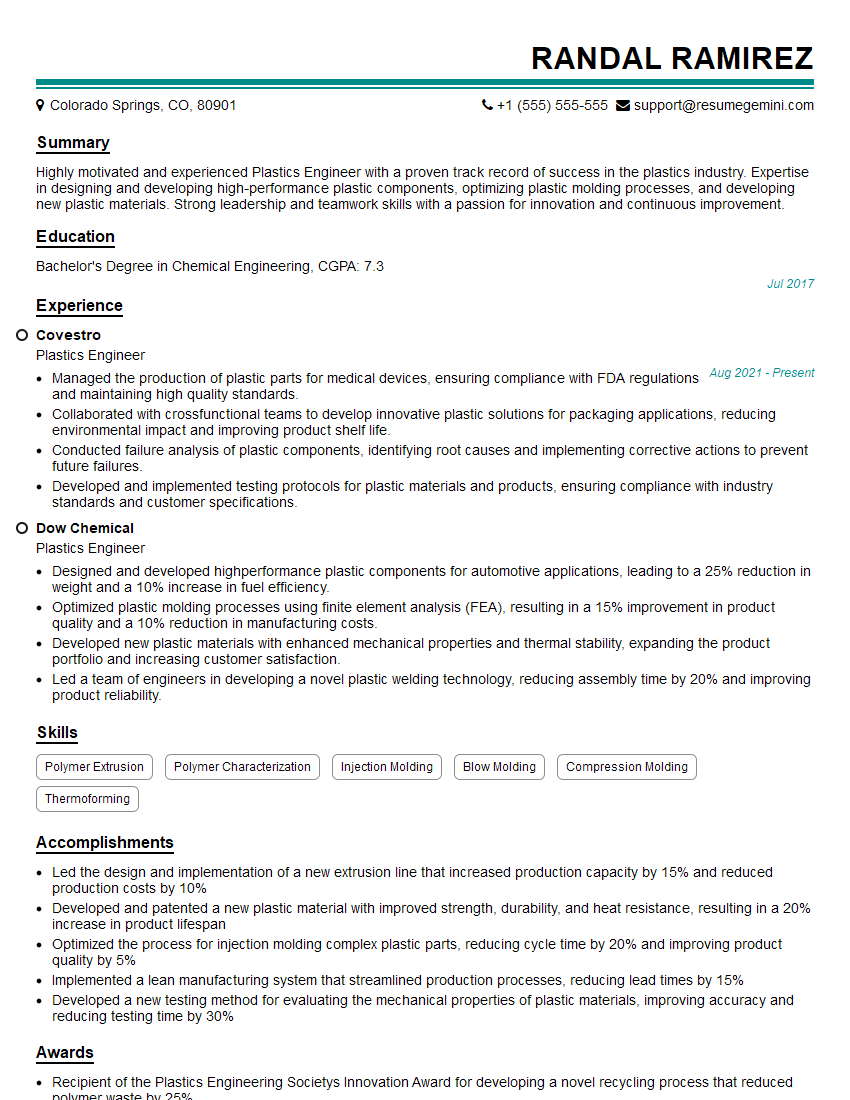
Mastering Plastic Material Science opens doors to exciting and impactful careers in a constantly evolving industry. A strong understanding of these concepts is critical for success in interviews and building a fulfilling career. To maximize your job prospects, focus on creating an ATS-friendly resume that showcases your skills and experience effectively. ResumeGemini is a trusted resource to help you build a professional and impactful resume tailored to the specific demands of the Plastic Material Science field. We provide examples of resumes specifically designed for this area to guide you in creating a winning application.
Explore more articles
Users Rating of Our Blogs
Share Your Experience
We value your feedback! Please rate our content and share your thoughts (optional).
What Readers Say About Our Blog
Amazing blog
hello,
Our consultant firm based in the USA and our client are interested in your products.
Could you provide your company brochure and respond from your official email id (if different from the current in use), so i can send you the client’s requirement.
Payment before production.
I await your answer.
Regards,
MrSmith
hello,
Our consultant firm based in the USA and our client are interested in your products.
Could you provide your company brochure and respond from your official email id (if different from the current in use), so i can send you the client’s requirement.
Payment before production.
I await your answer.
Regards,
MrSmith
These apartments are so amazing, posting them online would break the algorithm.
https://bit.ly/Lovely2BedsApartmentHudsonYards
Reach out at BENSON@LONDONFOSTER.COM and let’s get started!
Take a look at this stunning 2-bedroom apartment perfectly situated NYC’s coveted Hudson Yards!
https://bit.ly/Lovely2BedsApartmentHudsonYards
Live Rent Free!
https://bit.ly/LiveRentFREE
Interesting Article, I liked the depth of knowledge you’ve shared.
Helpful, thanks for sharing.
Hi, I represent a social media marketing agency and liked your blog
Hi, I represent an SEO company that specialises in getting you AI citations and higher rankings on Google. I’d like to offer you a 100% free SEO audit for your website. Would you be interested?