Every successful interview starts with knowing what to expect. In this blog, we’ll take you through the top Estimator interview questions, breaking them down with expert tips to help you deliver impactful answers. Step into your next interview fully prepared and ready to succeed.
Questions Asked in Estimator Interview
Q 1. Explain the different types of estimating methods.
Estimating methods fall into several categories, each with its own strengths and weaknesses. The choice depends heavily on the project’s complexity, available data, and the required accuracy level.
- Unit Price Estimating: This is a common method, particularly for simpler projects. You estimate the cost per unit (e.g., cost per square foot for flooring, cost per linear foot for fencing) and multiply it by the number of units required. It’s fast but can be less accurate for complex projects with diverse materials and labor.
- Quantity Takeoff (QTO) Estimating: This involves a detailed quantification of all materials needed, often done using specialized software. It’s more precise than unit pricing, especially for projects with many components. The quantities are then multiplied by unit costs to arrive at a total estimate.
- Resource-Based Estimating: This method focuses on the resources needed—labor, materials, equipment, and time—and estimates the cost of each. It’s very detailed and allows for better control over potential cost overruns, but requires extensive planning and accurate resource forecasting.
- Bottom-Up Estimating: This builds the estimate from the ground up by detailing the costs of each individual task or work package. It’s extremely accurate but very time-consuming.
- Analogous Estimating: This method uses the cost of similar past projects as a basis for estimating the current project. It’s quick but less precise, relying heavily on the comparability of past and current projects.
- Parametric Estimating: This statistical method uses parameters (e.g., square footage, number of rooms) and historical data to predict the cost. It’s useful for large projects where detailed estimation is impractical, but its accuracy depends heavily on the quality of the historical data and the relevance of the parameters.
For instance, building a simple shed might be effectively estimated using unit pricing, while a complex skyscraper would necessitate a combination of QTO and resource-based estimating.
Q 2. Describe your experience with takeoff software.
I have extensive experience with various takeoff software packages, including PlanSwift, On-Screen Takeoff, and Bluebeam Revu. My proficiency extends beyond simply extracting quantities; I understand how to leverage these tools for efficient project planning and cost control. I’m adept at using these programs to generate accurate quantity takeoffs from blueprints and other project documentation, ensuring consistent and precise data extraction. This reduces errors and strengthens the accuracy of the overall estimation.
For example, in a recent project involving a large-scale commercial renovation, I used PlanSwift to perform a detailed takeoff for multiple trades. This allowed for a more accurate materials list, resulting in a more precise and competitive bid. I also integrated the takeoff data seamlessly into our project management software, enhancing collaboration and communication among team members.
Q 3. How do you handle material cost fluctuations during a project?
Material cost fluctuations are inevitable. To mitigate their impact, I employ several strategies. First, I incorporate a price escalation clause into the contract, allowing for adjustments based on established indices (like the Producer Price Index) or market conditions. Second, I regularly monitor market prices for key materials throughout the project lifecycle, using online resources and supplier contacts. Third, I build contingency into the estimate to account for anticipated price swings. This buffer protects against unexpected increases. Lastly, I explore options for securing material prices through pre-purchasing or long-term contracts when feasible, particularly for critical materials with potential for significant price changes.
For example, during a recent project, we anticipated a potential increase in lumber prices. We secured a significant portion of our lumber needs upfront, locking in a favorable price and mitigating risk.
Q 4. What is your process for identifying and mitigating risks in estimating?
Risk identification and mitigation are crucial. My process begins with a thorough review of project plans, specifications, and site conditions. I identify potential risks using a combination of checklists, brainstorming sessions, and prior experience. These risks are then categorized and analyzed based on their likelihood and potential impact. Mitigation strategies are developed for each significant risk. These strategies might involve alternative approaches, contingency planning, insurance, or simply improved communication and coordination.
For instance, if a risk is identified concerning potential delays due to weather, the mitigation strategy might involve adjusting the schedule to account for possible setbacks or procuring alternative weather-protective materials.
This systematic approach ensures that potential problems are addressed proactively, leading to a more robust and reliable estimate.
Q 5. How do you create a detailed project budget?
Creating a detailed project budget involves breaking down the project into its smallest manageable components (Work Breakdown Structure or WBS). Each component has its associated costs estimated using appropriate methods (as discussed earlier). This results in a comprehensive cost breakdown that includes:
- Direct Costs: Materials, labor, equipment rental.
- Indirect Costs: Project management, permits, insurance.
- Contingency: A buffer for unforeseen expenses.
- Profit Margin: The desired profit for the project.
The budget should be presented in a clear and organized format, often using spreadsheets or specialized project management software. Regular monitoring and updates are vital to track actual costs against the budget and make necessary adjustments.
For example, creating a WBS for a house construction project will involve tasks like foundation work, framing, roofing, electrical, plumbing, etc. Each task has its corresponding material, labor, and equipment cost estimates.
Q 6. Explain your understanding of contingency and its role in estimating.
Contingency is a crucial element, representing a percentage added to the estimated cost to account for unforeseen expenses, risks, and uncertainties. It acts as a buffer to absorb unexpected issues without jeopardizing project success. The size of the contingency depends on several factors, including project complexity, historical data on similar projects, and the level of risk involved. A higher risk project requires a larger contingency. It is essential to clearly document the rationale behind the chosen contingency percentage.
For instance, a project with many unknowns or in a volatile market would typically require a higher contingency percentage (perhaps 10-15% or more) compared to a project with well-defined specifications and a stable market (perhaps 5-10%).
Q 7. How do you handle changes in project scope during the estimating phase?
Changes in project scope during the estimating phase are common and require careful management. Any change, regardless of size, needs to be formally documented and evaluated. The impact on the cost, schedule, and resources must be assessed. New estimates are then created for the revised scope, reflecting the additional costs or savings involved. These changes should be reviewed and approved by relevant stakeholders before proceeding. Transparency and clear communication throughout the process are critical to avoid misunderstandings and disputes.
For example, if a client requests an upgrade in flooring materials mid-estimation, a detailed comparison of costs between the original and upgraded material needs to be calculated and presented to the client for approval, along with the impact on the project timeline.
Q 8. Describe your experience with different types of contracts (e.g., lump sum, cost-plus).
My experience spans various contract types, each with its own risk and reward profile. Lump sum contracts are straightforward: I provide a fixed price for a defined scope of work. This requires meticulous upfront planning and accurate estimating to avoid losses. For example, I once worked on a lump sum contract for a residential renovation. Thorough measurements and material pricing were crucial to ensure profitability. Conversely, cost-plus contracts involve reimbursing my costs plus a predetermined fee or percentage. This approach offers more flexibility when dealing with unforeseen complexities, like unexpected soil conditions during a foundation build, but demands rigorous cost tracking and transparent communication.
I’ve also worked with unit-price contracts, where each item or task has a set price. This is useful for projects with variable quantities, like landscaping, where the precise amount of materials needed might not be known initially. Finally, I’m familiar with time and materials contracts, which are best suited for smaller, less-defined jobs where the exact scope is hard to predict accurately, requiring detailed hourly rates and material costs.
Q 9. How do you ensure accuracy in your estimates?
Accuracy is paramount in estimating. My approach involves a multi-layered process. First, I conduct thorough site visits and detailed drawings review, paying close attention to every element, from foundation details to finishes. Then, I break down the project into manageable tasks, creating a detailed Work Breakdown Structure (WBS). This allows for precise quantity takeoffs and avoids omissions. I utilize multiple pricing sources, comparing unit costs from various suppliers to ensure competitiveness and identify potential savings. I incorporate contingency for unforeseen issues – a percentage added to account for potential delays or material cost fluctuations. Finally, I perform rigorous quality checks and peer reviews to catch any potential errors before presenting the estimate.
For instance, if estimating drywall, I wouldn’t just calculate square footage. I’d account for waste, specific board sizes, additional labor for cutting around windows and doors, and potential repairs. This multi-faceted approach minimizes surprises and ensures a highly accurate estimate.
Q 10. How do you prioritize tasks when working on multiple estimates simultaneously?
Managing multiple estimates simultaneously requires a structured approach. I use a prioritization matrix that considers factors like deadline urgency, project size and complexity, and client importance. Urgent, high-value projects with tight deadlines naturally take precedence. I utilize project management software to track progress and deadlines across all estimates, allowing me to allocate my time effectively. Breaking down each estimate into smaller, manageable tasks and assigning deadlines helps maintain momentum and avoid feeling overwhelmed.
Imagine having three projects: a small residential remodel with a tight deadline, a large commercial project with a longer timeline, and a medium-sized industrial project. I’d prioritize the residential remodel due to its urgency, then allocate time to the industrial project based on its complexity and value, and finally, work on the commercial project in a more measured manner.
Q 11. Describe your experience with using estimating software (e.g., PlanGrid, Procore).
I have extensive experience with estimating software, including PlanGrid and Procore. These platforms significantly streamline the estimating process. PlanGrid’s ability to integrate drawings, specifications, and takeoffs into a single platform accelerates the takeoff process and minimizes errors. Procore excels in its robust reporting and collaboration features, enabling seamless communication with team members and clients. I utilize these tools for quantity takeoffs, material scheduling, cost tracking, and even progress reporting throughout the project lifecycle. This enhances accuracy, improves communication, and ultimately saves considerable time and effort.
For example, I use Procore to create a centralized repository for all project documents, allowing for easier access and reducing the chances of overlooking critical information. PlanGrid’s markup and annotation features are invaluable when making changes to the estimate.
Q 12. How familiar are you with different building codes and regulations?
I possess a solid understanding of building codes and regulations, both nationally and locally. My knowledge encompasses aspects like accessibility requirements (ADA compliance), fire safety codes (IBC), energy efficiency standards (IECC), and structural requirements. I routinely consult local jurisdictions’ building departments and refer to relevant code books to ensure compliance in my estimates. This includes verifying that proposed materials and construction methods adhere to all applicable regulations. Ignoring these codes can lead to costly revisions, delays, and even legal issues.
For example, if designing a kitchen in a historic building, I need to consider both the current building codes for safety and the preservation standards that may restrict certain modifications. This understanding is crucial for creating accurate and legally sound estimates.
Q 13. Explain your understanding of value engineering.
Value engineering is a systematic approach to improving a project’s functionality while reducing its overall cost without sacrificing quality. It involves analyzing all aspects of the project to identify potential cost reductions without compromising essential features. This might involve substituting materials, modifying designs, or optimizing construction methods. It’s about finding creative solutions to meet the client’s needs efficiently. I utilize value engineering techniques throughout the estimating process, collaborating with architects, engineers, and subcontractors to identify opportunities for cost savings.
For instance, in a commercial building, specifying a less expensive but equally durable flooring material without compromising its functionality is a form of value engineering. Or, streamlining the ductwork design can reduce both material costs and installation labor.
Q 14. How do you communicate estimates effectively to stakeholders?
Effective communication is key. I present estimates in a clear, concise, and easy-to-understand format. I avoid technical jargon whenever possible and use visual aids like charts and graphs to illustrate key aspects. The estimate is always accompanied by a detailed explanation of the methodology used, assumptions made, and potential risks. This transparency fosters trust and facilitates informed decision-making. I also offer a Q&A session after presenting the estimate, addressing client concerns and clarifying any ambiguities. I provide regular updates throughout the estimating process, keeping stakeholders informed of any changes or potential challenges.
For example, I might create a visual breakdown of the budget, clearly showing the allocation of costs to different project phases. This helps stakeholders understand where their money is going and enables them to make informed choices.
Q 15. How do you handle discrepancies between estimated and actual costs?
Discrepancies between estimated and actual costs are inevitable in any project, but understanding the root causes is crucial for improvement. My approach involves a multi-step process starting with a thorough variance analysis. This involves comparing the estimated costs with the actual costs, identifying the major areas of deviation, and quantifying the differences. For example, if material costs exceeded the estimate, I would investigate if this was due to unforeseen price increases, inaccurate quantity estimations, or changes in project scope.
Once the discrepancies are identified, I conduct a root cause analysis to pinpoint the reasons behind the variances. This may involve reviewing project documentation, interviewing team members, and analyzing project data. Based on this analysis, I generate a report outlining the causes, the financial impact of each cause, and recommendations for improvement in future estimations. For instance, if poor communication led to inaccurate labor estimations, I’d suggest implementing more robust communication channels and potentially adding buffer time for unforeseen delays.
Finally, I use this data to refine future estimation models. This might involve adjusting historical cost data, implementing better risk management strategies, and improving estimation techniques. The goal is to reduce the frequency and magnitude of cost variances through continuous improvement and learning from past experiences.
Career Expert Tips:
- Ace those interviews! Prepare effectively by reviewing the Top 50 Most Common Interview Questions on ResumeGemini.
- Navigate your job search with confidence! Explore a wide range of Career Tips on ResumeGemini. Learn about common challenges and recommendations to overcome them.
- Craft the perfect resume! Master the Art of Resume Writing with ResumeGemini’s guide. Showcase your unique qualifications and achievements effectively.
- Don’t miss out on holiday savings! Build your dream resume with ResumeGemini’s ATS optimized templates.
Q 16. Describe your experience with analyzing historical cost data.
Analyzing historical cost data is fundamental to accurate estimating. My experience involves using this data to identify trends, patterns, and potential risks. I typically employ several methods. First, I meticulously cleanse and validate the data to ensure its accuracy and reliability. This includes removing outliers, correcting errors, and accounting for inflation.
Next, I leverage statistical methods like regression analysis to identify relationships between cost drivers and project outcomes. For example, I might analyze the relationship between project size and labor costs, or the correlation between material prices and project duration. This allows me to create predictive models that forecast costs based on project characteristics.
Furthermore, I segment the data based on project type, location, and other relevant factors to identify specific cost trends for different contexts. This allows for a more refined estimation, recognizing that costs may vary significantly depending on the project’s unique circumstances. I frequently use software such as Microsoft Excel and specialized project management software to facilitate this analysis and visualize the findings. Visualizations, such as charts and graphs, make identifying trends and outliers much simpler and more intuitive.
Q 17. How do you incorporate labor costs into your estimates?
Incorporating labor costs requires a detailed understanding of the project’s scope and the skills required. My approach begins with a Work Breakdown Structure (WBS), which breaks the project into smaller, manageable tasks. For each task, I identify the required labor categories (e.g., electricians, plumbers, carpenters) and estimate the number of hours each category will require.
I then determine the appropriate hourly rates for each labor category. This considers factors such as location, skill level, and prevailing market rates. I also factor in overhead costs, including benefits, insurance, and payroll taxes. For example, if a carpenter’s hourly rate is $50, and the overhead is 30%, the total cost per hour would be $65. This ensures the estimate accurately reflects the true cost of labor.
To account for potential variations, I may use different estimation techniques for different aspects of the project. For example, I might use parametric estimating (e.g., cost per square foot for a construction project) for some tasks and bottom-up estimating (detailed estimation of individual tasks) for others. This combination often yields more accurate results. Finally, I always include a contingency buffer to account for unexpected delays or unforeseen circumstances, ensuring the labor cost estimate is robust and realistic.
Q 18. How do you account for unforeseen circumstances in your estimates?
Unforeseen circumstances are inevitable in any project. My approach focuses on proactive risk management through contingency planning. I begin by identifying potential risks through brainstorming sessions, risk assessments, and reviewing historical project data. These risks might include unexpected weather delays, material shortages, or changes in regulations.
For each identified risk, I assess its probability and potential impact on the project cost. I then quantify this impact by estimating the potential cost increase if the risk materializes. For instance, if a risk of equipment malfunction has a 20% probability and could cost an extra $10,000 to repair, I would add $2,000 (20% of $10,000) to the estimate as a contingency.
I incorporate these contingency amounts into the overall project estimate, creating a buffer to absorb unexpected costs. The size of the contingency buffer depends on the project’s complexity, duration, and the uncertainty associated with the identified risks. While a large contingency buffer can increase the estimate, it also reduces the risk of cost overruns later in the project. It’s a balance that requires careful judgment and experience.
Q 19. What is your experience with project scheduling and its relation to estimating?
Project scheduling and estimating are intrinsically linked; a realistic schedule is essential for accurate cost estimation. My experience involves using various scheduling techniques, including Critical Path Method (CPM) and Program Evaluation and Review Technique (PERT), to create a project schedule.
The schedule helps me determine the duration of each task, which is crucial for estimating labor and equipment costs. If a task takes longer than anticipated, the associated costs will also increase. Therefore, a well-defined schedule, with realistic durations for tasks, helps to establish a robust basis for the cost estimation. For example, if a schedule shows that a specific task requires 10 days, then I can calculate the labor costs for 10 days based on the hourly rates. If the schedule is inaccurate and the task takes 15 days, the cost estimate would be significantly underestimated.
Furthermore, I use scheduling software to create Gantt charts and other visual representations of the project timeline. These visualizations help to identify potential conflicts, dependencies, and critical paths, allowing for proactive risk management and more accurate cost estimations. A well-planned schedule enhances the overall effectiveness and reduces the chances of cost overruns.
Q 20. Explain your approach to quality control in estimating.
Quality control in estimating is paramount to ensuring accuracy and reliability. My approach involves several key steps. Firstly, I use a peer review process, where other estimators review my estimates to identify any potential errors or omissions. This ensures a fresh perspective and helps to catch mistakes that I might have overlooked.
Secondly, I utilize checklists and templates to standardize my estimation process. This ensures consistency and reduces the likelihood of human errors. These checklists cover all aspects of the estimation process, from gathering data to calculating costs and applying contingency buffers. I regularly update these checklists to reflect best practices and lessons learned from past projects.
Thirdly, I use various software tools and techniques to improve accuracy and efficiency. These include project management software, spreadsheets for calculations, and specialized estimation software that offers features like automated cost calculations and risk analysis. Regularly reviewing and updating these tools ensures that I’m leveraging the latest technology to improve accuracy. Finally, post-project analysis and reporting provides valuable feedback that informs continuous improvement, helping to refine my techniques and processes for future estimates.
Q 21. Describe a time you had to make a difficult decision regarding an estimate.
One challenging situation involved estimating costs for a large-scale renovation project with an extremely tight deadline. The client was adamant about a fixed-price contract, but the scope of work was still evolving, and there were significant uncertainties regarding the condition of the existing structure.
My initial estimate was based on the best available information, but I recognized the inherent risks. I had to weigh the need to secure the contract against the potential for significant cost overruns. To mitigate this, I proposed a phased approach, with a detailed estimate for the first phase, followed by conditional estimates for subsequent phases. This allowed for greater flexibility and transparency. I also built a larger contingency buffer than usual to account for the uncertainties.
Ultimately, we secured the contract. Although the later phases revealed unforeseen complexities, resulting in some cost overruns, the phased approach and clear communication minimized the conflict with the client. This experience taught me the importance of transparent communication, a detailed risk assessment, and a willingness to negotiate flexible contracts when dealing with significant uncertainties.
Q 22. How do you stay updated on the latest industry trends and pricing information?
Staying current in the estimating field requires a multi-pronged approach. It’s not just about knowing current material costs; it’s also about understanding market trends and potential cost fluctuations.
Industry Publications and Journals: I regularly subscribe to and read industry publications like Engineering News-Record and other specialized journals relevant to my area of expertise. These provide insights into pricing trends, new technologies, and best practices.
Online Resources and Databases: I utilize online resources such as RSMeans data, which provides comprehensive cost information, and various online marketplaces for materials to track price changes and availability. I also actively participate in online forums and communities to discuss current challenges and solutions.
Networking and Conferences: Attending industry conferences and networking events allows me to connect with other estimators, suppliers, and contractors. This direct interaction provides invaluable insights into current market conditions and pricing strategies. I actively engage in discussions and learn from the experiences of others.
Supplier Relationships: Building strong relationships with key suppliers is crucial. Regular communication helps me anticipate price changes and understand potential supply chain issues, allowing me to proactively adjust my estimates.
By combining these methods, I maintain a dynamic understanding of pricing and industry trends, ensuring my estimates remain accurate and competitive.
Q 23. What are your strengths and weaknesses as an estimator?
My strengths lie in my meticulous attention to detail, my ability to analyze complex data, and my proactive approach to problem-solving. I’m adept at identifying potential risks and incorporating contingency plans into my estimates. For instance, on a recent project involving historical building renovation, I anticipated potential delays due to unforeseen structural issues and included a buffer in the timeline, ultimately preventing significant cost overruns.
My weakness, which I’m actively working to improve, is sometimes getting overly involved in the details, potentially impacting efficiency on very large and complex projects. To mitigate this, I’ve implemented time management techniques and prioritized tasks to ensure project deadlines are met while maintaining accuracy.
Q 24. How do you handle pressure and deadlines?
I thrive under pressure and excel in fast-paced environments. My approach to handling deadlines involves a structured methodology. I break down large projects into smaller, manageable tasks with clearly defined deadlines for each. I use project management software to track progress and prioritize tasks, ensuring that critical aspects are addressed first. For instance, during a recent rush job for a hospital renovation, I effectively prioritized critical tasks and coordinated with the team to ensure timely completion while maintaining accuracy.
I also prioritize clear communication with my team and stakeholders, ensuring everyone is informed about progress and any potential challenges. This proactive approach helps to manage expectations and alleviate pressure effectively. Proactive communication prevents minor issues from escalating into major problems.
Q 25. Describe your experience working in a team environment.
I am a strong team player and value collaborative environments. My experience working in teams has demonstrated my ability to contribute effectively and communicate clearly with colleagues. I actively participate in brainstorming sessions, offering diverse perspectives and contributing to solutions. I believe in a shared responsibility approach, where everyone feels empowered to contribute their expertise and ideas. For example, in a recent project, my team and I worked closely together, each member focusing on their strength – one specializing in structural estimations, another on electrical, etc. This division of labor created a smooth and efficient workflow.
Furthermore, I am always willing to assist team members and share my knowledge, fostering a supportive and productive work environment. I believe in open communication and actively seek feedback to improve my contributions and ensure team success.
Q 26. How do you handle conflicting information from different sources?
Handling conflicting information is a common challenge in estimating. My approach involves a systematic process to resolve discrepancies. Firstly, I verify the source of each piece of information, determining its reliability and credibility. I look for evidence to support each claim, and I examine the methodology used to arrive at the conflicting data.
Source Verification: I cross-reference information from multiple reliable sources. If one source differs significantly from others, I investigate further to determine why.
Data Triangulation: I use different estimation methods (e.g., unit pricing, parametric estimating) to compare results and identify inconsistencies.
Documentation: I meticulously document all sources and my rationale for choosing a particular value, ensuring transparency and accountability.
Consultation: If discrepancies remain unresolved, I consult with senior estimators or subject matter experts to seek guidance and reach a consensus.
This systematic approach ensures accuracy and minimizes the risk of errors resulting from conflicting data.
Q 27. What is your preferred method for presenting your estimates?
My preferred method for presenting estimates is clear, concise, and visually appealing. I utilize a combination of written reports and visual aids to effectively communicate my findings. The report includes a detailed breakdown of costs, including materials, labor, and contingency factors.
Structured Report: A well-organized report with clear headings, subheadings, and tables makes the information easy to digest and follow.
Visual Aids: Charts and graphs illustrate key data points effectively, highlighting potential cost drivers and areas of risk.
Summary Table: A concise summary table at the beginning highlights the key estimate figures, allowing for quick comprehension.
Assumptions and Limitations: I explicitly state the assumptions and limitations of my estimate to ensure transparency and manage expectations.
This multi-faceted approach ensures that stakeholders can easily understand the estimate, identify key cost drivers, and assess potential risks associated with the project. This transparency builds trust and confidence in my work.
Q 28. How do you ensure your estimates are compliant with company policies?
Ensuring compliance with company policies is paramount in my work. I familiarize myself with all relevant policies and procedures before undertaking any estimating task. I consistently adhere to the company’s approved methods, cost databases, and reporting templates. For instance, if the company mandates the use of a specific software for cost estimation, I diligently use that software, ensuring accuracy and consistency.
Moreover, I maintain thorough documentation of my work, including all calculations, assumptions, and sources of information. This detailed record allows for easy verification of compliance and facilitates audits if necessary. I regularly review updates to company policies to ensure I remain informed and compliant with the latest standards. If uncertainties arise regarding policy interpretation, I seek clarification from my supervisors to ensure complete adherence.
Key Topics to Learn for Estimator Interview
- Cost Estimation Fundamentals: Understanding different estimation methods (top-down, bottom-up, parametric), accuracy vs. speed trade-offs, and the impact of uncertainty.
- Data Analysis & Interpretation: Working with historical data, identifying trends, and applying statistical methods to refine estimations. Practical application: Analyzing project completion rates to predict future timelines.
- Software Proficiency: Demonstrating expertise in relevant estimation software (mention specific software if applicable, otherwise keep generic). Practical application: Showcasing experience with data visualization and report generation.
- Risk Management in Estimation: Identifying potential risks and uncertainties, developing mitigation strategies, and incorporating contingency plans into cost estimations. Practical application: Presenting a scenario where a risk was identified and a mitigation strategy was successfully implemented.
- Communication & Collaboration: Clearly communicating estimations and justifications to stakeholders, working effectively in teams, and handling challenging questions or feedback. Practical application: Describing a situation where you effectively communicated complex estimations to a non-technical audience.
- Project Life Cycle Understanding: Demonstrating knowledge of the different phases of a project and how estimations are integrated throughout the process. Practical application: Explaining how estimations evolve and adapt as a project progresses.
- Profitability Analysis: Understanding the relationship between estimations, pricing, and overall project profitability. Practical application: Discussing approaches to ensure projects remain within budget and generate desired profit margins.
Next Steps
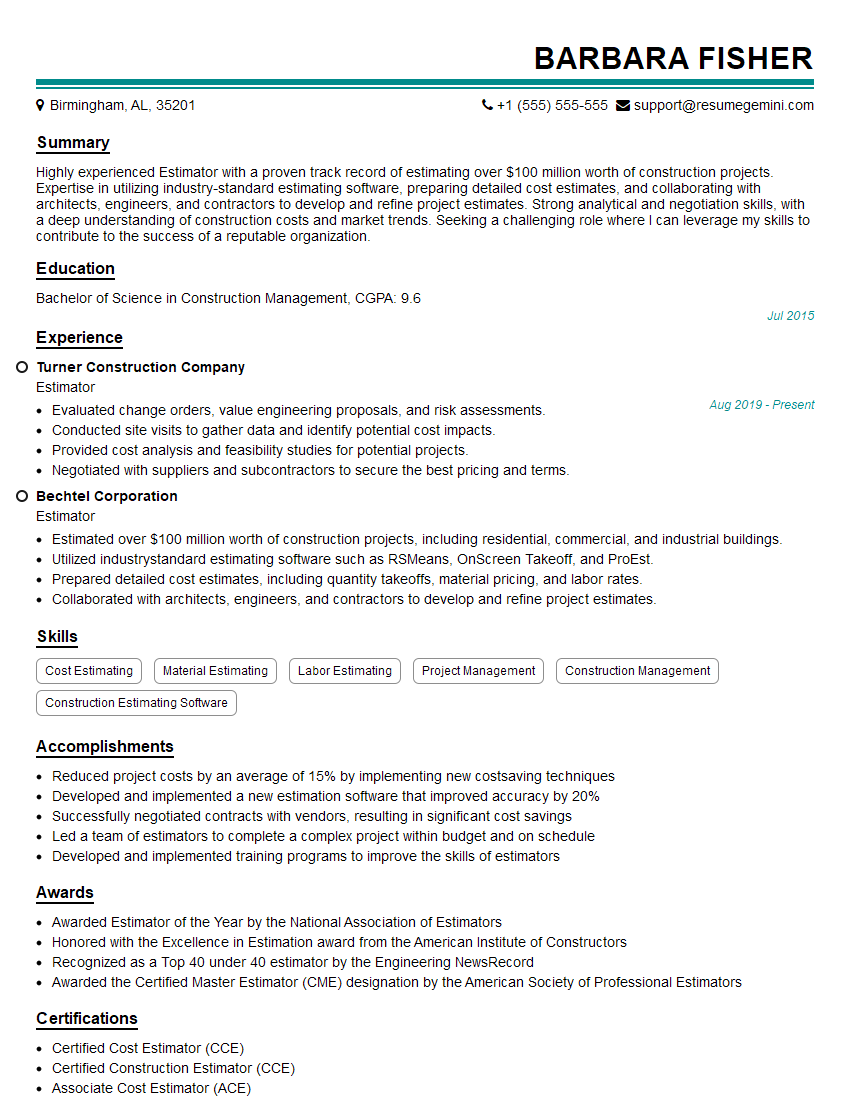
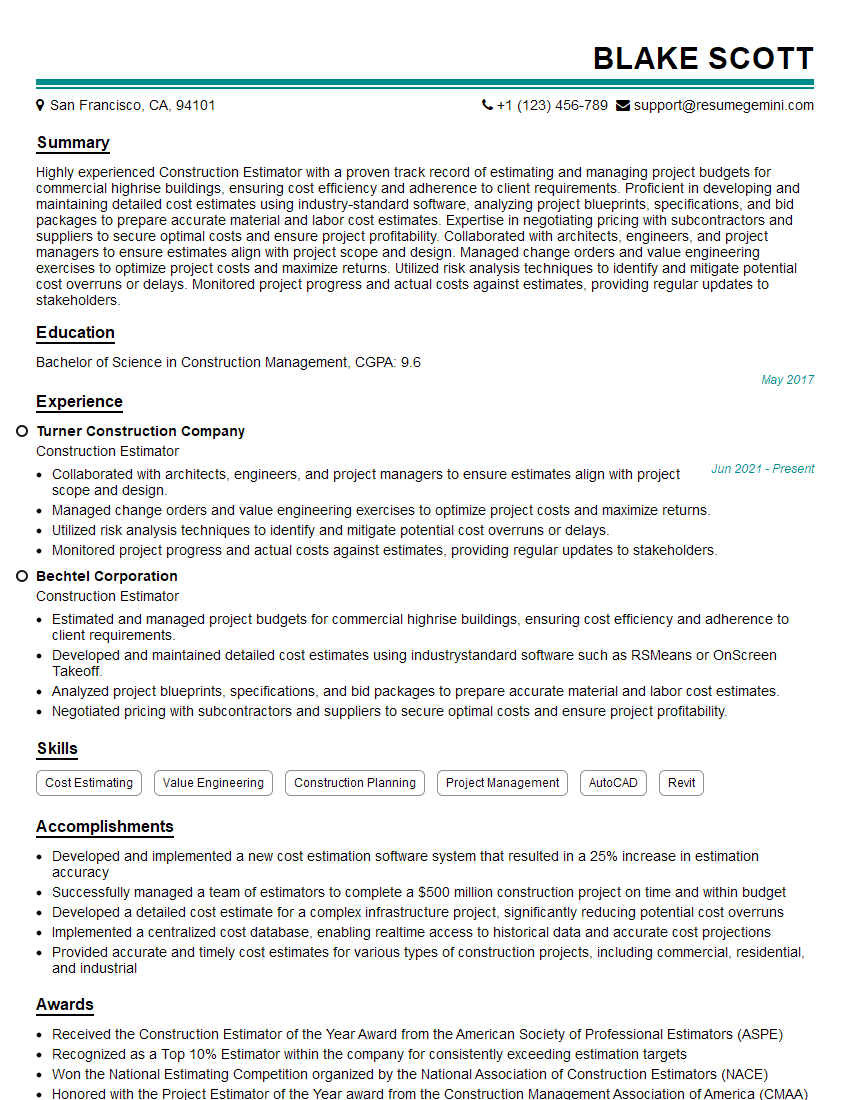
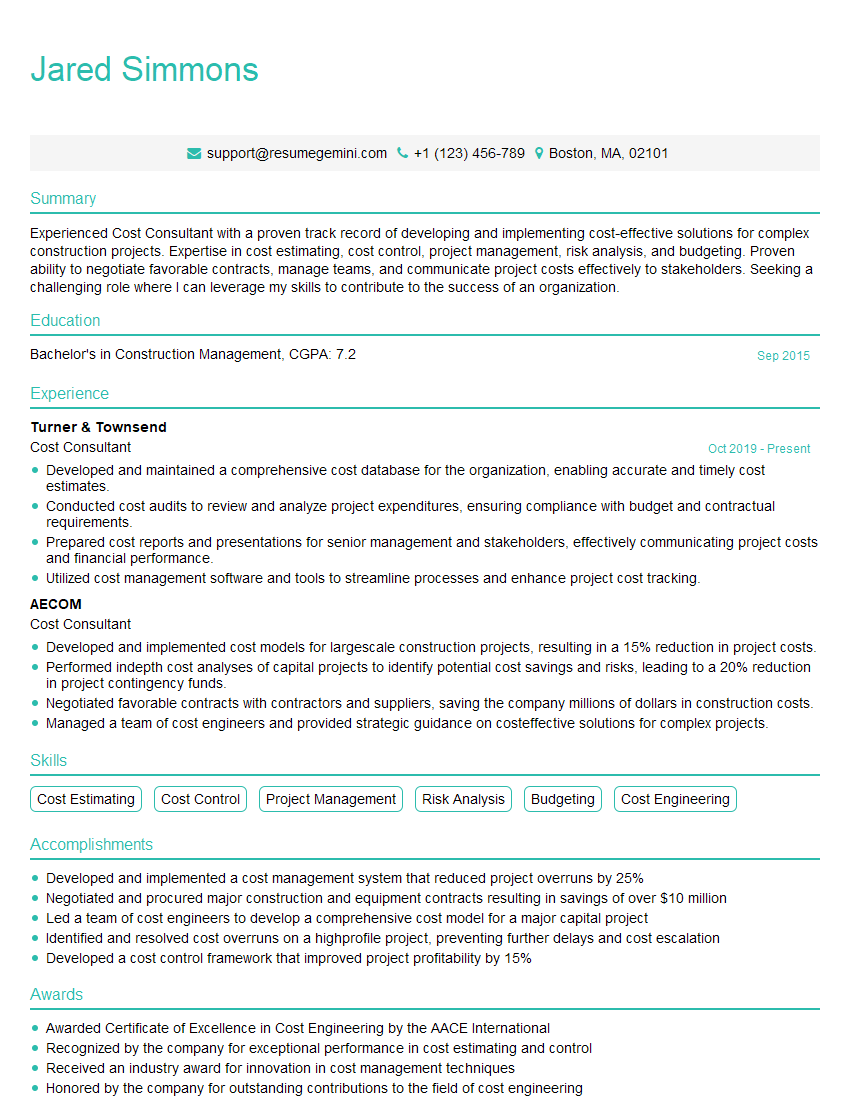
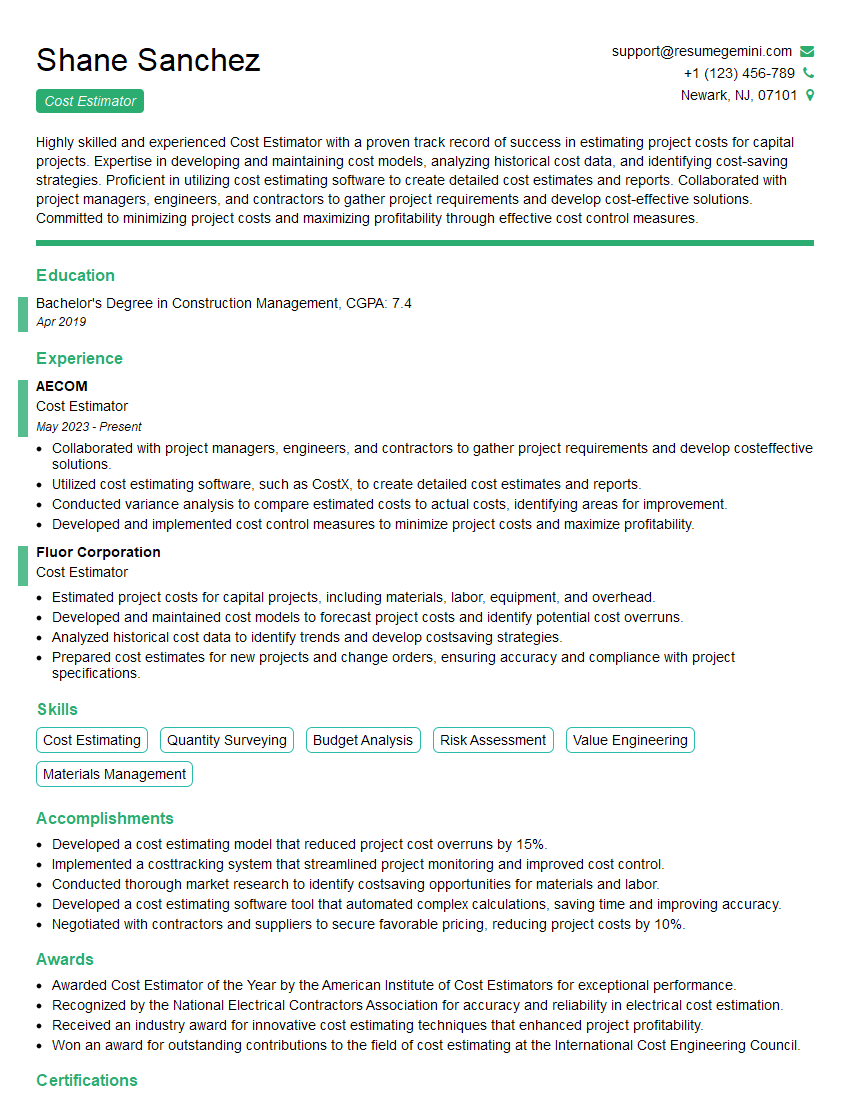
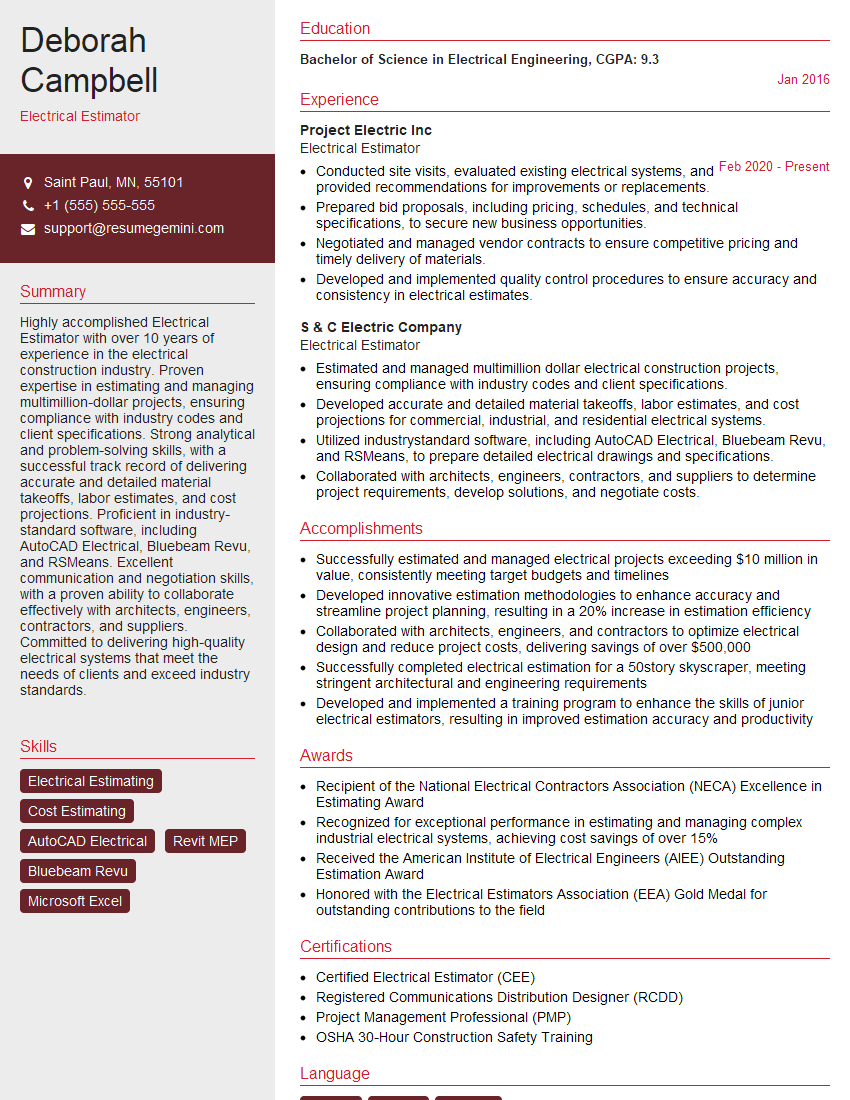
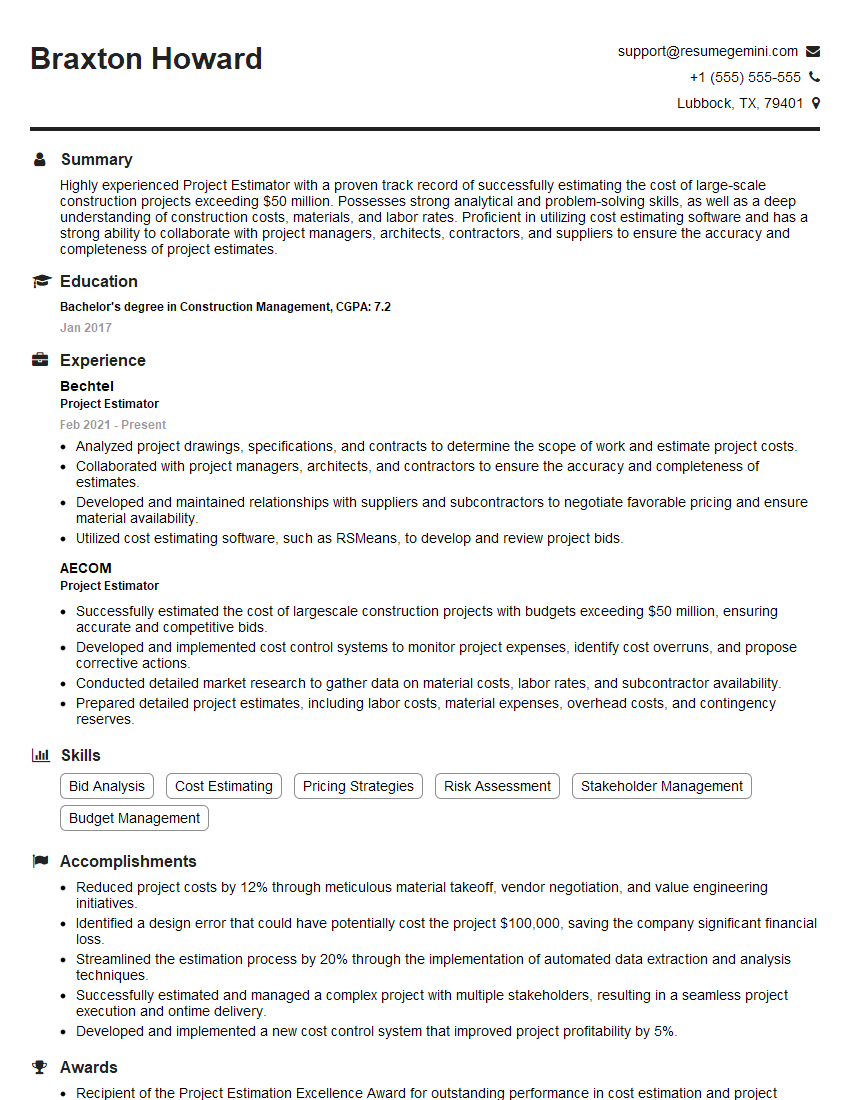
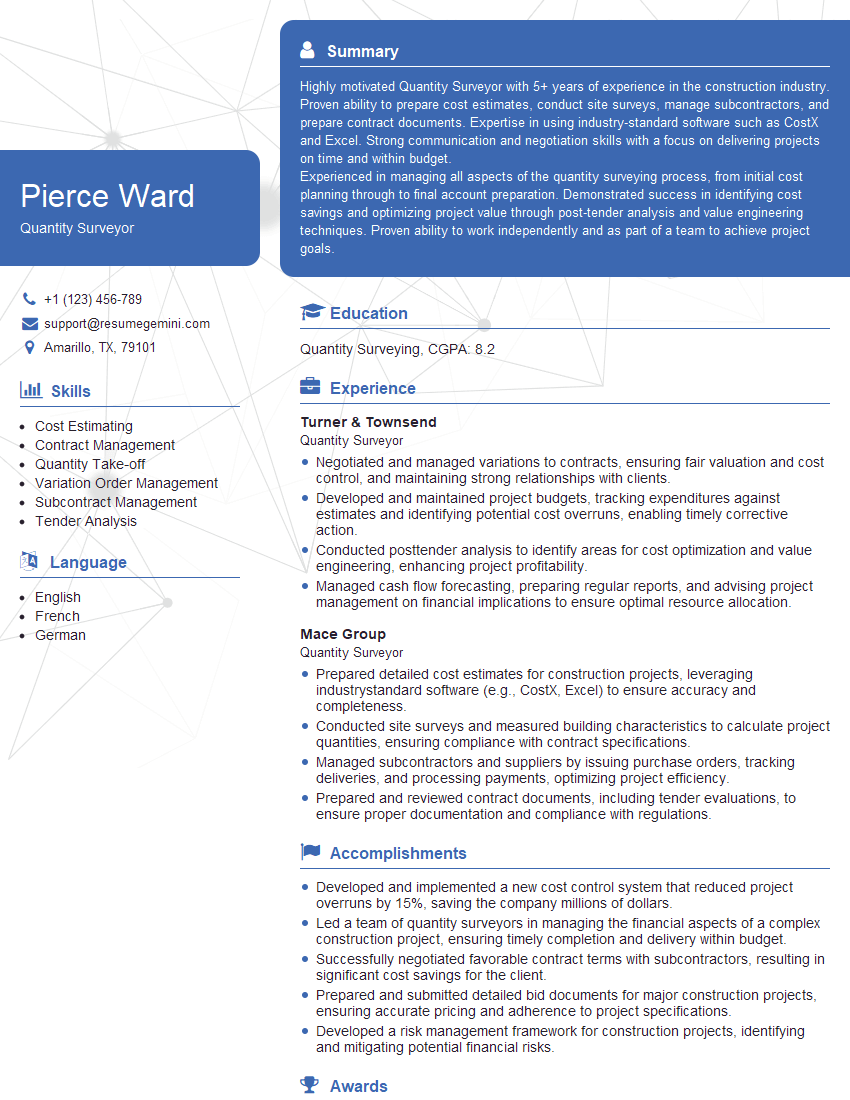
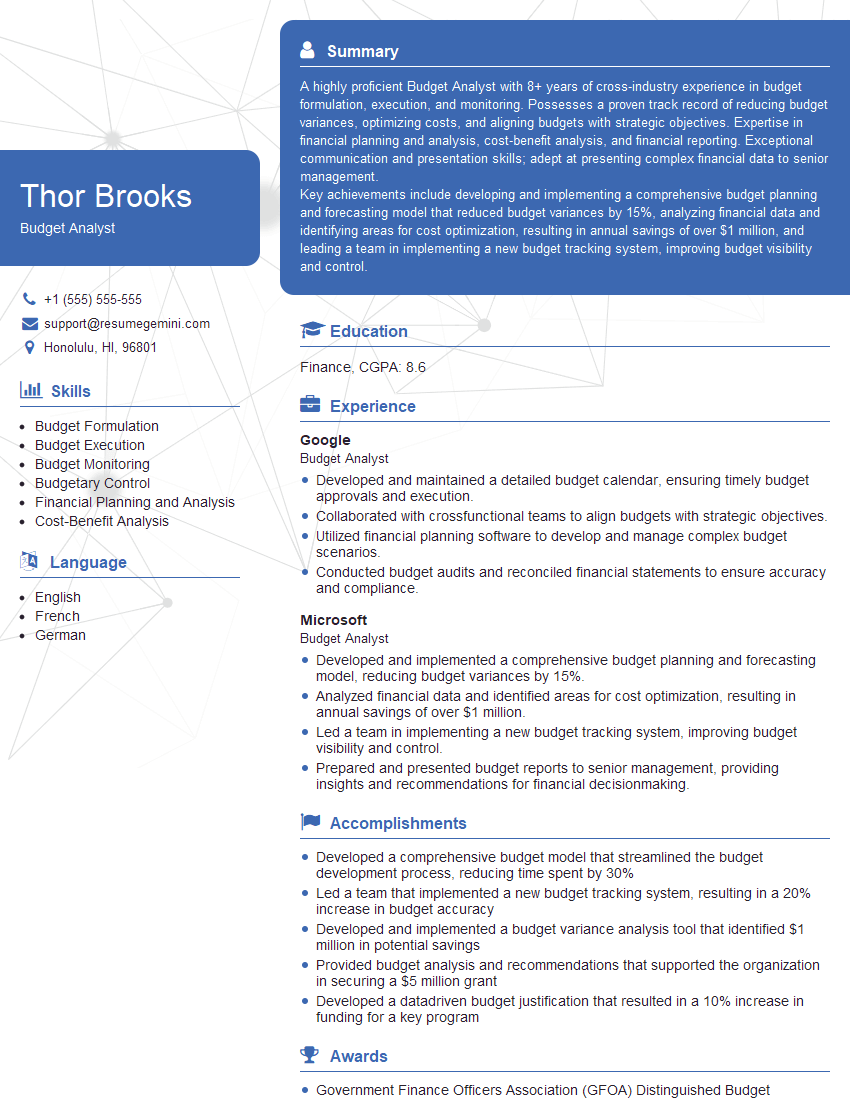
Mastering estimation techniques is crucial for career advancement in any project-based environment. Accurate and reliable estimations are the foundation of successful project delivery and ultimately, career success. To significantly enhance your job prospects, it’s vital to create an ATS-friendly resume that highlights your skills and experience effectively. ResumeGemini is a trusted resource to help you build a professional and impactful resume. Examples of resumes tailored to Estimator roles are available to guide you. Take advantage of these resources to present yourself as the ideal candidate.

Explore more articles
Users Rating of Our Blogs
Share Your Experience
We value your feedback! Please rate our content and share your thoughts (optional).
What Readers Say About Our Blog
Amazing blog
hello,
Our consultant firm based in the USA and our client are interested in your products.
Could you provide your company brochure and respond from your official email id (if different from the current in use), so i can send you the client’s requirement.
Payment before production.
I await your answer.
Regards,
MrSmith
hello,
Our consultant firm based in the USA and our client are interested in your products.
Could you provide your company brochure and respond from your official email id (if different from the current in use), so i can send you the client’s requirement.
Payment before production.
I await your answer.
Regards,
MrSmith
These apartments are so amazing, posting them online would break the algorithm.
https://bit.ly/Lovely2BedsApartmentHudsonYards
Reach out at BENSON@LONDONFOSTER.COM and let’s get started!
Take a look at this stunning 2-bedroom apartment perfectly situated NYC’s coveted Hudson Yards!
https://bit.ly/Lovely2BedsApartmentHudsonYards
Live Rent Free!
https://bit.ly/LiveRentFREE
Interesting Article, I liked the depth of knowledge you’ve shared.
Helpful, thanks for sharing.
Hi, I represent a social media marketing agency and liked your blog
Hi, I represent an SEO company that specialises in getting you AI citations and higher rankings on Google. I’d like to offer you a 100% free SEO audit for your website. Would you be interested?