Interviews are opportunities to demonstrate your expertise, and this guide is here to help you shine. Explore the essential Genre Fiction Writing interview questions that employers frequently ask, paired with strategies for crafting responses that set you apart from the competition.
Questions Asked in Genre Fiction Writing Interview
Q 1. What are the key characteristics of your preferred genre?
My preferred genre is science fiction, specifically space opera. Key characteristics include a vast scope, often involving interstellar travel and galactic civilizations. There’s a strong emphasis on world-building, creating detailed and believable alien cultures and societies, often exploring themes of humanity’s place in the universe, political intrigue on a cosmic scale, and advanced technology. Think of the epic scope of Star Wars or the intricate world-building of Dune. It’s about grand narratives, larger-than-life characters, and exciting space battles, but it also frequently delves into philosophical questions about humanity and our future.
- Vast Scope: Stories often span multiple planets, star systems, or even entire galaxies.
- Advanced Technology: Futuristic technology plays a crucial role, often shaping the plot and characters’ abilities.
- Alien Cultures: Diverse and richly detailed alien species are integral to the narrative.
- Exploration of Themes: Space opera grapples with big ideas: political power, survival, the nature of consciousness, and humanity’s destiny.
Q 2. Describe your writing process.
My writing process is iterative and involves several key stages. It begins with idea generation, often sparked by a compelling image, a philosophical question, or a unique concept. Then comes extensive world-building, outlining the setting, its history, politics, and the technology that shapes it. This often involves creating detailed timelines, maps, and character sketches. Next, I develop a detailed outline, mapping out the plot points, character arcs, and major conflicts. I then begin writing the first draft, focusing on getting the story down without worrying too much about perfection. This is followed by multiple rounds of revisions, focusing on plot holes, character consistency, pacing, and overall narrative flow. Finally, editing and proofreading are crucial steps to polish the manuscript before submission.
Think of it like building a house: you start with a blueprint (the outline), lay the foundation (the first draft), and then gradually add walls, windows, and finishing touches (revisions and editing) to create a complete and polished structure.
Q 3. How do you develop compelling characters?
Compelling characters are the heart of any good story. I develop them by giving them clear motivations, flaws, and internal conflicts. They need believable backstories and relationships that influence their actions and choices. I avoid creating perfect heroes or villains; instead, I strive for characters with depth and complexity, who make realistic choices even if those choices aren’t always morally perfect. For example, a seemingly heroic captain might make a morally gray decision to save her crew, revealing a hidden vulnerability and adding layers to her personality.
I use tools like character profiles to track their key traits, motivations, relationships, and arcs throughout the story. This helps maintain consistency and ensures that their actions feel organic and believable.
Q 4. How do you create believable plots?
Creating believable plots involves crafting a compelling central conflict that drives the narrative. This could be a war between empires, a mystery to solve, or a personal journey of self-discovery. The plot should be structured with rising action, a climax, and a resolution that feels satisfying and emotionally resonant. I avoid predictable plots by incorporating twists, turns, and unexpected developments that keep readers engaged and guessing. A strong plot also needs a clear cause-and-effect relationship; every event should logically flow from the previous one.
I often use plot outlining methods like the three-act structure or the Hero’s Journey to ensure a well-paced and structured narrative. These frameworks help me to organize my ideas and create a satisfying story arc.
Q 5. How do you handle writer’s block?
Writer’s block is a common challenge. My strategies include stepping away from the writing for a while to clear my head, engaging in other creative activities like sketching or listening to music, or changing my writing environment. Sometimes, it helps to freewrite – just writing whatever comes to mind without editing – to unlock new ideas. Talking through the problem with a fellow writer or a trusted friend can also help identify roadblocks and generate new perspectives. If I’m struggling with a specific scene or character, I might try focusing on a different part of the story, returning to the problematic section later with fresh eyes.
Essentially, it’s about breaking the cycle of frustration and finding ways to reignite creativity.
Q 6. How do you conduct research for your writing?
Research is crucial for believable science fiction. For space opera, this might involve studying astronomy, astrophysics, and the history of space exploration. Understanding the scientific principles behind interstellar travel, alien life, and advanced technology is important to build a plausible world. I also research different cultures and societies to create authentic alien civilizations, drawing inspiration from anthropological studies and historical events. This research ensures that the science and cultural elements are not only internally consistent but also add depth and richness to the narrative.
My research process involves reading scientific papers, watching documentaries, consulting with experts in relevant fields, and immersing myself in relevant historical and cultural contexts. The internet and academic databases are invaluable resources.
Q 7. What are some of the common tropes in your genre, and how do you avoid clichés?
Common tropes in space opera include the chosen one, the evil empire, the damsel in distress, and the unstoppable force versus immovable object conflict. To avoid clichés, I try to subvert expectations or add a unique twist to these familiar elements. For instance, the ‘chosen one’ might have significant doubts or flaws, the ‘evil empire’ might have justifiable grievances, and the ‘damsel in distress’ might be a powerful and resourceful character who ultimately rescues herself. I strive for originality by incorporating unexpected plot twists, exploring complex moral dilemmas, and creating unique characters and settings that differentiate my work from others in the genre.
Essentially, it’s about taking familiar elements and reimagining them in fresh and unexpected ways, adding depth and nuance to make them feel new again.
Q 8. How do you create suspense and tension in your writing?
Suspense and tension are the heartbeats of genre fiction. They’re created not just through plot twists, but through a careful manipulation of the reader’s expectations and anxieties. I achieve this through a multi-pronged approach:
Ticking Clocks and Rising Stakes: I introduce deadlines, whether it’s a bomb about to explode, a deadline for a magical ritual, or a rapidly closing window of opportunity. The closer the deadline, the higher the tension.
Information Gaps and Misdirection: Withholding crucial information from the reader, or giving them misleading clues, creates uncertainty and keeps them guessing. Think of the classic ‘whodunit’ mystery where the audience is presented with several possible suspects, all with plausible motives.
Escalating Threats and Consequences: The dangers faced by the protagonist shouldn’t remain static. Each obstacle should be greater than the last, raising the stakes continuously. A simple chase becomes a desperate flight for survival; a minor disagreement escalates into a deadly conflict.
Emotional Vulnerability: Showing the protagonist’s fear, doubt, and desperation amplifies the reader’s empathy and concern, thereby increasing the tension. We worry more when we connect emotionally with the character.
Sensory Detail and Pacing: Using vivid descriptions of the environment and employing a carefully controlled pace—slowing down during moments of anticipation, accelerating during moments of action—can significantly heighten the suspense.
For example, in a thriller, I might describe the protagonist’s frantic heartbeat and shallow breaths as they creep through a dark alley, foreshadowing an impending confrontation. This blend of internal and external detail increases the reader’s immersive experience and heightens the sense of danger.
Q 9. How do you structure your stories?
The structure of my stories often follows a classic three-act structure, although I adapt it based on the genre and specific story. This framework provides a solid foundation for building a compelling narrative:
Act I: Setup – This establishes the setting, introduces the protagonist and their world, hints at the central conflict, and ends with an inciting incident that throws the protagonist’s world into disarray.
Act II: Confrontation – The protagonist confronts the central conflict, faces obstacles, experiences setbacks, and often undergoes significant character development. This is where the majority of the plot unfolds, building tension and suspense.
Act III: Resolution – The conflict reaches a climax, where the protagonist confronts the main antagonist or solves the central problem. The story concludes with a resolution, tying up loose ends and leaving the reader with a sense of closure (or a satisfying cliffhanger, depending on the genre and series).
Within this framework, I utilize plot points – significant events that advance the plot and change the stakes – to propel the story forward. These points are carefully placed to maintain momentum and prevent the narrative from stagnating. I also utilize subplots to add depth and complexity to the story, often intertwining them with the main plot to create a richer tapestry of events. For instance, a subplot might involve a character’s personal struggle that mirrors the central conflict, adding emotional weight to the story.
Q 10. What is your preferred point of view and why?
My preferred point of view is largely determined by the story I’m telling, but I gravitate towards first-person and close third-person perspectives.
First-person: This offers an intimate and immediate connection with the protagonist. The reader experiences the story directly through their eyes and thoughts, fostering empathy and immediacy. This is particularly effective in genres like thrillers and mysteries where the protagonist’s perspective is central to solving the puzzle.
Close third-person (limited omniscient): This allows for a slightly wider scope than first-person, still primarily focusing on a single character’s perspective. It offers more flexibility in showing the character’s actions and thoughts while maintaining a close, intimate relationship with the reader. This can be beneficial in stories with more complex plot lines or multiple characters where a single perspective is still desirable.
I avoid omniscient point of view unless it’s specifically called for by the story’s needs, as it can sometimes distance the reader from the emotional core of the narrative. The choice always depends on what best serves the story and the emotional impact I wish to achieve.
Q 11. How do you develop world-building in your genre fiction?
World-building is crucial in genre fiction, laying the foundation upon which the story unfolds. My approach involves a layered strategy:
Concept and Scope: I begin by defining the core concept of my world – its magic system, technological level, social structures, and dominant cultures. I then determine the scope of my world – is it a small village, a vast empire, or a planet-spanning civilization? This helps establish the limits and possibilities of my setting.
Geography and Environment: I create a detailed map of the world (physical or metaphorical), outlining key locations, terrains, and geographical features. The environment should be integral to the story, affecting the plot, characters, and overall feel. A harsh, unforgiving desert might influence characters to become hardened survivors.
Culture and History: I develop the history, beliefs, customs, traditions, and social structures of the cultures within my world. These details bring the world to life and provide context for the characters’ actions and motivations.
Magic Systems (if applicable): If my genre involves magic, I create a well-defined system with clear rules and limitations. This prevents inconsistencies and ensures that magical elements feel integral to the narrative rather than deus ex machina.
Show, Don’t Tell: I weave world-building details into the narrative organically, revealing them gradually through the characters’ experiences and interactions with their environment, rather than through exposition dumps. For instance, rather than stating ‘the city is polluted’, I might describe characters coughing in the soot-filled air and avoiding certain areas due to the stench.
By layering these elements, I create a believable and immersive world that enhances the reader’s engagement and understanding of the story.
Q 12. Explain your approach to dialogue writing.
Dialogue is more than just characters talking; it’s a powerful tool for revealing character, advancing the plot, and building tension. My approach emphasizes realism and purpose:
Character Voice: Each character should have a unique voice that reflects their personality, background, and social standing. Their speech patterns, vocabulary, and sentence structure should be consistent throughout the story. A sophisticated aristocrat will speak differently from a rough-around-the-edges mercenary.
Subtext and Meaning: Dialogue should often hint at unspoken tensions or motivations, adding layers of meaning beyond the literal words. Silence can be as powerful as speech.
Action and Reaction: Dialogue should drive action and reveal how characters react to one another and to the unfolding events. A simple conversation can escalate into a conflict, or a casual remark can provide a vital clue.
Avoid Information Dumps: I avoid using dialogue solely to convey exposition. Instead, I weave information naturally into conversations, making it feel realistic and organic.
Read Aloud: I always read my dialogue aloud to ensure it sounds natural and believable. This helps identify awkward phrasing or unrealistic speech patterns.
For instance, instead of having characters explicitly state their romantic interest, I might show it through subtle flirting, nervous laughter, and lingering glances. This subtle approach is far more effective in building romantic tension.
Q 13. How do you edit and revise your work?
Editing and revising are crucial for polishing a manuscript and transforming it from a first draft into a publishable work. My process is iterative and involves several stages:
First Pass (Self-Edit): I focus on the big picture—plot holes, pacing, character consistency, and overall narrative arc. This stage is about refining the story’s structure and ensuring it flows logically.
Second Pass (Line Edit): I concentrate on sentence-level issues—grammar, punctuation, word choice, and sentence structure. I aim for clarity, conciseness, and style consistency.
Third Pass (Proofread): This is a final check for typos, grammatical errors, and inconsistencies. A fresh pair of eyes is often helpful at this stage.
Beta Readers/Critique Partners: I share my manuscript with trusted beta readers or critique partners, who provide feedback on plot, characters, pacing, and overall impact. Their feedback helps me identify blind spots and areas for improvement that I might have missed.
I treat each pass as an independent step, focusing on specific aspects of the manuscript rather than trying to fix everything at once. This phased approach allows for more effective and efficient editing, resulting in a cleaner, more polished final product.
Q 14. Describe your experience with beta readers or critique partners.
Beta readers and critique partners are invaluable to my writing process. They provide an external perspective that I, as the author, might lack. I carefully select individuals whose tastes align with my genre and who have a strong understanding of storytelling principles.
I provide my beta readers with clear guidelines, explaining what kind of feedback I’m looking for. This could range from identifying plot holes and inconsistencies to assessing character development and emotional impact. I then carefully review their feedback, considering each comment thoughtfully. I don’t necessarily implement every suggestion, but I use the feedback to identify areas for improvement and refine my manuscript.
Maintaining open communication with my beta readers is key. I’m always available to answer their questions and address their concerns. The goal isn’t just to get edits but to foster a collaborative relationship, where we’re working together to improve the story. This constructive feedback allows me to elevate my work beyond what I might accomplish alone.
Q 15. What are your strengths and weaknesses as a writer?
My greatest strength lies in crafting compelling narratives with strong character development within the genre fiction landscape. I excel at building immersive worlds and weaving intricate plots that keep readers hooked. I’m also a meticulous editor, ensuring consistent pacing and a polished final product. However, I recognize that my weakness is sometimes getting overly invested in details, potentially slowing down the writing process. I’m actively working on balancing detail with efficiency to streamline my workflow.
For example, in my recent fantasy novel, I spent weeks perfecting the description of a single magical artifact. While the detail added to the richness of the world, it also delayed the overall completion. I’m now employing techniques like outlining and time-boxing to manage this tendency.
Career Expert Tips:
- Ace those interviews! Prepare effectively by reviewing the Top 50 Most Common Interview Questions on ResumeGemini.
- Navigate your job search with confidence! Explore a wide range of Career Tips on ResumeGemini. Learn about common challenges and recommendations to overcome them.
- Craft the perfect resume! Master the Art of Resume Writing with ResumeGemini’s guide. Showcase your unique qualifications and achievements effectively.
- Don’t miss out on holiday savings! Build your dream resume with ResumeGemini’s ATS optimized templates.
Q 16. What is your understanding of the publishing industry?
The publishing industry is a complex ecosystem. My understanding encompasses traditional publishing, self-publishing, and hybrid models. Traditional publishing involves securing an agent and a publishing house, which offer editorial support, marketing, and distribution, but typically take a larger percentage of royalties. Self-publishing provides complete creative control and a higher royalty share but demands more upfront investment in editing, cover design, and marketing. Hybrid models offer a middle ground, combining elements of both.
I’m familiar with the various stages, from manuscript submission and editing to cover design, marketing campaigns, and sales distribution. Understanding the nuances of each stage is crucial for navigating the industry effectively, regardless of the chosen publishing path.
Q 17. How do you market and promote your work?
Marketing and promoting my work involves a multi-pronged approach. It starts with building an author platform – a strong online presence through a website and social media engagement. I regularly interact with readers, participate in online communities relevant to my genre, and share behind-the-scenes content. This fosters a sense of community and builds anticipation for my releases.
Furthermore, I utilize targeted advertising on social media platforms and consider collaborations with other authors or book bloggers. Email marketing remains a valuable tool to reach a dedicated readership. Finally, exploring opportunities like book signings, conventions, and online book events is vital for direct audience interaction and increased visibility.
Q 18. Are you familiar with different publishing models (traditional, self-publishing, hybrid)?
Yes, I am very familiar with the three main publishing models: traditional, self-publishing, and hybrid. Traditional publishing involves working with a literary agent and a publishing house that handles editing, design, marketing, and distribution. This offers significant resources but also relinquishes considerable control and results in a smaller royalty share for the author.
Self-publishing, on the other hand, gives the author complete creative control and a larger royalty share. However, it demands a significant investment in editing, cover design, marketing, and distribution. The author bears all the costs and responsibilities. Hybrid publishing attempts to bridge the gap between these two extremes, often offering some services like editing or marketing support for a fee, splitting the responsibilities and costs.
The optimal model depends on the author’s individual goals, resources, and risk tolerance.
Q 19. What is your target audience for your writing?
My target audience varies slightly depending on the specific genre and subgenre. For instance, my fantasy novels target adult readers who enjoy epic high-fantasy stories with complex characters and intricate world-building, similar to works by authors like Brandon Sanderson or Patrick Rothfuss. My mystery novels aim for readers of adult thrillers, appreciating fast-paced narratives with suspenseful twists, comparable to the style of authors like Gillian Flynn or Ruth Ware.
I conduct thorough market research to understand my target audience’s reading habits, preferences, and demographics, ensuring my writing resonates with their interests.
Q 20. How do you adapt your writing style to different genres?
Adapting my writing style to different genres requires a keen understanding of each genre’s conventions and reader expectations. For example, a romantic comedy requires a lighter tone, witty dialogue, and a focus on character relationships, while a dark fantasy needs a more serious and atmospheric tone with a higher emphasis on world-building and darker themes.
I analyze successful works within each genre to identify common elements like pacing, character archetypes, plot structures, and narrative voice. I then consciously adjust my writing style accordingly, ensuring that my work adheres to the genre’s expectations while still maintaining my unique authorial voice.
Q 21. How do you ensure consistency in your writing across multiple projects?
Maintaining consistency across multiple projects involves establishing clear writing guidelines and adhering to them throughout my work. This includes creating detailed character profiles, outlining consistent world-building rules, and developing a style guide for grammar, vocabulary, and narrative voice.
For example, I maintain a detailed world-building document for my fantasy series, ensuring consistency in the magic system, geography, and history. This document serves as a reference point for all my novels within that series, preventing inconsistencies and maintaining a cohesive world. Regular self-editing and feedback from beta readers also contribute significantly to maintaining consistency.
Q 22. Describe your experience with outlining and plotting.
Outlining and plotting are the backbone of any successful genre fiction novel. For me, it’s a dynamic process, not a rigid structure. I usually start with a core concept – a compelling ‘what if’ question or a fascinating character with a burning conflict. Then, I employ a blend of methods. Sometimes I begin with a detailed beat sheet, breaking the story into manageable sections with key plot points and character arcs. Other times, I prefer a more organic approach, creating a mind map to explore different narrative possibilities and character relationships. This allows for flexibility and discovery. For example, in my latest thriller, I initially planned a straightforward linear plot, but during the outlining process, a secondary character’s storyline became unexpectedly compelling, leading me to significantly rework the structure and add a compelling subplot. This highlights the importance of allowing for creative evolution throughout the outlining stage. Ultimately, the goal is to create a roadmap that guides me through the writing process without stifling my creativity.
Regardless of the method, I always ensure my outline includes a clear understanding of the protagonist’s goals, the major obstacles they face, and the stakes involved. This ensures a satisfying narrative arc with clear progression and resolution. I find that a well-defined outline not only saves time during the writing process but also helps maintain consistent pacing and thematic coherence.
Q 23. How do you manage multiple deadlines and projects?
Juggling multiple deadlines and projects requires meticulous planning and effective time management. I use a project management system, both digital and analog. I break down each project into smaller, manageable tasks with assigned deadlines, using tools like Trello or a simple spreadsheet. This allows me to visualize my workload and prioritize tasks effectively. Furthermore, I allocate specific blocks of time for each project, focusing intently on one at a time to avoid mental clutter. This ‘single-tasking’ technique helps me maintain concentration and avoid burnout. For instance, I might dedicate Monday mornings to researching a fantasy novel, Tuesday afternoons to writing a thriller chapter, and Wednesday evenings to marketing my latest release. In addition, I communicate proactively with editors and publishers to manage expectations and adjust schedules if needed. Flexibility is key; life happens, and I’ve learned to adapt my schedule accordingly. Regular self-assessment and adjustments are crucial to ensure I’m staying on track and avoiding overwhelm.
Q 24. How do you handle constructive criticism?
Constructive criticism is invaluable for growth as a writer. I approach it as an opportunity to learn and improve my craft. I actively seek feedback from beta readers, critique partners, and editors, and I try to maintain a professional, receptive attitude during the process. I listen carefully, asking clarifying questions to fully understand the feedback. However, I also filter the feedback. Not all criticism is equally valid. I differentiate between comments that point to genuine structural or pacing issues and those that reflect personal preference. For example, a comment about pacing may reveal a problem I need to address, whereas a comment about a character’s personality might just be a matter of taste. I look for patterns in the feedback; if multiple readers point to the same issue, it warrants more attention. Ultimately, the goal is to take the valuable insights, incorporate them thoughtfully, and continue improving my writing based on objective criticism rather than subjective opinions. This process leads to stronger, more polished work that resonates with a wider audience.
Q 25. What are your long-term career goals as a genre fiction writer?
My long-term career goal is to establish myself as a respected and prolific author within the genre fiction community. This involves consistently delivering high-quality work, building a loyal readership, and expanding my reach across different platforms. I aspire to explore diverse subgenres within genre fiction, experimenting with different styles and narrative structures while honing my craft. Beyond publishing novels, I’m also keen to contribute to the genre community through mentorship, workshops, and perhaps even teaching. The ultimate success for me is not solely commercial achievement but a lasting impact on readers and the literary landscape. I want to be known for both the quality of my writing and my contributions to the development of the genre.
Q 26. What are some of your favorite genre fiction books and why?
My favorite genre fiction books are incredibly diverse, reflecting the broad appeal of genre fiction itself. For instance, The Name of the Wind by Patrick Rothfuss captivated me with its lyrical prose and intricate world-building, while The Martian by Andy Weir impressed me with its scientific accuracy and compelling survival story. Gone Girl by Gillian Flynn exemplifies masterful suspense, keeping the reader on the edge of their seat. These books, though diverse in subgenre, share a common thread: compelling characters, well-paced plots, and engaging narratives that transcend the limitations of their respective genres. Each one taught me valuable lessons about character development, plot structure, and creating a captivating reading experience.
Q 27. Which authors inspire you, and why?
Many authors inspire me, but some stand out for specific reasons. Stephen King’s mastery of suspense and his ability to create relatable, flawed characters are continuously inspiring. Neil Gaiman’s imaginative world-building and his elegant prose style are deeply influential. Ursula K. Le Guin’s ability to weave profound philosophical themes into her science fiction and fantasy stories pushes me to explore deeper meaning in my own work. These authors represent different facets of genre fiction writing, highlighting the breadth and depth of the genre and encouraging me to strive for excellence in every aspect of my writing.
Q 28. Describe a project you are particularly proud of and why.
I’m particularly proud of my debut novel, “Echoes of the Obsidian Mirror”. It was a challenging project that pushed me creatively and technically. The novel, a dark fantasy, involved extensive world-building, complex character relationships, and a challenging plot structure with multiple timelines and interwoven storylines. Completing the manuscript and receiving positive feedback from beta readers and ultimately from my editor was a huge personal accomplishment. This project not only honed my writing skills but also instilled in me the confidence to tackle more ambitious projects in the future. The positive reception from readers, many of whom connected with the story’s themes of loss, redemption, and hope, made the entire experience immensely rewarding.
Key Topics to Learn for Your Genre Fiction Writing Interview
- Genre Conventions & Tropes: Understanding the established rules and recurring motifs within specific genres (e.g., thriller, romance, fantasy) and how to both utilize and subvert them effectively.
- Plot Structure & Narrative Arc: Mastering the art of crafting compelling narratives, including effective pacing, conflict resolution, and character development that resonate with the target audience.
- Worldbuilding (where applicable): For genres requiring extensive worldbuilding (fantasy, sci-fi), demonstrating a solid grasp of creating believable and immersive settings, magic systems, or futuristic technologies.
- Character Development & Archetypes: Creating relatable, believable, and memorable characters, understanding the use of archetypes, and exploring character motivations and arcs.
- Voice & Tone: Developing a consistent and engaging writing voice tailored to the specific genre and target audience. This includes understanding the nuances of tone and its impact on the overall reading experience.
- Show, Don’t Tell: Mastering the technique of conveying information through action, dialogue, and sensory details rather than relying on exposition.
- Revision & Editing: Demonstrating proficiency in self-editing and revising manuscripts, recognizing areas for improvement in pacing, plot, character development, and overall narrative coherence.
- Market Research & Audience Awareness: Understanding current trends in the genre fiction market and tailoring your writing style and themes to resonate with specific audience preferences.
- Copyright & Legal Aspects: Basic understanding of copyright law and responsible writing practices to avoid plagiarism and protect intellectual property.
Next Steps
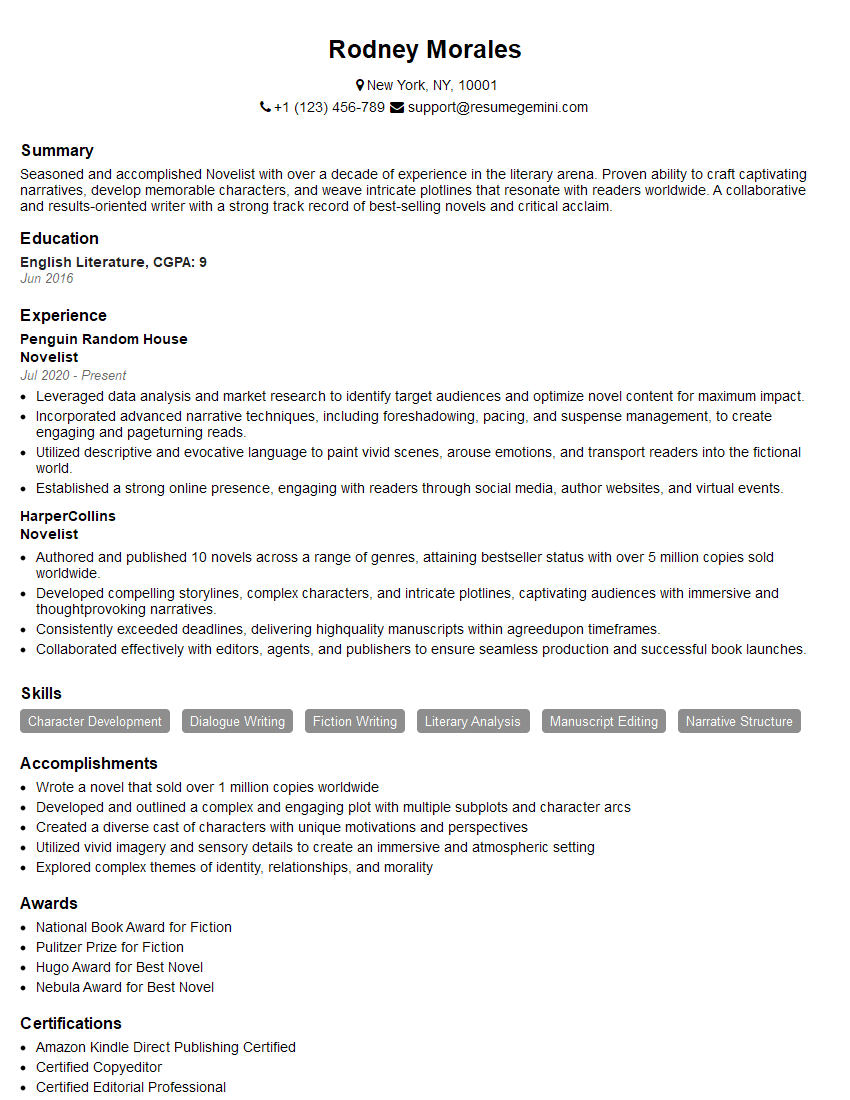
Mastering genre fiction writing is crucial for a successful and fulfilling career. It opens doors to a wide range of opportunities, from publishing novels and short stories to working in screenwriting, game development, or other creative fields. To maximize your job prospects, a strong, ATS-friendly resume is essential. ResumeGemini is a trusted resource that can help you craft a compelling resume showcasing your unique skills and experience in genre fiction writing. Examples of resumes tailored specifically to genre fiction writing are available, allowing you to create a document that stands out from the competition and makes a lasting impression on potential employers.
Explore more articles
Users Rating of Our Blogs
Share Your Experience
We value your feedback! Please rate our content and share your thoughts (optional).
What Readers Say About Our Blog
Amazing blog
Interesting Article, I liked the depth of knowledge you’ve shared.
Helpful, thanks for sharing.