Preparation is the key to success in any interview. In this post, we’ll explore crucial Gravity and Magnetic Data Acquisition interview questions and equip you with strategies to craft impactful answers. Whether you’re a beginner or a pro, these tips will elevate your preparation.
Questions Asked in Gravity and Magnetic Data Acquisition Interview
Q 1. Explain the principles of gravity and magnetic methods in geophysical exploration.
Gravity and magnetic methods are passive geophysical techniques used to explore the subsurface by measuring variations in the Earth’s gravitational and magnetic fields, respectively. Gravity methods measure variations in the acceleration due to gravity caused by density contrasts within the Earth. Denser subsurface materials cause a higher gravitational attraction than less dense materials. Magnetic methods, on the other hand, measure variations in the Earth’s magnetic field caused by variations in the magnetization of subsurface rocks. Rocks containing magnetic minerals, like magnetite, will produce a stronger magnetic field.
Imagine a bowling ball sitting on a trampoline; it creates a dip. Similarly, a dense ore body will create a localized increase in gravity. Now, imagine a strong magnet hidden under the trampoline; it would affect the alignment of tiny metal filings spread on the surface. This is analogous to how magnetic minerals affect the Earth’s magnetic field.
Q 2. What are the main sources of gravity and magnetic anomalies?
Gravity anomalies are primarily caused by variations in rock density. This can be due to differences in rock type (e.g., igneous intrusions having higher density than sedimentary rocks), changes in geological structure (like faults creating density contrasts), or the presence of subsurface deposits (such as ore bodies or cavities).
Magnetic anomalies, conversely, result from variations in the magnetization of rocks. This is influenced by the concentration of magnetic minerals, the rock’s magnetic susceptibility (how easily it becomes magnetized), and the Earth’s magnetic field at the time the rocks were formed (paleomagnetism plays a crucial role).
For instance, a buried basalt dike (a sheet-like intrusion of igneous rock) would produce both a gravity anomaly (due to its higher density) and a magnetic anomaly (due to its typically high magnetic mineral content).
Q 3. Describe different types of gravity and magnetic sensors and their applications.
Several gravity and magnetic sensors exist, each with specific applications. Gravity sensors primarily include gravimeters, which measure the acceleration due to gravity with high precision. These range from absolute gravimeters (measuring the absolute value of gravity) to relative gravimeters (measuring differences in gravity between locations). Absolute gravimeters are highly accurate but less portable, whereas relative gravimeters are portable and widely used in field surveys.
Magnetic sensors, commonly called magnetometers, include proton precession magnetometers, fluxgate magnetometers, and optically pumped magnetometers. Proton precession magnetometers are robust and relatively inexpensive, while fluxgate magnetometers offer higher sensitivity and faster sampling rates. Optically pumped magnetometers are highly sensitive and used for precise measurements in specialized applications.
The choice of sensor depends on the survey’s scale, required accuracy, and budget. For example, a regional gravity survey might use relative gravimeters, whereas a detailed mineral exploration survey might utilize high-sensitivity fluxgate magnetometers.
Q 4. How do you correct gravity data for latitude, elevation, and terrain effects?
Gravity data requires several corrections to account for variations in the Earth’s gravitational field not related to subsurface density contrasts. These corrections are crucial for accurate interpretation.
- Latitude Correction: Accounts for the Earth’s oblate shape (slightly flattened at the poles). Gravity is stronger at the poles and weaker at the equator.
- Elevation Correction (Free-air Correction): Compensates for the decrease in gravity with increasing elevation due to the increasing distance from the Earth’s center. This is essentially a simple inverse-square correction.
- Terrain Correction: Corrects for the gravitational attraction of nearby topographic features. Mountains exert a gravitational pull that needs to be removed to isolate the anomaly from the subsurface.
These corrections are usually applied using established formulas and software packages. For example, the Bouguer correction combines the elevation and terrain corrections. The accuracy of these corrections is vital for reliable interpretation, especially in rugged terrains.
Q 5. Explain the process of reducing magnetic data to a common datum.
Reducing magnetic data to a common datum involves removing variations in the Earth’s magnetic field that are not related to subsurface sources. The primary goal is to standardize data from different locations and times to facilitate comparison and interpretation. This process typically includes:
- Diurnal Correction: Removes variations in the Earth’s magnetic field over time (diurnal variations) due to solar activity and other external factors. This is achieved by using a base station magnetometer to continuously monitor the changes in the magnetic field.
- IGRF Correction (International Geomagnetic Reference Field): Removes the regional magnetic field variation predicted by the IGRF model, which represents the Earth’s main magnetic field. This helps isolate the local anomalies related to subsurface sources.
The corrected data represent the residual magnetic anomalies, which are directly linked to the magnetization of subsurface rocks. This procedure is critical for meaningful interpretation, as otherwise, the diurnal variations can mask the subtle anomalies associated with geological features.
Q 6. What are the limitations of gravity and magnetic methods?
Gravity and magnetic methods, while powerful, have limitations. Gravity methods suffer from a lack of vertical resolution; separating anomalies from different depths can be challenging. They are also insensitive to small, shallow features. The ambiguity inherent in the interpretation of gravity data requires additional information (e.g., geological constraints) for reliable models.
Magnetic methods are similarly affected by limited vertical resolution, especially when dealing with deeply buried sources. The presence of strong regional magnetic fields can mask weaker local anomalies. Interpretation is also complicated by the fact that magnetic minerals can occur in various rock types and in diverse concentrations.
Moreover, both methods are insensitive to non-magnetic, non-dense materials. These methods are most effectively used in conjunction with other geophysical methods (like seismic or electrical resistivity) for a comprehensive subsurface understanding.
Q 7. How do you identify and interpret gravity and magnetic anomalies?
Identifying and interpreting gravity and magnetic anomalies involve several steps. First, the corrected data are analyzed to identify areas of high and low values (anomalies). These anomalies are usually visualized using contour maps or 3D models.
Interpretation involves modeling the anomalies to infer the subsurface properties. Forward modeling involves creating a geological model and calculating the corresponding gravity or magnetic field, whereas inverse modeling involves finding the geological model that best fits the observed data. This process often involves iterative refinement and incorporating prior geological information.
Various techniques, such as spectral analysis, wavelet transforms, and Euler deconvolution, are utilized to enhance anomaly detection and provide depth estimates. The interpretation is often aided by geological knowledge of the area, including information on rock types, structures, and the geological history. This integrated approach significantly improves the accuracy and reliability of the interpretation.
Q 8. Describe the different types of gravity and magnetic surveys.
Gravity and magnetic surveys are geophysical techniques used to infer subsurface geology. They differ in the physical property they measure: gravity measures variations in Earth’s gravitational field, while magnetic surveys measure variations in the Earth’s magnetic field. Both types can be broadly classified based on the survey platform:
- Land Surveys: These involve ground-based measurements using gravimeters (gravity) and magnetometers (magnetic). They provide high-resolution data but are time-consuming and expensive, especially in difficult terrain.
- Airborne Surveys: These use aircraft carrying gravimeters and magnetometers. They are faster and cover larger areas than land surveys but have lower resolution. They are ideal for regional mapping.
- Marine Surveys: These utilize ships or submarines equipped with specialized sensors. They are particularly useful for offshore exploration and mapping of the seafloor.
Further distinctions can be made based on the specific application. For example, detailed gravity surveys might be employed to locate subsurface voids or dense ore bodies, while airborne magnetic surveys are commonly used in mineral exploration to detect magnetite-rich formations.
Q 9. What is the difference between regional and residual anomalies?
Regional and residual anomalies represent different scales of variation in gravity or magnetic fields. Imagine looking at a mountain range from far away (regional view) and then up close (residual view).
Regional anomalies represent large-scale variations in the Earth’s field, caused by deep-seated geological structures like large-scale density or magnetization contrasts at depth. They are typically smooth and have wavelengths that cover significant spatial extents. Think of the overall shape of the mountain range.
Residual anomalies represent smaller-scale, localized variations superimposed on the regional field. These are caused by shallower geological features. These are usually the features of interest, such as a specific ore body or a fault. Think of the individual peaks and valleys within the mountain range.
Separating regional and residual anomalies is crucial for interpretation, often accomplished using techniques like filtering or polynomial fitting to remove the regional trend, leaving behind the more localized, higher-frequency residual anomalies that reveal details about subsurface geology.
Q 10. How do you handle noise in gravity and magnetic data?
Noise in gravity and magnetic data comes from various sources, including instrumental drift, environmental factors (e.g., weather changes affecting gravity readings, cultural noise from power lines in magnetic surveys), and unmodeled geological features. Handling noise is vital for accurate interpretation.
Strategies include:
- Careful survey design: Planning the survey to minimize noise sources (e.g., avoiding power lines for magnetic surveys). Proper instrument calibration and regular checks.
- Data editing: Identifying and removing spurious data points (spikes or outliers) that clearly deviate from the expected trend.
- Filtering techniques: Applying digital filters (e.g., moving average, wavelet transforms) to smooth the data and suppress high-frequency noise. This needs careful consideration of the filter’s characteristics to prevent signal loss.
- Statistical methods: Using techniques like robust statistics to minimize the impact of outliers.
The choice of noise-handling technique depends on the type and magnitude of the noise, as well as the resolution requirements of the survey. It often requires iterative processes and expert judgement to balance noise reduction and preservation of important geological features.
Q 11. Explain the concept of Bouguer anomaly and its significance.
The Bouguer anomaly is a corrected gravity value that removes the effect of the topography and the mass of the rocks between the measurement point and a reference datum (usually sea level). It is a crucial step in gravity data processing because it allows us to focus on density variations within the subsurface, rather than the effects of the Earth’s shape and nearby surface rocks.
The calculation involves subtracting corrections for elevation (free-air correction), the effect of the rock slab between the measurement point and the reference datum (Bouguer correction), and often a terrain correction to account for the unevenness of the topography. The formula is roughly:
Bouguer Anomaly = Observed Gravity - Free-air Correction - Bouguer Correction - Terrain Correction
The significance of the Bouguer anomaly lies in its ability to isolate density variations related to subsurface geological structures, such as sedimentary basins, igneous intrusions, or mineral deposits. These density contrasts are expressed as positive or negative anomalies that can be mapped and interpreted to build subsurface models.
Q 12. Describe different methods for filtering gravity and magnetic data.
Filtering gravity and magnetic data is crucial to enhance signal-to-noise ratio and highlight specific features. Several methods exist, each with strengths and limitations:
- Moving Average Filters: Simple filters that smooth data by averaging values within a defined window. They effectively reduce high-frequency noise but can also blur sharp geological boundaries.
- Low-pass filters: These attenuate high-frequency components, allowing the smoother, longer-wavelength signals to pass through. They are useful for separating regional and residual anomalies.
- High-pass filters: These retain high-frequency components while attenuating low-frequency components. These are good for highlighting small, localized features.
- Band-pass filters: These allow a specific range of frequencies to pass through, helping to isolate anomalies within a certain size or depth range.
- Wavelet transforms: Sophisticated methods that decompose the data into different frequency components, allowing for more selective noise reduction and feature enhancement. They are very useful in separating out noisy signals.
The choice of filter depends heavily on the characteristics of the data and the geological problem being addressed. It’s crucial to understand the impact of each filter to avoid unintended loss of important geological information.
Q 13. How do you use gravity and magnetic data to create subsurface models?
Creating subsurface models from gravity and magnetic data involves a combination of data processing, interpretation, and forward modeling. The process isn’t straightforward, and often involves iterative steps of model building and refinement.
1. Data Processing: This involves correcting for instrumental drift, applying corrections (like the Bouguer correction for gravity), and filtering to enhance the signal.
2. Anomaly Interpretation: Analyzing the patterns and shapes of anomalies to infer the likely nature and geometry of subsurface structures. This often involves qualitative interpretation based on the shape and amplitude of anomalies, comparing these to known geological structures.
3. Forward Modeling: This is where we build a 3D model of the subsurface, assigning physical properties (density for gravity, magnetization for magnetic) to geological bodies. We then use software to calculate the gravity or magnetic field that would be produced by this model. We compare the calculated field to the observed data. If they don’t match, we adjust the model (shape, size, and physical properties of bodies) iteratively until a satisfactory fit is achieved. This process involves using inversion techniques to get a best-fitting solution.
4. Model Refinement: The process often requires multiple iterations of forward modeling, comparing the model’s predicted response to the observed data, and refining the model until a good fit is obtained. Integrating other geophysical or geological data (e.g., seismic data, well logs) can help constrain the model and improve its accuracy.
Q 14. What software packages are you familiar with for processing and interpreting gravity and magnetic data?
I’m proficient in several software packages commonly used for processing and interpreting gravity and magnetic data. These include:
- Geosoft Oasis Montaj: A comprehensive suite of tools for processing, modeling, and visualizing geophysical data. It’s widely used in the industry for its powerful processing capabilities and intuitive interface.
- Petrel (Schlumberger): Primarily an oil and gas reservoir modeling software, but it also includes modules for processing and interpreting gravity and magnetic data, particularly useful when integrating these data with seismic information.
- Magpi: Another specialized software for magnetic data processing and interpretation.
- GMT (Generic Mapping Tools): A collection of command-line tools for creating maps and processing gridded data. It’s highly versatile and useful for creating publication-quality visualizations.
- Python with libraries like NumPy, SciPy, and matplotlib: Offers a highly flexible programming environment for customized data processing and analysis. It allows for a lot of control and tailoring of algorithms to particular geological problems.
My familiarity with these software packages allows me to efficiently and effectively process and interpret gravity and magnetic data for a wide range of applications.
Q 15. Explain the concept of magnetic susceptibility and its importance in geophysical surveys.
Magnetic susceptibility is a fundamental property of a material that describes its ability to become magnetized in an external magnetic field. Imagine a piece of iron; it’s easily magnetized by a magnet, indicating high susceptibility. Conversely, a piece of wood shows little to no magnetization, signifying low susceptibility. In geophysical surveys, we use this property to infer the subsurface composition. Rocks and minerals have varying susceptibilities. For instance, magnetite, a common iron oxide mineral, possesses high susceptibility, making it easily detectable with magnetometers. By measuring the variations in the Earth’s magnetic field caused by these susceptible subsurface materials, we can create maps that delineate zones of different rock types or ore deposits. This is crucial for mineral exploration, archeological studies, and even engineering projects, where knowledge of subsurface geology is critical.
For example, a high magnetic susceptibility anomaly could indicate the presence of a magnetite-rich ore body, guiding further exploration efforts like drilling. Conversely, a low susceptibility zone might represent a different lithology.
Career Expert Tips:
- Ace those interviews! Prepare effectively by reviewing the Top 50 Most Common Interview Questions on ResumeGemini.
- Navigate your job search with confidence! Explore a wide range of Career Tips on ResumeGemini. Learn about common challenges and recommendations to overcome them.
- Craft the perfect resume! Master the Art of Resume Writing with ResumeGemini’s guide. Showcase your unique qualifications and achievements effectively.
- Don’t miss out on holiday savings! Build your dream resume with ResumeGemini’s ATS optimized templates.
Q 16. What are the applications of gravity and magnetic methods in mineral exploration?
Gravity and magnetic methods are indispensable tools in mineral exploration. They offer cost-effective ways to explore large areas and identify potential targets before employing more expensive techniques like drilling. Gravity methods are particularly useful in detecting dense ore bodies such as chromite, lead-zinc deposits, and some types of iron ore, which cause measurable increases in the local gravitational field. Magnetic methods are excellent for identifying iron-bearing minerals like magnetite, which causes strong local magnetic anomalies. These methods often act as complementary tools; for example, gravity data might identify a dense mass, while magnetic data could provide information about its composition.
Consider a scenario where we’re searching for iron ore. Magnetic surveys will highlight areas with high concentrations of magnetite, pointing us towards potential deposits. Simultaneously, gravity surveys can further constrain the size and depth of these deposits based on their density contrast with the surrounding rocks. The integration of both datasets allows for better target definition and resource estimation, significantly reducing exploration risk and costs.
Q 17. What are the applications of gravity and magnetic methods in oil and gas exploration?
In oil and gas exploration, gravity and magnetic methods primarily serve as regional exploration tools. They help identify large-scale geological structures such as basins, faults, and salt domes, which are often associated with hydrocarbon traps. Gravity data can be used to map the subsurface density variations caused by different sedimentary layers, helping identify potential structural traps. Magnetic methods are useful in defining the extent of igneous intrusions and identifying basement structures, providing valuable context for understanding the sedimentary basin’s formation and evolution.
For example, a significant gravity low could indicate a sedimentary basin with potentially porous and permeable layers capable of trapping hydrocarbons. Magnetic data might reveal the presence of a fault system that could compartmentalize the basin, influencing the distribution of oil and gas reserves. This information helps focus more detailed, and expensive, seismic surveys on areas with higher chances of discovering hydrocarbons.
Q 18. How do gravity and magnetic methods contribute to environmental studies?
Gravity and magnetic methods play crucial roles in various environmental studies. They can be used to map subsurface cavities, which can be important for assessing groundwater resources, identifying potential sinkholes, and understanding the stability of underground structures. These methods can also identify buried waste disposal sites or contaminated areas by detecting density or magnetic susceptibility contrasts between the contaminants and surrounding materials.
For example, a gravity survey might reveal a low-density anomaly indicating the presence of an underground cavity that could pose a safety risk. Similarly, magnetic data can highlight areas with high susceptibility values that could indicate the presence of buried metallic waste, potentially contaminating groundwater. This information is critical for environmental remediation efforts and helps in making informed decisions regarding land use and safety.
Q 19. Explain the concept of potential field continuation.
Potential field continuation is a powerful mathematical technique used to transform gravity or magnetic data to different levels of observation. Imagine you have a map showing the surface gravity field. Through potential field continuation, we can ‘simulate’ what the gravity field would look like at a higher or lower elevation. This is done using mathematical algorithms that extrapolate the observed field, removing the effects of near-surface geological features and revealing deeper structures.
Upward continuation helps to reduce the influence of near-surface noise and highlight deeper geological features. Conversely, downward continuation enhances the resolution of shallower anomalies but is more susceptible to noise amplification. This technique is crucial for separating shallow and deep-seated sources of anomalies, improving the interpretation of complex subsurface geology.
Q 20. Describe the process of designing a gravity or magnetic survey.
Designing a gravity or magnetic survey is a multi-step process that starts with defining the objectives. What are we trying to find? What is the size and depth of the target? Once the objectives are clear, we need to choose appropriate instrumentation, considering factors like the desired accuracy, the survey area’s terrain, and the anticipated signal strength. Next, we determine the survey parameters such as station spacing, survey lines, and the total area to be covered. The station spacing is crucial; it determines the resolution of the resulting data. Closer spacing improves resolution but increases the cost and effort. A careful balance is needed.
The survey design also includes planning for logistical aspects such as access to the survey area, permit requirements, and safety protocols. Finally, a quality control plan is crucial, outlining how we will ensure data accuracy and reliability. This entire process requires experience in geophysics and a good understanding of the geological context of the survey area. Poor planning can lead to wasted resources and unreliable results.
Q 21. How do you ensure the quality control of gravity and magnetic data?
Quality control (QC) in gravity and magnetic data acquisition is paramount. It involves several steps, beginning even before data acquisition. Pre-survey activities include calibrating the instruments, ensuring proper functioning and accuracy. During data acquisition, regular checks are made to monitor instrument stability and identify potential issues like drift or malfunction. This often includes repeated measurements at base stations to track instrument drift. Post-survey, the data undergo rigorous processing, including corrections for instrumental drift, terrain effects, latitude variations (for gravity), and diurnal variations (for magnetics). These corrections are crucial for eliminating systematic errors and obtaining reliable results.
Data validation involves checking for outliers and inconsistencies. We might employ statistical methods to identify and potentially remove or correct erroneous data points. Finally, the processed data is compared against existing geological information and other geophysical datasets to ensure consistency and reasonableness. A well-defined QC plan is vital for ensuring the reliability and validity of the final interpreted results.
Q 22. What safety precautions are necessary during gravity and magnetic data acquisition?
Safety during gravity and magnetic data acquisition is paramount. It’s a blend of common sense and specific precautions tailored to the environment. Think of it like this: you’re working in potentially remote and challenging locations, often with specialized equipment.
- Personnel Safety: This includes wearing appropriate personal protective equipment (PPE) such as hard hats, safety glasses, and high-visibility clothing, especially in areas with vehicular traffic or potential hazards like uneven terrain. First aid kits and communication devices are essential.
- Environmental Awareness: We must be mindful of the environment. This involves adhering to environmental regulations, avoiding sensitive ecosystems, and properly disposing of any waste. We need to be aware of wildlife and take appropriate measures to avoid disturbance or harm.
- Equipment Safety: Gravity meters are sensitive instruments. Careful handling and transportation are critical. We need to protect them from shocks, vibrations, and extreme temperatures. Magnetic sensors are equally vulnerable to external magnetic fields; we must maintain a safe distance from any sources of interference such as power lines or metal objects. Regular equipment calibration and maintenance checks are vital.
- Site Safety: Prior to commencing fieldwork, a thorough site assessment must be undertaken. This involves identifying and mitigating potential hazards, including unstable ground, extreme weather conditions, and the presence of dangerous animals. Clear communication and designated safety officers are key for larger projects.
For example, during a recent survey in a mountainous region, we encountered unexpected heavy rainfall, forcing us to halt operations and ensure everyone’s safety before resuming. Proactive safety measures prevented incidents and ensured the successful completion of the project.
Q 23. Explain the challenges in acquiring gravity and magnetic data in different terrains.
Acquiring gravity and magnetic data in diverse terrains presents unique challenges. The ease of data acquisition directly relates to the terrain’s accessibility and the presence of interfering signals. Think of it like trying to hear a whisper in a noisy room; the more noise, the harder it is to hear the whisper (the subtle gravity/magnetic signals).
- Rugged Terrain: Mountains, dense forests, and swamps make access difficult, demanding specialized equipment like drones or all-terrain vehicles. This also increases the risk of equipment damage and personnel safety issues.
- Urban Environments: Cities are rife with sources of magnetic and gravity interference (buildings, vehicles, power lines). Careful survey design, including base station measurements and careful selection of survey lines are essential to mitigate these interfering signals and avoid errors. High-density sampling is often necessary.
- Water Bodies: Marine gravity and magnetic surveys face logistical challenges in deploying and maintaining instruments at sea, and require specialized vessels and equipment. Water depth, currents, and weather conditions heavily impact data quality and safety.
- Cultural Considerations: Respect for local communities and potential impacts on cultural heritage sites is critical. Prior consultation and collaboration with local stakeholders are necessary.
For instance, during a marine gravity survey, unexpected strong currents caused significant drift in the vessel, compromising the quality of the data collected along one of the survey lines. This highlighted the need for careful weather forecasting and potentially adjusting the survey schedule.
Q 24. How do you interpret gravity and magnetic data in the context of geological structures?
Interpreting gravity and magnetic data involves identifying anomalies – variations from the expected background – and relating these to underlying geological structures. It’s like being a detective, using clues (anomalies) to piece together a story (geological model).
- Gravity Anomalies: Positive gravity anomalies typically indicate denser subsurface materials (like igneous intrusions or ore deposits), while negative anomalies suggest less dense materials (like sedimentary basins).
- Magnetic Anomalies: Magnetic anomalies are caused by variations in the magnetization of rocks. Highly magnetic rocks, like those containing iron oxides, produce strong anomalies. The shape and intensity of the anomalies can help determine the depth, size, and geometry of magnetic sources.
- Combined Interpretation: Integrating both gravity and magnetic data provides a more comprehensive understanding of the subsurface. For example, a gravity high could be further investigated with magnetic data to determine if the source is a mafic intrusion (magnetic) or a denser sedimentary layer (non-magnetic).
- Geological Context: Interpretation must consider regional geological information such as known faults, existing geological maps, and drilling data. This aids in the realistic interpretation of anomalies and avoids misinterpretations.
For example, in a project exploring for a mineral deposit, we observed a strong positive gravity and magnetic anomaly which, after integration with other datasets and geological mapping, successfully identified a previously unknown ore body.
Q 25. Describe your experience in using different types of geophysical software.
My experience encompasses several leading geophysical software packages. Proficiency in these tools is essential for processing, analyzing, and interpreting gravity and magnetic data effectively.
- Oasis Montaj: I’m highly proficient in Oasis Montaj, utilizing its functionalities for data processing, gridding, modeling, and visualization of gravity and magnetic data. I’ve used it extensively for various projects including regional geophysical surveys and mineral exploration programs. This software is highly robust and allows for sophisticated modeling techniques.
- Petrel: My experience includes Petrel, which allows for integration with seismic and well log data. This capability allows for a more holistic interpretation of subsurface geology.
- GM-SYS: I have experience using GM-SYS for gravity and magnetic modeling, especially forward modeling and inversion routines. This software has a strong reputation in the academic and industry realms for its powerful tools.
For example, in one project, I leveraged Oasis Montaj’s advanced gridding and filtering capabilities to remove noise from a highly variable gravity dataset acquired in a complex mountainous region, improving the subsequent 3D modeling.
Q 26. How do you integrate gravity and magnetic data with other geophysical datasets?
Integrating gravity and magnetic data with other geophysical datasets significantly enhances the accuracy and resolution of subsurface models. Think of it like assembling a jigsaw puzzle; each dataset provides a piece of the bigger picture.
- Seismic Data: Seismic reflection and refraction data provide high-resolution images of subsurface structure, giving an independent assessment of the geological models generated from gravity and magnetic data.
- Electromagnetic (EM) Data: EM data is sensitive to electrical conductivity variations, complementing gravity and magnetic data by providing information on different physical properties of subsurface materials.
- Remote Sensing Data: Satellite imagery and aerial photographs can assist in identifying surface geological features and structures, which aids in interpreting subsurface anomalies.
- Well Log Data: Direct measurements of physical properties from boreholes give ground truth data that is used to calibrate and validate the geophysical interpretations.
For instance, in a hydrocarbon exploration project, integrating gravity and magnetic data with seismic reflection data improved the delineation of subsurface faults and helped to identify potential reservoir locations that weren’t readily apparent from the seismic alone.
Q 27. Explain your experience with data processing workflow for gravity and magnetic data.
My data processing workflow for gravity and magnetic data is systematic, ensuring high-quality results. It’s like baking a cake; you need to follow the recipe carefully to get the desired outcome.
- Data Acquisition and Preprocessing: This stage involves downloading the raw data, checking for any anomalies or errors, applying corrections for instrument drift and tidal effects (in gravity) and diurnal variations (in magnetics). Data is then reviewed for outliers or noise.
- Data Reduction: This stage involves reducing the data to meaningful units and applying corrections for latitude, elevation, and terrain effects to correct for variations in the earth’s field. It might also involve corrections for instrumental drift and other environmental effects.
- Gridding and Filtering: Raw data is then converted into a grid format to facilitate visualization and interpretation. Filtering techniques remove unwanted noise and enhance the signals representing subsurface geological structures.
- Anomaly Separation: Once the data has been cleaned, the regional and residual components of the anomalies are separated. Regional gravity or magnetic fields reflect larger-scale structures, whereas residual anomalies highlight local features.
- Interpretation and Modeling: This stage utilizes various techniques to interpret the anomalies, including forward and inverse modeling, and the integration of other geophysical and geological datasets.
For example, during one project, we used sophisticated filtering techniques in Oasis Montaj to suppress the effects of cultural noise on the magnetic data, enhancing the identification of shallow mineral deposits.
Q 28. Discuss your understanding of the inverse problem in geophysics.
The inverse problem in geophysics is a fundamental challenge: determining the subsurface properties from surface measurements. It’s like trying to deduce the shape of a hidden object using only its shadow. The problem is inherently non-unique because many different subsurface models can produce similar surface observations.
This means that any interpretation is a model, representing our best attempt to explain the data. Different algorithms and prior geological information will influence the final model. The goal is to find a model that is geologically reasonable and adequately fits the observations. Techniques used to address the non-uniqueness include:
- Regularization: This technique incorporates prior knowledge or constraints to stabilize the inversion process and reduce the ambiguity of the solution.
- Iterative methods: These methods refine a starting model iteratively, comparing synthetic data from the model to the observed data, until convergence is achieved.
- Bayesian methods: These probabilistic techniques provide a measure of uncertainty associated with the estimated parameters, reflecting the inherent ambiguity of the inverse problem.
Addressing the inverse problem requires careful consideration of data quality, appropriate inversion methods, and integration with other geological information to build a robust and realistic subsurface model. It’s an ongoing process of refinement and validation, guided by geological insights.
Key Topics to Learn for Gravity and Magnetic Data Acquisition Interview
- Fundamental Principles: Gravitational and magnetic fields, their sources, and their behavior. Understand the underlying physics governing these phenomena.
- Data Acquisition Techniques: Familiarize yourself with various instruments used in gravity and magnetic surveys (e.g., gravimeters, magnetometers). Understand data logging procedures and potential sources of error.
- Data Processing and Interpretation: Learn about data reduction, correction techniques (e.g., terrain corrections, latitude corrections), and filtering methods. Understand how to interpret processed data to identify geological features.
- Geological Applications: Explore the use of gravity and magnetic data in various geological applications, such as mineral exploration, hydrocarbon exploration, and structural geology studies. Be prepared to discuss case studies.
- Potential Field Modeling: Understand the principles of forward and inverse modeling techniques used to interpret gravity and magnetic anomalies. Develop a strong grasp of model building and interpretation.
- Data Integration and Visualization: Learn how to integrate gravity and magnetic data with other geophysical and geological datasets. Practice visualizing data using various software packages.
- Uncertainty and Error Analysis: Understand the sources of uncertainty in gravity and magnetic data and how to quantify and mitigate their effects on interpretation.
- Software Proficiency: Highlight your experience with relevant software packages used in gravity and magnetic data processing and interpretation (mention specific software if you have experience with any).
Next Steps
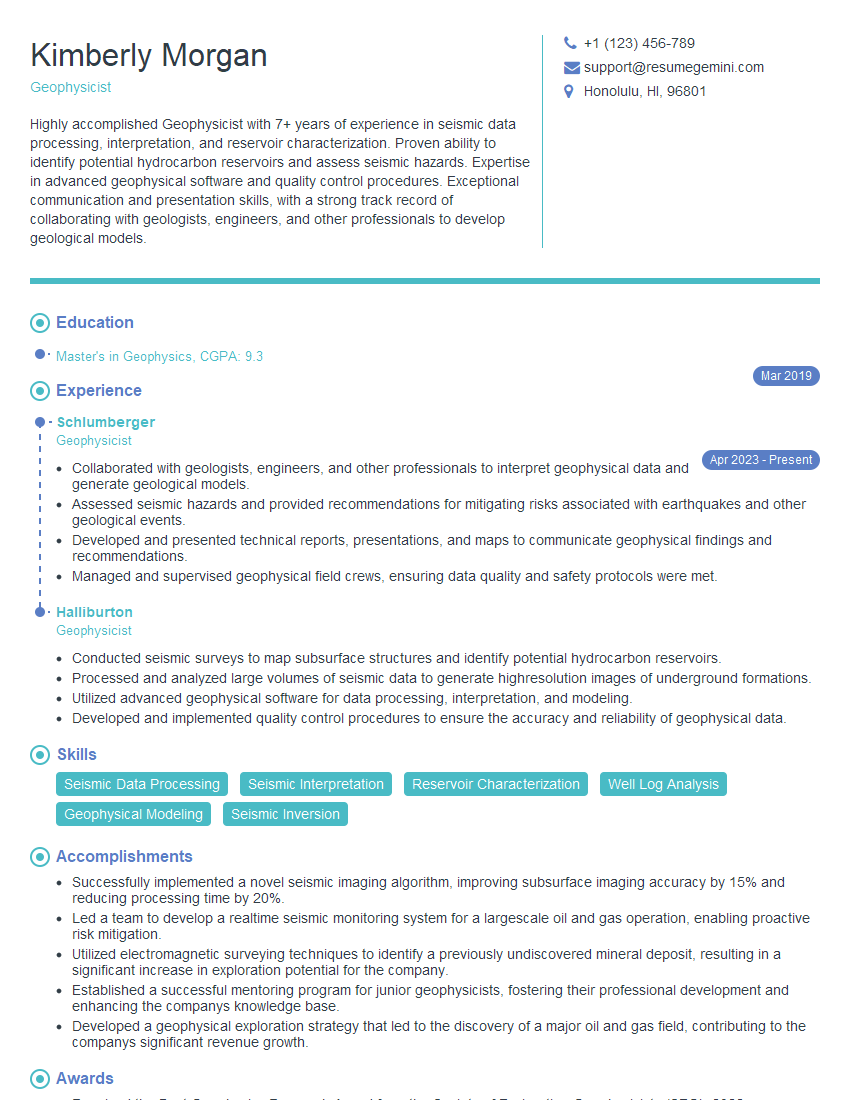
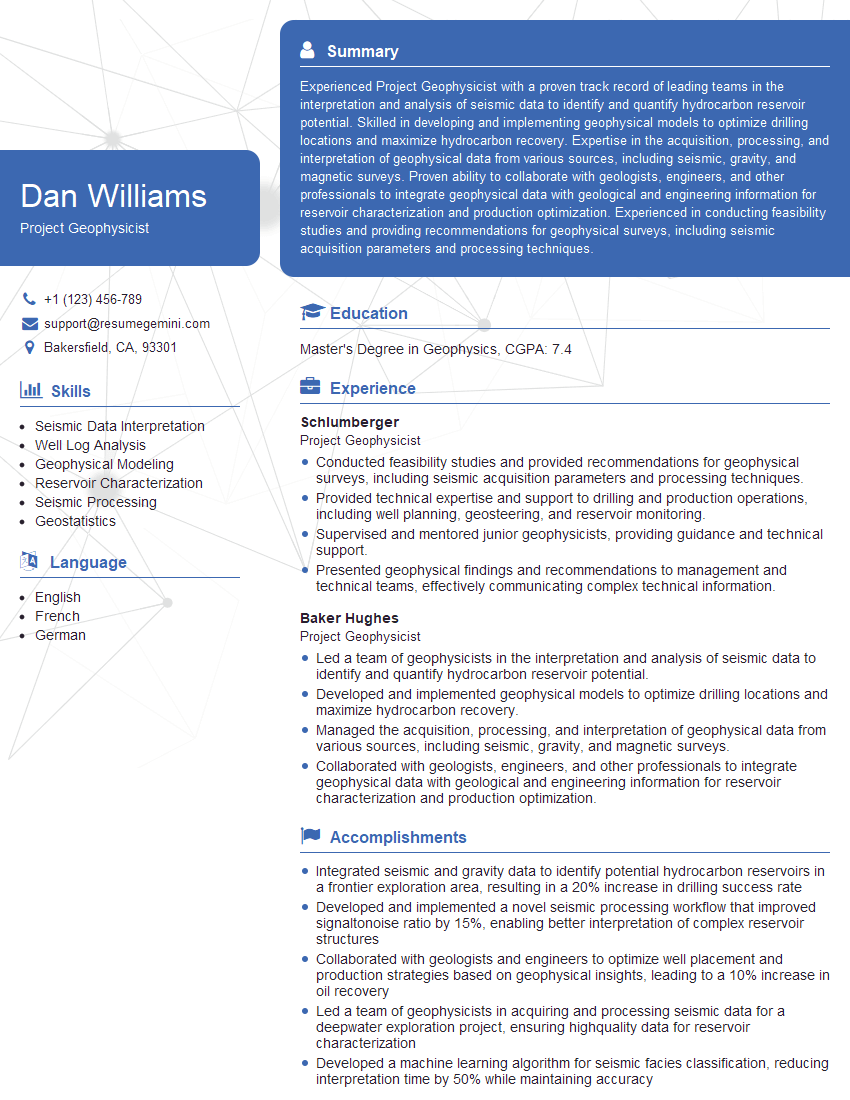
Mastering Gravity and Magnetic Data Acquisition opens doors to exciting careers in geophysics, resource exploration, and environmental studies. A strong understanding of these techniques significantly enhances your employability and paves the way for career advancement. To maximize your job prospects, create a compelling and ATS-friendly resume that effectively showcases your skills and experience. We highly recommend using ResumeGemini to build a professional and impactful resume. ResumeGemini provides a streamlined process and offers examples of resumes tailored to Gravity and Magnetic Data Acquisition to help you get started. Invest time in crafting a strong resume – it’s your first impression with potential employers.
Explore more articles
Users Rating of Our Blogs
Share Your Experience
We value your feedback! Please rate our content and share your thoughts (optional).
What Readers Say About Our Blog
Amazing blog
Interesting Article, I liked the depth of knowledge you’ve shared.
Helpful, thanks for sharing.