Interviews are more than just a Q&A session—they’re a chance to prove your worth. This blog dives into essential Physics of Sound interview questions and expert tips to help you align your answers with what hiring managers are looking for. Start preparing to shine!
Questions Asked in Physics of Sound Interview
Q 1. Explain the relationship between frequency, wavelength, and the speed of sound.
The relationship between frequency (f), wavelength (λ), and the speed of sound (v) is fundamental in acoustics. They are interconnected by a simple equation: v = fλ. This means the speed of sound is the product of its frequency and wavelength.
Imagine throwing pebbles into a still pond. The frequency represents how many pebbles you throw per second (waves per second). The wavelength is the distance between the crests of two consecutive waves. The speed is how fast the ripples spread outwards. If you throw pebbles faster (higher frequency), the ripples will be closer together (shorter wavelength), but the speed of the ripples in the water remains constant (assuming the water properties don’t change).
In the case of sound, the speed depends on the medium (air, water, steel, etc.). A higher frequency sound wave will have a shorter wavelength, and a lower frequency sound wave will have a longer wavelength, but the speed remains constant for a given medium at a specific temperature and pressure.
Q 2. Describe the difference between longitudinal and transverse waves.
Sound waves, unlike light waves, are longitudinal waves. This means the particles in the medium (like air molecules) vibrate parallel to the direction of wave propagation. Think of a slinky being pushed and pulled; the coils move back and forth along the direction of the push.
Transverse waves, on the other hand, have particles vibrating perpendicular to the direction of wave propagation. Imagine shaking a rope up and down; the rope itself moves up and down (perpendicular), but the wave travels horizontally.
Light waves are transverse waves. The difference is crucial. The way these waves interact with matter is distinct, influencing phenomena like polarization (present in transverse waves but absent in longitudinal waves).
Q 3. What is the Doppler effect, and how does it apply to sound?
The Doppler effect describes the change in frequency or wavelength of a wave in relation to an observer who is moving relative to the source of the wave. In simpler terms, if the source of sound is moving towards you, the sound waves are compressed, resulting in a higher perceived frequency (higher pitch). Conversely, if the source is moving away, the waves are stretched, resulting in a lower perceived frequency (lower pitch).
A common example is the siren of an ambulance. As it approaches, the siren sounds higher pitched, and as it moves away, it sounds lower pitched. The effect is pronounced when the relative speed between source and observer is significant compared to the speed of sound. This principle is used in various applications, including Doppler radar (measuring speed of objects), medical ultrasound (imaging internal organs), and astronomy (measuring the velocity of stars).
Q 4. Explain the concept of sound intensity and decibels.
Sound intensity refers to the power of a sound wave per unit area. It’s essentially how much sound energy is hitting a particular surface. It’s measured in Watts per square meter (W/m²). However, the human ear perceives sound intensity logarithmically, not linearly. This is where decibels (dB) come into play.
The decibel scale is a logarithmic scale that compares a given sound intensity (I) to a reference intensity (I₀), typically the threshold of human hearing (10⁻¹² W/m²). The formula is: dB = 10 log₁₀(I/I₀). A 10 dB increase represents a tenfold increase in intensity, while a 20 dB increase represents a hundredfold increase.
For example, a whisper is around 30 dB, normal conversation is around 60 dB, and a rock concert can reach 120 dB, which can cause hearing damage.
Q 5. What are the different types of sound absorption materials and their applications?
Sound absorption materials are designed to dampen sound waves by converting sound energy into heat. Different materials have varying absorption coefficients depending on frequency.
- Porous materials: These materials (like acoustic foam, fiberglass, mineral wool) have interconnected pores that trap sound waves, converting the energy into heat through friction. They are excellent for absorbing mid and high frequencies.
- Resonant absorbers: These materials (like Helmholtz resonators) are designed to absorb specific frequencies based on their physical dimensions. They are often used for low-frequency absorption.
- Membrane absorbers: These materials use a thin membrane stretched over an air cavity. The membrane vibrates in response to sound, dissipating energy. They’re effective for mid-range frequencies.
- Panel absorbers: These consist of a rigid panel mounted on a frame. The air cavity behind the panel and the vibration of the panel itself absorb sound energy. They work effectively over a broader frequency range.
Applications include recording studios, concert halls, home theaters, and offices, where noise reduction is crucial for comfort and improved acoustics.
Q 6. Describe the principles of sound reflection and reverberation.
Sound reflection occurs when sound waves strike a hard surface and bounce back. The angle of incidence (the angle at which the sound wave hits the surface) equals the angle of reflection (the angle at which the sound wave bounces off). This is governed by the law of reflection.
Reverberation is the persistence of sound in a space after the original sound source has stopped. It’s caused by multiple reflections of sound waves off surfaces within the enclosed space. The duration and character of reverberation depend on factors like the size and shape of the room, the absorptive properties of the surfaces, and the frequency content of the sound.
In a concert hall, some reverberation is desirable to create a richer, more immersive sound. However, excessive reverberation can lead to muddiness and make speech difficult to understand. Acoustical design carefully manages reflection and reverberation to optimize sound quality.
Q 7. How do you measure sound levels using a sound level meter?
A sound level meter is an instrument used to measure sound pressure levels (SPL) in decibels (dB). The process involves:
- Calibration: Before any measurement, the sound level meter needs to be calibrated using a calibrator, ensuring its accuracy.
- Measurement: The sound level meter’s microphone is positioned at the desired location. It captures the sound waves, and the meter processes the signal to display the SPL in dB. Different weighting filters (A, C, Z) might be used, accounting for the frequency response of the human ear.
- Recording and Analysis: The meter typically displays the sound levels in real-time. Some advanced meters record data for later analysis.
Consider factors like background noise during measurement and proper microphone positioning for accurate results. Different weighting networks (A, C, Z) on the meter are used depending on the application, with the ‘A’ weighting being most common for assessing noise impact on humans due to its closer alignment with human hearing sensitivity.
Q 8. Explain the concept of sound impedance and its significance in acoustics.
Sound impedance is the opposition a medium offers to the propagation of sound waves. Think of it like resistance in an electrical circuit – a higher impedance means the sound wave has more difficulty traveling through the material. It’s a complex quantity, encompassing both resistance (how much energy is absorbed) and reactance (how much energy is stored and released). It’s crucial in acoustics because it dictates how sound energy is transmitted, reflected, and absorbed at interfaces between different media (e.g., air and a wall, air and water).
Specifically, it’s defined as the ratio of sound pressure to particle velocity. A high impedance material reflects more sound, while a low impedance material absorbs or transmits more. For example, a hard, dense wall has a high acoustic impedance compared to air, resulting in significant sound reflection. This principle is fundamental in designing sound barriers, architectural acoustics, and medical ultrasound.
Understanding impedance matching is also important for efficient sound transmission. In speaker design, for instance, engineers aim for impedance matching between the speaker and the amplifier to minimize energy loss and maximize sound output. Mismatched impedances lead to sound distortion and reduced efficiency.
Q 9. What are the common methods for noise control and reduction?
Noise control and reduction strategies aim to minimize unwanted sound levels. These methods can be broadly categorized into:
- Absorption: Using materials that absorb sound energy, preventing it from reflecting and propagating further. Think of acoustic panels made of porous materials like foam or fiberglass. These are commonly used in recording studios and concert halls.
- Isolation: Preventing sound from traveling from one space to another. This often involves using dense, massive barriers like thick walls, double-glazed windows, and sealed doors. Mass is key here; the heavier the barrier, the better the isolation.
- Damping: Reducing vibrations that generate sound. This is commonly achieved using vibration dampeners or isolating equipment from the surrounding structures. For instance, placing machinery on vibration-isolating mounts can significantly reduce noise pollution.
- Active Noise Cancellation: This advanced technique uses a secondary sound wave, precisely out of phase with the unwanted noise, to cancel it out. It’s often used in noise-canceling headphones.
- Sound Masking: Introducing a more desirable sound to mask the unwanted noise. This is often employed in offices to reduce the distraction caused by ambient sounds. Background music or ambient soundscapes are often used for this.
The specific method or combination of methods used depends on the source of noise, its frequency, and the desired level of reduction.
Q 10. Describe different types of microphones and their applications.
Microphones convert sound waves into electrical signals. Different types are designed for specific applications, each with unique characteristics:
- Dynamic Microphones: Robust and relatively inexpensive, they use a moving coil within a magnetic field to generate the signal. They are less sensitive to handling noise and are commonly used for live sound reinforcement and broadcasting.
- Condenser Microphones: Highly sensitive and capable of capturing a wider range of frequencies, they require external power. They are favored in recording studios for their detailed sound reproduction and are often used for recording vocals and instruments.
- Ribbon Microphones: These use a thin metallic ribbon suspended in a magnetic field. They offer a unique, warm sound with a natural presence and are often used for recording instruments like guitars and horns.
- Electret Condenser Microphones: A type of condenser microphone that incorporates a permanently charged electret element, eliminating the need for a separate power supply. These are commonly used in everyday applications like smartphones and laptops.
- Boundary Microphones (PZM): Designed to be mounted on a surface, these are useful for capturing sound from a larger area. Often used in conferencing systems and video recording.
The choice of microphone depends heavily on the application. For example, a dynamic microphone might be preferred for a live concert due to its robustness, while a condenser microphone might be better suited for recording delicate acoustic instruments in a studio setting.
Q 11. Explain the principles of sound localization.
Sound localization is our ability to determine the location of a sound source. Our brains use several cues to achieve this:
- Interaural Time Difference (ITD): The difference in the time it takes for a sound to reach each ear. If a sound source is to the right, it reaches the right ear slightly before the left.
- Interaural Level Difference (ILD): The difference in sound intensity (loudness) between the two ears. The head acts as a sound shadow, reducing the intensity of sound reaching the ear farther from the source. This effect is more pronounced at higher frequencies.
- Spectral Cues: The pinna (outer ear) modifies the sound waves before they reach the eardrum, creating frequency-specific filtering effects. These unique spectral cues help the brain identify the sound source’s elevation and location.
- Head-Related Transfer Function (HRTF): The overall effect of the pinna and head on the sound’s frequency spectrum. HRTFs are unique to each individual and are crucial for accurate sound localization.
These cues, processed by our brain, allow us to locate sounds relatively accurately in three-dimensional space. However, localization can be challenging with complex sounds or in reverberant environments.
Q 12. What are the characteristics of a good listening environment?
A good listening environment optimizes sound quality and minimizes distractions. Key characteristics include:
- Appropriate Reverberation Time (RT60): The time it takes for sound to decay by 60dB after the source stops. The optimal RT60 varies depending on the intended use (e.g., shorter RT60 for speech intelligibility, longer RT60 for musical performance).
- Balanced Frequency Response: The room should reproduce all frequencies with equal loudness. Uneven frequency response can lead to certain frequencies being amplified or attenuated, creating a muddy or harsh sound.
- Minimal Reflections and Standing Waves: Unwanted reflections can create echoes and muddiness. Standing waves (stationary patterns of sound energy) occur in rooms with parallel walls and create uneven sound pressure distribution.
- Low Background Noise: Ambient noise should be kept to a minimum to avoid masking the desired sounds. This includes external noise as well as internal sources such as HVAC systems.
- Proper Acoustic Treatment: Using sound absorption materials, diffusers (to scatter sound reflections), and bass traps (to control low-frequency buildup) can significantly improve the quality of the listening environment.
Achieving a good listening environment involves careful design and construction or appropriate acoustic treatment of existing spaces.
Q 13. Describe different types of room modes and their impact on sound quality.
Room modes are resonant frequencies caused by the superposition of sound waves reflecting off the room’s boundaries. They are standing waves with nodes (points of minimal pressure) and antinodes (points of maximal pressure) distributed throughout the space. These modes are primarily excited by low-frequency sounds, impacting bass reproduction significantly.
Different types of room modes exist depending on the dimensions of the room:
- Axial Modes: Sound waves reflect between two parallel surfaces (e.g., floor and ceiling, two opposite walls).
- Tangential Modes: Sound waves reflect between four surfaces (e.g., between two pairs of parallel walls).
- Oblique Modes: Sound waves reflect off all six surfaces of the room.
Room modes impact sound quality by causing certain frequencies to be emphasized (antinodes) or attenuated (nodes), resulting in an uneven frequency response. This can lead to a “boomy” or “muddy” bass sound, depending on the location within the room. Effective acoustic treatment using bass traps and diffusion can minimize the impact of problematic room modes.
Q 14. Explain the concept of critical distance in acoustics.
The critical distance in acoustics refers to the distance from a sound source where the direct sound level equals the reverberant sound level. Beyond this distance, the reverberant sound becomes dominant, and the sound quality deteriorates.
Imagine a speaker in a room. Close to the speaker, the direct sound from the speaker is much stronger than the reflections. As you move farther away, the intensity of the direct sound decreases faster than the reverberant sound because the direct sound weakens with the square of distance, while the reverberant sound weakens more slowly. The critical distance is the point where these two sound levels are equal.
The critical distance is influenced by several factors:
- Sound Source Power: A more powerful source will have a larger critical distance.
- Reverberation Time of the Room: A room with a longer reverberation time will have a smaller critical distance.
- Absorption Characteristics of the Room: A room with more sound absorption will have a larger critical distance.
Understanding the critical distance is crucial in designing spaces where speech clarity or sound reproduction is important. In concert halls, for instance, the goal is to have a substantial critical distance to maintain a strong direct sound field, even for the furthest listener, minimizing the perception of muddiness.
Q 15. What are some common issues related to architectural acoustics?
Architectural acoustics deals with the design of spaces to achieve optimal sound quality. Common issues arise from unwanted reflections, excessive reverberation, noise intrusion, and insufficient sound isolation. For instance, a lecture hall with excessive reverberation makes speech unintelligible, while a recording studio with poor sound isolation renders recordings unusable due to external noise. These problems stem from inappropriate choices of building materials, room geometry, and the lack of sound-absorbing or sound-diffusing elements.
- Excessive Reverberation: Sound persists for too long after the source stops, causing muddiness and blurring of sounds. This is particularly problematic in large, hard-surfaced rooms.
- Echoes: Distinct reflections of sound from surfaces, often creating distracting or unpleasant listening experiences.
- Poor Sound Isolation: Sounds from adjacent rooms or exterior sources penetrate the space, disrupting the intended acoustic environment.
- Flutter Echo: Repeated reflections between parallel surfaces, creating a rapid succession of echoes that sounds like a flapping sound.
- Standing Waves: Specific frequencies build up in certain locations within a room due to interference patterns, leading to uneven sound distribution.
Career Expert Tips:
- Ace those interviews! Prepare effectively by reviewing the Top 50 Most Common Interview Questions on ResumeGemini.
- Navigate your job search with confidence! Explore a wide range of Career Tips on ResumeGemini. Learn about common challenges and recommendations to overcome them.
- Craft the perfect resume! Master the Art of Resume Writing with ResumeGemini’s guide. Showcase your unique qualifications and achievements effectively.
- Don’t miss out on holiday savings! Build your dream resume with ResumeGemini’s ATS optimized templates.
Q 16. How do you design for optimal acoustics in a concert hall?
Designing a concert hall for optimal acoustics is a complex process that requires careful consideration of multiple factors. The primary goal is to create a balance between reverberation time, sound clarity, and even sound distribution throughout the audience area. This involves strategic use of reflective and absorptive surfaces, and thoughtful room shaping.
- Reverberation Time: The time it takes for sound to decay to a certain level after the source stops. It needs to be carefully tuned to suit the type of music performed. A longer reverberation time is often preferred for orchestral music, while shorter times are better for chamber music.
- Shape and Volume: The shape of the hall significantly impacts sound reflections and distribution. Shoebox designs, for example, are known for their excellent sound diffusion properties, while vineyard designs offer a more intimate and focused sound experience.
- Material Selection: The surfaces within the hall significantly affect the acoustic behavior. Reflective surfaces such as plaster or marble are used strategically to direct sound towards the audience, while absorptive materials like wood panels or carpets help to control reverberation.
- Sound Diffusers: These are designed to scatter sound waves, preventing excessive reflections and improving sound uniformity. Different diffusers (e.g., quadratic residue diffusers) can be used depending on the desired effect.
- Computer Modeling: Before construction, sophisticated computer modeling (e.g., ray tracing, image source methods) is commonly employed to predict and optimize the acoustic performance of the design.
Q 17. Explain the principles of sound reinforcement systems.
Sound reinforcement systems aim to amplify and distribute sound to a larger audience than could be reached naturally. This involves microphones to capture the sound, amplifiers to boost its power, and loudspeakers to project it to the listeners. Careful system design is crucial to ensure intelligibility, even sound coverage, and minimal feedback (a high-pitched squeal caused by positive feedback loops between microphone and loudspeaker).
- Microphones: Convert sound waves into electrical signals. Different types are suited to different applications (e.g., dynamic microphones for live performances, condenser microphones for recording studios).
- Mixers: Combine signals from multiple microphones, adjust their levels, and apply equalization (EQ) and other effects.
- Amplifiers: Boost the power of the electrical signals to drive the loudspeakers.
- Loudspeakers: Convert electrical signals back into sound waves. Proper placement and selection of speakers is crucial for achieving even sound coverage and minimizing undesirable effects like comb filtering (interference patterns causing dips and peaks in frequency response).
- Equalization (EQ): Adjusts the balance of different frequencies in the sound signal. This is used to compensate for deficiencies in the room acoustics or to shape the overall sound of the system.
Q 18. What are some applications of ultrasound?
Ultrasound, sound waves with frequencies above the human hearing range (typically above 20 kHz), has numerous applications in various fields. It’s non-invasive and offers high resolution imaging capabilities, making it invaluable for medical and industrial applications.
- Medical Imaging: Ultrasound imaging (sonography) is widely used for visualizing internal organs and tissues, aiding in diagnosis of various medical conditions.
- Medical Therapy: Focused ultrasound can be used for targeted tissue destruction or stimulation (e.g., treatment of tumors or kidney stones).
- Industrial Non-Destructive Testing (NDT): Ultrasound is employed to detect flaws or defects in materials such as metals, composites, and plastics, enhancing the safety and reliability of structures and machinery.
- Sonar: Used in underwater navigation and mapping, utilizing the reflection of ultrasound signals to determine distances and identify objects.
- Cleaning: Ultrasonic cleaning baths use high-frequency sound waves to dislodge dirt and debris from delicate objects.
Q 19. How do you deal with noise pollution in an urban environment?
Addressing noise pollution in urban environments requires a multi-pronged approach involving legislation, engineering solutions, and public awareness campaigns. The strategies focus on reducing noise at the source, blocking its transmission, and masking it with other sounds.
- Source Control: Stricter regulations on noise emissions from vehicles, construction sites, and industrial facilities are crucial. Quieter engine designs and noise-reducing technologies are important advancements.
- Path Control: Building barriers (such as sound walls) along busy roads and planting trees to absorb sound can effectively reduce noise propagation.
- Receiver Control: Soundproofing buildings and improving insulation helps protect residents from noise intrusion. This can involve using double-glazed windows and sound-absorbing materials within the building.
- Noise Masking: Introducing ambient soundscapes, such as white noise generators or nature sounds, can help to mask intrusive noises, making them less perceptible.
- Public Awareness: Educating the public about the harmful effects of noise pollution and promoting responsible noise behavior are vital for long-term success.
Q 20. Describe the concept of psychoacoustics.
Psychoacoustics is the scientific study of how humans perceive sound. It bridges the gap between the physical properties of sound waves and the subjective experience of hearing. This means it explores not just how loud something is, measured in decibels, but also how we interpret that loudness, and how other factors like timbre and context modify our experience.
For example, two sounds with the same physical intensity (measured in decibels) might be perceived differently in loudness due to factors such as frequency content and duration. A 1kHz pure tone might sound louder than a 100 Hz tone of the same intensity.
Psychoacoustic principles are crucial in audio engineering, music production, and hearing aid design, influencing the way we design and process sounds to enhance the listening experience. For instance, the phenomenon of masking is used to efficiently compress audio data without significant loss of perceived quality. A loud sound masks quieter sounds at nearby frequencies, allowing engineers to reduce the intensity of the masked sounds without affecting the listener’s perception of the audio.
Q 21. Explain the difference between subjective and objective sound quality assessment.
Objective sound quality assessment relies on measurable physical parameters of the sound, such as frequency response, total harmonic distortion, and signal-to-noise ratio. These parameters are measured using instruments and provide a quantitative evaluation of the sound. For example, a measurement of distortion (THD) gives a numerical value showing how much the signal is corrupted by harmonics.
Subjective sound quality assessment, on the other hand, involves human listeners rating the sound based on their perception. This evaluation considers factors such as loudness, clarity, timbre, and overall preference. Subjective methods involve listening tests where participants rate sound quality using scales or questionnaires. For example, a listening test could rate how pleasant a recording sounds on a scale of 1 to 5.
Both methods are valuable and often used together. Objective measurements can identify potential problems in a sound system, while subjective evaluations reveal the impact on the actual listening experience. For instance, a loudspeaker might pass objective tests, but listeners might still find it lacks clarity. A balanced approach, combining both objective and subjective measures, is essential for comprehensive sound quality evaluation.
Q 22. Describe the phenomenon of sound diffraction.
Sound diffraction is the bending of sound waves as they pass around an obstacle or through an opening. Imagine throwing a pebble into a calm pond; the waves don’t just stop at the edge of a floating leaf, they bend around it. Similarly, sound waves don’t abruptly stop when encountering a barrier; they bend and spread out, albeit with reduced intensity. This phenomenon is governed by the wavelength of the sound and the size of the obstacle.
The amount of diffraction depends on the ratio of the wavelength to the size of the obstacle. If the wavelength is much larger than the obstacle, the diffraction is significant, and the sound waves bend around the obstacle extensively. Conversely, if the wavelength is much smaller than the obstacle, the diffraction is minimal, and the sound is largely blocked.
Examples: We can hear someone calling us from around a corner because the sound waves diffract around the corner. Similarly, the bass frequencies from a loudspeaker will diffract more readily around obstacles than higher-frequency sounds, which is why you’ll often hear the bass better from further away.
Q 23. How does temperature affect the speed of sound?
Temperature significantly impacts the speed of sound. In general, the speed of sound increases with increasing temperature. This is because higher temperatures mean air molecules move faster, leading to more frequent collisions and a quicker transmission of sound waves.
The relationship isn’t perfectly linear, but a good approximation for dry air is given by the formula:
v = 331.4 + 0.6Twhere ‘v’ is the speed of sound in meters per second and ‘T’ is the temperature in degrees Celsius.
Practical Application: This effect is important in various fields, including meteorology. Temperature gradients in the atmosphere can cause sound waves to refract (bend), leading to variations in sound propagation, such as the apparent strengthening or weakening of sounds at different distances.
Q 24. Explain the concept of resonance.
Resonance is a phenomenon where a system oscillates with greater amplitude at some frequencies than at others. Think of pushing a child on a swing. You don’t push randomly; you push at the natural frequency of the swing (its resonance frequency). This timed pushing maximizes the swing’s amplitude. Similarly, when a sound wave’s frequency matches the natural frequency of an object, the object vibrates more intensely.
This is because energy is efficiently transferred from the sound wave to the object. The object’s natural frequency depends on its physical properties like mass, stiffness, and shape.
Examples: A wine glass shattering when exposed to a high-pitched note, the soundboard of a musical instrument amplifying the vibrations of the strings, and the resonance of the vocal tract shaping the human voice. Understanding resonance is crucial in designing musical instruments, architectural acoustics, and predicting structural vibrations.
Q 25. What are some common signal processing techniques used in acoustics?
Many signal processing techniques are used in acoustics to analyze and manipulate sound. Some common ones include:
- Filtering: Removing unwanted frequencies (e.g., noise reduction). This can be done using various filter types, such as high-pass, low-pass, band-pass, and notch filters.
- Fourier Transform: Decomposing a complex sound wave into its constituent frequencies, allowing us to see the frequency content of the signal. This is essential for analyzing different sounds and isolating specific components.
- Time-Frequency Analysis: Techniques like the short-time Fourier transform (STFT) or wavelet transform allow us to see how the frequency content of a signal changes over time, which is particularly useful for analyzing non-stationary sounds.
- Signal Averaging: Improving the signal-to-noise ratio by averaging multiple recordings of the same sound. This is helpful when dealing with weak signals embedded in noise.
These techniques are implemented using software packages such as MATLAB, Python with libraries like SciPy and Librosa, and specialized acoustic analysis software.
Q 26. Describe your experience with acoustic modeling software.
I have extensive experience using various acoustic modeling software packages. My proficiency includes using commercially available packages like COMSOL Multiphysics and specialized acoustic simulation software, as well as working with open-source tools. I’m proficient in building 3D models of spaces, defining material properties, and simulating sound propagation to predict sound fields and perform noise reduction analysis. My experience spans diverse applications, from designing concert halls and recording studios to simulating noise propagation in urban environments. I’m comfortable with both the theoretical underpinnings of the numerical methods used in these programs (Finite Element Method, Boundary Element Method) and their practical application.
Q 27. How do you analyze acoustic data and interpret the results?
Acoustic data analysis involves a combination of signal processing techniques and physical interpretation. I typically begin by visualizing the data using spectrograms and other time-frequency representations. This gives a good overview of the sound’s frequency content and how it changes over time.
Next, I might use statistical methods to analyze parameters like sound pressure levels, frequency spectra, and temporal characteristics. Depending on the specific problem, I might focus on specific features of the sound, such as identifying particular frequencies or analyzing the temporal patterns of acoustic events. Interpretation of the results requires careful consideration of the experimental setup and the physical processes that produced the sound. For example, I might use my knowledge of sound propagation and room acoustics to understand the effect of a room’s geometry and materials on the sound field. Finally, I ensure I properly document the results and present them clearly and effectively.
Q 28. Describe a challenging acoustics problem you solved and how you approached it.
One challenging project involved reducing noise levels in a large industrial plant. The noise sources were complex and varied, and the plant layout was intricate. My approach involved a multi-stage process:
- Noise Source Identification: Using sound level meters and acoustic cameras, I identified the primary noise sources—high-speed machinery and air compressors.
- Acoustic Modeling: I developed a 3D acoustic model of the plant using COMSOL Multiphysics. This allowed me to simulate sound propagation and assess the effectiveness of different noise reduction strategies.
- Noise Control Strategies: Based on the model results, I proposed several noise reduction measures, including:
- Enclosing noisy equipment in sound-attenuating enclosures.
- Installing acoustic barriers to block sound propagation.
- Optimizing the layout of equipment to minimize noise interference.
- Implementation and Verification: The proposed strategies were implemented, and post-implementation sound level measurements were conducted to verify their effectiveness.
The project successfully reduced noise levels significantly, improving the working conditions for employees and meeting regulatory requirements. The use of acoustic modeling played a key role in achieving this by optimizing the placement of noise control measures and maximizing their effectiveness.
Key Topics to Learn for Physics of Sound Interview
- Wave Properties: Understanding longitudinal waves, superposition, interference (constructive and destructive), diffraction, and the Doppler effect. Consider their application in various acoustic phenomena.
- Sound Intensity and Decibels: Mastering the concepts of sound intensity, intensity level (dB), and the logarithmic scale. Be prepared to discuss applications in noise control and audio engineering.
- Acoustics of Rooms and Spaces: Explore reverberation, echo, and sound absorption. Understand how these factors influence the design of concert halls, recording studios, and other acoustically sensitive environments.
- Musical Acoustics: Familiarize yourself with the physics behind musical instruments, including string vibrations, resonance in wind instruments, and the production of different musical timbres.
- Ultrasound and its Applications: Understand the principles of ultrasound generation and detection. Be ready to discuss applications in medical imaging, non-destructive testing, and sonar.
- Signal Processing Techniques: Develop a foundational understanding of Fourier analysis and its use in analyzing and manipulating sound signals. This is crucial for many advanced applications.
- Problem-Solving Approaches: Practice solving quantitative problems involving wave equations, intensity calculations, and the application of relevant formulas. Develop a strong understanding of the underlying physics.
Next Steps
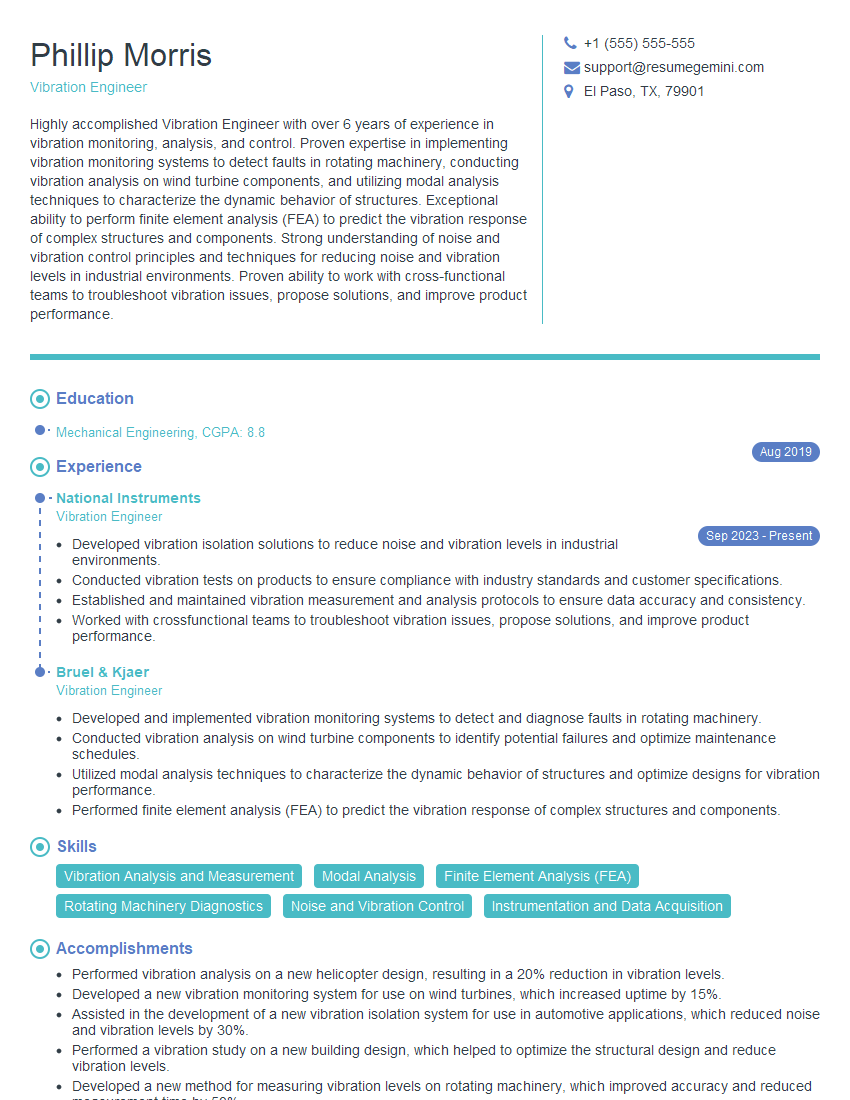
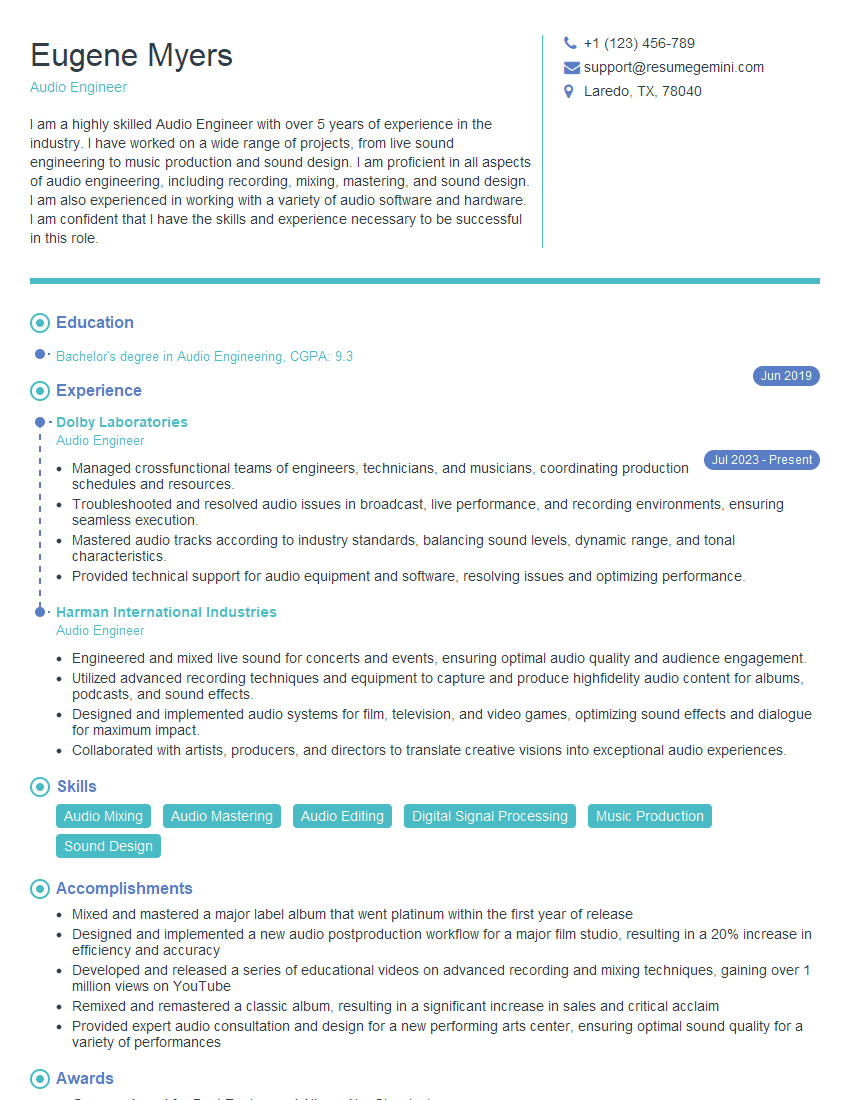
A strong grasp of the Physics of Sound opens doors to exciting careers in acoustics, audio engineering, medical physics, and research. To maximize your job prospects, focus on crafting an ATS-friendly resume that showcases your skills and experience effectively. ResumeGemini is a trusted resource that can help you build a professional and impactful resume, ensuring your qualifications are clearly presented to potential employers. Examples of resumes tailored to Physics of Sound are available to guide you through this process.
Explore more articles
Users Rating of Our Blogs
Share Your Experience
We value your feedback! Please rate our content and share your thoughts (optional).
What Readers Say About Our Blog
Amazing blog
Interesting Article, I liked the depth of knowledge you’ve shared.
Helpful, thanks for sharing.