Preparation is the key to success in any interview. In this post, we’ll explore crucial Explosives and Bomb Disposal interview questions and equip you with strategies to craft impactful answers. Whether you’re a beginner or a pro, these tips will elevate your preparation.
Questions Asked in Explosives and Bomb Disposal Interview
Q 1. Describe the different types of explosive materials and their characteristics.
Explosive materials are broadly categorized based on their chemical composition and detonation characteristics. Understanding these differences is crucial for safe handling and disposal.
- High Explosives: These detonate rapidly, producing a powerful shockwave. Examples include:
- TNT (Trinitrotoluene): A common military explosive, known for its stability and relatively low sensitivity to shock.
- RDX (Research Department Explosive): A highly powerful and brisant explosive used in many military applications, including plastic explosives like C4.
- PETN (Pentaerythritol tetranitrate): A very powerful and sensitive high explosive found in detonators and some plastic explosives.
- Low Explosives: These burn rapidly, producing a pushing effect rather than a shockwave. Examples include:
- Black Powder: A mixture of charcoal, sulfur, and potassium nitrate, historically significant but now less frequently used.
- Smokeless Powder: Used as a propellant in firearms and some improvised explosive devices (IEDs).
- Primary Explosives: Extremely sensitive to shock, friction, or heat and used as detonators to initiate high explosives. Examples include:
- Lead Azide: Used in many detonators due to its sensitivity and reliability.
- Mercury Fulminate: Historically significant, but its use is declining due to toxicity.
The characteristics, including sensitivity, brisance (shattering power), and velocity of detonation, significantly influence the hazard posed by each explosive type. For instance, a highly sensitive primary explosive requires significantly more caution during handling than a relatively insensitive high explosive like TNT.
Q 2. Explain the process of identifying and classifying an explosive device.
Identifying and classifying an explosive device is a systematic process that prioritizes safety. It typically involves a visual inspection from a safe distance followed by more detailed examination if deemed safe.
- Visual Assessment: This involves careful observation of the device’s shape, size, components, and any visible markings or labels. The presence of wires, timers, batteries, and other components provides clues to its potential function and composition.
- X-ray/Imaging Techniques: Non-destructive techniques like X-ray and other imaging technologies help to reveal the internal structure and components without directly handling the device. This can identify the type of explosive potentially used and its triggering mechanism.
- Chemical Analysis (if safe): Small samples might be collected and analyzed (using techniques like gas chromatography-mass spectrometry) to identify the explosive material. This is usually performed only after other less intrusive methods have been completed and safety is assured.
- Classification: Once sufficient information is gathered, the device is classified based on its type (e.g., improvised explosive device, military ordnance), the suspected explosive used, and its potential hazard.
The entire process adheres to strict safety protocols, prioritizing the bomb disposal technician’s safety and the safety of the surrounding environment. Incorrect identification can have catastrophic consequences.
Q 3. Outline the safety procedures followed during an explosive ordnance disposal operation.
Explosive ordnance disposal (EOD) operations demand stringent safety procedures to minimize risks.
- Controlled Access: Establishing a secure perimeter around the device, evacuating people from the danger zone, and controlling access to the site.
- Personal Protective Equipment (PPE): EOD technicians wear specialized protective suits, helmets, and other gear designed to mitigate the impact of a potential explosion.
- Remote Handling Techniques: Utilizing robots and other remote handling tools to manipulate the device, reducing direct contact and exposure.
- Detailed Planning: Thoroughly planning the operation, including the approach, neutralization method, and contingency plans. This involves considering the environmental conditions and potential obstacles.
- Communication: Maintaining clear communication between team members and coordinating efforts to ensure a smooth and safe operation.
- Post-Blast Procedures: Implementing procedures for managing the aftermath of a controlled detonation or accidental explosion, including securing the area and ensuring the safety of personnel.
These safety procedures are not just guidelines; they are critical elements that ensure the survival of the EOD team and the public.
Q 4. What are the various methods used for neutralizing explosive devices?
Neutralizing explosive devices depends on several factors, including the type of device, its accessibility, and the surrounding environment. Methods include:
- Controlled Detonation: This involves carefully detonating the device in a controlled environment, usually in a remote location or a purpose-built disposal facility, minimizing the risk to life and property.
- Disarmament: Carefully removing the explosive components of a device, often using specialized tools, to render it safe. This is a high-risk procedure and only attempted when deemed safe.
- Water Dispersal (for certain water-soluble explosives): In some cases, the device may be submerged in water to dissolve or deactivate the explosives. This is highly situation-specific and depends on the explosive’s properties and the available resources.
- Chemical Neutralization: Using chemical agents to render the explosive inert. This is a complex process and requires expertise in chemistry and explosives.
The choice of method is a critical decision that considers various factors and depends heavily on the specific circumstances and the information available about the explosive device.
Q 5. Discuss the ethical considerations involved in bomb disposal.
Bomb disposal presents numerous ethical considerations that EOD technicians face daily.
- Risk to Life: The inherent danger of the job necessitates a constant balancing of risk to the technician versus the risk to the public. The decision to attempt disarmament versus detonation often involves weighing these competing risks.
- Protecting Innocent Lives: The primary ethical consideration is safeguarding innocent lives, both from the immediate threat of the explosive and potential secondary threats from uncontrolled detonation.
- Evidence Preservation: In some cases, the explosive device may be part of a larger investigation. Maintaining the integrity of the evidence requires careful handling and documentation, creating a potential conflict between evidence preservation and immediate public safety.
- Use of Force: The use of force, even in controlled detonation, involves consequences, and it is essential to ensure that the force used is proportional to the threat.
EOD technicians must make difficult decisions under immense pressure, requiring a strong ethical compass and adherence to established protocols and guidelines.
Q 6. How do you assess the risk associated with an explosive device?
Risk assessment for an explosive device is a multi-faceted process involving the analysis of various factors. This is crucial to determine the appropriate response and mitigation strategies.
- Type and Quantity of Explosive: The type of explosive used influences the blast radius and the potential for fragmentation. The quantity directly impacts the destructive potential.
- Construction of the Device: The design and engineering of the device determine its stability, sensitivity, and potential for unintended detonation.
- Environment: The surroundings affect the potential damage. For example, a device in a crowded area presents a higher risk than one in an isolated location. The presence of flammable materials further increases the risk.
- Triggering Mechanism: The complexity and reliability of the triggering mechanism affect the predictability of the detonation and the possibility of premature activation.
A thorough risk assessment is crucial to select the appropriate response strategy, including determining the safest method for neutralization, and outlining the necessary safety procedures.
Q 7. Explain the principles of controlled detonation.
Controlled detonation is a crucial technique used in EOD to neutralize explosive devices safely. The principle lies in directing the energy released from the explosion in a controlled manner to minimize damage and risk.
The process typically involves:
- Selecting a suitable location: A remote, secure location with minimal surrounding structures and personnel is selected for the detonation. This location is often a designated disposal range or a controlled demolition site.
- Choosing the appropriate charge: A secondary explosive charge of sufficient power to reliably detonate the primary device is selected. This charge is carefully placed to ensure complete detonation.
- Initiation systems: A safe and reliable initiation system is used to remotely detonate the secondary charge, preventing any accidental or premature detonation.
- Safety precautions: Rigorous safety protocols are implemented to protect personnel and property. This includes the use of blast barriers, remote detonation procedures, and post-detonation safety checks.
The success of a controlled detonation hinges on careful planning, execution, and strict adherence to safety guidelines. The goal is not just to destroy the device, but to do so without causing further harm or damage.
Q 8. What are the potential hazards associated with post-blast investigation?
Post-blast investigations are inherently hazardous. The immediate dangers include the potential for secondary devices – unexploded ordnance or booby traps left to target investigators. The scene itself might be structurally unstable, posing risks of collapse. There’s also the risk of exposure to hazardous materials, such as toxic chemicals or biological agents, depending on the nature of the explosive used. Furthermore, sharp fragments from the explosion can remain embedded, posing a serious threat. Finally, there’s the psychological hazard; the scene is often gruesome and emotionally disturbing for those involved.
- Structural Instability: A building might be weakened significantly, creating the risk of further collapse during investigation.
- Secondary Devices: Bomb makers often employ booby traps to target first responders and investigators.
- Hazardous Materials: The explosive itself or its components might contain toxic substances that can cause injury or illness.
- Unexploded Components: Parts of the explosive device might remain unexploded, posing a lingering threat.
Q 9. Describe your experience with different types of improvised explosive devices (IEDs).
My experience encompasses a wide range of IEDs, from simple low-explosive devices using readily available materials like fertilizer and fuel oil (commonly known as ANFO – Ammonium Nitrate Fuel Oil) to sophisticated devices incorporating military-grade explosives and electronic triggering mechanisms. I’ve encountered IEDs utilizing various initiation systems, including pressure plates, timers, and remote detonators. I’ve also dealt with devices concealed in everyday objects, making them especially difficult to detect. For example, I worked on a case where a seemingly innocuous backpack was rigged with a complex tripwire system and a significant amount of C4. Another case involved a vehicle-borne IED disguised as a delivery van, highlighting the ingenuity and adaptability of those constructing these devices.
- ANFO Devices: These are relatively simple to construct but can still cause substantial damage.
- Military-grade Explosive IEDs: These devices often involve sophisticated electronic components and are capable of causing immense destruction.
- Improvised Pressure Plate Devices: These devices use pressure sensitive switches to initiate the explosion.
- Concealed IEDs: Disguising bombs in everyday items is a tactic to deceive and surprise victims and responders.
Q 10. How do you handle suspicious packages or devices?
Handling suspicious packages or devices requires a methodical and cautious approach. The first priority is to establish a safe perimeter and evacuate the immediate area. We then employ a layered approach to assessment, starting with visual inspection from a safe distance using binoculars or long-range cameras. This helps identify any obvious triggers or suspicious features. If the device is accessible and appears to be benign (e.g., a damaged appliance, a package with unknown contents), the first step might involve x-ray screening, and/or specialized sensors. But if the package appears unstable or risky, remote detection technologies, such as robots equipped with cameras and manipulators, are used for close examination, along with bomb suits. Ultimately, the aim is to neutralize the threat safely and efficiently, often involving controlled demolition or careful disarming.
This process is about reducing risks at every stage. We don’t rush; patience is crucial.
Q 11. What are the legal and regulatory requirements related to explosives handling?
The legal and regulatory requirements surrounding explosives handling are stringent and vary depending on the jurisdiction. Generally, there are strict licensing and permitting procedures for the possession, use, transportation, and storage of explosives. These regulations cover everything from the type of explosive to the level of security required for storage facilities. Failure to comply can result in severe penalties, including hefty fines and imprisonment. There are also stringent record-keeping requirements and regular inspections to ensure compliance. Specific regulations also govern the transportation of explosives, stipulating requirements for vehicles, packaging, and personnel training. The regulations also address training certifications, and operational procedures.
These regulations exist to mitigate the risks associated with the potentially devastating consequences of mishandling explosives, ensuring public safety.
Q 12. Explain the role of X-ray and other detection technologies in EOD.
X-ray and other detection technologies are indispensable tools in EOD. X-ray machines provide images that reveal the internal structure of a suspicious object, helping identify components such as explosives, detonators, and triggering mechanisms. Other technologies, such as millimeter-wave scanners, can detect concealed objects even through clothing or packaging. We also utilize metal detectors to locate metallic components, and trace detection equipment can identify explosive residues or specific chemicals. These technologies significantly enhance our ability to assess the threat level and plan a safe and effective disposal or disabling strategy. The integration of these technologies, often via robotic platforms, allows for remote analysis, significantly reducing the risks to personnel.
Q 13. How do you manage stress and pressure during high-stakes situations?
High-stakes situations demand effective stress management. My approach is multifaceted. Firstly, rigorous training and preparation builds confidence and reduces uncertainty. Secondly, a strong team dynamic provides crucial support. The camaraderie and shared experience help alleviate pressure. Thirdly, I prioritize physical fitness and mental well-being through regular exercise and mindfulness techniques. Finally, I understand the importance of debriefing after critical incidents, processing the experience, and learning from it. This prevents burnout and fosters resilience. In essence, it’s about combining physical preparedness with mental fortitude and a strong support network.
Q 14. Describe your experience working as part of a team in a high-pressure environment.
Teamwork is paramount in EOD. High-pressure environments demand clear communication, efficient coordination, and mutual trust. Each team member has a defined role, and we rely heavily on shared expertise and experience. Effective communication is crucial, especially under pressure. I recall one incident involving a complex device; clear and concise communication between the robot operator, the bomb technician, and the command center was essential for the successful neutralization of the device. Everyone understood their role and worked seamlessly together, highlighting the importance of coordinated effort and trust under extreme stress.
Q 15. How do you maintain your technical knowledge and skills in the field of EOD?
Maintaining proficiency in EOD requires a multifaceted approach. It’s a constantly evolving field, with new explosives and techniques emerging regularly. My strategy involves a combination of:
- Continuous Training: I regularly participate in advanced training courses offered by both national and international organizations. These courses cover the latest in explosive identification, disposal techniques, and technological advancements in robotic systems and counter-IED strategies.
- Professional Development: I actively engage with professional journals, attend conferences, and participate in workshops to stay abreast of emerging threats and best practices. This keeps my knowledge current and helps me adapt to evolving challenges.
- Hands-on Experience: Practical experience is invaluable. I actively seek opportunities to participate in diverse EOD operations, both simulated and real-world scenarios. This allows for continuous refinement of skills and builds confidence in handling complex situations.
- Collaboration and Knowledge Sharing: I actively collaborate with colleagues, sharing experiences and best practices. This peer-to-peer learning is essential for staying sharp and developing innovative solutions.
- Self-Study: Independent study using technical manuals, research papers, and online resources supplements formal training. This allows for deeper exploration of specific areas of interest and continuous improvement of knowledge.
This holistic approach ensures I maintain the highest level of competence and safety in my work.
Career Expert Tips:
- Ace those interviews! Prepare effectively by reviewing the Top 50 Most Common Interview Questions on ResumeGemini.
- Navigate your job search with confidence! Explore a wide range of Career Tips on ResumeGemini. Learn about common challenges and recommendations to overcome them.
- Craft the perfect resume! Master the Art of Resume Writing with ResumeGemini’s guide. Showcase your unique qualifications and achievements effectively.
- Don’t miss out on holiday savings! Build your dream resume with ResumeGemini’s ATS optimized templates.
Q 16. What are the common causes of accidental explosions?
Accidental explosions stem from a variety of causes, many stemming from human error or negligence. Common causes include:
- Improper Handling of Explosives: This includes mishandling during transportation, storage, or use. A simple mistake like static electricity discharge near sensitive explosives can have devastating consequences.
- Lack of Training or Awareness: Insufficient training on safe handling procedures can lead to accidental detonation. This is especially true with improvised explosive devices (IEDs), where understanding the explosive’s construction and sensitivity is crucial.
- Faulty Equipment: Malfunctioning detonators, faulty wiring, or damaged explosive devices can lead to unexpected explosions. Regular inspection and maintenance of equipment are vital.
- Environmental Factors: Extreme temperatures, humidity, or exposure to certain chemicals can destabilize explosives, increasing the risk of accidental detonation.
- Unforeseen Chemical Reactions: Mixing incompatible substances, especially those with oxidizing properties, can lead to spontaneous combustion and explosions.
For example, I once responded to an incident where an amateur pyrotechnician accidentally detonated a homemade firework due to improper mixing of chemicals. Thorough training and adherence to safety protocols are fundamental in preventing such accidents.
Q 17. How do you mitigate the risks associated with transporting explosive materials?
Transporting explosive materials is inherently risky. Mitigating this risk involves a multi-layered approach:
- Secure Packaging: Explosives must be packaged according to strict regulations, using specialized containers designed to absorb shock and prevent accidental detonation. The packaging needs to be clearly labeled with hazard warnings.
- Specialized Vehicles: Transportation should utilize vehicles specifically designed for transporting hazardous materials. These vehicles often feature features like blast-resistant compartments and secure locking mechanisms.
- Trained Personnel: Only trained and licensed personnel should handle and transport explosives. This personnel must be well-versed in safety protocols and emergency response procedures.
- Route Planning: The route should be carefully planned to avoid populated areas and high-traffic zones. This minimizes potential impact in case of an incident.
- Escort Vehicles: For particularly sensitive shipments, escort vehicles might be necessary to provide additional security and support.
- Compliance with Regulations: Strict adherence to all relevant national and international regulations concerning transportation of hazardous materials is paramount.
For instance, the transportation of military-grade explosives often involves a convoy of specialized vehicles with armed escorts, adhering to strict protocols and contingency plans.
Q 18. Describe your experience with robotic bomb disposal systems.
Robotic bomb disposal systems have revolutionized EOD. My experience encompasses the use of various robotic platforms, including those with manipulators for precise handling of devices, cameras for detailed visual inspection, and X-ray capabilities for internal analysis. These robots allow for safe examination and disposal of suspicious packages from a safe distance.
I’ve utilized robots in numerous scenarios, from examining suspicious packages at airports to disabling IEDs in high-risk environments. The robots allow for a more thorough and controlled approach, reducing the risk to human life. Specifically, I’m proficient in operating robots equipped with disruption tools, allowing for controlled neutralization of explosive devices without the need for close-proximity intervention.
However, it’s crucial to remember that robots are tools. Effective use requires significant training and understanding of both the robot’s capabilities and limitations. Even with advanced technology, a deep understanding of explosive ordnance is still necessary for effective disposal.
Q 19. Explain the different types of explosive breaching techniques.
Explosive breaching techniques are employed to gain entry into structures or containers, often in emergency situations. Different techniques are chosen based on the specific situation and the type of obstacle:
- Shaped Charges: These employ a precisely shaped explosive charge to focus the blast energy, creating a highly penetrative jet of molten metal that can cut through thick steel or concrete. This is commonly used for breaching doors or walls.
- Linear Shaped Charges (LSCs): These are similar to shaped charges but produce a longer, narrower cut, ideal for creating precise openings in walls or vehicles.
- Satchel Charges: These consist of a large amount of explosive packed in a flexible container, used for breaching thicker barriers or creating larger openings. They are less precise than shaped charges.
- Breaching Tools with Explosives: These combine mechanical tools like wedges or rams with small explosive charges to aid in breaching.
- Explosively Formed Penetrators (EFPs): These are specialized munitions designed to penetrate heavily armored targets. Their use is highly specialized and usually restricted to military applications.
The choice of breaching technique depends heavily on factors like the material to be breached, the required size and shape of the opening, and the safety of personnel involved. A thorough assessment of the situation is crucial before selecting a technique. For example, in a hostage rescue scenario, a precise opening created by a shaped charge would be preferred over the more destructive approach of a satchel charge.
Q 20. How do you handle a situation where a bomb threat is deemed non-credible?
When a bomb threat is deemed non-credible, the process involves a systematic approach prioritizing safety and efficiency. The investigation is crucial to prevent future threats.
- Documentation: All information regarding the threat—including its origin, content, and any evidence—is thoroughly documented. This is essential for future analysis and potentially linking the threat to other incidents.
- Communication: Transparency is key. Affected individuals and organizations are informed of the threat’s non-credibility, alleviating unnecessary fear and anxiety.
- Debriefing: A thorough debriefing involving the investigating team is crucial. This helps to identify any lessons learned and strengthen future responses.
- Threat Assessment Review: The initial threat assessment is reviewed to understand how the credibility was determined to be non-credible. This improves the accuracy of future threat assessments.
- Potential Follow-up Actions: Depending on the circumstances, follow-up actions might include contacting law enforcement or mental health professionals if the threat is linked to an unstable individual.
Despite the threat being non-credible, maintaining vigilance is essential. The processes used in a non-credible threat investigation are designed to deter further threats and enhance preparedness for potential future events.
Q 21. What are the environmental considerations involved in explosive ordnance disposal?
Environmental considerations in EOD are paramount. The use of explosives can have significant consequences for the environment, particularly concerning soil and water contamination. Key considerations include:
- Soil Contamination: Explosives, their byproducts, and any debris from detonation can contaminate the soil, potentially impacting flora and fauna. Remediation efforts such as soil removal or bioremediation might be necessary.
- Water Contamination: If explosives or their byproducts enter water bodies, this can have a severe impact on aquatic life. This requires careful containment and cleanup efforts.
- Air Pollution: Explosions can release harmful gases and particulate matter into the atmosphere. Assessing and mitigating this risk is crucial.
- Waste Management: Proper disposal of contaminated materials and unexploded ordnance (UXO) is essential to prevent further environmental harm. This often involves specialized procedures and disposal sites.
- Sustainable Practices: Employing environmentally friendly disposal techniques and minimizing the use of explosives whenever possible are essential for protecting the environment.
For example, during the cleanup of a bombing range, we had to implement stringent measures to prevent soil erosion and to carefully dispose of contaminated soil, ensuring it did not leach into nearby waterways. Environmental impact assessments are frequently conducted prior to and following any EOD operation to ensure minimal impact.
Q 22. Explain the procedures for securing a blast scene.
Securing a blast scene is paramount to ensuring the safety of responders and preserving evidence. It’s a multi-phased approach starting with establishing a perimeter well beyond the suspected blast radius. This perimeter is then progressively expanded as the situation is assessed. We utilize a tiered approach, starting with a hot zone (the immediate blast area), a warm zone (for decontamination and staging), and a cold zone (command post and support).
The initial focus is on rendering the scene safe. This involves searching for secondary devices – a common tactic in terrorist attacks. We use trained explosive detection canines and advanced technologies like ground-penetrating radar to detect hidden explosives. Once the immediate area is deemed safe, a thorough search of the scene begins to collect evidence such as unexploded ordnance fragments, detonation devices, and other critical items. The entire process is meticulously documented with photographs, videos, and detailed sketches. Every piece of debris, no matter how small, becomes a potential clue.
For instance, in one case, a seemingly insignificant piece of circuit board found far from the main blast site helped us trace the bomb-maker’s workshop. Effective scene security requires detailed planning, meticulous execution, and a strong command structure to coordinate all efforts effectively.
Q 23. Describe your experience with different types of detonators.
My experience encompasses a wide range of detonators, from simple electric detonators to sophisticated non-electric systems. Electric detonators, commonly used in blasting operations, are initiated by an electrical current. These are relatively straightforward but sensitive to static electricity and require careful handling. Non-electric detonators, like those using shock tubes or pyrotechnic systems, offer advantages in terms of safety and reduced sensitivity to stray electrical currents. They are often preferred in hazardous environments or when working with large quantities of explosives.
I’ve also worked with detonators incorporating specialized safety features like delay elements, allowing for controlled sequential detonations in demolition projects. Understanding the specific characteristics of each detonator type – its sensitivity, initiation method, and delay time – is critical for safe and effective use. Misunderstanding these characteristics can have devastating consequences.
One challenging case involved identifying a rare type of detonator concealed within a sophisticated improvised explosive device (IED). Its unique design initially hindered identification, but thorough analysis, including microscopic examination and testing, enabled us to understand its function and safely disarm the device.
Q 24. How do you identify and handle different types of fuses?
Fuse identification and handling require careful observation and a deep understanding of various fuse types. Common fuses include safety fuses, which burn at a predictable rate, and detonating cord, a high-velocity explosive cord used to transmit detonation. Visual inspection plays a crucial role. The diameter, color, and markings on the fuse are important identifiers. For example, a safety fuse might have a specific color-coded marking indicating its burn rate.
We also employ specialized tools, such as fuse cutters and other specialized equipment to handle fuses safely. Remember, never assume anything about a fuse. Always treat it with utmost caution. Improvised fuses present a heightened risk as their burn rate and reliability are unpredictable. In such cases, we utilize X-ray or other non-invasive methods to assess their composition and potential hazard.
In one instance, we encountered an IED with an unusually long and complex fuse system. By meticulously examining the fuse and its components, we were able to determine the approximate detonation time, allowing for safe evacuation and controlled neutralization of the device.
Q 25. What are the health and safety risks associated with exposure to explosives?
Exposure to explosives carries significant health and safety risks. Direct contact with explosives can result in severe injuries, including burns, blast injuries, and even death. Inhalation of explosive dust or fumes can cause respiratory problems, including lung damage. Long-term exposure to certain explosive compounds can also lead to various health issues, including neurological problems and increased cancer risk.
The risk also extends to secondary hazards, such as the release of toxic substances during detonation. For example, many explosives contain heavy metals that can contaminate the environment. These heavy metals can accumulate in the body, leading to long-term health problems. Additionally, the psychological effects of working with explosives are substantial, with long-term stress and post-traumatic stress disorder (PTSD) being a significant concern for EOD personnel.
Therefore, stringent safety protocols are paramount, including the use of personal protective equipment (PPE), such as blast suits, respirators, and eye protection. Regular health monitoring and psychological support are also critical aspects of mitigating these risks.
Q 26. Explain the process of preparing a detailed post-incident report.
A post-incident report is a comprehensive and detailed account of the entire event, from initial response to final scene clearance. It serves as a crucial record for future investigations, training, and improved operational procedures. The report follows a structured format, beginning with a concise summary of the incident. This includes the date, time, location, type of explosive device, and any casualties.
The subsequent sections offer a meticulous account of the actions taken, including the initial response, scene security, evidence collection, and device disposal. We include detailed descriptions of the explosive device, including its components, construction, and triggering mechanism. Detailed photographs, sketches, and video recordings support the narrative. Any challenges encountered during the operation and lessons learned are also documented. The report concludes with recommendations for improved techniques or equipment based on the incident.
For instance, one report I prepared documented a series of improvised devices, highlighting recurring design elements. This analysis led to the development of improved detection and disabling techniques that were later disseminated through training programs.
Q 27. How do you communicate effectively with law enforcement and other emergency responders?
Effective communication is the cornerstone of successful bomb disposal operations. Clear, concise, and unambiguous communication is vital for coordinating efforts among various agencies. We utilize a standardized communication protocol to ensure everyone understands the situation and their role. This includes using clear, concise terminology and avoiding jargon unless absolutely necessary. Regular briefings and updates are essential to keep all parties informed.
I’ve found that active listening is as critical as clear speaking. Understanding the perspectives and concerns of other responders is crucial for effective teamwork. Establishing a strong command structure helps maintain order and efficiency, especially in high-pressure situations. We also utilize various communication tools, including radios, satellite phones, and secure data networks, depending on the circumstances. The goal is to create a collaborative environment where all stakeholders feel comfortable and informed.
In one specific instance, swift communication between my team, local law enforcement, and the fire department led to a rapid and coordinated response that prevented a larger-scale incident.
Q 28. Describe your experience with using specialized equipment and tools in EOD.
My experience with specialized EOD equipment and tools is extensive. This includes X-ray and gamma-ray imaging systems, which provide non-invasive inspection of suspicious packages. I’m proficient in using robotic systems for safe handling and disabling of explosive devices, reducing risk to human personnel. These robots often incorporate tools such as cutters, grabbers, and water cannons for neutralizing different types of devices.
I’ve also worked extensively with various types of explosive detection equipment, ranging from handheld detectors to sophisticated systems capable of detecting trace amounts of explosive residues. Proper calibration and maintenance of all equipment is crucial. The understanding of their limitations is as important as their capabilities. We regularly train and refine our skills in the use and maintenance of these systems.
One scenario required the use of a remotely operated underwater vehicle (ROV) to locate and neutralize a suspected explosive device submerged in a harbor. The successful use of this specialized equipment demonstrated the importance of having a diverse range of tools and expertise available for various situations.
Key Topics to Learn for Explosives and Bomb Disposal Interview
- Chemistry of Explosives: Understanding the chemical composition, properties, and reactions of various explosives (high explosives, low explosives, etc.). This includes knowledge of detonation, deflagration, and blast wave propagation.
- Bomb Threat Assessment and Response: Practical application of threat assessment methodologies, including scene safety procedures, risk evaluation, and the development of safe response strategies. This also encompasses communication protocols and coordination with other emergency services.
- Explosives Detection and Identification: Techniques and technologies used to detect and identify explosive materials, including their chemical signatures and physical characteristics. This covers both field-portable and laboratory-based methods.
- Disarmament Techniques and Procedures: Safe and effective methods for disabling explosive devices, including the understanding of different types of explosive mechanisms and initiation systems. Emphasis on risk mitigation and safety protocols.
- Safety Procedures and Regulations: Comprehensive knowledge of relevant safety regulations, handling procedures, and emergency response protocols for explosives and bomb disposal operations. Understanding legal and ethical considerations is crucial.
- Post-Blast Investigation: Techniques for analyzing bomb scenes, collecting evidence, and determining the type and origin of explosive devices used. Understanding forensic methodologies is essential.
- Technical Problem Solving and Decision Making under Pressure: Demonstrating the ability to analyze complex situations, make critical decisions under pressure, and solve problems effectively in high-stakes environments.
Next Steps
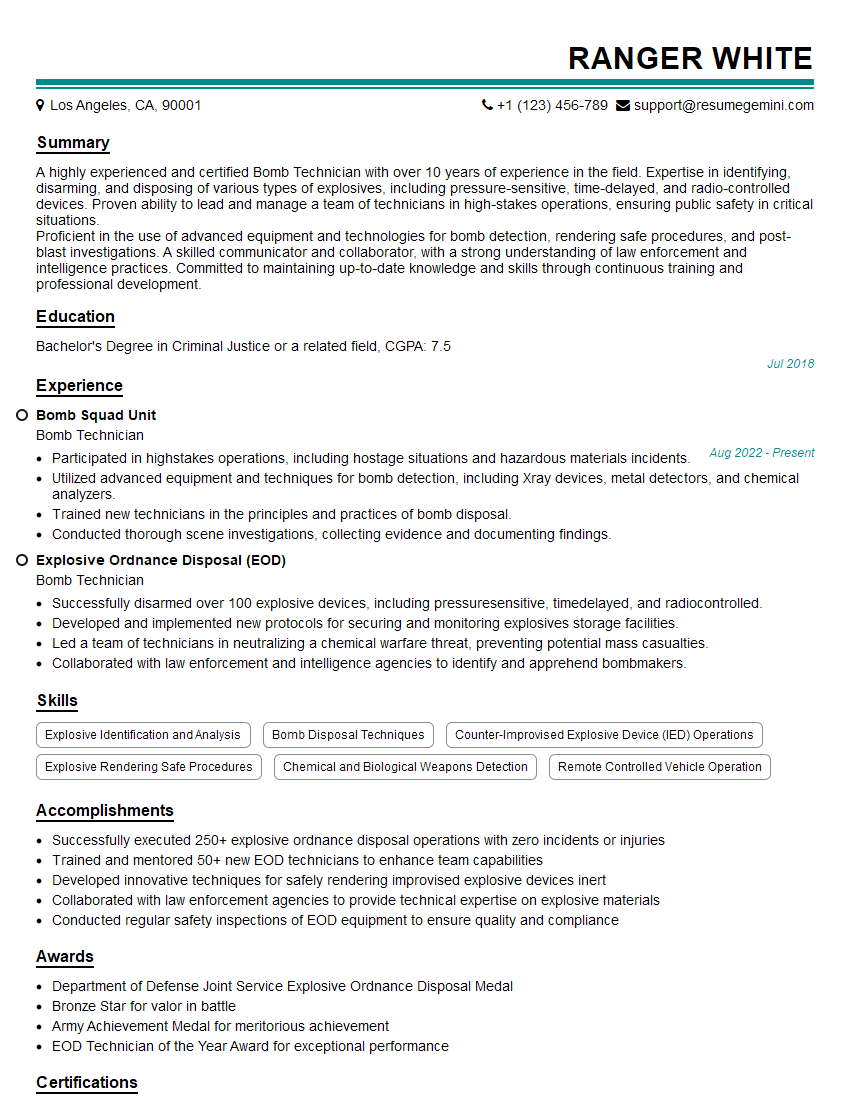
Mastering Explosives and Bomb Disposal opens doors to a rewarding career with significant impact. This specialized field demands meticulous attention to detail, exceptional problem-solving skills, and unwavering commitment to safety. To significantly increase your chances of landing your dream role, creating a strong, ATS-friendly resume is paramount. ResumeGemini is a trusted resource that can help you build a professional resume that highlights your unique skills and experience. Examples of resumes tailored specifically for Explosives and Bomb Disposal professionals are available, providing you with templates to adapt and customize for your own application.

Explore more articles
Users Rating of Our Blogs
Share Your Experience
We value your feedback! Please rate our content and share your thoughts (optional).
What Readers Say About Our Blog
Amazing blog
hello,
Our consultant firm based in the USA and our client are interested in your products.
Could you provide your company brochure and respond from your official email id (if different from the current in use), so i can send you the client’s requirement.
Payment before production.
I await your answer.
Regards,
MrSmith
hello,
Our consultant firm based in the USA and our client are interested in your products.
Could you provide your company brochure and respond from your official email id (if different from the current in use), so i can send you the client’s requirement.
Payment before production.
I await your answer.
Regards,
MrSmith
These apartments are so amazing, posting them online would break the algorithm.
https://bit.ly/Lovely2BedsApartmentHudsonYards
Reach out at BENSON@LONDONFOSTER.COM and let’s get started!
Take a look at this stunning 2-bedroom apartment perfectly situated NYC’s coveted Hudson Yards!
https://bit.ly/Lovely2BedsApartmentHudsonYards
Live Rent Free!
https://bit.ly/LiveRentFREE
Interesting Article, I liked the depth of knowledge you’ve shared.
Helpful, thanks for sharing.
Hi, I represent a social media marketing agency and liked your blog
Hi, I represent an SEO company that specialises in getting you AI citations and higher rankings on Google. I’d like to offer you a 100% free SEO audit for your website. Would you be interested?