Interviews are more than just a Q&A session—they’re a chance to prove your worth. This blog dives into essential Access and Identity Management interview questions and expert tips to help you align your answers with what hiring managers are looking for. Start preparing to shine!
Questions Asked in Access and Identity Management Interview
Q 1. Explain the difference between authentication and authorization.
Authentication verifies who you are, while authorization determines what you’re allowed to do. Think of it like this: authentication is like showing your driver’s license to prove your identity, while authorization is like being granted permission to drive on a specific road. You might be authenticated (you have a valid license), but not authorized to drive on a closed highway.
Authentication focuses on confirming the identity of a user, typically using credentials like usernames and passwords, biometrics (fingerprint, facial recognition), or security tokens. A successful authentication process proves the user is who they claim to be.
Authorization, on the other hand, deals with access control. After authentication, the system checks what resources or actions the authenticated user is permitted to access or perform based on pre-defined policies and roles. For instance, a system administrator might be authenticated and then authorized to access all system configurations, whereas a regular user would only have authorization to access their own data.
Q 2. Describe the concept of least privilege access.
The principle of least privilege access (LPA) dictates that users and processes should only have the necessary permissions required to perform their tasks, and no more. This significantly reduces the potential impact of security breaches. If a malicious actor compromises a user account with excessive privileges, the damage they can inflict is far greater than if that account had only the minimum necessary permissions.
Example: A help desk agent only needs access to reset passwords and view basic user information, not to modify system configurations or access sensitive financial data. Restricting access to only what’s absolutely needed ensures that even if the help desk agent’s account is compromised, the potential for harm is minimized. Implementing LPA often involves granular access control lists (ACLs) and careful role definition.
Q 3. What are the key components of an Identity and Access Management (IAM) system?
A robust Identity and Access Management (IAM) system typically consists of several key components working together:
- Identity Store: A central repository containing information about users, groups, and their attributes (e.g., name, email, department). This can be a directory service like Active Directory or a cloud-based identity provider.
- Authentication Service: Verifies the identity of users attempting to access resources. This might utilize various methods like passwords, multi-factor authentication (MFA), or single sign-on (SSO).
- Authorization Service: Determines what a user is permitted to do after successful authentication, based on predefined policies and roles.
- Access Control Engine: Enforces the authorization decisions made by the authorization service, controlling access to resources based on user permissions.
- Provisioning and Deprovisioning: Automated processes for adding (provisioning) and removing (deprovisioning) user accounts and their associated permissions, ensuring accounts are properly managed throughout their lifecycle.
- Auditing and Monitoring: Logs and tracks all access attempts, successful and unsuccessful, to detect and respond to suspicious activity. This provides an audit trail for compliance and security investigations.
Q 4. Explain different authentication methods (e.g., MFA, SSO, Passwordless).
Several authentication methods exist, each offering varying levels of security:
- Multi-Factor Authentication (MFA): Requires users to provide multiple forms of authentication, such as a password and a one-time code from a mobile app. This adds an extra layer of security, making it much harder for attackers to gain unauthorized access, even if they obtain a password.
- Single Sign-On (SSO): Allows users to access multiple applications with a single set of credentials. This simplifies user experience and improves security by reducing the number of passwords users need to manage. Examples include Okta and Azure Active Directory.
- Passwordless Authentication: Eliminates passwords altogether, replacing them with methods like biometric authentication, one-time passcodes, or security keys. This significantly reduces the risk of password-related breaches, as there are no passwords to steal or crack.
The choice of authentication method depends on the specific security requirements and risk tolerance of an organization. For high-security environments, MFA and passwordless authentication are often preferred.
Q 5. What are some common IAM security risks and how can they be mitigated?
IAM systems face several security risks:
- Credential Stuffing: Attackers use lists of stolen usernames and passwords to attempt to gain access to accounts.
- Phishing: Users are tricked into revealing their credentials through deceptive emails or websites.
- Privilege Escalation: An attacker gains higher privileges than they were originally granted.
- Insider Threats: Malicious or negligent insiders misuse their access privileges.
- Weak or Stolen Credentials: Users choose weak passwords or have their passwords compromised.
Mitigation strategies:
- Implement MFA: Significantly reduces the risk of credential stuffing and phishing attacks.
- Regular Security Awareness Training: Educates users about phishing and other social engineering tactics.
- Strong Password Policies: Enforces the use of complex and unique passwords.
- Principle of Least Privilege: Grants users only the necessary permissions.
- Regular Security Audits: Identify and address vulnerabilities in the IAM system.
- Intrusion Detection and Prevention Systems: Monitor for suspicious activity and block malicious attempts.
Q 6. How does role-based access control (RBAC) work?
Role-Based Access Control (RBAC) is a method of managing access rights based on the roles users belong to within an organization. It simplifies access management by grouping users with similar responsibilities into roles and assigning permissions to those roles rather than to individual users. This improves efficiency and reduces administrative overhead.
Example: An organization might have roles such as ‘Sales Manager,’ ‘Sales Representative,’ and ‘Marketing Manager.’ The ‘Sales Manager’ role might have permissions to access sales reports, manage sales teams, and approve sales deals, while the ‘Sales Representative’ role might only have access to their own sales data. If a user changes roles, their permissions are automatically updated based on the assigned role.
RBAC simplifies administration, improves consistency, and makes it easier to manage changes in user responsibilities. It promotes a more structured and organized approach to access control.
Q 7. What is attribute-based access control (ABAC)?
Attribute-Based Access Control (ABAC) is a fine-grained access control model that goes beyond RBAC by basing access decisions on multiple attributes of users, resources, and the environment. This allows for highly dynamic and context-aware access control.
Example: Imagine a system where access to a sensitive document is granted based on the user’s department, location, time of day, and the classification level of the document. ABAC can evaluate all these attributes to make an access decision. A user in the ‘Finance’ department working from the company office between 9 AM and 5 PM might be authorized to access a ‘Confidential’ document, but not a user in the ‘Marketing’ department accessing the document from home outside of working hours.
ABAC offers greater flexibility and granularity than RBAC, allowing organizations to implement highly customized access control policies that adapt to changing business requirements and security needs.
Q 8. Explain the concept of single sign-on (SSO).
Single Sign-On (SSO) is a session management technique that allows a user to access multiple applications with a single set of credentials. Imagine having to remember a different username and password for every website you visit – that’s a nightmare! SSO solves this by acting as a central authentication point. Once you log in with your SSO credentials, you’re automatically authenticated for all connected applications, eliminating the need to re-enter your login information repeatedly.
There are several SSO protocols, including SAML (Security Assertion Markup Language), OAuth 2.0, and OpenID Connect. SAML is commonly used for enterprise applications, while OAuth 2.0 and OpenID Connect are often favored for web and mobile applications. A typical example is logging into your company’s intranet. After a successful login with your corporate credentials, you can access various internal applications without repeated authentication. This streamlines the user experience and enhances security by reducing the risk of compromised credentials.
Q 9. Describe different types of identity stores.
Identity stores are databases that hold user identities and their associated attributes. There are various types, each with its strengths and weaknesses:
- Local Identity Stores: These are databases residing within individual applications or systems. For example, a database within a specific software application holding user details and access rights only for that application. This approach is simple but leads to fragmentation and management challenges as the number of applications grows.
- Centralized Identity Stores (Directory Services): These are central repositories, like Microsoft Active Directory or OpenLDAP, that manage user identities and their attributes across multiple applications. They offer better management, improved security, and streamlined access control but require careful planning and setup.
- Cloud-Based Identity Stores: Services like Azure Active Directory, AWS IAM, and Google Cloud Identity Platform manage identities in the cloud. They often provide additional features such as multi-factor authentication (MFA) and single sign-on (SSO) capabilities. These offer scalability and flexibility but rely on external connectivity and can add vendor lock-in.
- Federated Identity Stores: These combine elements of centralized and distributed identity management. Users authenticate with their home organization’s identity provider, and that identity is then trusted by other organizations. This approach is ideal for collaborations between businesses or organizations where they may need to access each other’s resources securely.
Choosing the right identity store depends on the organization’s size, security requirements, budget, and technological infrastructure.
Q 10. What are the benefits of using a centralized IAM system?
A centralized Identity and Access Management (IAM) system offers numerous benefits:
- Improved Security: Centralized management enables consistent enforcement of security policies, simplifies password management with features like password complexity rules and password expiration, and enables better monitoring of user activity. This reduces the attack surface compared to scattered local systems.
- Enhanced Productivity: SSO eliminates the hassle of multiple logins, boosting user efficiency. Self-service password resets empower users to quickly regain access, minimizing downtime.
- Reduced Costs: Centralized management reduces administrative overhead by automating many tasks. Streamlined provisioning and de-provisioning of accounts minimize the risks of human error.
- Better Compliance: A centralized system simplifies auditing and reporting for compliance with industry regulations such as GDPR and HIPAA.
- Scalability and Flexibility: A centralized IAM system can easily adapt to the changing needs of an organization, accommodating growth and new applications.
For instance, a large company with many departments and applications would significantly benefit from the improved control, reduced costs, and enhanced security a centralized IAM system offers. It simplifies the management of user access rights and greatly reduces security risks associated with managing scattered and inconsistent access controls.
Q 11. How do you manage privileged access accounts effectively?
Managing privileged accounts—those with elevated access—requires a robust strategy emphasizing the principle of least privilege. These accounts pose a significant security risk if compromised. Effective management includes:
- Least Privilege: Grant only the necessary permissions to each privileged account. Avoid overly broad access rights.
- Separation of Duties: Distribute critical tasks among multiple users, preventing a single person from having excessive control.
- Regular Audits: Frequently review privileged account access rights to ensure they remain appropriate and identify any unnecessary permissions.
- Multi-Factor Authentication (MFA): Implement strong MFA for all privileged accounts, adding an extra layer of security.
- Privileged Access Management (PAM) Solutions: Utilize dedicated PAM solutions that provide features such as session recording, auditing, and control over privileged access to systems and applications. These solutions often involve vaulting credentials and providing secure access through a dedicated interface.
- Just-in-Time (JIT) Access: Grant privileged access only when needed, then revoke it afterwards. This significantly reduces the risk window.
For example, a database administrator should only have access to the database server and not the entire network infrastructure. A strong PAM solution would be employed to manage and audit all access to the database server.
Q 12. What is a security information and event management (SIEM) system, and how does it relate to IAM?
A Security Information and Event Management (SIEM) system is a centralized security monitoring tool that collects and analyzes security logs from various sources, including IAM systems. It helps organizations detect and respond to security threats. A SIEM system correlates events from different sources to identify patterns and potential security breaches.
The relationship between SIEM and IAM is crucial. IAM systems generate valuable security logs that provide context to security events. The SIEM uses these logs to monitor user activity, identify suspicious behavior (e.g., failed login attempts, access to sensitive data outside of normal working hours), and detect potential security violations. By integrating IAM logs into a SIEM system, organizations can get a comprehensive view of their security posture and proactively address potential threats. For instance, a SIEM might alert security personnel if an unusual number of failed login attempts are detected from a particular user account, potentially indicating a brute-force attack.
Q 13. What are the key challenges in implementing an IAM system?
Implementing a robust IAM system presents several challenges:
- Complexity: IAM systems can be complex to design, implement, and manage, requiring specialized skills and knowledge.
- Integration Challenges: Integrating an IAM system with existing applications and systems can be difficult and time-consuming. Legacy systems may not have the necessary APIs or capabilities to easily integrate.
- Cost: Implementing and maintaining an IAM system can be expensive, encompassing software licenses, hardware, professional services, and ongoing maintenance.
- User Adoption: Successfully adopting a new IAM system often requires changing user workflows and behaviors, necessitating effective training and communication strategies.
- Maintaining Up-to-Date Security Policies: Security policies need constant review and updating to address ever-evolving threats and vulnerabilities.
- Data Migration and Consolidation: Migrating and consolidating user data from multiple systems into a central repository can be a complex and error-prone process.
Careful planning, phased rollout, and appropriate training and support are crucial to mitigating these challenges. Starting with a pilot project to validate the chosen approach and gathering user feedback is crucial for a smooth deployment.
Q 14. How do you ensure compliance with relevant regulations (e.g., GDPR, HIPAA) in the context of IAM?
Ensuring compliance with regulations like GDPR and HIPAA in the context of IAM requires a multi-faceted approach:
- Data Minimization: Collect and store only the necessary user data.
- Access Control: Implement granular access controls based on the principle of least privilege to restrict data access only to authorized personnel.
- Data Encryption: Encrypt sensitive data both in transit and at rest.
- Data Retention Policies: Establish clear data retention policies that comply with legal requirements. Regularly purge unnecessary data.
- Consent Management: Obtain explicit consent from users before collecting and processing their personal data. This is especially vital for GDPR compliance.
- Auditing and Logging: Maintain detailed audit trails to track access to sensitive data. This helps in demonstrating compliance to regulators.
- Incident Response Plan: Develop a comprehensive incident response plan to effectively handle data breaches or security incidents.
- Data Subject Access Requests (DSAR): Implement a process to efficiently handle DSARs to allow individuals to access, modify, or delete their personal data.
For example, complying with HIPAA requires meticulous access control to protected health information (PHI) and strict auditing practices. Regularly reviewing and updating access rights, and maintaining detailed audit logs, is vital for demonstrating compliance with the regulation.
Q 15. Explain the importance of identity governance and administration (IGA).
Identity Governance and Administration (IGA) is crucial for securing an organization’s digital assets by managing user access and privileges effectively. Think of it as the central nervous system for your organization’s security posture. It ensures that only authorized individuals have access to the resources they need, and only for as long as they need them. Without IGA, you risk data breaches, compliance violations, and operational inefficiencies.
IGA encompasses several key functions: Provisioning (automatically creating and assigning user accounts), de-provisioning (removing access when an employee leaves or changes roles), access certification (regularly reviewing and approving user access rights), and identity lifecycle management (managing the entire journey of an identity from creation to deletion). A robust IGA program minimizes security risks and ensures regulatory compliance by implementing strong access control policies and providing audit trails.
For example, imagine a scenario where an employee leaves the company. Without IGA, their access might remain active, leaving the organization vulnerable to potential misuse. With IGA, their access is automatically revoked, immediately mitigating the risk.
Career Expert Tips:
- Ace those interviews! Prepare effectively by reviewing the Top 50 Most Common Interview Questions on ResumeGemini.
- Navigate your job search with confidence! Explore a wide range of Career Tips on ResumeGemini. Learn about common challenges and recommendations to overcome them.
- Craft the perfect resume! Master the Art of Resume Writing with ResumeGemini’s guide. Showcase your unique qualifications and achievements effectively.
- Don’t miss out on holiday savings! Build your dream resume with ResumeGemini’s ATS optimized templates.
Q 16. Describe your experience with different IAM solutions (e.g., Okta, Azure AD, AWS IAM).
I have extensive experience with several leading IAM solutions, including Okta, Azure Active Directory (Azure AD), and AWS Identity and Access Management (IAM). My experience spans implementing, configuring, and managing these platforms across various organizational settings.
- Okta: I’ve used Okta to implement single sign-on (SSO) across multiple SaaS applications, simplifying user access and improving security. I’ve also leveraged Okta’s lifecycle management capabilities for automated user provisioning and de-provisioning.
- Azure AD: My work with Azure AD includes managing user identities, group policies, and conditional access policies to enhance security and control access to cloud resources, including Microsoft 365 applications. I’ve also integrated Azure AD with on-premises Active Directory using Azure AD Connect.
- AWS IAM: I’ve used AWS IAM to manage access to AWS services and resources. This includes creating and managing users, groups, roles, and policies to ensure granular control and least privilege access. I’ve also implemented multi-factor authentication (MFA) and other security best practices within the AWS environment.
In each case, I’ve focused on tailoring the solution to meet specific organizational needs, ensuring a balance between security and usability. My approach always considers the organization’s security posture, compliance requirements, and overall business objectives.
Q 17. How do you handle identity lifecycle management?
Identity lifecycle management (ILM) is the process of managing user identities from their creation to their termination. It’s a continuous cycle that involves several key stages.
- Provisioning: Creating new user accounts and assigning initial permissions based on their role and responsibilities. This often involves automation to ensure efficiency and consistency.
- Maintenance: Regularly reviewing and updating user access rights to ensure they remain appropriate. This might involve changing roles, permissions, or access levels based on organizational changes or employee promotions.
- Certification: Periodically reviewing user access to ensure that it’s still justified. This often involves a formal process of attestation and approval.
- Deprovisioning: Removing user accounts and access rights when an employee leaves the company, changes roles, or no longer requires access. This is critical for maintaining security and minimizing risk.
I utilize automated workflows and tools to streamline the ILM process, minimizing manual intervention and reducing the risk of human error. This ensures timely and accurate management of user identities, enhancing security and operational efficiency.
For instance, I implemented a system that automatically de-provisions users upon termination, reducing the risk of former employees retaining access to sensitive data.
Q 18. Explain your understanding of password management best practices.
Password management is paramount in securing access to systems and data. Best practices include:
- Strong Password Policies: Enforce the use of complex passwords with sufficient length, including uppercase and lowercase letters, numbers, and special characters. Regular password changes are also crucial.
- Password Managers: Encourage the use of password managers to store and manage passwords securely. This helps users create and remember strong, unique passwords for each account without compromising security.
- Multi-Factor Authentication (MFA): Implementing MFA adds an extra layer of security by requiring users to provide multiple forms of authentication, such as a password and a one-time code from a mobile app or hardware token.
- Password Expiration and Rotation: Regularly rotate passwords, ensuring that they are changed periodically to minimize the impact of potential breaches. This is particularly important for privileged accounts.
- Account Lockout Policies: Implementing account lockout policies protects accounts from brute-force attacks by temporarily locking accounts after multiple failed login attempts.
- Password Self-Service: Providing a self-service password reset portal empowers users to reset their own passwords without requiring IT support, improving efficiency and user experience.
Ignoring these best practices increases the risk of compromised accounts and data breaches. Therefore, a comprehensive password management strategy is a cornerstone of any strong IAM program.
Q 19. How would you approach auditing and reporting for IAM?
Auditing and reporting are critical components of IAM. They provide insights into access patterns, security events, and compliance status. My approach involves:
- Defining Audit Requirements: Identifying the specific audit requirements based on regulatory compliance mandates and organizational security policies.
- Configuring Audit Logging: Enabling detailed audit logging across all IAM systems and applications to capture relevant events, including login attempts, access requests, and permission changes.
- Centralized Log Management: Aggregating audit logs from various sources into a centralized log management system for efficient analysis and reporting.
- Developing Custom Reports: Creating custom reports to visualize key metrics, identify security trends, and ensure compliance. Examples include reports on user access activity, failed login attempts, and privileged user actions.
- Regular Review and Analysis: Regularly reviewing audit logs and reports to detect anomalies, investigate security incidents, and identify areas for improvement.
These practices provide valuable insights into security posture and facilitate proactive threat mitigation. For instance, identifying unusual login attempts from unusual geographic locations can signal a potential breach and enable timely intervention.
Q 20. Describe your experience with integrating IAM with other security tools.
I have extensive experience integrating IAM with other security tools, such as SIEM (Security Information and Event Management) systems, SOAR (Security Orchestration, Automation, and Response) platforms, and vulnerability scanners. These integrations enhance security posture by providing a holistic view of security events and automating response actions.
For example, I’ve integrated IAM with a SIEM system to correlate IAM events with other security logs, enabling the detection of sophisticated attacks that might otherwise go unnoticed. This integration provides a more comprehensive view of security incidents and facilitates quicker response times.
Another example is integrating IAM with a SOAR platform to automate incident response processes. This automation helps streamline workflows, reducing response times and improving operational efficiency. The integration allows for automated actions, such as account lockdown or de-provisioning, based on security alerts triggered by the SIEM system or other security tools.
Q 21. What are your experiences with different access control models?
I’m familiar with various access control models, each with its strengths and weaknesses. The choice of model depends on the specific security requirements and organizational context.
- Role-Based Access Control (RBAC): This model assigns permissions based on roles or job functions. It’s efficient for managing access in larger organizations where users often share similar responsibilities. For example, all members of the ‘Finance’ role have access to financial systems.
- Attribute-Based Access Control (ABAC): This model grants access based on attributes of the user, resource, or environment. It provides more granular control and flexibility than RBAC. For example, access could be granted based on location, time of day, or device type.
- Rule-Based Access Control (RuleBAC): This model defines access control based on predefined rules that govern access to resources. It’s particularly useful for implementing complex access control policies that cannot be easily managed using RBAC or ABAC.
- Mandatory Access Control (MAC): This model, often used in highly secure environments, assigns security labels to both users and data. Access is granted only if the user’s security clearance is sufficient for the data’s classification. It’s primarily used in governmental and defense sectors.
I’ve implemented and managed different access control models in diverse settings, selecting the most appropriate model based on the specific needs of the organization and the sensitivity of the data involved. The selection process carefully considers factors like scalability, manageability, and the level of granularity needed for access control.
Q 22. Explain your understanding of directory services.
Directory services are the central nervous system of any organization’s IT infrastructure. Think of them as a sophisticated phone book, but instead of listing names and numbers, they store information about every object in your network – users, computers, printers, applications, and more. This information includes attributes like usernames, passwords, group memberships, and access rights. Popular examples include Microsoft Active Directory, OpenLDAP, and cloud-based services like AWS Directory Service.
These services provide a single source of truth for identity and access management, streamlining user management and simplifying the process of granting and revoking access to resources. Imagine trying to manage access to hundreds of servers individually; a directory service makes this task manageable and scalable. Key features include authentication, authorization, and access control, ensuring that only authorized users can access authorized resources.
- Authentication: Verifying the identity of a user or device.
- Authorization: Determining what a user or device is allowed to access.
- Access Control: Enforcing the authorization policies.
Q 23. How do you address issues related to account provisioning and de-provisioning?
Account provisioning and de-provisioning are crucial for maintaining security and efficiency. Provisioning refers to the process of creating and configuring new user accounts, assigning them necessary permissions and access rights. De-provisioning is the opposite – removing accounts and associated privileges when an employee leaves or their role changes.
I address these issues by implementing automated processes using scripting or dedicated IAM tools. Manual processes are error-prone and time-consuming. Automation ensures consistency and minimizes security risks associated with lingering access. For example, I’ve implemented scripts that automatically create user accounts upon onboarding, assign them to appropriate Active Directory groups based on their role, and automatically delete accounts when an employee departs, simultaneously removing their access to all relevant systems and applications. This is often integrated with HR systems for seamless synchronization.
Furthermore, I employ robust access review processes, regularly auditing accounts to identify inactive or unnecessary accounts. This reduces the attack surface and improves compliance with industry regulations.
Q 24. Describe your experience with vulnerability assessments related to IAM.
Vulnerability assessments are essential for identifying weaknesses in the IAM infrastructure. I have extensive experience performing these assessments using a combination of automated tools and manual reviews. Automated tools scan for known vulnerabilities, such as weak passwords, default credentials, and insecure configurations. Manual reviews involve examining the IAM configuration for potential misconfigurations or loopholes that automated tools might miss.
For example, I’ve used tools like Nessus and OpenVAS to scan for common IAM vulnerabilities. I’ve also conducted manual reviews of access control lists (ACLs) to ensure the principle of least privilege is being followed – users only have access to the resources necessary for their jobs. This helps identify potential privilege escalation vulnerabilities. Findings are documented, prioritized based on severity, and remediation plans are developed and implemented.
Beyond technical vulnerabilities, I also assess the organization’s IAM policies and procedures for potential weaknesses. This includes reviewing access request processes, password policies, and account lifecycle management processes.
Q 25. What are the key considerations when designing an IAM architecture?
Designing a robust IAM architecture requires careful consideration of several key factors. It’s not just about choosing the right tools; it’s about building a system that aligns with your organization’s specific needs and security posture.
- Scalability: The architecture should be able to handle growth without compromising performance or security.
- Security: Implementing strong authentication, authorization, and access control mechanisms is paramount. This often involves multi-factor authentication (MFA) and regular security audits.
- Compliance: The architecture must meet relevant regulatory requirements, such as HIPAA, PCI DSS, or GDPR.
- Integration: The system should integrate seamlessly with existing systems and applications to avoid creating silos.
- Usability: The system should be easy for users to access and manage their accounts.
- Maintainability: The architecture should be designed for ease of maintenance and updates.
A well-designed IAM architecture utilizes a layered approach, employing different tools and techniques for authentication, authorization, and auditing. This allows for flexibility and scalability while ensuring robust security.
Q 26. How do you stay up-to-date with the latest IAM technologies and best practices?
Staying current in the dynamic world of IAM is critical. I actively engage in several strategies to maintain my expertise:
- Industry Conferences and Webinars: Attending conferences such as RSA Conference and Black Hat, and participating in webinars offered by vendors and industry experts keeps me abreast of emerging threats and best practices.
- Professional Certifications: Pursuing certifications like CISSP, CISM, or AWS Certified Security – Specialty (IAM) demonstrates commitment to ongoing professional development and validates my knowledge.
- Online Courses and Training: Platforms like Coursera, Udemy, and vendor-specific training programs offer in-depth knowledge on new technologies and techniques.
- Industry Publications and Blogs: Regularly reading publications and blogs from trusted sources, such as SANS Institute and security blogs, provides insights into current trends and emerging threats.
- Community Engagement: Participating in online forums and communities, such as those on Reddit and LinkedIn, allows for knowledge sharing and discussion of best practices.
Q 27. Explain your experience with automating IAM processes.
Automation is the cornerstone of efficient and secure IAM. I have extensive experience automating various IAM processes using scripting languages like Python and PowerShell, along with tools like Ansible and Terraform. For instance, I’ve automated user account provisioning and de-provisioning using scripts that integrate with HR systems and Active Directory. This ensures that accounts are created and deleted automatically based on employee lifecycle events.
I’ve also automated password reset processes, implementing self-service password reset portals and integrating them with multi-factor authentication for enhanced security. Furthermore, I’ve automated the generation of access review reports, using scripting to extract data from Active Directory and present it in an easily consumable format for auditors. This saves considerable time and effort, allowing for more frequent reviews and improved security posture.
Automating these processes not only saves time and resources, but also significantly reduces human error, a major source of security vulnerabilities in IAM.
Q 28. Describe a time you had to troubleshoot a complex IAM issue.
One challenging scenario involved a critical application that unexpectedly went offline due to an IAM-related issue. Users reported they were suddenly unable to access the application, causing significant disruption. Initial investigation pointed to a potential issue with group memberships in Active Directory.
My troubleshooting steps involved:
- Verification: First, I verified the issue wasn’t caused by a network outage or application malfunction by checking server logs and network connectivity.
- Log Analysis: I then analyzed the Active Directory logs to pinpoint the exact time of the failure and identify any relevant events. This revealed a recent script error that had unintentionally removed a critical group from the application’s access control list.
- Remediation: I immediately restored the group membership using Active Directory commands and confirmed application accessibility. A new script was implemented to minimize potential errors.
- Root Cause Analysis: I performed a thorough review of the script that caused the problem, identifying the flaws and implementing stricter error handling and testing procedures to prevent recurrence.
- Documentation and Communication: I thoroughly documented the incident, including the root cause, resolution steps, and preventative measures, and communicated the resolution and remediation steps to stakeholders. A post-incident review was also conducted to improve our processes.
This incident highlighted the importance of robust logging, comprehensive testing, and thorough documentation in preventing and resolving IAM-related issues.
Key Topics to Learn for Access and Identity Management Interview
- Identity and Access Management (IAM) Fundamentals: Understand the core principles of IAM, including authentication, authorization, and accounting (AAA). Explore different IAM models and architectures.
- Directory Services: Gain proficiency in using and managing directory services like Active Directory, LDAP, or cloud-based directories. Understand concepts like user management, group policies, and delegation.
- Access Control Models: Become familiar with various access control models such as Role-Based Access Control (RBAC), Attribute-Based Access Control (ABAC), and Discretionary Access Control (DAC). Understand their strengths and weaknesses.
- Authentication Mechanisms: Explore different authentication methods, including password-based authentication, multi-factor authentication (MFA), single sign-on (SSO), and biometric authentication. Understand their security implications.
- Authorization and Privilege Management: Learn how to effectively manage user privileges and permissions to ensure least privilege access. Understand the importance of regular access reviews and audits.
- Security and Compliance: Understand relevant security standards and compliance regulations (e.g., HIPAA, GDPR, SOC 2) related to IAM and data protection.
- Cloud IAM Services: Familiarize yourself with cloud-based IAM services offered by major providers like AWS (IAM), Azure (Azure AD), and Google Cloud (Cloud IAM). Understand their features and how they differ.
- Practical Application: Consider real-world scenarios like implementing MFA, designing an RBAC model for a specific application, or troubleshooting authentication issues. Practice explaining your problem-solving approach.
- Troubleshooting and Problem Solving: Develop your skills in diagnosing and resolving common IAM challenges, such as password resets, account lockouts, and access control issues. Focus on systematic troubleshooting methodologies.
Next Steps
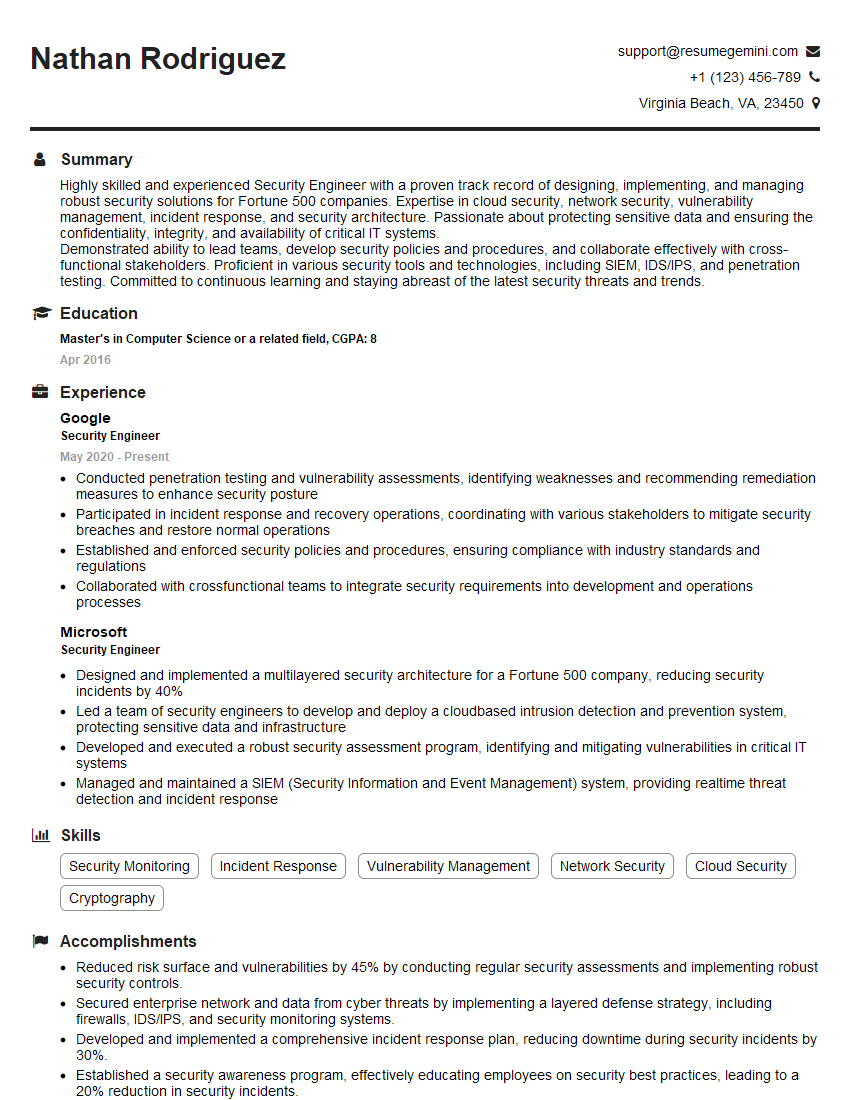
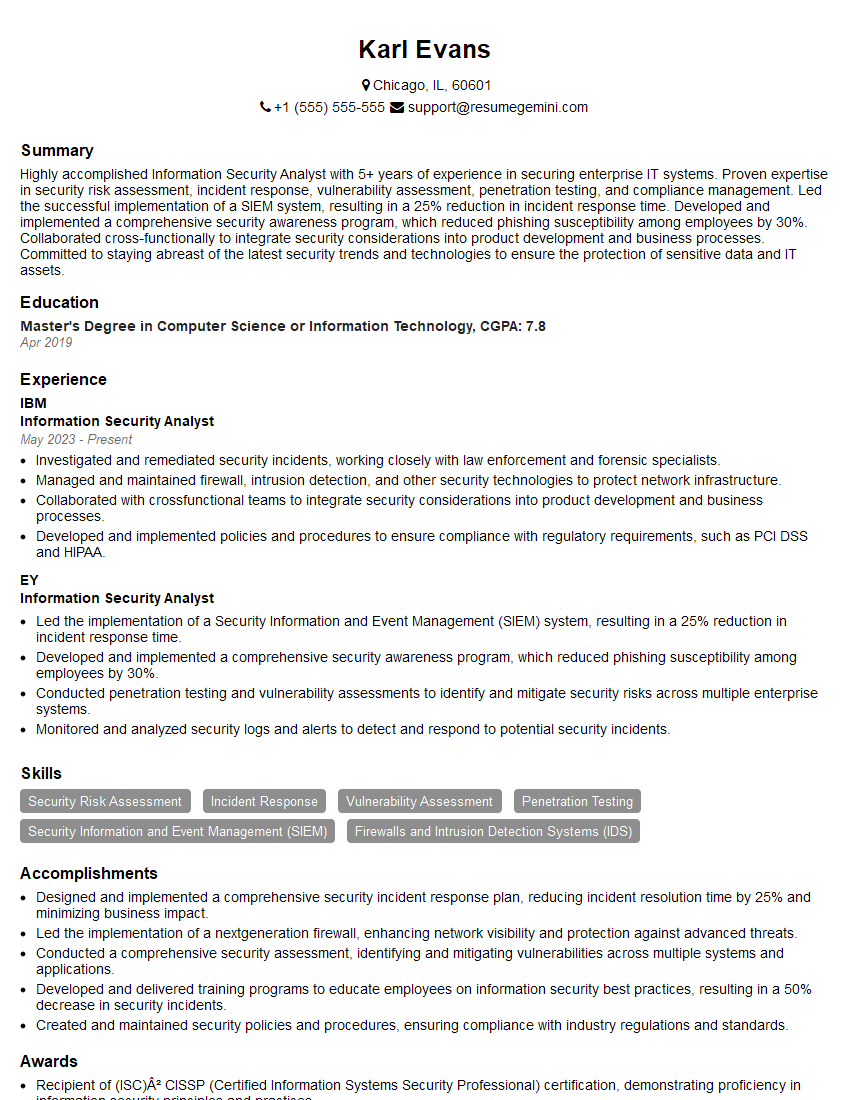
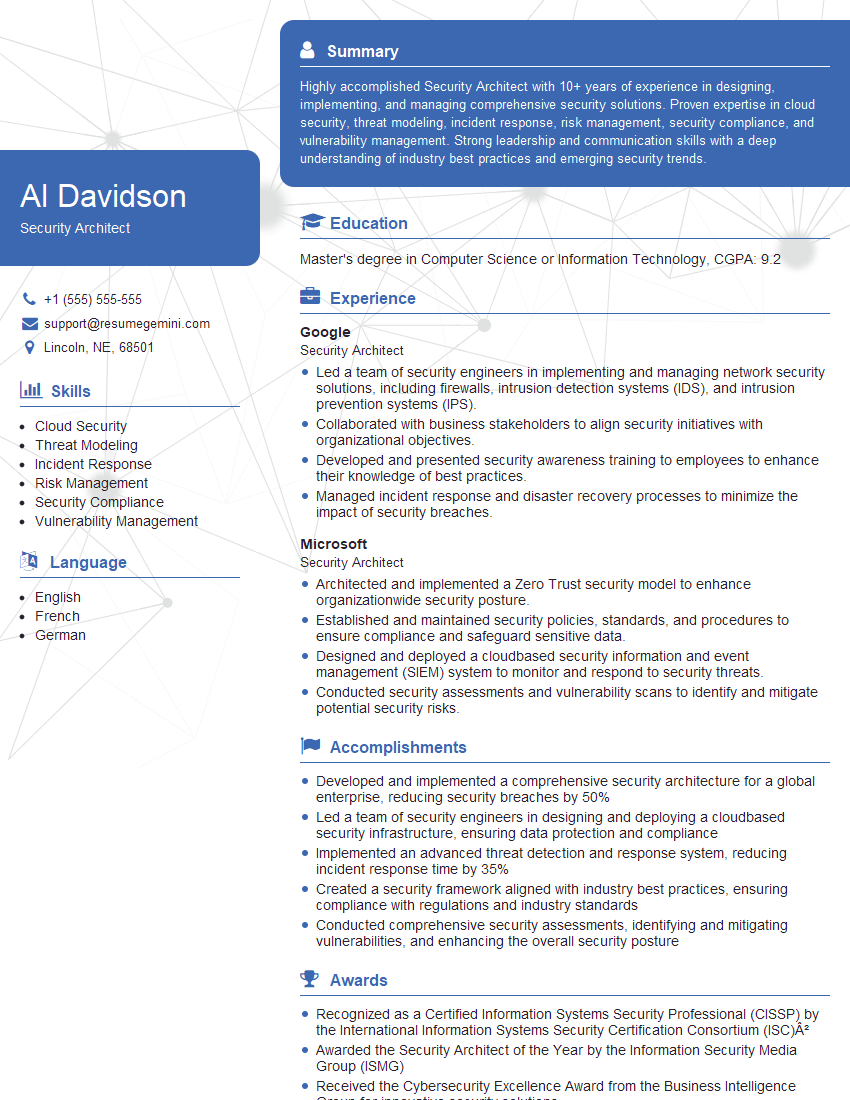
Mastering Access and Identity Management opens doors to exciting career opportunities in a rapidly growing field, offering high demand and excellent compensation. To maximize your job prospects, create a compelling and ATS-friendly resume that showcases your skills and experience effectively. ResumeGemini is a trusted resource to help you build a professional resume that stands out. They provide examples of resumes tailored to Access and Identity Management, ensuring your application makes a strong impression. Take the next step towards your dream job today!
Explore more articles
Users Rating of Our Blogs
Share Your Experience
We value your feedback! Please rate our content and share your thoughts (optional).
What Readers Say About Our Blog
Amazing blog
hello,
Our consultant firm based in the USA and our client are interested in your products.
Could you provide your company brochure and respond from your official email id (if different from the current in use), so i can send you the client’s requirement.
Payment before production.
I await your answer.
Regards,
MrSmith
hello,
Our consultant firm based in the USA and our client are interested in your products.
Could you provide your company brochure and respond from your official email id (if different from the current in use), so i can send you the client’s requirement.
Payment before production.
I await your answer.
Regards,
MrSmith
These apartments are so amazing, posting them online would break the algorithm.
https://bit.ly/Lovely2BedsApartmentHudsonYards
Reach out at BENSON@LONDONFOSTER.COM and let’s get started!
Take a look at this stunning 2-bedroom apartment perfectly situated NYC’s coveted Hudson Yards!
https://bit.ly/Lovely2BedsApartmentHudsonYards
Live Rent Free!
https://bit.ly/LiveRentFREE
Interesting Article, I liked the depth of knowledge you’ve shared.
Helpful, thanks for sharing.
Hi, I represent a social media marketing agency and liked your blog
Hi, I represent an SEO company that specialises in getting you AI citations and higher rankings on Google. I’d like to offer you a 100% free SEO audit for your website. Would you be interested?