The thought of an interview can be nerve-wracking, but the right preparation can make all the difference. Explore this comprehensive guide to Audio Equipment Maintenance interview questions and gain the confidence you need to showcase your abilities and secure the role.
Questions Asked in Audio Equipment Maintenance Interview
Q 1. Describe your experience troubleshooting faulty audio mixers.
Troubleshooting faulty audio mixers involves a systematic approach. I start by visually inspecting the mixer for any obvious issues like loose connections, damaged components, or signs of liquid damage. Then, I move to a functional check, systematically testing each channel, input, and output. This often includes using a known good signal source and monitoring the output with a known good device.
For example, if a specific channel isn’t working, I’ll check the channel’s input gain, the fader, the EQ settings, and the aux sends. If the problem persists, I’ll use a multimeter to test the signal path for continuity and voltage, isolating the faulty component. I also check the power supply and internal connections. Frequently, problems stem from simple issues like a blown fuse or a bad potentiometer. However, more complex issues might require component-level repair, which often involves soldering and replacing faulty integrated circuits (ICs) or other components. In those cases, having a schematic diagram of the mixer is crucial. I’ve successfully diagnosed and repaired issues ranging from simple gain problems to complex routing malfunctions in a variety of mixer brands and models, from small analog mixers to larger digital consoles.
Q 2. Explain the process of calibrating a microphone.
Microphone calibration ensures accurate signal reproduction. The process depends on the type of microphone and intended application. For most dynamic microphones, calibration isn’t strictly necessary as they are generally designed to operate without significant variations. However, condenser microphones, often more sensitive, might require calibration for optimal performance. This often involves adjusting the input gain on the preamplifier or interface to achieve the desired signal level without clipping or excessive noise.
The process generally involves connecting the microphone to a calibrated sound level meter (SLM) and an audio interface. You then generate a known sound level (e.g., using a calibrated sound source like a tone generator) and adjust the input gain on the interface until the SLM reads the expected level. You’d repeat this across different frequencies to ensure consistent response. Sophisticated calibration procedures might require specialized software and equipment to account for frequency response variations. This is vital in professional settings such as broadcasting and recording studios to achieve consistent and reliable sound reproduction.
Q 3. How do you diagnose and repair a malfunctioning amplifier?
Diagnosing a malfunctioning amplifier begins with a safety check – ensuring the power is off. I then inspect the amplifier visually for obvious damage. Next, I test the power supply using a multimeter, checking for correct voltage and current. I systematically test all input and output stages, using a signal generator and oscilloscope to identify where the problem lies. I’ll look for issues like blown fuses, faulty transistors, damaged capacitors, or problems in the feedback loop.
For example, if there’s no output, I’ll check the power supply, then the input stage for signal presence, and finally, the output stage for any sign of operation. If I detect a problem in the output stage, I might need to replace transistors or other components. If the problem lies in the power supply, it could involve replacing faulty capacitors or rectifiers. The complexity of repair depends on the amplifier’s design and the specific fault. I’ve repaired various amplifier types including solid-state, tube, and class-D, employing techniques like soldering, component replacement, and PCB repair. Thorough knowledge of electronics is essential for this task.
Q 4. What are the common causes of speaker distortion?
Speaker distortion is an unwelcome artifact resulting in an unpleasant, unnatural sound. Several factors contribute to it. Overdriving the speaker (playing audio at a volume exceeding its capacity) is a common culprit. This forces the speaker cone to move beyond its linear range, resulting in harmonic distortion (the addition of unwanted frequencies).
Other causes include clipping (a sudden cutoff of the waveform due to exceeding the amplifier’s output limits), which is often heard as a harsh, grating sound. Faulty or damaged components within the speaker itself, such as a damaged voice coil or a torn cone, can also cause distortion. In some cases, environmental factors like excessive heat or moisture can negatively impact the speaker’s performance, leading to distortion. In a PA system, improper impedance matching between the amplifier and speakers can also result in distortion and damage. Identifying the root cause involves testing various aspects of the system, from the audio source to the speakers themselves.
Q 5. How do you maintain and clean audio equipment to prevent damage?
Maintaining and cleaning audio equipment is crucial for longevity and optimal performance. Regular dusting with a soft brush or compressed air removes dust and debris that can accumulate on delicate components. For more thorough cleaning, I might use specialized cleaning solutions and swabs for sensitive parts like potentiometers and faders. Remember to always disconnect the equipment from the power source before cleaning!
For sensitive components, isopropyl alcohol (IPA) is generally safe, but always test a small, inconspicuous area first. Avoid excessive moisture. Proper storage is also vital, keeping equipment in a cool, dry place away from direct sunlight and excessive heat. Regular inspections can help identify potential issues early on, such as loose connections or corroded contacts. Using appropriate carrying cases and protective covers when transporting equipment protects them from physical damage. Following these practices significantly reduces the risk of costly repairs and maximizes the lifespan of equipment. I find this preventative maintenance is far more efficient than reacting to problems.
Q 6. Explain your experience with different types of audio cables and connectors.
My experience encompasses a wide range of audio cables and connectors, including XLR, TRS (1/4 inch), RCA, and USB. XLR connectors are primarily used for balanced audio signals, providing excellent noise rejection, ideal for microphones and professional audio equipment. TRS connectors are used for both balanced and unbalanced audio, commonly found in instruments and audio interfaces. RCA connectors, unbalanced, are prevalent in consumer electronics and home audio systems. USB is commonly used for digital audio transmission, offering both power and data capabilities.
I understand the importance of choosing the right cable for the application, considering factors like cable length, gauge (thickness), and shielding to minimize signal loss and interference. I can identify issues like damaged connectors, short circuits, and poor shielding in cables, and know how to properly terminate cables to ensure optimal signal integrity. Experience shows that a seemingly minor cable problem can create major issues, leading to signal degradation, hum, and other audio problems. Proper cable management is essential for a clean setup and prevents unwanted noise.
Q 7. Describe your experience with digital audio workstations (DAWs).
My experience with Digital Audio Workstations (DAWs) extends to various popular software options, including Pro Tools, Logic Pro X, Ableton Live, and Cubase. I’m proficient in recording, editing, mixing, and mastering audio using these platforms. This includes tasks like track routing, EQing, compression, reverb, delay, and other effects processing. I’m familiar with MIDI editing, virtual instruments, and plugin management. I can set up and troubleshoot DAW-related issues like latency, buffer underruns, and plugin conflicts.
For instance, I can efficiently set up a complex recording session, manage large numbers of audio tracks, and solve common problems such as audio dropouts or system crashes. DAW familiarity is vital for modern audio production. My ability to diagnose and resolve technical issues within the DAW environment enhances my overall problem-solving skills. I’ve utilized DAWs in various professional contexts, from music production and post-production audio for film to sound design and audio for video games.
Q 8. How familiar are you with different audio signal processing techniques?
My familiarity with audio signal processing techniques is extensive. I’m proficient in various methods, from basic amplification and attenuation to more complex techniques like equalization, compression, limiting, reverb, delay, and dynamic processing. Understanding these techniques is crucial for shaping the audio signal to achieve the desired sonic characteristics.
- Equalization (EQ): Adjusting the balance of frequencies to correct tonal imbalances or sculpt the sound. For example, boosting the bass frequencies in a recording to make it sound warmer or cutting harsh high frequencies to reduce sibilance.
- Compression: Reducing the dynamic range of a signal, making quieter parts louder and louder parts quieter. This is commonly used to make vocals more present in a mix or to control the peaks of instruments.
- Reverb and Delay: Adding artificial reverberation or delay to create spatial depth and interest. A simple example is adding a short delay to a guitar part to create a rhythmic feel.
- Dynamic Processing: Using tools like gates, expanders, and de-essers to control the dynamics of a signal, like removing background noise or taming harsh consonants.
I understand the interplay between these techniques and how they can be used creatively and effectively to enhance audio quality and achieve specific artistic goals.
Q 9. How do you troubleshoot audio signal routing issues?
Troubleshooting audio signal routing issues involves a systematic approach. It’s like detective work! First, I’d visually inspect all cables and connections, ensuring they are securely plugged in and undamaged. Then, I’d systematically trace the signal path, from the source to the output, using signal meters or test tones. I’ll work backwards from the point where the issue manifests.
- Identify the problem: Pinpoint precisely where the signal is missing or distorted.
- Isolate the section: Determine which part of the system (e.g., mixer, amplifier, cables) is causing the problem.
- Test individual components: By substituting known good equipment, I can narrow down to a faulty component.
- Check signal levels: Use a multimeter or signal level meters to ensure signal levels aren’t too high (clipping) or too low (weak signal). I’d also check for impedance mismatches which can cause attenuation.
- Inspect cabling: Look for breaks, shorts, or poor connections in the cables.
For example, if a microphone isn’t working, I would check the microphone cable, the microphone itself, the mixer channel, and the output from the mixer. Using a test tone, I can trace whether the signal is getting through each stage of the system.
Q 10. What are the safety precautions you take when working with audio equipment?
Safety is paramount! When working with audio equipment, I always prioritize safety by following these precautions:
- Power Down Before Working: Always unplug equipment from the power source before making any internal repairs or adjustments. This prevents electric shocks.
- Grounding: Ensure equipment is properly grounded to prevent electrical hazards and hum. Static electricity can also damage components, so I take the necessary precautions to avoid static buildup.
- Proper Lifting Techniques: Heavier equipment requires careful lifting and maneuvering to avoid injury.
- Hearing Protection: I consistently use hearing protection when working in environments with high sound levels to protect against noise-induced hearing loss (NIHL).
- Cable Management: Proper cable management prevents tripping hazards and keeps things organized.
- Emergency Procedures: I’m familiar with emergency procedures, including how to respond to electrical shocks or equipment malfunctions.
Once, I was working on a large sound system at a festival, and a power surge caused a short circuit. Luckily, my emphasis on proper grounding and power management prevented serious damage and injury.
Q 11. Describe your experience with preventative maintenance on audio systems.
Preventative maintenance is key to the longevity and reliability of audio systems. My approach includes regular inspections and cleaning, which helps identify potential issues before they become major problems.
- Visual Inspections: Checking for loose connections, frayed cables, or damaged components.
- Cleaning: Regularly cleaning equipment with appropriate cleaning agents. Dust accumulation can cause overheating and malfunctions.
- Calibration: Calibrating audio equipment, like mixing consoles and equalizers, ensures consistent performance and accurate measurements.
- Software Updates: Keeping firmware and software updated on digital audio equipment is important to fix bugs, improve performance, and add new features.
- Component Testing: Periodically testing components and replacing any worn or failing parts.
For example, I’ve implemented a preventative maintenance schedule for a corporate event space that involves weekly inspections, monthly cleaning and testing, and yearly professional servicing. This approach reduces costly repairs and downtime.
Q 12. How do you handle emergency repairs during a live event?
During a live event, emergency repairs require quick thinking and decisive action. My priority is minimizing disruption to the performance.
- Assess the Situation: Quickly determine the nature and extent of the problem. Is it a minor issue or a major system failure?
- Isolate the Problem: Identify the faulty component or connection as quickly as possible.
- Implement a Temporary Fix: If possible, I’ll implement a temporary workaround. This could involve swapping out a faulty cable, switching to a backup component, or adjusting settings.
- Communicate Effectively: Maintain clear communication with the event staff and performers about the situation and the expected resolution time.
- Document Everything: Following the emergency fix, I’ll meticulously document what occurred, what steps were taken, and any necessary repairs for the future.
I once encountered a blown amplifier during a concert. Having a backup amplifier readily available and prepared enabled me to quickly switch and minimize the interruption, ensuring the show went on with minimal fuss.
Q 13. Explain your understanding of impedance matching in audio systems.
Impedance matching is crucial in audio systems for efficient power transfer and optimal signal quality. Impedance is the opposition to the flow of electrical current, measured in ohms (Ω). A mismatch between the output impedance of a source (like an amplifier) and the input impedance of a load (like a speaker) can result in signal loss, distortion, and even damage to equipment.
Think of it like trying to fit a square peg into a round hole. The proper matching ensures maximum signal transfer. The general rule is for the impedance of the load (speaker, for example) to be considerably higher than the output impedance of the source (amplifier). For example, an amplifier with an 8-ohm output impedance would ideally connect to an 8-ohm speaker or higher. Significant mismatches lead to significant power loss. In many professional audio applications, using transformers helps optimize impedance matching.
Q 14. How do you identify and address feedback issues in a sound system?
Feedback in a sound system, that dreaded screech or howl, is caused by a positive feedback loop where the amplified sound is picked up by a microphone and re-amplified, creating a continuous cycle of increasing volume.
Identifying and addressing feedback requires a methodical approach:
- Identify the Frequency: The feedback usually occurs at a specific frequency. Using an equalizer, I’ll locate the offending frequency and reduce the gain at that frequency to reduce or eliminate the feedback.
- Microphone Placement: Carefully adjust microphone positions. Feedback is often caused by microphones being too close to speakers or pointing directly at them. Consider using directional microphones to reduce unwanted sounds.
- Speaker Placement: Monitor placement is also important. Adjusting speaker angles or positions can greatly reduce feedback.
- Gain Staging: Proper gain staging, ensuring appropriate signal levels throughout the system, is crucial. Avoid setting levels too high, as this increases the likelihood of feedback.
- EQ: As mentioned above, the use of an equalizer (EQ) to reduce gain at specific frequencies can cut down the feedback.
- Feedback Suppressors: Some advanced sound systems use specialized feedback suppression technology that automatically identifies and reduces feedback in real-time.
Often a combination of these techniques is required to effectively eliminate feedback. I’ve found a systematic process of elimination and careful adjustment using the equalizer and positioning of the microphone and speakers to be the most effective method.
Q 15. What are your preferred methods for testing audio equipment functionality?
Testing audio equipment functionality involves a systematic approach combining visual inspection, signal tracing, and specialized measurements. I begin with a visual check for any obvious damage, loose connections, or signs of overheating. Then, I use a combination of test signals – such as sine waves, pink noise, and square waves – injected at various points in the signal chain. This allows me to identify any frequency response issues, distortion, or signal degradation. For example, injecting a sine wave at different frequencies into a mixer allows me to pinpoint precisely where a potential problem with high frequencies might exist. Finally, I utilize specialized test equipment like oscilloscopes and audio analyzers to perform precise measurements of signal levels, impedance, and other crucial parameters. This ensures a comprehensive evaluation of the audio equipment’s performance and identifies potential issues before they become major problems.
In addition to these methods, I also employ listening tests to assess the subjective audio quality. This subjective analysis is crucial for identifying subtle problems such as phase cancellation or unwanted coloration that might not be detected through purely objective measurements. Think of it like a sommelier tasting wine; objective measurements tell you the alcohol content and acidity but the tasting tells you if it’s balanced and enjoyable.
Career Expert Tips:
- Ace those interviews! Prepare effectively by reviewing the Top 50 Most Common Interview Questions on ResumeGemini.
- Navigate your job search with confidence! Explore a wide range of Career Tips on ResumeGemini. Learn about common challenges and recommendations to overcome them.
- Craft the perfect resume! Master the Art of Resume Writing with ResumeGemini’s guide. Showcase your unique qualifications and achievements effectively.
- Don’t miss out on holiday savings! Build your dream resume with ResumeGemini’s ATS optimized templates.
Q 16. What software and tools are you proficient in for audio maintenance?
My software proficiency includes digital audio workstations (DAWs) such as Pro Tools, Logic Pro X, and Ableton Live. These are indispensable for analyzing audio signals, applying various signal processing techniques, and performing precise audio edits. I’m also adept at using audio analysis software, including Smaart, Room EQ Wizard (REW), and SoundCheck, for detailed measurements and system optimization. For hardware diagnostics and repair, I use specialized tools such as multimeters, oscilloscopes, signal generators, and spectrum analyzers. I’m proficient in soldering and possess a comprehensive understanding of electronic circuit boards, allowing me to effectively troubleshoot and repair electronic components. For example, using Smaart allows me to accurately identify and correct acoustic issues in a live sound reinforcement system.
Q 17. Describe your experience working with different types of audio transducers.
My experience encompasses a wide range of audio transducers, including dynamic, ribbon, condenser, and electret microphones; various loudspeaker designs (cone, horn, electrostatic); and headphones (dynamic, planar magnetic, electrostatic). I understand the unique characteristics of each transducer type, their operational principles, and their respective strengths and weaknesses. For example, I know that condenser microphones offer high sensitivity and detail but are more fragile than dynamic microphones. Similarly, I’m familiar with the different impedance matching requirements for different transducers and their impact on audio signal quality. This understanding enables me to select the appropriate transducer for a given application and to effectively troubleshoot problems related to their performance. Troubleshooting a failing loudspeaker, for instance, involves checking the voice coil, the surround, the cone, and also examining the crossover network.
Q 18. How familiar are you with different audio compression techniques?
I’m highly familiar with various audio compression techniques, including dynamic range compression, limiting, and multiband compression. I understand the applications and limitations of each technique and how they affect the perceived loudness, dynamics, and overall sound quality of audio signals. Dynamic range compression is often used to increase the apparent loudness of music, especially in broadcast and mastering, by reducing the difference between the loudest and quietest parts. Multiband compression is more advanced and allows independent compression of different frequency ranges. Understanding these techniques enables me to select the appropriate compression method for different situations, for example, to subtly control dynamics in a voice recording versus aggressively compressing a drum track for a more powerful impact. I also understand how to avoid over-compression, which can result in a loss of natural dynamics and an artificial, “pumping” effect.
Q 19. What is your experience with analog versus digital audio equipment?
I have extensive experience with both analog and digital audio equipment and appreciate the strengths and limitations of each. Analog equipment, with its tubes and transformers, often delivers a warm, rich sound, but it can be prone to noise and distortion. Digital audio offers superior signal-to-noise ratio, flexibility, and precision, but can sometimes sound less “organic” or “musical”. I have worked with vintage analog mixing consoles, tape machines, and other analog gear, and I know how to properly maintain and troubleshoot these delicate pieces of equipment. I am just as comfortable working with modern digital audio interfaces, digital mixing consoles, and digital signal processors (DSPs). In many professional setups, a hybrid approach—combining the best qualities of both analog and digital—is commonly utilized.
Q 20. Describe your experience with audio system design and installation.
I have significant experience in audio system design and installation, ranging from small home theaters to large-scale professional studios and live sound reinforcement systems. My process begins with a thorough understanding of the client’s needs and the acoustic properties of the space. This includes taking acoustic measurements and creating system design proposals that incorporate the right selection of audio equipment, including speakers, amplifiers, mixers, signal processing units, and cabling. The goal is to ensure optimal sound quality, appropriate loudness, and coverage within the environment. During installation, I meticulously follow industry best practices regarding grounding, cable management, and safety procedures. After installation, I perform a comprehensive system calibration and tuning to optimize the system’s performance. A successful installation is one that is nearly invisible to the end-user: they only experience the quality sound that is designed to match their specific use case.
Q 21. How do you manage multiple audio inputs and outputs effectively?
Effectively managing multiple audio inputs and outputs requires a deep understanding of signal flow and routing. I use a combination of hardware and software techniques to achieve this. In the hardware realm, this often involves using a mixing console or a digital audio interface with multiple inputs and outputs. These devices allow me to route audio signals between different sources and destinations with precision and flexibility. In software, DAWs offer similar routing capabilities. I can also use signal processors such as matrix mixers or routers to manage complex audio configurations, especially in large-scale systems. I meticulously plan and label all connections, use appropriate cabling, and implement clear and consistent naming conventions for audio channels. This not only helps in setting up the system but also significantly simplifies troubleshooting and maintenance. Clear documentation is also a critical part of efficient management; without it, even simple modifications can become very difficult.
Q 22. What is your experience with audio network protocols?
My experience with audio network protocols is extensive, encompassing both Dante and AES67. Dante, a proprietary protocol, is known for its robustness and low latency, making it ideal for professional live sound and studio applications. I’ve worked extensively with Dante-enabled devices, troubleshooting network issues such as clock synchronization problems and configuring redundant network setups to ensure system reliability. AES67, on the other hand, is an open standard that offers interoperability between different manufacturers’ equipment. I understand the complexities of configuring AES67 networks, including managing different sample rates and clocking strategies. My experience includes setting up and maintaining large-scale audio networks for both fixed installations and live events, ensuring seamless audio transmission across multiple devices and locations. For instance, I once resolved a critical latency issue in a large-scale theatre installation by meticulously examining the Dante network configuration, identifying a bottleneck in the network switch, and implementing a solution involving a higher-capacity switch and optimized network routing.
Q 23. Explain your understanding of audio signal flow in a typical studio setup.
In a typical recording studio, the audio signal flow usually begins with the sound source—a microphone, instrument, or digital audio workstation (DAW). The signal then travels through a preamplifier, which boosts the signal level and shapes its impedance. Next, it might pass through an equalizer to adjust the frequency balance, a compressor to control dynamic range, and possibly other effects processors like reverb or delay. From there, the processed signal is sent to an analog-to-digital converter (ADC) for digital recording and manipulation within a DAW. During mixing, the signals from various sources are routed, processed further, and combined. Finally, the mixed signal is converted back to analog (DAC) for monitoring or mastering before being sent to final output devices like speakers or recording equipment. Think of it like a river flowing from its source (microphone), with different dams (preamps, EQs, compressors) controlling its flow and direction, before reaching the sea (speakers). I’ve personally designed and implemented several studio setups using this flow, always ensuring proper signal levels and impedance matching to maintain audio quality.
Q 24. How familiar are you with different types of audio equalizers?
My familiarity with audio equalizers is comprehensive, covering parametric, graphic, and shelving EQs. Parametric EQs offer the most control, allowing adjustment of gain, frequency, and Q (bandwidth) of each frequency band. I frequently use parametric EQs to surgically address specific frequency issues in recordings. Graphic EQs, with their visual representation of the frequency response, are useful for broad adjustments or shaping the overall tonal balance. Shelving EQs, on the other hand, affect a range of frequencies above or below a specific cutoff point, useful for boosting or cutting bass or treble. I’ve had extensive experience troubleshooting issues related to EQ settings, such as muddiness in low frequencies or harshness in high frequencies, and adjusting them appropriately. For example, I recently helped a musician achieve a cleaner vocal sound by using a parametric EQ to reduce a resonant frequency that was causing muddiness in the midrange.
Q 25. Describe your experience with acoustic treatment and room optimization.
Acoustic treatment and room optimization are critical for achieving high-quality recordings and mixes. My experience encompasses identifying and addressing acoustic issues such as standing waves, reflections, and flutter echoes. I’m proficient in using various acoustic treatment solutions, including bass traps, diffusers, and absorption panels, to control these issues and create a more accurate and balanced listening environment. I consider room dimensions, material properties and speaker placement when recommending treatment solutions. In one project, I optimized a home studio by strategically placing bass traps in corners, diffusers on the walls, and absorption panels to minimize reflections and create a more natural and immersive listening space. The improvements were clearly evident in the enhanced clarity and improved sound quality that resulted. I always begin with acoustic measurements using specialized software and equipment to objectively analyze the acoustic characteristics of a room before proposing solutions.
Q 26. How do you stay updated with the latest advancements in audio technology?
Staying updated on the latest advancements in audio technology is a continuous process. I regularly read professional audio publications, both online and print. I also actively participate in online forums and communities, attending webinars and workshops on new technologies and techniques. Industry trade shows like AES offer excellent opportunities to network with peers and manufacturers, gaining firsthand knowledge of new products and innovations. I also subscribe to industry newsletters and podcasts, and maintain a professional network to share information and discuss relevant issues. This multi-faceted approach ensures that I remain at the forefront of this evolving field and am prepared to tackle any technological challenges that arise.
Q 27. How do you prioritize tasks when multiple audio equipment needs repair?
Prioritizing tasks when multiple audio equipment needs repair requires a systematic approach. I first assess the urgency of each repair based on factors such as the equipment’s criticality to ongoing projects, the potential downtime if left unrepaired, and the severity of the malfunction. For example, a malfunctioning mixing console in a live sound situation requires immediate attention, while a less crucial piece of equipment can wait. I then consider the complexity of each repair and the time it may require. Once this assessment is done, I create a prioritized list of tasks, ensuring that critical and time-sensitive repairs are addressed first. This ensures efficient workflow and minimizes disruption to production schedules.
Q 28. Describe your experience documenting maintenance procedures and findings.
Detailed documentation of maintenance procedures and findings is crucial for maintaining a history of equipment performance and facilitating future repairs. I use a standardized format to record all maintenance activities, including the equipment involved, the nature of the problem, the steps taken for the repair, the parts used (if any), and the final outcome. This documentation often includes photographic or video evidence to support the findings. The format is designed to be easily searchable and retrievable, so that relevant information about a specific device can be easily found at any point in time. This meticulous approach minimizes redundancy and enhances the overall efficiency of maintenance operations.
Key Topics to Learn for Audio Equipment Maintenance Interview
- Troubleshooting Analog Circuits: Understanding signal flow, common failure points in amplifiers, mixers, and equalizers, and using multimeters and oscilloscopes for diagnosis.
- Digital Audio Workstation (DAW) Maintenance: Troubleshooting software and hardware integration issues, understanding audio interface functionality, and resolving common DAW glitches and errors.
- Preventive Maintenance Procedures: Developing and implementing regular cleaning, inspection, and calibration routines for various audio equipment, including microphones, speakers, and recording devices.
- Speaker Repair and Replacement: Diagnosing speaker malfunctions (e.g., blown drivers, damaged voice coils), understanding impedance matching, and performing repairs or replacements.
- Microphone Technology and Maintenance: Understanding different microphone types (dynamic, condenser), their polar patterns, and troubleshooting common issues such as low output or noise.
- Audio Signal Processing: Understanding fundamental concepts like equalization, compression, and limiting, and their practical applications in maintaining optimal audio quality.
- Safety Procedures and Regulations: Adhering to safety protocols when working with electrical equipment, understanding relevant industry regulations, and prioritizing personal safety.
- Component Level Repair: Basic understanding of soldering techniques, reading schematic diagrams, and identifying faulty components within audio equipment.
- Acoustic Principles: Basic understanding of acoustics, including concepts like room treatment, sound absorption and reflection, and their impact on audio systems.
- Documentation and Reporting: Maintaining accurate records of maintenance activities, generating clear and concise reports, and effectively communicating technical information.
Next Steps
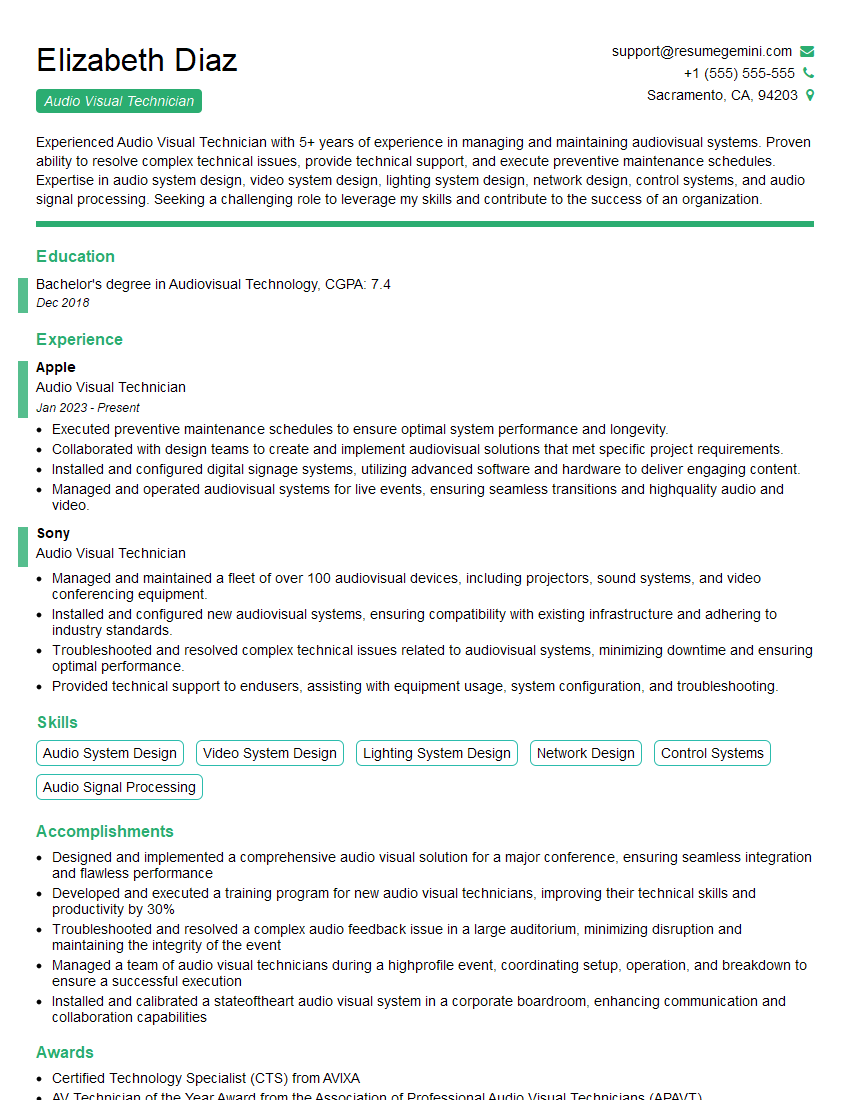
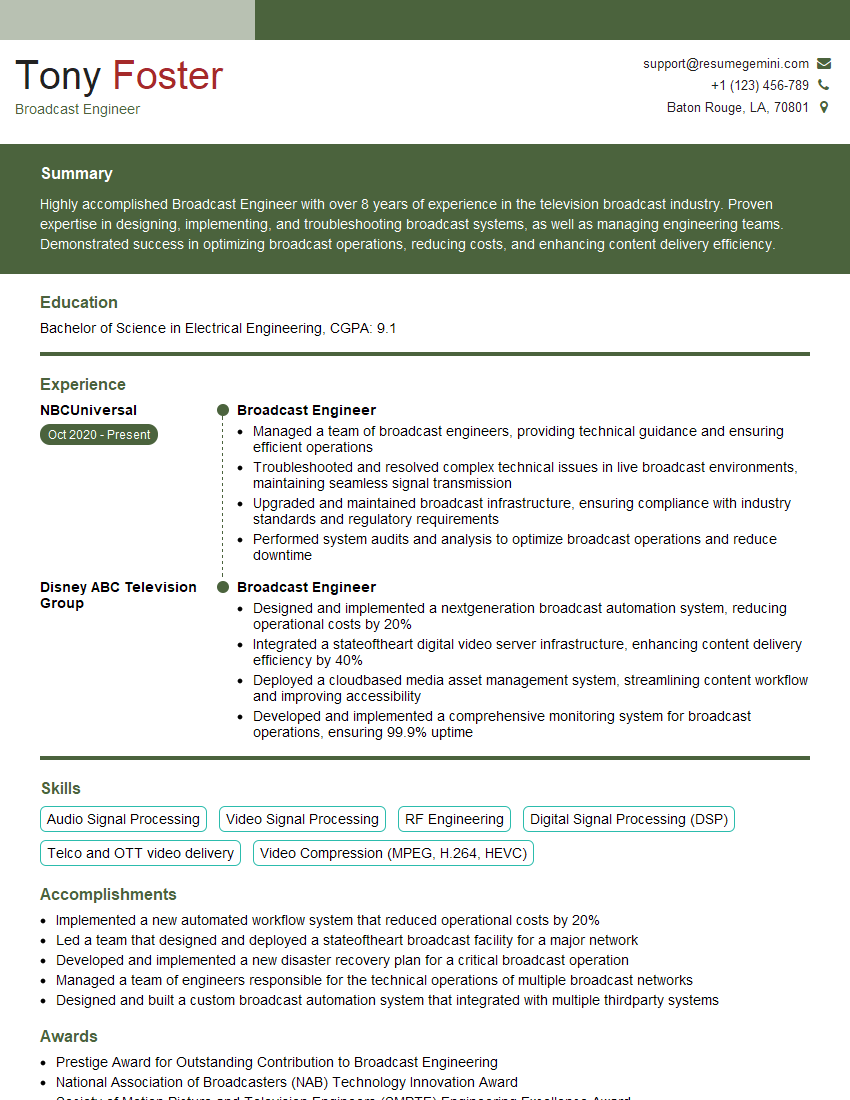
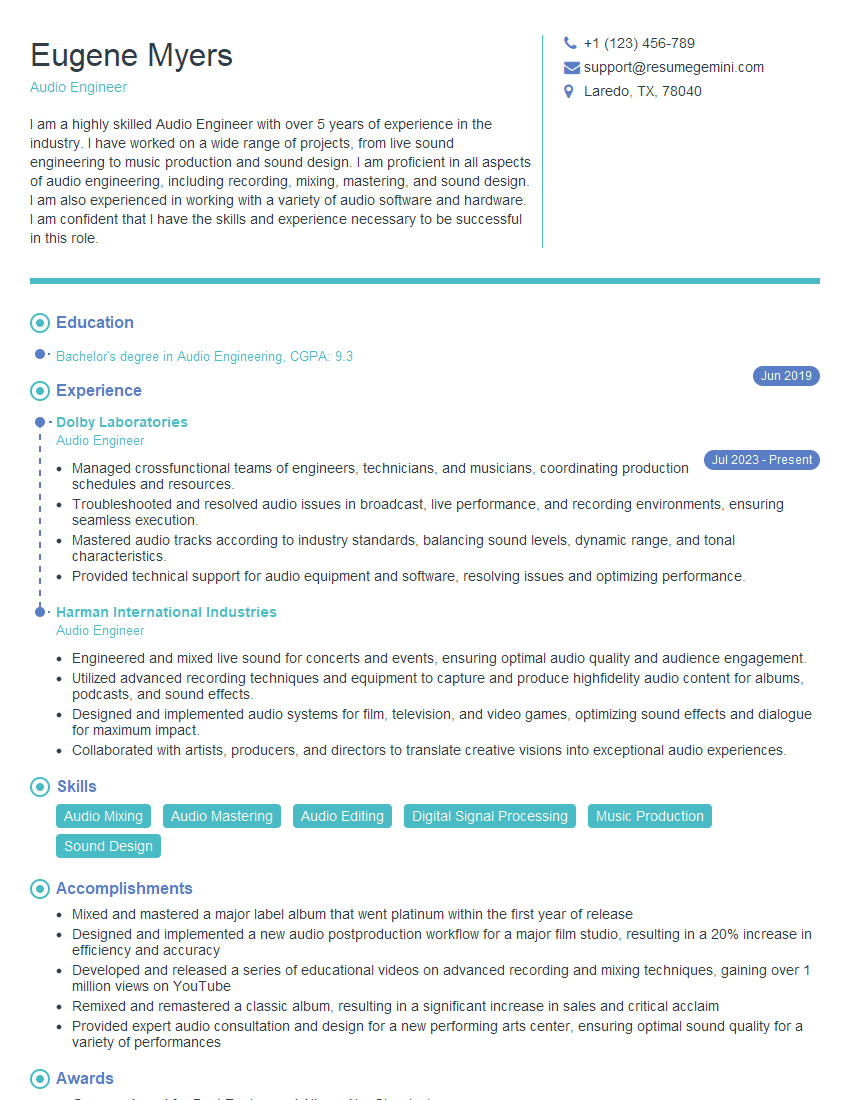
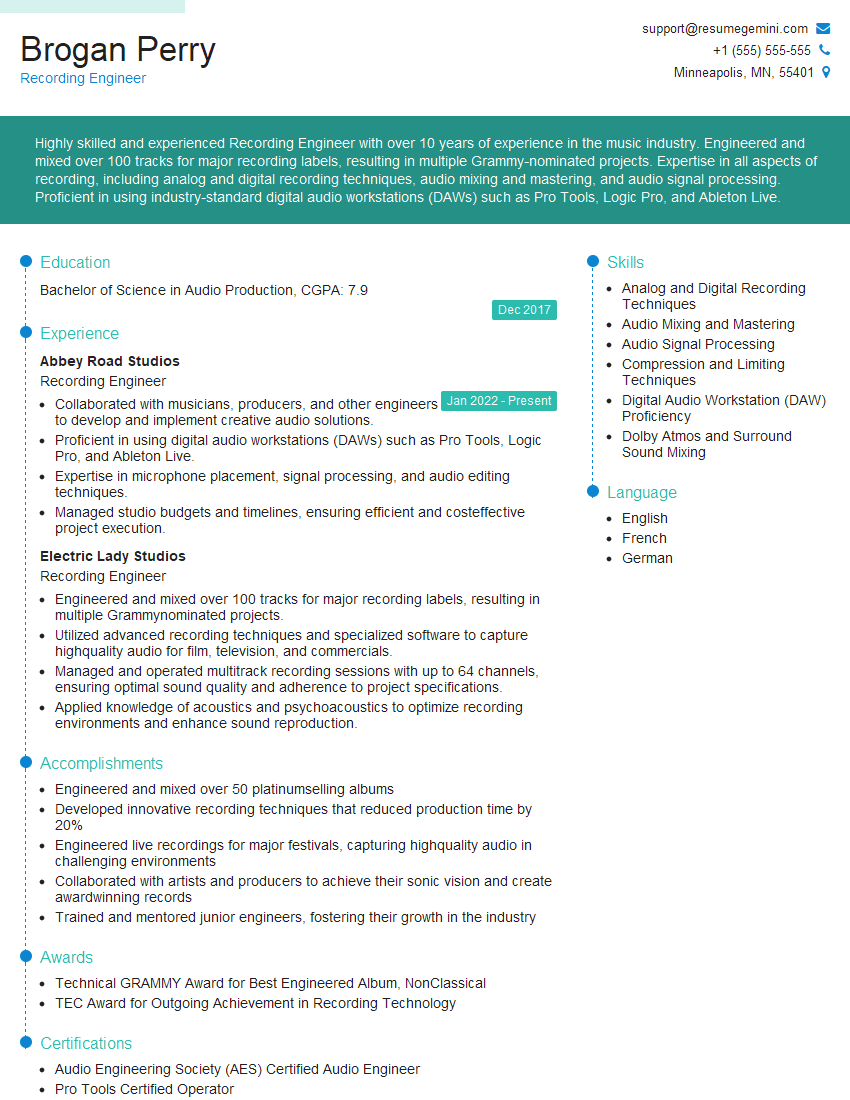
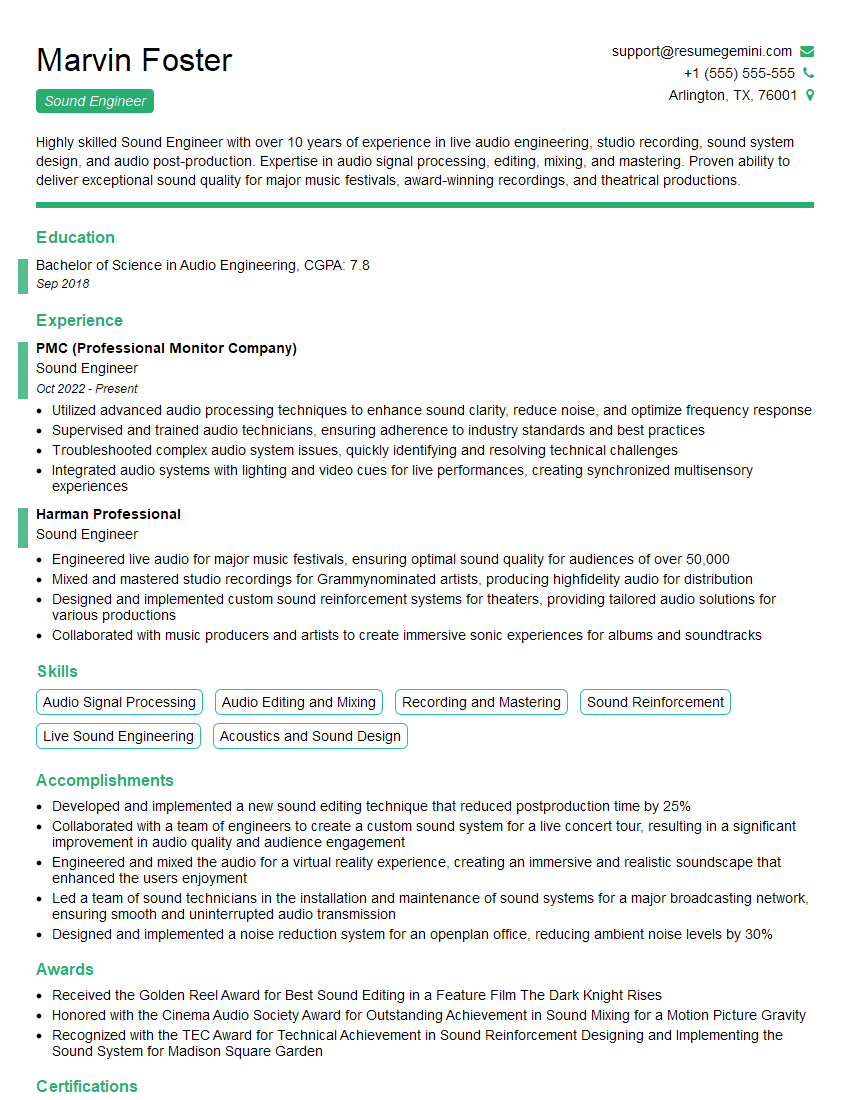
Mastering Audio Equipment Maintenance opens doors to exciting career opportunities in live sound, recording studios, broadcast engineering, and more. A strong understanding of these skills will significantly boost your earning potential and career progression. To maximize your job prospects, creating a compelling and ATS-friendly resume is crucial. ResumeGemini is a trusted resource that can help you craft a professional resume that highlights your skills and experience effectively. ResumeGemini provides examples of resumes tailored to Audio Equipment Maintenance to help you get started. Invest in your future; build a resume that showcases your expertise!

Explore more articles
Users Rating of Our Blogs
Share Your Experience
We value your feedback! Please rate our content and share your thoughts (optional).
What Readers Say About Our Blog
hello,
Our consultant firm based in the USA and our client are interested in your products.
Could you provide your company brochure and respond from your official email id (if different from the current in use), so i can send you the client’s requirement.
Payment before production.
I await your answer.
Regards,
MrSmith
hello,
Our consultant firm based in the USA and our client are interested in your products.
Could you provide your company brochure and respond from your official email id (if different from the current in use), so i can send you the client’s requirement.
Payment before production.
I await your answer.
Regards,
MrSmith
These apartments are so amazing, posting them online would break the algorithm.
https://bit.ly/Lovely2BedsApartmentHudsonYards
Reach out at [email protected] and let’s get started!
Take a look at this stunning 2-bedroom apartment perfectly situated NYC’s coveted Hudson Yards!
https://bit.ly/Lovely2BedsApartmentHudsonYards
Live Rent Free!
https://bit.ly/LiveRentFREE
Interesting Article, I liked the depth of knowledge you’ve shared.
Helpful, thanks for sharing.
Hi, I represent a social media marketing agency and liked your blog
Hi, I represent an SEO company that specialises in getting you AI citations and higher rankings on Google. I’d like to offer you a 100% free SEO audit for your website. Would you be interested?