Unlock your full potential by mastering the most common Hardwood Installation interview questions. This blog offers a deep dive into the critical topics, ensuring you’re not only prepared to answer but to excel. With these insights, you’ll approach your interview with clarity and confidence.
Questions Asked in Hardwood Installation Interview
Q 1. What types of hardwood flooring have you installed?
Throughout my career, I’ve installed a wide variety of hardwood flooring types. This includes solid hardwood, engineered hardwood, and even reclaimed wood. Solid hardwood is the classic choice, offering durability and timeless beauty, but it’s more susceptible to moisture damage. Engineered hardwood, with its plywood core, offers greater stability in varied climates. Reclaimed wood provides a unique aesthetic, and adds character and history to a space. I’ve worked with various plank widths, thicknesses, and finishes, from traditional to modern styles, adapting my techniques to suit each project’s specifications.
- Solid Hardwood: Oak (red and white), Maple, Cherry, Walnut, Hickory.
- Engineered Hardwood: Similar species to solid hardwood, often with a thinner veneer layer.
- Reclaimed Wood: Barn wood, salvaged flooring, and other repurposed lumber.
Q 2. Describe your experience with different wood species.
My experience spans a broad range of wood species, each with its unique characteristics. Oak, for example, is known for its strength and durability, making it a popular choice. However, red oak is generally more porous than white oak, requiring a slightly different approach to finishing. Maple offers a lighter, cleaner look, but can be harder to work with due to its density. Cherry possesses a rich reddish hue that deepens with age, while walnut is prized for its dark, elegant tones and fine grain. Hickory boasts exceptional hardness and durability but can be more challenging to install due to its variations in color and texture. I carefully consider the specific properties of each species when planning the installation, adapting my techniques accordingly. For instance, harder woods like hickory may require specialized tools and more careful measuring to avoid damage.
Q 3. Explain the process of acclimating hardwood flooring.
Acclimating hardwood flooring is crucial to prevent expansion and contraction after installation. This process involves storing the flooring within the room where it will be installed for a minimum of 72 hours, and ideally up to a week or longer depending on the wood type and climate conditions. This allows the wood to adjust to the ambient temperature and humidity levels, minimizing the risk of warping, buckling, or gapping. I meticulously monitor the temperature and humidity of the room using a hygrometer and thermometer, ensuring the environment is stable before beginning the installation. I’ve learned through experience that neglecting this step can lead to significant problems down the line, requiring costly repairs or even complete replacement of the flooring.
Q 4. What are the common methods for installing hardwood floors?
The most common methods for installing hardwood floors are nail-down and glue-down. Nail-down installation involves securing the planks directly to the subfloor using nails or cleats, suitable for solid hardwood and providing a solid and durable floor. Glue-down installation uses adhesive to bond the planks to the subfloor, often preferred for engineered hardwood, particularly in areas with radiant heating where nailing may damage the heating elements. Floating floors, which utilize a click-lock system and do not require adhesive or nails, are also becoming increasingly popular, offering ease of installation and sound dampening, though they lack the rigidity of nailed installations. Each method has its advantages and disadvantages; my selection depends on factors such as the type of hardwood, subfloor condition, and project specifications.
Q 5. How do you measure and calculate the required amount of flooring?
Accurately measuring and calculating the required amount of hardwood flooring is paramount to avoid material shortages or excess waste. I begin by meticulously measuring the area of each room, accounting for irregularities in the walls and any obstacles. This involves careful measurements of length and width, often broken into smaller, manageable sections. I then calculate the square footage and add a waste factor of 5-10%, depending on the complexity of the room layout and the presence of unusual cuts. I always account for the direction of the planks, considering the aesthetic impact and minimizing waste by strategically planning the layout. For example, placing longer planks in the more prominent areas and utilizing smaller cuts in less visible locations. This detailed approach ensures a smooth and efficient installation process, minimizes material waste, and provides a professional result.
Q 6. What tools and equipment are essential for hardwood installation?
A comprehensive set of tools is essential for efficient and high-quality hardwood installation. This includes a measuring tape, chalk line, hand saw or circular saw (with appropriate blades), hammer, nail gun (for nail-down installations), flooring adhesive (for glue-down installations), wood flooring pull bar, tapping block, knee kicker, moisture meter, and various hand tools like chisels and screwdrivers. Safety equipment is equally important and includes safety glasses, hearing protection, and work gloves. Specialized tools such as a flooring nailer or a power planer are often used for larger jobs and enhancing efficiency. The specific tools I use depend on the method and material chosen.
Q 7. Describe your experience with different subfloor types.
My experience encompasses various subfloor types, each demanding a specific approach. Plywood subfloors are common and generally provide a stable base, requiring assessment of their levelness and moisture content. Concrete subfloors necessitate careful preparation to ensure cleanliness, dryness, and proper leveling. I have encountered situations with existing hardwood subfloors, requiring assessment for structural integrity and potential repairs or leveling before installation of new flooring. Each type of subfloor requires unique considerations; a damaged or uneven subfloor will directly compromise the quality and longevity of the hardwood floor installation. Assessing the subfloor condition and taking appropriate preparation steps are crucial for a successful project.
Q 8. How do you prepare a subfloor for hardwood installation?
Subfloor preparation is paramount for a successful hardwood installation. Think of it as building a strong foundation for a house – if the base is weak, the entire structure suffers. The process involves several crucial steps:
- Cleaning: Thoroughly remove all debris, dust, and any loose material. A shop vacuum is essential here. Imagine trying to glue wood to a dusty surface – it won’t stick properly!
- Leveling: The subfloor needs to be level and smooth. Unevenness will show through the hardwood, leading to squeaks and an unsightly floor. This might involve using self-leveling compound to fill in low spots or sanding down high areas. I’ve seen projects where a seemingly minor imperfection led to significant problems later on.
- Moisture Testing: This is critically important, especially with concrete subfloors. Excessive moisture can lead to cupping, buckling, and mold growth. Using a moisture meter is non-negotiable; this allows for objective measurements and prevents costly mistakes.
- Repairing Damage: Any cracks, holes, or damage to the subfloor must be repaired before installation. This might involve patching with concrete or plywood, ensuring a stable base.
- Priming (Concrete Subfloors): A moisture barrier and a concrete primer are crucial for concrete subfloors to prevent moisture migration and provide a good bonding surface for the underlayment.
Proper subfloor preparation saves time, money, and headaches down the line. I’ve had to redo installations because of inadequate subfloor preparation, which is always a frustrating and costly experience.
Q 9. What are the different types of hardwood flooring finishes?
Hardwood flooring finishes determine the look, durability, and maintenance requirements of your floor. The main types include:
- Unfinished: Requires on-site finishing after installation, allowing for complete customization of color and sheen. This gives the installer more control, but also adds time and complexity.
- Pre-finished: Factory-finished at the manufacturer, offering convenience and immediate usability. The finish is usually more durable, and this method is less messy than on-site finishing. Different levels of durability are available, depending on the factory’s processes.
- UV-cured finishes: These are becoming increasingly popular in prefinished hardwood. They are very durable, tough and fast drying.
- Aluminum Oxide finishes: Extremely durable and resistant to scratches and wear. A common choice for high-traffic areas.
Choosing the right finish depends on factors like budget, desired aesthetic, and the level of foot traffic expected. For instance, a busy family home might benefit from a highly durable pre-finished floor with an aluminum oxide finish, while a less-used guest room might be suitable for a beautiful unfinished floor with a custom finish.
Q 10. Explain the process of finishing hardwood floors.
Finishing hardwood floors is a meticulous process that requires skill and precision. The steps generally involve:
- Sanding: This crucial step removes imperfections and creates a smooth surface for the finish to adhere to. Multiple sanding stages with progressively finer grits are used, often starting with a rough grit and finishing with a very fine one to achieve a smooth and even surface.
- Cleaning: After each sanding stage, thorough cleaning is required to remove dust, a process crucial for proper adhesion of the finish.
- Applying the Finish: This usually involves applying multiple coats of polyurethane or other suitable finish, allowing each coat to dry completely before applying the next. The application method can vary (brush, roller, or spray), each with its own advantages and disadvantages.
- Buffing/Screening (Between Coats): This step is vital for creating a seamless final finish. It removes any imperfections or dust nibs between coats.
- Final Cleaning: After the final coat has cured, the floor is meticulously cleaned to remove any dust or debris.
The entire finishing process is a delicate balance of technique and patience. Rushing this stage can compromise the quality and longevity of the finished floor. I always emphasize the importance of following manufacturer’s instructions and utilizing appropriate safety measures like proper ventilation and respirators.
Q 11. How do you handle transitions between different flooring types?
Transitions between different flooring types require careful planning and execution to create a smooth, aesthetically pleasing, and functional connection. Several methods exist:
- Transition Strips: These are metal or wood strips designed to bridge the gap between two different floor types, smoothly transitioning from one material to the other. Various styles are available to match different aesthetic requirements.
- T-Molding: This is a classic transition strip specifically for changes in height between flooring types.
- Reduce Molding: Used when one floor is slightly higher than the other, this creates a gradual transition to cover the height difference.
- Custom Fabrication: In more complex situations, custom-made transitions might be necessary to achieve a seamless and visually appealing result.
The choice of transition method depends on the height difference between the floors, the materials involved, and the overall design of the space. For instance, a transition between hardwood and tile often necessitates a transition strip to handle the difference in thickness and material.
Q 12. Describe your experience with installing hardwood around obstacles.
Installing hardwood around obstacles like doorways, pipes, and columns requires precision and careful planning. I approach these situations strategically:
- Precise Measurement and Layout: Accurate measurements are crucial to ensure a precise fit around the obstacle. This often involves creating templates or carefully marking the cuts.
- Appropriate Cutting Techniques: Depending on the obstacle, different cutting techniques may be needed, such as using a jigsaw for intricate cuts or a circular saw for straight cuts. Skillful use of the tools is crucial.
- Utilizing Filler and Repair: After cutting and fitting the hardwood around the obstacles, any gaps or imperfections are usually filled with appropriate filler and then sanded smooth for a seamless finish.
- Pre-planning: The best approach is to pre-plan the layout and cut pieces in advance, especially for complex installations that include many obstacles. This significantly reduces the potential for errors.
I recall one project where we had to install hardwood around a complex network of pipes in a basement. Careful planning and precise cutting were essential to ensure a visually appealing and structurally sound result. Precision is key when working around obstacles to avoid visible gaps or poorly matched pieces.
Q 13. How do you ensure the proper moisture content of the hardwood before installation?
Ensuring proper moisture content in hardwood before installation is vital to prevent problems later on. Wood that is too dry or too wet can shrink, expand, cup, or buckle, ruining the floor. The ideal moisture content depends on the wood species and the environment but typically falls within a range of 6-8%.
- Acclimation: The most important step is to allow the hardwood to acclimate to the environment where it will be installed. This means storing the wood in the room for several days or weeks to allow it to adjust to the temperature and humidity levels. This is non-negotiable.
- Moisture Meter: Using a reliable moisture meter to measure the moisture content of the wood before, during, and even after installation, provides accurate readings and ensures that the wood is within acceptable ranges.
- Environmental Control: Maintaining stable temperature and humidity levels in the installation area during and after installation helps prevent excessive moisture fluctuations that can damage the wood.
Ignoring acclimation can lead to significant problems down the line. I’ve seen countless examples of floors buckling or shrinking because the wood wasn’t allowed to acclimate properly. It’s a simple step, but a vital one.
Q 14. What are the common problems encountered during hardwood installation, and how do you address them?
Several common problems can arise during hardwood installation. Knowing how to address them proactively is crucial for a successful outcome.
- Uneven Subfloor: As discussed earlier, an uneven subfloor leads to squeaks and an uneven floor. The solution is to level the subfloor before installation using self-leveling compound or other appropriate methods.
- Improper Acclimation: Wood that’s too dry or too wet will cause problems. The solution is proper acclimation, as described previously.
- Gaps Between Boards: This can result from improper installation or incorrect moisture content. The solution might involve refitting boards or using fillers.
- Nail Pops: These are nails that have risen above the surface. The solution involves carefully countersinking the nails and refilling the holes.
- Squeaking Floors: Usually caused by movement between the boards and the subfloor. Solutions include adding additional adhesive or fasteners.
Troubleshooting involves careful observation, understanding the root cause, and applying appropriate solutions. Experience helps in quickly diagnosing and resolving these issues, saving time and money in the long run. I always advise clients to thoroughly inspect the floor after installation to identify and address any minor issues before they become significant problems.
Q 15. What safety precautions do you take during hardwood installation?
Safety is paramount in hardwood installation. It’s not just about preventing injuries; it’s about ensuring a smooth, efficient, and high-quality job. My safety protocol starts with proper personal protective equipment (PPE), including safety glasses to protect my eyes from flying debris, hearing protection to mitigate the noise from power tools, and sturdy work boots with slip-resistant soles to prevent falls. I always use dust masks or respirators, especially when working with hardwood dust, a known respiratory irritant. Before starting any cutting or nailing, I clear the work area of any obstacles to prevent tripping hazards. I also meticulously inspect the area for potential hazards such as exposed wires or uneven surfaces. Furthermore, I always secure the area with caution tape and inform the homeowners about the process to ensure their safety as well. For tasks involving ladders or elevated work, I strictly adhere to safe ladder practices, including ensuring three points of contact at all times.
For example, on a recent project involving a large staircase, I employed scaffolding for additional safety, rather than relying solely on a ladder. This meticulous approach to safety not only protects me but also contributes to a higher quality installation by preventing accidents that could delay or compromise the project.
Career Expert Tips:
- Ace those interviews! Prepare effectively by reviewing the Top 50 Most Common Interview Questions on ResumeGemini.
- Navigate your job search with confidence! Explore a wide range of Career Tips on ResumeGemini. Learn about common challenges and recommendations to overcome them.
- Craft the perfect resume! Master the Art of Resume Writing with ResumeGemini’s guide. Showcase your unique qualifications and achievements effectively.
- Don’t miss out on holiday savings! Build your dream resume with ResumeGemini’s ATS optimized templates.
Q 16. Describe your experience with using different adhesives and fasteners.
My experience with adhesives and fasteners is extensive. I’ve worked with a range of adhesives, from water-based polyurethanes, which are excellent for their low-VOC (volatile organic compound) content and strong bond, to solvent-based options that offer superior grab in challenging conditions. The choice depends heavily on the type of wood, the subfloor, and the specific job requirements. For instance, engineered hardwood often uses a moisture-activated adhesive, whereas solid hardwood might necessitate a stronger, solvent-based option for a more robust bond.
In terms of fasteners, I’m proficient with various methods, including nails, staples, and screws. Choosing the right fastener depends on the wood species, thickness, and the installation method. For example, solid hardwood often requires nails or screws for added strength and stability, while engineered hardwood can sometimes be installed using adhesive alone, or a combination of adhesive and staples for improved speed. I’m familiar with the nuances of using various nail guns, ensuring appropriate penetration depth to avoid damaging the hardwood without compromising the hold. Proper fastening is crucial for long-term stability and preventing squeaking or movement.
Q 17. How do you ensure the proper alignment and spacing of hardwood planks?
Precise alignment and spacing are crucial for a beautiful and durable hardwood floor. I employ several techniques to maintain consistent spacing and alignment. Before installation, I lay out a straight line using a chalk line to ensure a perfect starting point. I use spacers of the recommended size, often 1/4 inch, between planks to maintain consistent gaps allowing for expansion and contraction. A tapping block prevents damage to the planks while ensuring they are tightly fitted together. Regular checks with a measuring tape and a level ensure that the planks remain in alignment both across and along the flooring’s length. For intricate designs or patterns, I often use templates and carefully mark each plank to guarantee correct positioning. Think of it like building with very precise LEGO bricks – each piece needs to fit perfectly to create a cohesive and strong structure.
For instance, when installing herringbone patterns, I meticulously mark each plank’s placement to ensure the angle remains consistent throughout the installation. This attention to detail results in a stunning, professionally-installed floor.
Q 18. How do you handle expansion and contraction gaps in hardwood flooring?
Expansion and contraction are natural characteristics of wood, especially in response to changes in humidity and temperature. Ignoring this can lead to buckling or gaps in the flooring. To accommodate this, I always leave expansion gaps around the perimeter of the room, and between the flooring and any fixed objects such as walls and doorways. These gaps are typically 1/4 to 1/2 inch, depending on the wood type and climate. I use expansion strips, specifically designed for this purpose, to fill these gaps. These are often made of a pliable material and are easily concealed after the installation. These expansion gaps provide the wood with room to move without causing damage. Failing to account for this natural phenomenon is a common mistake leading to costly repairs.
For example, in a climate with high humidity variations, I would increase the expansion gap to give more room for the wood to expand during humid seasons.
Q 19. What are your troubleshooting skills regarding hardwood floor installation?
Troubleshooting is an integral part of hardwood installation. My experience enables me to quickly diagnose and resolve issues. For instance, if I encounter uneven subflooring, I address it before installation, either by leveling the subfloor or using a self-leveling compound. If planks are not fitting correctly, I may need to check for debris under the planks and make adjustments to the spacing or alignment. Squeaking sounds often indicate poor adhesion or improper fastening, necessitating a closer inspection and possibly refastening or re-gluing the affected areas. Understanding the root cause is key – it’s not about simply fixing the symptom, but rather solving the underlying problem.
Recently, I encountered a situation where a section of flooring started cupping (curving upwards). By carefully investigating, I determined that the subfloor had higher-than-average moisture content. Addressing the moisture issue resolved the cupping problem and prevented further damage.
Q 20. How do you maintain quality control throughout the installation process?
Maintaining quality control is a continuous process, starting with selecting high-quality materials and meticulously preparing the subfloor. I inspect each plank for defects before installation, ensuring that it meets the required quality standards. Throughout the installation, I regularly check the alignment, spacing, and levelness of the floor, making any necessary adjustments along the way. I also carefully inspect the transitions between different sections and rooms. Once the installation is complete, a thorough final inspection ensures that the floor is level, meets the specified finish, and the gaps are correctly sized. Detailed documentation of every step helps in addressing any post-installation issues efficiently and proactively.
Taking photos at various stages of the installation process provides a valuable record for both the client and myself. This approach ensures that any issue can be easily traced back to its source, allowing for prompt and effective resolution.
Q 21. What is your experience with different types of wood flooring profiles (e.g., solid, engineered)?
I have extensive experience with both solid and engineered hardwood flooring. Solid hardwood is a timeless classic, known for its durability and beauty, but requires a more stable subfloor and is more susceptible to moisture damage. Engineered hardwood, on the other hand, is a more versatile option, often more stable and less prone to moisture-related issues due to its layered construction. I understand the advantages and disadvantages of each type and choose the best option depending on the client’s budget, preferences, and the specific conditions of the installation site. For instance, in basements or areas prone to moisture, engineered hardwood is often the more practical choice. In a high-end application where lasting durability and aesthetic appeal are paramount, solid hardwood can be the preferred option.
I also have experience with different wood profiles, from planks with square edges to those with bevelled edges that create visual interest. Understanding the characteristics of various wood species is crucial, as this dictates the installation method, appropriate adhesive, and even the level of care required for long-term maintenance.
Q 22. Describe your experience with installing different patterns (e.g., herringbone, parquet)?
My experience encompasses a wide range of hardwood flooring patterns, including the classic herringbone and intricate parquet designs. Herringbone, with its distinctive V-shaped pattern, requires precise cuts and meticulous planning to ensure a seamless and visually appealing result. I’ve installed both traditional single herringbone and more complex variations like double herringbone, each demanding a different level of precision. Parquet, which involves arranging smaller pieces of wood into geometric patterns, presents its own unique challenges. I’m proficient in various parquet patterns, such as basketweave, chevron, and Versailles, each needing careful planning and execution to achieve the desired aesthetic.
For example, on a recent project featuring a large Versailles parquet floor, I utilized a combination of pre-cut parquet blocks and custom-cut pieces to seamlessly integrate around architectural features like columns and doorways. This required precise measurements, careful layout planning and a deep understanding of how the pattern repeats. The final result was stunning, showcasing the intricate detail and craftsmanship involved.
Furthermore, I am adept at creating custom patterns based on client specifications, translating their vision into a reality through careful planning and skilled execution. This involves creating detailed diagrams, calculating material needs and executing the installation with accuracy and attention to detail.
Q 23. How familiar are you with relevant building codes and safety regulations?
Adherence to building codes and safety regulations is paramount in my work. I’m intimately familiar with local, state, and national codes related to hardwood flooring installation, including those concerning moisture content, subfloor preparation, and installation methods. This includes understanding regulations surrounding the use of adhesives, finishes, and safety procedures to prevent accidents during installation and to ensure the longevity and safety of the finished floor.
For instance, I always check the moisture content of the subfloor using a moisture meter (discussed further in a later question) to ensure it meets the required standards before starting the installation. I also follow strict safety protocols, including proper ventilation, use of appropriate personal protective equipment (PPE), and disposal of hazardous materials according to regulations. My attention to detail and adherence to regulations guarantees not only a beautiful finished product, but also a safe and compliant project.
Q 24. Describe your experience working with different types of underlayments.
My experience with underlayments is extensive, ranging from basic polyethylene foam to more advanced systems designed for sound dampening, moisture control, and thermal insulation. Understanding the properties of different underlayments is critical for ensuring a successful hardwood floor installation. The choice of underlayment is dependent on various factors such as the type of subfloor, the species of hardwood, and the client’s specific requirements.
I’ve worked with various types including:
- Polyethylene foam: A cost-effective option for basic cushioning and moisture protection.
- Cork underlayment: Excellent for sound insulation and comfort underfoot.
- Rubber underlayment: Provides superior sound dampening and can help to minimize impact noise.
- LVL (Laminated Veneer Lumber) underlayment: Ideal for leveling uneven subfloors.
Q 25. What is your experience with using a moisture meter?
Using a moisture meter is a fundamental part of my workflow. I utilize a calibrated, reliable moisture meter to accurately measure the moisture content of both the subfloor and the hardwood lumber itself. This critical step prevents future problems like cupping, crowning, and other issues caused by moisture imbalances. I know how to properly operate different types of moisture meters, interpreting the readings and understanding the implications for the installation.
For example, before commencing a recent installation, I discovered a high moisture reading in a section of the concrete subfloor. This prompted me to recommend delaying the installation and addressing the moisture issue before proceeding, preventing potential damage to the new hardwood floor and ensuring client satisfaction. My proficiency in using a moisture meter is a critical component of ensuring the quality and longevity of my work.
Q 26. How do you manage your time and prioritize tasks during a project?
Effective time management is crucial for successful project completion. My approach involves a multi-stage process. I begin by carefully reviewing project plans, creating detailed schedules, and allocating appropriate timeframes for each stage of the installation. I break down larger tasks into smaller, manageable components. This allows for better tracking of progress and easier identification of potential delays.
I prioritize tasks based on their dependencies and critical path, ensuring that essential steps are completed first to avoid bottlenecks. This often involves close coordination with other contractors or suppliers. For instance, on a recent large-scale project, I carefully scheduled the delivery of materials to coincide with the completion of subfloor preparation, optimizing efficiency and minimizing downtime. Regular communication with clients keeps them informed and allows for proactive adjustments to the schedule if needed.
Q 27. Can you provide examples of projects where you faced challenges and how you overcame them?
One project involved installing a herringbone pattern in a historic building with uneven walls and significant variations in the subfloor. The challenge was achieving a seamless, aesthetically pleasing pattern while compensating for the existing irregularities. I overcame this by using a combination of shims and custom-cut pieces to level the subfloor and maintain the integrity of the herringbone pattern. This required meticulous attention to detail and a flexible approach, adapting my technique to fit the specific conditions of the space. The final result was a beautiful and expertly installed floor that blended seamlessly with the historic architecture.
Another challenge involved a client changing the flooring selection at the last minute. This required a swift reassessment of the project timeline and budget to accommodate the new materials and potential adjustments to the installation method. Through clear communication and creative problem-solving, I successfully managed the change, minimizing disruption to the project timeline and ensuring a satisfactory outcome for the client. In both cases, adaptability, problem-solving skills, and clear communication were essential to successful project completion.
Q 28. What are your salary expectations?
My salary expectations are commensurate with my experience and expertise in hardwood flooring installation. I am confident that my skillset, attention to detail and proven ability to manage complex projects justify a competitive compensation package. I am open to discussing specific salary figures based on the specifics of the role and company benefits offered.
Key Topics to Learn for Hardwood Installation Interview
- Subfloor Preparation: Understanding different subfloor types (concrete, plywood, etc.), moisture content testing, leveling techniques, and appropriate underlayment selection.
- Acclimation of Hardwood: The crucial process of allowing hardwood to adjust to the environment before installation, preventing expansion and contraction issues after installation.
- Measurement and Layout: Accurate room measurement, calculating material needs, creating efficient installation plans, and understanding different layout patterns (e.g., straight, herringbone, chevron).
- Installation Methods: Understanding and applying various installation techniques including nail down, glue down, floating floor, and click-lock systems. Knowing the advantages and disadvantages of each method.
- Wood Species and Grades: Familiarity with common hardwood species, their characteristics (hardness, durability, color variations), and grading systems.
- Tools and Equipment: Demonstrating knowledge of essential tools (e.g., measuring tapes, saws, nail guns, flooring nailers, moisture meters) and their safe and efficient use.
- Finishing Techniques: Understanding sanding, staining, sealing, and finishing processes to achieve a professional and durable final product. Knowledge of different finishes and their properties.
- Troubleshooting and Problem Solving: Ability to identify and resolve common installation issues such as uneven floors, squeaking, gapping, and expansion/contraction problems.
- Safety Procedures: Demonstrating awareness and adherence to safety protocols and best practices for handling tools and materials.
- Estimating and Budgeting: Ability to accurately estimate material costs, labor costs, and provide a comprehensive project budget.
Next Steps
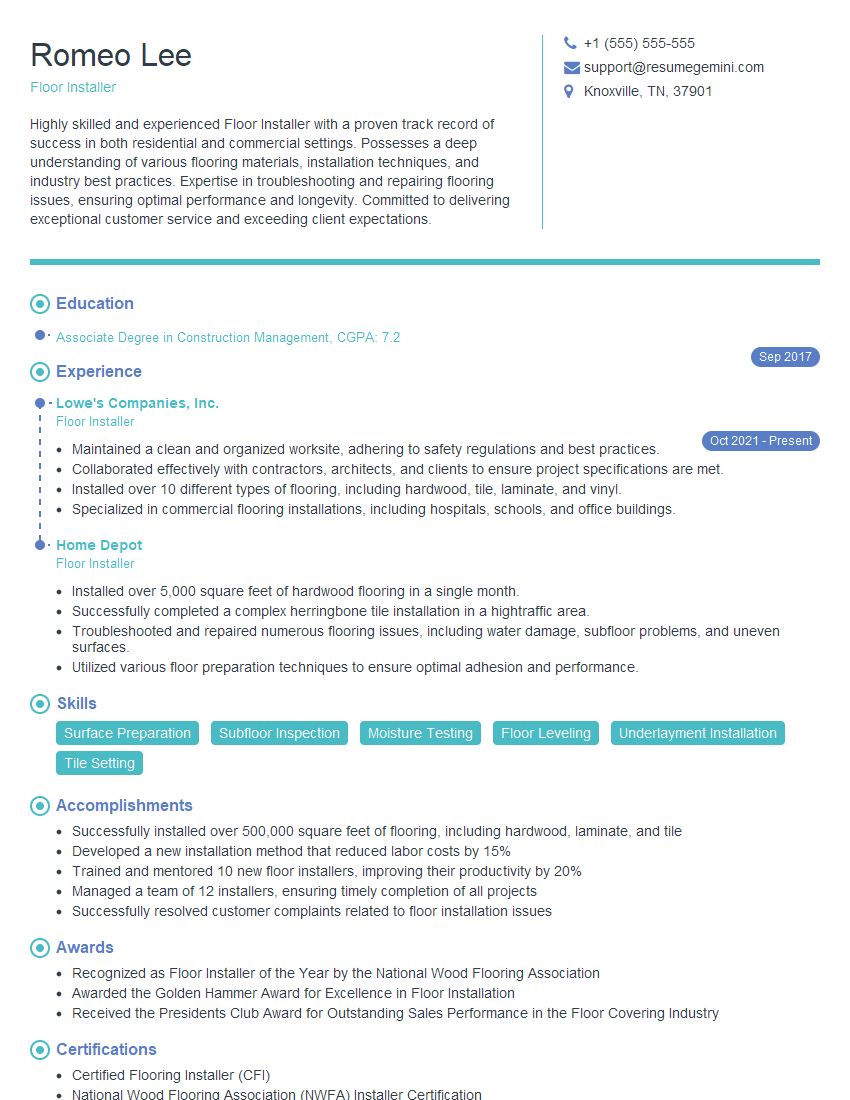
Mastering hardwood installation opens doors to a rewarding career with excellent growth potential. As a skilled installer, you’ll be in high demand, commanding competitive wages and building a strong professional reputation. To maximize your job prospects, creating an ATS-friendly resume is crucial. ResumeGemini is a trusted resource that can help you build a compelling resume that highlights your skills and experience effectively. We offer examples of resumes tailored to the hardwood installation industry to help you get started. Invest time in crafting a professional resume and showcasing your expertise – it’s the key to unlocking your career aspirations.




Explore more articles
Users Rating of Our Blogs
Share Your Experience
We value your feedback! Please rate our content and share your thoughts (optional).
What Readers Say About Our Blog
Amazing blog
Interesting Article, I liked the depth of knowledge you’ve shared.
Helpful, thanks for sharing.