The thought of an interview can be nerve-wracking, but the right preparation can make all the difference. Explore this comprehensive guide to Image Editing and Optimization interview questions and gain the confidence you need to showcase your abilities and secure the role.
Questions Asked in Image Editing and Optimization Interview
Q 1. Explain the difference between lossy and lossless image compression.
The core difference between lossy and lossless image compression lies in how they handle data during the compression process. Lossless compression algorithms, like PNG, reduce file size without discarding any image data. Think of it like carefully packing a suitcase – you rearrange items to fit more, but nothing gets left behind. Lossy compression, such as JPEG, achieves higher compression ratios by discarding some image data deemed less important. This is similar to throwing out unnecessary items from your suitcase to create more space. The result is a smaller file size, but at the cost of some image quality.
Lossless compression is ideal for images with sharp lines, text, or areas requiring precise detail, as no information is lost. Lossy compression is preferred when file size is paramount, such as for web images where speed is crucial, and a slight reduction in quality is acceptable.
Q 2. What are the advantages and disadvantages of using JPEG, PNG, and GIF formats?
Each image format – JPEG, PNG, and GIF – has its own strengths and weaknesses:
JPEG (Joint Photographic Experts Group): Advantages include excellent compression for photographic images, resulting in small file sizes. Disadvantages are its lossy nature, leading to potential quality degradation with repeated editing, and its poor handling of sharp lines and text.
PNG (Portable Network Graphics): Advantages include lossless compression, preserving image detail, and support for transparency. Disadvantages are its larger file sizes compared to JPEG for photographic images.
GIF (Graphics Interchange Format): Advantages include support for animation and transparency, making it ideal for simple graphics and logos. Disadvantages are its limited color palette (256 colors), resulting in posterization for images with many colors, and its generally larger file size compared to JPEG for non-animated images.
The choice of format depends heavily on the image content and intended use. For example, I’d use JPEG for photographs on a website prioritizing speed, PNG for logos requiring crisp lines and transparency, and GIF for simple animations or icons.
Q 3. Describe your experience with Adobe Photoshop.
I’ve been using Adobe Photoshop extensively for over 10 years, mastering its tools for various image editing tasks. My proficiency spans from basic retouching and color correction to advanced techniques like masking, compositing, and creating high-resolution images for print. I’m comfortable navigating all its features, including layer management, adjustment layers, filters, and actions. For instance, I recently used Photoshop to retouch product images for an e-commerce client, removing blemishes and enhancing colors to create visually appealing product shots. I’m also proficient in using Photoshop’s automation features to streamline batch processing of images.
Q 4. How do you optimize images for web use?
Optimizing images for web use is crucial for fast loading times and a better user experience. My approach involves several steps:
Choosing the right format: Selecting JPEG for photographs, PNG for graphics with sharp lines or transparency, or GIF for animations.
Resizing: Reducing image dimensions to match the intended web layout, avoiding unnecessarily large files. I use appropriate tools to resize without losing crucial detail.
Compression: Using appropriate compression levels, balancing file size and quality. I often start with a higher quality setting and gradually reduce it until an acceptable compromise is reached.
File naming and organization: Using descriptive file names and organizing images into folders for easy access and management.
Tools like TinyPNG and ImageOptim can significantly reduce file sizes without substantial quality loss. I also leverage web-based tools to check the compression level without manually guessing.
Q 5. What techniques do you use for image retouching?
My image retouching techniques depend on the desired outcome and image condition. Common methods I employ include:
Spot Healing Brush: For removing small blemishes and imperfections.
Clone Stamp Tool: For seamlessly blending textures and replacing damaged areas.
Patch Tool: For repairing larger areas by sampling and replacing with a similar texture.
Frequency Separation: A more advanced technique to separate texture and color, allowing for targeted adjustments without affecting the overall image balance. It’s like carefully separating the canvas texture from the paint layer to edit them individually.
Dodge and Burn Tools: For refining highlights and shadows, adding depth and realism.
I always strive for a natural and believable retouch, avoiding overly processed or artificial results. The goal is enhancement, not alteration.
Q 6. How do you ensure color consistency across different devices?
Ensuring color consistency across different devices is crucial for maintaining visual fidelity. My strategies include:
Using a color profile: Working in a color-managed environment, consistently employing a standard color profile like sRGB for web or Adobe RGB for print. This ensures colors are interpreted correctly by different devices.
Calibrating monitors: Regularly calibrating my monitors using a colorimeter guarantees accurate color representation on my screen, minimizing discrepancies.
Soft proofing: Using Photoshop’s soft proofing feature to simulate how an image will look on different devices, aiding in correcting any inconsistencies.
Converting to sRGB for web use: When preparing images for the web, converting to sRGB ensures they are rendered accurately across various browsers and devices.
Remember, absolute color consistency across all devices is impossible, but these methods minimize variation significantly.
Q 7. Explain your workflow for editing a batch of images.
My workflow for editing a batch of images focuses on efficiency and consistency. I typically follow these steps:
Initial assessment: Reviewing all images to determine the required edits and level of retouching.
Creating actions (if applicable): If similar edits are needed for multiple images, I create actions in Photoshop to automate repetitive tasks. This is efficient when dealing with consistent edits like resizing or color correction for product photography.
Batch processing: Using Photoshop’s batch processing features, or third-party tools, to apply actions or adjustments across all images.
Individual adjustments: After batch processing, I perform individual adjustments, focusing on specific image needs. This handles the images with unique challenges.
Quality control: A final review of all images to ensure consistency and quality before final export.
This structured approach ensures a uniform result, reduces time spent on repetitive tasks, and minimizes human error.
Q 8. How do you handle large image files efficiently?
Handling large image files efficiently is crucial for maintaining workflow speed and storage space. The key is to work in a non-destructive way and utilize appropriate file formats and software features. Imagine trying to edit a massive, high-resolution image directly in Photoshop – it would be incredibly slow! Instead, I prioritize these strategies:
Using Lossless Compression: For archiving or situations where quality is paramount, TIFF or PNG files are excellent. They maintain all image data without compression artifacts, but file sizes can be large.
Using Lossy Compression (Judiciously): JPEG is a lossy format, meaning some image data is discarded for smaller file sizes. This is perfect for web images or situations where minor quality loss is acceptable. The trick is finding the right balance between file size and visual quality, often using the ‘save for web’ options in software like Photoshop or GIMP.
Working with Smart Objects (Photoshop): In Photoshop, Smart Objects allow for non-destructive editing. This means any modifications you make (resizing, filters, etc.) can be undone or adjusted without degrading the original image quality. It’s like keeping a backup copy of your changes.
Using Proxies (Photoshop): High-resolution images can be time-consuming to edit. Creating lower-resolution proxies lets you work efficiently, and when you’re finished, you simply upgrade back to the original resolution.
Managing File Organization: A logical file structure is as essential as efficient editing. I use a naming convention, organized folders, and avoid scattered files to find images quickly.
For example, I recently worked on a project with several gigabytes of high-resolution architectural photos. Instead of directly manipulating the massive RAW files, I created smaller JPEG proxies for initial editing, ensuring a smooth workflow. Then, I exported the final result with lossy compression at high quality.
Q 9. Describe your experience with image editing software other than Photoshop (e.g., GIMP, Lightroom).
While Photoshop is my primary tool, I have extensive experience with GIMP (GNU Image Manipulation Program) and Adobe Lightroom. GIMP is a powerful, open-source alternative to Photoshop, particularly useful for tasks like image manipulation and retouching. Its layer support and extensive plugin ecosystem make it surprisingly versatile. I’ve used GIMP for various projects, including creating website banners and manipulating logos where the budget was limited.
Lightroom, on the other hand, excels in photo organization, raw development, and non-destructive editing. Its strengths lie in batch processing, color grading, and metadata management. I’ve used Lightroom for extensive photo cataloging and post-processing, particularly when working with large volumes of images from photoshoots. For instance, I used Lightroom’s powerful tools to edit over 500 photos from a recent wedding, adjusting exposure, white balance, and color saturation efficiently.
Q 10. How familiar are you with different color spaces (e.g., RGB, CMYK)?
Understanding color spaces is fundamental to image editing. Different color spaces represent color differently and are optimized for different purposes.
RGB (Red, Green, Blue): The additive color model used for screens (monitors, phones, TVs). Each color is created by combining varying intensities of red, green, and blue light.
CMYK (Cyan, Magenta, Yellow, Key/Black): The subtractive color model used for printing. It works by subtracting colors from white light using inks. Because inks don’t mix perfectly, CMYK often has a more limited color gamut than RGB.
Other Color Spaces: There are many more like LAB (used for color correction), HSV (hue, saturation, value, intuitive for color adjustments), and many more specialized color spaces.
Choosing the right color space is critical. For web graphics, RGB is essential. For print media, CMYK is necessary, and often requires converting from RGB, which might lead to slight color shifts. A critical aspect is managing color profiles to ensure color accuracy across different devices and output methods.
Q 11. How do you sharpen images without introducing artifacts?
Sharpening images without introducing artifacts requires a delicate balance and understanding of sharpening techniques. Over-sharpening often creates a harsh, unnatural look with ‘halos’ around edges. Here’s my approach:
Unsharp Mask: This is a classic technique. It enhances contrast along edges, making them appear sharper. The key is to adjust the amount, radius, and threshold parameters carefully. A small radius and threshold are usually better to avoid haloing.
Smart Sharpen (Photoshop): Photoshop’s Smart Sharpen offers more sophisticated control. It allows you to specify sharpening based on the image’s characteristics, reducing artifacts. I often use this for its ability to reduce noise while sharpening.
High-Pass Filter: This filter isolates high-frequency details. By blending this filter with the original image, you can selectively sharpen details. It provides finer control but requires more experience.
Using a non-destructive workflow: Layer masks and adjustment layers allow you to precisely control where sharpening occurs, preventing over-sharpening in undesired areas.
For instance, when sharpening portraits, I might use a smaller radius for the skin to avoid creating harsh artifacts while using a larger radius for the hair to add definition.
Q 12. What are some common image editing pitfalls to avoid?
Many common pitfalls can severely impact the quality and professionalism of edited images. These include:
Over-sharpening: As mentioned previously, this leads to a harsh, unnatural look with visible artifacts.
Over-saturation: Excessively saturated colors look artificial and unrealistic.
Incorrect White Balance: Images with incorrect white balance appear too warm or too cool, making colors look inaccurate.
Poor Cropping: A badly cropped image can ruin composition and focus.
Ignoring Noise Reduction: High ISO images often have noise that needs to be addressed without losing detail.
Overusing Filters: Using too many filters often makes images look artificial and processed.
Each of these mistakes often results from rushing the process. Careful planning and attention to detail is key to achieving high-quality results.
Q 13. Explain your experience with image resizing techniques.
Resizing images is a common task, and the method used greatly influences the final result. Simply stretching or compressing an image using poor methods leads to pixelation and loss of detail.
Bicubic Resampling: This is generally the best method for both enlarging and reducing image size. It calculates new pixel values based on surrounding pixels, resulting in smoother transitions.
Nearest Neighbor: This method is fast but results in pixelated images, particularly when enlarging. It’s best used when speed is paramount but quality is less important.
Bilinear Resampling: A compromise between bicubic and nearest neighbor. It’s faster than bicubic but doesn’t produce as smooth results.
Non-Destructive Resizing: In Photoshop, resizing Smart Objects keeps the original image data intact, so the resize is reversible.
When I need to resize a product image for an online store, I’ll typically use bicubic sharpening to create crisp, high-quality images that maintain their detail and appearance at a smaller size. Conversely, if I need to reduce the size of a very large image to fit in a memory-constrained system or reduce upload time, I might use a method like bicubic to reduce file size.
Q 14. How do you handle image resolution and DPI?
Image resolution refers to the number of pixels in an image (e.g., 1920 x 1080 pixels). DPI (dots per inch) refers to the printer resolution – the number of ink dots printed per inch of physical space. They’re related but distinct concepts.
Resolution: Affects image sharpness and detail. Higher resolution means more pixels and more detail.
DPI: Affects print quality. Higher DPI generally results in sharper prints. However, DPI is irrelevant for images displayed on screens; the screen’s resolution determines the displayed sharpness.
If I’m preparing an image for print, I need to ensure the resolution is high enough (e.g., 300 DPI or higher) to produce a sharp print. The DPI setting is essential during printing but not a factor in screen display. I often work in higher resolutions for print work and then create lower-resolution versions for online use.
Q 15. Describe your process for removing blemishes and imperfections from photos.
Removing blemishes and imperfections from photos is a crucial step in image editing, often involving a combination of techniques. My process usually begins with a careful assessment of the image. I determine the nature and severity of the imperfections – are we dealing with minor skin blemishes, dust spots, or more significant flaws like scratches or tears? This helps me choose the appropriate tools and techniques.
For minor imperfections, I frequently use the healing brush tool or the clone stamp tool in software like Photoshop or GIMP. The healing brush intelligently samples surrounding pixels to seamlessly blend the blemish away, while the clone stamp allows for more precise control, copying pixels from one area to another. For more significant flaws, I might employ techniques like content-aware fill (Photoshop) which analyzes surrounding image data to intelligently fill in the damaged area.
For example, when removing a small blemish on a person’s face, I would use a small brush size with the healing brush, carefully sampling from a nearby area of similar skin tone and texture. For a larger scratch on an antique photo, content-aware fill might be the most efficient choice. Throughout the process, I zoom in to ensure a flawless result and maintain the natural look and feel of the image, avoiding any obvious patching or distortion.
Navigate your job search with confidence! Explore a wide range of Career Tips on ResumeGemini. Learn about common challenges and recommendations to overcome them.
Craft the perfect resume! Master the Art of Resume Writing with ResumeGemini’s guide. Showcase your unique qualifications and achievements effectively.
Don’t miss out on holiday savings! Build your dream resume with ResumeGemini’s ATS optimized templates.
Q 16. What are your preferred methods for optimizing images for different screen sizes?
Optimizing images for different screen sizes is vital for a good user experience. The core principle is to provide the appropriate image resolution for each device without compromising quality. I typically use a combination of techniques to achieve this.
One approach is to create multiple versions of the same image at different resolutions. For example, I might create a high-resolution image for desktop screens (e.g., 1920×1080 pixels), a medium-resolution image for tablets (e.g., 1024×768 pixels), and a low-resolution image for smartphones (e.g., 640×480 pixels). This involves saving different versions of the same image with different dimensions.
Another method involves using responsive image techniques (discussed in the next question) which use the srcset attribute in the HTML tag, letting the browser select the best image for the device’s screen size and resolution. This avoids the need to manually create multiple versions for every screen size and enables efficient image delivery.
Finally, compression plays a huge role. I always compress images without sacrificing too much visible quality. Tools like TinyPNG and ImageOptim offer excellent lossy and lossless compression options.
Q 17. How do you create responsive images for websites?
Creating responsive images for websites involves using HTML’s element or the srcset attribute within the tag. Both provide a way to offer the browser a selection of images to choose from, based on the device’s capabilities.
The element is more powerful, allowing you to specify different image sources based on various criteria like device pixel ratio (dpr) and media queries. For instance:
This code provides a small image for devices with a screen width of less than 768 pixels, a medium image for screens between 768 and 1023 pixels, and a large image for screens of 1024 pixels or wider. The img tag serves as a fallback for browsers that don’t support the element.
The srcset attribute in the tag provides a more concise approach when you are primarily differentiating by device pixel ratio (dpr):
Here, the browser will select image-small.jpg by default, but will opt for image-medium.jpg if the device supports a dpr of 2, and image-large.jpg if the dpr is 3.
Q 18. How do you ensure images are accessible to people with disabilities?
Ensuring image accessibility for people with disabilities is paramount. This involves providing alternative text descriptions (alt text) for all images and using appropriate file formats and color contrasts.
Alt text is crucial for screen readers used by visually impaired individuals. It concisely describes the image’s content and purpose. For example, instead of , you’d use . The alt text should be descriptive and avoid phrases like “image of…”
Color contrast is essential for individuals with low vision. The contrast between the image and the surrounding text or background should be sufficient for readability. Tools are available online to check color contrast ratios, ensuring sufficient accessibility.
File formats also impact accessibility. Using appropriate formats like PNG for images with sharp lines and text and JPEG for photographs can ensure image quality and size optimizations that can improve performance for users with slower internet speeds.
Finally, considering the image’s context within the overall design is key. For example, decorative images that don’t contribute to the content can use an empty alt attribute (alt="">). This communicates to assistive technologies that the image is purely decorative.
Q 19. What are your strategies for managing image assets?
Managing image assets efficiently is critical in any project. My strategy involves a combination of organization, naming conventions, and utilizing asset management tools.
I begin by creating a well-organized folder structure. This might involve categorizing images by project, type, or subject matter. Consistent and descriptive file naming is equally crucial. I avoid using generic names like ‘image1.jpg’ and instead opt for meaningful names that reflect the image’s content. For example: ‘product-red-shoe-front.jpg’ is far better than ‘image1.jpg’
Asset management systems are invaluable for larger projects. Tools like Adobe Creative Cloud Assets, Bynder, or Canto offer features for centralized storage, version control, metadata management, and collaborative workflows. These tools facilitate easy retrieval, sharing, and tracking of images across teams.
Regular backups are essential to prevent data loss. I regularly back up my image assets to multiple locations, using both local and cloud-based storage. This ensures protection against hardware failures or accidental deletion.
Q 20. How familiar are you with metadata and its importance in image management?
Metadata is essential in image management because it provides crucial information about the image, facilitating efficient search, organization, and retrieval. I am very familiar with using and leveraging metadata.
Metadata includes details such as the date the image was taken, the camera used, the GPS location (if available), keywords describing the image content, copyright information, and more. This data is embedded within the image file itself (EXIF data, IPTC data) or stored separately in a database linked to the asset management system.
For example, the EXIF data might include the camera model, aperture, shutter speed, and ISO. The IPTC data might contain descriptive keywords, such as ‘portrait’, ‘landscape’, ‘cityscape’, etc. The effective use of metadata allows me to efficiently search and filter image assets based on these attributes. Imagine searching a large database of photos; knowing the exact date and location a photo was taken significantly reduces the search time compared to manually reviewing each image.
Furthermore, metadata is crucial for copyright management, ensuring proper attribution and preventing unauthorized use.
Q 21. Explain your understanding of image file size optimization techniques.
Image file size optimization is crucial for website performance and user experience. Large images slow down page load times, negatively affecting SEO and user engagement. My optimization techniques focus on achieving a balance between image quality and file size.
Firstly, I choose the appropriate file format: JPEG is ideal for photographs, offering good compression with acceptable quality loss. PNG is better for images with sharp lines, text, or transparency, as it provides lossless compression. WebP is a newer format that often provides better compression than both JPEG and PNG.
Secondly, I use image editing software to reduce the image dimensions to a size appropriate for its intended use on a website. Often, images are unnecessarily large, requiring significant downscaling. This can be done non-destructively so you can return to the original at any time.
Thirdly, I utilize compression techniques. Lossy compression (JPEG) discards some image data to reduce file size, while lossless compression (PNG) maintains all data, resulting in a larger file size. I carefully balance compression levels to minimize quality loss while achieving significant file size reductions. Tools like TinyPNG and ImageOptim provide effective and efficient compression.
Finally, for web use, I leverage responsive image techniques (as discussed previously) to ensure the browser only downloads the image appropriate for the viewer’s screen size and device pixel ratio. This prevents users from downloading unnecessarily large images.
Q 22. How do you deal with copyright issues when using images?
Copyright is paramount in image editing. Before using any image, I meticulously check its license. Resources like Creative Commons provide a clear framework for understanding usage rights. If unsure, I always err on the side of caution and seek permission from the copyright holder. For example, an image labeled ‘Creative Commons Attribution’ requires me to credit the original creator in any work I publish. Ignoring copyright can lead to legal issues, so understanding licenses and obtaining necessary permissions are crucial steps in my workflow.
In professional settings, I often work with stock photo agencies which provide legally cleared images for commercial use. This eliminates much of the guesswork and risk associated with copyright infringement.
Q 23. Describe your experience with image manipulation techniques like cloning and healing.
Cloning and healing are essential image manipulation techniques. Cloning involves copying a section of an image and pasting it over another area, often to remove unwanted elements or replicate textures. Healing, conversely, blends the copied section more seamlessly, often using content-aware algorithms to match the surrounding environment. Imagine a photo with an unwanted object; cloning would replace it with a similar texture from a nearby area. Healing would further refine the result to create a more natural-looking outcome.
I have extensive experience with both techniques across various software such as Photoshop and GIMP, proficiently employing different brush sizes, opacity, and blending modes to achieve the desired level of realism. For instance, I’ve used cloning to remove distracting elements from landscapes and healing to seamlessly retouch minor skin blemishes in portraits.
Q 24. How do you troubleshoot common image editing problems?
Troubleshooting image editing problems involves a systematic approach. Firstly, I identify the nature of the problem – is it a technical glitch, a stylistic issue, or a problem with the source image? For example, if colours appear washed out, I’d check the image’s histogram and adjust contrast/brightness. If an image is blurry, the problem may lie in the original image resolution or it may be a focus issue that cannot be fixed. I also always work non-destructively, saving my original image file and working on a separate layer to allow for easy undo and rollback options.
If the problem is software-related, I’ll try restarting the program, checking for updates, or even reinstalling if necessary. Sometimes, consulting online forums or the software’s documentation proves helpful in resolving specific errors.
Q 25. Explain your understanding of different image editing workflows.
Image editing workflows vary greatly depending on the project’s requirements. A typical workflow might look like this: 1. Image Intake and Assessment: Evaluating the image’s quality, resolution, and purpose. 2. Initial Adjustments: Correcting exposure, white balance, and color casts. 3. Retouching and Manipulation: Removing blemishes, cloning objects, or adjusting composition. 4. Enhancements: Sharpening, noise reduction, and other enhancements. 5. Color Grading and Styling: Applying color palettes and filters to match specific styles. 6. Output and Optimization: Saving the image in the correct format and resolution for its intended use (web, print etc.).
For high-volume projects, I often implement batch processing to streamline tasks like resizing and format conversion. This efficiency is crucial for meeting deadlines.
Q 26. What are your strengths and weaknesses in image editing?
My strengths lie in my deep understanding of color theory, image composition, and advanced retouching techniques. I excel in creating photorealistic results and have a knack for troubleshooting complex issues. I’m also highly proficient in using Adobe Photoshop and other image editing software.
My weakness, if I had to identify one, is sometimes being overly meticulous, leading to longer editing times. However, I’m actively working on improving my time management skills by prioritizing tasks and focusing on efficient workflows.
Q 27. How do you stay updated with the latest trends in image editing and optimization?
Staying updated in image editing requires continuous learning. I regularly follow industry blogs, subscribe to relevant newsletters, and attend online webinars. Participating in online communities and forums dedicated to image editing allows me to engage with other professionals, learn from their experiences, and discover new techniques. I also actively test new software updates and experiment with emerging technologies to enhance my skillset.
Following key influencers and attending industry conferences are also excellent ways to stay abreast of trends in image editing and optimization.
Q 28. Describe a time you had to solve a challenging image editing problem.
Once, I was tasked with restoring a severely damaged historical photograph. The image was faded, scratched, and had significant tear marks. My initial approach was to use Photoshop’s healing brush and cloning tools to fill the damaged areas. However, simply patching the photo didn’t capture the subtle texture and grain of the original. To address this, I used frequency separation to separately edit the image details and colour. I refined the textures by hand before blending them back together. The final result successfully restored the image, preserving its historical value while minimising obvious digital artifacts.
This experience highlighted the importance of understanding different retouching techniques and adopting a layered, methodical approach when tackling intricate restoration tasks.
Note: These questions offer general guidance, it’s important to tailor your answers to your specific role, industry, job title, and work experience.
Key Topics to Learn for Image Editing and Optimization Interview
Image Formats & Compression: Understanding JPEG, PNG, GIF, WebP, and their respective strengths and weaknesses. Practical application: Choosing the optimal format for web and print based on file size, quality, and intended use.
Color Management & Profiles: Working with color spaces (RGB, CMYK), color profiles (sRGB, Adobe RGB), and ensuring color accuracy across different devices and workflows. Practical application: Correctly converting images for various output methods (web, print).
Image Editing Software Proficiency: Demonstrating expertise in Adobe Photoshop, Lightroom, or other relevant software. Practical application: Explaining your workflow for retouching, compositing, or optimizing images for specific purposes.
Image Optimization for Web: Techniques for reducing file size without compromising quality, using tools and techniques like lossy and lossless compression, image resizing, and sharpening. Practical application: Optimizing images for faster website loading times and improved user experience.
Responsive Image Design: Creating images that adapt to different screen sizes and resolutions. Practical application: Implementing techniques like srcset and sizes attributes for responsive image delivery.
Accessibility & Image Alt Text: Understanding the importance of descriptive alt text for visually impaired users. Practical application: Writing effective alt text that accurately conveys the image’s content and context.
Image Manipulation Techniques: Demonstrate understanding of techniques like layer masking, blending modes, retouching, and color correction. Practical application: Solving common image editing problems and demonstrating efficient workflows.
Workflow & Automation: Understanding efficient image editing workflows and the use of actions or batch processing for increased productivity. Practical application: Describing your approach to handling large volumes of images.
Next Steps
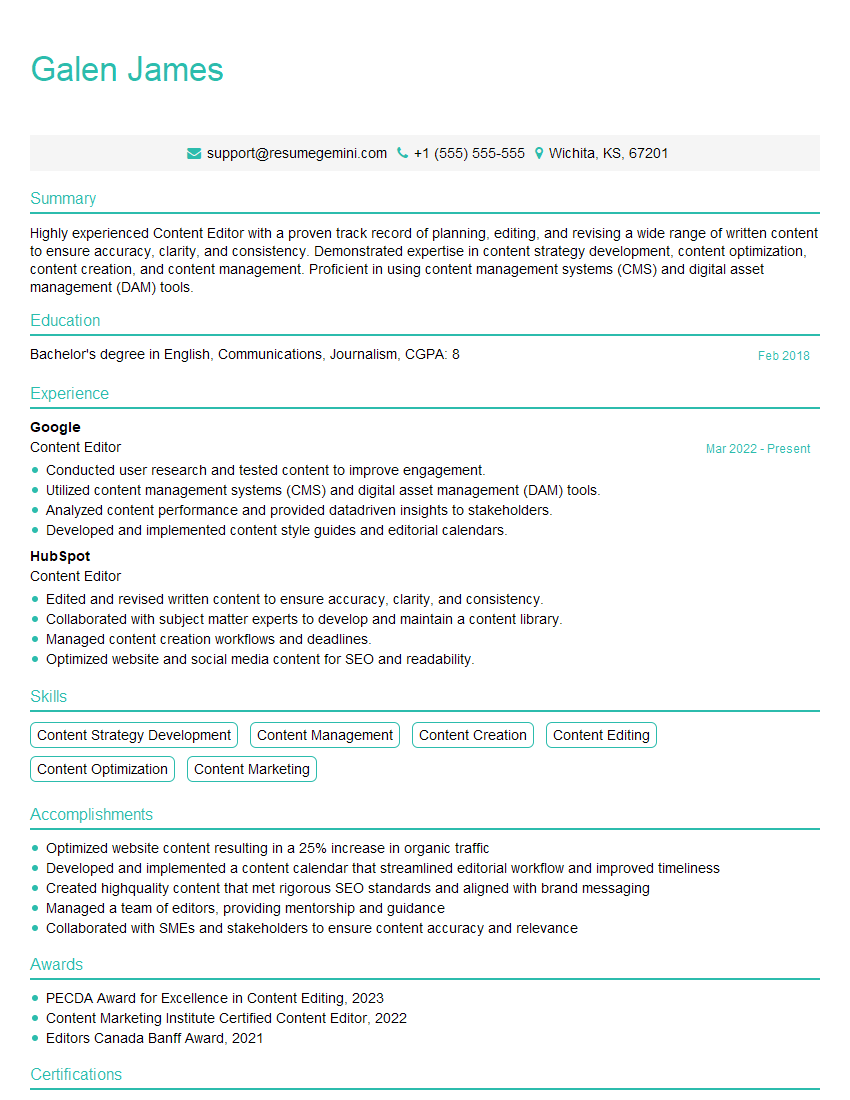
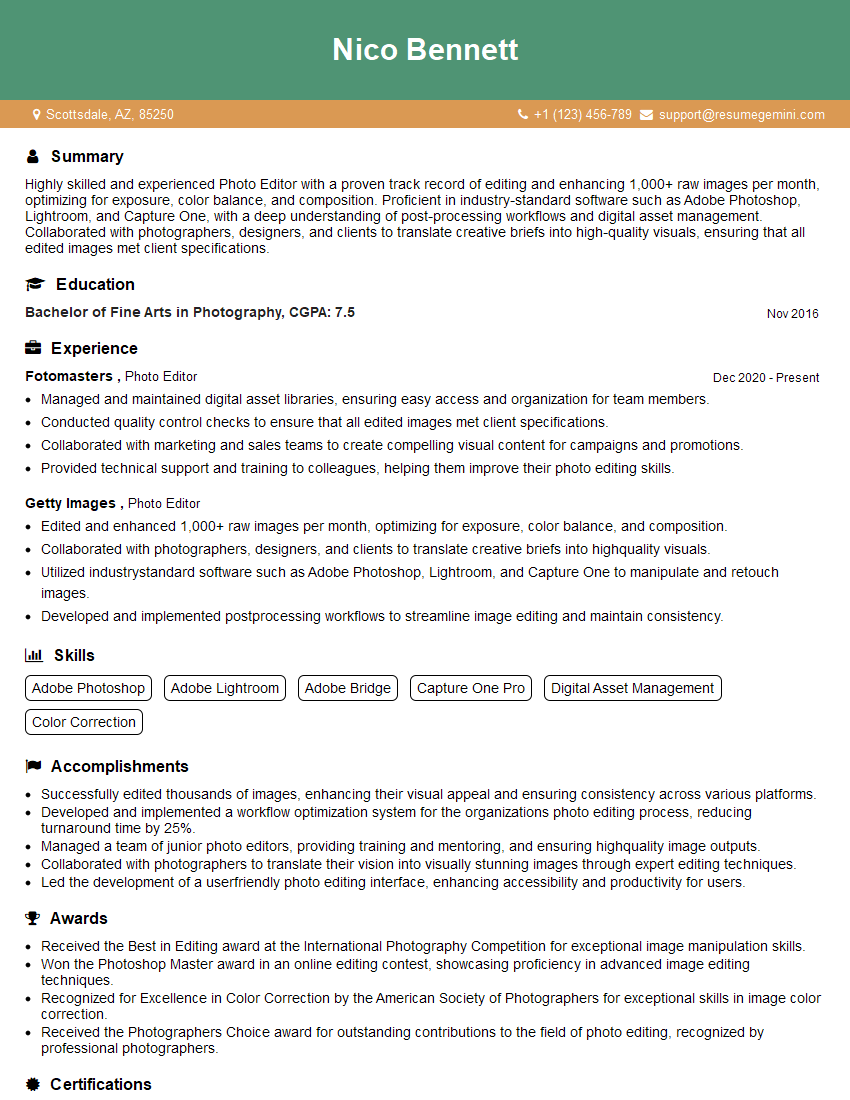
Mastering Image Editing and Optimization is crucial for a successful career in design, web development, and many other creative fields. A strong understanding of these techniques will significantly boost your employability and open doors to exciting opportunities. To maximize your job prospects, create an ATS-friendly resume that highlights your skills and experience effectively. ResumeGemini is a trusted resource that can help you build a professional and impactful resume. Examples of resumes tailored to Image Editing and Optimization are available to help you get started.
Crafting a tailored resume is the first step toward standing out in a competitive job market. Use ResumeGemini to align your skills and experience with the company’s needs, showcasing your expertise with precision and confidence.
We value your feedback! Please rate our content and share your thoughts (optional).
What Readers Say About Our Blog
hello,
Our consultant firm based in the USA and our client are interested in your products.
Could you provide your company brochure and respond from your official email id (if different from the current in use), so i can send you the client’s requirement.
Payment before production.
I await your answer.
Regards,
MrSmith
hello,
Our consultant firm based in the USA and our client are interested in your products.
Could you provide your company brochure and respond from your official email id (if different from the current in use), so i can send you the client’s requirement.
Payment before production.
I await your answer.
Regards,
MrSmith
These apartments are so amazing, posting them online would break the algorithm.
Take a look at this stunning 2-bedroom apartment perfectly situated NYC’s coveted Hudson Yards!
https://bit.ly/Lovely2BedsApartmentHudsonYards
Live Rent Free!
https://bit.ly/LiveRentFREE
Interesting Article, I liked the depth of knowledge you’ve shared.
Helpful, thanks for sharing.
Hi, I represent a social media marketing agency and liked your blog
Hi, I represent an SEO company that specialises in getting you AI citations and higher rankings on Google. I’d like to offer you a 100% free SEO audit for your website. Would you be interested?