Preparation is the key to success in any interview. In this post, we’ll explore crucial Drumming interview questions and equip you with strategies to craft impactful answers. Whether you’re a beginner or a pro, these tips will elevate your preparation.
Questions Asked in Drumming Interview
Q 1. Explain the different types of drum strokes and their applications.
Drum strokes are the fundamental building blocks of drumming, each producing a unique sound and feel. They are categorized by the way the stick interacts with the drumhead. Mastering various strokes is crucial for developing versatility and expression.
- Single Stroke Roll (RSR): Alternating right and left hand strokes. Think of a steady, even beat – essential for basic grooves and timekeeping.
R L R L R L - Double Stroke Roll (RLRL): Two strokes with each hand, creating a faster feel. This is foundational for building speed and control.
RR LL RR LL - Paradiddle (RLRR LRLL): A combination of single and double strokes, crucial for developing hand independence and coordination. It’s like a rhythmic workout for your hands.
R L R R L R L L - Flam (RL): A soft grace note (ghost note) followed by a stronger main note. This creates a syncopated, jazzy effect and enhances dynamics.
(R)L (L)R. The parenthesis indicates a softer, ghost note. - Ruff (RL): Similar to a flam but both notes are played at the same volume. This is often used for accents.
- Taps and drags: These involve bouncing the sticks off the drumhead while maintaining control for accents, fills and dynamic variations. These are incredibly expressive when used creatively.
Applications of these strokes are wide-ranging, from basic rock beats to complex jazz solos. For instance, a single stroke roll forms the foundation of many rock grooves, while paradiddles are frequently used in more intricate rhythms and solos. Flams add subtle nuances to a beat, particularly in jazz and funk styles.
Q 2. Describe your experience with various drum tuning techniques.
Drum tuning is an art form in itself. It’s not just about tightening the lugs; it’s about achieving a specific resonant frequency for each drum to match the desired sound and playing style. I’ve experimented with a variety of methods, from using tuning keys to employing electronic tuners for precision.
My approach typically involves a combination of ear tuning and digital tuning tools. I start by loosely tightening all lugs, then gradually tune each drum to a fundamental pitch, focusing on the tone I want to achieve. I often use a combination of listening for the desired resonance and also using an electronic tuner for accuracy, especially when tuning toms to specific pitches for creating complex polyrhythms or specific tonal colors.
I’ve learned to recognize the nuances of different drumheads – the tension needed to achieve a certain sound varies depending on the material and thickness. Over the years I have found specific head types and tuning strategies that work well for different musical genres. For example, thicker drum heads usually result in a fuller, deeper tone, while thinner heads provide a brighter, more snappy sound. Experimentation is key – I encourage everyone to listen carefully and find the sounds that resonate with them.
Q 3. How do you maintain proper posture and ergonomics while drumming?
Maintaining proper posture and ergonomics is crucial to prevent injuries and ensure long-term playing comfort. I always prioritize a relaxed but upright posture.
- Seated Posture: I sit upright with my feet flat on the floor, ensuring my knees are at a comfortable angle. This allows for free movement and keeps my back supported.
- Drum Height: The drum throne height is adjusted so my elbows are parallel to the floor when playing the snare. This prevents strain on my shoulders and arms.
- Stick Grip: I use a relaxed grip, allowing for controlled rebound and avoiding tension which can lead to injuries like carpal tunnel syndrome or tendonitis.
- Regular Breaks: Taking frequent breaks helps prevent fatigue and stiffness. A 5-minute break every hour is a beneficial practice.
Think of it like this: your body is an instrument too, and you need to treat it with respect. Proper technique ensures you can play for years to come without pain and injury. It also allows for a greater level of freedom in expression and dynamics.
Q 4. What are your preferred drum brands and why?
My preferred drum brands often depend on the specific application, but I have a strong affinity for Tama, Pearl, and DW Drums.
- Tama: I appreciate their build quality and the wide range of options available, from their Starclassic series to their more affordable Imperialstar line. They offer excellent value and versatility.
- Pearl: Known for their exceptional hardware and innovative features. Their Masters series is a top choice in many professional settings for it’s reliability and sound quality.
- DW Drums: DW drums are renowned for their exceptional quality and their custom options. They cater to a more high-end market but offer unparalleled sound and playability.
Ultimately, the ‘best’ brand is subjective and depends on individual preferences and budget. However, these brands consistently deliver high-quality drums that stand the test of time.
Q 5. Discuss your experience with different drum kits and configurations.
My experience spans various drum kit configurations, from basic rock setups to larger jazz kits with multiple toms. The ideal configuration always depends on the musical genre and the specific role within the band.
For rock, a standard 5-piece kit (bass drum, snare drum, hi-hat, one rack tom, and one floor tom) is usually sufficient. For jazz, I might opt for a larger kit with multiple toms, allowing for greater melodic and rhythmic complexity. I’ve also worked with smaller kits, which emphasize minimalism and precision. My preference always comes down to ensuring the drums I use enhance the music, not distract from it.
Recently I’ve experimented with hybrid kits, integrating electronic drums or percussion with acoustic instruments, opening up creative possibilities for a more unique sound. This experimentation keeps me challenged and creative in my drumming.
Q 6. How do you read and interpret drum sheet music?
Reading drum sheet music involves understanding a specific notation system that represents the rhythmic and melodic aspects of drumming. While standard musical notation is used, it’s adapted to show how and where the different drum parts should be played.
The staff shows the rhythm, typically using standard note and rest values. But instead of notes on lines and spaces, symbols indicate the drum that’s being struck (e.g., a circle for the snare, an ‘x’ for the bass drum, and various other symbols for cymbals and toms). Often a line is used to indicate which foot or hand is playing each part. A time signature dictates the rhythmic feel (e.g., 4/4 for common rock rhythms).
Understanding the context is important: analyzing the overall arrangement and understanding the style of music to best interpret the notation is key to producing the intended rhythmic and dynamic expression.
Q 7. Explain your approach to practicing rudiments and developing technique.
Rudiments are the foundation of drumming technique, like scales are for a guitarist or pianist. My practice routine involves systematic and deliberate work on these building blocks, focusing on controlled and consistent execution.
I start with slow tempos, emphasizing precision and proper technique over speed. Gradually, I increase the tempo as accuracy improves. I use a metronome religiously to develop a strong sense of timing and groove.
Beyond basic rudiments, I incorporate variations and combinations to challenge myself and develop musicality. I often use rudiments as a basis for improvisational exercises, applying them to different rhythmic contexts and playing different grooves. This allows for the development of speed, control, coordination, and creativity.
Practicing with a variety of drum types (acoustic, electronic) and different styles (rock, jazz, funk) enhances the applicability of the rudiments. The goal isn’t just technical proficiency, but to integrate the rudiments into spontaneous and expressive playing. It’s a continuous process of refining technique and developing musicality.
Q 8. Describe your experience working with other musicians in a band or ensemble setting.
Collaboration is the lifeblood of any successful musical ensemble. My experience working with other musicians spans various genres and settings, from small jazz trios to large rock bands. I believe in active listening – not just hearing the music, but understanding the nuances of each musician’s playing and adjusting my own accordingly. For example, in a jazz setting, I might need to be more responsive and improvisational, subtly shifting my rhythms to complement the soloist’s phrasing. In a rock band, a tighter, more driving beat is often required, providing a solid foundation for the other instruments. Effective communication is key; whether it’s discussing song arrangements beforehand, finding a comfortable dynamic balance during rehearsals, or offering constructive feedback, open dialogue fosters a positive and productive musical environment.
A memorable experience involved collaborating with a particularly dynamic guitarist who loved to incorporate complex, unexpected chord changes. Initially, it was challenging, but through careful listening and a willingness to experiment with different rhythmic approaches, we developed a symbiotic relationship where my drumming both supported and enhanced his improvisations. This process of mutual respect and creative exchange is crucial for achieving a cohesive and engaging musical performance.
Q 9. How do you adapt your drumming style to different musical genres?
Adapting my drumming style to different genres involves a deep understanding of each genre’s rhythmic characteristics and underlying feel. For instance, playing funk requires a strong emphasis on the pocket – that is, playing precisely on the beat with a groove that keeps the music moving. This often involves ghost notes and subtle rhythmic variations to create a syncopated feel. In contrast, playing progressive metal demands complex polyrhythms, odd time signatures, and blast beats, demanding technical proficiency and precision.
In jazz, the focus shifts towards improvisation and interaction with other musicians, requiring a keen sense of listening and responsiveness. I approach each genre by researching its history, listening to key artists, and practicing the rhythmic nuances specific to that style. The key is not simply mimicking the sounds but understanding the underlying principles and making them my own. Visualizing the rhythmic patterns and internalizing the feel are crucial elements of this adaptation process. For example, when transitioning from a straight 4/4 rock beat to a swung 4/4 jazz feel, the emphasis on the offbeat becomes prominent, altering the rhythmic placement of accents and note lengths.
Q 10. Explain your understanding of time signatures and rhythmic complexities.
Time signatures define the rhythmic structure of a piece of music, specifying the number of beats per measure and the type of note that receives one beat. Common time signatures include 4/4 (four beats per measure, quarter note gets one beat), 3/4 (three beats per measure, quarter note gets one beat) and 6/8 (six beats per measure, eighth note gets one beat). Rhythmic complexity arises from the interplay of different rhythmic patterns within a given time signature, often using syncopation (accents on offbeats), polyrhythms (simultaneous use of two or more different rhythmic patterns), and complex subdivisions of the beat.
Understanding time signatures is fundamental for playing in time and with the correct feel. For example, playing a 7/8 time signature requires a strong internalization of the rhythmic structure, which might involve grouping the seven eighth notes into different patterns (e.g., 2+2+3 or 3+2+2) to help maintain a steady pulse. Similarly, polyrhythms, such as playing a triplet pattern against a duplet pattern, demand precise coordination and a deep understanding of rhythmic ratios. I regularly practice challenging time signatures and polyrhythms to expand my rhythmic vocabulary and strengthen my sense of time.
Q 11. How do you troubleshoot drum kit malfunctions during a performance?
Troubleshooting drum kit malfunctions during a performance requires a combination of preparedness, quick thinking, and a degree of improvisation. Before any performance, I conduct a thorough check of my kit, ensuring all drums and cymbals are securely mounted, heads are properly tuned, and hardware is functioning correctly. I also carry a small toolkit with essential items like drum keys, spare sticks, and a multi-tool.
If a problem arises during a performance, my approach is systematic: First, I assess the severity of the issue. A broken cymbal can often be temporarily replaced with another; a snapped drumhead might require a quick change if possible, or the affected drum can be strategically avoided until the end of the set. If a pedal malfunctions, I might need to adapt my playing to minimize reliance on the affected pedal. Communication with the band is crucial in adjusting the setlist or improvising around the problem. Experience helps in developing quick solutions, but a calm and focused mindset is essential to avoid further complications.
Q 12. Describe your experience with microphone placement and sound reinforcement for drums.
Microphone placement and sound reinforcement are crucial for achieving a balanced and impactful drum sound. Proper mic placement can drastically affect the overall tone and clarity of each drum and cymbal. Typically, a kick drum is miked internally with a dynamic microphone to capture the low-frequency thump, while snare drums benefit from a combination of dynamic and condenser microphones to capture both the punch and the overtones. Toms often use condenser mics for their clearer, more detailed sound.
Overhead microphones capture the overall ambience and stereo image of the drum kit. The choice of microphone type and their positioning relative to the drums significantly impacts the final sound, influencing elements such as the level of bleed (unwanted sound from other instruments), the stereo width, and the overall tone. In a professional recording studio, careful consideration is given to acoustic treatment and sound isolation to minimize external noise and achieve a pristine sound. I have significant experience working with various sound engineers to optimize the sound of my drum kit, from adjusting mic placement to fine-tuning the EQ and compression in the mixing console.
Q 13. How do you handle stage fright or performance anxiety?
Stage fright, or performance anxiety, is a common experience for many musicians, myself included. I manage it through a combination of preparation, mindfulness, and positive self-talk. Thorough rehearsal is fundamental – the more comfortable I am with the material, the less anxious I feel on stage. I also practice relaxation techniques, such as deep breathing exercises, to calm my nerves before a performance.
Focusing on the music itself helps me to transcend my anxiety. The energy of the performance, the connection with my bandmates, and the interaction with the audience can be incredibly rewarding and help to alleviate any initial nervousness. Visualizing a successful performance and focusing on the positive aspects of playing music can help shift the mental focus away from negative self-doubt. Remembering to enjoy the experience and the creative process is a crucial aspect of overcoming stage fright.
Q 14. Discuss your approach to recording drums in a studio setting.
Recording drums in a studio setting requires a meticulous and systematic approach. The process begins with careful preparation, including tuning the drums to the desired pitch, selecting the appropriate microphones for each drum and cymbal, and planning the placement of those mics relative to the drums. The goal is to capture a balanced, clear sound for each drum element.
Different recording techniques can be employed, from close miking for detailed capture of individual drum sounds to the use of overhead mics to achieve a wider stereo image. The use of isolation booths and acoustic treatment helps in eliminating unwanted noise. After the initial recording, I often work with the producer and engineer to fine-tune the drum sounds through EQ, compression, and other effects. The process of tracking and mixing drums requires a strong understanding of both acoustic principles and audio engineering techniques. Ultimately, the success of a drum recording depends on the collaboration between the drummer, the engineer, and the producer to achieve a cohesive and impactful sound that serves the overall vision of the song.
Q 15. What is your experience with drum programming and sequencing software?
My experience with drum programming and sequencing software is extensive. I’m proficient in several DAWs (Digital Audio Workstations), including Logic Pro X, Ableton Live, and Pro Tools. I’m not just comfortable using the MIDI editor to input drum parts; I understand the nuances of sound design and sample manipulation within these programs. This allows me to create unique and expressive drum sounds beyond what’s available in pre-made kits. For example, I frequently use layering and processing techniques to achieve specific sonic textures – perhaps a bright, snappy snare layered with a darker, more resonant one for a nuanced, full sound. I also use these programs for arranging and composing entire drum tracks, experimenting with different groove styles and time signatures, and building complex rhythmic patterns from the ground up. Beyond the basic input of notes, I’m adept at using automation to create dynamic changes in volume, pan, and effects throughout a track, adding subtle movement and interest.
Career Expert Tips:
- Ace those interviews! Prepare effectively by reviewing the Top 50 Most Common Interview Questions on ResumeGemini.
- Navigate your job search with confidence! Explore a wide range of Career Tips on ResumeGemini. Learn about common challenges and recommendations to overcome them.
- Craft the perfect resume! Master the Art of Resume Writing with ResumeGemini’s guide. Showcase your unique qualifications and achievements effectively.
- Don’t miss out on holiday savings! Build your dream resume with ResumeGemini’s ATS optimized templates.
Q 16. Explain your understanding of dynamics and their role in musical expression.
Dynamics are the variations in loudness and intensity within a musical performance. They are absolutely crucial for musical expression, as they add emotion, shape phrases, and create a sense of movement and drama. Think of it like speaking – you wouldn’t speak every word at the same volume, would you? Dynamics add the same nuance to music. A soft, delicate roll can build to a powerful crescendo, expressing increasing tension and excitement. Conversely, a strong, driving beat can soften to a whisper, creating a sense of intimacy or reflection. I utilize dynamics in my playing by controlling my stick technique, footwork, and the force I apply to the drums. For instance, I might use ghost notes (very soft notes played for textural effect) to add subtlety to a quiet passage, or utilize full power strokes for forceful emphasis. Understanding and applying dynamics effectively allows me to communicate a wide range of emotions and musical ideas to the listener.
Q 17. Describe your experience with improvisation and soloing on the drums.
Improvisation and soloing are integral parts of my drumming style. I’ve honed my skills through years of practice and performance, developing a strong understanding of rhythmic vocabulary, melodic phrasing, and dynamic control. My approach to improvisation is not just about random note choices; it’s about creating a compelling narrative. I often begin with a simple rhythmic motif and gradually develop it, adding variations, syncopations, and fills. I frequently incorporate elements of other musical genres, drawing inspiration from jazz, funk, and even classical music. I find that a strong foundation in rudiments and rhythmic patterns provides the structure for spontaneous creativity. For example, while soloing, I might use a paradiddle-diddle as a starting point, then layer in ghost notes, flams, and rolls to build complexity. The key is listening carefully and responding intuitively to the music around me, whether it’s a band or a backing track.
Q 18. How do you develop your creative musical ideas while playing drums?
Developing creative musical ideas on the drums involves a multi-faceted approach. It starts with listening: actively listening to music from various genres, analyzing drum parts, and trying to understand what makes them work. I also spend time experimenting on the kit, playing around with different rhythmic ideas, exploring different drum sounds, and discovering new ways to use dynamics and groove. I find that sketching ideas out on paper or using notation software can be very helpful. Collaborating with other musicians is another essential element of my creative process. Jamming sessions, even informal ones, allow for spontaneous musical exploration and can spark new ideas. Furthermore, I constantly seek out opportunities for growth by taking workshops, studying transcriptions of drum solos, and learning from other drummers. Taking these different approaches allows me to stay creative and continually develop my musical voice.
Q 19. How do you handle constructive criticism and feedback on your drumming?
I view constructive criticism as an invaluable tool for improvement. I actively seek feedback from trusted mentors, fellow musicians, and even audience members. My approach to receiving criticism involves actively listening, seeking to understand the perspective of the person offering the feedback, and not taking it personally. I don’t dismiss criticism out of hand; rather, I analyze it thoughtfully. For example, if someone points out inconsistencies in my timing, I would focus on practicing exercises to improve my timekeeping. If the feedback involves my dynamics, I’d analyze recordings of my playing to identify areas for improvement. Ultimately, I use constructive criticism as a blueprint for growth, transforming it into opportunities to strengthen my skills and refine my artistic expression. The goal is continuous improvement.
Q 20. What are some of your favorite drum solos or drummers, and why?
Choosing just a few favorite drum solos or drummers is difficult, as there are so many inspiring artists! However, some of the drummers that have profoundly impacted my playing include John Bonham (Led Zeppelin), for his power, groove, and sheer creativity; Stewart Copeland (The Police), for his inventive rhythmic ideas and syncopation; and Ginger Baker (Cream), for his incredible feel and technical proficiency. I’m drawn to these artists because their playing transcends mere technical ability; it’s full of emotion, creativity, and an unmistakable personal style. Their solos often incorporate elements of surprise and unexpected turns, while always serving the song. I frequently study their performances, listening for nuances and techniques to learn from. It’s about studying the way they build intensity, manipulate dynamics, and tell a story through their playing – qualities that inspire me to constantly strive for greater musical expression.
Q 21. Describe your experience with teaching or mentoring other drummers.
I have significant experience teaching and mentoring other drummers. I’ve taught students of all ages and skill levels, from complete beginners to advanced players pursuing professional careers. My teaching philosophy emphasizes a holistic approach. It’s not simply about technical proficiency; it’s about fostering a love for music and developing a strong musical foundation. My lessons cover a range of topics, including rudiments, groove development, reading music, soloing techniques, and understanding the role of the drums within various musical contexts. I adapt my teaching methods to suit the individual student’s needs, goals, and learning style. I find that building a strong rapport with my students is key; creating a supportive and encouraging environment allows them to feel comfortable taking risks, making mistakes, and ultimately progressing as musicians. Mentoring involves guiding their musical journey, helping them to discover their own voice and approach to drumming.
Q 22. What are your strengths and weaknesses as a drummer?
My greatest strength as a drummer lies in my ability to adapt to diverse musical styles and seamlessly integrate into different band dynamics. I’m proficient in reading charts quickly and accurately, translating complex rhythmic notations into a fluid and expressive performance. I also excel at building strong musical relationships with other musicians, fostering a collaborative and supportive atmosphere. A weakness I’m actively working on is developing even greater proficiency in complex polyrhythms. While I can execute them, improving my speed and precision in these areas will elevate my playing to another level. This is something I’m actively addressing through focused practice and engaging with challenging material.
Q 23. How do you stay updated on new drumming techniques and trends?
Staying current in the drumming world requires a multi-faceted approach. I regularly attend workshops and masterclasses by leading drummers, which allows for direct interaction and learning. I actively subscribe to drumming magazines, both print and digital, and follow prominent drummers and educators on social media platforms like YouTube and Instagram. This exposes me to a wide range of styles, techniques, and new equipment. Critically, I actively listen to a vast range of music, analyzing the drumming in diverse genres to identify and learn new approaches to rhythm, feel, and dynamics. I view continuous learning as an essential part of being a professional musician.
Q 24. How do you manage your practice schedule and maintain a high level of skill?
Maintaining a high level of skill demands a structured and consistent practice regimen. My typical week includes dedicated practice sessions focusing on different aspects of drumming. One day might focus on rudiments and technical exercises, the next on groove development within a specific genre, and another on incorporating new techniques learned from recent workshops or research. I always incorporate warm-up exercises to prevent injuries and ensure proper hand and foot technique. I also believe in the importance of rest and recovery, avoiding over-practicing, which can lead to burnout and hinder progress. Regular performance opportunities, whether in rehearsals or gigs, provide invaluable real-world experience that complements and enhances my practice sessions. It’s about finding a balance that allows for both focused development and sustaining my passion for music.
Q 25. Describe your experience with different drum styles (e.g., rock, jazz, funk).
My drumming experience spans a broad spectrum of styles. In rock, my focus is on powerful, driving grooves and precise fills, often drawing inspiration from drummers like John Bonham and Neil Peart. In jazz, I emphasize rhythmic complexity and improvisation, drawing from the styles of Elvin Jones and Art Blakey. The nuances of swing feel are paramount, requiring focus on subtle variations in timing and dynamics. My funk experience involves honing my ability to create infectious grooves using ghost notes and syncopation. Drummers like Clyde Stubblefield and Steve Gadd have heavily influenced this style, emphasizing tight pocket and an undeniable groove. I aim to bring the energy and precision of each style into my performance.
Q 26. Explain your understanding of groove and feel in drumming.
Groove and feel are intertwined concepts central to expressive drumming. Groove refers to the rhythmic pulse and energy of a performance, while feel encompasses the subtle variations in timing and dynamics that give a performance its character and emotion. A strong groove is built on a solid foundation of timekeeping, but feel is what elevates a performance from merely correct to truly captivating. Feel is often described as ‘playing in the pocket,’ which means anticipating the musical phrase, playing slightly ahead or behind the beat in a way that complements the music. It’s about creating a sense of swing or lilt, giving the rhythm a natural, almost human-like quality. I strive for a groove that is both infectious and nuanced, using subtle variations in dynamics, ghost notes, and accents to create a unique sonic landscape.
Q 27. How do you maintain your drum equipment and ensure it’s always in optimal condition?
Maintaining my drum equipment is crucial for consistent and high-quality performance. After every session or gig, I thoroughly wipe down my drums and hardware, removing sweat and dust. I regularly inspect heads for wear and tear, replacing them as needed to maintain optimal tone and responsiveness. I keep my cymbals polished to prevent corrosion and maintain their brilliance. I also regularly lubricate moving parts like pedals and hi-hat stands, ensuring smooth and reliable action. For more involved maintenance, such as bearing edge work or shell repairs, I consult with a qualified drum technician. This preventative maintenance ensures my equipment is consistently in peak condition, allowing me to focus solely on my performance.
Q 28. What are your salary expectations for this role?
My salary expectations for this role are commensurate with my experience and skill set, and competitive within the industry. Considering my expertise in various drumming styles, my extensive performance history, and my dedication to ongoing professional development, I’m seeking a salary in the range of [Insert Salary Range Here]. However, I am open to discussing this further based on the specifics of the role and the overall compensation package.
Key Topics to Learn for Your Drumming Interview
- Rudiments and Technique: Mastering basic drum rudiments and applying them to various musical contexts. Demonstrate understanding of grip, stroke techniques, and dynamics.
- Time and Groove: Discuss your understanding of rhythmic concepts, including subdivisions, syncopation, and polyrhythms. Show how you apply these to create a solid groove and maintain accurate timing.
- Reading and Sight-Reading: Explain your proficiency in reading drum notation and your ability to sight-read new music effectively. Prepare examples to showcase your skills.
- Styles and Genres: Highlight your expertise in various drumming styles (e.g., jazz, rock, funk, Latin). Discuss how your approach adapts to different musical genres and contexts.
- Listening and Musicality: Explain your ability to listen critically to music, identify rhythmic and melodic elements, and apply that understanding to your own drumming. Discuss your approach to musical phrasing and interpretation.
- Equipment and Maintenance: Demonstrate knowledge of different drum kits, cymbals, and other percussion instruments. Discuss basic maintenance and setup procedures.
- Ensemble Playing and Collaboration: Discuss your experience playing with other musicians, emphasizing your ability to listen, communicate, and contribute effectively within a group setting.
- Improvisation and Creativity: Share your approaches to improvising drum parts. Showcase your ability to develop your own unique drumming style and contribute creative ideas to musical projects.
Next Steps
Mastering drumming is key to unlocking exciting career opportunities in music performance, education, recording studios, and beyond. To maximize your job prospects, it’s crucial to present your skills effectively. An ATS-friendly resume is essential for getting your application noticed. We recommend using ResumeGemini to build a professional and impactful resume that highlights your unique drumming abilities. ResumeGemini provides examples of resumes tailored to the drumming industry, giving you a head start in creating a compelling application.
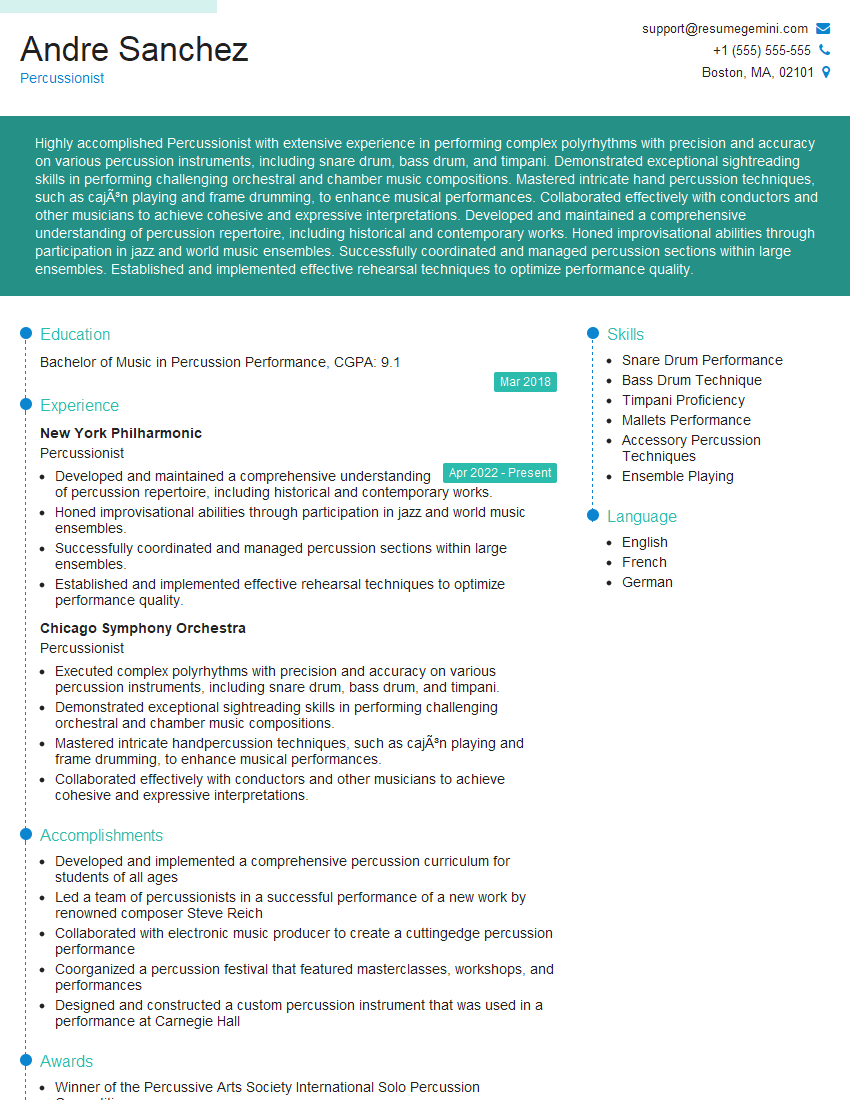
Explore more articles
Users Rating of Our Blogs
Share Your Experience
We value your feedback! Please rate our content and share your thoughts (optional).
What Readers Say About Our Blog
hello,
Our consultant firm based in the USA and our client are interested in your products.
Could you provide your company brochure and respond from your official email id (if different from the current in use), so i can send you the client’s requirement.
Payment before production.
I await your answer.
Regards,
MrSmith
hello,
Our consultant firm based in the USA and our client are interested in your products.
Could you provide your company brochure and respond from your official email id (if different from the current in use), so i can send you the client’s requirement.
Payment before production.
I await your answer.
Regards,
MrSmith
These apartments are so amazing, posting them online would break the algorithm.
https://bit.ly/Lovely2BedsApartmentHudsonYards
Reach out at [email protected] and let’s get started!
Take a look at this stunning 2-bedroom apartment perfectly situated NYC’s coveted Hudson Yards!
https://bit.ly/Lovely2BedsApartmentHudsonYards
Live Rent Free!
https://bit.ly/LiveRentFREE
Interesting Article, I liked the depth of knowledge you’ve shared.
Helpful, thanks for sharing.
Hi, I represent a social media marketing agency and liked your blog
Hi, I represent an SEO company that specialises in getting you AI citations and higher rankings on Google. I’d like to offer you a 100% free SEO audit for your website. Would you be interested?