Every successful interview starts with knowing what to expect. In this blog, we’ll take you through the top Lighting Design and Equipment interview questions, breaking them down with expert tips to help you deliver impactful answers. Step into your next interview fully prepared and ready to succeed.
Questions Asked in Lighting Design and Equipment Interview
Q 1. Explain the difference between incandescent, fluorescent, and LED lighting.
Incandescent, fluorescent, and LED lighting represent distinct generations of lighting technology, each with its own strengths and weaknesses. Incandescent lights produce light by heating a filament until it glows. They are simple, inexpensive, and produce a warm, inviting light, but they are highly inefficient, converting most energy into heat rather than light, and have a short lifespan.
Fluorescent lights, on the other hand, generate light by passing an electric current through a gas, causing it to emit ultraviolet (UV) radiation that then excites a phosphor coating inside the tube, producing visible light. They are more energy-efficient than incandescent lights and have a longer lifespan, but they can be bulky, take time to reach full brightness, and the light quality can appear somewhat cold and harsh.
LEDs (Light Emitting Diodes) are semiconductor devices that emit light when an electric current passes through them. They are the most energy-efficient of the three, have a very long lifespan, are available in a wide range of color temperatures and can be easily dimmed. While initially more expensive, their long lifespan and low energy consumption often lead to lower overall costs.
Think of it like this: incandescent is like a traditional wood-burning stove – warm, cozy, but inefficient. Fluorescent lighting is like a modern gas furnace – more efficient, but maybe not as inviting. LEDs are like a heat pump – highly efficient and versatile.
Q 2. Describe the principles of color temperature and its impact on lighting design.
Color temperature, measured in Kelvin (K), describes the appearance of light, ranging from warm to cool. Lower Kelvin values (e.g., 2700K) represent warmer, more yellowish light, reminiscent of incandescent bulbs, while higher values (e.g., 6500K) represent cooler, bluish light similar to daylight. This significantly impacts lighting design because different color temperatures evoke different moods and are suitable for various applications.
For example, a warm color temperature (2700K-3000K) is often used in residential settings like living rooms and bedrooms to create a relaxing and comfortable ambiance. Cooler color temperatures (4000K-6500K) are more suitable for workplaces or retail spaces where higher levels of alertness and task performance are desired. Incorrect color temperature can drastically impact the atmosphere and even the perceived size of a space. A very cool light can make a space feel sterile, while overly warm light can make it feel cramped.
Choosing the right color temperature is a critical decision in lighting design, carefully considering the function and desired atmosphere of the space.
Q 3. What are the different types of dimming systems and their applications?
Dimming systems control the intensity of light, offering flexibility and energy savings. Several types exist, each with specific applications:
- Incandescent Dimmers: These are simple and inexpensive, using a resistor to reduce the voltage supplied to the bulb. However, they are only compatible with incandescent bulbs and are not energy-efficient.
- Triac Dimmers: These are commonly used for incandescent and some halogen lamps. They switch the voltage on and off rapidly to control the light intensity, resulting in some flickering in some lamps.
- 0-10V Dimmers: These utilize a control signal between 0 and 10 volts to adjust light intensity. They are more reliable and energy-efficient than triac dimmers and often used with fluorescent and LED lights.
- DALI (Digital Addressable Lighting Interface): This digital protocol provides individual control of multiple lights using a network. It allows for advanced features like scene setting, group control, and feedback on light status. Very versatile and efficient.
- DMX (Digital Multiplex): Primarily used in theatrical and architectural lighting, DMX offers precise control over a large number of fixtures and offers more sophisticated lighting effects.
The choice of dimming system depends on the type of lighting fixtures, budget, and the desired level of control and features. For a simple residential application, a triac dimmer might suffice. However, for larger commercial projects requiring sophisticated control, DALI or DMX systems would be more appropriate.
Q 4. How do you calculate the required lighting levels for a specific space?
Calculating required lighting levels involves considering several factors. The most common method uses the Illuminating Engineering Society (IES) recommended illuminance levels for various spaces. This is expressed in lux (lx), which is lumens per square meter.
The process generally involves:
- Determine the space type: Different spaces (office, retail, residential) have different recommended illuminance levels.
- Find the recommended illuminance: Consult IES publications or other lighting design guidelines for the appropriate lux level for your space type.
- Calculate the area: Measure the area of the space you need to illuminate.
- Determine the light fixture efficacy (lumens/watt): This information is provided by the manufacturer of your light fixture.
- Consider light loss factors: Account for factors such as light absorption by walls, furniture, and dirt accumulation. These are usually expressed as percentages.
- Calculate the required lumens: Multiply the area by the desired illuminance level and the light loss factor to determine the total lumens required.
- Calculate the number of fixtures: Divide the total required lumens by the output of a single fixture.
For example: If an office requires 500 lx, the area is 100 square meters, the light loss factor is 70%, and the fixture emits 3000 lumens, you would need approximately 1.17 fixtures (500 lx * 100 m² * 1.3 = 65000 lumens / 3000 lumens/fixture ≈ 22 fixtures). You’d then round up to the nearest whole number.
Q 5. Explain the concept of illuminance and luminance.
Illuminance and luminance are both measures of light, but they describe different aspects. Illuminance measures the amount of light falling on a surface, while luminance measures the amount of light emitted or reflected from a surface in a specific direction.
Illuminance is measured in lux (lx) and describes the intensity of light incident on a surface. Imagine shining a flashlight on a wall – the illuminance is how bright the light is on that specific area of the wall.
Luminance is measured in candelas per square meter (cd/m²) or nits and describes the brightness of a surface as perceived by the observer. This takes into account not just the light falling on the surface but also how much light is reflected or emitted by the surface and the angle of view. Think of the same flashlight on the wall; the luminance would be how bright that spot on the wall *appears* to your eye.
A high illuminance doesn’t necessarily mean high luminance; a highly reflective surface will have a higher luminance than a dark surface under the same illuminance.
Q 6. What are the common lighting design software programs you are proficient in?
I am proficient in several lighting design software programs, including:
- Dialux evo: A widely used software for lighting calculations and simulations, offering features like daylight analysis and energy efficiency assessments.
- Relux: Another powerful software that provides similar capabilities to Dialux, including advanced lighting simulations and energy analysis.
- AgI32: A very powerful and flexible software for complex lighting simulations and design.
- Autodesk Revit: While primarily a BIM (Building Information Modeling) software, Revit integrates well with lighting design workflows allowing for coordinated design.
My experience with these programs allows me to create accurate lighting designs, optimize energy efficiency, and visualize the final lighting scheme before implementation, minimizing errors and ensuring client satisfaction.
Q 7. Describe your experience with lighting control systems (e.g., DMX, DALI).
I have extensive experience with lighting control systems like DMX and DALI. DMX, using a robust protocol with 512 channels, provides precise control over individual lighting fixtures, commonly used in theatrical settings, architectural lighting, and entertainment venues. I’ve worked on projects integrating DMX to create dynamic lighting shows, synchronized to music or other events, requiring precise control and synchronization.
DALI, on the other hand, offers a more scalable and network-based solution for commercial and residential lighting applications. It allows for individual addressing of lights and facilitates complex scene settings, group control, and energy management strategies. I’ve utilized DALI in large commercial buildings to implement energy-saving strategies and create flexible lighting scenarios that could be controlled remotely.
My proficiency extends to troubleshooting these systems, programming control sequences, and integrating them with building management systems (BMS), ensuring optimal performance and efficiency.
Q 8. How do you address lighting challenges in different architectural styles?
Addressing lighting challenges in different architectural styles requires a deep understanding of how light interacts with materials, shapes, and the overall aesthetic. For instance, a minimalist modern design might benefit from clean lines and integrated lighting, possibly using recessed LED fixtures for a seamless look. In contrast, a traditional Victorian home might call for more ornate fixtures, perhaps chandeliers and wall sconces, to highlight architectural details and create a warmer ambiance. The key is to carefully consider the style’s defining characteristics and use lighting to enhance, not detract from them.
- Modern Architecture: Emphasizes clean lines and functionality. Lighting solutions often include recessed lighting, track lighting, and linear LED fixtures to highlight architectural features and create a minimalist aesthetic.
- Traditional Architecture: Features ornate details and a sense of history. Lighting choices often incorporate chandeliers, pendant lights, wall sconces, and table lamps to enhance the richness and elegance of the space.
- Contemporary Architecture: Blends modern and traditional elements. Lighting designs integrate various fixtures, using layers of ambient, accent, and task lighting to create a flexible and dynamic atmosphere.
Ultimately, successful lighting design is about understanding the architectural style and using lighting to complement its unique qualities. It’s a delicate balance between form and function, where the lighting enhances the space’s character without overpowering it. For example, in a rustic farmhouse, I might use exposed filament bulbs in pendant lights to create a warm, inviting atmosphere, whereas a sleek, contemporary office building would benefit from the efficiency and clean look of LED panels.
Q 9. Explain your understanding of energy-efficient lighting solutions.
Energy-efficient lighting solutions are crucial for both environmental responsibility and cost savings. This involves selecting fixtures and lamps with high energy efficiency ratings and employing smart control systems. Key aspects include:
- High-efficiency lighting sources: LEDs (Light Emitting Diodes) are the clear leader, offering significantly higher lumens per watt compared to traditional incandescent or fluorescent bulbs. We also consider OLEDs (Organic Light Emitting Diodes) for specific applications needing very thin and flexible light sources.
- Efficient fixture design: Choosing fixtures that minimize light loss through effective reflectors and diffusers is key. Properly designed fixtures maximize the light output and minimize wasted energy.
- Smart controls: Dimming systems, occupancy sensors, and daylight harvesting strategies significantly reduce energy consumption by only illuminating spaces when and where needed. For instance, a system that automatically dims the lights when natural daylight is sufficient is a powerful energy saver.
- Daylight optimization: Maximizing the use of natural daylight is paramount. Strategic window placement and the use of light shelves can reduce the need for artificial lighting during the day.
In a recent project, we integrated occupancy sensors and daylight harvesting in an office building, resulting in a 40% reduction in energy consumption compared to a similar building without these features. The initial investment in smart controls quickly pays off through long-term energy savings.
Q 10. How do you incorporate sustainable practices in your lighting designs?
Incorporating sustainable practices in lighting designs goes beyond simply using energy-efficient bulbs. It encompasses the entire lifecycle of the lighting system, from material sourcing to disposal. This includes:
- Material selection: Choosing fixtures made from recycled or sustainably sourced materials is important. This minimizes the environmental impact of manufacturing.
- Energy efficiency: As mentioned before, selecting high-efficiency lighting sources and controls is vital. This reduces operational energy consumption significantly.
- Long lifespan components: Prioritizing fixtures with long-lasting LEDs and durable components reduces the frequency of replacements and minimizes waste generation.
- Recyclable materials: Specifying fixtures designed for easy disassembly and recycling at the end of their lifespan is crucial for responsible waste management.
- Reduced light pollution: Implementing shielded fixtures and aiming light downward to prevent light trespass significantly reduces negative environmental impacts associated with light pollution. This preserves the night sky and safeguards wildlife.
For example, in a recent project, we specified fixtures with a high percentage of recycled aluminum and ensured that the chosen LEDs had a minimum lifespan of 50,000 hours, drastically reducing replacement needs. This holistic approach ensures the lighting system aligns with broader sustainability goals.
Q 11. Describe your experience with lighting simulations and renderings.
Lighting simulations and renderings are invaluable tools in the design process. Software like DIALux evo, AGi32, and Lumion allows us to visualize the lighting scheme’s impact on a space before installation. This helps prevent costly mistakes and ensures the final result aligns with the design intent.
These tools enable us to:
- Precisely model the space: We import architectural plans and 3D models to create accurate representations.
- Simulate various lighting scenarios: We can experiment with different fixture types, placements, and intensities to optimize the lighting effect.
- Analyze illuminance levels: We ensure compliance with lighting codes and standards by analyzing the luminance and illuminance levels across the space.
- Create photorealistic renderings: These renderings effectively communicate the design concept to clients and stakeholders.
In one project, using a lighting simulation program, we identified a potential glare issue in a large atrium before construction. By adjusting fixture placement and shielding, we eliminated the problem in the design phase, saving considerable time and cost. The simulations provide a risk-mitigation strategy that reduces costly revisions during construction or after occupancy.
Q 12. What are your strategies for managing lighting projects within budget and timeline?
Managing lighting projects within budget and timeline requires careful planning and execution. This involves:
- Detailed budgeting: Creating a comprehensive budget that includes all costs, from fixture purchase and installation to labor and software licenses. This usually involves close collaboration with contractors.
- Realistic scheduling: Developing a realistic project schedule that considers procurement lead times, installation timelines, and potential delays. Using project management software for monitoring and reporting progress is crucial.
- Value engineering: Exploring cost-effective alternatives without compromising quality or design intent. This could involve selecting slightly less expensive fixtures with comparable performance or using innovative control systems.
- Regular monitoring and reporting: Tracking progress against the budget and schedule and reporting any variances to the relevant stakeholders. This ensures timely intervention if any issues arise.
- Contingency planning: Allocating a portion of the budget for unforeseen expenses and delays. This prevents budget overruns and ensures project completion within the stipulated timeframe.
In a recent project, we utilized a value engineering approach by switching to a more cost-effective LED fixture without compromising performance. This allowed us to stay within the budget while achieving the desired lighting quality.
Q 13. How do you collaborate with architects, engineers, and other stakeholders?
Collaboration is essential in lighting design. I work closely with architects, engineers, contractors, and clients to ensure a cohesive and successful project. This includes:
- Regular communication: Maintaining open and frequent communication with all stakeholders through meetings, email, and project management software. This ensures everyone is informed and aligned with the design’s progress.
- Coordination meetings: Holding regular coordination meetings with all project team members to address any design or technical challenges and ensure seamless integration with other building systems.
- Sharing design documents: Providing all stakeholders with up-to-date design drawings, specifications, and renderings. This fosters transparency and prevents misunderstandings.
- Active listening: Listening attentively to feedback from all parties involved and incorporating valuable insights into the design. This ensures the final design satisfies the needs of all stakeholders.
- Constructive feedback: Providing clear and concise feedback to architects and engineers on the feasibility of their design concepts with respect to lighting. This includes highlighting potential design conflicts, energy efficiency improvements, and construction concerns.
In one particular instance, collaborating closely with the structural engineer early in the design phase, we were able to successfully incorporate lighting fixtures into the building’s structural elements, avoiding costly post-construction modifications and ensuring a seamless integration of aesthetics and structural integrity.
Q 14. Explain your troubleshooting experience with lighting equipment malfunctions.
Troubleshooting lighting equipment malfunctions requires a systematic approach. My experience involves:
- Identifying the problem: The first step is to accurately pinpoint the source of the malfunction. Is the problem a single fixture, a circuit, or a broader system issue? This often includes checking fuses, circuit breakers, and power supplies.
- Testing and diagnostics: Utilizing multimeters and other testing equipment to check voltage, current, and continuity. We also utilize specialized software to diagnose control system issues.
- Identifying the cause: Once the problem is located, we diagnose the cause—is it a faulty fixture, a wiring problem, or a damaged component?
- Implementing the solution: This could involve replacing a faulty fixture, repairing damaged wiring, or replacing a malfunctioning component. Depending on the severity of the problem and the availability of replacement parts, this can range from a simple swap to more involved repair work.
- Preventative maintenance: Recommending preventative maintenance measures to prevent future issues. This includes regular inspections, cleaning, and testing of lighting systems. We encourage this preventive approach to extend equipment life and minimize unexpected downtimes.
For example, I once encountered a situation where an entire floor’s lighting was out. Through systematic troubleshooting, we discovered a blown main circuit breaker caused by an overloaded circuit. This was quickly resolved by redistributing the load, preventing significant disruption and financial losses.
Q 15. How do you ensure lighting safety compliance in your designs?
Ensuring lighting safety compliance is paramount in my designs. It’s not just about avoiding accidents; it’s about creating a responsible and enjoyable environment. My approach involves a multi-stage process starting with a thorough risk assessment. This identifies potential hazards, such as improper wiring, inadequate insulation, or incorrect fixture placement. I meticulously select fixtures that meet relevant safety standards, including certifications like UL (Underwriters Laboratories) or ETL (Intertek Testing Services). These certifications guarantee the product has met rigorous safety tests.
Next, I design the system to adhere to national and local electrical codes. This includes using the correct gauge wire, ensuring proper grounding, and implementing appropriate circuit protection (breakers, GFCIs). I also consider potential heat build-up, particularly in enclosed spaces, and specify fixtures with adequate thermal management. Finally, documentation is crucial. My designs include detailed schematics, specifications, and installation instructions that clearly outline safety protocols. This ensures that electricians and maintenance personnel understand and follow the necessary safety measures.
For example, in a recent museum project, we used low-voltage LED lighting embedded in the display cases. This minimized the risk of electric shock and ensured consistent illumination without excessive heat generation. Regular inspections and maintenance plans are always included in my recommendations as well.
Career Expert Tips:
- Ace those interviews! Prepare effectively by reviewing the Top 50 Most Common Interview Questions on ResumeGemini.
- Navigate your job search with confidence! Explore a wide range of Career Tips on ResumeGemini. Learn about common challenges and recommendations to overcome them.
- Craft the perfect resume! Master the Art of Resume Writing with ResumeGemini’s guide. Showcase your unique qualifications and achievements effectively.
- Don’t miss out on holiday savings! Build your dream resume with ResumeGemini’s ATS optimized templates.
Q 16. Describe your understanding of lighting standards and regulations.
My understanding of lighting standards and regulations is comprehensive, covering both national and international codes. In the US, the most important is the National Electrical Code (NEC), which dictates safe installation practices. I also closely follow IES (Illuminating Engineering Society) recommended practices for lighting design, which offer guidance on light levels, glare control, and energy efficiency. Beyond national standards, I am familiar with local building codes, which might have additional requirements. For example, some cities have specific regulations regarding light trespass (light spilling onto neighboring properties) or dark sky ordinances that limit light pollution.
Internationally, standards like IEC (International Electrotechnical Commission) publications are essential for projects outside the US. Keeping abreast of these evolving standards is a continuous process involving professional development, attending industry events, and actively monitoring updates published by relevant organizations. It’s about more than just compliance; it’s ensuring the lighting design is not only safe but also contributes to a sustainable and environmentally friendly outcome.
Q 17. What are the key considerations for outdoor lighting design?
Outdoor lighting design presents unique challenges and opportunities. Key considerations include light pollution, energy efficiency, safety, and security.
- Light Pollution: Minimizing light trespass onto neighboring properties and upward into the night sky is critical. This involves careful selection of fixture types (e.g., shielded luminaires), aiming light downwards, and using appropriate color temperatures to reduce the impact on wildlife and astronomy.
- Energy Efficiency: Outdoor lighting often operates for extended periods, so energy efficiency is paramount. LEDs are the preferred choice due to their low energy consumption and long lifespan. Motion sensors and dimming controls can further enhance energy savings.
- Safety and Security: Adequate illumination is crucial for safety, particularly in walkways, parking lots, and entrances. However, excessively bright lighting can create glare and reduce visibility. A balanced approach is needed, using appropriate light levels and fixture placement to ensure both safety and security without creating nuisance.
- Aesthetics: The lighting should complement the architectural style and landscaping of the space. The choice of fixtures, their size and style, and their placement should be carefully considered to create a harmonious and visually appealing environment.
For example, in a recent park lighting project, we used dark-sky compliant LEDs with adjustable aiming to minimize light pollution while providing safe illumination of pathways. We also incorporated motion sensors to conserve energy and ensure safety in less-used areas.
Q 18. How do you select appropriate lighting fixtures for various applications?
Selecting appropriate lighting fixtures is a multifaceted process involving a careful assessment of the application’s specific needs.
- Functionality: What is the primary purpose of the lighting? Is it for task illumination, ambient lighting, or accent lighting? This will dictate the type of fixture, its light distribution, and its light level.
- Aesthetics: The fixture’s style and design should be compatible with the overall aesthetic of the space. The material, finish, and size of the fixture must complement the surroundings.
- Environment: The environmental conditions will affect the choice of fixture. For outdoor applications, weather resistance and durability are critical considerations. For damp or wet locations, special enclosures are needed.
- Energy Efficiency: The fixture’s energy efficiency rating (lumens per watt) is an important factor, particularly in large-scale projects. LEDs are generally the most energy-efficient option.
- Budget: The cost of the fixture is also a significant factor. A balance must be struck between cost, performance, and longevity.
For instance, in a retail setting, we might use track lighting with adjustable spotlights for accent lighting on merchandise, while using recessed downlights for general ambient lighting. In an office setting, we’d prioritize task lighting at workstations while ensuring sufficient ambient light to promote productivity and comfort.
Q 19. Explain your knowledge of different light sources (e.g., LEDs, HID, metal halide).
My knowledge of light sources encompasses a wide range of technologies, each with its own advantages and disadvantages.
- LEDs (Light Emitting Diodes): LEDs are now the dominant light source due to their high energy efficiency, long lifespan, small size, and ability to produce a wide range of color temperatures. They are also highly dimmable and offer excellent color rendering.
- HID (High-Intensity Discharge): HID lamps, including metal halide and high-pressure sodium, were once widely used but are being replaced by LEDs due to their lower energy efficiency and shorter lifespan. Metal halide lamps offer better color rendering than high-pressure sodium but require more energy.
- Metal Halide: This type of HID lamp produces a brighter, whiter light than high-pressure sodium, making it suitable for applications requiring better color rendering, such as retail spaces or sports fields. However, they have a shorter lifespan and require time to reach full brightness.
- High-Pressure Sodium: These lamps are highly efficient and offer a long lifespan. However, they produce a yellowish light with poor color rendering, making them unsuitable for applications where accurate color reproduction is critical.
The choice of light source depends on the specific application and priorities. For example, LEDs are ideal for general lighting in offices and homes due to their efficiency and color rendering. High-pressure sodium may still be cost-effective in large-scale outdoor lighting where color rendering is less critical. However, LEDs are rapidly replacing other technologies across the board due to continuous improvements in efficiency and cost.
Q 20. Describe your experience with theatrical or stage lighting design.
My experience with theatrical and stage lighting design is extensive, encompassing both technical and creative aspects. I understand the importance of precise control over light intensity, color, and direction to create specific moods and effects. This involves a deep understanding of lighting instruments, such as spotlights, ellipsoidal reflectors, Fresnels, and LED pars, as well as lighting control consoles and software. I am proficient in creating lighting plots, scheduling cues, and coordinating with other technical staff to ensure seamless execution of lighting designs.
A key aspect of stage lighting is the use of color mixing to create a wide range of colors and effects. I’m experienced in using color gels, LED color mixing, and advanced lighting techniques like gobo projection to create dynamic and visually engaging productions. Beyond the technical aspects, I also focus on the narrative and emotional impact of lighting, ensuring that it enhances the storytelling and mood of the performance. For example, I designed the lighting for a recent production of Hamlet, using a combination of deep blues and muted golds to create a sense of mystery and foreboding. The careful placement of lighting instruments helped to draw attention to key moments in the play and helped shape the audience’s emotional experience.
Q 21. How do you design for different lighting moods and ambiances?
Designing for different lighting moods and ambiances involves manipulating several key elements: light level, color temperature, color saturation, and light distribution.
- Light Level: Lower light levels generally create a more intimate and relaxed atmosphere, whereas higher light levels can feel more energetic and stimulating.
- Color Temperature: Warm colors (low color temperature, around 2700K) create a cozy and inviting atmosphere, while cool colors (high color temperature, above 5000K) feel more modern and energetic.
- Color Saturation: Highly saturated colors are more vibrant and dramatic, while less saturated colors are more subtle and understated.
- Light Distribution: The way light is distributed in a space impacts the mood. Direct lighting can feel harsh, while diffused lighting is softer and more relaxing.
For example, in a restaurant setting, warm-toned lighting with lower light levels creates a romantic and intimate ambiance, while a bright and airy office space might use cool-toned lighting with higher light levels to stimulate productivity. In a retail store, carefully placed accent lighting can highlight specific products, while ambient lighting creates a welcoming atmosphere. The combination and balance of these elements allows me to create customized lighting designs suited to a variety of environments, goals, and aesthetics.
Q 22. Explain your approach to selecting the appropriate color rendering index (CRI).
Selecting the appropriate Color Rendering Index (CRI) is crucial for achieving the desired aesthetic and functional performance of a lighting scheme. CRI, on a scale of 0 to 100, measures how accurately a light source renders the colors of objects compared to a reference source (usually sunlight). A higher CRI indicates better color rendition.
My approach involves a thorough understanding of the space and its purpose. For instance:
- Museums and art galleries demand high CRI (90+) to accurately display artwork. Anything lower risks misrepresenting the colors, which is unacceptable.
- Retail spaces benefit from high CRI (80-90) to showcase products attractively. Good color rendering helps customers perceive the quality of goods accurately.
- Industrial settings may prioritize functionality over color accuracy, sometimes accepting lower CRI values (70-80) if energy efficiency is a higher concern.
- Residential spaces offer flexibility. While high CRI is preferable for living areas and kitchens, lower CRIs can be appropriate for less critical areas like hallways or bathrooms.
Ultimately, I work closely with the client to understand their priorities – budget, energy efficiency, desired ambiance – and select the CRI that best balances these factors with the space’s functional requirements. It’s not always about maximizing CRI; it’s about optimizing it for the specific application.
Q 23. How do you handle client feedback and revisions during the design process?
Client feedback is paramount. I believe in a collaborative design process, ensuring transparency and open communication. I typically incorporate client feedback through several methods:
- Regular progress meetings: These meetings allow for real-time discussion and adjustments based on client preferences.
- Presentation of design options: I often present a range of lighting scenarios, highlighting pros and cons of each to facilitate informed decision-making by the client.
- Digital mockups and simulations: These visualizations offer a clear representation of how the lighting scheme will appear in the space, enabling early identification and resolution of any issues.
- Iterative revision process: Revisions are expected and welcomed. I create a documented record of all changes, ensuring consistent tracking and communication.
I find that by actively listening, asking clarifying questions, and providing visual representations, I can effectively integrate client feedback without compromising the technical integrity of the design. I approach every revision as an opportunity to refine and enhance the final product.
Q 24. What is your experience with lighting calculations and design software?
I have extensive experience with lighting calculations and design software, using tools like DIALux evo, Relux, and AGi32. My proficiency encompasses:
- Illuminance calculations: Determining the required light levels for various spaces and tasks based on relevant standards and codes (like IES).
- Luminance calculations: Assessing the brightness of surfaces to ensure visual comfort and avoid glare.
- Energy modeling: Analyzing energy consumption and optimizing designs for sustainability.
- 3D modeling and visualization: Creating photorealistic renderings to showcase the lighting design’s impact on the space.
I leverage these programs to create detailed lighting plans, incorporating elements such as fixture selection, placement, and control systems. The software helps to ensure the design meets the client’s functional and aesthetic needs while adhering to relevant building codes and energy efficiency standards. For example, in a recent project, DIALux evo was instrumental in simulating the impact of different lighting configurations on a museum’s artwork, helping us choose fixtures that optimized color rendering and minimized light spill.
Q 25. Describe your understanding of light pollution and its mitigation strategies.
Light pollution is the excessive or inappropriate illumination of the night sky, impacting astronomical observations, wildlife, human health, and energy efficiency. My understanding of light pollution includes its various sources, such as poorly shielded outdoor lighting, excessive brightness, and inappropriate light color.
Mitigation strategies I employ include:
- Using shielded fixtures: This directs light downward, minimizing upward spill and sky glow.
- Employing low-intensity lighting: Reducing the overall light output to only what’s necessary.
- Choosing appropriate color temperatures: Warm-colored light (2700K-3000K) reduces the impact on nocturnal wildlife compared to cooler-colored light.
- Implementing motion sensors and timers: These reduce light use when it’s not needed.
- Utilizing dark-sky-friendly lighting practices: This involves adhering to guidelines designed to minimize light pollution.
I consider light pollution during the initial stages of a project, ensuring that the lighting design is environmentally responsible and contributes to a sustainable solution. For instance, in a recent park project, we incorporated dark-sky-friendly LED lighting with motion sensors to ensure safety and security while minimizing disruption to nocturnal wildlife.
Q 26. Explain your experience with integrated lighting systems and smart home technology.
My experience with integrated lighting systems and smart home technology is substantial. I understand the benefits of integrating lighting into a broader home automation system for increased convenience, energy efficiency, and enhanced user experience.
This includes experience with:
- DALI (Digital Addressable Lighting Interface): A digital protocol allowing for individual control of lighting fixtures, enabling advanced functionalities like dimming, scene setting, and fault detection.
- KNX: A standardized system for home automation, incorporating lighting control along with other aspects such as security, HVAC, and shading.
- Various smart home platforms: Experience integrating lighting with platforms like Crestron, Lutron, and Philips Hue, to provide seamless control via mobile apps and voice assistants.
I often integrate sensors (occupancy, daylight) to automate lighting based on real-time needs, optimizing energy use and improving comfort. For instance, I recently designed a smart lighting system for a high-end residential project that automatically adjusted lighting levels based on natural daylight availability, creating a dynamic and energy-efficient environment.
Q 27. How do you stay updated on the latest trends and technologies in lighting design?
Staying updated on the latest trends and technologies is crucial in the rapidly evolving field of lighting design. I actively pursue knowledge through several avenues:
- Industry publications and journals: I regularly read publications such as LD+A (Lighting Design & Application) and other relevant journals to stay informed on new technologies and design approaches.
- Industry conferences and workshops: Attending conferences like Lightfair International provides valuable insights into the latest advancements and networking opportunities.
- Continuing education courses: I participate in online and in-person courses to enhance my skills and knowledge in areas like lighting controls, sustainable design, and new lighting technologies.
- Manufacturer websites and training: Staying abreast of new product releases and technological developments directly from manufacturers is key.
- Professional organizations: Active membership in organizations like the IES (Illuminating Engineering Society) provides access to resources, research, and networking opportunities.
By actively engaging in these activities, I maintain a cutting-edge understanding of the field and ensure that my designs incorporate the most innovative and sustainable solutions.
Q 28. Describe a challenging lighting project you worked on and how you overcame the challenges.
One challenging project involved illuminating a historic cathedral. The primary challenges included preserving the historical integrity of the space, meeting stringent conservation requirements, and achieving a balance between aesthetic appeal and energy efficiency. The existing lighting was inadequate, inefficient, and damaged some of the delicate artwork.
My approach involved a multi-stage process:
- Thorough site assessment: A detailed survey of the cathedral’s architecture, artwork, and existing electrical infrastructure was essential to understand the constraints and opportunities.
- Careful fixture selection: We used museum-quality, low-energy LED fixtures that minimized heat output and light spill, preventing damage to the artwork and architectural elements.
- Precise lighting calculations and simulations: We used specialized software to simulate lighting levels and distributions, ensuring even illumination while avoiding glare or hotspots.
- Collaboration with conservation experts: Close collaboration with preservation specialists helped to ensure that all lighting interventions were compatible with the building’s historical integrity.
- Phased implementation: The project was implemented in phases to minimize disruption and allow for adjustments based on observations during the installation process.
The successful completion of this project demonstrated my ability to navigate complex constraints and deliver a lighting solution that met both technical requirements and the client’s aesthetic vision while respecting the historical significance of the building. The result was a beautifully illuminated space, showcasing the cathedral’s architectural features and artwork without compromising its historical significance.
Key Topics to Learn for Lighting Design and Equipment Interview
- Illumination Principles: Understanding concepts like luminance, illuminance, and color temperature, and their impact on different design scenarios.
- Lighting Fixture Types and Applications: Familiarity with various fixture types (e.g., LEDs, incandescent, fluorescent) and their suitability for specific applications (e.g., theatrical lighting, architectural lighting, film lighting).
- Light Control Techniques: Knowledge of dimming systems, color mixing, and different control protocols (e.g., DMX, DALI).
- Design Software and Tools: Proficiency in relevant design software (e.g., AutoCAD, Dialux, Revit) and familiarity with light metering equipment.
- Energy Efficiency and Sustainability: Understanding energy-efficient lighting solutions and sustainable practices in lighting design.
- Electrical Safety and Codes: Knowledge of relevant electrical safety regulations and codes pertaining to lighting installations.
- Color Theory and its Application in Lighting: Understanding color mixing, color temperature, and the psychological effects of light and color on space and mood.
- Problem-Solving and Troubleshooting: Ability to identify and resolve common lighting design and equipment issues, demonstrating practical experience.
- Budgeting and Project Management: Understanding the cost implications of different lighting solutions and experience in managing lighting projects within budget and timeline constraints.
- Communication and Collaboration: Effective communication skills to collaborate with clients, contractors, and other stakeholders.
Next Steps
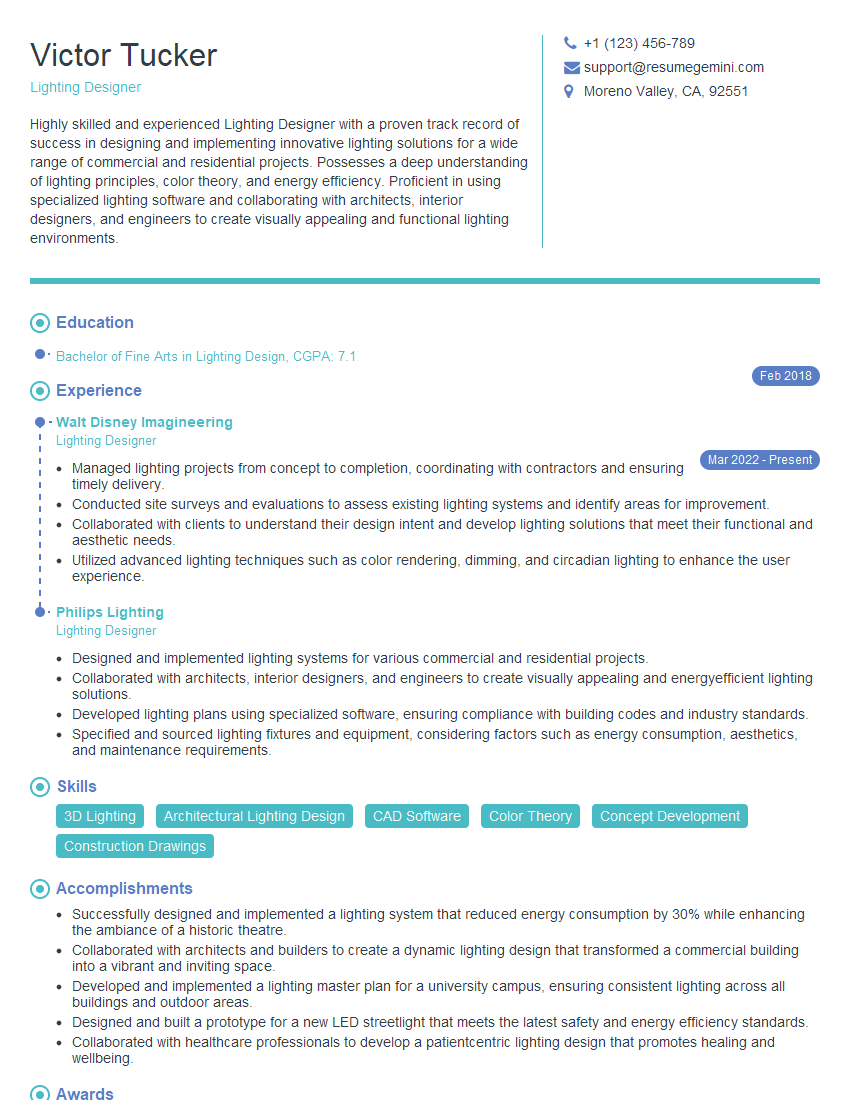
Mastering Lighting Design and Equipment is crucial for career advancement in this dynamic field. A strong understanding of these concepts will open doors to exciting opportunities and higher earning potential. To significantly boost your job prospects, crafting an ATS-friendly resume is paramount. ResumeGemini is a trusted resource to help you build a professional resume that highlights your skills and experience effectively. Examples of resumes tailored to Lighting Design and Equipment are available, showcasing how to best present your qualifications to potential employers. Take advantage of these resources to create a resume that truly represents your abilities and helps you land your dream job.
Explore more articles
Users Rating of Our Blogs
Share Your Experience
We value your feedback! Please rate our content and share your thoughts (optional).
What Readers Say About Our Blog
Amazing blog
Interesting Article, I liked the depth of knowledge you’ve shared.
Helpful, thanks for sharing.