The thought of an interview can be nerve-wracking, but the right preparation can make all the difference. Explore this comprehensive guide to Furniture Metalwork interview questions and gain the confidence you need to showcase your abilities and secure the role.
Questions Asked in Furniture Metalwork Interview
Q 1. Describe your experience with different welding techniques (MIG, TIG, Stick).
My experience encompasses all three primary welding techniques: MIG, TIG, and Stick. Each has its strengths and weaknesses, making them suitable for different applications in furniture metalwork.
- MIG (Metal Inert Gas) welding: I’m highly proficient in MIG welding, which is excellent for fast, high-volume production. It’s ideal for joining thicker gauge metals, particularly steel, and creating strong, reliable welds in furniture frames and supports. I often use it for continuous welds on large pieces. For example, I’ve used MIG welding to create the sturdy frames for a line of modern outdoor lounge chairs.
- TIG (Tungsten Inert Gas) welding: TIG welding allows for precise control and produces incredibly clean, aesthetically pleasing welds. This is invaluable when working with thinner materials or when the weld appearance is crucial. I often use TIG for detail work, joining thinner stainless steel or aluminum components, like decorative elements on a coffee table or the intricate framework of a stylish chair. The precision makes it perfect for achieving the desired look in high-end furniture.
- Stick (Shielded Metal Arc Welding) welding: Stick welding is a robust and versatile method, particularly useful in outdoor environments or when access to electricity is limited. Although it’s not as clean as TIG, its portability makes it suitable for on-site repairs or projects requiring less precise welds in heavier gauge materials. I’ve utilized stick welding on several occasions for repairs to outdoor metal furniture where more precise aesthetic welding wasn’t a primary concern.
My expertise extends to choosing the appropriate technique based on the metal type, thickness, desired aesthetic, and project requirements.
Q 2. What types of metals are commonly used in furniture manufacturing?
The choice of metal in furniture manufacturing depends heavily on the design, intended use, and budget. Some of the most common metals include:
- Steel: Steel is a workhorse in furniture manufacturing, offering high strength and durability at a relatively low cost. Mild steel is widely used, but higher-strength steels are employed when structural integrity is paramount. It’s easy to weld and readily available.
- Stainless Steel: Prized for its corrosion resistance and sleek appearance, stainless steel is prevalent in high-end and outdoor furniture. Different grades offer varying degrees of strength and corrosion resistance. The higher-grade stainless steels are more expensive but offer enhanced durability, perfect for furniture exposed to the elements.
- Aluminum: Aluminum’s lightweight yet strong nature makes it popular in modern furniture designs. It’s also corrosion resistant, making it a good choice for outdoor settings. However, it’s more challenging to weld than steel.
- Wrought Iron: With its distinctive rustic look, wrought iron is often used for decorative elements and furniture with a traditional or antique aesthetic. It is extremely durable and weather-resistant but can be heavy and require specialized techniques for welding and shaping.
Often, a combination of metals is used to leverage the specific advantages of each. For example, a steel frame might be combined with aluminum decorative elements for strength and aesthetics.
Q 3. Explain the process of sheet metal fabrication for furniture components.
Sheet metal fabrication is crucial for creating many furniture components. The process typically involves several steps:
- Design and Layout: The process begins with a design, often from a blueprint or CAD drawing. The design dictates the dimensions, shape, and any necessary cutouts or bends.
- Cutting: The sheet metal is cut to the required shape using various methods, including shearing, laser cutting, waterjet cutting, or punching. Laser cutting offers high precision for intricate designs. Shearing is a simpler, faster method for straight cuts.
- Forming and Bending: Press brakes or bending machines are used to precisely bend the sheet metal into the desired angles and shapes. This step often involves creating curves, flanges, and other features essential for the furniture’s functionality and appearance.
- Welding (if applicable): If multiple sheet metal pieces need to be joined, welding techniques are used to create strong and lasting joints. The choice of welding method depends on the metal type, thickness, and design requirements.
- Finishing: Once the component is assembled, various finishing techniques are applied, such as powder coating, painting, or polishing, to protect the metal and enhance its appearance.
For example, the sleek curved side panels of a modern desk would likely involve laser cutting, precise bending using a press brake, and potential welding of seams, followed by powder coating for a durable and attractive finish.
Q 4. How do you ensure the structural integrity of metal furniture?
Ensuring structural integrity is paramount in metal furniture. Several methods contribute to this:
- Proper Material Selection: Choosing the right metal and gauge (thickness) is crucial. Higher-strength steels or specialized alloys are selected for applications demanding robust performance.
- Sound Welding Techniques: Proper welding procedures ensure strong, reliable joints. Weld quality is consistently checked throughout the process. I employ non-destructive testing methods (like visual inspection) to ensure complete penetration and avoid defects.
- Reinforcement and Bracing: Strategic placement of reinforcement elements, such as gussets (triangular plates) or additional bracing, strengthens joints and prevents stress concentrations. This is especially important in high-stress areas such as chair legs or table supports.
- Robust Joint Design: Well-designed joints are key to distributing stress effectively. Properly designed connections, such as overlapping joints or butt welds with reinforcement, can significantly increase overall structural strength.
- Finite Element Analysis (FEA): In complex designs, FEA can be used to simulate stress distribution and identify potential weak points before production. This allows for design modifications to optimize structural integrity.
For instance, on a heavy-duty workbench, I might employ thicker steel, strategically placed gussets at crucial joints, and rigorous quality checks to guarantee that the workbench can withstand even the most strenuous use.
Q 5. What safety precautions do you follow when working with metal?
Safety is my top priority. Working with metal involves inherent risks, necessitating strict adherence to safety protocols:
- Personal Protective Equipment (PPE): This includes safety glasses, welding helmets with appropriate shade lenses, welding gloves, fire-resistant clothing, and closed-toe shoes. I never compromise on PPE.
- Proper Ventilation: Welding produces fumes and gases that can be harmful. I ensure adequate ventilation to remove these from the work area, often using exhaust systems or working in well-ventilated spaces.
- Fire Safety: Welding can ignite flammable materials. I keep a fire extinguisher nearby and clear the work area of combustibles. I also check for any potential ignition sources before commencing work.
- Electrical Safety: I follow strict electrical safety procedures, ensuring proper grounding of equipment, using insulated tools, and never working with wet or damaged electrical equipment. I always turn off power when working on electrical connections.
- Handling Hazardous Materials: I handle metal cleaning solvents and other potentially harmful materials carefully, following safety data sheets and using appropriate personal protective equipment. This includes proper disposal.
Safety training is ongoing, and I regularly review and update my safety procedures to stay current with best practices.
Q 6. Describe your experience with different metal finishing techniques.
Metal finishing is crucial for both aesthetics and durability. My experience includes several techniques:
- Powder Coating: This offers excellent durability, scratch resistance, and a wide range of color options. It’s particularly useful for outdoor furniture.
- Painting: Painting provides a wide variety of colors and finishes but may require more frequent touch-ups than powder coating.
- Polishing: Polishing creates a high-gloss, reflective finish, enhancing the look of stainless steel or other polished metals. This method requires careful attention to detail.
- Electroplating: This technique applies a thin layer of another metal (like chrome or nickel) to provide corrosion resistance or a decorative finish. This is frequently seen on higher-end pieces.
- Anodizing (for Aluminum): This process creates a durable, corrosion-resistant oxide layer on aluminum, offering both protection and a unique finish.
The choice of finishing technique depends on factors such as the metal type, the desired appearance, and the expected level of durability. For example, I’d likely powder coat a steel garden bench for durability, while polishing would be more appropriate for a high-end stainless steel coffee table.
Q 7. How do you read and interpret blueprints for metal furniture?
Reading blueprints is fundamental to my work. I am proficient in interpreting various types of drawings, including:
- Orthographic Projections: These drawings show multiple views (top, front, side) of the furniture piece, providing dimensions and detailing.
- Isometric Drawings: These 3D views aid in visualizing the overall shape and spatial relationships of the components.
- Detail Drawings: These provide magnified views of specific parts, showing critical dimensions, tolerances, and manufacturing details.
- Welding Symbols: These symbols indicate the type of weld, size, and location on the blueprint. Understanding these symbols is critical for proper welding.
- Bill of Materials (BOM): The BOM lists all the necessary materials, their dimensions, and quantities required for construction.
I use a combination of measuring tools like rulers, calipers, and protractors to ensure accurate interpretation and construction. I pay close attention to dimensions, tolerances, and material specifications to ensure the final product matches the blueprint precisely. Any ambiguities are clarified before starting the project.
Q 8. Explain your experience with CAD software for furniture design.
My experience with CAD software for furniture design is extensive. I’m proficient in several industry-standard programs, including AutoCAD, SolidWorks, and Fusion 360. I use these tools throughout the entire design process, from initial sketching and 3D modeling to generating detailed fabrication drawings. For example, in a recent project designing a bespoke metal shelving unit, I used SolidWorks to create a parametric model, allowing me to easily adjust dimensions and explore different design iterations. This ensured the client’s specific needs were met while optimizing material usage. Furthermore, I leverage the rendering capabilities of these programs to create photorealistic visualizations for client presentations, enhancing communication and reducing misunderstandings.
My workflow typically involves creating a 2D sketch, followed by building a 3D model to check for design flaws or manufacturing complexities. Then, I generate detailed 2D drawings including dimensions, material specifications, and fabrication notes for the manufacturing team. This seamless transition from concept to production is crucial for efficient and accurate metalwork.
Q 9. How do you handle discrepancies between design specifications and material availability?
Discrepancies between design specifications and material availability are a common challenge in furniture metalwork. My approach involves a multi-step process that prioritizes finding the best solution without compromising the design’s integrity. First, I thoroughly investigate alternative materials with similar properties. For instance, if a specific grade of stainless steel isn’t available, I’ll explore other grades with comparable strength and corrosion resistance. Second, I carefully examine the design itself to see if minor adjustments can accommodate the available materials. This might involve slightly altering dimensions or joining techniques. Third, I communicate transparently with the client, presenting them with various options and explaining the trade-offs involved. Open communication ensures everyone is on board with the final decision.
For example, in one project, the initial design called for a particular type of brass tubing that was unavailable. After researching alternatives, I proposed using a slightly thicker gauge of a readily available brass tubing. This minor adjustment maintained the aesthetic appeal while ensuring timely project completion.
Q 10. What troubleshooting skills do you possess regarding metal fabrication issues?
Troubleshooting is a critical part of metal fabrication. My skills encompass a wide range of issues, from identifying welding defects to diagnosing problems with CNC machining. I start by systematically examining the problem, considering all possible causes. This might involve checking the material for defects, verifying machine settings, or assessing the quality of the welding parameters. My approach is methodical, focusing on identifying the root cause rather than simply treating the symptoms.
For instance, if I encounter inconsistent welds, I’d check the welding machine’s settings (voltage, amperage, travel speed), the condition of the welding electrodes, and the cleanliness of the metal surfaces. I’m also adept at using various testing tools to measure weld penetration, hardness, and other crucial parameters. Understanding the material behavior and machine operation is vital for effective troubleshooting.
Q 11. Describe your experience with CNC machining in furniture metalwork.
My experience with CNC machining is extensive, encompassing programming, operation, and maintenance. I’m proficient in using various CNC machines, including milling machines and laser cutters, to fabricate intricate metal components for furniture. I utilize CAM software (Computer-Aided Manufacturing) to generate CNC programs based on my CAD models, ensuring precise and repeatable results. This allows for complex shapes and high precision, which would be extremely challenging or impossible to achieve manually.
I’ve used CNC machining extensively in creating bespoke furniture pieces, such as intricate metal inlays for tables or precisely cut components for chairs. For example, I once used a CNC milling machine to create a series of custom metal brackets with highly detailed curves, a task that would have been nearly impossible to achieve with traditional methods. My knowledge extends to post-processing, including deburring and surface finishing, to ensure a high-quality final product.
Q 12. How do you maintain and repair metal fabrication equipment?
Maintaining and repairing metal fabrication equipment is crucial for safety and efficiency. I follow a rigorous preventative maintenance schedule, including regular cleaning, lubrication, and inspection of all machinery. This ensures the equipment operates optimally and extends its lifespan. I’m also skilled in performing minor repairs, such as replacing worn parts or adjusting machine settings. For more complex repairs, I know when to call in qualified technicians.
My maintenance routine includes documenting all inspections and repairs, ensuring a clear history of the equipment’s condition. This proactive approach minimizes downtime and prevents unexpected breakdowns, ensuring smooth project workflow.
Q 13. What are the common challenges in furniture metalwork, and how do you address them?
Common challenges in furniture metalwork include material cost fluctuations, maintaining precise tolerances during fabrication, and managing complex designs. Addressing these requires a strategic approach. For material cost fluctuations, I explore alternative materials or design adjustments to mitigate the impact. For precise tolerances, I carefully plan each fabrication step and employ advanced techniques like CNC machining and precise measuring tools. For complex designs, I break down the project into manageable modules and utilize advanced CAD/CAM software to ensure accuracy and efficiency.
For example, in one project involving intricate laser cutting, I used a combination of design optimization and careful machine setup to minimize material waste and achieve the required precision, resulting in cost savings and a high-quality product.
Q 14. Explain your experience with different types of metal joining techniques.
My experience encompasses a wide range of metal joining techniques, including welding (MIG, TIG, and stick), brazing, soldering, riveting, and bolting. The choice of technique depends on factors such as the type of metal, the desired strength, the aesthetic requirements, and the complexity of the joint. For example, TIG welding is ideal for creating strong, aesthetically pleasing joints in thin-gauge materials, while MIG welding is better suited for thicker materials and faster production. Riveting is a good choice for applications where a strong, permanent joint is needed without the use of heat. Bolting allows for disassembly, making it ideal for modular furniture.
I am adept at selecting and applying the most appropriate technique for each specific situation, ensuring the resulting joint is both strong and visually appealing. My understanding of the strengths and limitations of each method allows me to make informed decisions that optimize both functionality and aesthetics.
Q 15. How do you ensure the accuracy and precision of your metalwork?
Accuracy and precision in metalwork are paramount. It’s not just about aesthetics; it’s about structural integrity and functionality. We achieve this through a multi-pronged approach.
Precise Measurement and Planning: Before any cutting or bending, meticulous measurements and detailed drawings are essential. I use digital calipers and measuring tapes, frequently double-checking my work. Computer-aided design (CAD) software allows for even greater precision, creating accurate templates for cutting and forming.
High-Quality Tools and Equipment: Investing in and maintaining top-tier tools like shears, presses, and welders is crucial. Properly calibrated equipment minimizes errors and ensures consistent results. For example, a well-maintained laser cutter offers superior accuracy compared to a hand-operated shear.
Proper Techniques and Skill: Years of experience have honed my skills in various metalworking techniques. This includes mastering different welding methods (MIG, TIG, etc.) to ensure strong, clean joints, and using bending and forming techniques that minimize distortion. Practice and continuous learning are key.
Quality Control Checks: Regular checks throughout the process, including using measuring tools at every stage, ensure that the work remains on track. I also use alignment tools to maintain the accuracy of component parts before assembly.
Career Expert Tips:
- Ace those interviews! Prepare effectively by reviewing the Top 50 Most Common Interview Questions on ResumeGemini.
- Navigate your job search with confidence! Explore a wide range of Career Tips on ResumeGemini. Learn about common challenges and recommendations to overcome them.
- Craft the perfect resume! Master the Art of Resume Writing with ResumeGemini’s guide. Showcase your unique qualifications and achievements effectively.
- Don’t miss out on holiday savings! Build your dream resume with ResumeGemini’s ATS optimized templates.
Q 16. Describe your understanding of metal properties and their impact on design.
Understanding metal properties is fundamental to successful design. Different metals have vastly different characteristics, which directly influence design choices. For example:
Steel: Strong and durable, but can be heavy and susceptible to rust unless treated appropriately. This influences designs; we might use thinner gauges of steel for lighter pieces or incorporate rust-proofing measures like powder coating.
Aluminum: Lightweight and corrosion-resistant, but less strong than steel. Designs often exploit its lightness, creating larger, more intricate pieces without compromising structural integrity. Aluminum is often chosen for outdoor furniture due to its resistance to rust.
Brass: Aesthetically pleasing, relatively strong, and corrosion-resistant. Its malleability allows for intricate detailing, making it suitable for decorative elements. Brass furniture often features elaborate patterns and shapes.
Stainless Steel: Extremely durable, corrosion-resistant, and readily available in various finishes. The strength of stainless steel makes it ideal for creating robust, long-lasting furniture designs that can withstand heavy use.
Considering these properties allows me to select the most appropriate metal for a project, ensuring both functionality and aesthetics are met. For instance, a delicate coffee table might use brass for its visual appeal, while a sturdy garden bench would need the strength of steel.
Q 17. What quality control measures do you implement in your work?
Quality control is integrated into every stage of my workflow. It’s not an afterthought; it’s a continuous process.
Material Inspection: I begin by inspecting incoming materials for defects, ensuring they meet the required specifications. This includes checking for flaws, consistent gauge, and surface quality.
Process Monitoring: Throughout fabrication, I regularly monitor the quality of welds, the precision of cuts, and the accuracy of bends using measuring instruments. Any deviations are immediately addressed.
Regular Maintenance of Equipment: Well-maintained equipment minimizes errors and ensures consistent output. Regularly scheduled maintenance is a cornerstone of my quality control process.
Final Inspection: Before delivery, every piece undergoes a thorough final inspection. This includes checking for any defects, ensuring the finish is flawless, and confirming that it meets the design specifications. A detailed checklist ensures nothing is overlooked.
Q 18. How do you estimate material costs and production time for metal furniture projects?
Estimating material costs and production time requires a combination of experience and meticulous planning. It’s not a guess; it’s a calculated process.
Detailed Design and Bill of Materials: Starting with a detailed design allows me to create a comprehensive bill of materials (BOM). The BOM precisely lists all necessary materials, their quantities, and their current market prices. Software can assist in this process.
Labor Cost Estimation: This involves considering the time required for each step of the production process – cutting, forming, welding, finishing – and factoring in my hourly rate or the cost of employing other craftspeople. Past projects provide valuable data for estimations.
Contingency Planning: Unexpected issues can arise. Therefore, I always include a contingency buffer in both material costs (to account for waste or material defects) and production time (to handle unforeseen delays). This prevents cost overruns and ensures project completion on time.
Software and Databases: I leverage project management software and databases to track past project costs and timelines. This historical data helps to refine future estimates and improve accuracy.
Q 19. Explain your experience with different types of metal finishes (e.g., powder coating, plating).
I’ve extensive experience with various metal finishes, each offering unique properties and aesthetic qualities.
Powder Coating: This durable and versatile finish provides excellent corrosion protection and a wide range of color options. It’s environmentally friendly compared to some traditional methods. I use it frequently for outdoor furniture and pieces requiring high durability.
Plating (e.g., Chrome, Nickel, Zinc): Plating enhances the appearance and protects the base metal from corrosion. Chrome plating gives a sleek, modern look; nickel adds a subtle sheen; and zinc offers excellent corrosion resistance. The choice depends entirely on the desired aesthetic and level of protection.
Painting: For customized looks or specific color requirements, painting offers flexibility. Proper surface preparation is crucial for paint adhesion and longevity. I generally use high-quality automotive paints for superior durability.
Polishing and Brushing: These methods enhance the natural beauty of the metal, providing a unique finish. Polishing creates a highly reflective surface, while brushing can offer a more textured look. These are often combined with other finishes to achieve a layered effect.
The choice of finish impacts not only the appearance but also the cost and durability of the finished product.
Q 20. Describe your experience working with different gauges of sheet metal.
Different gauges of sheet metal affect the strength, weight, and formability of the final product. Selecting the right gauge is crucial for both structural integrity and aesthetic appeal.
Thicker Gauges (e.g., 16 gauge and below): These are stronger and more durable but heavier and more difficult to work with. They are suitable for pieces requiring high strength, such as chair frames or table legs.
Thinner Gauges (e.g., 20 gauge and above): Lighter and easier to work with, but less robust. They’re often used for decorative elements or where weight is a significant concern, for instance, in panels or smaller details.
My experience allows me to select the appropriate gauge based on the design requirements. I also take into account factors such as the intended use of the piece and the type of metal being used (e.g., aluminum can be thinner for the same strength compared to steel).
For example, a heavy-duty industrial shelf would require a thicker gauge steel, whereas a decorative wall art piece might employ a thinner gauge aluminum or brass.
Q 21. How do you handle complex or intricate metalwork designs?
Complex or intricate designs demand a methodical approach and specialized skills. It’s not just about technical ability; it’s about problem-solving.
Breaking Down the Design: I begin by breaking down the complex design into smaller, manageable components. This allows for a more organized and efficient workflow. Each component is carefully planned and fabricated separately before assembly.
Advanced Techniques: Intricate designs may require specialized techniques such as precision welding, intricate bending, or the use of specialized tools like punches and dies. My expertise in these techniques is essential.
Prototyping and Refinement: I often create prototypes to test the feasibility and refine the design before full-scale production. This minimizes errors and allows for necessary adjustments.
Collaboration and Consultation: For extremely complex designs, collaborating with other experts or consulting with design engineers may be beneficial. This ensures the project meets all requirements and utilizes best practices.
For instance, a design incorporating many curved and intersecting metal pieces might require multiple bending operations and precise welding to ensure both aesthetic appeal and structural stability. The prototyping phase would allow me to check the fit and function of these components before finalizing the design and production.
Q 22. How do you manage your workload and prioritize tasks in a fast-paced environment?
In a fast-paced furniture metalwork environment, efficient workload management is crucial. I employ a multi-pronged approach. Firstly, I use a digital project management system to meticulously track all projects, deadlines, and individual tasks. This allows for a clear overview of my workload at all times. Secondly, I prioritize tasks using a combination of urgency and importance (Eisenhower Matrix). Urgent and important tasks, like meeting a critical deadline for a client, take precedence. Less urgent but important tasks, such as refining my welding techniques or sourcing new materials, are scheduled strategically to avoid last-minute rushes. Finally, I break down large projects into smaller, manageable steps, creating achievable milestones that I can track and celebrate upon completion. This prevents feeling overwhelmed and maintains momentum throughout the process.
For example, recently I had three concurrent projects: a large-scale wrought iron staircase, custom metal shelving for a boutique, and several smaller decorative pieces. My project management system allowed me to allocate specific time slots for each, ensuring all deadlines were met without compromising quality. Breaking down the staircase project into individual sections (fabrication, assembly, finishing) allowed me to focus on one aspect at a time, minimizing stress and maximizing efficiency.
Q 23. Explain your experience with working from sketches or hand-drawn designs.
I have extensive experience working from sketches and hand-drawn designs. This is a fundamental skill in custom furniture metalwork. Often, clients provide initial concepts through sketches, and my ability to translate these into precise fabrication plans is key. I start by carefully analyzing the sketches, identifying dimensions, angles, and details. Then, I create detailed technical drawings, either manually or using CAD software, incorporating precise measurements and specifications. These drawings serve as blueprints for the entire fabrication process, ensuring accuracy and consistency.
For instance, I recently worked on a project based on a client’s sketch of a uniquely shaped metal bed frame. The sketch, while visually appealing, lacked precise measurements. My skill in interpreting the artistic intent and converting it into a workable plan was crucial. I meticulously measured angles, calculated material requirements, and generated detailed shop drawings that enabled me to successfully fabricate the bed frame to the client’s satisfaction.
Q 24. What is your experience with different types of metal cutting tools?
My expertise encompasses a wide range of metal cutting tools, each suited for specific applications. I am proficient in using:
- Abrasive cutting tools: Angle grinders with cutting discs for rough cuts and shaping. I understand the importance of safety precautions like using appropriate PPE and managing the heat generated during this process.
- Shearing tools: Various types of shears, including hand shears for smaller pieces and power shears for larger sheets of metal. The selection of shear type depends on the thickness and material of the metal.
- Mechanical cutting tools: Bandsaws for intricate curves and straight cuts, offering precise and clean cuts. I’m also skilled in using milling machines for creating more complex shapes and features.
- Laser cutting tools: I have experience using CNC laser cutters for high-precision cutting of intricate designs. This technology enables precise, repeatable cuts, particularly useful for complex geometric shapes and mass production of smaller components.
- Plasma cutting tools: These are employed for thicker metal sheets, offering fast and efficient cuts, especially when dealing with steel. I understand the proper techniques for minimizing material waste and ensuring clean cuts.
The choice of tool depends on the specific metal, thickness, and desired accuracy of the cut. Each tool requires a distinct set of safety procedures that I follow religiously to prevent accidents.
Q 25. Describe your experience with working on large-scale furniture projects.
I possess significant experience in crafting large-scale furniture projects. These projects often demand meticulous planning, precise execution, and efficient teamwork. My experience includes working on intricate wrought iron staircases, extensive custom-designed metal gates, and substantial outdoor furniture sets. Managing large-scale projects involves careful consideration of logistics, material handling, and assembly techniques. I work closely with other craftsmen, including welders, fabricators, and finishers, to ensure the project stays on schedule and within budget.
One notable project involved constructing a grand wrought iron staircase for a historical building restoration. This required careful consideration of weight distribution, structural integrity, and the need to maintain the architectural style of the building. The process involved creating detailed shop drawings, procuring materials, managing the fabrication process, and finally, assembling the staircase on-site. This project highlighted the importance of meticulous planning, teamwork, and on-site problem-solving.
Q 26. How do you ensure the durability and longevity of your metalwork?
Ensuring the durability and longevity of my metalwork is paramount. I achieve this through a multi-faceted approach:
- Material Selection: Choosing high-quality, corrosion-resistant metals is crucial. For outdoor applications, I favor materials like stainless steel or powder-coated steel, while for indoor projects, mild steel with appropriate finishes may suffice.
- Proper Fabrication Techniques: Precise welding techniques, ensuring proper penetration and minimal distortion, are essential. I employ various welding methods, such as MIG, TIG, and stick welding, depending on the project’s requirements.
- Surface Finishing: I utilize various surface finishing techniques to protect the metal from corrosion and enhance its aesthetic appeal. These include powder coating, galvanizing, painting, and polishing. The choice of finish depends on the intended use and environmental conditions.
- Quality Control: Regular inspections and quality checks throughout the fabrication process are vital to identify and address any flaws early on. This proactive approach minimizes the risk of future failures.
For example, when fabricating outdoor furniture, I always opt for powder-coated steel to provide superior protection against rust and weathering. This ensures the furniture remains durable and aesthetically pleasing for many years.
Q 27. What are your strengths and weaknesses as a furniture metalworker?
My strengths as a furniture metalworker lie in my precision, attention to detail, and problem-solving abilities. I possess a keen eye for design and a deep understanding of materials and fabrication techniques. I am adept at translating design concepts into functional and aesthetically pleasing pieces. I also pride myself on my ability to collaborate effectively with clients and fellow craftspeople.
One area I am continually working to improve is my speed. While I strive for precision, sometimes this comes at the cost of overall production time. I am actively implementing strategies to improve my efficiency without compromising quality, such as optimizing my workflow and adopting new time-saving techniques.
Q 28. Describe a time you had to overcome a challenge in a metalwork project.
During a recent project involving a complex, curved metal canopy, I encountered a challenge with warping during the welding process. The thin metal sheets were prone to distortion due to the heat generated from welding. My initial approach, using a continuous weld, resulted in significant warping. To overcome this, I implemented a step-by-step approach. I divided the canopy into smaller sections, welding each section individually and allowing for cooling before proceeding. I also used specialized welding techniques, such as tack welding and applying clamps to minimize distortion. This iterative process, combined with the use of jigs and fixtures, resolved the warping issue and resulted in a successful project. This experience reinforced the importance of understanding material properties and adapting my techniques to meet specific challenges.
Key Topics to Learn for Furniture Metalwork Interview
- Metal Selection & Properties: Understanding the characteristics of different metals (steel, aluminum, brass, etc.) used in furniture manufacturing, including their strength, durability, weldability, and aesthetic qualities. Consider the trade-offs between cost and performance.
- Fabrication Processes: Familiarity with various metalworking techniques such as welding (MIG, TIG, spot welding), cutting (plasma, laser, shearing), bending, forming, and finishing. Be prepared to discuss your experience with specific equipment and techniques.
- Design & Engineering Principles: Understanding structural integrity, weight distribution, joint design, and the impact of metal properties on overall furniture design. Be ready to discuss how design choices affect functionality and durability.
- Safety Procedures & Regulations: Demonstrate knowledge of relevant safety protocols for operating machinery and handling materials in a metalworking environment. Understanding OSHA guidelines or equivalent regulations is crucial.
- Quality Control & Inspection: Explain your understanding of quality control measures used in furniture metalwork, including inspection techniques to ensure the final product meets quality standards and specifications. This includes identifying and addressing defects.
- Blueprint Reading & Interpretation: Demonstrate your ability to accurately read and interpret technical drawings and blueprints used in furniture metalwork. This shows your ability to translate designs into practical actions.
- Troubleshooting & Problem-Solving: Be ready to discuss your approach to identifying and resolving common issues encountered during the metalworking process. Examples include welding defects, material imperfections, or dimensional inaccuracies.
Next Steps
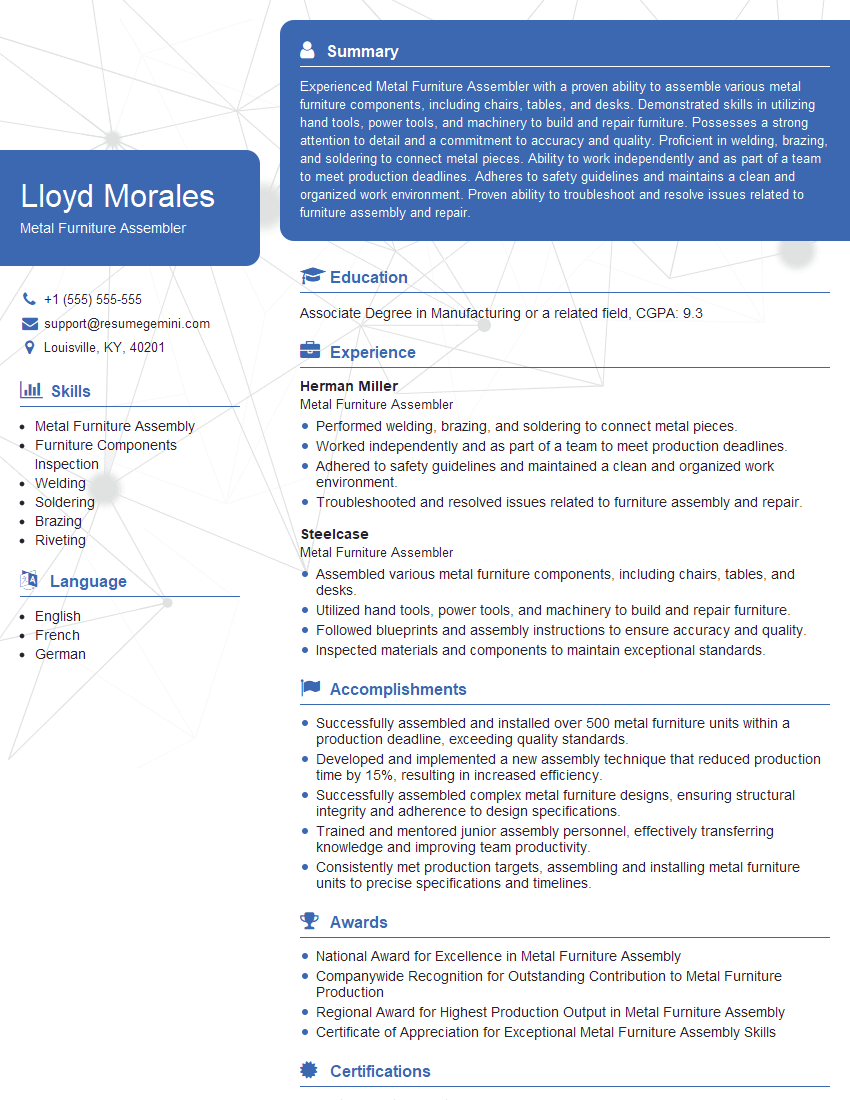
Mastering Furniture Metalwork opens doors to rewarding and diverse career opportunities within the manufacturing and design industries. A strong understanding of these techniques positions you for advancement and higher earning potential. To significantly improve your chances of securing your dream role, focus on crafting an ATS-friendly resume that highlights your skills and experience effectively. ResumeGemini is a trusted resource that can help you build a professional and impactful resume tailored to the Furniture Metalwork industry. We provide examples of resumes tailored to Furniture Metalwork to guide you in creating your own.
Explore more articles
Users Rating of Our Blogs
Share Your Experience
We value your feedback! Please rate our content and share your thoughts (optional).
What Readers Say About Our Blog
hello,
Our consultant firm based in the USA and our client are interested in your products.
Could you provide your company brochure and respond from your official email id (if different from the current in use), so i can send you the client’s requirement.
Payment before production.
I await your answer.
Regards,
MrSmith
hello,
Our consultant firm based in the USA and our client are interested in your products.
Could you provide your company brochure and respond from your official email id (if different from the current in use), so i can send you the client’s requirement.
Payment before production.
I await your answer.
Regards,
MrSmith
These apartments are so amazing, posting them online would break the algorithm.
https://bit.ly/Lovely2BedsApartmentHudsonYards
Reach out at [email protected] and let’s get started!
Take a look at this stunning 2-bedroom apartment perfectly situated NYC’s coveted Hudson Yards!
https://bit.ly/Lovely2BedsApartmentHudsonYards
Live Rent Free!
https://bit.ly/LiveRentFREE
Interesting Article, I liked the depth of knowledge you’ve shared.
Helpful, thanks for sharing.
Hi, I represent a social media marketing agency and liked your blog
Hi, I represent an SEO company that specialises in getting you AI citations and higher rankings on Google. I’d like to offer you a 100% free SEO audit for your website. Would you be interested?