Interviews are opportunities to demonstrate your expertise, and this guide is here to help you shine. Explore the essential International Astronomical Union Member interview questions that employers frequently ask, paired with strategies for crafting responses that set you apart from the competition.
Questions Asked in International Astronomical Union Member Interview
Q 1. Explain the significance of the IAU’s role in defining astronomical nomenclature.
The International Astronomical Union (IAU) plays a crucial role in standardizing astronomical nomenclature, preventing confusion and fostering clear communication within the global astronomical community. Think of it like a global naming authority for celestial objects. Without a unified system, imagine the chaos of multiple independent naming conventions – it would be impossible to collaborate effectively. The IAU’s responsibility encompasses naming newly discovered planets, stars, galaxies, and other celestial bodies, along with surface features on these objects (like craters on the Moon or Martian mountains). This involves establishing clear guidelines and procedures, ensuring that names are both meaningful and unique, avoiding duplication and controversy. For example, the IAU approved the names for the moons of Pluto, such as Charon, Nix, Hydra, Kerberos, and Styx, after a rigorous process to avoid confusion or conflicts.
Q 2. Describe the IAU’s contribution to international collaboration in astronomy.
The IAU significantly contributes to international collaboration in astronomy through several key activities. It acts as a central hub for astronomers worldwide, facilitating communication and coordination of research efforts. This is achieved through various programs, such as organizing international conferences and workshops, creating joint projects, and disseminating astronomical data. The IAU encourages the development of standard protocols for data sharing, ensuring that different observatories and research groups can effectively integrate and analyze their data, leading to more comprehensive studies. One prominent example is the collaborative efforts to coordinate observations of transient astronomical events, like supernovae, where prompt global collaboration is crucial for understanding these phenomena. The IAU fosters collaboration through its various working groups and divisions, enabling specialists to work on specific aspects of astronomy, share results, and address challenges together.
Q 3. What are the major divisions within the IAU and their respective focuses?
The IAU is structured into several divisions, each focusing on a specific area of astronomy. While the exact number and structure may evolve, some key divisions and their focuses generally include:
- Division A: Fundamental Astronomy: This division focuses on celestial mechanics, astrometry (precise measurement of positions and movements of celestial objects), reference frames, time, and Earth rotation.
- Division B: Facilities, Technologies and Data Science: This division deals with the development and improvement of astronomical instruments, telescopes, data analysis techniques, and data archiving.
- Division C: Planetary Systems Sciences: This division focuses on the study of planets, their moons, asteroids, comets, and other objects within planetary systems.
- Division D: High Energy Phenomena and Astrophysics: This division focuses on the study of high-energy objects and phenomena, such as black holes, neutron stars, active galactic nuclei, and cosmic rays.
- Division E: Sun and Heliosphere: This division focuses on the study of the Sun, its activity, and its interaction with the solar system.
- Division F: Stars: This division focuses on the study of stars, including their formation, evolution, and properties.
- Division G: Galaxies and the Universe: This division focuses on the study of galaxies, their structure, formation, and evolution, as well as cosmology and the universe as a whole.
These divisions collaborate through working groups and commissions to tackle specific research topics and standardization efforts.
Q 4. How does the IAU’s system of astronomical coordinates work?
The IAU’s system of astronomical coordinates is based on a celestial sphere, an imaginary sphere surrounding the Earth onto which celestial objects are projected. It uses two main coordinates to pinpoint a celestial object’s position: right ascension (RA) and declination (Dec). Think of it like latitude and longitude on Earth, but for the sky.
Right Ascension (RA) is analogous to longitude and measures the east-west position of an object, measured in hours, minutes, and seconds, eastward from the vernal equinox (a specific point in the sky where the Sun crosses the celestial equator during its northward movement).
Declination (Dec) is analogous to latitude and measures the north-south position of an object, measured in degrees, minutes, and seconds, north or south of the celestial equator.
For example, the coordinates of the star Polaris (the North Star) are approximately RA 2h 31m 49s, Dec +89° 15′ 51″. This precise system allows astronomers to locate and track objects across the sky with great accuracy, irrespective of the observer’s location on Earth. The system utilizes the equatorial coordinate system as the standard, aligning with Earth’s rotation.
Q 5. Explain the concept of astronomical magnitudes and their application.
Astronomical magnitudes are a logarithmic scale used to measure the brightness of celestial objects. The brighter an object appears, the lower its magnitude. This seemingly counterintuitive scale stems from its historical development. A magnitude difference of 5 corresponds to a brightness ratio of 100. A first-magnitude star is about 2.5 times brighter than a second-magnitude star, and so on.
There are two main types of magnitudes: apparent magnitude and absolute magnitude.
- Apparent magnitude (m) measures how bright an object appears from Earth. It depends on the object’s intrinsic luminosity (actual brightness) and its distance from us. A bright star close to Earth may have a lower apparent magnitude than a dim star far away.
- Absolute magnitude (M) measures how bright an object would appear if it were at a standard distance of 10 parsecs (about 32.6 light-years) from Earth. This standardizes brightness comparison, allowing astronomers to assess the intrinsic luminosity of objects regardless of their distance.
Astronomical magnitudes are essential for classifying stars and other celestial bodies, understanding their physical properties, and comparing the brightness of different objects.
Q 6. Describe different types of telescopes and their observational capabilities.
Telescopes are the cornerstone of observational astronomy, each type offering unique capabilities. Some major types include:
- Refracting telescopes: These use lenses to gather and focus light. They are simple in design but suffer from chromatic aberration (color fringing) and are difficult to build in large sizes.
- Reflecting telescopes: These use mirrors to gather and focus light. They avoid chromatic aberration and can be built significantly larger than refracting telescopes, allowing for greater light-gathering power and resolution. Most large professional telescopes are reflectors.
- Radio telescopes: These detect radio waves emitted by celestial objects. They are crucial for studying objects invisible in the visible spectrum, like pulsars and quasars. Radio telescopes often work together in arrays to achieve high resolution.
- Space telescopes: These telescopes operate above Earth’s atmosphere, avoiding atmospheric distortion and light pollution. This enables clearer images and observations across a wider range of wavelengths, including infrared, ultraviolet, X-ray, and gamma-ray.
The choice of telescope depends on the specific scientific goals. For instance, studying distant galaxies requires a large reflecting telescope or a space-based telescope, while mapping the surface of planets might involve a combination of ground-based and space-based telescopes across different wavelengths.
Q 7. What are some current challenges facing observational astronomy?
Observational astronomy faces several current challenges:
- Light pollution: Increasing artificial light from cities and other human sources interferes with ground-based observations, making it harder to detect faint objects.
- Atmospheric distortion: Earth’s atmosphere distorts incoming light, blurring images and reducing the resolution of ground-based telescopes. Adaptive optics techniques help mitigate this, but are complex and expensive.
- Data deluge: Modern telescopes generate enormous amounts of data, posing challenges for storage, processing, and analysis. Efficient data management techniques and advanced algorithms are crucial for effectively handling this data.
- Technological limitations: There are inherent limitations to the technology available for building and operating telescopes, which limit resolution and the range of wavelengths we can observe.
- Funding limitations: Astronomical research is expensive, and securing funding for building and operating telescopes, as well as supporting related research, remains a significant challenge.
Addressing these challenges requires innovative technological developments, international collaborations, and effective resource management within the astronomical community.
Q 8. Explain the basics of stellar evolution and its stages.
Stellar evolution is the process by which stars change over time. It’s a fascinating journey dictated primarily by a star’s initial mass. Think of it like a life cycle, but on a cosmic scale.
- Protostar: A star begins as a giant cloud of gas and dust called a nebula. Gravity pulls this material together, forming a protostar, which slowly heats up.
- Main Sequence Star: Once the core temperature reaches about 10 million Kelvin, nuclear fusion begins, converting hydrogen into helium. This is the longest phase of a star’s life, and our Sun is currently in this stage.
- Red Giant (for Sun-like stars): As hydrogen fuel runs out, the core contracts, and the outer layers expand, cooling and turning red. The star becomes a red giant, much larger than its previous size.
- Planetary Nebula: After the red giant phase, the outer layers are ejected into space, forming a beautiful planetary nebula. This leaves behind a small, dense core.
- White Dwarf: The remaining core is a white dwarf – a very hot, dense object that slowly cools over trillions of years.
- Massive Star Evolution: Stars much more massive than our Sun follow a different path. They fuse heavier elements, eventually becoming supergiants before exploding as supernovae. The remnant can be a neutron star or a black hole.
Understanding stellar evolution helps us understand the origin of elements heavier than hydrogen and helium, which are crucial for planet formation and life itself. For example, the gold in your jewelry was likely forged in a supernova explosion!
Q 9. Describe the different types of galaxies and their properties.
Galaxies are massive collections of stars, gas, dust, and dark matter, bound together by gravity. There are three main types:
- Spiral Galaxies: These galaxies have a flat, rotating disk with spiral arms containing young stars and gas. Our Milky Way galaxy is a spiral galaxy. They’re characterized by ongoing star formation.
- Elliptical Galaxies: These are smoother, more elliptical in shape, and contain mostly older stars. They have less gas and dust than spirals, and star formation is much less active.
- Irregular Galaxies: These don’t have a regular shape like spirals or ellipticals. They often result from galaxy interactions and mergers, and they tend to have high rates of star formation.
The properties of galaxies, like their size, mass, morphology (shape), and star formation rate, are influenced by a range of factors, including their formation history and interactions with other galaxies. Observing different galaxy types helps us understand the large-scale structure of the universe and galaxy evolution itself.
Q 10. Explain the concept of redshift and its significance in cosmology.
Redshift is the stretching of light waves as they travel through an expanding universe. Imagine an ambulance siren – as it moves away, the pitch (frequency) gets lower. Similarly, as galaxies move away from us, the light they emit gets stretched, shifting toward the red end of the spectrum (longer wavelengths).
The amount of redshift is directly proportional to the distance of the galaxy. This is described by Hubble’s Law: v = H₀d, where v is the velocity of recession, H₀ is the Hubble constant (a measure of the expansion rate of the universe), and d is the distance.
Redshift is crucial in cosmology because it allows us to measure the distances to distant galaxies and understand the expansion rate of the universe. It provides strong evidence for the Big Bang theory.
Q 11. What is the Cosmic Microwave Background and its importance?
The Cosmic Microwave Background (CMB) is the faint afterglow of the Big Bang. It’s a near-uniform radiation bath permeating the universe, originating from a time when the universe was much hotter and denser. Think of it as the ‘baby picture’ of the universe.
The CMB’s importance lies in several key aspects:
- Evidence for the Big Bang: The CMB’s existence is a powerful piece of evidence supporting the Big Bang theory.
- Understanding the early universe: The tiny temperature fluctuations in the CMB provide insights into the initial conditions of the universe and the formation of large-scale structures.
- Cosmology’s foundation: Studies of the CMB have helped refine our understanding of cosmological parameters, such as the density of dark matter and dark energy.
The detailed mapping of the CMB’s temperature fluctuations by satellites like COBE and WMAP has revolutionized our understanding of the universe’s origins and evolution.
Q 12. Describe the role of dark matter and dark energy in the universe.
Dark matter and dark energy are two mysterious components of the universe that we cannot directly observe but whose existence we infer through their gravitational effects.
- Dark Matter: We know dark matter exists because of its gravitational influence on visible matter, galaxies, and galaxy clusters. It’s about five times more abundant than ordinary matter, yet its composition remains unknown. It doesn’t interact with light, making it invisible to telescopes.
- Dark Energy: Dark energy is an even more enigmatic force accelerating the expansion of the universe. It constitutes about 68% of the universe’s energy density and acts as a sort of anti-gravity, pushing galaxies apart.
Understanding dark matter and dark energy is one of the biggest challenges in modern cosmology. Their nature and properties have profound implications for the ultimate fate of the universe.
Q 13. Explain the different methods used to detect exoplanets.
Exoplanets, planets orbiting stars other than our Sun, are detected using various methods, each with its strengths and weaknesses:
- Radial Velocity Method (Doppler Spectroscopy): This method detects the subtle wobble of a star caused by the gravitational pull of an orbiting planet. A planet’s pull causes slight changes in the star’s light spectrum.
- Transit Method: This involves observing the slight dimming of a star’s light as a planet passes in front of it (transits). This method is particularly effective in finding planets that orbit close to their stars.
- Direct Imaging: This technique involves directly imaging the exoplanet, usually using advanced techniques to block out the starlight and reveal the faint light from the planet. It’s challenging because planets are much fainter than their host stars.
- Microlensing: This method uses the gravitational lensing effect of a star to detect the presence of a planet. When a star passes in front of another, its gravity can magnify the light from the background star, and a planet orbiting the foreground star can cause a distinct signature in the light curve.
Each method has its limitations, and often multiple methods are used to confirm the existence and characterize an exoplanet.
Q 14. What are some key ethical considerations in astronomical research?
Ethical considerations in astronomical research are becoming increasingly important as our capabilities advance. Key issues include:
- Data Sharing and Accessibility: Ensuring equitable access to data and resources, especially for researchers in less developed countries.
- Environmental Impact: Minimizing the environmental footprint of large astronomical facilities, particularly in remote and sensitive ecosystems.
- Cultural Sensitivity: Respecting the cultural significance of sites used for astronomical observations, particularly Indigenous sites.
- Potential Misuse of Information: The responsible use of astronomical data, particularly in areas that could have security or military implications.
- Public Engagement and Communication: Communicating scientific findings accurately and transparently to the public and addressing potential misinterpretations.
Professional organizations like the International Astronomical Union are playing an increasing role in developing and promoting ethical guidelines for the field.
Q 15. Describe the impact of light pollution on astronomical observations.
Light pollution, the excessive illumination of the night sky by artificial light sources, significantly hinders astronomical observations. It’s like trying to see faint stars in a brightly lit room – the overwhelming brightness obscures the weaker signals.
Specifically, light pollution increases the sky’s background brightness, making it harder to detect faint objects like distant galaxies or exoplanets. This reduces the depth and quality of astronomical images. The artificial light can also scatter within the atmosphere, creating a hazy glow that washes out the details of celestial objects. For example, astronomers working in urban areas face a much greater challenge in observing deep-sky objects compared to those in remote observatories. Professional observatories often employ sophisticated techniques like specialized filters and adaptive optics to minimize the impact of light pollution, but complete elimination is often impossible.
Career Expert Tips:
- Ace those interviews! Prepare effectively by reviewing the Top 50 Most Common Interview Questions on ResumeGemini.
- Navigate your job search with confidence! Explore a wide range of Career Tips on ResumeGemini. Learn about common challenges and recommendations to overcome them.
- Craft the perfect resume! Master the Art of Resume Writing with ResumeGemini’s guide. Showcase your unique qualifications and achievements effectively.
- Don’t miss out on holiday savings! Build your dream resume with ResumeGemini’s ATS optimized templates.
Q 16. Explain the process of data analysis in astronomical research.
Astronomical data analysis is a multi-step process involving several stages. First, raw data from telescopes or other instruments needs to be calibrated. This involves correcting for instrumental effects, such as detector noise and atmospheric distortion. Think of it like developing a photo – you need to adjust brightness, contrast, and remove any blemishes before you get a clear image.
Next, data reduction techniques are applied to extract meaningful information from the calibrated data. This may involve subtracting background noise, identifying and characterizing astronomical sources, and measuring their properties (brightness, position, spectrum).
Finally, statistical analysis and modeling techniques are employed to interpret the reduced data and draw conclusions. This often involves comparing observations to theoretical models or simulations to test hypotheses and explore various phenomena. For instance, astronomers may use sophisticated statistical methods to detect subtle variations in the brightness of a star to infer the presence of an orbiting planet.
Many tools and software packages are utilized. These include software like IRAF, IDL, and Python libraries like Astropy and SciPy. These provide the capability for image processing, spectral analysis, and statistical modeling.
Q 17. How do you assess the reliability and validity of astronomical data?
Assessing the reliability and validity of astronomical data is crucial. We employ several strategies. First, we look at the quality of the data itself. This involves checking for systematic errors, random noise, and potential biases introduced by the instruments or observation techniques. A thorough examination of the calibration procedures is essential. Imagine a faulty scale – all your weight measurements would be incorrect.
Second, we compare our data to independent measurements or datasets. Consistency across multiple sources strengthens the reliability of our findings. For instance, if different telescopes all detect the same object at the same position and with similar properties, it increases our confidence in the result.
Third, we assess the uncertainties associated with our measurements. This involves quantifying the errors that are inherent in the observation process. Proper error propagation through the analysis is essential to obtain meaningful estimates of the uncertainties in our conclusions. Proper error analysis gives a realistic assessment of the confidence we can place in our results.
Finally, peer review is vital. Submitting our work to scientific journals for rigorous review by other experts in the field ensures that our methods and conclusions are carefully scrutinized before publication.
Q 18. Describe your experience with astronomical software and data analysis tools.
My experience with astronomical software and data analysis tools is extensive. I am proficient in using various packages including IRAF, which is a powerful suite of tools for image reduction and analysis, and IDL (Interactive Data Language), known for its strength in handling large datasets and creating visualizations. I also have considerable experience with Python, leveraging libraries like Astropy and SciPy for tasks ranging from data manipulation and statistical analysis to sophisticated modeling and simulation.
In my research, I regularly employ these tools to process raw data from various telescopes, analyze spectral data, and create detailed visualizations. For example, I recently used Python and Astropy to analyze data from the Hubble Space Telescope to study the distribution of dark matter in a galaxy cluster. The capabilities of these tools are essential for processing and analyzing large quantities of data and extracting meaningful insights.
Q 19. Explain your knowledge of different astronomical databases and catalogs.
I am familiar with a wide range of astronomical databases and catalogs, including the SIMBAD astronomical database, a comprehensive resource containing information on celestial objects; the NASA/IPAC Extragalactic Database (NED), which focuses on extragalactic objects; and the Vizier database, a service that provides access to numerous astronomical catalogs. These databases are invaluable resources for astronomers, providing access to a wealth of information on the properties of celestial objects, their positions, and their observed characteristics.
For example, when researching the properties of a specific galaxy, I would often consult NED to obtain information about its redshift, morphology, and luminosity. Using these databases is essential for connecting our observations with previously collected data and putting our work in the broader context of astronomical knowledge.
Q 20. Describe your familiarity with publication processes in astronomy journals.
My familiarity with the publication process in astronomy journals is thorough. The process typically starts with the preparation of a manuscript that adheres to the specific guidelines of the target journal. This involves careful structuring of the paper, including abstract, introduction, methodology, results, discussion, and conclusion sections.
Once a manuscript is ready, it’s submitted to the journal’s editorial office. It then undergoes peer review, where experts in the field evaluate the scientific rigor, methodology, and significance of the work. This process can involve multiple rounds of revisions and feedback from the reviewers and the editor. After the revisions are complete and the paper meets the journal’s standards, it is accepted for publication and undergoes copyediting and typesetting before being released.
This process is crucial for ensuring the quality and validity of published research. The peer review ensures accuracy and promotes the advancement of the field.
Q 21. What are some current research areas in your field of astronomy?
Current research in astronomy spans a wide range of exciting topics. One area is the search for exoplanets and the characterization of their atmospheres. This involves using sophisticated techniques to detect planets orbiting other stars and to analyze the composition of their atmospheres, searching for signs of potential habitability.
Another active area is the study of dark matter and dark energy, which constitute a significant portion of the universe’s mass-energy content but remain largely mysterious. Researchers are exploring different models and observation techniques to better understand their nature and role in the evolution of the universe.
Finally, the study of galaxy formation and evolution continues to be a major focus. This involves using both observational and theoretical techniques to understand how galaxies form, evolve, and interact with each other over cosmic time. New powerful telescopes, like the James Webb Space Telescope, are providing unprecedented data to propel this research forward.
Q 22. Explain your experience in presenting your research findings.
Presenting research findings is crucial for disseminating knowledge and fostering collaboration within the astronomical community. My experience spans various formats, from contributing to peer-reviewed publications in journals like Astronomy & Astrophysics and The Astrophysical Journal to presenting at international conferences such as the IAU General Assembly and smaller specialized workshops. I’ve presented using diverse methods, including oral presentations with accompanying slides, poster presentations, and even contributing to collaborative online publications.
For oral presentations, I focus on clear and concise communication, tailoring the complexity to the audience’s expertise. I begin with a captivating introduction outlining the problem, my approach, and key findings. Then, I systematically present my data, using visualizations like graphs and charts to enhance understanding. Finally, I conclude with a summary of my findings, their implications, and potential future research directions, always allowing ample time for questions and discussion. Poster presentations allow for a more interactive exchange and the ability to delve into specific aspects of the research depending on the audience’s interests.
For example, at the 2023 IAU General Assembly, I presented my work on the characterization of exoplanet atmospheres using transit spectroscopy. I tailored my presentation, incorporating less technical details for the plenary session compared to the specialized exoplanet session, ensuring effective communication across different levels of expertise.
Q 23. How do you stay up-to-date with the latest advancements in astronomy?
Keeping abreast of the rapid advancements in astronomy requires a multifaceted approach. I regularly read peer-reviewed journals like Nature, Science, and the specialized astronomical publications mentioned earlier. I actively participate in online communities like arXiv, which provides pre-prints of research papers, giving me early access to cutting-edge findings.
Furthermore, I attend international conferences and workshops, actively engaging in discussions with leading researchers in the field. This allows for firsthand exposure to the latest findings and facilitates valuable networking opportunities. I also follow prominent astronomers and research groups on social media platforms like Twitter and utilize online resources like NASA’s Astrophysics Data System (ADS) for literature searches and access to astronomical data archives. This combined approach ensures a comprehensive and up-to-date understanding of the astronomical landscape.
Q 24. How would you contribute to the IAU’s mission and goals?
The IAU’s mission of promoting and safeguarding astronomy worldwide aligns perfectly with my research goals and aspirations. I would contribute through active participation in IAU working groups related to my field of expertise, such as those focusing on exoplanet research or astronomical data analysis. My contributions would encompass sharing my research findings, participating in collaborative projects, and contributing to the organization’s efforts in fostering international collaboration in astronomy.
Specifically, I could aid in the development of standardized data formats and analysis techniques within the IAU, ensuring that astronomical data are accessible and readily usable by the broader scientific community. I could also contribute to outreach and education programs, aiming to promote astronomy education globally and foster the next generation of astronomers. My experience in international collaborations would be particularly valuable in facilitating cross-border research initiatives and promoting diversity and inclusion within the IAU.
Q 25. Describe a time you overcame a technical challenge in your research.
During my research on characterizing the atmospheres of exoplanets, I encountered a significant technical challenge related to data calibration. The initial data sets contained significant instrumental noise, which significantly affected the accuracy of our atmospheric models. This noise wasn’t easily removed using standard techniques. To overcome this challenge, I employed a multi-step approach.
First, I thoroughly investigated the origin of the noise, consulting with instrumentation experts and reviewing the telescope’s operational logs. Then, I explored various data reduction and calibration techniques, including wavelet denoising and principal component analysis. Through iterative testing and refinement, I developed a customized pipeline integrating these techniques. Finally, I validated the accuracy of the calibrated data by comparing them to independent data sets and established benchmarks. This resulted in significantly cleaner data allowing for more accurate atmospheric modeling and ultimately yielded scientifically meaningful results. This experience highlighted the importance of persistence and interdisciplinary collaboration in overcoming technical hurdles.
Q 26. Describe your experience collaborating with researchers from different backgrounds.
Collaboration is integral to modern astronomical research, and I’ve had the opportunity to work with researchers from diverse backgrounds, including astronomers, physicists, engineers, and computer scientists. My experiences have taught me the value of diverse perspectives and skills in addressing complex scientific problems. For example, during a project involving the development of a new algorithm for analyzing astronomical images, I worked closely with a computer scientist specializing in machine learning. His expertise significantly enhanced the efficiency and accuracy of our algorithm.
To facilitate effective collaboration, I prioritize open communication, active listening, and mutual respect for each team member’s expertise. We maintain clear communication channels, using tools like shared online documents and regular video conferences to stay synchronized. The ability to navigate different communication styles and working methodologies has been invaluable to achieving common research goals and fostering a productive and inclusive research environment.
Q 27. How do you handle conflicting data or interpretations in your research?
Conflicting data or interpretations are common in scientific research, and astronomy is no exception. When encountering such situations, I employ a systematic approach based on rigorous scientific methodology. The first step involves a thorough review of the data acquisition and analysis methods, looking for potential sources of error or bias. This often involves comparing different data reduction techniques and validating against independent datasets.
Next, I consider potential systematic effects which can influence observations or data analysis. We might have to delve deeper into the underlying physical processes to reconcile conflicting interpretations. If the discrepancy remains after rigorous scrutiny, I might explore alternative hypotheses or models. Sometimes it’s necessary to acknowledge the uncertainty and present the conflicting results alongside a discussion of their limitations. The crucial aspect is transparency and clear articulation of the uncertainties involved in the scientific process. This approach supports the advancement of knowledge, even in the face of ambiguous findings.
Q 28. Explain your understanding of the scientific method and its application in astronomy.
The scientific method is the cornerstone of astronomical research, a systematic process used to investigate the universe. It involves formulating hypotheses based on observations, designing experiments or collecting data to test these hypotheses, analyzing the results, and drawing conclusions. In astronomy, this often involves gathering observational data from telescopes, analyzing spectra, and modelling astrophysical processes.
For instance, consider the discovery of exoplanets. The initial hypothesis was that planets could form around other stars, beyond our solar system. Observations using the transit method (detecting the slight dimming of a star as a planet passes in front of it) and radial velocity method (measuring the wobble of a star caused by the gravitational pull of a planet) provided data to test this hypothesis. Analysis of the collected data led to confirmation of the existence of exoplanets and spurred further research into their characteristics and formation mechanisms. The scientific method in astronomy is an iterative process, with new observations and theoretical models constantly refining our understanding of the universe.
Key Topics to Learn for International Astronomical Union Member Interview
- IAU Structure and Governance: Understand the IAU’s organizational structure, committees, divisions, and working groups. Familiarize yourself with its bylaws and decision-making processes.
- IAU’s Role in Astronomy: Grasp the IAU’s impact on astronomical research, collaboration, education, and outreach. Consider its role in naming celestial objects and standardizing astronomical practices.
- Ethical Considerations in Astronomy: Be prepared to discuss ethical issues related to data sharing, scientific integrity, and the responsible conduct of research within the astronomical community. This includes understanding the IAU’s role in promoting ethical behavior.
- International Collaboration in Astronomy: Explore the IAU’s role in fostering international cooperation and collaboration on astronomical projects. Consider the challenges and benefits of global partnerships in astronomical research.
- Astronomy-Related Policy and Advocacy: Familiarize yourself with the IAU’s involvement in advocating for astronomy funding, education, and public awareness. Understand the policy landscape impacting astronomical research.
- Specific Areas of Expertise: Depending on your area of expertise within astronomy (e.g., planetary science, astrophysics, cosmology), be ready to discuss your research and its relevance to the broader astronomical community and the IAU’s goals.
- Problem-Solving and Communication: Be prepared to discuss your approach to tackling complex scientific problems and effectively communicating your research to both scientific and non-scientific audiences. Consider how you would contribute to the IAU’s collaborative efforts.
Next Steps
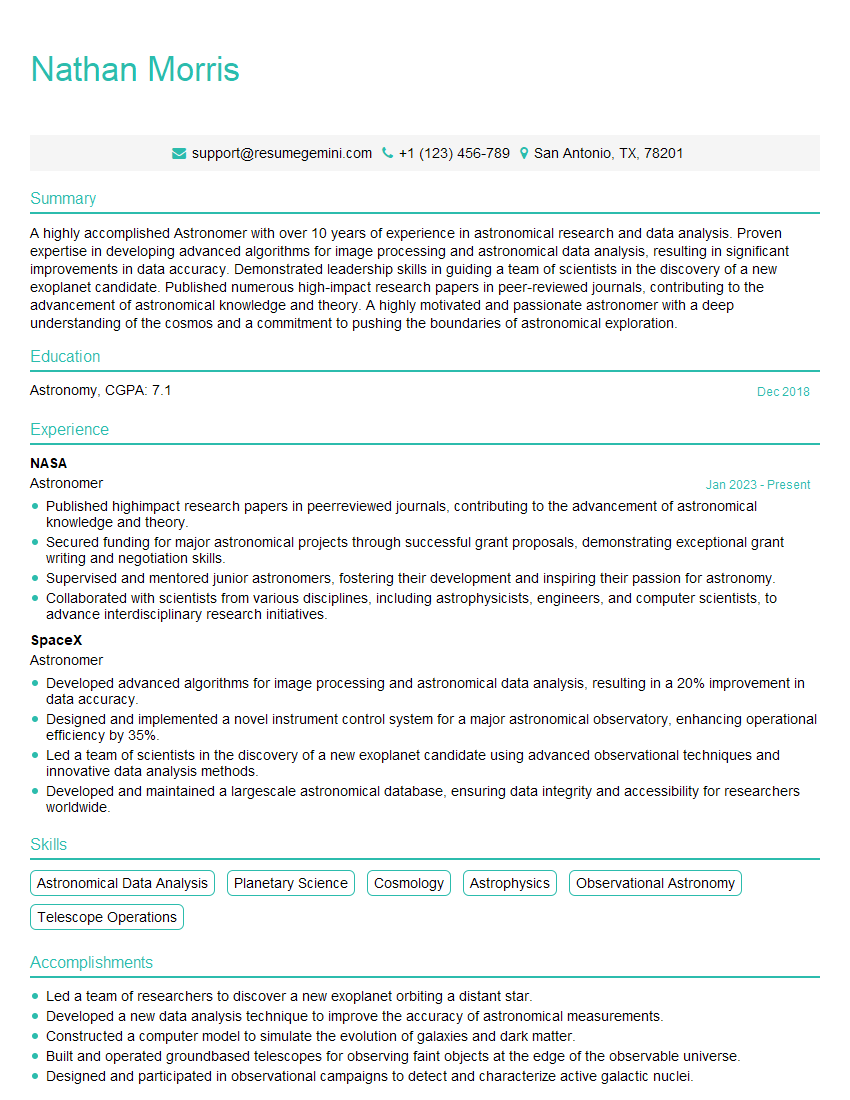
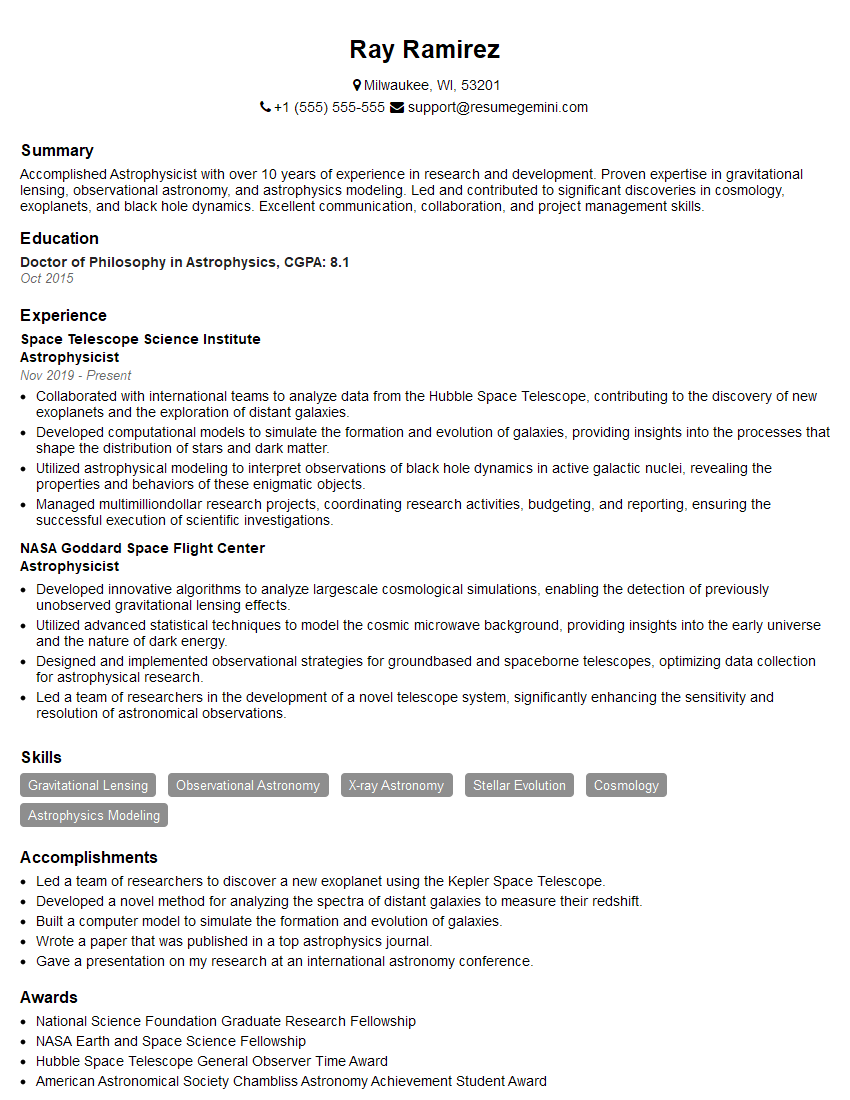
Becoming an International Astronomical Union member signifies a significant achievement, opening doors to collaborations, networking opportunities, and enhanced professional recognition within the global astronomy community. To maximize your chances of securing a position, crafting a compelling and ATS-friendly resume is crucial. A well-structured resume highlights your skills and experience effectively, improving your visibility to recruiters and increasing your interview invitations. We strongly recommend leveraging ResumeGemini to build a professional and impactful resume tailored to the specific requirements of your target role. ResumeGemini provides tools and examples to help you create a resume that truly showcases your qualifications. Examples of resumes tailored to International Astronomical Union Member applications are available to help guide your process.
Explore more articles
Users Rating of Our Blogs
Share Your Experience
We value your feedback! Please rate our content and share your thoughts (optional).
What Readers Say About Our Blog
Amazing blog
hello,
Our consultant firm based in the USA and our client are interested in your products.
Could you provide your company brochure and respond from your official email id (if different from the current in use), so i can send you the client’s requirement.
Payment before production.
I await your answer.
Regards,
MrSmith
hello,
Our consultant firm based in the USA and our client are interested in your products.
Could you provide your company brochure and respond from your official email id (if different from the current in use), so i can send you the client’s requirement.
Payment before production.
I await your answer.
Regards,
MrSmith
These apartments are so amazing, posting them online would break the algorithm.
https://bit.ly/Lovely2BedsApartmentHudsonYards
Reach out at [email protected] and let’s get started!
Take a look at this stunning 2-bedroom apartment perfectly situated NYC’s coveted Hudson Yards!
https://bit.ly/Lovely2BedsApartmentHudsonYards
Live Rent Free!
https://bit.ly/LiveRentFREE
Interesting Article, I liked the depth of knowledge you’ve shared.
Helpful, thanks for sharing.
Hi, I represent a social media marketing agency and liked your blog
Hi, I represent an SEO company that specialises in getting you AI citations and higher rankings on Google. I’d like to offer you a 100% free SEO audit for your website. Would you be interested?