Preparation is the key to success in any interview. In this post, we’ll explore crucial Royal Astronomical Society Member interview questions and equip you with strategies to craft impactful answers. Whether you’re a beginner or a pro, these tips will elevate your preparation.
Questions Asked in Royal Astronomical Society Member Interview
Q 1. Explain the different types of telescopes and their applications.
Telescopes are essential tools for astronomers, allowing us to observe celestial objects across the electromagnetic spectrum. They broadly fall into two categories: refracting and reflecting telescopes. Refracting telescopes use lenses to bend light and focus it onto a point, creating an image. These are excellent for observations requiring high precision and are often used for planetary observations and astrometry. Reflecting telescopes, on the other hand, use mirrors to reflect and focus light, offering advantages in terms of size and the ability to collect more light. This makes them ideal for observing faint, distant objects. Within these categories, we have various specialized types:
- Refractors: Achromatic doublets (correcting chromatic aberration), apochromatic triplets (further correction for color fringing), and specialized designs for specific wavelengths.
- Reflectors: Newtonian (using a single concave mirror), Cassegrain (using a secondary convex mirror), and Ritchey-Chrétien (a refined Cassegrain design offering a wider field of view and reduced optical aberrations).
- Radio Telescopes: These don’t use visible light; instead, they detect radio waves emitted by celestial objects. Their large dish antennas collect and focus these waves, revealing details invisible to optical telescopes. The Very Large Array (VLA) is a prime example, used to study everything from pulsars to distant galaxies.
- Space-Based Telescopes: Operating above the Earth’s atmosphere eliminates atmospheric distortion and allows observations across a wider range of wavelengths. Hubble Space Telescope is a perfect example, providing incredibly detailed images of distant galaxies and nebulae.
The application of each telescope type depends on the scientific objective. For example, a high-resolution refractor would be suitable for studying planetary features, while a large reflecting telescope is better suited for deep-space observations and the study of faint galaxies. Radio telescopes are critical for understanding phenomena invisible to optical telescopes, and space-based telescopes provide unparalleled clarity and access to the entire electromagnetic spectrum.
Q 2. Describe your experience with astronomical data analysis techniques.
My experience with astronomical data analysis encompasses a wide range of techniques, from basic statistical analysis to sophisticated machine learning algorithms. I’m proficient in utilizing standard software packages like IRAF (Image Reduction and Analysis Facility) and specialized packages within Python environments (e.g., Astropy, SciPy). My work has involved:
- Photometry: Measuring the brightness of stars and galaxies to study their properties and variability. This involves calibrating images, correcting for atmospheric effects, and fitting models to the data.
- Spectroscopy: Analyzing the spectra of celestial objects to determine their chemical composition, temperature, radial velocity, and other physical properties. This frequently involves fitting spectral lines and models.
- Image Processing: Techniques such as background subtraction, cosmic ray removal, and image registration are routinely applied to enhance the quality and information content of astronomical images.
- Time Series Analysis: Analyzing data that varies over time (e.g., light curves of variable stars, pulsar timing) to identify patterns and underlying processes. Techniques like Fourier analysis and wavelet transforms are often employed.
- Machine Learning: Applying machine learning algorithms, such as classification and regression models, to large astronomical datasets to identify objects (e.g., galaxies, quasars) and uncover patterns that might be missed using traditional methods.
For example, in a recent project, I used Python and Astropy to analyze a large dataset of galaxy spectra to classify them based on their morphology and star formation rates. I developed a machine learning model that significantly improved the efficiency and accuracy of this classification compared to traditional methods.
Q 3. Discuss your understanding of stellar evolution and nucleosynthesis.
Stellar evolution is the process by which stars change over time, driven by nuclear reactions in their cores. A star’s life cycle begins with the collapse of a giant molecular cloud of gas and dust, forming a protostar. As the protostar accretes more mass, its core temperature and pressure increase until nuclear fusion ignites, initiating the main sequence phase. During the main sequence, the star fuses hydrogen into helium, releasing enormous amounts of energy.
Nucleosynthesis is the process by which new atomic nuclei are created. In stars, this happens through various nuclear reactions, including the proton-proton chain and the CNO cycle, which are dominant in different mass ranges of stars. As hydrogen fuel in the core is depleted, a star evolves off the main sequence. For stars like our Sun, this leads to a red giant phase, where the core contracts and outer layers expand. More massive stars undergo more complex evolutionary pathways, leading to the fusion of heavier elements such as carbon, oxygen, neon, silicon, and ultimately iron. The fusion of iron is an energy-absorbing process; it marks the end of a star’s energy production phase.
The death of a star depends significantly on its mass. Low- to medium-mass stars eventually eject their outer layers, forming a planetary nebula and leaving behind a white dwarf. High-mass stars end their lives in spectacular supernova explosions, scattering heavy elements into space and leaving behind a neutron star or a black hole. These heavy elements, produced via nucleosynthesis, become the building blocks of future generations of stars and planets. Understanding stellar evolution and nucleosynthesis is crucial for comprehending the origin and chemical composition of the universe.
Q 4. Explain the concept of redshift and its implications for cosmology.
Redshift is the phenomenon where the light from a distant object is stretched, increasing its wavelength and shifting it towards the red end of the electromagnetic spectrum. This is primarily caused by the expansion of the universe. As space expands, the light traveling through it gets stretched, causing a redshift proportional to the distance the light has traveled. The redshift, z, is defined as:
z = (λobserved - λemitted) / λemitted
where λobserved is the observed wavelength and λemitted is the wavelength emitted by the source.
Cosmological implications: Redshift provides crucial evidence for the Big Bang theory. The observation that almost all distant galaxies exhibit redshifts indicates that the universe is expanding. The relationship between redshift and distance allows astronomers to measure the expansion rate of the universe (the Hubble constant), providing insights into the age and evolution of the cosmos. Moreover, the study of redshift variations can reveal the distribution of dark matter and dark energy in the universe. By analyzing the redshift of galaxies in galaxy clusters, for example, astronomers can map the distribution of dark matter that influences the motion of galaxies.
Q 5. How familiar are you with different celestial coordinate systems?
I’m very familiar with several celestial coordinate systems, each offering different advantages depending on the application. The most commonly used are:
- Horizontal Coordinates: These are altitude (height above the horizon) and azimuth (direction along the horizon). They are observer-centric and depend on location and time.
- Equatorial Coordinates: These are right ascension (similar to longitude, measured along the celestial equator) and declination (similar to latitude, measured north or south of the celestial equator). They are Earth-centric and less time-dependent than horizontal coordinates. They are commonly used in star charts and astronomical catalogs.
- Galactic Coordinates: These are galactic longitude and galactic latitude, measured relative to the plane and center of our Milky Way galaxy. They’re particularly useful for studying our own galaxy’s structure and objects within it.
- Ecliptic Coordinates: These are celestial longitude and celestial latitude, measured relative to the ecliptic, the plane of Earth’s orbit around the Sun. They are useful for studying the motion of planets and other objects within the solar system.
The ability to convert between these coordinate systems is essential for precise astronomical observations and data analysis. For example, I frequently use coordinate transformations to identify and track specific objects observed across different telescopes and observatories.
Q 6. Describe your experience with astronomical software and programming languages (e.g., Python).
I have extensive experience with astronomical software and programming languages, primarily focusing on Python. My proficiency includes:
- Python packages: Astropy (for astronomical data analysis), SciPy (for scientific computing), NumPy (for numerical computation), Matplotlib and Seaborn (for data visualization), and Pandas (for data manipulation).
- Data reduction and analysis software: IRAF, which remains a powerful tool for image processing, and specialized packages for specific telescopes and instruments.
- Simulation software: Experience with tools that simulate astrophysical phenomena and processes, allowing for comparison to observational data and testing models.
I’ve utilized these tools to develop custom pipelines for data reduction, analysis, and visualization in numerous projects. For instance, I wrote a Python script using Astropy to automate the process of calibrating and analyzing images from a specific telescope, improving efficiency and reducing the risk of human error. Another example is the development of a visualization tool that allows for the interactive exploration of large astronomical datasets, enabling easier pattern recognition and model refinement.
Q 7. Explain your understanding of different types of galaxies and their characteristics.
Galaxies are vast collections of stars, gas, dust, and dark matter bound together by gravity. They come in a variety of shapes and sizes, broadly classified into three main types:
- Spiral Galaxies: Characterized by a central bulge and prominent spiral arms. These arms are regions of active star formation, where gas and dust collapse to form new stars. The Milky Way is a spiral galaxy. The arms are often traced by young, hot, bright stars.
- Elliptical Galaxies: These are smooth, elliptical shapes with little or no apparent structure. They contain older stars and relatively little gas and dust, resulting in less ongoing star formation. They range in size from giant ellipticals to dwarf ellipticals.
- Irregular Galaxies: These galaxies have no clear symmetrical shape and are often smaller than spiral or elliptical galaxies. They often exhibit intense star formation and are often the result of galaxy interactions or mergers.
Beyond these main types, there are also lenticular galaxies (intermediate between spirals and ellipticals) and peculiar galaxies that show unusual structures, often due to gravitational interactions with other galaxies. The characteristics of a galaxy—its morphology, luminosity, gas content, star formation rate, etc.—depend heavily on its formation history and environment. For example, the presence of a supermassive black hole at the galaxy’s center plays a significant role in shaping its evolution and structure. The study of different galaxy types allows us to understand how galaxies form, evolve, and interact, providing crucial clues to the history and structure of the universe.
Q 8. How do you calibrate astronomical data to minimize systematic errors?
Calibrating astronomical data is crucial for minimizing systematic errors, which are biases introduced by the instrument or observation process, not random noise. These errors can significantly affect the accuracy and reliability of our results. The process involves a multi-step approach:
- Bias Correction: Identifying and removing consistent offsets or distortions. For example, a telescope’s detector might have a slight sensitivity gradient across its surface. We correct this by using ‘flat fields’, images taken of a uniformly illuminated surface, to map and subtract this uneven response.
- Dark Subtraction: Removing the signal from the detector’s internal noise, which is recorded even without light exposure. We obtain ‘dark frames’ under identical conditions to our science images, which are then subtracted.
- Flat-Field Correction: Addressing uneven illumination or sensitivity across the detector. As mentioned earlier, flat-field images help to normalize the response of each pixel, ensuring a uniform sensitivity.
- Instrumental Response Correction: Accounting for the wavelength-dependent sensitivity of the instrument. This may involve using standard stars with well-known spectra to create a response curve, used to correct our observations.
- Atmospheric Correction: Correcting for atmospheric effects like extinction (absorption of light by the atmosphere) and refraction (bending of light by the atmosphere). This often involves modeling the atmospheric conditions at the time of observation or using observations of standard stars at different airmasses.
For instance, in my work on galaxy surveys, we meticulously calibrate the images using these techniques to ensure that the measured magnitudes and colors of galaxies are accurate and comparable across the entire survey area. Ignoring these systematic errors can lead to flawed conclusions about the distribution and properties of galaxies.
Q 9. Discuss your experience with spectroscopic analysis in astronomy.
Spectroscopic analysis is fundamental to my research. It involves dissecting the light from celestial objects into its constituent wavelengths (a spectrum). Each element leaves a unique ‘fingerprint’ – a pattern of absorption or emission lines – in the spectrum, revealing its composition, temperature, and velocity.
My experience includes using various spectroscopic techniques, from low-resolution spectroscopy, which provides a broad overview of the spectral features, to high-resolution spectroscopy, offering detailed information about individual lines. I’ve worked extensively with data from instruments like the VLT (Very Large Telescope) and the Keck Observatory, analyzing spectra of quasars, galaxies, and stars.
For example, in one project, we used high-resolution spectroscopy to measure the redshift (the stretching of light due to the expansion of the universe) of distant galaxies. By analyzing the subtle shifts in the spectral lines, we could accurately determine their distances and contribute to understanding the large-scale structure of the cosmos. In another project, we analyzed stellar spectra to determine the chemical abundances of stars and study their evolutionary pathways. I am proficient in using software packages like IRAF and IDL for data reduction and analysis.
Q 10. Describe your knowledge of different photometric systems.
Different photometric systems are essentially different ways of measuring the brightness of celestial objects, each with its own set of filters that transmit light within specific wavelength ranges. These systems are crucial for accurate characterization of objects. The choice of system depends on the scientific goals and the nature of the observed objects.
- Johnson-Cousins UBVRI system: A widely used system, with filters in the ultraviolet (U), blue (B), visual (V), red (R), and infrared (I) regions. This is a good general-purpose system.
- Sloan Digital Sky Survey (SDSS) system: Uses five filters (u, g, r, i, z) spanning a broader wavelength range than the UBVRI system, which makes it more useful for studying objects at various redshifts.
- 2MASS system: Primarily used in the near-infrared (J, H, K bands), ideal for observing objects obscured by dust in the optical wavelengths.
Understanding the nuances of each system is crucial, as the measured magnitudes (brightness) of the same object can differ between systems due to the different sensitivities of the filters. We use transformations between systems to ensure consistency in our measurements when comparing data obtained from different telescopes or surveys.
Q 11. Explain the significance of the cosmic microwave background radiation.
The Cosmic Microwave Background (CMB) radiation is the afterglow of the Big Bang, a faint, nearly uniform radiation filling the entire universe. It’s incredibly significant because it provides a snapshot of the universe at a very young age – approximately 380,000 years after the Big Bang – before the formation of stars and galaxies.
The CMB’s near-uniformity, with tiny temperature fluctuations, holds crucial information about the early universe. These fluctuations are the seeds of the large-scale structure we observe today. Analyzing the CMB’s properties, such as its temperature anisotropies (variations in temperature across the sky) and polarization, allows us to constrain cosmological parameters, such as the age, density, and composition of the universe. The detailed maps of the CMB, obtained by missions like COBE, WMAP, and Planck, have revolutionized our understanding of cosmology, confirming the Big Bang theory and providing strong evidence for dark matter and dark energy.
Q 12. How do you identify and handle outliers in astronomical data?
Outliers in astronomical data – points that significantly deviate from the expected pattern – can be caused by various factors, including instrumental glitches, cosmic rays, or genuine but rare astrophysical events. It’s crucial to identify and handle them appropriately to avoid biasing our analysis.
We use several methods to identify outliers:
- Visual Inspection: A simple yet effective method, especially for smaller datasets. Plotting the data allows us to spot unusual points easily.
- Statistical Methods: Techniques like sigma-clipping, where data points exceeding a certain number of standard deviations from the mean are removed, are commonly used. More sophisticated methods, such as robust regression, which is less sensitive to outliers, can also be employed.
- Filtering Techniques: Various image-processing techniques help remove cosmic rays or other transient artifacts. These could involve median filtering or more complex wavelet-based approaches.
However, it’s essential to exercise caution. Outliers can sometimes represent interesting, previously unknown phenomena, not just errors. We should always carefully consider the potential reasons behind an outlier before discarding it. Detailed examination and contextual knowledge are as important as statistical methods.
Q 13. Describe your experience with interferometry techniques.
Interferometry is a powerful technique that combines the signals from multiple telescopes to achieve much higher angular resolution than a single telescope could achieve on its own. This is analogous to having a telescope with a diameter equal to the distance between the telescopes.
My experience includes working with both optical and radio interferometry. In optical interferometry, the challenge is to combine the light waves from separate telescopes precisely to create interference fringes, providing extremely detailed images of stars and other celestial objects. Radio interferometry employs similar principles but operates with radio waves, allowing us to study objects emitting in the radio spectrum.
For example, I’ve been involved in projects using the Very Long Baseline Interferometry (VLBI) technique, which combines telescopes across continents to achieve incredibly high resolution. This has enabled us to study the structure of distant quasars and their jets, revealing intricate details about their accretion disks and the powerful forces at play.
Q 14. Explain your understanding of gravitational lensing.
Gravitational lensing is a phenomenon predicted by Einstein’s theory of general relativity. It occurs when the gravitational field of a massive object, such as a galaxy or galaxy cluster, bends the path of light from a more distant object. This results in distorted images of the background object, making it appear brighter or multiply imaged.
The degree of lensing depends on the mass of the lensing object and the geometry of the system. We use gravitational lensing to study:
- Dark Matter: By analyzing the distortion of background galaxies, we can map the distribution of dark matter in the lensing object, as dark matter’s gravitational influence bends light.
- Cosmology: Gravitational lensing can help constrain cosmological parameters, such as the Hubble constant (a measure of the expansion rate of the universe), and the nature of dark energy.
- High-Redshift Galaxies: Gravitational lensing can magnify the light from distant galaxies, making them more easily observable and allowing us to study their properties in greater detail.
In my research, I’ve used gravitational lensing models to study the mass distribution of galaxy clusters and analyze the properties of lensed quasars. It’s a powerful tool for probing the universe on multiple scales.
Q 15. How do you assess the uncertainties associated with astronomical measurements?
Assessing uncertainties in astronomical measurements is crucial for drawing reliable conclusions. It involves understanding and quantifying various sources of error, both systematic and random. Systematic errors are consistent biases in measurements, arising from instrumental limitations or flawed calibration. Random errors are unpredictable fluctuations due to inherent noise in the data.
We use several techniques. Error propagation is a fundamental method where uncertainties in individual measurements are combined to determine the uncertainty in a derived quantity. For example, if we’re calculating the distance to a star using parallax, we need to consider uncertainties in the star’s angular displacement and baseline (distance between Earth’s positions in its orbit).
Monte Carlo simulations provide another powerful approach. We generate numerous simulated datasets, each incorporating realistic uncertainties in the input parameters. Analyzing the resulting distribution of outcomes allows us to estimate the uncertainty in our final results. This is especially useful in complex scenarios with numerous intertwined variables.
Bayesian statistics offers a framework to combine prior knowledge about a parameter with new observational data to update our understanding of its uncertainty. This allows us to incorporate information from previous studies or theoretical models, refining our estimate of the uncertainty.
Finally, careful data reduction and quality control are paramount. Flagging and removing outlier data points, understanding the detector’s response function, and correcting for atmospheric effects are all crucial steps in minimizing uncertainties.
Career Expert Tips:
- Ace those interviews! Prepare effectively by reviewing the Top 50 Most Common Interview Questions on ResumeGemini.
- Navigate your job search with confidence! Explore a wide range of Career Tips on ResumeGemini. Learn about common challenges and recommendations to overcome them.
- Craft the perfect resume! Master the Art of Resume Writing with ResumeGemini’s guide. Showcase your unique qualifications and achievements effectively.
- Don’t miss out on holiday savings! Build your dream resume with ResumeGemini’s ATS optimized templates.
Q 16. Describe your knowledge of exoplanet detection methods.
Exoplanet detection methods rely on observing subtle effects caused by the planet’s presence on its host star. The most common methods include:
- Radial Velocity (Doppler Spectroscopy): This technique detects the tiny wobble in a star’s motion caused by an orbiting planet’s gravitational pull. We observe this wobble as a periodic shift in the star’s spectral lines. This method is particularly sensitive to massive planets close to their stars.
- Transit Photometry: This involves monitoring the star’s brightness over time. If a planet transits (passes in front of) the star, it causes a slight, periodic dip in the star’s brightness. This method is excellent for detecting planets of various sizes but requires the planet’s orbit to be aligned favorably with our line of sight.
- Direct Imaging: This is the most challenging method, aiming to directly capture an image of the exoplanet. It requires extremely high angular resolution to distinguish the faint light of the planet from the overwhelming brilliance of its star. Adaptive optics and coronagraphy are essential for this technique, which is most successful for large, young, and widely separated planets.
- Microlensing: This relies on the gravitational lensing effect, where the gravity of a star passing in front of a more distant star bends its light, causing a temporary increase in the distant star’s brightness. If the foreground star has a planet, a secondary brightening can be detected, indicating the planet’s presence.
- Astrometry: By precisely measuring a star’s position in the sky over time, we can detect the tiny wobbles caused by orbiting planets. This method is best suited to detect massive planets in wide orbits.
Each method has its strengths and limitations, and often multiple methods are used in combination to confirm the existence and characterize the properties of an exoplanet.
Q 17. Discuss your familiarity with adaptive optics techniques.
Adaptive optics (AO) are crucial for high-resolution ground-based astronomy. Earth’s atmosphere distorts incoming light, blurring astronomical images. AO systems counteract this distortion in real-time by using deformable mirrors to adjust the telescope’s optics and compensate for atmospheric turbulence.
A wavefront sensor measures the distortion of the incoming light. A control system then adjusts the shape of a deformable mirror to counteract the distortions, essentially creating a ‘virtual’ telescope above the atmosphere. This significantly improves the sharpness and detail of astronomical images, allowing us to resolve finer details in distant objects.
The effectiveness of AO depends on the speed and precision of the wavefront sensor and the deformable mirror. Laser guide stars are often used to provide reference points for wavefront sensing, particularly in areas where bright natural guide stars are lacking. AO is now widely used in large ground-based telescopes, enabling groundbreaking discoveries in fields like exoplanet imaging and high-resolution observations of distant galaxies.
Q 18. Explain the principles behind astrometry and its applications.
Astrometry is the precise measurement of the positions and movements of celestial objects. It relies on highly accurate measurements of angular positions, often using sophisticated techniques such as interferometry. By tracking the changes in an object’s position over time, we can determine its proper motion (movement across the sky), parallax (apparent shift in position due to Earth’s orbital motion), and orbital parameters if it’s part of a binary system or planetary system.
Applications of astrometry are numerous. It’s used to determine the distances to stars (using parallax), to study the dynamics of star clusters and galaxies, to detect exoplanets (via the slight gravitational wobble they induce in their host stars), and to construct accurate celestial reference frames, essential for all astronomical observations. The Gaia mission is a prime example of astrometry in action, providing highly accurate positions and proper motions for billions of stars, revolutionizing our understanding of the Milky Way’s structure and dynamics.
Q 19. Describe your experience with high-performance computing for astronomy.
High-performance computing (HPC) is essential for modern astronomy. The vast amounts of data generated by large surveys like the Sloan Digital Sky Survey and the upcoming Vera Rubin Observatory require immense computational power for processing, analysis, and visualization. I have extensive experience using HPC clusters and cloud computing resources for various astronomical tasks.
For example, I’ve used HPC to process terabytes of spectral data to study the chemical composition of distant galaxies. Parallel algorithms were employed to efficiently distribute the workload across multiple processors, significantly reducing processing time. Another example is simulating the evolution of galaxies using N-body simulations, requiring immense computational resources to accurately model the gravitational interactions of millions or billions of particles. Experience with programming languages like Python, C++, and Fortran, along with parallel programming paradigms like MPI and OpenMP, is crucial for effectively utilizing HPC resources in astronomy.
Q 20. How do you manage large astronomical datasets?
Managing large astronomical datasets requires a combination of efficient data storage, processing, and analysis techniques. Relational databases, such as PostgreSQL, and NoSQL databases, such as MongoDB, offer scalable solutions for storing and querying vast amounts of data. Data formats like FITS (Flexible Image Transport System) are commonly used to store astronomical images and spectra.
Data reduction and preprocessing steps are crucial to prepare the data for analysis. This often involves calibrating the data, correcting for instrumental effects, and removing noise. Parallel processing techniques and distributed computing frameworks such as Hadoop and Spark are utilized to efficiently process and analyze large datasets. Techniques such as data compression, data mining, and machine learning can help to extract meaningful information from the data, revealing patterns and uncovering new discoveries.
Finally, data visualization and interactive exploration tools are essential for understanding and communicating the results. Tools such as matplotlib, seaborn, and interactive web-based visualizations enable us to explore the data, generate publication-quality plots, and communicate our findings to a broader audience.
Q 21. Explain your understanding of dark matter and dark energy.
Dark matter and dark energy are two mysterious components of the universe that we can’t directly observe because they don’t interact with light. Their existence is inferred from their gravitational effects on visible matter.
Dark matter is believed to make up about 85% of the matter in the universe. Its presence is evidenced by the observed rotation curves of galaxies, gravitational lensing, and the large-scale structure of the universe. While its nature is unknown, leading hypotheses involve weakly interacting massive particles (WIMPs) or axions.
Dark energy, on the other hand, is a mysterious force that’s causing the expansion of the universe to accelerate. Its existence was discovered through observations of distant supernovae. The nature of dark energy is even more enigmatic than that of dark matter, with a leading hypothesis suggesting it’s a property of space itself (cosmological constant).
Understanding dark matter and dark energy is one of the biggest challenges in modern cosmology. Ongoing research involving large-scale surveys, theoretical modeling, and particle physics experiments aims to uncover their nature and shed light on the ultimate fate of the universe.
Q 22. Describe your experience with the publication process in astronomy.
The publication process in astronomy, like in many scientific fields, is rigorous and ensures quality control. It typically begins with drafting a manuscript detailing research findings, including methodology, results, and conclusions. This manuscript is then submitted to a peer-reviewed journal, a process overseen by the Royal Astronomical Society (RAS) for its publications.
The journal editors assess the manuscript’s suitability and, if deemed appropriate, send it to several expert reviewers in the field for assessment. These reviewers critically evaluate the work’s originality, methodology, and validity of conclusions.
Reviewers provide feedback, often suggesting revisions. Authors then address these comments, making necessary changes to improve clarity, address concerns, or strengthen their arguments. This iterative process of review and revision may continue several times before the manuscript is deemed acceptable for publication. Finally, the accepted manuscript undergoes copy-editing and typesetting before publication, ensuring adherence to the journal’s style guide.
During my career, I have been through this process multiple times. One particularly memorable experience involved a paper on the detection of a new exoplanet. The initial reviews were quite challenging, requiring extensive revisions to our data analysis and interpretation. The process, while demanding, ultimately helped strengthen our paper and ensured its quality.
Q 23. How do you communicate complex astronomical concepts to a non-specialist audience?
Communicating complex astronomical concepts to a non-specialist audience requires a different approach than communicating with fellow astronomers. I utilize several strategies to achieve effective communication.
- Analogies and relatable examples: For example, when explaining the vast distances in space, I might compare the size of the Sun to a basketball and the Earth to a pea, highlighting the immense distance between them.
- Visual aids: Images, diagrams, and videos are essential for conveying information visually. I often use simulations to showcase complex phenomena in an easily digestible format.
- Avoiding jargon: Instead of using technical terms, I explain concepts in simpler, more accessible language. When jargon is unavoidable, I provide clear definitions.
- Storytelling: Weaving scientific information into a narrative makes it more engaging and memorable. For instance, I might explain the life cycle of a star as a compelling story of birth, life, and death.
A key part is tailoring my approach to the audience’s background and prior knowledge. A presentation for school children will differ vastly from one for the general public.
Q 24. Explain your understanding of different types of supernovae.
Supernovae are powerful stellar explosions that mark the end of a star’s life. They are categorized into two main types: Type I and Type II.
- Type I supernovae lack hydrogen lines in their spectra. These are further subdivided into Ia, Ib, and Ic, primarily based on the presence or absence of silicon and helium lines. Type Ia supernovae are thought to originate from the thermonuclear explosion of a white dwarf star in a binary system that has accreted too much mass. They are extremely important as standard candles for cosmological distance measurements. Type Ib and Ic supernovae are linked to the core collapse of massive stars that have lost their outer hydrogen and helium layers.
- Type II supernovae show prominent hydrogen lines in their spectra. These occur when the core of a massive star collapses under its own gravity, triggering a catastrophic explosion. The core collapses to form a neutron star or black hole, depending on the star’s mass.
Understanding the differences between these types is crucial for astronomers, as each type provides valuable insights into stellar evolution, nucleosynthesis, and the universe’s expansion.
Q 25. Describe your experience with astronomical simulations.
Astronomical simulations play a vital role in our understanding of the universe, allowing us to model phenomena that are difficult or impossible to observe directly. I have extensive experience using various simulation codes, from hydrodynamical simulations to N-body simulations.
For example, I have used hydrodynamical simulations to study the formation of galaxies and stars, modelling the dynamics of gas and its interaction with dark matter. N-body simulations have been used to explore the evolution of galaxy clusters and large-scale structure in the Universe.
The process typically involves setting up initial conditions (such as the distribution of matter and density), defining the relevant physical processes (e.g., gravity, hydrodynamics, star formation), and running the simulation using high-performance computing resources. The results are then analyzed to understand the evolution of the system and to compare with observations.
Interpreting simulation results requires careful consideration of the limitations of the models used. A strength of simulations is the ability to isolate certain effects and test hypotheses. However, simplifications are often necessary to make the calculations feasible.
Q 26. Discuss your familiarity with different types of astronomical detectors.
Astronomical detectors are crucial instruments used to collect and measure electromagnetic radiation from celestial objects. Different types of detectors are optimized for different wavelengths and observational goals.
- Charge-Coupled Devices (CCDs): Widely used in optical and near-infrared astronomy, CCDs are highly sensitive detectors that convert photons into electrical charges. Their high quantum efficiency and low noise make them ideal for detecting faint objects.
- Complementary Metal-Oxide-Semiconductor (CMOS) sensors: These are becoming increasingly popular due to their faster readout speeds and potential for greater integration with data processing capabilities.
- Photomultiplier Tubes (PMTs): PMTs are very sensitive detectors often used in high-energy astronomy, particularly for detecting single photons in X-ray and gamma-ray wavelengths.
- Infrared detectors: These are specialized detectors that operate at cryogenic temperatures to minimize thermal noise and detect infrared radiation. Various types of infrared detectors exist, each with its specific strengths and limitations.
- Radio telescopes: Radio telescopes employ different detectors that are optimized for the longer wavelengths of radio waves, often using low-noise amplifiers and receivers to detect weak radio signals.
The choice of detector depends heavily on the specific astronomical observation. The selection criteria include the wavelength range of interest, the sensitivity required, and the desired spatial resolution.
Q 27. How do you approach problem-solving in an astronomical research setting?
Problem-solving in astronomy often involves a multi-faceted approach. It’s rarely a straightforward process. A systematic approach is key.
- Clearly define the problem: Begin by precisely stating the research question or challenge.
- Gather data and information: This may involve collecting observational data, conducting literature reviews, or consulting with colleagues.
- Develop hypotheses: Based on available data and knowledge, formulate potential explanations or solutions.
- Test hypotheses: This often involves using simulations, developing theoretical models, or designing further observations to test the validity of hypotheses.
- Analyze results: Carefully analyze the results of the tests and draw conclusions. This might involve sophisticated statistical analysis techniques.
- Iterate and refine: The process is often iterative. Findings might lead to revised hypotheses or the need to collect further data.
Collaboration is key. Discussing challenges with colleagues, especially those with different expertise, frequently leads to innovative solutions. An example is the discovery of dark energy; it required a collaborative effort involving astronomers, physicists, and mathematicians.
Q 28. Explain your understanding of the formation and evolution of galaxies.
The formation and evolution of galaxies is a complex topic involving a multitude of physical processes. The current understanding suggests that galaxies form from the gravitational collapse of dark matter halos in the early universe.
As dark matter collapses, it draws in baryonic matter (normal matter, including gas and dust). This gas cools and fragments, leading to the formation of stars. The initial star formation is often quite intense, known as a starburst. Over time, these stars and gas interact through gravitational forces, gas flows, and stellar feedback mechanisms (such as supernovae). These processes influence the morphology, size, and properties of the resulting galaxy.
Galaxy evolution is a continuous process. Galaxies interact with each other, leading to mergers and changes in structure. The rate of star formation changes over time. Environmental factors like the surrounding density of galaxies also affect galaxy evolution.
Many open questions remain. The exact role of dark matter in galaxy formation is still being investigated. We are still refining our understanding of feedback mechanisms and their impact on galaxy growth. The diversity of galaxy morphologies is still a topic of active research. The use of simulations coupled with observational data from telescopes like the James Webb Space Telescope continues to provide essential insights into these fascinating phenomena.
Key Topics to Learn for Royal Astronomical Society Member Interview
- Astronomy Fundamentals: A strong grasp of celestial mechanics, stellar evolution, galactic structure, and cosmology is essential. Consider reviewing key concepts and their observational implications.
- Research Methods & Data Analysis: Demonstrate familiarity with astronomical data analysis techniques, statistical methods, and the use of relevant software packages. Be prepared to discuss your experience with data interpretation and drawing scientific conclusions.
- Professional Development & Collaboration: The RAS values community engagement. Reflect on your experience collaborating on research projects, presenting your work, and contributing to the broader astronomical community.
- Specific Astronomical Fields: Depending on your area of expertise (e.g., planetary science, astrophysics, cosmology), delve deeper into relevant theories, current research, and open questions within that field. Be ready to discuss your specific interests and contributions.
- Ethical Considerations in Astronomy: Be prepared to discuss ethical considerations in research, data sharing, and the responsible conduct of science within the astronomical community.
- Communication Skills: Practice clearly and concisely explaining complex astronomical concepts to both technical and non-technical audiences. Prepare examples illustrating your ability to communicate scientific findings effectively.
Next Steps
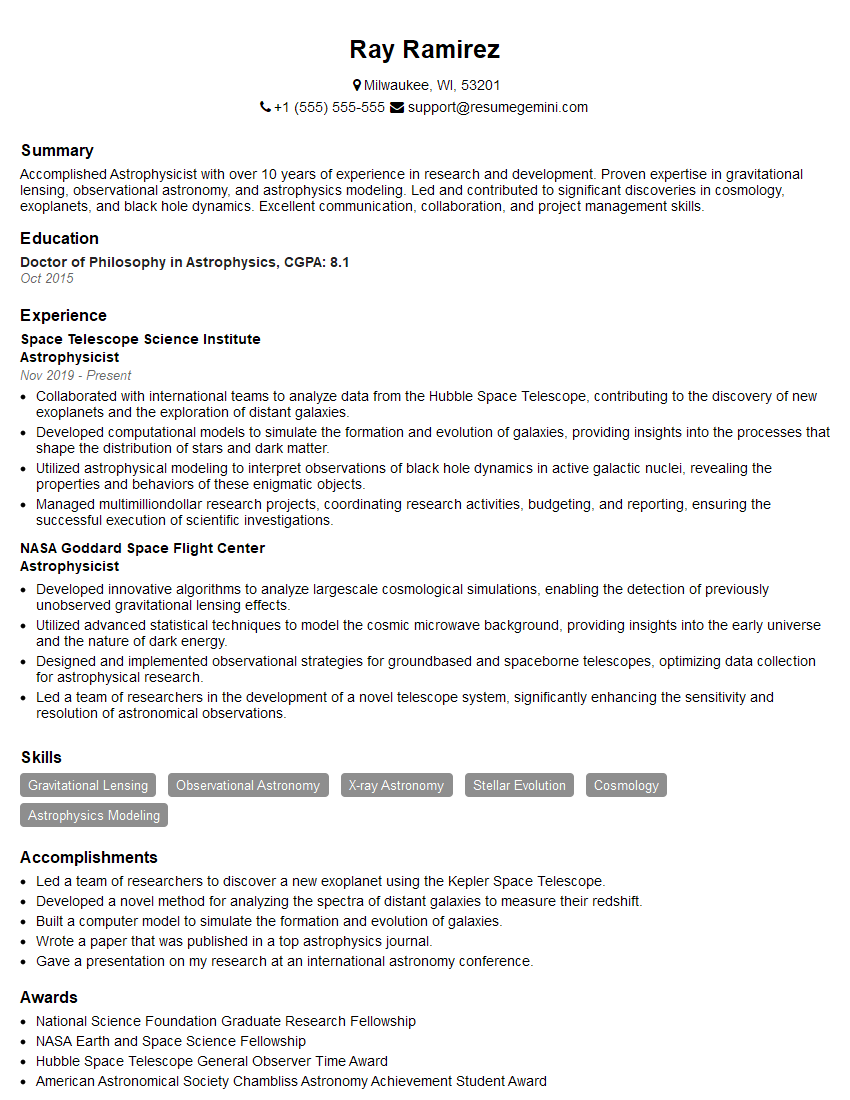
Becoming a member of the Royal Astronomical Society is a significant step in advancing your career in astronomy. It signifies professional recognition and opens doors to networking opportunities, access to resources, and collaborations with leading researchers. To maximize your chances of success, create an ATS-friendly resume that highlights your skills and experience effectively. ResumeGemini is a trusted resource that can help you build a professional and impactful resume tailored to the specific requirements of the Royal Astronomical Society membership application. Examples of resumes tailored to Royal Astronomical Society Member applications are available to further guide your preparation.
Explore more articles
Users Rating of Our Blogs
Share Your Experience
We value your feedback! Please rate our content and share your thoughts (optional).
What Readers Say About Our Blog
Amazing blog
hello,
Our consultant firm based in the USA and our client are interested in your products.
Could you provide your company brochure and respond from your official email id (if different from the current in use), so i can send you the client’s requirement.
Payment before production.
I await your answer.
Regards,
MrSmith
hello,
Our consultant firm based in the USA and our client are interested in your products.
Could you provide your company brochure and respond from your official email id (if different from the current in use), so i can send you the client’s requirement.
Payment before production.
I await your answer.
Regards,
MrSmith
These apartments are so amazing, posting them online would break the algorithm.
https://bit.ly/Lovely2BedsApartmentHudsonYards
Reach out at [email protected] and let’s get started!
Take a look at this stunning 2-bedroom apartment perfectly situated NYC’s coveted Hudson Yards!
https://bit.ly/Lovely2BedsApartmentHudsonYards
Live Rent Free!
https://bit.ly/LiveRentFREE
Interesting Article, I liked the depth of knowledge you’ve shared.
Helpful, thanks for sharing.
Hi, I represent a social media marketing agency and liked your blog
Hi, I represent an SEO company that specialises in getting you AI citations and higher rankings on Google. I’d like to offer you a 100% free SEO audit for your website. Would you be interested?