Are you ready to stand out in your next interview? Understanding and preparing for Equalization Techniques interview questions is a game-changer. In this blog, we’ve compiled key questions and expert advice to help you showcase your skills with confidence and precision. Let’s get started on your journey to acing the interview.
Questions Asked in Equalization Techniques Interview
Q 1. Explain the difference between parametric and graphic equalizers.
Parametric and graphic equalizers are both tools for adjusting the frequency balance of an audio signal, but they differ significantly in their approach. Think of it like this: a graphic EQ is like a painter using a palette of pre-mixed colors, while a parametric EQ is like a painter mixing their own custom colors from scratch.
A graphic equalizer uses a visual display with sliders representing fixed frequency bands (e.g., octaves or thirds of octaves). You adjust the gain (boost or cut) of each band independently. This provides a quick, intuitive way to make broad adjustments, great for shaping the overall tonal balance. However, it lacks the precision of a parametric EQ.
A parametric equalizer offers more control by allowing you to adjust three parameters for each frequency band: frequency (the center frequency of the adjustment), gain (the amount of boost or cut), and Q factor (the bandwidth of the adjustment, explained further in the next question). This level of precision is ideal for targeting specific frequencies and precisely shaping the sound, which is very important for problem-solving in professional audio.
For example, a graphic EQ might be used to quickly brighten a dull vocal, while a parametric EQ would be used to precisely cut a resonant frequency causing muddiness in the bass guitar.
Q 2. Describe the concept of Q factor in equalization.
The Q factor in equalization describes the bandwidth, or width, of a filter’s effect. It essentially determines how narrow or wide the adjustment is around the center frequency. A high Q value creates a very narrow band, affecting only a small range of frequencies, while a low Q value creates a wider band, affecting a larger range of frequencies.
Imagine a bell curve; the Q factor determines the curve’s width. A high Q is a tall, narrow bell, while a low Q is a short, wide bell.
Consider a scenario where there’s a nasty resonant frequency at 250 Hz causing a muddy sound in your mix. A high Q setting would allow you to precisely cut that frequency without significantly affecting the nearby frequencies, whereas a low Q setting would cut a wider range of frequencies, potentially making the sound thin or lifeless. The optimal Q factor depends on the specific issue and desired effect; often experimentation is necessary.
Q 3. How do you identify and correct frequency masking issues using equalization?
Frequency masking occurs when one sound’s presence makes another sound less audible, even if both are present at significant levels. This often happens when a louder sound is present in a similar frequency range. For example, a powerful bass drum can mask a subtle guitar part in the same low-frequency range.
To identify masking, listen critically to your mix, paying attention to instruments in similar frequency ranges. If a sound seems to ‘disappear’ or ‘get lost’ despite having adequate level, it may be masked. Using a spectrum analyzer (visual representation of frequencies) can help visualize potential masking situations.
Correcting masking usually involves equalizing. If a bass drum is masking a guitar, you might try these strategies:
- Cut the offending frequency in the bass drum: Use a parametric EQ to subtly cut the bass drum’s energy around the frequency where the guitar sits. Be mindful not to remove the essential low-end punch of the drum.
- Boost the masked frequency in the guitar: Carefully boost the guitar’s level in the frequency range that’s getting masked, paying close attention to avoid muddiness or unpleasant resonance.
- Frequency separation: Strategically use EQ to move the instruments to different frequency areas, minimizing overlap.
The key is careful and iterative adjustment. Listen critically after each change, making sure to maintain overall balance.
Q 4. What are the common types of equalization filters (e.g., high-pass, low-pass, band-pass, notch)?
Equalization filters are like tools in a sound technician’s toolbox, each designed for specific frequency manipulation tasks. Here are common types:
- High-pass filter: Allows high frequencies to pass through while attenuating (reducing) low frequencies. Think of it as a ‘low-cut’ filter – useful to remove unwanted rumble or mud from a signal, like removing low-frequency noise from a vocal track.
- Low-pass filter: Allows low frequencies to pass through while attenuating high frequencies. Often used to smooth out harshness in a signal, or to separate frequencies like removing high-frequency hiss from a bass guitar.
- Band-pass filter: Allows a specific range of frequencies to pass through, attenuating both higher and lower frequencies. This is extremely helpful for isolating specific parts of the audio spectrum; for example, only passing the upper-midrange frequencies to boost the presence of a guitar.
- Notch filter: A very narrow band-reject filter that attenuates a very specific frequency while leaving other frequencies untouched. Very useful for removing specific resonant frequencies like feedback or unwanted room modes in a live sound setting.
Q 5. Explain the relationship between equalization and phase response.
Equalization significantly impacts the phase response of an audio signal. While it’s usually not a significant issue with simple boost/cut adjustments, complex equalization, especially with multiple narrow filters, can introduce phase shifts. These shifts can lead to a loss of clarity, a change in the perceived timing of the sound, and potentially a thinning or unnatural quality in the audio.
Phase response is about the timing relationships between different frequencies. When a signal is delayed at certain frequencies after EQ, this can create problems. This is why it’s often recommended to use a minimum number of EQ adjustments, and to apply broad changes instead of using many narrow cuts or boosts. Some high-end EQs offer phase correction features to help minimize problems with phase distortion.
Q 6. How does equalization affect the overall loudness of a signal?
Equalization can affect the overall loudness of a signal in a few ways. Cutting frequencies will generally decrease perceived loudness, as you’re reducing the total energy. Boosting frequencies can increase perceived loudness, but it’s not a direct, one-to-one relationship. A boost of 6dB in one frequency band doesn’t necessarily mean your overall signal will be 6dB louder.
For example, boosting the mid-range frequencies might make an instrument sound louder and more present without necessarily increasing the overall perceived loudness; however boosting the bass frequencies can significantly increase overall loudness in your mix.
It’s crucial to remember that boosting frequencies can lead to distortion if the signal becomes too hot and that you don’t want to overuse this. The goal of equalization is primarily to improve the tonal balance, not to increase the overall loudness—that’s typically done with gain staging and compression.
Q 7. Describe your approach to using equalization in a live sound mixing environment.
In a live sound mixing environment, my approach to equalization is primarily subtractive and problem-solving oriented. My approach consists of a three-step process: preventative measures, identifying problems, and applying EQ
Step 1 (Preventative): Before the show starts, I aim to minimize issues with proper microphone placement, instrument setup, and PA system configuration. This reduces the need for extensive EQ later on. A good live sound system does not require a lot of eq, but should be a starting point before the concert.
Step 2 (Problem Identification): During soundcheck and the show, I listen critically for any muddiness, harshness, feedback, or other issues. I frequently use a spectrum analyzer to visualize the frequencies to aid in understanding the spectrum and what’s happening in the audio.
Step 3 (EQ Application): I mostly use high-pass filters to remove low-frequency rumble. I then use parametric EQs to address specific issues. I rarely use graphic EQs in live sound as they lack the precision needed for quick fixes. My philosophy is to apply small, targeted adjustments rather than large, sweeping changes. After each adjustment, I step back and listen critically to check how it affects the overall mix balance.
In a live setting, speed and efficiency are key. I focus on fixing problems quickly and effectively to maintain a smooth flow during the performance.
Q 8. How do you use equalization to improve the clarity of vocals?
Vocal clarity in equalization is all about sculpting the frequency spectrum to let the essential vocal elements shine through. We achieve this by carefully addressing specific frequency ranges. For instance, muddiness in the low-midrange (around 250-500 Hz) can be addressed with a subtle cut, allowing the vocals to sit better in the mix and avoid clashing with the bass or drums. Conversely, boosting frequencies around 3-5 kHz can add presence and air to the vocals, making them cut through the mix more effectively. Think of it like sculpting a statue – you’re removing unnecessary material (reducing frequencies) and highlighting the key features (boosting frequencies) to reveal the beautiful form.
Example: A vocalist’s recording sounds muffled. By applying a gentle cut around 250 Hz and a small boost around 4 kHz, we can dramatically improve clarity and presence, making the vocals more intelligible and engaging.
Q 9. How do you use equalization to achieve a balanced mix across different frequencies?
Achieving a balanced mix across different frequencies is a crucial aspect of professional audio engineering. It’s about ensuring each instrument and vocal occupies its own sonic space without masking or clashing with others. This involves a holistic approach, carefully listening and making adjustments across the entire frequency range. We want to avoid harshness (typically in higher frequencies), muddiness (in low-mid frequencies), and thinness (lack of body in the low frequencies).
Process: I typically start by soloing each track and EQing it individually. This helps identify problematic frequencies and allows for targeted adjustments. Then, I’ll group similar instruments (e.g., guitars) and listen for clashes or overlaps. Finally, I’ll EQ the entire mix to ensure a smooth and balanced sonic landscape. The goal is to create a mix where every element is clear and distinct, contributing to a unified sound.
Q 10. Explain the concept of shelving equalization.
Shelving equalization is a type of EQ that applies a gradual boost or cut across a wide range of frequencies, above or below a specific crossover frequency. Unlike parametric EQs which affect a narrow band, shelving EQs are like tilting a shelf – adjusting the entire level of a broad frequency range gently.
Types: There are two main types: high-shelf EQ (affecting higher frequencies) and low-shelf EQ (affecting lower frequencies).
Applications: A high-shelf EQ might be used to add brightness to a track or tame harshness in the high frequencies. A low-shelf EQ can be used to add warmth to a track, or to reduce excessive bass. Shelving EQs are ideal for making broad adjustments to the overall tonal balance of a track or mix, rather than surgically targeting specific frequencies.
Q 11. Describe your experience with using real-time analyzers (e.g., spectrum analyzers) during equalization.
Real-time analyzers, like spectrum analyzers, are indispensable tools in my equalization workflow. They provide a visual representation of the audio’s frequency content, allowing for precise and informed decisions. I use them to identify problem frequencies, confirm the effectiveness of my EQ adjustments, and ensure the overall spectral balance of a track or mix.
Example: If I hear a harshness in a vocal, I’ll use a spectrum analyzer to pinpoint the exact frequency range responsible. Then, I can precisely target that frequency with a narrow cut to remove the harshness without affecting other desirable frequencies. This avoids making broad, potentially damaging cuts that might remove positive aspects of the audio.
Q 12. How do you handle feedback issues using equalization?
Feedback is a high-pitched squeal or howl that occurs when a sound system amplifies its own output. It’s caused by a positive feedback loop, where the sound is amplified, reaches the microphone, is amplified again, and the cycle repeats, leading to the unpleasant sound. EQ plays a critical role in mitigating feedback.
Solution: The key is to identify the frequency causing the feedback and then apply a narrow cut at that specific frequency using a parametric EQ. Often, a real-time analyzer will be extremely useful here. It’s crucial to use a very narrow Q-factor (bandwidth) to avoid affecting other desirable frequencies. A small cut is usually enough to eliminate the feedback effectively.
Q 13. Explain your process for troubleshooting equalization problems.
Troubleshooting equalization problems is a systematic process. I usually start by identifying the specific issue – is it muddiness, harshness, lack of presence, or something else? Then, I carefully analyze the audio, using my ears and a spectrum analyzer to pinpoint the problematic frequencies. I start with small adjustments, carefully listening and observing the effect on the overall sound.
Step-by-step:
- Isolate the Problem: Determine which element needs EQ adjustment (specific instrument or vocal).
- Identify Problematic Frequencies: Use a spectrum analyzer and your ears to locate frequencies causing issues.
- Make Small, Targeted Adjustments: Begin with subtle boosts or cuts to avoid drastic changes.
- Listen Critically: Compare the sound before and after each adjustment, noting the impact on the entire mix.
- Iterate: Continue adjusting until the desired sonic balance is achieved.
Often, the solution lies in finding the right balance between boosting some frequencies and cutting others. It’s an iterative process involving careful listening, observation, and a degree of artistic judgment.
Q 14. How do you determine appropriate gain staging before applying equalization?
Gain staging, the process of setting appropriate signal levels throughout the audio chain, is crucial before applying equalization. Proper gain staging ensures that the signals are at optimal levels, preventing clipping (distortion) and maximizing dynamic range. It also ensures that the EQ adjustments have the desired effect without adding noise or artifacts.
Process: I typically start by setting the levels of individual tracks so they’re neither too hot (close to clipping) nor too quiet. This is often done before any significant EQ processing. I usually aim for peaks around -18dBFS to allow headroom for dynamic changes and EQ boosts. Once the gain staging is set, I then proceed with equalization, making adjustments within the existing headroom.
Example: If a track is too loud, simply reducing its gain is a preferred first step. Applying an EQ cut to reduce loudness can lead to unintended loss of frequencies and tonal qualities.
Q 15. What are the potential negative consequences of over-equalization?
Over-equalization, essentially boosting or cutting frequencies excessively, can lead to a muddy, harsh, or unnatural sound. Think of it like over-seasoning a dish – too much of a good thing ruins the overall flavor.
- Muddy Low-End: Excessive boosting of low frequencies can cause a buildup of bass, making the mix unclear and lacking definition. This is especially true if multiple instruments occupy the same low-frequency range.
- Harsh Highs: Over-boosting high frequencies can result in a harsh, brittle sound, leading to listener fatigue. This often manifests as excessive sibilance (hissing ‘s’ sounds) or an overall unpleasant ‘brightness’.
- Phase Cancellation: Aggressive EQ cuts can sometimes create phase cancellation issues, particularly if you’re making drastic cuts around the same frequency range on multiple tracks. This can lead to a thin or weak sound in that frequency region.
- Unnatural Tone: Over-equalization often strips away the natural character and timbre of an instrument or vocal. A subtly EQ’d sound retains its inherent qualities; an overly EQ’d sound sounds processed and artificial.
The key is subtle adjustments and mindful listening. Remember, less is often more when it comes to equalization.
Career Expert Tips:
- Ace those interviews! Prepare effectively by reviewing the Top 50 Most Common Interview Questions on ResumeGemini.
- Navigate your job search with confidence! Explore a wide range of Career Tips on ResumeGemini. Learn about common challenges and recommendations to overcome them.
- Craft the perfect resume! Master the Art of Resume Writing with ResumeGemini’s guide. Showcase your unique qualifications and achievements effectively.
- Don’t miss out on holiday savings! Build your dream resume with ResumeGemini’s ATS optimized templates.
Q 16. How do you approach equalization in different acoustic environments (e.g., studio, live venue)?
Equalization strategies vary significantly depending on the acoustic environment. A studio provides a controlled setting, while a live venue presents unpredictable acoustic challenges.
- Studio: In a studio, you have much greater control over the sound. I typically start by making sure the monitors are properly calibrated, then employ precise EQ adjustments to shape individual tracks within the mix, focusing on subtle corrective and creative EQ to ensure a balanced and polished final product. Here, I might use surgical cuts to address specific frequency resonances or boosts to enhance certain aspects of a sound.
- Live Venue: Live venues present unique acoustic characteristics, often with unpredictable resonances and standing waves. Before the gig, I’ll typically do some sound checks, listening carefully for problematic frequencies that need to be addressed. During a live sound mix, I might rely more on broad equalization to counteract feedback, tame problematic frequencies, or shape the overall sound to fit the room. Real-time adjustments based on the listening experience in that space are crucial.
The fundamental difference is the level of control. The studio allows for detailed, meticulous work, while live sound demands quick decision-making and adaptability.
Q 17. Describe your experience with different equalization plugins (e.g., FabFilter Pro-Q, Waves plugins).
I’ve extensively used various EQ plugins, including FabFilter Pro-Q and several Waves plugins. Each has its strengths and weaknesses.
- FabFilter Pro-Q: Known for its precise controls and intuitive interface, Pro-Q is excellent for surgical EQ work. Its dynamic EQ section is invaluable for tackling problematic frequencies that fluctuate in level. I often use its spectral display to visualize the frequency response and make informed decisions.
- Waves plugins (e.g., Waves Q10, Renaissance EQ): Waves offers a wide range of EQ options, from vintage-style emulations to modern, transparent designs. Waves plugins are often chosen for their emulation of classic hardware equalizers. I find their different character to be useful for different kinds of sound design.
My choice of plugin often depends on the specific task. For surgical work requiring very precise adjustments, I frequently choose Pro-Q. For imparting a specific character or emulating a certain console, I might turn to a Waves plugin.
Q 18. How do you use equalization to enhance the bass frequencies?
Enhancing bass frequencies requires a careful approach. Overdoing it leads to muddiness, so I focus on precision and context.
- Subtle Boosts: I usually start with gentle boosts in the 60-100Hz range to add weight and fullness, but monitor for any muddiness. If muddiness arises, I often try a subtractive approach, cutting around 250-500Hz to help alleviate it.
- Low-Cut Filter: Applying a high-pass filter (low-cut) to remove unnecessary low-frequency content that’s not contributing to the bass but might be causing mud is a common first step. This is particularly important for instruments that don’t actually need to occupy the low-end frequencies (like guitars or vocals).
- Context is Key: The ideal bass boost depends heavily on the mix. A solo bassline will require different EQ settings than a bassline within a full band arrangement. Careful listening to the entire mix is essential to make adjustments in context.
I might visualize the frequency response using a spectrum analyzer to pinpoint the areas needing attention, and employ narrow Q boosts to target specific frequencies without affecting adjacent ranges.
Q 19. How do you use equalization to control sibilance in vocals?
Controlling sibilance, those harsh ‘s’ sounds, involves targeted frequency cuts around 5-8kHz. The key is subtlety.
- Subtle Cuts: I generally avoid aggressive cuts, opting instead for small reductions (1-3dB) in the crucial frequency region. A narrow Q is important to target only the sibilance and not make the vocals sound dull.
- Dynamic EQ: A dynamic EQ can be incredibly helpful. This allows for the reduction of sibilance only when it becomes excessively prominent, preserving the natural energy of the vocals.
- De-Esser: Specialized de-essers are designed specifically to tame sibilance. These often feature a compressor-like behavior, reducing the gain of the offending frequencies only when they exceed a threshold.
- Multiband Compression: Using multiband compression, you could compress the specific frequency range containing the sibilance, making it less prominent.
Remember, the goal is not to eliminate all sibilance but to control it and make it less harsh and more pleasant.
Q 20. What is the importance of A/B comparisons when equalizing?
A/B comparisons are essential for objective equalization. It’s easy to get ‘ear fatigue’ and lose perspective while making adjustments.
By constantly switching between the processed and unprocessed signals, I can clearly hear the impact of each adjustment. This helps me avoid making decisions based on momentary perception rather than the overall effect. A/B comparison is crucial for preventing over-processing and ensuring any adjustments have a positive and purposeful effect.
Q 21. Explain your understanding of headroom management in relation to equalization.
Headroom management is critical in equalization. It refers to the available dynamic range before the signal clips (reaches its maximum level).
Applying significant boosts increases the level of your audio signal. If you boost too much without managing your headroom, you risk distortion. So, I often pre-fader adjust the gain of a track *before* significant EQ adjustments. In digital audio workstations, you usually have a meter indicating the headroom to prevent distortion. I then make certain that the track has adequate headroom. This ensures that the signal remains within a safe range, preventing clipping and unwanted distortion during the processing.
Maintaining sufficient headroom prevents unintended artifacts and allows for subsequent processing stages like compression or mastering without further risking clipping or signal distortion. It’s a fundamental aspect of a clean and professional mix.
Q 22. How do you apply equalization to correct frequency imbalances in a recording?
Equalization, or EQ, is the process of adjusting the balance of frequencies in an audio signal. Think of it like a graphic equalizer on your stereo – it allows you to boost or cut certain frequencies to correct imbalances or shape the overall sound. To correct frequency imbalances in a recording, you analyze the audio’s frequency spectrum, identifying areas that are too loud or too quiet. For instance, a recording might have an excessive amount of low-frequency muddiness, making the bass sound overwhelming. Using an EQ, you’d cut (reduce the level of) those low frequencies. Conversely, if the vocals sound thin and lack presence, you might boost (increase the level of) the mid-range frequencies. This process involves using different EQ types (parametric, graphic, shelving) and carefully adjusting frequencies, gain, and Q (bandwidth) until a balanced and pleasing sound is achieved.
For example, imagine a recording with a harsh, sibilant ‘s’ sound. This is often caused by excessive high-frequency energy in the vocal range (around 5-8kHz). A parametric EQ allows for precise control: you’d find the offending frequency, cut it slightly, and adjust the Q to narrowly target the problem area, avoiding unintended coloration of other frequencies. The goal isn’t to make everything perfectly flat, but to create a clear, natural, and aesthetically pleasing sound.
Q 23. Describe your experience with using equalization for mastering.
In mastering, equalization plays a crucial role in ensuring the final mix translates well across various playback systems. My experience involves using EQ subtly to address overall tonal balance, ensuring the track sounds cohesive and competitive within its genre. I often utilize surgical EQ techniques to eliminate problem frequencies (such as unwanted resonances or muddiness) that might not be apparent in the mix stage. This might involve narrow cuts around specific frequencies to target resonant frequencies in kick drums or guitars. I often use gentle shelving EQs to subtly shape the overall tonal character of the master, perhaps boosting the low end to improve warmth or slightly attenuating harshness in the high frequencies for added clarity. The key in mastering is to make the subtle, strategic adjustments that enhance the entire mix without drawing undue attention to the EQ itself. The goal is transparency; listeners shouldn’t notice the EQ, only the improved sound.
Q 24. What are some common mistakes to avoid when using equalization?
Common mistakes in EQing include:
- Over-EQing: This leads to a muddy or unnatural sound. Less is often more – small adjustments can make a big difference.
- Boosting instead of cutting: It’s generally easier and cleaner to cut unwanted frequencies than to boost desired frequencies, as boosting can amplify noise and create unwanted resonances.
- Ignoring phase cancellation: EQing can sometimes cause phase issues, leading to a thin or weak sound. Careful monitoring and potentially using a phase meter can help avoid this.
- Using too narrow Q-factors: While precision is beneficial, extremely narrow cuts or boosts can lead to an unnatural sound.
- Lack of reference tracks: Comparing your work to well-mastered tracks in the same genre helps you judge the overall balance and understand the industry standards.
- Not using your ears: Relying solely on visual representations of the frequency spectrum can be misleading. Always trust your ears – if something sounds wrong, it probably is.
Q 25. How do you use equalization in conjunction with other audio processing techniques (e.g., compression, limiting)?
EQ works in tandem with other audio processing techniques. It’s often used before compression to shape the dynamics of the signal and ensure the compressor is working with a cleaner, more balanced source. For instance, cutting harsh frequencies before compression prevents those frequencies from being amplified by the compressor. After compression, EQ can be used to address any tonal changes caused by compression or to enhance the character of the compressed signal. Limiting often comes last in the chain, and its purpose is typically to avoid clipping or distortion. Using EQ before limiting ensures you are limiting the clearest possible signal.
For example, a vocal track might be compressed to bring out its detail and even out its dynamics. However, the compression might inadvertently make the sibilance more prominent. After the compression, a narrow cut around the sibilant frequencies would resolve this issue.
Q 26. Explain the differences between linear and non-linear equalization.
Linear EQ directly alters the amplitude of frequencies proportionally without impacting the phase of the signal. This means that a linear EQ boost at a specific frequency simply increases the amplitude of that frequency by a set amount. Non-linear EQ, on the other hand, manipulates the signal in a more complex way – such as through distortion, waveshaping, or dynamic EQ – which can affect the phase and introduce harmonic distortion. This can lead to desirable tonal changes but should be used more judiciously as it can affect the clarity and naturalness of the sound.
Think of it this way: linear EQ is like adjusting the volume knobs on individual frequency bands on a stereo. Non-linear EQ is more akin to applying a unique ‘effect’ to each frequency band – it’s a more powerful but potentially more unpredictable tool.
Q 27. Describe a time you had to troubleshoot a complex equalization problem. What was your approach?
I once encountered a situation where a recording had a severe resonance in the low-mid range (around 250Hz) that was causing muddiness and masking other instruments. Simply cutting at 250Hz didn’t resolve it because it was a broad resonance. My approach was systematic:
- Identify the problem: Thoroughly analyzed the frequency spectrum to pinpoint the exact frequency range causing the problem.
- Experiment with different Q-factors: I started with a wider Q to initially reduce the overall resonance, then gradually narrowed the Q to address the most problematic parts of the resonance.
- Employ multiple cuts: Instead of one large cut, I employed several smaller cuts at slightly different frequencies within the resonant area, to effectively ‘flatten’ the curve without creating phase issues.
- A/B comparison: Continuously compared the processed sound to the original using A/B comparisons to judge the changes objectively.
- Reference tracks: Checked how similar recordings in the genre handled low-mid frequencies.
This step-by-step method allowed for a precise and natural-sounding correction. The key was understanding that a complex problem might require a multifaceted solution that carefully balances precision and avoiding unintended consequences.
Q 28. How would you explain the concept of equalization to someone with no technical background?
Imagine your voice is made up of many different sounds, some high and some low. Equalization is like having a sound ‘sculpting’ tool that lets you adjust the balance of these sounds. If some sounds are too loud (like a harsh ‘s’ sound), you can lower their volume. If others are too quiet (like the bass in a song), you can boost them. It’s all about making the overall sound clearer, more balanced, and more pleasing to the ear. Just like a painter uses different colors to create a picture, a sound engineer uses EQ to shape and enhance the sounds in a recording.
Key Topics to Learn for Equalization Techniques Interview
- Fundamental Concepts: Gain a strong understanding of the core principles behind equalization, including frequency response, amplitude, and phase.
- Types of Equalization: Master the differences and applications of parametric, graphic, and shelving equalization. Understand when to use each type effectively.
- Practical Applications in Audio Engineering: Explore real-world scenarios where equalization is crucial, such as mixing, mastering, live sound reinforcement, and broadcast.
- Frequency Spectrum Analysis: Develop your skills in identifying problematic frequencies and applying equalization to address issues like muddiness, harshness, and lack of clarity.
- Q Factor and Gain Control: Understand how to manipulate the Q factor and gain to achieve precise and targeted adjustments in the frequency response.
- Room Acoustics and Equalization: Explore how equalization can be used to compensate for acoustic anomalies in recording studios or live performance venues.
- Digital Signal Processing (DSP) and Equalization: Understand the role of DSP in modern equalization techniques and the advantages of digital processing over analog methods.
- Problem-Solving Approach: Practice diagnosing audio problems, identifying the root causes, and applying appropriate equalization strategies to achieve desired results. Develop a systematic approach to troubleshooting.
- Subjective Listening Skills: Develop your ability to critically listen and make informed decisions based on your auditory perception of the audio material.
Next Steps
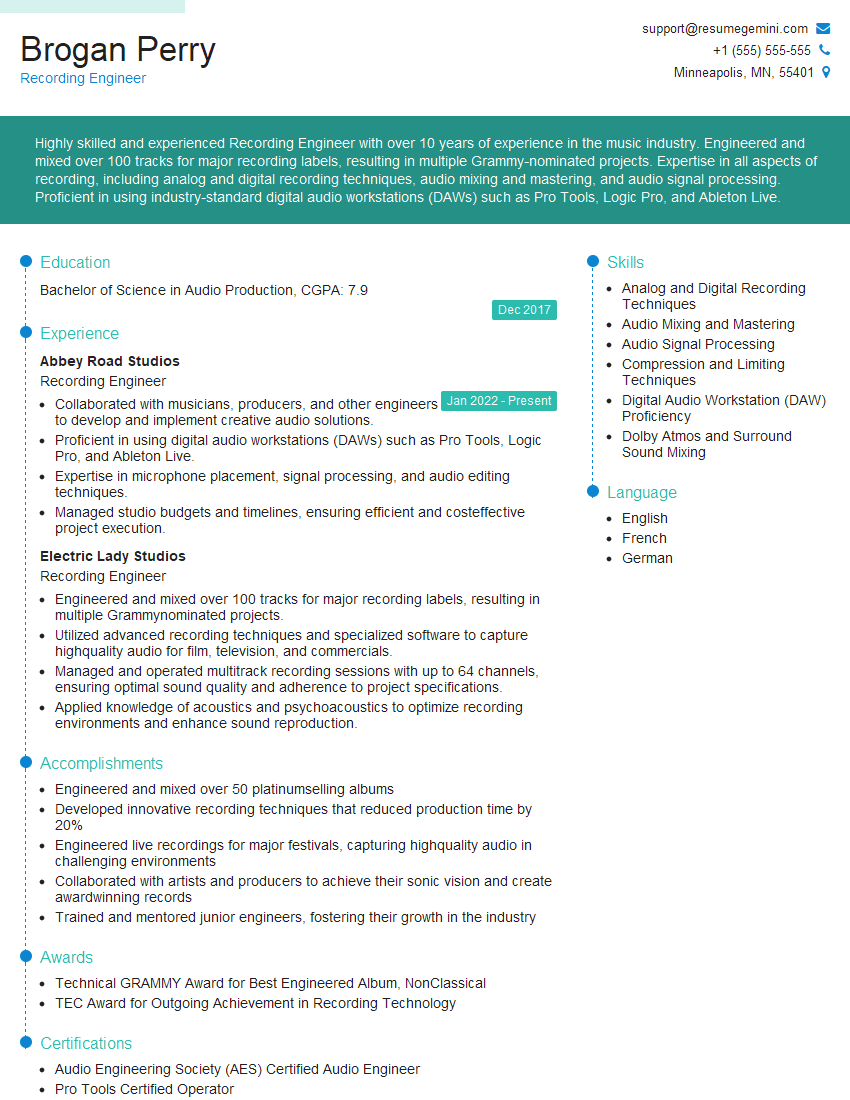
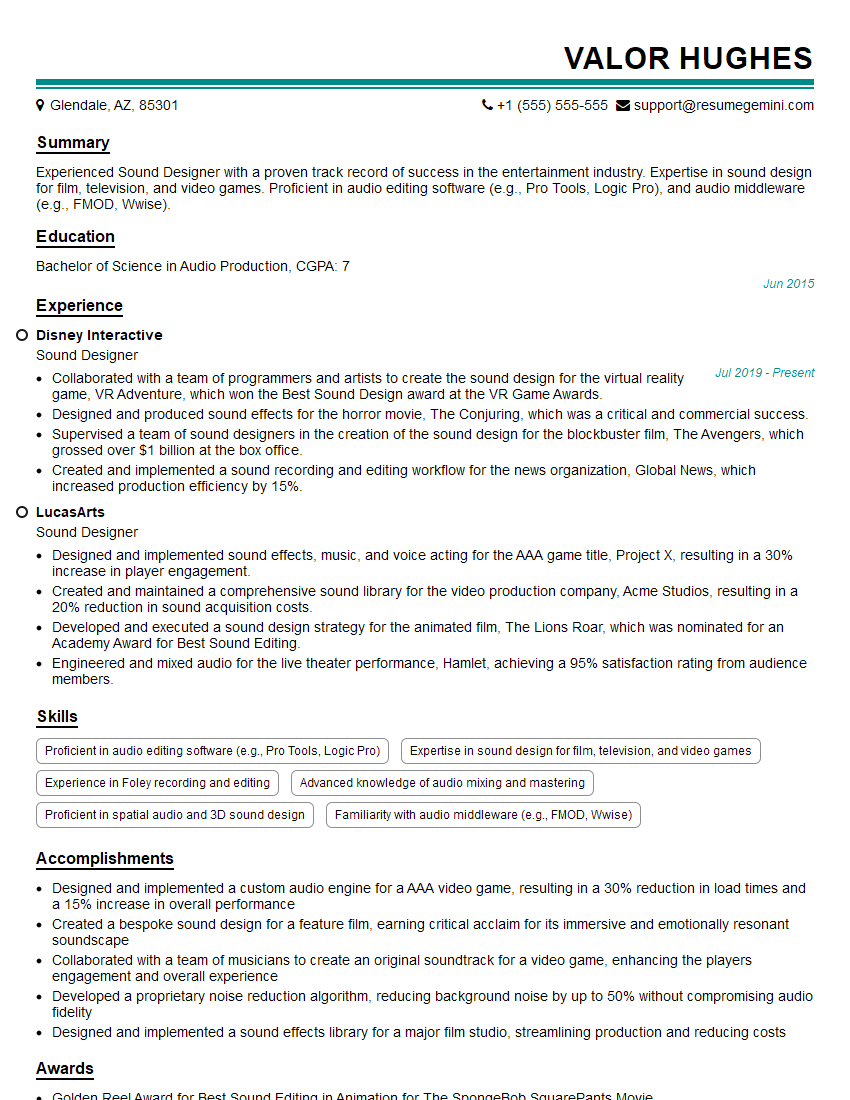
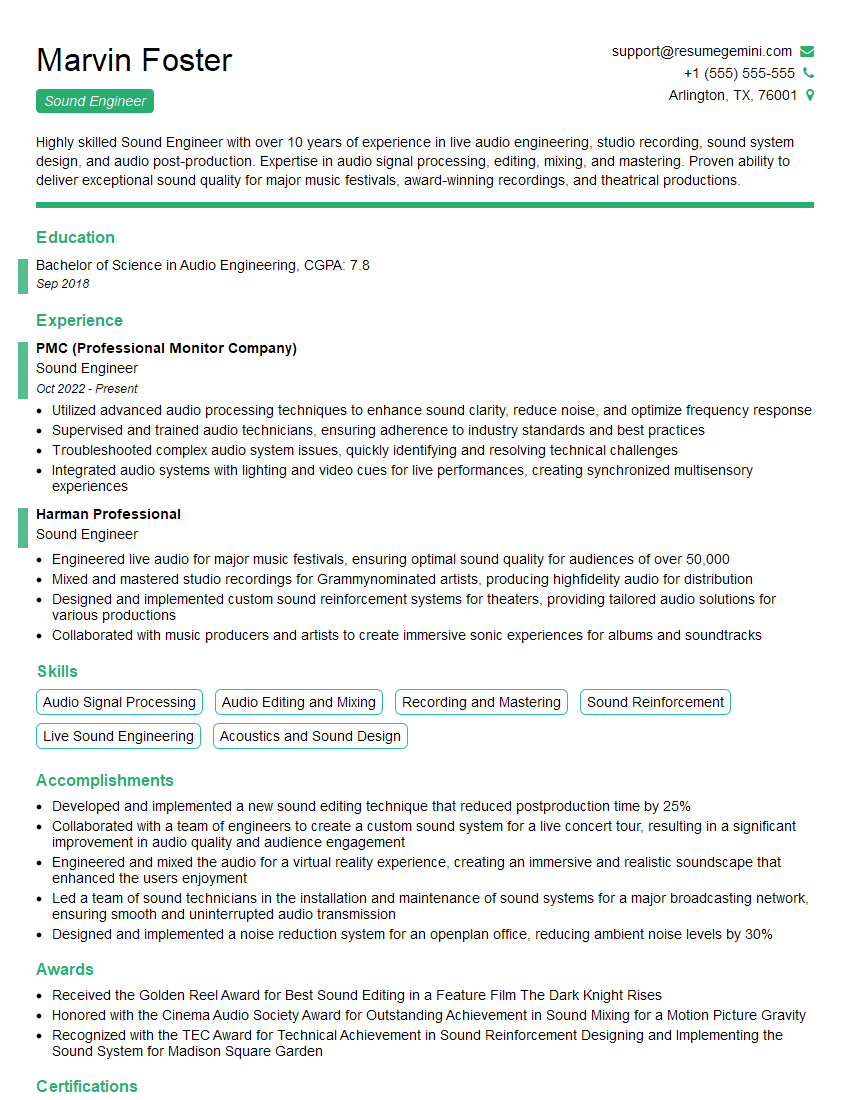
Mastering equalization techniques is crucial for career advancement in audio engineering, music production, and related fields. A strong grasp of these principles significantly enhances your problem-solving capabilities and technical expertise. To increase your job prospects, invest time in crafting an ATS-friendly resume that highlights your skills and experience effectively. ResumeGemini is a trusted resource that can help you build a professional and impactful resume. Examples of resumes tailored to Equalization Techniques are available to guide you.
Explore more articles
Users Rating of Our Blogs
Share Your Experience
We value your feedback! Please rate our content and share your thoughts (optional).
What Readers Say About Our Blog
Amazing blog
hello,
Our consultant firm based in the USA and our client are interested in your products.
Could you provide your company brochure and respond from your official email id (if different from the current in use), so i can send you the client’s requirement.
Payment before production.
I await your answer.
Regards,
MrSmith
hello,
Our consultant firm based in the USA and our client are interested in your products.
Could you provide your company brochure and respond from your official email id (if different from the current in use), so i can send you the client’s requirement.
Payment before production.
I await your answer.
Regards,
MrSmith
These apartments are so amazing, posting them online would break the algorithm.
https://bit.ly/Lovely2BedsApartmentHudsonYards
Reach out at BENSON@LONDONFOSTER.COM and let’s get started!
Take a look at this stunning 2-bedroom apartment perfectly situated NYC’s coveted Hudson Yards!
https://bit.ly/Lovely2BedsApartmentHudsonYards
Live Rent Free!
https://bit.ly/LiveRentFREE
Interesting Article, I liked the depth of knowledge you’ve shared.
Helpful, thanks for sharing.
Hi, I represent a social media marketing agency and liked your blog
Hi, I represent an SEO company that specialises in getting you AI citations and higher rankings on Google. I’d like to offer you a 100% free SEO audit for your website. Would you be interested?