Feeling uncertain about what to expect in your upcoming interview? We’ve got you covered! This blog highlights the most important Portfolio of Basketry Work interview questions and provides actionable advice to help you stand out as the ideal candidate. Let’s pave the way for your success.
Questions Asked in Portfolio of Basketry Work Interview
Q 1. Describe your experience with various basketry materials (e.g., willow, rattan, reed).
My experience with basketry materials is extensive, encompassing a wide range of natural fibers. Willow, with its pliability and strength, is a favorite for creating sturdy, elegant forms. I’m adept at working with various willow varieties, selecting those best suited for specific basket styles and desired textures. Rattan, known for its durability and glossy sheen, allows for intricate designs and finer details. I’ve worked with different rattan grades, understanding their strengths and weaknesses in terms of flexibility and resistance to breakage. Reed, particularly its various types like seagrass and rushes, offers a unique textural element. I’m experienced in preparing reeds for weaving, understanding how different drying techniques impact their workability. Beyond these primary materials, I’ve also worked with other natural fibers like grasses, vines, and even recycled materials, constantly exploring new possibilities.
For example, I once crafted a large, decorative basket using a combination of thick willow for the structure and thinner rattan for the intricate pattern work. The contrast in texture and color created a visually striking piece.
Q 2. Explain your proficiency in different basket weaving techniques (e.g., coil, twining, plaiting).
My basket weaving techniques are diverse, reflecting years of practice and experimentation. I’m proficient in coil weaving, where individual coils of material are stitched together to form the basket shape. This technique is versatile, allowing for both simple and complex designs. Twining involves weaving one or more pliable elements around a set of vertical elements – a classic and strong method often seen in tighter baskets. Plaiting, similar to braiding, uses interwoven strands to create a flat or three-dimensional texture. I frequently use a combination of these techniques in a single project, layering the techniques to achieve depth and visual interest.
For instance, I might use coil weaving to create the base of a basket, then transition to twining for the sides, incorporating plaiting elements to form decorative patterns or handles.
Q 3. How do you plan and execute a complex basketry design?
Planning and executing a complex basketry design involves a meticulous process. It begins with sketching and visualizing the final product, considering factors like size, shape, material suitability, and desired design elements. I often create scale drawings and 3D models (although sometimes just using a well-placed collection of materials) to refine the design and ensure all aspects work together harmoniously. I carefully select the materials, ensuring their quality and quantity are sufficient for the project’s scale and complexity. Then, I work through the construction step-by-step, frequently checking measurements and adjusting my approach as needed. This iterative process ensures accuracy and allows for creativity within a structured framework.
For a recent commission, I designed a large, intricately patterned basket with multiple interwoven panels. I started with detailed sketches, experimenting with various color combinations and weave patterns before settling on a final design. The creation process itself involved carefully preparing and measuring my materials and progressing the weaving in distinct sections to manage the complexity.
Q 4. What software or tools do you use for designing or creating basketry patterns?
While there isn’t widely used basketry-specific design software, I leverage readily available tools to support my work. I use digital drawing software like Adobe Illustrator to create precise scale drawings and to explore different weave patterns digitally. Sometimes this helps me visualize the finished product before I start weaving. I might also use photography and image editing software to document my work, analyze texture, and refine future designs. The key is to use the tools to enhance my creative process and not let them dictate it. Ultimately, my hands and the materials remain the core of the design and production process.
Q 5. Describe your process for estimating the time and materials required for a project.
Estimating time and materials requires a deep understanding of the project’s complexities. I start by meticulously analyzing the design, identifying the different weaving techniques and the amount of material required for each section. My experience allows me to accurately estimate the amount of material needed, accounting for waste and potential errors. I use past projects as a baseline and adjust the estimates based on the intricacy of the design and the chosen materials. Estimating time involves factoring in the complexity of the weaving, the preparation time for materials, and any unforeseen delays. I create a detailed timeline, breaking the project down into manageable phases, to ensure efficient work flow and effective time management.
For example, if I’m working with a new type of reed, I’ll build in extra time for experimentation and learning. I find that meticulous planning is key to minimizing waste and ensuring projects are completed on schedule and within budget.
Q 6. How do you handle unexpected challenges during the basket weaving process?
Unexpected challenges are inherent to the craft. They might include material imperfections, design alterations, or unforeseen technical difficulties. My approach is to remain flexible and adaptable. I carefully analyze the problem, identifying the root cause and exploring potential solutions. This might involve adjusting the design slightly, experimenting with alternative weaving techniques, or sourcing replacement materials. Documentation and a willingness to learn from mistakes are crucial. I maintain a detailed record of every project, including the challenges encountered and the solutions implemented. This learning process informs future projects and minimizes the likelihood of similar issues arising.
I once encountered a knot in a batch of willow that disrupted my weaving pattern. Instead of discarding the whole batch, I carefully worked around the knot, adapting my weaving to incorporate it, resulting in a unique, textured detail in the finished basket.
Q 7. Explain your approach to quality control in basketry production.
Quality control is paramount in basketry. It starts with the selection of high-quality materials and extends throughout the entire production process. I rigorously inspect the materials before starting a project, discarding any that show signs of damage or imperfection. During weaving, I regularly check for inconsistencies in tension, weave density, and overall structural integrity. I also pay close attention to the finishing details, ensuring that the edges are neatly trimmed and the overall appearance is consistent with the design. After completion, I inspect the finished basket for any defects, ensuring structural soundness and aesthetic appeal. This dedication to quality reflects my commitment to creating durable, aesthetically pleasing pieces that stand the test of time. Ultimately, my reputation relies on delivering consistently high-quality work.
Q 8. How do you price your basketry pieces?
Pricing my basketry pieces is a multifaceted process that considers several key factors. It’s not just about the cost of materials; it also encompasses the time invested, the complexity of the design, the uniqueness of the piece, and the current market value for similar handcrafted items.
- Material Costs: I meticulously track the cost of all raw materials, from reeds and willows to dyes and finishes. This forms the base price.
- Labor Costs: I calculate my hourly rate based on my experience and the market rate for similar skilled artisans. The more intricate the design and the more hours required, the higher the labor cost component. For example, a finely woven, elaborate picnic basket will naturally command a higher price than a simple bread basket.
- Design Complexity and Uniqueness: Highly intricate designs or pieces incorporating unique techniques and materials will have a higher price point reflecting their rarity and the skill involved. A bespoke commission, created to a client’s specific design, would fall into this category.
- Market Research: I regularly research online marketplaces, craft fairs, and galleries to stay informed about comparable pieces and their pricing. This ensures my prices remain competitive and reflective of the market value.
Ultimately, I aim to create a fair price that reflects the value of my craftsmanship and the unique qualities of each basket.
Q 9. Describe your experience with marketing and selling your basketry work.
Marketing and selling my basketry work has evolved over the years. I’ve experimented with various approaches, and found a successful blend of online and offline strategies.
- Online Presence: I maintain a website showcasing my work with high-quality photographs and detailed descriptions. I’m active on social media platforms like Instagram and Etsy, regularly posting images of my creations and engaging with potential customers. This allows me to reach a wider audience beyond my local area.
- Craft Fairs and Markets: Participating in local craft fairs and markets provides direct interaction with customers, allowing me to showcase my work in person, answer questions, and gain immediate feedback. It’s a great way to build relationships and establish brand recognition.
- Collaborations: I’ve collaborated with local businesses, such as gift shops and home décor stores, to sell my work on consignment. This expands my reach and introduces my baskets to a new customer base.
- Word-of-Mouth Marketing: Satisfied customers often recommend my work to their friends and family, which has been a valuable source of new business. Providing exceptional customer service is key to fostering positive word-of-mouth referrals.
By combining these methods, I’ve been able to build a sustainable business selling my basketry work.
Q 10. How do you maintain your tools and equipment?
Maintaining my tools and equipment is crucial for producing high-quality work and ensuring my safety. Regular cleaning and sharpening are essential.
- Cleaning: After each use, I thoroughly clean my tools, removing any residual materials like reed splints, glue, or dye. I use a stiff brush and warm soapy water to remove debris and then dry them completely to prevent rust or damage.
- Sharpening: I regularly sharpen my knives and other cutting tools using honing steels and sharpening stones. Sharp tools are safer and produce cleaner, more precise cuts, leading to better basket construction.
- Storage: I store my tools in a dry, organized manner to prevent damage and rust. I use tool rolls or cases to keep my knives and other sharp tools safely contained.
- Repair and Replacement: I promptly repair or replace any damaged tools to maintain efficiency and prevent accidents.
Proper tool maintenance not only extends their lifespan but also significantly improves the quality and consistency of my work.
Q 11. What safety precautions do you adhere to while working with basketry materials?
Safety is paramount in my basketry practice. I adhere to several safety precautions to minimize risks:
- Sharp Tools: I handle sharp tools like knives and secateurs with utmost care, always cutting away from myself and keeping my fingers clear of the blade. I use cutting mats to protect my work surface.
- Eye Protection: When working with sharp tools or materials that could splinter, I wear safety glasses to protect my eyes from flying debris.
- Proper Ventilation: When using dyes or finishes that produce fumes, I work in a well-ventilated area or wear a respirator to prevent inhalation of harmful substances.
- Protective Clothing: I often wear long sleeves and gloves to protect my skin from splinters, sharp edges, and dyes.
- First Aid Kit: I maintain a readily accessible first-aid kit to address minor cuts, scrapes, or splinters that may occur.
By consistently following these safety procedures, I can work safely and efficiently, minimizing the risk of injury.
Q 12. How do you stay updated on current trends and techniques in basketry?
Staying updated on current trends and techniques in basketry is vital for maintaining my skills and creativity. I utilize several methods to achieve this:
- Professional Organizations: I’m a member of several basketry guilds and organizations. These groups offer workshops, demonstrations, and networking opportunities, allowing me to learn from other artisans and stay informed about innovative techniques.
- Workshops and Classes: I regularly attend workshops and classes taught by renowned basketry instructors, both locally and internationally. This allows me to learn new techniques and expand my skillset.
- Books and Magazines: I maintain a collection of books and magazines dedicated to basketry, which serve as valuable resources for inspiration and learning new techniques.
- Online Resources: I frequently explore online resources, such as websites, blogs, and forums dedicated to basketry, to discover new ideas and stay current with trends.
Continual learning ensures my work remains fresh, inventive, and competitive within the craft.
Q 13. Describe your experience with different finishing techniques for basketry.
Finishing techniques are crucial for enhancing the appearance and durability of basketry pieces. I employ a variety of methods based on the material and desired effect:
- Natural Finishes: For a rustic, natural look, I sometimes leave the basket unfinished, allowing the natural beauty of the material to shine through. This works particularly well with certain types of willow or rattan.
- Oil Finishes: Applying a natural oil, like linseed oil, protects the basket from moisture and enhances its color and sheen. This is a common and effective method for many types of baskets.
- Varnish Finishes: For added protection and a glossy finish, I sometimes use varnish, which creates a durable waterproof layer. This is particularly useful for baskets that will be exposed to the elements, such as garden baskets.
- Dyeing: I use natural or synthetic dyes to color the materials before weaving, allowing for greater control over the final color and pattern. Natural dyes, like those from plants, create a more subtle and unique color palette.
- Wax Finishes: Beeswax or other natural waxes can be applied to provide a water-resistant finish while enhancing the basket’s natural texture. It gives a more matte finish than varnish.
The choice of finish depends greatly on the desired aesthetic and the functionality of the basket. It’s often a matter of balancing durability with the artistic expression of the piece.
Q 14. How do you adapt your basketry skills to meet client needs?
Adapting my basketry skills to meet client needs is a crucial part of my work. I thrive on collaborating with clients to create unique, personalized pieces.
- Consultations: Before starting a commission, I always have a thorough consultation with the client to discuss their vision, desired size, shape, materials, and any specific design elements they have in mind. I encourage them to share images and examples of baskets they like.
- Custom Designs: I often create custom designs based on client preferences. This might involve adapting existing designs, incorporating specific weaving techniques, or developing entirely new designs from scratch.
- Material Selection: I work with a range of materials and can help clients select the most appropriate materials for their project, considering factors like durability, aesthetic preferences, and budget.
- Flexibility: I understand that client needs can change, and I am flexible in accommodating revisions and adjustments throughout the creation process. Transparency and communication are key.
- Communication: Consistent communication throughout the process helps to manage expectations and ensure the final product meets the client’s vision.
By working closely with clients, I can create bespoke basketry pieces that truly meet their individual needs and preferences, resulting in pieces that are both functional and personally meaningful.
Q 15. Explain your experience with working collaboratively on large-scale basketry projects.
Collaboration is crucial in large-scale basketry projects. My experience involves coordinating teams, assigning tasks based on individual strengths (e.g., someone skilled in intricate weaving might focus on detailed sections, while another handles larger structural elements), and establishing clear communication channels. For example, on a recent commission for a massive ceremonial basket, we had a team of five, each responsible for a specific quadrant. Regular check-ins ensured consistent progress, aesthetic uniformity, and timely completion. We utilized a shared digital platform to track progress, share design updates, and address any arising issues promptly. This collaborative approach ensured not only efficiency but also a high level of quality control, resulting in a unified and stunning final product.
Career Expert Tips:
- Ace those interviews! Prepare effectively by reviewing the Top 50 Most Common Interview Questions on ResumeGemini.
- Navigate your job search with confidence! Explore a wide range of Career Tips on ResumeGemini. Learn about common challenges and recommendations to overcome them.
- Craft the perfect resume! Master the Art of Resume Writing with ResumeGemini’s guide. Showcase your unique qualifications and achievements effectively.
- Don’t miss out on holiday savings! Build your dream resume with ResumeGemini’s ATS optimized templates.
Q 16. Describe a time you had to troubleshoot a problem during a basketry project.
During the construction of a large, intricate wall hanging using dyed reeds, I encountered a significant problem: a section of the weaving began to unravel due to an unforeseen tension imbalance. My immediate response was to carefully analyze the affected area, identifying the specific points of stress. I then employed a combination of techniques to address the issue. First, I carefully re-weaved the unraveling section, reinforcing the structure with additional, subtly integrated reeds. Secondly, I adjusted the tension across the entire piece using specialized clamps, ensuring a balanced distribution of stress. Finally, I meticulously checked the entire work for any similar potential weaknesses and proactively adjusted the tension in those areas. The successful troubleshooting demonstrated my problem-solving abilities and my commitment to delivering high-quality work even when faced with unexpected challenges.
Q 17. How do you handle constructive criticism regarding your basketry work?
I embrace constructive criticism as an invaluable tool for growth and improvement. I view feedback not as a personal attack, but as an opportunity to refine my skills and enhance my work. For example, if a client suggests that a particular element feels too busy, I’ll carefully consider their perspective. I might revise the design, simplifying that area or re-evaluating the color palette. I always maintain open communication with the client throughout the process. This collaborative approach ensures that the final piece reflects both my artistic vision and meets the client’s expectations. Taking feedback seriously has led to significant improvements in my design sensibilities and overall craftsmanship.
Q 18. How do you balance creative freedom with client expectations?
Balancing creative freedom and client expectations requires a delicate yet crucial approach. I initiate the process with thorough consultations, actively listening to the client’s needs and preferences while simultaneously presenting my design ideas and expertise. This allows for a collaborative design process where their vision and my creative input converge. For example, if a client wants a basket in a specific color scheme that doesn’t align perfectly with my aesthetic, I would propose slight variations or complementary choices to ensure both the client’s satisfaction and my artistic integrity are maintained. The key is open communication and compromise, leading to a final product that meets all expectations while remaining a testament to skillful craftsmanship and artistic vision.
Q 19. Describe your knowledge of different historical and cultural basketry styles.
My knowledge of historical and cultural basketry styles is extensive. I’ve studied techniques from various cultures, including the intricate coil basketry of Native American tribes, the tight-weave traditions of Southeast Asia, and the elegant forms of European basket makers. Understanding these historical styles provides a rich foundation for innovation. For instance, I might draw inspiration from the geometric patterns of ancient Peruvian basketry when designing a contemporary piece, blending traditional techniques with modern materials and aesthetics. This broad understanding allows me to cater to diverse client preferences and to create truly unique and meaningful pieces.
Q 20. How do you ensure the durability and longevity of your basketry creations?
Durability and longevity are paramount in my work. I achieve this through a multi-pronged approach. First, I select high-quality, sustainably sourced materials like rattan, willow, or seagrass, ensuring their inherent strength and resistance to decay. Secondly, I utilize time-tested weaving techniques, ensuring tight, even weaves that distribute stress effectively. Thirdly, I often incorporate finishing treatments like natural oils or waxes, which protect the basket from moisture and wear. Finally, I provide clients with care instructions to maintain the longevity of their pieces. This attention to detail, from material selection to aftercare guidance, guarantees that my creations will endure for years to come.
Q 21. What is your approach to managing inventory of basketry materials?
Managing basketry materials requires careful organization and inventory control. I maintain a detailed spreadsheet tracking material types, quantities, and suppliers. This allows me to efficiently order new supplies and avoid running out of key materials during projects. I store materials in a climate-controlled environment to prevent damage from moisture or temperature fluctuations. Furthermore, I regularly inspect my inventory to identify any damaged or unusable materials and dispose of them responsibly. This meticulous approach ensures that I always have the right materials on hand, allowing for smooth project execution and minimizing waste.
Q 22. Describe your experience with teaching or mentoring others in basketry.
I’ve had the pleasure of teaching and mentoring basketry for over ten years, both in formal classroom settings and through private workshops. My approach focuses on building a strong foundational understanding of weaving techniques, progressing to more complex designs and material choices. I begin by demonstrating fundamental knots and weaves like plain weave and twill, using readily available materials. Then I encourage experimentation, helping students develop their own style. For example, I recently guided a group of teenagers through creating coiled baskets using natural reeds harvested sustainably from a local wetland. This project incorporated lessons on material sourcing, prep, and design, culminating in beautifully unique pieces. Mentoring involves individualized instruction, adapting my teaching style to different learning paces and skill levels. I find that providing constructive criticism and celebrating successes are key to fostering confidence and skill development.
Q 23. Explain your understanding of sustainable and ethical practices in basketry.
Sustainable and ethical practices in basketry are paramount to me. It starts with responsible sourcing of materials. I prioritize locally sourced, sustainably harvested materials whenever possible, such as willow grown on my own property or responsibly managed reed beds. I avoid using endangered or threatened plant species. My workshop practices minimize waste; I reuse scraps for smaller projects or compost them. Furthermore, I teach my students about these practices, emphasizing the importance of minimizing our environmental impact. Ethical considerations also extend to fair wages and working conditions. I believe in paying artisans fairly for their time and skill, promoting ethical trade practices, and supporting communities involved in traditional basketry. Using natural dyes, rather than harsh chemicals, is another key aspect of my commitment to sustainability.
Q 24. How would you create a basket designed for a specific function or purpose?
Designing a basket for a specific function requires a thorough understanding of both the intended use and the properties of the materials. For instance, if I were designing a bread basket, I’d consider factors like ventilation (to prevent sogginess), structural integrity (to support the weight of a loaf), and aesthetic appeal (a pleasing shape and size). I’d choose a material that’s food-safe and breathable, perhaps willow or even a tightly woven rush. The weaving pattern would be chosen for strength and to allow for sufficient airflow. If the purpose were a picnic basket, I might incorporate compartments for different foods and include a handle for easy carrying. The process involves sketching initial designs, experimenting with different weaves and materials on a small scale, refining the design based on initial prototypes, and finally creating the finished piece. Detailed planning is crucial, focusing on functionality alongside visual design.
Q 25. Describe your experience with different types of basketry finishes (e.g., varnish, oil).
My experience with basketry finishes encompasses a range of natural and synthetic options. Natural oils, such as linseed oil, provide a subtle sheen and protect the basket from moisture, enhancing the natural beauty of the material. However, they require more frequent reapplication and can darken the basket’s color over time. Varnishes offer a more durable and water-resistant finish, but can sometimes create a less natural look. I’ve also experimented with wax finishes, providing a smooth, protective layer while maintaining a more natural feel. The choice depends on factors such as the type of material, desired level of protection, and aesthetic preference. For instance, a delicate willow basket might benefit from linseed oil, while a sturdier seagrass basket might be better suited to a varnish. I always test finishes on a small, inconspicuous area before applying them to the entire piece to avoid any unexpected reactions.
Q 26. How do you manage your time effectively to meet project deadlines?
Effective time management is crucial for meeting project deadlines. I utilize a project management system that involves breaking down larger projects into smaller, manageable tasks with allocated timeframes. This allows for better organization and progress tracking. I prioritize tasks based on urgency and importance, focusing on the most critical elements first. I also build in buffer time to account for unexpected delays or complexities that might arise. Furthermore, I consistently review my schedule, adjusting it as needed to stay on track and ensure that I’m working efficiently. Setting realistic deadlines and avoiding overcommitment are also key to preventing burnout and ensuring quality work. For example, I recently used a Gantt chart to schedule the steps involved in creating a large-scale commissioned piece, ensuring timely completion without sacrificing quality.
Q 27. What are your strengths and weaknesses as a basketry artisan?
My strengths lie in my creative problem-solving skills, attention to detail, and ability to adapt to different design challenges. I’m highly proficient in various weaving techniques and materials, and I possess a keen eye for aesthetics and functionality. My experience in teaching and mentoring has honed my communication skills. A weakness I’m actively working on is delegating tasks when dealing with large-scale projects. I sometimes find it difficult to relinquish control, but I’m actively learning to trust and collaborate with others to improve efficiency and workflow. I regularly seek feedback to identify areas for improvement and consistently engage in professional development opportunities to broaden my skillset.
Q 28. What are your salary expectations for this role?
My salary expectations for this role are commensurate with my experience, skills, and the market rate for experienced basketry artisans with my level of expertise. I’m open to discussing a competitive salary range based on the specific details of the position and responsibilities.
Key Topics to Learn for Portfolio of Basketry Work Interview
- Material Selection and Properties: Understanding the strengths, weaknesses, and suitability of various weaving materials (e.g., rattan, willow, reed, seagrass) for different basketry styles and intended uses. This includes considerations of durability, flexibility, and aesthetic appeal.
- Weaving Techniques and Structures: Mastery of various weaving techniques (e.g., coil, twining, plaiting, wicker) and their application in creating different basket forms and textures. This includes understanding the structural integrity of each technique.
- Design Principles and Aesthetics: Applying principles of design (e.g., balance, proportion, rhythm, emphasis) to create visually appealing and functional baskets. This involves understanding the relationship between form and function in basketry.
- Tools and Equipment: Familiarity with the various tools and equipment used in basketry, including their proper use and maintenance. This extends to understanding safety procedures when using sharp tools.
- Finishing Techniques: Knowledge of various finishing techniques to enhance the appearance and durability of finished baskets (e.g., staining, sealing, polishing). This includes understanding the impact of different finishes on the material.
- Troubleshooting and Problem-Solving: Ability to identify and resolve common problems encountered during the basket-making process, such as uneven weaving, breakage of materials, or structural instability. This includes demonstrating practical solutions and preventative measures.
- Portfolio Presentation and Communication: Effectively communicating your design process, creative choices, and technical skills through a well-organized and visually compelling portfolio. This includes understanding how to articulate your design philosophy and artistic vision.
Next Steps
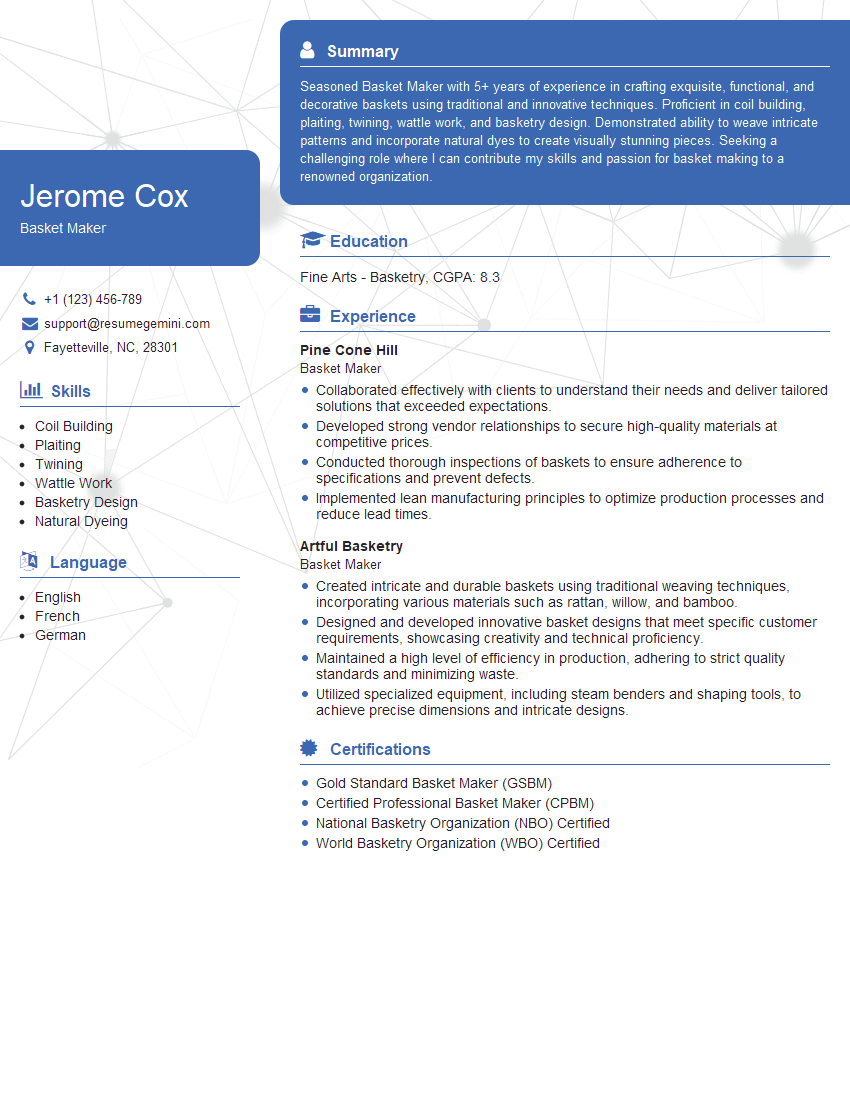
Mastering these key areas of basketry will significantly enhance your career prospects, opening doors to exciting opportunities in design, craft production, and teaching. To further strengthen your application, focus on creating an ATS-friendly resume that highlights your skills and experience effectively. ResumeGemini is a trusted resource to help you build a professional and impactful resume that showcases your unique talents. Examples of resumes tailored to showcasing expertise in Portfolio of Basketry Work are available to guide you through this process.
Explore more articles
Users Rating of Our Blogs
Share Your Experience
We value your feedback! Please rate our content and share your thoughts (optional).
What Readers Say About Our Blog
Amazing blog
hello,
Our consultant firm based in the USA and our client are interested in your products.
Could you provide your company brochure and respond from your official email id (if different from the current in use), so i can send you the client’s requirement.
Payment before production.
I await your answer.
Regards,
MrSmith
hello,
Our consultant firm based in the USA and our client are interested in your products.
Could you provide your company brochure and respond from your official email id (if different from the current in use), so i can send you the client’s requirement.
Payment before production.
I await your answer.
Regards,
MrSmith
These apartments are so amazing, posting them online would break the algorithm.
https://bit.ly/Lovely2BedsApartmentHudsonYards
Reach out at BENSON@LONDONFOSTER.COM and let’s get started!
Take a look at this stunning 2-bedroom apartment perfectly situated NYC’s coveted Hudson Yards!
https://bit.ly/Lovely2BedsApartmentHudsonYards
Live Rent Free!
https://bit.ly/LiveRentFREE
Interesting Article, I liked the depth of knowledge you’ve shared.
Helpful, thanks for sharing.
Hi, I represent a social media marketing agency and liked your blog
Hi, I represent an SEO company that specialises in getting you AI citations and higher rankings on Google. I’d like to offer you a 100% free SEO audit for your website. Would you be interested?