Interviews are more than just a Q&A session—they’re a chance to prove your worth. This blog dives into essential Adapting Lyrics for Different Musical Styles interview questions and expert tips to help you align your answers with what hiring managers are looking for. Start preparing to shine!
Questions Asked in Adapting Lyrics for Different Musical Styles Interview
Q 1. Explain the process of adapting lyrics to a different musical genre.
Adapting lyrics to a different musical genre is a multifaceted process requiring a deep understanding of both the source material and the target style. It’s not just about changing words; it’s about transforming the song’s essence to resonate with the new genre’s conventions. This involves analyzing several key aspects: the original lyrics’ rhythm, rhyme scheme, thematic content, and emotional tone. Then, you consider the characteristics of the target genre – its typical tempo, instrumentation, vocal style, and lyrical structure. For example, adapting a ballad to a punk rock song requires a complete overhaul, shortening lines, simplifying the vocabulary, and injecting a faster, more aggressive energy into both the words and the implied delivery.
The process typically involves several steps: 1) Deep analysis: understanding the core message and emotional arc of the original lyrics. 2) Genre research: identifying the key lyrical and rhythmic features of the target genre. 3) Adaptation: rewriting the lyrics to fit the new style while retaining the original meaning and emotional impact. 4) Testing and refining: singing or performing the adapted lyrics to ensure they flow naturally and effectively within the new musical context.
Q 2. How do you maintain the original meaning and emotional impact when adapting lyrics?
Maintaining the original meaning and emotional impact during lyric adaptation is crucial. It’s like translating a delicate painting – you want to preserve its essence while perhaps adjusting the medium. This necessitates a nuanced understanding of both the linguistic and emotional nuances of the original lyrics. Techniques include:
- Semantic equivalence: Focusing on conveying the same meaning, even if it requires using different words or phrases. For instance, ‘melancholy’ might be replaced with ‘heartbreak’ depending on the target genre’s vernacular.
- Emotional resonance: Maintaining the emotional core of the song. If the original is sorrowful, the adaptation should also evoke sadness, although it might manifest differently. A slow, melancholic ballad could become a more intensely emotional, minimalist song in a different genre.
- Figurative language adaptation: Carefully transforming metaphors, similes, and other literary devices to maintain their impact in the new context. A simple metaphor from the original might become a more elaborate description depending on the chosen style.
For instance, a romantic ballad’s heartfelt declaration could be expressed more indirectly and subtly in a jazz song, yet the underlying emotion of love remains.
Q 3. Describe your approach to adapting lyrics for a target audience with different cultural backgrounds.
Adapting lyrics for different cultural backgrounds requires sensitivity and cultural awareness. It’s not merely about translating words; it’s about understanding and respecting the cultural context. This involves researching the target audience’s cultural norms, values, and preferences. Certain idioms, metaphors, and references might be culturally specific and need replacement or adaptation to avoid misunderstanding or offense.
For example, a lyric referencing a specific holiday or cultural event might need to be adapted to a universal theme or replaced with an equivalent celebration from the target culture. Direct translation can sometimes lead to awkward or inappropriate phrasing, thus requiring creative rewording to maintain the natural flow and relevance. A collaborative approach with individuals from the target culture is often extremely helpful to guarantee accuracy and cultural sensitivity.
Q 4. What strategies do you use to ensure rhythmic and metrical consistency during lyric adaptation?
Maintaining rhythmic and metrical consistency is paramount. The song’s structure and feel heavily rely on this. Strategies include:
- Syllable count adjustment: Carefully altering the number of syllables in lines to match the new rhythm without sacrificing meaning. This might involve adding or removing words, using synonyms, or slightly altering the phrasing.
- Stress and intonation: Adapting the emphasis on certain words to maintain the rhythmic flow, even if it slightly modifies the original meaning. Certain accents are easier to achieve in some styles than others.
- Use of rhythmic devices: Employing poetic devices like alliteration, assonance, or consonance to create rhythmic patterns that complement the new musical style. These techniques add natural flow.
Consider the original song having a consistent iambic pentameter; in adaptation, you might have to modify it to fit the target style’s rhythm, using techniques of syllable insertion, substitution or deletion without disturbing the meaning.
Q 5. How do you handle situations where direct translation is impossible or inappropriate?
When direct translation is impossible or inappropriate, creative paraphrasing and contextual adaptation are essential. This involves focusing on conveying the underlying message and emotional impact rather than adhering to a literal translation. Techniques include:
- Paraphrasing: Re-expressing the original meaning in different words and phrases that are more appropriate for the target language and culture. This is especially important when dealing with idioms or cultural references.
- Contextual adaptation: Modifying the lyrics to fit the specific context of the target genre and audience. This might involve changing the setting, characters, or even the overall narrative.
- Imagery substitution: Using alternative imagery to express the same emotion or idea in a way that resonates with the new cultural and linguistic context.
For example, a culturally specific metaphor in the original lyrics might be replaced with a more universally understood image that evokes a similar feeling.
Q 6. Explain your understanding of different poetic forms and how they influence lyric adaptation.
Different poetic forms significantly influence lyric adaptation. Understanding these forms helps in shaping the adapted lyrics to fit the new musical style. For example, a sonnet’s strict structure might need to be loosened for a free-flowing pop song, while a haiku’s brevity could perfectly suit a minimalist electronic track.
The knowledge of poetic forms like sonnets, haikus, free verse, and ballads helps me to understand and make informed decisions about what to keep and what to adapt. Each form suggests different rhythmic structures, rhyme schemes, and overall tonal qualities that impact how the lyrics are perceived. Adapting a ballad into another genre, for instance, might involve maintaining the storytelling aspect, even if the form needs to be compressed or modified to fit the new rhythm and overall structure.
Q 7. How do you adapt lyrics to fit a specific vocal range or singing style?
Adapting lyrics to a specific vocal range or singing style necessitates consideration of vocal capabilities and the expressive potential of the lyrics. For instance, adapting a song for a baritone will require different phrasing and possibly a lower pitch for certain parts than if it were meant for a soprano. This involves:
- Pitch adjustment: Modifying the melodic contour to fit the target vocal range. This might involve simplifying the melody or adjusting the intervals.
- Phrasing alteration: Breaking down longer phrases into shorter, more manageable units suitable for the singer’s breath control and stamina.
- Word selection: Choosing words and phrases that are easier to sing within the given vocal range. Avoiding tongue twisters and overly complex consonant clusters is key.
For a powerful rock vocalist, for example, you might simplify phrasing and utilize more forceful words and metaphors, whereas a soft ballad singer benefits from nuanced vocabulary and phrasing.
Q 8. Describe your experience working with different music software for lyric adaptation.
My experience with music software for lyric adaptation is extensive. I’m proficient in a range of Digital Audio Workstations (DAWs) including Logic Pro X, Ableton Live, and Pro Tools. Beyond DAWs, I utilize lyric writing and editing software like Final Draft and Celtx for managing large projects and collaborating effectively with teams. Each software offers unique advantages; for example, Logic Pro X’s powerful MIDI editing capabilities are invaluable when working with composers to ensure syllable counts and rhythmic phrasing match the music. Ableton Live excels in its intuitive workflow for experimental projects involving looping and sampling, allowing for creative lyric integration. Pro Tools’ industry-standard capabilities are crucial for professional-level mixing and mastering, ensuring the final product is sonically polished.
I also leverage specialized tools for translation and language analysis, vital for adapting lyrics across languages. These tools often include dictionaries, thesauri, and grammar checkers specialized for musical contexts.
Q 9. What are some common challenges you face when adapting lyrics, and how do you overcome them?
Adapting lyrics presents several challenges. One common hurdle is maintaining the rhyme scheme and meter while altering the meaning or simplifying the language. For instance, translating a complex metaphor from one language into another while preserving its poetic effect can be tricky. Another challenge is fitting lyrics to a new melody. The original lyrics might have a certain rhythm and syllable count that doesn’t work with the new music. This requires creative rewriting and sometimes even restructuring the entire lyrical message.
To overcome these, I employ a multi-step process. First, I carefully analyze both the original lyrics and the new music, identifying key rhythmic and melodic elements. Then, I experiment with different phrasing, word choices, and even sentence structures to find the best fit. I may use tools like syllable counters to ensure rhythmic consistency. Finally, I iterate with the composer, receiving feedback and making adjustments until a perfect synergy between lyrics and music is achieved. It’s a bit like fitting pieces of a jigsaw puzzle—requiring patience, creativity, and a good ear.
Q 10. How do you determine the appropriate level of linguistic simplification for a particular target audience?
Determining the appropriate level of linguistic simplification hinges on a thorough understanding of the target audience. I consider factors such as age, education level, and cultural background. For example, children’s songs require significantly simpler language and vocabulary than those intended for adults. Similarly, lyrics for a specific regional dialect would differ from those aimed at a national or international audience.
My approach involves using readability tests and seeking feedback from representative members of the target audience. I might use tools that measure sentence length, word complexity, and vocabulary frequency. For instance, the Flesch-Kincaid readability tests offer a numerical score reflecting the reading level. I would aim for a score appropriate to my target audience. Gathering feedback is crucial; it allows me to refine the lyrics, ensuring they are both engaging and easily understood by the intended listeners.
Q 11. How do you handle copyright issues when adapting existing lyrics?
Copyright is paramount. Adapting existing lyrics without permission is illegal. My process begins with thorough research to identify the copyright holder(s). I then contact them to seek permission for adaptation, clearly outlining my intended use and providing details of the project. This usually involves a licensing agreement, which specifies the terms of use, including any fees or royalties payable.
Sometimes, adapting lyrics from public domain works (copyright expired) is feasible; however, careful consideration of any derivative works’ copyright is still necessary. In cases of uncertainty, consulting with a copyright lawyer is advisable to ensure full legal compliance.
Q 12. What is your process for collaborating with composers and other musicians during lyric adaptation?
Collaboration is central to my work. I engage with composers and musicians from the initial stages of a project. This begins with open discussions about the song’s intended mood, message, and target audience. I often provide the composer with initial lyric drafts, enabling them to compose music that directly reflects the lyrical content and rhythm. Regular feedback sessions allow for iterative refinement. This dynamic process ensures the lyrics and music complement each other harmoniously.
Effective communication is key. I might use shared online document platforms (like Google Docs) to facilitate collaborative editing and feedback, enabling real-time updates and comments.
Q 13. How do you ensure that adapted lyrics remain faithful to the original intent of the song?
Maintaining faithfulness to the original intent involves a deep understanding of the song’s underlying message, themes, and emotional tone. This requires careful analysis of the original lyrics, considering their context and the composer’s artistic vision. My adaptation aims to preserve the essence of the song, even while making changes to accommodate the new style or language. It’s not about literal translation; it’s about conveying the same emotional impact and core message.
For instance, when adapting a melancholic ballad to a more upbeat tempo, I might focus on rewriting verses to emphasize hope and resilience instead of despair, while still preserving the core emotional arc of the story.
Q 14. Describe your experience working with diverse musical styles and languages.
My experience spans diverse musical styles and languages. I’ve worked on projects ranging from classical to pop, folk to jazz, and hip-hop to electronic music. Each genre has its unique lyrical conventions; for example, rhyming patterns and rhythmic structures differ significantly between a traditional ballad and a rap song. The language of the lyrics also impacts the approach. Translating lyrics from English to Spanish might necessitate adjusting the phrasing and even the metaphor’s cultural relevance. Each language possesses its unique rhythm and flow, and adapting lyrics requires a sensitivity to these.
I’ve worked with multiple languages, including Spanish, French, German, and Mandarin. This experience has honed my ability to appreciate the nuances of various linguistic structures and cultural contexts, and this ability is crucial to crafting meaningful adaptations that resonate with diverse audiences.
Q 15. How do you adapt lyrics to fit a specific tempo or musical structure?
Adapting lyrics to a specific tempo or musical structure requires a nuanced understanding of both the lyrical content and the musical framework. It’s like fitting a puzzle together – the lyrics must comfortably occupy the available space without sacrificing meaning or flow.
Firstly, I analyze the original lyrics, identifying key phrases and emotional beats. Then, I examine the target tempo and structure (e.g., number of bars, rhythmic patterns). If the tempo is faster, I might shorten phrases, use simpler sentence structures, or even omit less crucial details. For a slower tempo, I might elaborate on existing imagery, add descriptive details, or extend certain phrases.
For example, a fast-paced pop song might require concise, punchy lines, while a ballad might allow for longer, more reflective verses. Consider a line like “I miss you so.” In a fast song, it might become “Missing you.” In a slow song, it could expand to “I miss you so, the way the sun misses the dawn.”
The key is to maintain the song’s core message while ensuring a perfect synchronization between lyrics and music. I often work with a musical score or demo track to ensure proper syllabic stress and rhythmic alignment.
Career Expert Tips:
- Ace those interviews! Prepare effectively by reviewing the Top 50 Most Common Interview Questions on ResumeGemini.
- Navigate your job search with confidence! Explore a wide range of Career Tips on ResumeGemini. Learn about common challenges and recommendations to overcome them.
- Craft the perfect resume! Master the Art of Resume Writing with ResumeGemini’s guide. Showcase your unique qualifications and achievements effectively.
- Don’t miss out on holiday savings! Build your dream resume with ResumeGemini’s ATS optimized templates.
Q 16. How do you ensure that adapted lyrics flow naturally and sound authentic in the new language/style?
Ensuring natural flow and authenticity in adapted lyrics demands a deep understanding of both the source and target languages/styles. This goes beyond simple translation; it’s about capturing the essence, the spirit, and the emotional impact of the original while creating something that feels genuinely native to the new context.
I achieve this through several strategies. First, I immerse myself in the target language and style, listening to music, reading literature, and observing how native speakers communicate. I focus on idioms, colloquialisms, and rhythmic patterns specific to the genre.
For instance, a direct translation might sound unnatural. Imagine translating “it’s raining cats and dogs” literally into another language. Instead, I need to find an equivalent idiom that conveys the same intensity and imagery in the target language. This requires cultural sensitivity and an ear for natural language.
Then, I constantly refine the lyrics through multiple drafts, testing the rhythm, flow, and naturalness through reading aloud and receiving feedback from native speakers. This iterative process guarantees authenticity and prevents any awkwardness that might arise from a literal translation.
Q 17. How do you incorporate local idioms and expressions when adapting lyrics for a different culture?
Incorporating local idioms and expressions is crucial for making adapted lyrics resonate with the target audience. It’s about making the song feel like it belongs to that culture, not just a foreign import. This requires thorough research and a keen understanding of the cultural nuances.
My approach is to build a lexicon of relevant idioms and expressions specific to the target culture and genre. I might consult dictionaries, linguistic resources, and collaborate with native speakers to identify expressions that accurately convey the intended meaning and emotional tone.
For example, a playful expression common in one culture might not have a direct equivalent in another. Instead of a direct translation, I would search for a different phrase or metaphor that creates the same effect within the target culture. This adds a layer of authenticity and makes the lyrics more engaging for the local audience.
Caution is also needed to avoid cultural appropriation or misinterpretations. Sensitivity and careful consideration of cultural norms are essential to prevent unintended offense.
Q 18. Explain your proficiency in using lyric writing software or tools.
I’m proficient in several lyric writing software and tools, leveraging their features to streamline my workflow and enhance the quality of my adaptations. I’m comfortable using both dedicated lyric-writing programs and general-purpose tools like word processors with robust formatting capabilities.
Specific software I frequently utilize includes [mention specific software names, e.g., Final Draft, Celtx, or even simple text editors with advanced features like Google Docs]. These tools assist with tasks such as:
- Rhyme and meter checking: Many programs offer built-in tools to assist with finding rhymes, identifying metrical patterns, and ensuring consistency throughout the song.
- Collaboration features: Tools that facilitate collaboration with musicians, translators, and other collaborators are invaluable in refining the lyrics.
- Formatting and organization: Properly formatting lyrics for readability and clear communication with collaborators is crucial, and these tools often simplify this process.
My proficiency lies not just in using these tools individually, but in strategically combining them to manage different aspects of the lyric adaptation process effectively.
Q 19. Describe a situation where you had to adapt lyrics to overcome a specific creative constraint.
I once had to adapt a song with a very specific rhythmic structure that was extremely difficult to maintain while translating it into another language. The original song’s rhythm relied on specific syllable counts and internal rhymes that didn’t translate directly into the target language.
To overcome this, I used a combination of techniques. I first looked for semantic equivalents that preserved the meaning but allowed for flexibility in syllable count. Where direct translation was impossible, I subtly shifted the emphasis in the melody and rhythm, working closely with the composer to find notes that accommodated the new syllable count without disrupting the overall musical flow.
I also experimented with adding or removing words carefully to create a new, natural rhythm that resonated with the new language and maintained the original song’s emotional impact. The process required extensive back-and-forth with the composer, but the final result was a successful adaptation that seamlessly integrated the musical and lyrical elements.
Q 20. How do you evaluate the success of lyric adaptation?
Evaluating the success of lyric adaptation isn’t solely about accuracy; it’s a multifaceted assessment encompassing several crucial aspects.
My evaluation process involves:
- Audience reception: The most critical aspect is how the adapted lyrics resonate with the target audience. Do they understand and connect with the lyrics emotionally? This often involves testing the lyrics on focus groups or gathering feedback from listeners.
- Cultural appropriateness: Do the lyrics reflect the cultural context and sensitivities of the target audience? Any inappropriate cultural references must be carefully reviewed and addressed.
- Musicality and flow: Do the adapted lyrics maintain a natural rhythm and flow within the musical structure? This involves examining the syllable counts, rhythmic patterns, and overall melodic fit.
- Faithfulness to the original (if applicable): While adaptation often involves creative liberties, it’s important to determine how well the essential meaning, tone, and emotion of the original song are captured.
A successful adaptation achieves a balance between preserving the essence of the original work and creating a compelling and authentic experience for the target audience.
Q 21. What are your strategies for streamlining the process of lyric adaptation?
Streamlining lyric adaptation requires a systematic approach and effective utilization of resources. I achieve this through several strategies.
Firstly, I establish a clear workflow:
- Analysis: Thoroughly analyze the original lyrics, identifying key themes, emotions, and stylistic elements.
- Research: Conduct thorough research on the target language, culture, and musical style.
- Initial translation/adaptation: Create an initial draft, focusing on accurately conveying the core message.
- Refinement: Refine the draft to ensure natural language, rhythm, and flow, collaborating with native speakers and musicians.
- Testing and feedback: Test the adapted lyrics with the target audience, gathering feedback to identify areas for improvement.
- Finalization: Incorporate feedback and finalize the adapted lyrics.
Secondly, I leverage technology and tools effectively. Using lyric writing software, translation software, and collaborative platforms streamlines tasks like rhyme checking, rhythm analysis, and feedback integration.
Finally, I embrace collaboration: Working closely with native speakers, musicians, and cultural experts ensures a high-quality, culturally sensitive adaptation. A collaborative approach is critical for success.
Q 22. How do you manage deadlines and prioritize tasks in a fast-paced music production environment?
Managing deadlines and priorities in a fast-paced music production environment requires a structured approach. I utilize project management techniques like breaking down large tasks into smaller, manageable chunks. For lyric adaptation, this might mean tackling one verse at a time, or focusing on specific sections based on their complexity or importance to the overall song structure. I use digital tools like task management software to track progress, set deadlines for each sub-task, and visually monitor my workflow. Prioritization is key; I often utilize the Eisenhower Matrix (Urgent/Important) to identify tasks that need immediate attention versus those that can be scheduled later. For example, adapting lyrics for the chorus, which carries the emotional weight of the song, often takes precedence over adapting a bridge section. Regular communication with the team ensures everyone is aligned and allows for prompt adjustments if needed.
Q 23. Describe your familiarity with music theory and its role in lyric adaptation.
Music theory is fundamental to my work. A deep understanding of rhythm, meter, rhyme schemes, and melody is crucial for adapting lyrics successfully. For instance, understanding the time signature (e.g., 4/4, 3/4) helps ensure the adapted lyrics fit the song’s rhythmic structure. Knowing about chord progressions allows me to tailor the lyrics to complement the harmonic movement of the music. I frequently analyze the original lyrics’ metrical pattern and rhyme scheme before adjusting them. If a song changes from a major key to a minor key, for example, the adapted lyrics might need to reflect that shift in emotional tone, perhaps using more somber or reflective language. My strong theoretical foundation ensures that the adapted lyrics not only fit the musical structure but also enhance its impact.
Q 24. How do you maintain the integrity of the original work while making changes for a new context?
Maintaining the integrity of the original work while adapting it requires a delicate balance between fidelity and creative license. I start by thoroughly understanding the original lyrics’ meaning, intent, and emotional impact. Then, I look for ways to rephrase or restructure sentences, change words, and even add or remove lines while still preserving the essence of the message. For example, if adapting a song from English to Spanish, I might choose words that convey the same emotional nuance, even if they aren’t direct translations. If adapting a country song to pop, I might simplify some imagery, but make sure the emotional core remains intact. This involves deep engagement with the source material and a keen sensitivity to the artist’s artistic vision.
Q 25. Discuss your experience with different methods for verifying the accuracy of adapted lyrics.
Verifying the accuracy of adapted lyrics involves multiple steps. First, I meticulously compare the adapted lyrics against the original, line by line. Then, I use a combination of techniques including:
- Human review: I have colleagues, often native speakers in the target language, review the adapted lyrics for accuracy and natural flow.
- Software tools: Several software programs can check for grammatical errors, consistency, and even stylistic issues.
- Testing in the musical context: Once adapted, I always test the lyrics against the music. This final step helps to ensure a natural flow and appropriate rhythmic structure.
Q 26. What are your preferred resources for researching different musical styles and cultural contexts?
My research process involves a range of resources. For musical styles, I frequently use online databases like AllMusic and Rate Your Music to explore different genres, subgenres, and artists. I also rely on academic journals and books for deeper theoretical understanding. For cultural contexts, I use ethnographic studies, cultural dictionaries, and reputable online resources, always ensuring that my sources are credible and vetted. Immersion is also key: listening to many examples of music from the relevant style and geographic region helps me internalize the nuances and develop a keen understanding of the genre’s characteristics.
Q 27. How do you adapt lyrics to match the emotional tone and mood of the music?
Matching lyrics to the emotional tone and mood of the music is crucial. I start by identifying the emotional arc of the music – what feelings are conveyed in each section? This helps inform my choices about word selection, sentence structure, and overall imagery. For example, if a song starts with a slow, melancholic melody, I’ll choose lyrics that reflect feelings of sadness or loss. As the music builds in intensity, the lyrics might become more assertive or passionate. I also carefully consider the rhythm and tempo of the music. A fast-paced, upbeat tempo calls for short, punchy lyrics; a slow, deliberate tempo might require more lyrical and descriptive phrases.
Q 28. How do you handle feedback and revisions during the lyric adaptation process?
Handling feedback and revisions is an iterative process. I actively solicit feedback from various stakeholders, including musicians, producers, and the original artist (if applicable). I view feedback as an opportunity to improve the lyrics. I carefully consider every suggestion, taking into account its merit, the overall vision of the project, and the time constraints. I often provide detailed explanations of my choices, even when I decide not to implement a particular change. I treat revisions as a collaborative process, aiming for a final product that reflects a blend of creative perspectives and artistic integrity.
Key Topics to Learn for Adapting Lyrics for Different Musical Styles Interview
- Understanding Musical Styles: Analyze the rhythmic, melodic, and harmonic characteristics of various genres (e.g., blues, jazz, pop, country) and how they influence lyrical content and delivery.
- Lyrical Adaptation Techniques: Explore methods for modifying existing lyrics to fit a new musical style, including adjusting meter, rhyme scheme, phrasing, and vocabulary.
- Maintaining Lyrical Integrity: Learn strategies for preserving the core message and emotional impact of lyrics while adapting them for a different genre. This includes balancing creativity with the original intent.
- Genre-Specific Lyrical Conventions: Understand the typical lyrical themes, structures, and stylistic choices associated with different musical genres.
- Practical Application: Practice adapting sample lyrics from one genre to another, paying attention to the changes necessary for a successful transition.
- Collaboration and Feedback: Discuss the importance of collaboration with musicians and other creatives during the adaptation process, and how to effectively incorporate feedback.
- Copyright and Legal Considerations: Understand the legal implications of adapting existing lyrics and how to navigate copyright issues.
Next Steps
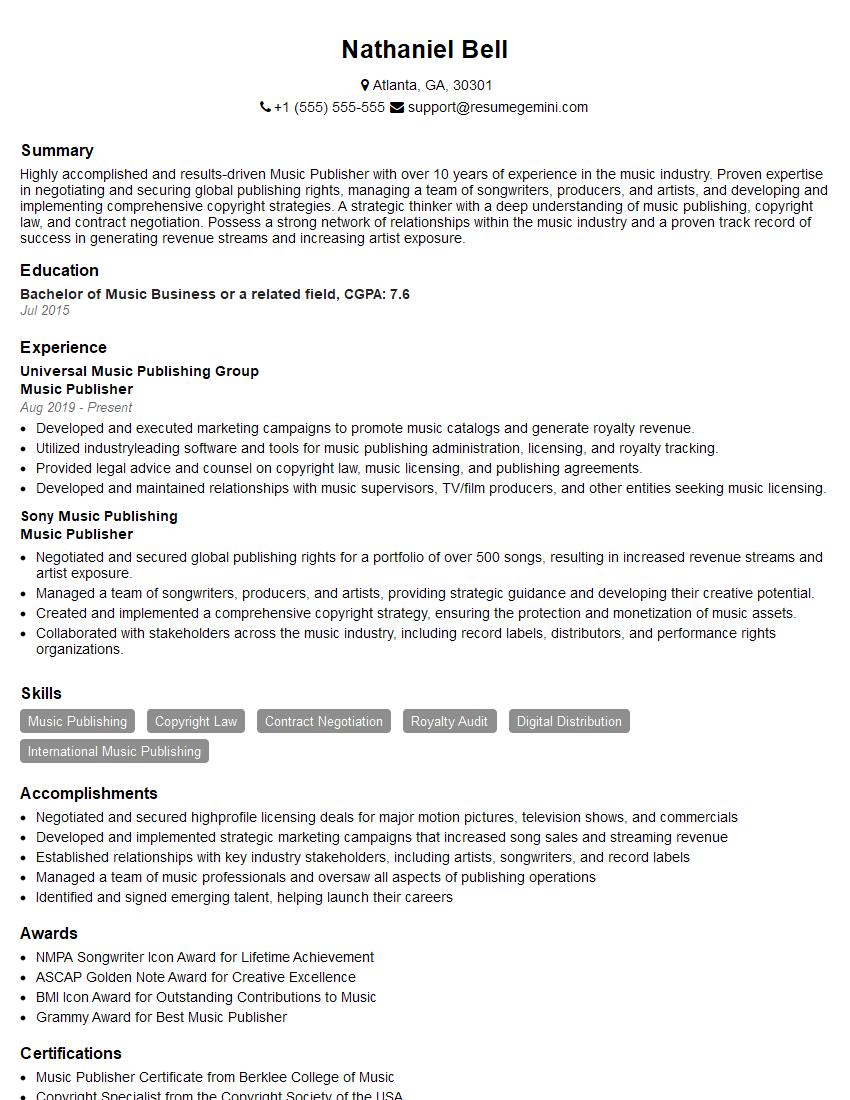
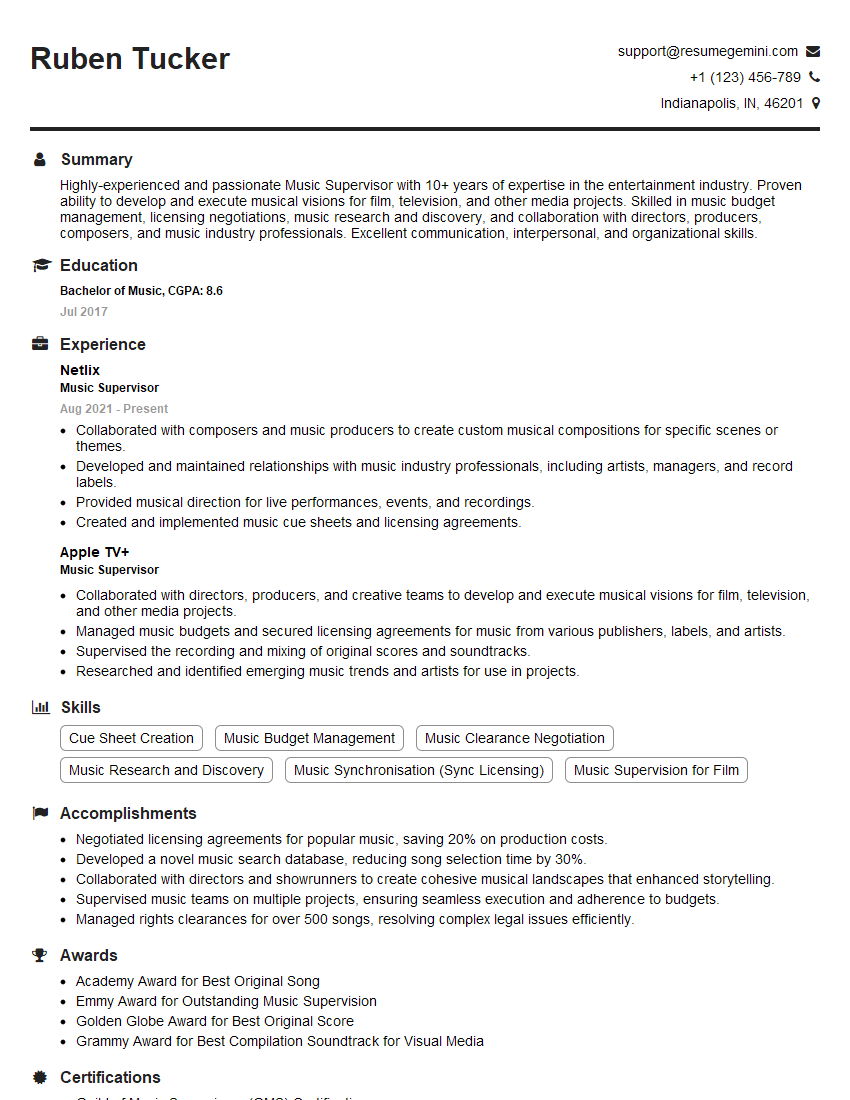
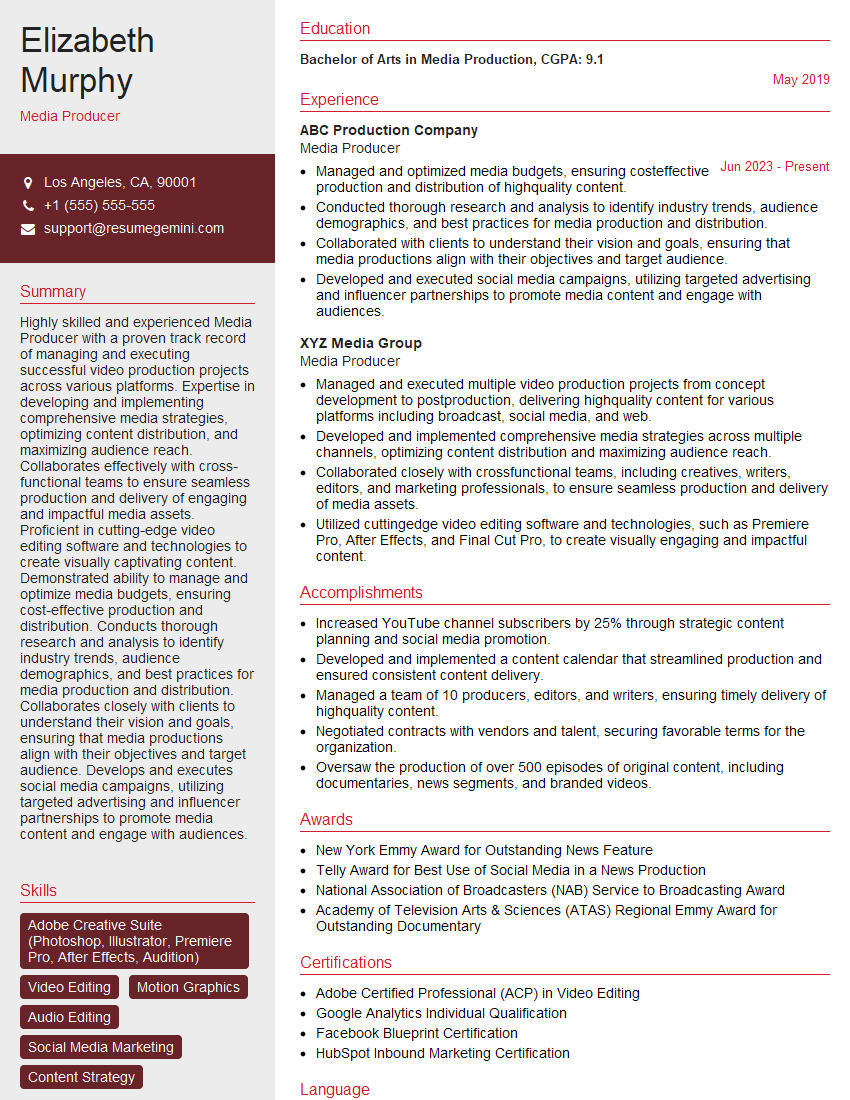
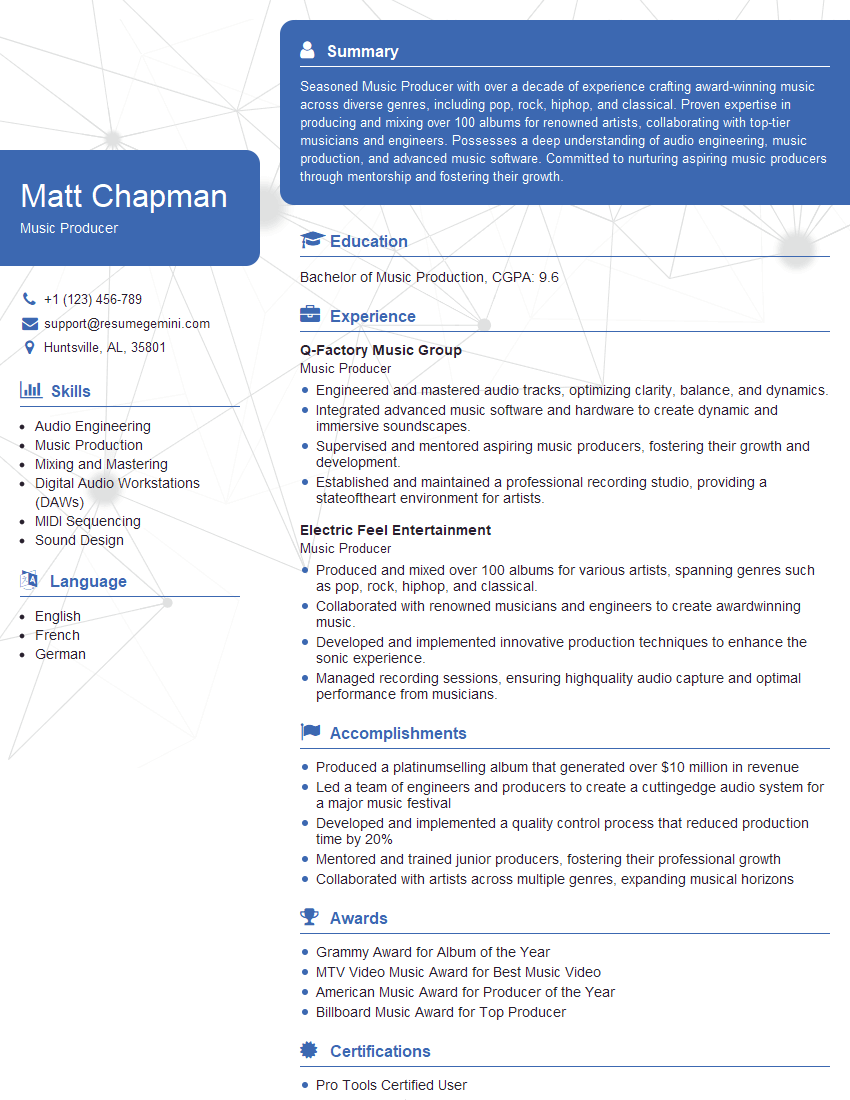
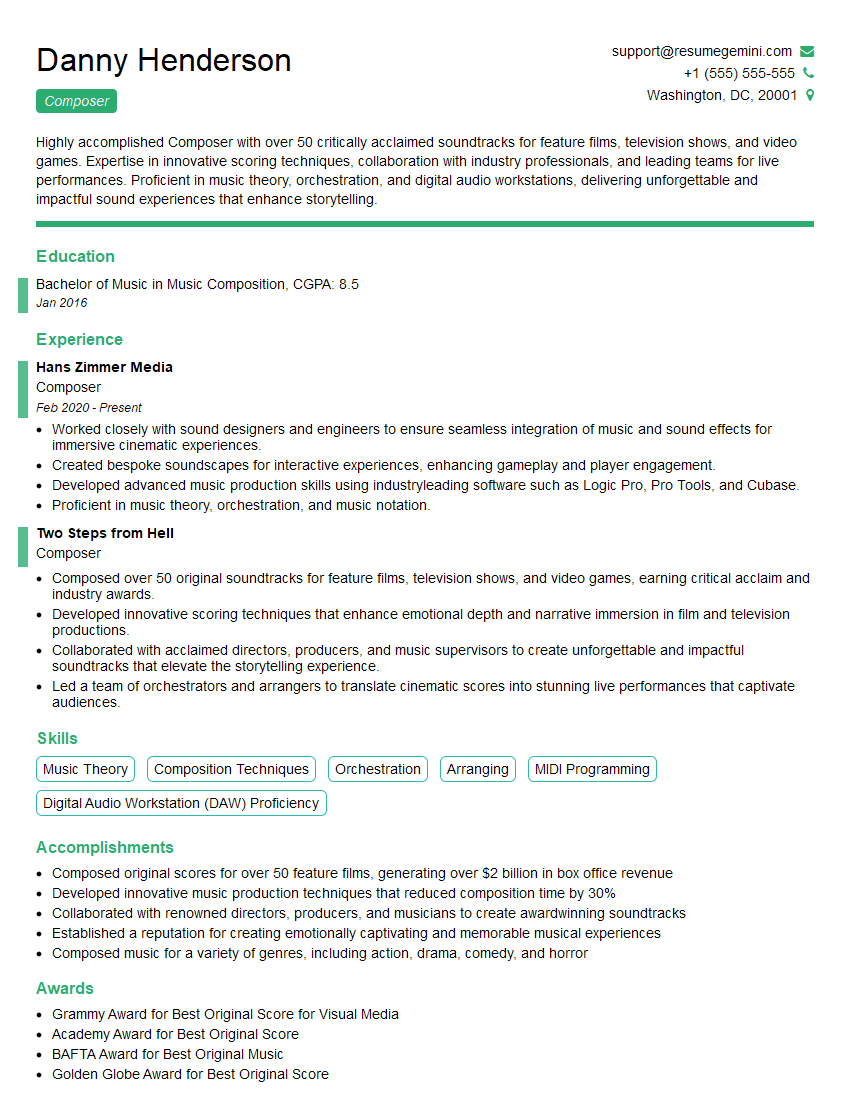
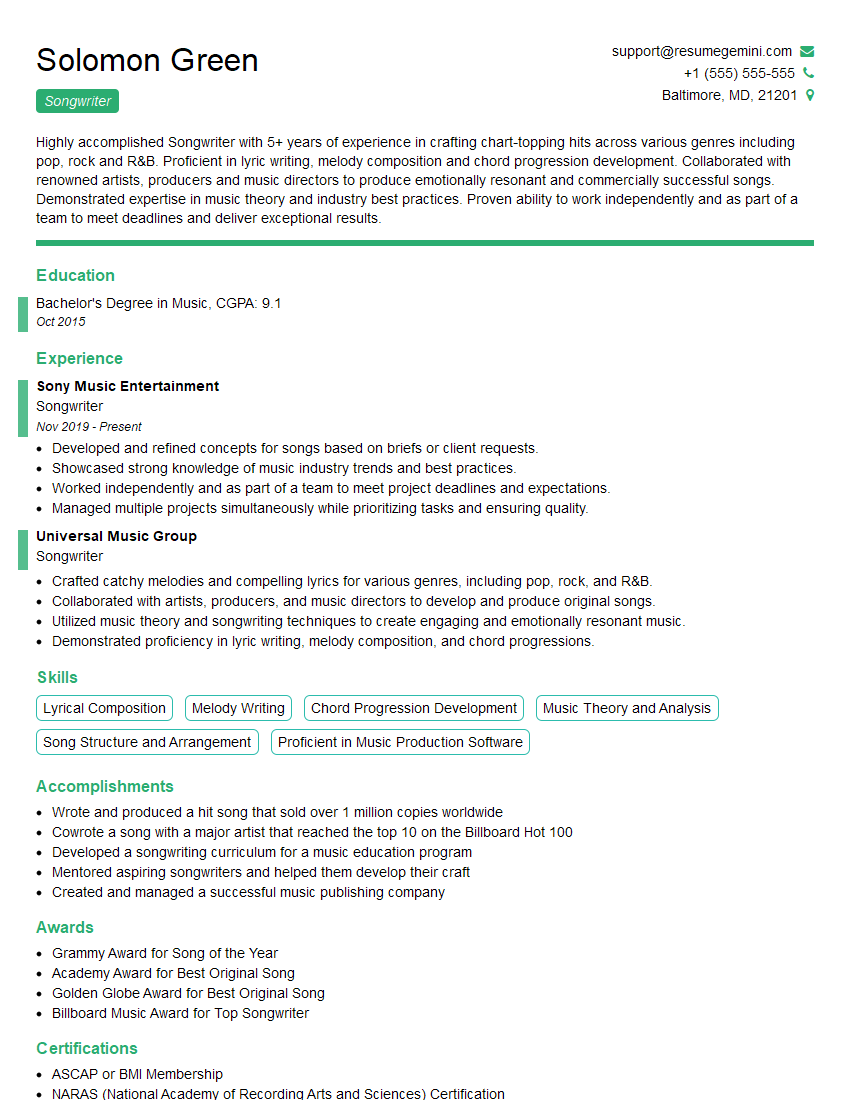
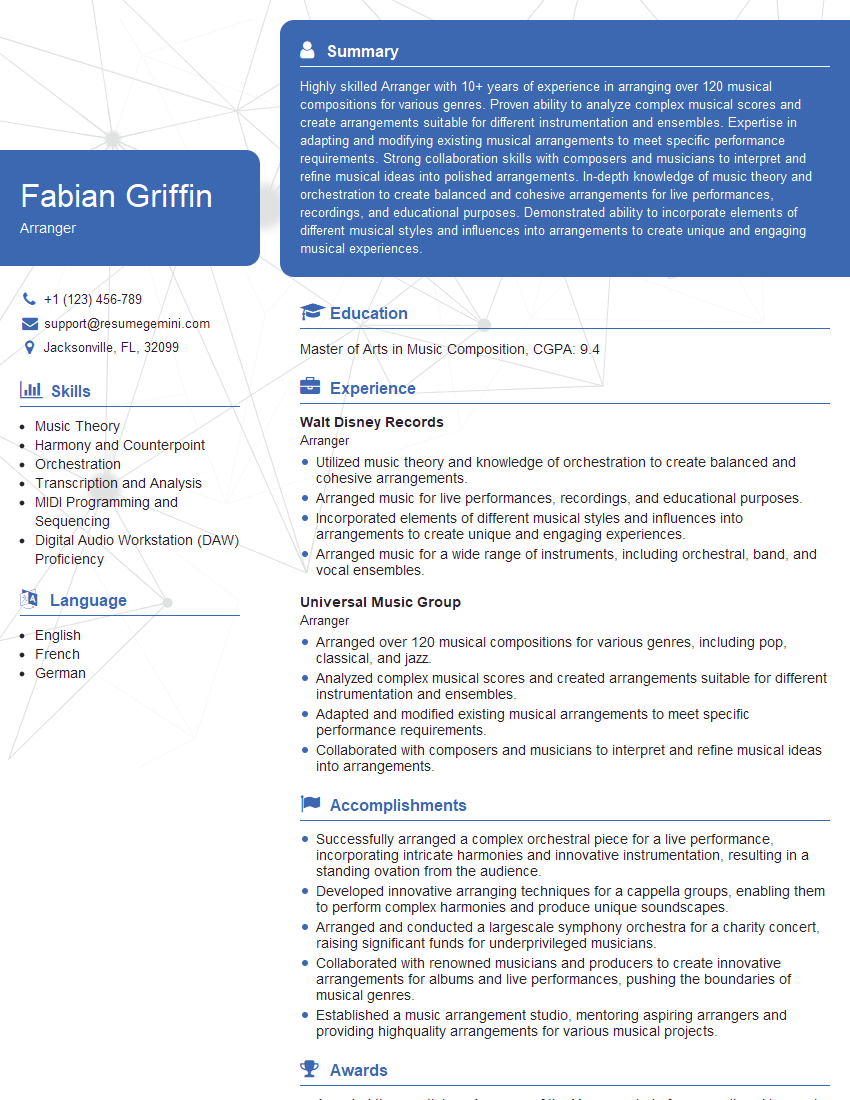
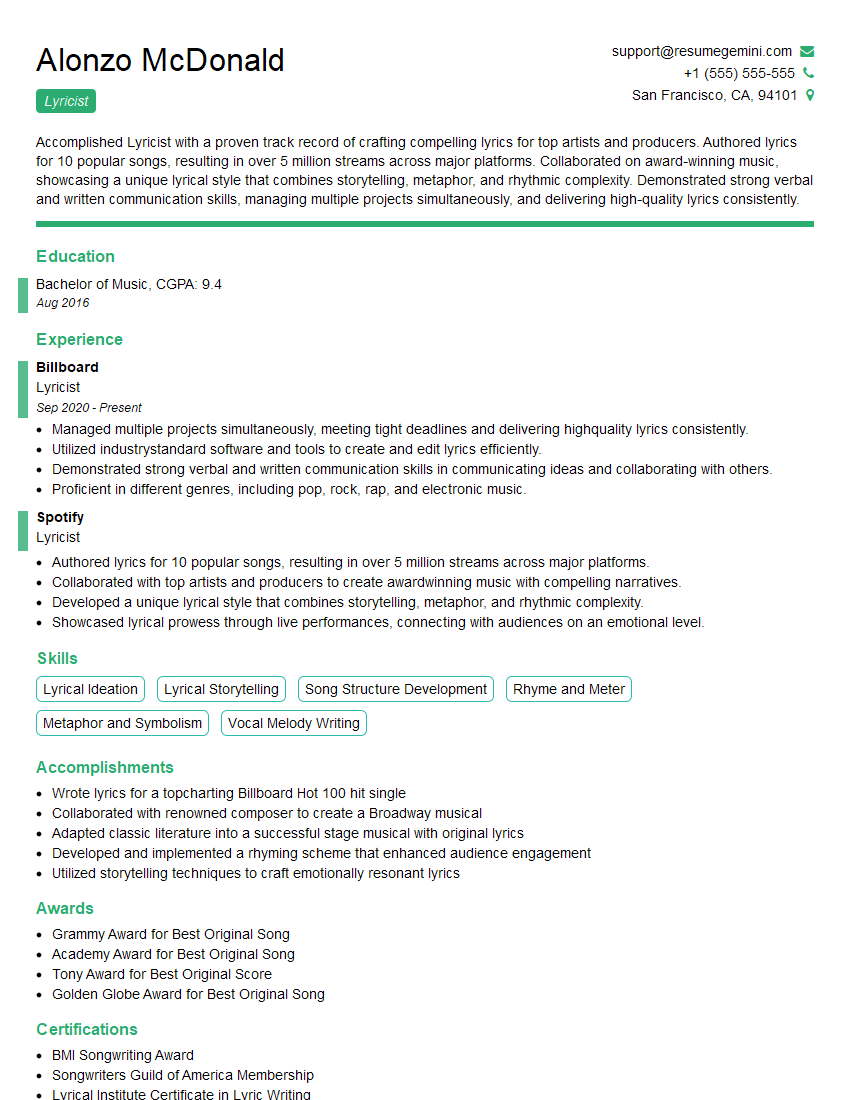
Mastering the art of adapting lyrics for different musical styles significantly enhances your versatility and marketability as a songwriter, lyricist, or music producer. It demonstrates creativity, adaptability, and a deep understanding of music theory and various genres. To make your skills shine to potential employers, crafting a strong, ATS-friendly resume is crucial. ResumeGemini can help you build a compelling resume that showcases your unique abilities and experience in adapting lyrics. Examples of resumes tailored to highlight expertise in adapting lyrics for different musical styles are available for your review, giving you a head start in presenting your qualifications effectively.
Explore more articles
Users Rating of Our Blogs
Share Your Experience
We value your feedback! Please rate our content and share your thoughts (optional).
What Readers Say About Our Blog
Amazing blog
hello,
Our consultant firm based in the USA and our client are interested in your products.
Could you provide your company brochure and respond from your official email id (if different from the current in use), so i can send you the client’s requirement.
Payment before production.
I await your answer.
Regards,
MrSmith
hello,
Our consultant firm based in the USA and our client are interested in your products.
Could you provide your company brochure and respond from your official email id (if different from the current in use), so i can send you the client’s requirement.
Payment before production.
I await your answer.
Regards,
MrSmith
These apartments are so amazing, posting them online would break the algorithm.
https://bit.ly/Lovely2BedsApartmentHudsonYards
Reach out at BENSON@LONDONFOSTER.COM and let’s get started!
Take a look at this stunning 2-bedroom apartment perfectly situated NYC’s coveted Hudson Yards!
https://bit.ly/Lovely2BedsApartmentHudsonYards
Live Rent Free!
https://bit.ly/LiveRentFREE
Interesting Article, I liked the depth of knowledge you’ve shared.
Helpful, thanks for sharing.
Hi, I represent a social media marketing agency and liked your blog
Hi, I represent an SEO company that specialises in getting you AI citations and higher rankings on Google. I’d like to offer you a 100% free SEO audit for your website. Would you be interested?