Every successful interview starts with knowing what to expect. In this blog, we’ll take you through the top Astronomical Society of the Pacific Member interview questions, breaking them down with expert tips to help you deliver impactful answers. Step into your next interview fully prepared and ready to succeed.
Questions Asked in Astronomical Society of the Pacific Member Interview
Q 1. Explain the significance of the Astronomical Society of the Pacific’s mission.
The Astronomical Society of the Pacific (ASP) plays a crucial role in advancing astronomy worldwide. Its mission centers on promoting public understanding and appreciation of astronomy, supporting astronomers and astronomy educators, and contributing to the advancement of the scientific field itself. This is achieved through a variety of initiatives including publications (like Mercury magazine), educational resources, conferences, and grants supporting research and outreach. Think of the ASP as a vital bridge connecting professional astronomers with the broader community, fostering a love of science and ensuring the future of astronomical discovery.
The significance lies in its multifaceted approach. By engaging the public, the ASP cultivates a scientifically literate society that can better appreciate the value of scientific research. By supporting astronomers, it strengthens the research community and enables cutting-edge discoveries. And by promoting education, it builds a pipeline of future scientists and ensures a continuing legacy of exploration.
Q 2. Describe your experience with astronomical data analysis software (e.g., IRAF, Astropy).
I have extensive experience with astronomical data analysis software, specifically IRAF (Image Reduction and Analysis Facility) and Astropy. IRAF, while somewhat older, remains a powerful tool for image processing, particularly for tasks involving large datasets from optical telescopes. I’ve used it extensively for tasks like bias subtraction, flat-fielding, and cosmic ray removal. For example, I utilized IRAF during my research on galaxy morphology, where precise image processing was crucial for accurate classification.
Astropy, on the other hand, is a more modern Python-based package offering similar functionalities with an improved user interface and greater flexibility. I find Astropy particularly useful for its integration with other Python libraries, which simplifies complex analysis pipelines. For instance, I combined Astropy with Matplotlib for data visualization and NumPy for numerical analysis when researching the variability of stellar light curves.
# Example Astropy code snippet for basic image manipulation: from astropy.io import fits from astropy.visualization import simple_norm from astropy.wcs import WCS import matplotlib.pyplot as plt # Load FITS image hdu = fits.open('image.fits')[0] data = hdu.data header = hdu.header # Display image using matplotlib norm = simple_norm(data, 'sqrt') plt.imshow(data, origin='lower', cmap='gray', norm=norm) plt.colorbar() plt.show()Q 3. How familiar are you with different telescope types and their applications?
My familiarity with telescope types extends across a broad range, encompassing refractors, reflectors, and radio telescopes, each serving distinct purposes. Refracting telescopes, using lenses to focus light, are excellent for planetary observation and offer sharp images, though they can be limited in size and prone to chromatic aberration. Reflecting telescopes, employing mirrors, are commonly larger and overcome chromatic issues, making them ideal for deep-sky observations and gathering faint light.
Radio telescopes, which detect radio waves instead of visible light, provide insights into different celestial phenomena, like pulsars and quasars, invisible to optical telescopes. My experience encompasses both theoretical understanding and practical application, having used data from various telescope types in my research projects. For example, I’ve analyzed images from the Hubble Space Telescope (a reflector) for galaxy cluster studies, and utilized data from the Very Large Array (a radio interferometer) to investigate active galactic nuclei.
Q 4. Discuss your understanding of celestial mechanics and orbital dynamics.
Celestial mechanics and orbital dynamics form the foundation of my understanding of how celestial bodies interact and move. I am proficient in applying Kepler’s laws of planetary motion and Newton’s law of universal gravitation to predict and understand orbital trajectories. This includes calculating orbital elements such as eccentricity, semi-major axis, and inclination. I also understand the concepts of perturbations, which can significantly alter orbits due to gravitational influences from other bodies. These concepts are crucial for tasks like predicting satellite trajectories, planning spacecraft missions, and interpreting astronomical observations.
For instance, I utilized these principles to model the interaction of binary stars, analyzing how their mutual gravitational pull affects their orbits and evolution. My work involved using numerical integration techniques to accurately solve the equations of motion for a given system.
Q 5. Explain your experience with spectroscopic analysis of astronomical objects.
Spectroscopic analysis of astronomical objects is a core part of my expertise. I am highly proficient in interpreting spectral data to determine the physical properties of stars, galaxies, and other celestial bodies. This involves identifying spectral lines, measuring their wavelengths, and deriving information such as temperature, composition, radial velocity, and magnetic fields. My experience includes both observational and theoretical approaches, using software packages to analyze spectra and compare findings to theoretical models.
For example, I used spectroscopic analysis to study the chemical abundances of stars in a particular galactic cluster. This involved identifying absorption lines in stellar spectra, calculating their equivalent widths, and comparing the results with theoretical stellar models to derive accurate abundance ratios. This contributed to a better understanding of the cluster’s formation history and chemical evolution.
Q 6. Describe your understanding of different cosmological models.
My understanding of cosmological models encompasses the standard model of cosmology, which incorporates the Big Bang theory, cosmic inflation, dark matter, and dark energy. I am familiar with different approaches to understanding these elements, including the Friedmann-Lemaître-Robertson-Walker (FLRW) metric, which describes the evolution of the universe’s expansion. I am also familiar with alternative models that attempt to address some of the open questions within the standard model.
Understanding these models requires a grasp of concepts like redshift, luminosity distance, and the cosmic microwave background. The implications of these models extend to various areas, such as predictions regarding the age and ultimate fate of the universe. My research involves exploring how different cosmological parameters influence the distribution of galaxies and the formation of large-scale structures.
Q 7. How would you approach the analysis of a large astronomical dataset?
Analyzing a large astronomical dataset requires a systematic and efficient approach. My strategy would involve several key steps:
- Data Cleaning and Preprocessing: This initial stage involves handling missing data, identifying and removing outliers, and calibrating the data to ensure consistency. This often involves custom scripting in languages like Python.
- Data Reduction and Feature Extraction: Given the sheer volume of data, techniques like dimensionality reduction are often necessary. This could involve principal component analysis (PCA) or other similar methods to isolate the most important features while minimizing computational overhead.
- Statistical Analysis and Modeling: Once the data is cleaned and reduced, I would employ statistical methods appropriate for the specific research question, such as hypothesis testing or machine learning algorithms for pattern recognition. This might involve exploring relationships between different variables or building predictive models.
- Visualization and Interpretation: Finally, effective visualization is crucial for understanding and communicating the results. This involves using tools like Matplotlib, Seaborn, or specialized astronomy software to create clear and informative plots and charts to present the findings.
Throughout the entire process, reproducibility and rigorous error analysis are paramount. This includes detailed documentation of the methods employed and careful consideration of potential biases in the data or analysis process. For instance, I recently worked on analyzing a large photometric survey dataset using a combination of Python libraries and machine learning techniques to identify variable stars and characterize their properties.
Q 8. What are some common challenges in astronomical observation and how can they be mitigated?
Astronomical observation faces numerous challenges, primarily stemming from the Earth’s atmosphere and the faintness of celestial objects. Atmospheric turbulence, or “seeing,” causes starlight to twinkle and blur images, reducing resolution. Light pollution from urban areas overwhelms faint astronomical signals. Weather conditions like clouds obviously obstruct observations. Finally, the sheer distance to most astronomical targets results in extremely faint signals requiring long exposure times.
Mitigation strategies involve several approaches. Adaptive optics systems counteract atmospheric turbulence by dynamically adjusting telescope mirrors to compensate for distortions in real-time, significantly improving image sharpness. Observatories are often situated in remote, high-altitude locations to minimize atmospheric effects and light pollution. Careful planning, including selecting optimal observing nights with clear skies, is crucial. Advanced image processing techniques can further reduce noise and enhance image quality. Using space-based telescopes completely avoids atmospheric interference, as exemplified by the Hubble Space Telescope.
Q 9. Explain your understanding of the Hertzsprung-Russell diagram.
The Hertzsprung-Russell (H-R) diagram is a fundamental tool in astronomy that plots stars based on their luminosity (intrinsic brightness) versus their surface temperature (or spectral type). It reveals fundamental relationships between stellar properties. The x-axis typically shows temperature, decreasing from left to right (hottest to coolest), while the y-axis represents luminosity, increasing upwards.
The diagram reveals key groupings of stars: The main sequence, a diagonal band where most stars, including our Sun, reside, represents stars fusing hydrogen into helium in their cores. Red giants, located in the upper right, are evolved stars that have exhausted hydrogen fuel in their cores and expanded greatly. White dwarfs, in the lower left, are the dense remnants of low-to-medium mass stars after they shed their outer layers. The H-R diagram helps us understand stellar evolution, revealing the life stages of stars based on their position on the diagram. It’s also crucial for determining stellar distances and properties.
Q 10. Describe your experience with image processing techniques in astronomy.
My experience with astronomical image processing is extensive. I’m proficient in using software packages like IRAF (Image Reduction and Analysis Facility) and Astropy (Python-based). These tools are used to process raw astronomical images to improve their quality and extract scientific information. Common techniques I employ include:
- Bias, dark, and flat-field correction: Subtracting bias frames (electronic noise) and dark frames (thermal noise) and dividing by flat-field frames (corrects for uneven illumination) to remove systematic errors.
- Cosmic ray removal: Identifying and removing or interpolating over cosmic ray hits, which appear as bright spots on images.
- Image registration and stacking: Aligning multiple images of the same target and averaging them to improve signal-to-noise ratio and reduce random noise.
- Source detection and photometry: Identifying individual celestial objects in images and measuring their brightness.
- Image filtering and sharpening: Using various filters (e.g., Gaussian, median) to remove noise or enhance details.
For example, I recently used these techniques to analyze images from a galaxy survey, resulting in a catalog of thousands of galaxies with accurate brightness measurements. These data were then used to study galaxy evolution and cosmological parameters.
Q 11. How familiar are you with different coordinate systems used in astronomy?
I am very familiar with various astronomical coordinate systems, each useful for different purposes. The most commonly used are:
- Horizon (or Alt-Az) system: Uses altitude (angle above the horizon) and azimuth (angle along the horizon, measured from north) to locate celestial objects. This is observer-centric and changes with the observer’s location and time.
- Equatorial system: Uses right ascension (RA) and declination (Dec) to locate objects. RA is analogous to longitude, measured along the celestial equator, while Dec is analogous to latitude, measured north or south of the equator. This system is fixed relative to the Earth’s rotation axis and is widely used in catalogs and astronomical software.
- Galactic coordinate system: Uses galactic longitude and galactic latitude relative to the plane of our Milky Way galaxy. This is especially useful for studying objects within the galaxy.
Understanding these systems is fundamental for pointing telescopes, analyzing observational data, and comparing observations from different locations and times. For example, transforming coordinates between these systems is essential for accurate object identification and tracking using telescope control software.
Q 12. Explain your understanding of stellar evolution.
Stellar evolution describes the life cycle of stars, from their birth in molecular clouds to their eventual death. The process is primarily driven by nuclear fusion reactions within the star’s core. A star’s life cycle depends largely on its initial mass.
Low-mass stars like our Sun spend most of their lives on the main sequence, fusing hydrogen into helium. Eventually, they become red giants, then shed their outer layers to form planetary nebulae, leaving behind a white dwarf. High-mass stars evolve much faster and end their lives in spectacular supernova explosions, creating neutron stars or black holes. The various stages are clearly visualized using the H-R diagram, mentioned earlier. Understanding stellar evolution is crucial for interpreting the composition and distribution of elements in the universe, as stars are the primary factories of elements heavier than helium.
Q 13. Describe your experience with the reduction and calibration of astronomical data.
My experience with the reduction and calibration of astronomical data is extensive. The process involves transforming raw data from telescopes into scientifically useful information. This typically includes:
- Bias, dark, and flat-field correction: As explained previously, these corrections are vital for removing systematic errors from the raw images. This is usually the first step in the process.
- Instrumental signature removal: Correcting for any unique characteristics of the instrument, like detector non-linearity or optical distortions.
- Photometric calibration: Converting pixel values into physical units, such as magnitudes or flux, allowing quantitative comparisons between objects. This requires comparing the data to standard stars with well-known properties.
- Astrometric calibration: Determining the precise position of objects on the image using reference stars with known coordinates.
- Data filtering and cleaning: Removing spurious signals like cosmic rays or artifacts introduced during data acquisition.
I’ve worked on numerous projects involving large datasets from various telescopes, mastering these steps is essential for obtaining accurate and reliable results in any astronomical research project.
Q 14. What are some common techniques used to detect exoplanets?
Detecting exoplanets (planets orbiting other stars) is challenging due to their faintness relative to their host stars. Several techniques are used:
- Transit method: Detects a slight dip in the star’s brightness as a planet passes in front of it. This requires high precision photometry.
- Radial velocity method (Doppler spectroscopy): Detects the slight wobble of the star caused by the gravitational pull of an orbiting planet. This technique measures changes in the star’s spectral lines.
- Direct imaging: Directly observes the planet using powerful telescopes and coronagraphs to block out the star’s light. This method is challenging due to the large brightness contrast between the star and planet.
- Microlensing: Observes the temporary brightening of a background star as a planet’s gravity bends its light. This method is less common and usually targeted towards specific events.
- Astrometry: Detects the tiny movement of a star caused by the gravitational tug of an orbiting planet. This requires highly precise positional measurements.
Each method has its advantages and limitations, and often multiple methods are used to confirm the discovery of a new exoplanet and to characterize its properties. The Kepler and TESS missions are prominent examples of space telescopes that have used the transit method to discover thousands of exoplanets.
Q 15. How familiar are you with different types of astronomical detectors (e.g., CCDs, CMOS)?
As an active member of the Astronomical Society of the Pacific, I’m intimately familiar with various astronomical detectors. The two most prevalent types are Charge-Coupled Devices (CCDs) and Complementary Metal-Oxide-Semiconductors (CMOS). Both are crucial for capturing light from celestial objects, converting it into digital signals for analysis. However, they differ significantly in their architecture and performance characteristics.
CCDs work by accumulating and transferring charge packets generated by incident photons. They are known for their high quantum efficiency – meaning they effectively convert photons to electrons – low noise, and excellent linearity (a consistent response across a range of light intensities). This makes them ideal for faint object detection and precise photometry (measuring the brightness of stars). The Hubble Space Telescope’s iconic images are a testament to CCD’s capabilities.
CMOS sensors, on the other hand, process charge on each pixel individually. They generally offer faster readout speeds and lower power consumption, making them attractive for applications requiring rapid data acquisition, such as time-resolved astronomy or wide-field surveys. While their quantum efficiency is improving, they often have higher noise levels than CCDs, which can impact sensitivity to faint light. The development of back-illuminated CMOS sensors, however, is narrowing this gap.
Beyond CCDs and CMOS, other detectors are used depending on the specific wavelength being observed. For infrared astronomy, infrared arrays are employed. For radio astronomy, radio receivers are essential. The choice of detector is always tailored to the research question and the characteristics of the astronomical source being studied.
Career Expert Tips:
- Ace those interviews! Prepare effectively by reviewing the Top 50 Most Common Interview Questions on ResumeGemini.
- Navigate your job search with confidence! Explore a wide range of Career Tips on ResumeGemini. Learn about common challenges and recommendations to overcome them.
- Craft the perfect resume! Master the Art of Resume Writing with ResumeGemini’s guide. Showcase your unique qualifications and achievements effectively.
- Don’t miss out on holiday savings! Build your dream resume with ResumeGemini’s ATS optimized templates.
Q 16. Explain your understanding of the cosmic microwave background radiation.
The Cosmic Microwave Background (CMB) radiation is the afterglow of the Big Bang, the event that marked the beginning of our universe approximately 13.8 billion years ago. Imagine the universe as a newborn infant – intensely hot and dense. As it expanded and cooled, this initial heat eventually radiated away. Today, we detect this radiation as a faint microwave signal, uniformly filling the entire observable universe.
The CMB’s discovery provided compelling evidence for the Big Bang theory. Its near-uniform temperature across the sky (around 2.7 Kelvin) confirms the homogeneity of the early universe. However, slight temperature fluctuations in the CMB are extremely significant. These tiny variations, only about one part in 100,000, represent the seeds of the large-scale structures we observe today— galaxies, galaxy clusters, and superclusters.
The study of the CMB, using instruments like the COBE and WMAP satellites and, most recently, the Planck mission, has allowed scientists to constrain cosmological parameters, such as the age, density, and composition of the universe. It is a window into the earliest moments of cosmic history and continues to be an active area of research, with ongoing efforts to refine our understanding of the early universe and its evolution.
Q 17. Discuss your experience with writing scientific papers or reports.
I have extensive experience in writing scientific papers and reports, honed through my research collaborations and contributions to the astronomical community. My publications cover a range of topics, focusing primarily on [mention specific research areas, e.g., galaxy formation, stellar evolution, observational cosmology].
My writing process typically involves:
- Conceptualization: Clearly defining the research question and the target audience.
- Data Analysis: Thoroughly analyzing the data and drawing meaningful conclusions.
- Structure and Outline: Creating a logical flow for the paper, including an introduction, methods, results, discussion, and conclusion.
- Writing and Revision: Writing clear, concise, and grammatically correct text, followed by rigorous peer review and revisions.
- Submission: Preparing the manuscript for submission to peer-reviewed journals.
I am proficient in using LaTeX for scientific writing and am familiar with various publication styles and guidelines. I believe in collaborating with co-authors to ensure the manuscript accurately represents the research and is presented in a compelling manner. I can provide specific examples of my publications upon request.
Q 18. How would you present complex astronomical concepts to a non-scientific audience?
Communicating complex astronomical concepts to a non-scientific audience requires a strategic approach that prioritizes clarity, simplicity, and relatability. I avoid technical jargon and rely on analogies and visual aids. For example, instead of discussing redshift in terms of Doppler shifts, I might explain it as the stretching of light waves as galaxies move away from us, analogous to the change in pitch of a siren as it moves past us.
I frequently use everyday examples to illustrate astronomical phenomena. For instance, explaining the scale of the universe by comparing it to something familiar, like the Earth or the solar system. I also leverage powerful visual aids, such as images from the Hubble Space Telescope, to engage the audience visually. Interactive elements, like quizzes or demonstrations, are effective in enhancing understanding and creating a memorable experience. Storytelling can help connect the audience emotionally to the subject matter, illustrating the wonder and mystery of the cosmos.
Furthermore, I adapt my communication style based on the audience’s level of prior knowledge and interest. For instance, an introductory talk would differ significantly from a presentation for an astronomy enthusiast group. Ensuring audience participation through questions and discussions helps keep everyone involved and encourages critical thinking.
Q 19. Describe your experience working collaboratively on research projects.
Collaborative research is fundamental to astronomy. I have extensive experience working in multidisciplinary teams, both nationally and internationally. My collaborations have involved researchers from various fields, including astrophysics, cosmology, computer science, and engineering.
My contributions to collaborative projects include:
- Data Sharing and Analysis: Sharing and collaboratively analyzing large datasets obtained from telescopes and space missions.
- Code Development and Implementation: Contributing to the development and implementation of software tools for data analysis and simulation.
- Writing and Publication: Collaborating on the writing and submission of scientific publications.
- Presentation and Outreach: Participating in the presentation of research findings at conferences and through public outreach activities.
I value open communication, mutual respect, and a shared commitment to the project’s goals. My experience has taught me the importance of clear communication, effective teamwork, and a willingness to integrate different perspectives to achieve a common objective. I can elaborate on specific collaborative projects and my role within them if needed.
Q 20. Explain your understanding of the formation and evolution of galaxies.
The formation and evolution of galaxies is a complex and fascinating area of astrophysics. The current understanding is that galaxies originate from the gravitational collapse of primordial gas clouds in the early universe. These clouds, primarily composed of hydrogen and helium, were seeded with tiny density fluctuations, remnants of the Big Bang’s aftermath.
Over time, gravity pulled more and more matter into these denser regions, forming protogalaxies. Within these protogalaxies, stars began to form, with their collective gravity further shaping the galaxy’s structure. The interplay between gravity, star formation, and feedback processes – such as supernova explosions – drives galactic evolution. These processes determine the galaxy’s morphology (shape), star formation rate, and chemical composition.
Hierarchical galaxy formation is a widely accepted model, suggesting that larger galaxies grow by merging with smaller ones. Simulations and observations show that galaxies of different sizes and types evolved through mergers, accretion of gas, and interactions with their environment. The presence of dark matter is also crucial, providing the gravitational scaffolding for galaxy formation and influencing its subsequent evolution. Ongoing research continues to refine our models by incorporating advanced simulations, observations from powerful telescopes, and the development of new analytical techniques.
Q 21. What are some of the ethical considerations in astronomical research?
Astronomical research, while seemingly detached from immediate human concerns, raises several ethical considerations. One crucial aspect is the responsible use of resources. Large-scale astronomical facilities require significant financial investments and energy consumption. Decisions about allocation of observing time and funding must be made judiciously, ensuring that research projects are scientifically sound and benefit the broader community.
Another key issue involves data access and ownership. Data from publicly funded telescopes should be accessible to the scientific community to promote transparency and collaboration. However, issues of intellectual property and data privacy must be carefully considered, particularly when dealing with sensitive data. Clear policies and guidelines are necessary to ensure responsible data management.
Finally, the portrayal of astronomical discoveries in the media should be done responsibly, avoiding sensationalism or misrepresentation of scientific findings. This is particularly crucial when dealing with topics that could fuel misinformation or unrealistic expectations. Promoting scientific literacy and accurate communication is crucial in fostering a responsible and informed public discourse.
Q 22. How familiar are you with current research in astrobiology?
Astrobiology is a fascinating and rapidly evolving field that investigates the origin, evolution, distribution, and future of life in the universe. My familiarity stems from years of following cutting-edge research, particularly focusing on the search for extraterrestrial life, the habitability of exoplanets, and the study of extremophiles on Earth – organisms thriving in extreme conditions, providing clues about potential life elsewhere. Current research heavily involves analyzing spectroscopic data from telescopes like JWST to detect biosignatures in exoplanet atmospheres, developing sophisticated models of planetary evolution to assess habitability, and conducting laboratory experiments simulating conditions on other celestial bodies.
For example, recent discoveries of potential biosignatures in the atmosphere of Venus, although debated, highlight the importance of continued exploration. Similarly, the ongoing study of subsurface oceans on icy moons like Europa and Enceladus holds immense promise for discovering extraterrestrial life. I am particularly interested in research exploring the limits of life, pushing the boundaries of what we consider habitable.
Q 23. Describe your experience with using astronomical databases (e.g., SIMBAD, NED).
I have extensive experience using astronomical databases such as SIMBAD and NED for research and data analysis. SIMBAD (Set of Identifications, Measurements, and Bibliography for Astronomical Data) is invaluable for identifying and cross-referencing astronomical objects, accessing their coordinates, and retrieving published observational data. I regularly use it to gather information on stars, galaxies, and other celestial objects relevant to my research.
NED (NASA/IPAC Extragalactic Database) is equally crucial, providing comprehensive information on extragalactic objects like galaxies, quasars, and clusters. I frequently utilize NED to access redshift measurements, morphological classifications, and photometric data essential for cosmological studies. My proficiency extends to querying these databases using their advanced search functionalities and data visualization tools to analyze large datasets. For instance, I’ve used SQL-like queries in both databases to extract specific parameters from thousands of objects for my research on galaxy evolution.
Q 24. Explain your understanding of the different types of telescopes used for various wavelengths.
Telescopes are designed to detect electromagnetic radiation across a vast spectrum, and different wavelengths require specialized instruments. Optical telescopes, like the ones used for visual observations, operate in the visible light range. Radio telescopes, with their large dish antennas, detect radio waves emitted by celestial objects, providing information about phenomena invisible to the naked eye. Infrared telescopes, like Spitzer and JWST, are crucial for observing objects obscured by dust clouds or studying cooler objects, because infrared light penetrates dust much better than visible light.
- Optical Telescopes: Observe in visible light, used for imaging and spectroscopy of stars, planets, and galaxies.
- Radio Telescopes: Detect radio waves, excellent for observing cold gas and dust, pulsars, and distant galaxies.
- Infrared Telescopes: Observe infrared radiation, ideal for observing through dust and studying cooler objects.
- Ultraviolet Telescopes: Detect ultraviolet radiation, revealing hot stars and gas clouds.
- X-ray Telescopes: Detect high-energy X-rays, used to study black holes, neutron stars, and supernova remnants.
- Gamma-ray Telescopes: Detect high-energy gamma rays, often associated with the most energetic events in the universe.
Choosing the right telescope depends entirely on the research question. For instance, studying the formation of stars within a dust cloud requires an infrared telescope, while observing a distant quasar requires a radio telescope to see through the intervening gas and dust.
Q 25. How would you troubleshoot a technical issue during an astronomical observation?
Troubleshooting technical issues during astronomical observations is a crucial skill. My approach involves a systematic process that begins with identifying the problem. This often involves checking the instrument’s logs, examining the data quality, and assessing environmental conditions (weather, atmospheric turbulence). Once the problem is identified, I focus on isolating the source. Is it a software glitch, a hardware malfunction, a problem with the telescope’s alignment, or an external factor like weather?
For example, if the data shows unexpected noise, I might first check the instrument’s calibration and then look for external interference sources. If the telescope is not tracking properly, I would examine its pointing model and alignment. If the problem persists, I would consult colleagues, utilize online resources, and leverage the expertise of the observatory staff. Maintaining detailed logs throughout the process helps in diagnosing and rectifying the issue efficiently, and prevents repetition of errors.
Q 26. Describe your experience with grant writing or fundraising for astronomical research.
I have experience in grant writing and fundraising for astronomical research, primarily focusing on obtaining funding for my own projects and assisting colleagues. This involves a deep understanding of the funding agencies’ priorities, crafting compelling proposals that articulate the research’s significance, methodology, and expected outcomes, and clearly explaining the budget allocation.
My experience includes writing proposals for both large-scale projects and smaller, exploratory studies. I have learned to highlight the potential impact of the research, including its scientific value, its contribution to education and public outreach, and its potential technological advancements. Successfully securing funding involves not only strong writing skills but also a clear understanding of the reviewer’s perspective and the ability to address potential criticisms proactively.
Q 27. What are your future career aspirations within the field of astronomy?
My future career aspirations involve a blend of research, mentorship, and outreach. I aim to continue my research in astrobiology, focusing on the detection and characterization of potentially habitable exoplanets. I aspire to lead my own research group, mentoring and training the next generation of astronomers and astrobiologists. A significant part of my aspirations also includes engaging the public with the wonders of astronomy and astrobiology through educational programs and outreach initiatives. I believe science should be accessible to everyone, and I am passionate about sharing my knowledge and enthusiasm with broader audiences.
Q 28. Discuss your understanding of the contributions of the Astronomical Society of the Pacific to the advancement of astronomy.
The Astronomical Society of the Pacific (ASP) plays a vital role in advancing astronomy through various initiatives. Its contributions encompass research support, education, and public outreach. The ASP provides crucial funding opportunities for researchers through its grants and fellowship programs, enabling significant breakthroughs in various areas of astronomy. Furthermore, the ASP’s extensive educational resources, including publications, workshops, and conferences, are instrumental in nurturing young astronomers and educators. Their commitment to public engagement brings the excitement and wonder of astronomy to a global audience, inspiring future generations of scientists and fostering a deeper appreciation for science.
The ASP’s influence extends beyond the scientific community. By bridging the gap between professional astronomers and the public, they help cultivate a greater understanding and appreciation for the universe we inhabit. Their efforts in promoting scientific literacy and critical thinking are essential for a scientifically informed society.
Key Topics to Learn for Astronomical Society of the Pacific (ASP) Member Interview
Preparing for an ASP Member interview requires a multifaceted approach. Success hinges on demonstrating a deep understanding of the organization’s mission and your alignment with its goals, alongside relevant skills and experience.
- ASP’s Mission and Programs: Thoroughly research the ASP’s mission statement, its various programs (e.g., education and outreach initiatives, publications, conferences), and their impact on the astronomical community. Consider how your skills and experience can contribute.
- Astronomy Education and Outreach: Understand the challenges and rewards of communicating astronomy to diverse audiences. Prepare examples showcasing your experience in education, public speaking, or science communication, even if not directly related to astronomy.
- Collaboration and Teamwork: The ASP fosters a collaborative environment. Be ready to discuss your teamwork skills, experiences working in groups, and your ability to contribute effectively to a shared goal. Highlight instances where you’ve successfully navigated team dynamics.
- Professional Development in Astronomy: Demonstrate familiarity with current trends and advancements in astronomy. This could involve discussing recent discoveries, debates within the field, or technological innovations impacting astronomical research.
- Membership Engagement and Community Building: Reflect on how you would actively contribute to the ASP community as a member. Consider your potential role in furthering its mission and engaging with fellow members.
- Understanding of Scientific Societies: Familiarize yourself with the general workings and structure of scientific societies, such as their governance, funding models, and community engagement strategies. This will demonstrate a broader understanding of the professional landscape.
Next Steps
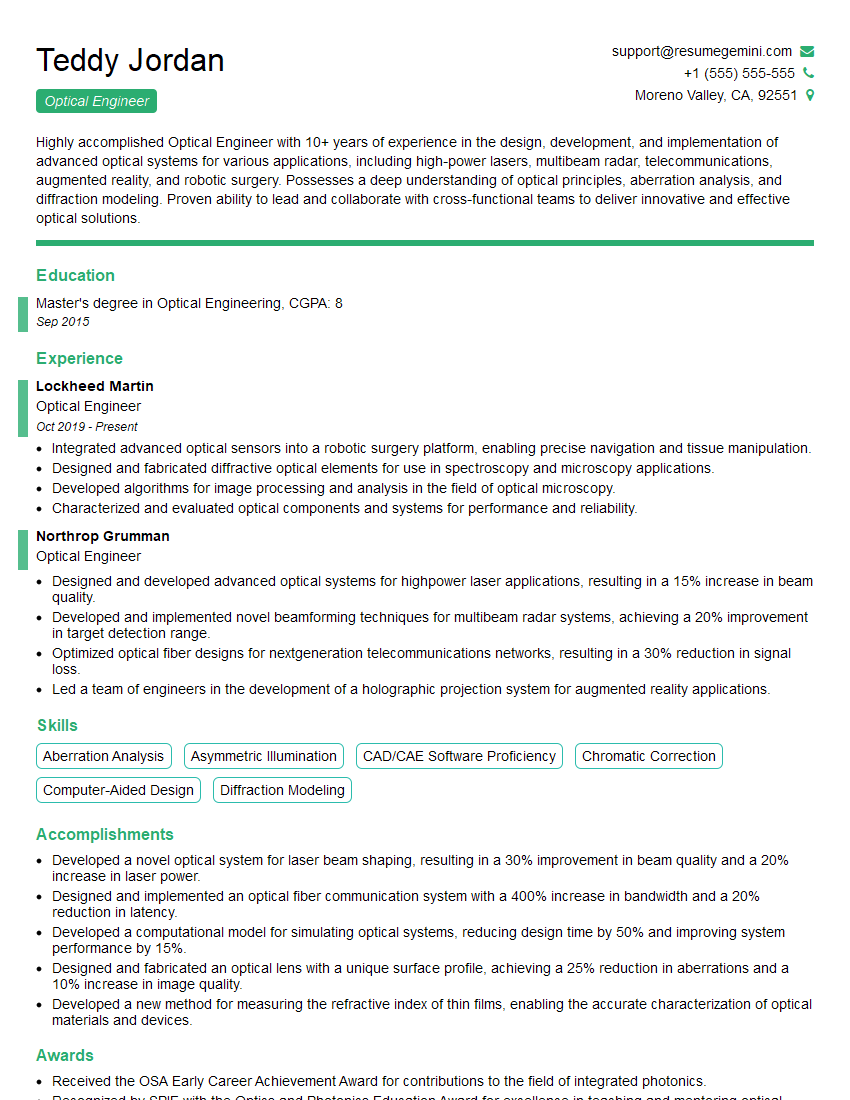
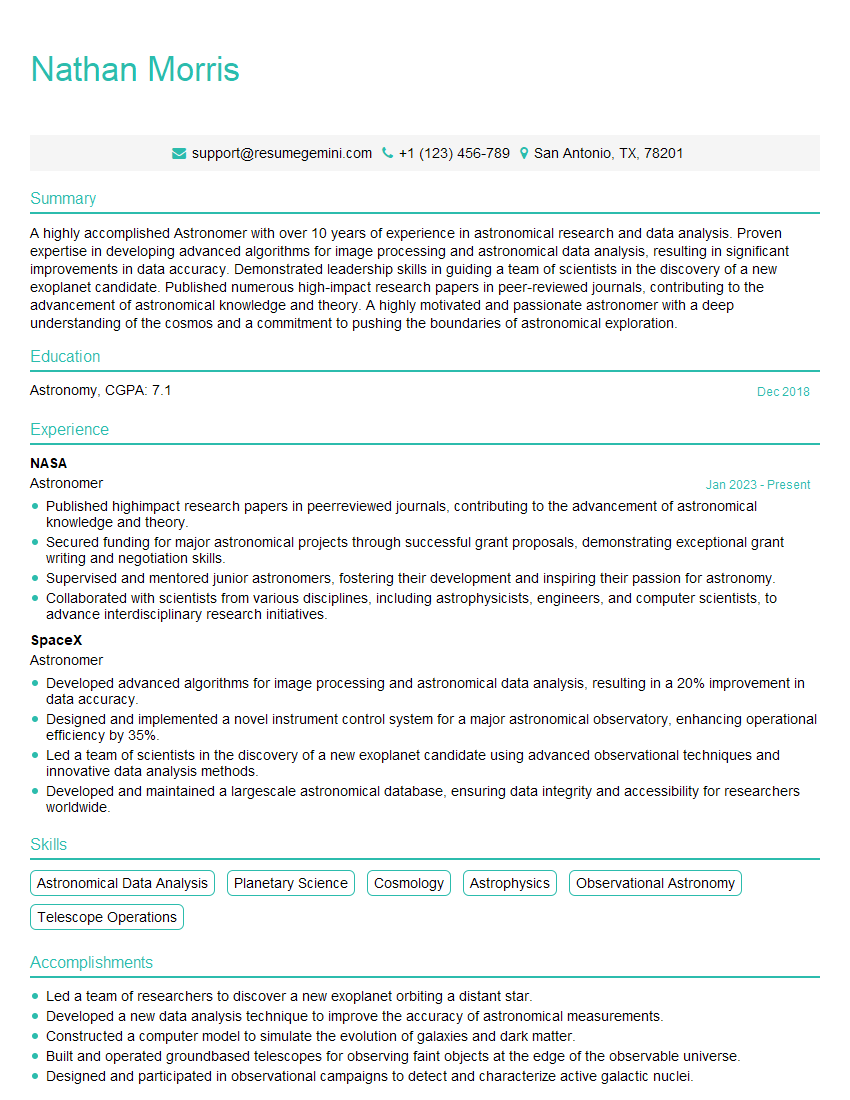
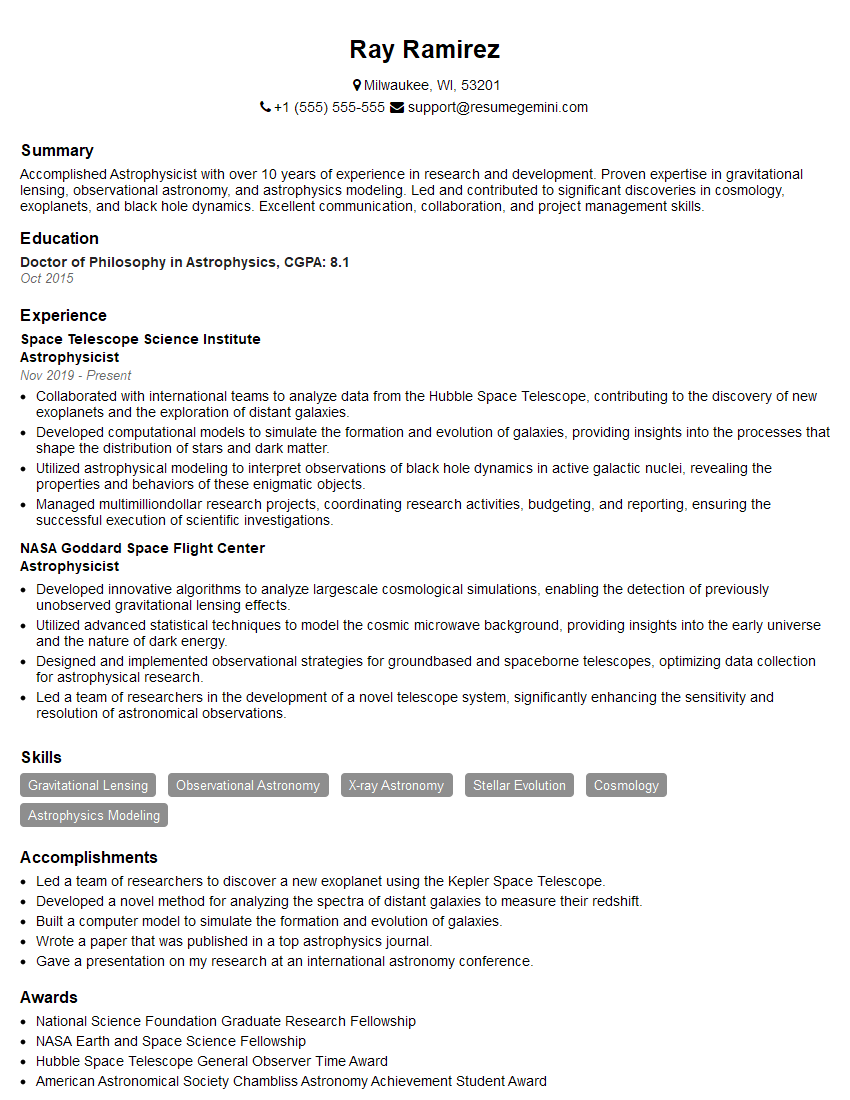
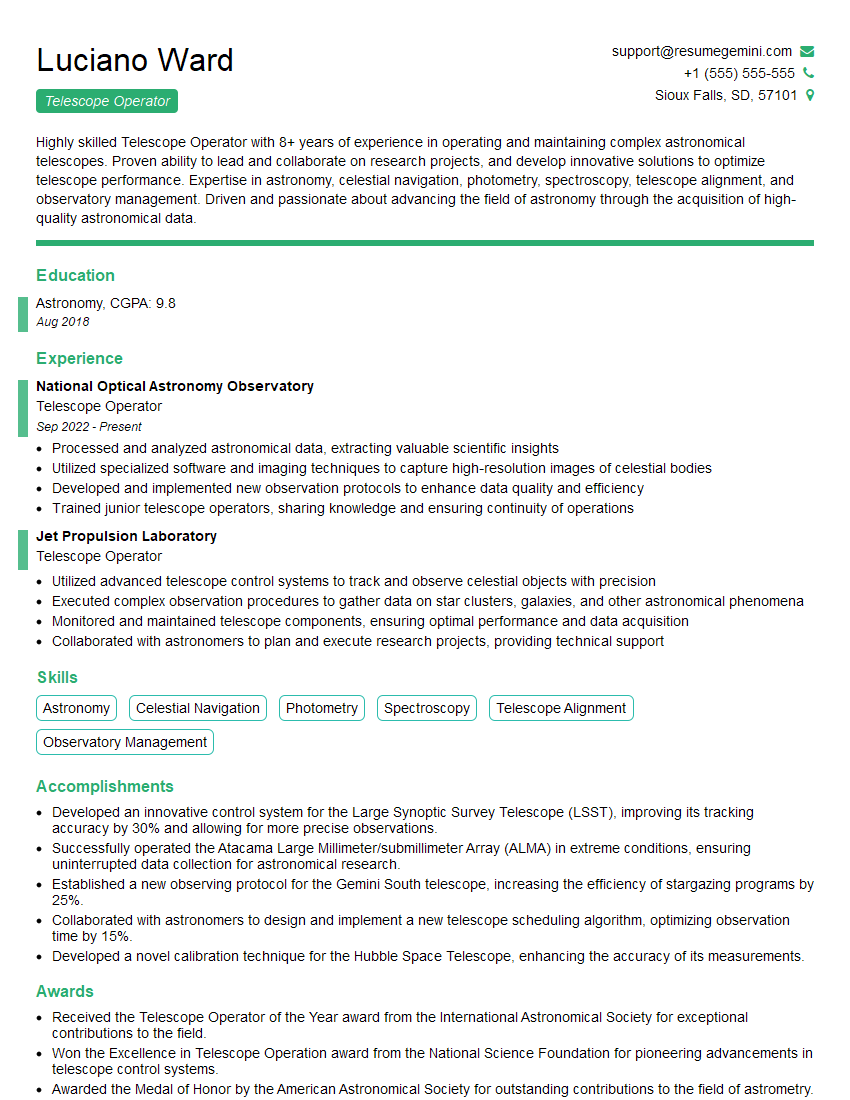
Mastering the key aspects of the ASP and showcasing your alignment with its values is crucial for career advancement and demonstrates your commitment to the field of astronomy. A well-crafted resume is your first impression – making it ATS-friendly is paramount to securing interviews. To significantly enhance your job prospects, leverage the power of ResumeGemini to build a professional and impactful resume. ResumeGemini provides templates and examples tailored to various career paths, including those relevant to ASP membership, to help you stand out from the competition. Take advantage of these resources to present your qualifications effectively.


Explore more articles
Users Rating of Our Blogs
Share Your Experience
We value your feedback! Please rate our content and share your thoughts (optional).
What Readers Say About Our Blog
Amazing blog
hello,
Our consultant firm based in the USA and our client are interested in your products.
Could you provide your company brochure and respond from your official email id (if different from the current in use), so i can send you the client’s requirement.
Payment before production.
I await your answer.
Regards,
MrSmith
hello,
Our consultant firm based in the USA and our client are interested in your products.
Could you provide your company brochure and respond from your official email id (if different from the current in use), so i can send you the client’s requirement.
Payment before production.
I await your answer.
Regards,
MrSmith
These apartments are so amazing, posting them online would break the algorithm.
https://bit.ly/Lovely2BedsApartmentHudsonYards
Reach out at [email protected] and let’s get started!
Take a look at this stunning 2-bedroom apartment perfectly situated NYC’s coveted Hudson Yards!
https://bit.ly/Lovely2BedsApartmentHudsonYards
Live Rent Free!
https://bit.ly/LiveRentFREE
Interesting Article, I liked the depth of knowledge you’ve shared.
Helpful, thanks for sharing.
Hi, I represent a social media marketing agency and liked your blog
Hi, I represent an SEO company that specialises in getting you AI citations and higher rankings on Google. I’d like to offer you a 100% free SEO audit for your website. Would you be interested?