Feeling uncertain about what to expect in your upcoming interview? We’ve got you covered! This blog highlights the most important Clear and Precise Articulation of Train Information interview questions and provides actionable advice to help you stand out as the ideal candidate. Let’s pave the way for your success.
Questions Asked in Clear and Precise Articulation of Train Information Interview
Q 1. Explain the importance of concise language when announcing train delays.
Concise language is paramount in train delay announcements because it minimizes passenger confusion and frustration. Passengers need crucial information quickly, without unnecessary details. Ambiguity can lead to panic and overcrowding. Think of it like a medical emergency – concise instructions save lives.
For instance, instead of saying: “Due to unforeseen circumstances on the Red Line, there is currently a significant delay impacting all trains traveling towards downtown. We apologize for any inconvenience this may cause. Our engineers are working diligently to resolve the issue. We will provide further updates as they become available.”, a better announcement would be: “Red Line: Significant delays to downtown. Updates to follow.” The second version delivers the key information instantly, leaving room for more detail later if needed.
- Clarity: Use simple, direct language, avoiding jargon.
- Brevity: Get to the point immediately.
- Accuracy: Ensure the information is correct.
Q 2. Describe your method for prioritizing information during a critical train disruption.
My method for prioritizing information during a critical train disruption uses a three-tiered system based on immediate urgency:
- Safety: This is always top priority. Announcements related to evacuations, emergency exits, or immediate safety concerns take precedence. For example, “Passengers on platform 3, please proceed to the designated emergency exits.” This needs to be immediate and clear.
- Current Status: Next comes conveying the current situation, including the cause of the disruption (e.g., ‘Signal failure on the Blue Line’), and the extent (e.g., ‘Significant delays expected’). This requires accurate information from control.
- Alternative Actions: Finally, provide options available to passengers, such as alternative routes, shuttle bus services, or expected resumption times (if known). It’s essential to be realistic and avoid false promises about timing.
I also utilize visual aids where possible such as digital displays to complement verbal announcements, maximizing the reach and clarity of information.
Q 3. How would you communicate a complex train schedule change to passengers with varying levels of understanding?
Communicating complex schedule changes requires a multi-faceted approach. I would begin by breaking down the information into smaller, manageable chunks. I would:
- Provide a concise overview: Start with a summary highlighting the key changes – what lines are affected, the general impact (delays, cancellations).
- Use clear, simple language: Avoid technical jargon. Instead of saying ‘line diversion,’ say ‘trains will now be using a different route’.
- Offer multiple communication channels: Utilize digital displays showing a simplified schedule, written announcements with large, clear font sizes, and verbal announcements repeated at regular intervals.
- Provide specific examples: Give practical examples of how the schedule changes affect specific destinations, providing estimated times of arrival and/or departure for key stations.
- Offer assistance: Have staff available to answer questions and assist passengers individually.
Consider visual aids, like maps highlighting affected routes, to further enhance comprehension.
Q 4. What strategies do you use to ensure all passengers hear and understand critical announcements?
Ensuring all passengers hear and understand announcements requires a layered approach:
- Multiple announcement points: Use a network of strategically placed speakers throughout the station and onboard trains to ensure wide coverage.
- Visual reinforcement: Display critical information on digital screens and printed posters. Visuals are crucial for passengers who may not hear the announcements clearly or have hearing impairments.
- Redundancy: Repeat announcements frequently, using different phrasing to ensure comprehension.
- Multiple languages: If applicable, use multilingual announcements to cater to diverse passenger groups.
- Text-to-speech technology: Consider incorporating technologies allowing passengers to receive alerts via text message or mobile app.
- Staff assistance: Train station staff can provide assistance to those who need additional help understanding announcements.
Q 5. How would you handle a situation where conflicting information is received from different sources about train status?
Conflicting information is a serious issue. My approach is to:
- Verify Information: Immediately cross-reference the conflicting data with multiple sources – control systems, supervisors, and other staff members.
- Prioritize Reliable Sources: Determine which source is most reliable based on its track record and access to real-time data. Control center updates typically have highest priority.
- Communicate with Transparency: Be honest with passengers. For example, “We are currently working to resolve discrepancies in information regarding the delays on the Green Line. We will provide a confirmed update as soon as possible.”
- Issue Corrections Promptly: Once the correct information is verified, disseminate a correction announcement clearly and swiftly. Emphasize the correction explicitly.
This demonstrates professionalism and builds trust with passengers, even in challenging situations.
Q 6. Explain how you would adapt your communication style to diverse passenger groups (e.g., language barriers, disabilities).
Adapting communication to diverse groups necessitates sensitivity and awareness:
- Language Barriers: Use multilingual announcements and provide printed information in different languages. Consider providing translation services.
- Visual Impairments: Use clear and concise verbal announcements, and ensure the information is available in alternative formats like Braille or large print.
- Hearing Impairments: Utilize visual aids such as LED boards and text alerts. Ensure sufficient lighting in announcements areas and consider the use of loop systems.
- Cognitive Impairments: Use simple language, short sentences, and provide clear, unambiguous instructions.
- Cultural Differences: Be aware of cultural nuances in communication styles and adjust language appropriately. For example, certain cultures may require more formal tones.
The key is to ensure everyone has access to the information in a format they can understand.
Q 7. Describe a time you had to deliver urgent information quickly and accurately under pressure.
During a severe snowstorm, a major power outage affected signaling systems across several lines. The situation was chaotic, and I had to relay urgent information to thousands of stranded passengers. My actions were:
- Assess the situation: Quickly gathered information about the extent of the disruption and the number of affected passengers.
- Prioritize essential information: Focused my announcements on safety – providing information on emergency lighting, warm shelters, and evacuation routes.
- Coordinate with team: Worked collaboratively with colleagues to disseminate information through multiple channels (PA system, text alerts, social media).
- Remain calm and reassuring: Maintained a calm and reassuring tone to mitigate passenger anxiety, emphasizing that we were working diligently to resolve the problem.
- Provide regular updates: Even if there wasn’t much new information, regular updates reduced the uncertainty and reassured passengers.
By efficiently communicating the right information in a timely and reassuring manner, we successfully navigated the crisis and minimized disruption.
Q 8. How would you utilize technology to assist in disseminating train information effectively?
Technology plays a crucial role in disseminating train information effectively. Think of it as a multi-pronged approach for reaching every passenger.
Real-time Data Feeds: Integrating with central control systems allows for instant updates on delays, cancellations, platform changes, and service disruptions. This data can be pushed to various channels simultaneously.
Mobile Apps: A dedicated app provides personalized alerts, journey planning tools, and real-time tracking of the train’s location. Imagine receiving a notification five minutes before your train arrives at your station— incredibly convenient!
Digital Displays: Strategically placed screens at stations and within trains offer clear, visual information, accessible to a wide range of passengers, including those with visual or auditory impairments. These can show scheduled arrivals/departures, platform numbers, and any service updates.
Social Media Integration: Utilizing platforms like Twitter or Facebook allows for rapid communication of major disruptions and provides a channel for passenger queries. This is particularly helpful for reaching a broader audience quickly.
Automated Announcements: Sophisticated PA systems can offer pre-recorded and live announcements, providing clear and consistent messaging across different parts of a station or train.
Q 9. What are some common pitfalls in communicating train information, and how would you avoid them?
Common pitfalls in communicating train information often stem from a lack of clarity, accuracy, and timely updates. Imagine the frustration caused by unclear announcements!
Inaccurate Information: Providing incorrect times or platform numbers is extremely detrimental to passenger trust and can lead to significant inconvenience.
Ambiguous Language: Using jargon or vague terms can confuse passengers. Avoid technical terms and use clear, concise phrasing. For example, instead of saying “signal failure affecting services,” say “there is a delay on this line due to a technical issue.”
Delayed Updates: Not keeping passengers informed about delays or changes quickly enough can lead to anxiety and frustration. The more quickly you address issues, the better.
Inconsistent Messaging: Providing conflicting information across different communication channels is confusing. Ensure all information is standardized and consistent.
To avoid these, establish clear protocols for information verification, utilize a centralized information system, and train staff to use clear, concise language. Regular training and drills on handling unexpected situations are vital.
Q 10. How would you ensure the information you convey is both accurate and easy to understand?
Accuracy and clarity are paramount. Think of it like this: providing wrong information is worse than providing no information at all.
Data Verification: Always cross-reference information from multiple reliable sources before communicating it. Never rely on a single source.
Simple Language: Avoid technical jargon. Use plain English or the relevant language of the region. Focus on conveying essential details clearly and concisely.
Visual Aids: Support textual information with visual cues, such as maps or diagrams to illustrate changes or delays. A picture is often worth a thousand words!
Repetition and Emphasis: Key information should be repeated and emphasized using appropriate intonation in announcements, bold text in digital displays or even different colors to draw attention.
Regularly reviewing and updating communication procedures ensures the effectiveness and accuracy of the delivered information.
Q 11. Describe your experience using different communication channels for train information (e.g., PA system, digital displays).
My experience encompasses various channels. Each requires a distinct approach for optimal effectiveness.
PA System: I’ve utilized PA systems extensively, emphasizing clear articulation, proper pacing, and a calm, reassuring tone. Using a microphone effectively, ensuring proper amplification and minimizing background noise is essential. Specific examples of language used for different announcements (e.g., delays, cancellations, platform changes) have been developed and refined.
Digital Displays: These provide the opportunity for structured and visually appealing information. I’ve worked to design displays that are easy to read at a glance and include key information concisely. I understand the value of different fonts, sizes, and color schemes in enhancing readability and clarity.
Mobile Apps and Websites: I’ve contributed to content updates on websites and mobile apps, ensuring that information is up-to-date and consistent across platforms, using clear visual cues to convey information.
Q 12. How do you verify the accuracy of train information before communicating it to passengers?
Verifying the accuracy of information is a critical step. My approach involves a multi-step process.
Cross-referencing: I verify the information with multiple sources, including the central control system, train dispatchers, and on-site staff. This helps to eliminate potential errors or inconsistencies.
Timeliness: I check the timestamp of the information to ensure it’s current and reflects the latest updates. Outdated information is worse than none.
Conciseness: I ensure all messages are concise, clear and easily understood to avoid ambiguity.
Reviewing Procedures: I regularly review established protocols and procedures for obtaining and disseminating information.
Q 13. Explain your understanding of the importance of maintaining calm and professionalism during stressful situations on train operations.
Maintaining calm and professionalism, even during stressful situations, is crucial. It’s about setting a reassuring tone for passengers.
A calm demeanor helps to diffuse tension and reassures passengers that the situation is being handled effectively. Professionalism involves using clear, concise communication, providing factual information without speculation, and offering assistance where possible. It’s about conveying empathy and understanding to passengers facing disruption.
Imagine a significant delay – a calm, professional announcement will be far more effective than a flustered one.
Q 14. How would you handle a situation where passengers are agitated due to a train delay?
Handling agitated passengers requires a calm, empathetic, and proactive approach.
Acknowledge Emotions: Start by acknowledging passengers’ frustration and understanding their concerns. A simple “I understand your frustration” can go a long way.
Provide Updates: Offer regular and clear updates on the situation, including estimated delays and any actions being taken to resolve the problem. Transparency builds trust.
Offer Solutions: If possible, offer alternative solutions, such as providing refreshments or re-routing options. Even small gestures of goodwill can make a big difference.
De-escalation Techniques: Use active listening, speak calmly and clearly, and avoid arguing. If a passenger is excessively aggressive, seek assistance from security personnel.
Transparency and Honesty: Be upfront about what’s happening, even if the news is not positive. Honesty builds trust, even during challenging circumstances.
Q 15. Describe your approach to crisis communication in the context of rail transportation.
My approach to crisis communication in rail transportation prioritizes accuracy, speed, and empathy. It’s built on a three-stage framework: Immediate Response, Information Dissemination, and Ongoing Updates.
Immediate Response: This involves swiftly acknowledging the crisis (e.g., a major derailment) through all available channels – public address systems at stations, digital signage, social media, and press releases. The initial message focuses on confirming the event, assuring passenger safety, and directing them to seek immediate assistance. We avoid speculation and stick to factual information.
Information Dissemination: This phase involves distributing updates regularly, using a tiered approach based on the urgency and relevance of information. For instance, critical updates on evacuation procedures or emergency medical services would precede less critical information about delays or alternative routes. We utilize multiple communication channels to ensure broad reach.
Ongoing Updates: We maintain consistent communication until the crisis is resolved, providing regular updates about the situation, efforts to resolve it, and the expected impact on services. Transparency and honesty are key – admitting uncertainties while providing the best information available is crucial to maintaining trust.
Example: During a severe snowstorm causing widespread delays, we’d immediately communicate delays, advise passengers to check the website for live updates, and provide information on alternative transportation options, shelter, and hotlines for support.
Career Expert Tips:
- Ace those interviews! Prepare effectively by reviewing the Top 50 Most Common Interview Questions on ResumeGemini.
- Navigate your job search with confidence! Explore a wide range of Career Tips on ResumeGemini. Learn about common challenges and recommendations to overcome them.
- Craft the perfect resume! Master the Art of Resume Writing with ResumeGemini’s guide. Showcase your unique qualifications and achievements effectively.
- Don’t miss out on holiday savings! Build your dream resume with ResumeGemini’s ATS optimized templates.
Q 16. How would you deal with a passenger who misunderstands or misinterprets train information?
Handling passenger misunderstandings requires patience, active listening, and clear, concise explanations. I begin by acknowledging their concern and validating their feelings. Then, I reiterate the relevant train information in plain language, avoiding jargon. If necessary, I use visual aids like train schedules or maps to clarify the situation.
I would ask clarifying questions to understand the root of their misunderstanding. For example, asking ‘What part of the announcement was unclear?’ or ‘Can I help you find the information you’re looking for?’ helps pinpoint the issue. If the misunderstanding stems from conflicting information, I would investigate and correct the source of the error.
Example: If a passenger misinterprets a delay announcement to mean the train is canceled, I would confirm the delay, explain the cause, and state the revised departure time. I might offer alternative options like connecting trains or refunds, depending on the circumstances.
Q 17. How do you ensure your communication remains impartial and objective?
Maintaining impartiality and objectivity is vital. I achieve this by adhering to established communication protocols and using factual, verifiable information. I avoid personal opinions or biased language. I also ensure that all sides of a situation are presented fairly if appropriate.
For instance, when reporting delays caused by an incident, I would state the facts of the incident without assigning blame until investigations are complete. If there are conflicting reports, I would state both accounts clearly while also indicating the ongoing investigation. I utilize official sources for data and cross-reference information to confirm accuracy.
Example: In the event of a service disruption due to a signal failure, I would report the disruption factually, explaining that signal repairs are underway without speculating on the cause or blaming specific personnel or departments.
Q 18. Explain your experience working with different communication systems within the rail network.
My experience encompasses various communication systems within the rail network, including:
- Public Address Systems (PA): I’m proficient in using PA systems at stations to deliver clear and concise announcements. I understand the importance of clear diction, appropriate volume, and using a consistent format.
- Digital Signage: I’m experienced in preparing and scheduling dynamic displays on digital information screens at stations and on board trains, ensuring accuracy and visual appeal.
- Website and Mobile Apps: I’m skilled at updating real-time information on railway websites and mobile applications, focusing on usability and accuracy.
- Social Media: I’m adept at utilizing social media platforms for disseminating information, managing passenger queries, and addressing concerns efficiently and promptly.
- Internal Communication Systems: I’m familiar with internal communication tools used for coordinating information flow between staff members, dispatchers, and control centers.
This diverse experience allows me to tailor communication strategies to different audiences and utilize the most effective medium for a given situation.
Q 19. How would you prioritize multiple train updates to communicate the most crucial information first?
Prioritizing train updates requires a well-defined framework. My approach uses a system of urgency levels: Critical, High, Medium, and Low.
- Critical: Involves immediate threats to passenger safety (e.g., evacuation notices, medical emergencies).
- High: Significantly impacts service and requires immediate attention (e.g., major delays, cancellations).
- Medium: Causes inconvenience but doesn’t pose immediate safety threats (e.g., minor delays, platform changes).
- Low: Relatively minor updates (e.g., minor schedule adjustments).
The communication strategy prioritizes delivering critical and high-urgency updates first, followed by medium and then low. This ensures that passengers receive the most important information swiftly, while less urgent information is communicated subsequently. A clear visual representation of this priority system is also crucial, for instance using colored alerts on the website or app.
Q 20. Describe a situation where you had to explain complex technical information in simple terms.
I once had to explain the complexities of a planned track maintenance affecting multiple lines to passengers in simple terms. The technical information involved signaling system upgrades, which were difficult for the average commuter to grasp. My approach involved breaking down the information into simple steps:
- Start with the ‘Why’: I explained that the maintenance was necessary to improve the reliability and safety of the rail network.
- Use Analogies: I compared track maintenance to car maintenance, explaining how regular servicing prevents breakdowns and improves performance.
- Focus on the Impact: I explained what this means for passengers – specific line closures, alternative routes, and expected delays.
- Visual Aids: I used a simplified map highlighting affected lines and alternate routes.
- Offer Support: I provided information on how passengers could get help with route planning and refunds.
This layered approach ensured that the complex technical details were translated into understandable information for the general public, thereby mitigating confusion and anxiety.
Q 21. What steps do you take to prevent misunderstandings related to train information?
Preventing misunderstandings requires a multi-faceted approach:
- Clear and Concise Language: Using simple, unambiguous language, avoiding jargon and technical terms whenever possible.
- Structured Information: Presenting information in a logical and organized manner, using bullet points, numbered lists, or visual aids.
- Multiple Communication Channels: Employing various channels like PA systems, digital signage, websites, apps, and social media to maximize reach and redundancy.
- Regular Testing and Feedback: Conducting regular reviews of communication materials and seeking feedback from passengers to identify potential areas for improvement.
- Cross-Checking Information: Ensuring consistency and accuracy by cross-checking information across multiple sources.
- Accessibility Considerations: Providing information in multiple formats (e.g., audio, text, visual) to cater to passengers with diverse needs.
By focusing on these steps, we minimize ambiguity and ensure that passengers receive accurate, easily understandable train information.
Q 22. How do you incorporate visual aids to improve communication of train information?
Visual aids are crucial for clear and concise train information dissemination. They enhance understanding, especially in multilingual environments or for passengers with varying literacy levels. I use a multi-pronged approach:
Digital Displays: Real-time updates on large, easily visible screens showing departure/arrival times, platform numbers, and any delays. These should be strategically placed throughout the station and on board the trains themselves. For example, a clear, large font displaying ‘Train 123 to London, delayed 15 minutes, Platform 5’ would be significantly more effective than a small, text-heavy announcement.
Signage: Well-designed, consistent signage is essential for wayfinding. Clear indicators for platforms, exits, and amenities use symbols and multilingual text, maximizing accessibility. For instance, directional arrows with platform numbers, clearly labelled toilets, and escalator/lift indicators are critical.
Maps and Diagrams: Interactive digital maps or printed maps within the station and on train platforms help passengers quickly orient themselves. These maps can highlight relevant information such as gate locations, waiting areas, and connecting services. I ensure these are simple, easy to read, and updated regularly.
Color-Coding: Consistent color-coding of platforms, train lines, and announcements ensures quick visual recognition. For example, using a consistent color for announcements related to a specific train line helps passengers to quickly filter out information not relevant to them.
Q 23. Describe your proficiency in using different types of microphones and PA systems.
I’m proficient in using a variety of microphones and PA systems. My experience includes handheld dynamic microphones for announcements in crowded areas, lapel microphones for hands-free announcements, and headset microphones for clear and intimate communication. I’m also familiar with different PA system configurations, from simple single-speaker setups to complex multi-zone systems with dedicated amplifiers and mixing consoles.
My skillset includes:
- Microphone Technique: Proper microphone handling, ensuring consistent volume and clarity, avoiding feedback issues, and understanding the optimal distance from the microphone based on the environment.
- PA System Operation: Testing the system before each announcement, adjusting volume and equalization, understanding emergency override protocols, and troubleshooting minor technical issues.
- Audio Mixing: Basic audio mixing skills to ensure clarity and avoid sound clashes, using appropriate volume levels for different announcements.
I always prioritize clear articulation and audibility, adapting my microphone technique and PA system settings to the specific environment and the number of passengers present. For instance, I would use a more powerful PA system and adjust the equalization for a larger, noisier station compared to a smaller one.
Q 24. How would you handle a situation where equipment malfunctions during an important announcement?
Equipment malfunction during an important announcement is a serious situation. My immediate response involves a multi-step procedure:
- Assess the situation: Determine the nature of the malfunction. Is it a complete blackout, microphone failure, or just a volume issue?
- Use alternative methods: If the PA system is down, I would immediately switch to alternative communication methods. This could involve using a megaphone (if available), making announcements to smaller groups of passengers, or utilizing available station staff to relay information manually.
- Prioritize crucial information: In any situation, I would prioritize conveying the most essential information to passengers—this might include immediate safety instructions or critical delays.
- Notify relevant personnel: Immediately report the technical issue to the station control and engineering teams to facilitate repairs.
- Maintain calm and reassure passengers: A calm, authoritative demeanor reassures passengers during uncertainty. I would inform them about what’s happening and what steps are being taken to resolve the issue.
Once the issue is resolved, I would make a follow-up announcement to ensure all passengers are informed of the updated information and to apologize for the inconvenience.
Q 25. How do you adapt your communication to different levels of passenger awareness?
Adapting communication to different passenger awareness levels is vital. My approach focuses on clear, concise messages, tailored to specific audiences:
Regular Announcements: Standard announcements use clear, concise language, avoiding jargon. They should clearly state the train number, destination, platform number, and departure time. For example, ‘Train 347 to Birmingham, departing from platform 7 at 10:15 AM.’
Delay Announcements: During delays, I provide detailed information about the reason for the delay, estimated duration, and alternative travel options if available. I might say ‘Due to unforeseen circumstances, Train 347 to Birmingham is delayed by approximately 30 minutes. We apologize for the inconvenience.’
Emergency Announcements: In emergencies, I prioritize clear, concise instructions, using simple language and avoiding technical terms. These announcements would focus on passenger safety and evacuation procedures.
Multilingual Support: In diverse environments, I incorporate multilingual announcements, using clear visuals in conjunction with the spoken word. Pre-recorded announcements in multiple languages, supported by visual cues, are often effective.
I always use a calm and reassuring tone, ensuring that passengers understand the situation and know that their safety is a top priority.
Q 26. How would you respond to a passenger who challenges the accuracy of train information?
Handling a passenger who challenges the accuracy of train information requires a calm, professional, and empathetic approach. I would follow these steps:
- Listen attentively: I would first listen carefully and respectfully to the passenger’s concerns, ensuring they feel heard and understood.
- Verify the information: I would discreetly verify the information using official sources such as the train schedule system or contacting station control.
- Explain the situation clearly: Based on the verification, I would calmly explain the situation to the passenger, acknowledging any inaccuracies or potential misunderstandings.
- Offer assistance and alternatives: If an error is discovered, I would sincerely apologize and offer any assistance possible, such as alternative travel arrangements or contact details for customer service.
- Maintain professionalism: Regardless of the situation, maintaining a professional and respectful demeanor is crucial. Avoid arguing and focus on resolving the issue and ensuring passenger satisfaction.
For example, if a passenger questions a delay, I would say something like, ‘I understand your frustration. Let me check the official schedule to confirm the delay and provide you with the most accurate information.’
Q 27. Describe your process for confirming and updating information about train schedules and delays.
Confirming and updating train information is a continuous process. My methodology integrates multiple sources to ensure accuracy and timeliness:
- Real-time Data Systems: I primarily rely on real-time digital displays and internal communication systems linked to the central train control. This provides instantaneous updates on schedules and delays.
- Cross-referencing: I regularly cross-reference information from multiple sources (e.g., the official website, mobile applications, and announcements from train control) to ensure consistency and identify any discrepancies.
- Internal Communication: I maintain constant communication with station personnel and train control to receive any updates or urgent changes to train schedules.
- Passenger Feedback: While not a primary source, I carefully consider passenger feedback, especially if multiple passengers report the same issue. This can sometimes identify anomalies not reflected in the digital systems.
- Incident Reporting: I follow established protocols for reporting and documenting any unforeseen incidents or significant delays, including detailed descriptions and timing to assist with future analysis and improved communication strategies.
This multi-layered approach ensures the information I provide to passengers is accurate, up-to-date, and reliable. Regular updates are crucial, especially during peak hours or in the event of disruptions to avoid passenger confusion and delays.
Key Topics to Learn for Clear and Precise Articulation of Train Information Interview
- Understanding Train Schedules & Timetables: Mastering the interpretation and accurate conveyance of complex train schedules, including delays and platform changes.
- Announcing Train Information Clearly: Developing concise and easily understood announcements for various audiences, considering potential language barriers and differing levels of familiarity with rail travel.
- Handling Difficult Situations: Practicing responses to unexpected events such as significant delays, cancellations, or passenger inquiries requiring quick thinking and problem-solving.
- Using Appropriate Terminology: Familiarizing yourself with standard railway terminology and using it consistently to ensure accurate and professional communication.
- Prioritizing Information: Learning to effectively prioritize critical information (e.g., platform changes, delays) while conveying all necessary details concisely.
- Nonverbal Communication: Understanding the importance of clear and confident body language and vocal delivery to enhance message clarity and build trust with passengers.
- Responding to Passenger Inquiries: Practicing effective communication techniques to answer passenger questions calmly and helpfully, even under pressure.
- Emergency Procedures & Announcements: Understanding and practicing emergency procedures and announcements to ensure accurate and timely communication in critical situations.
Next Steps
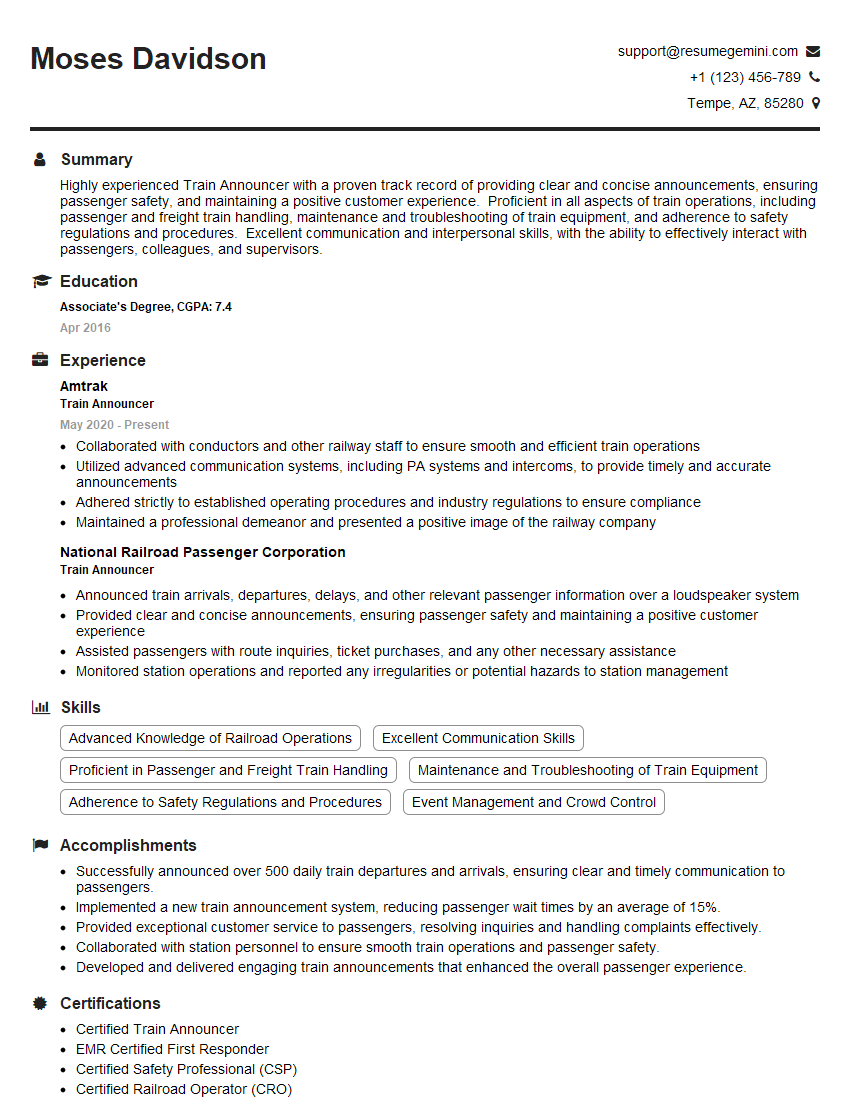
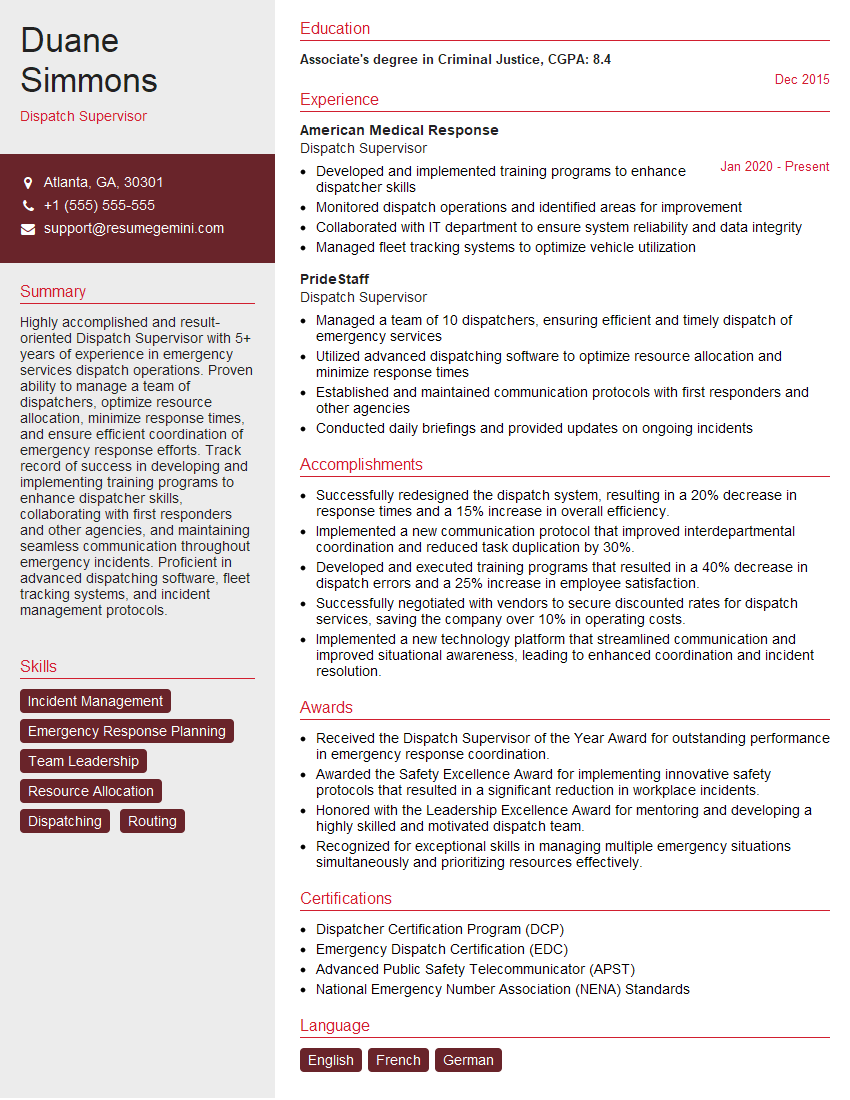
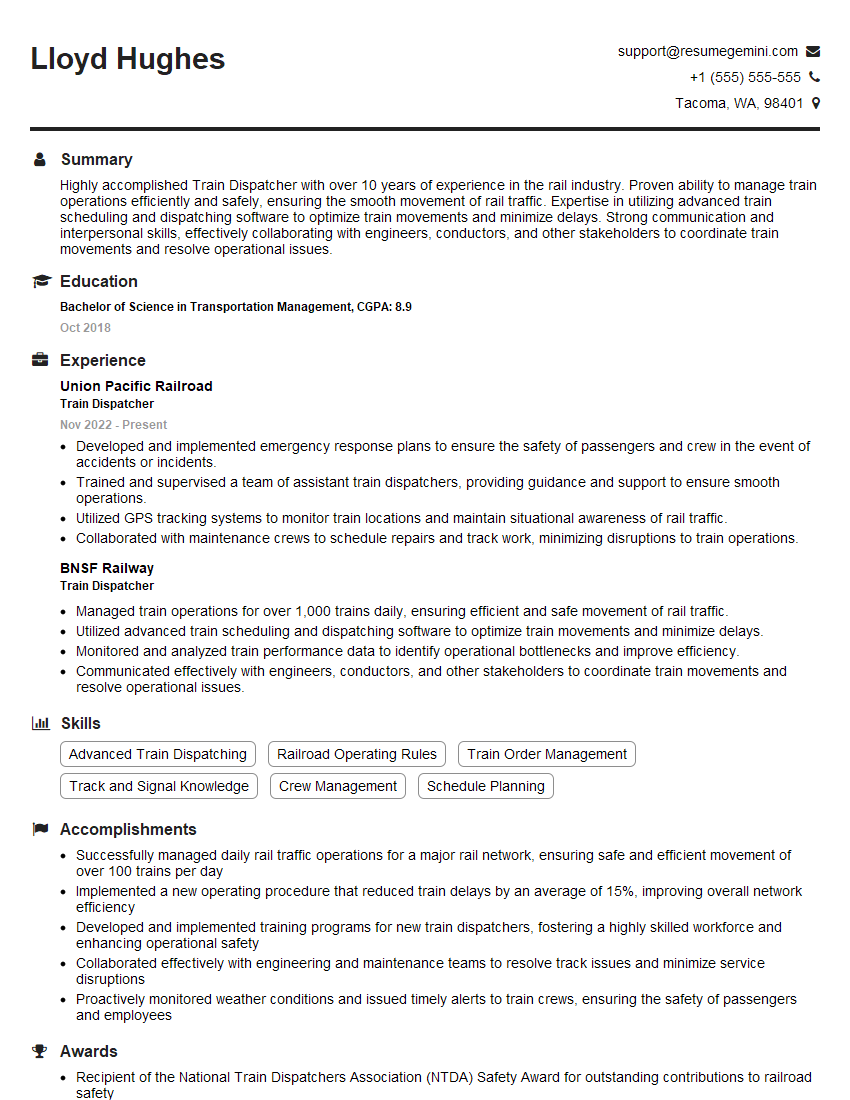
Mastering clear and precise articulation of train information is crucial for career advancement in the rail industry, demonstrating professionalism and ensuring passenger safety and satisfaction. A well-crafted resume is your first impression on potential employers. To maximize your job prospects, create an ATS-friendly resume that highlights your skills and experience effectively. ResumeGemini is a trusted resource to help you build a professional and impactful resume. We provide examples of resumes tailored to the specific requirements of Clear and Precise Articulation of Train Information roles to help you get started. Invest time in crafting a compelling resume – it’s your key to unlocking exciting opportunities.
Explore more articles
Users Rating of Our Blogs
Share Your Experience
We value your feedback! Please rate our content and share your thoughts (optional).
What Readers Say About Our Blog
Amazing blog
hello,
Our consultant firm based in the USA and our client are interested in your products.
Could you provide your company brochure and respond from your official email id (if different from the current in use), so i can send you the client’s requirement.
Payment before production.
I await your answer.
Regards,
MrSmith
hello,
Our consultant firm based in the USA and our client are interested in your products.
Could you provide your company brochure and respond from your official email id (if different from the current in use), so i can send you the client’s requirement.
Payment before production.
I await your answer.
Regards,
MrSmith
These apartments are so amazing, posting them online would break the algorithm.
https://bit.ly/Lovely2BedsApartmentHudsonYards
Reach out at BENSON@LONDONFOSTER.COM and let’s get started!
Take a look at this stunning 2-bedroom apartment perfectly situated NYC’s coveted Hudson Yards!
https://bit.ly/Lovely2BedsApartmentHudsonYards
Live Rent Free!
https://bit.ly/LiveRentFREE
Interesting Article, I liked the depth of knowledge you’ve shared.
Helpful, thanks for sharing.
Hi, I represent a social media marketing agency and liked your blog
Hi, I represent an SEO company that specialises in getting you AI citations and higher rankings on Google. I’d like to offer you a 100% free SEO audit for your website. Would you be interested?