Are you ready to stand out in your next interview? Understanding and preparing for Door Window Treatment Installation interview questions is a game-changer. In this blog, we’ve compiled key questions and expert advice to help you showcase your skills with confidence and precision. Let’s get started on your journey to acing the interview.
Questions Asked in Door Window Treatment Installation Interview
Q 1. What types of window treatments are you experienced installing?
My experience encompasses a wide range of window treatments. I’m proficient in installing various types of blinds, including Venetian blinds (both horizontal and vertical), roller blinds, cellular shades (honeycomb shades), Roman shades, and bamboo blinds. I also have extensive experience with curtains and draperies, working with a variety of fabrics and heading styles. Furthermore, I’m comfortable installing shutters, both interior and exterior, in various materials like wood and faux wood.
- Blinds: Venetian, Roller, Cellular, Bamboo
- Shades: Roman
- Curtains & Draperies: Various fabrics and heading styles
- Shutters: Wood, Faux Wood
Q 2. Describe your experience with measuring windows for treatments.
Accurate measurements are paramount for a perfect fit. I begin by carefully examining the window frame, noting any obstructions like molding or unusual angles. I then measure the width of the window at multiple points – top, middle, and bottom – to account for any irregularities. Height is measured similarly, from the top of the frame to the sill. I always record these measurements in writing, including the type of window (e.g., double-hung, casement) and any special features. For inside mount installations, I measure the inside dimensions of the window frame; for outside mount installations, I measure the outside dimensions, adding allowances for the desired overhang. I double-check all measurements to minimize errors. I always communicate with the client to clarify their preferences and expectations before the installation. For example, if the client wants the blinds to cover the entire window frame or just the window opening.
Q 3. How do you handle difficult window shapes or sizes?
Difficult window shapes and sizes require a customized approach. For arched windows, I often create custom-shaped blinds or shades, sometimes incorporating a combination of straight and curved components. For oddly shaped windows or very large windows, I might recommend a combination of treatments or carefully plan the installation to accommodate the unique features. I always consult with the client and offer various options, explaining the pros and cons of each approach before proceeding. For example, for a triangular window, I might use a custom-cut roller shade or a series of smaller shades strategically positioned.
Q 4. Explain your process for installing blinds.
My blind installation process is systematic and efficient. First, I carefully inspect the window and the blinds to ensure everything is intact and ready for installation. Then, I accurately measure the window frame (if inside mount) or the area above the window (if outside mount). Next, I install the brackets securely according to the manufacturer’s instructions. Once the brackets are in place, I carefully position the blind headrail into the brackets, ensuring it’s level and aligned. Finally, I adjust the tilt mechanism and check the operation to ensure smooth and easy functionality. I always clean up any debris and leave the area tidy.
- Inspect window and blinds
- Measure window/area
- Install brackets
- Position headrail
- Adjust tilt mechanism
- Clean up
Q 5. What are the different types of blind mechanisms you’re familiar with?
I’m experienced with various blind mechanisms, including cord-operated, cordless (lift systems), motorized, and even some older systems using wands or tapes. Cordless lifts offer child safety and ease of use, while motorized blinds offer convenience and automated control. Understanding the nuances of each mechanism is critical for proper installation and troubleshooting.
- Cord-operated: Traditional lift and tilt cords.
- Cordless: Lift systems using a wand or other mechanisms.
- Motorized: Electrically operated blinds.
- Wand/Tape Operated: Older styles needing specific installation knowledge.
Q 6. How do you install curtains and draperies?
Curtain and drapery installation varies depending on the chosen hanging method. For rod-pocket curtains, I simply slide the rod through the pocket at the top of the curtain panel. For grommet-top curtains, I insert the rod through the grommets. More complex installations involve using hooks and rings attached to the curtain heading and hanging them on a decorative rod or track system. This requires careful measuring and positioning to ensure proper drape and pleat formation. Installation may also involve installing curtain rods or tracks which involves understanding their construction and secure fixation to the wall or ceiling. I always ensure the curtains hang evenly and smoothly, making any necessary adjustments to achieve the desired look.
Q 7. What tools and equipment are essential for your work?
Essential tools for my work include a measuring tape (precise, accurate measurements are crucial!), a level (ensures straight and even installations), a drill with various drill bits (for installing brackets and rods), a screwdriver set (Phillips and flathead), scissors or shears (for cutting cords or fabrics as needed), a ladder (for reaching high windows), and a safety glasses. Depending on the task at hand, I might also use specialized tools such as a staple gun or a stud finder. Safety is a priority, and appropriate safety gear, such as safety glasses, is always used.
Q 8. How do you ensure the proper operation of installed window treatments?
Ensuring proper operation of installed window treatments involves a multi-step process focusing on both the mechanics and the aesthetics. It begins even before installation, with careful consideration of the chosen treatment and the window’s characteristics. For example, heavy drapes might require stronger hardware than lightweight blinds.
After installation, I meticulously test every function. This includes checking for smooth raising and lowering (for blinds and shades), easy opening and closing (for curtains and drapes), and the proper alignment of all components. I look for any binding or friction. If using cords or chains, I verify they operate freely and are the correct length for easy access and safe operation, ensuring they are out of reach of children. Finally, I demonstrate the operation to the client, answering any questions and providing clear instructions on care and maintenance. I even provide a quick reference sheet outlining the specific cleaning and operational instructions. I consider the job complete only when the client is completely satisfied with the functionality and appearance.
Q 9. Describe your troubleshooting skills when facing installation problems.
Troubleshooting is a critical part of my job. It starts with careful observation. I’ll examine the problem systematically, starting with the most obvious issues. For example, if a blind is jammed, I’ll first check for any obstructions – perhaps a child’s toy or a piece of fabric caught in the mechanism. If it’s a more complex problem, I’ll refer to the manufacturer’s installation and troubleshooting guide.
My approach is methodical. I’ll check the mounting hardware for looseness or damage. I’ll inspect the cords or chains for tangles or breakage. I’ll inspect the tracks and rails for alignment and debris. I might also consider the window itself – sometimes, a warped frame can interfere with proper operation. If the problem is beyond my immediate expertise, I won’t hesitate to contact the manufacturer for support or, if necessary, recommend a qualified specialist.
For instance, I once encountered a situation where a motorized blind wouldn’t respond to the remote. After checking the power supply and batteries, I discovered a loose wire connection inside the motor housing. A simple reconnection solved the problem. This highlights the importance of methodical troubleshooting and familiarity with the inner workings of different systems.
Q 10. How do you maintain safety standards during installation?
Safety is paramount. I always use appropriate safety equipment, including safety glasses, work gloves, and sturdy footwear. When working at heights, I use a stable ladder or scaffold and always ensure it’s properly positioned and secured. I’m meticulous about following all manufacturer’s safety guidelines for handling tools and materials. Before beginning any work, I’ll clear the area of any potential hazards and inform any occupants of the work being performed. This includes keeping pets and children away from the work area.
I use caution when handling sharp objects like scissors or knives, always cutting away from myself. When working with electrical components (like motorized blinds), I ensure the power is disconnected before making any repairs or adjustments. I am also aware of the potential for falling objects and take precautions to prevent accidents. I believe safety isn’t just about following rules; it’s a mindset that permeates every aspect of my work.
Q 11. Explain your experience with different types of mounting hardware.
My experience encompasses a wide variety of mounting hardware, including inside mount brackets (for installation inside the window frame), outside mount brackets (for installation on the wall or window casing), and specialty brackets for unique window configurations (such as arched or bay windows). I’m proficient with different materials, such as plastic, metal, and wood, and understand the strengths and weaknesses of each. For instance, I know that metal brackets are generally stronger and more durable than plastic ones, but can be more challenging to install if the window frame isn’t perfectly square. I can adjust my technique and choose the best hardware depending on the specific window treatment and window itself.
I also have experience with different mounting methods, including drilling, screwing, and adhesive mounting. I understand how to choose the appropriate method based on factors such as the window material, the weight of the window treatment, and the building’s structure. I always select the hardware that ensures a secure and stable installation, while minimizing damage to the window and surrounding surfaces.
Q 12. What are the common challenges faced during window treatment installation?
Common challenges include difficult window configurations (e.g., bay windows, skylights), improperly sized window treatments (leading to fitting issues), uneven or damaged window frames (making secure mounting difficult), and unexpected obstacles during installation (e.g., hidden electrical wiring). Sometimes, the client’s expectations might not align with the reality of the installation, requiring compromise and creative solutions.
For instance, installing blinds on a bay window requires precise measurement and careful attention to detail to ensure a smooth, even fit across multiple window panes. If the window frames are damaged or warped, it may require additional work to create a stable mounting surface and might even require the client to consider repairs before proceeding with the installation. I find that thorough communication with the client, clear expectations, and contingency planning are key to mitigating many of these challenges.
Q 13. How do you handle customer complaints or requests for adjustments?
Handling customer complaints or requests for adjustments starts with active listening. I make sure I fully understand the client’s concern and approach the issue with empathy and understanding. I take notes and avoid interrupting until they’ve fully explained their issue. I might ask clarifying questions like, “Can you show me what’s bothering you?” or “When did you first notice this issue?”
My goal is to find a mutually agreeable solution. If the problem is related to a faulty installation, I’ll take responsibility and rectify the situation promptly. If it’s something that is within the scope of my ability to fix, I will provide a timeline for the adjustment, keeping the client updated throughout the process. If the issue is beyond my scope, I’ll explain this honestly and transparently, offering potential solutions or referrals to relevant professionals.
I maintain a calm and professional demeanor, even in challenging situations. I view each complaint as an opportunity to improve my service and build stronger client relationships. Ultimately, resolving the issue to the client’s satisfaction is always my priority.
Q 14. What is your experience with installing motorized window treatments?
I have significant experience installing motorized window treatments, including smart blinds and shades controlled via apps or voice assistants. This includes both new installations and retrofits. The process involves careful planning, including wiring considerations, and understanding the specific requirements of each system. It is crucial to have a good understanding of both the mechanical and electrical aspects, as well as the programming and setup procedures associated with different brands and models.
I am familiar with various control systems, power sources, and troubleshooting techniques for motorized systems. For example, I’ve worked with systems that use battery power, wired connections, and even solar power. I understand the importance of correctly integrating the system with the home’s existing electrical setup, including understanding potential power limitations and ensuring proper safety measures are in place. I always test the functionality thoroughly after installation, demonstrating the operation and features to the client.
I’ve also had the opportunity to work with various smart home integration systems, making sure the motorized window treatments function seamlessly within the client’s overall smart home ecosystem.
Q 15. Explain your knowledge of various fabrics and materials used in window treatments.
Choosing the right fabric is crucial for both the aesthetic and functional aspects of window treatments. My knowledge encompasses a wide range of materials, each with its own unique properties.
- Natural Fibers: Think cotton, linen, and silk. These offer a luxurious feel and breathability, but can be more prone to wrinkles and fading. Cotton, for instance, is a popular choice for its durability and easy care, while linen provides a more relaxed, sophisticated look. Silk, though elegant, requires more delicate handling.
- Synthetic Fibers: Polyester, nylon, and acrylic are common choices. They’re often more durable, wrinkle-resistant, and fade-resistant than natural fibers, making them ideal for high-traffic areas or rooms with harsh sunlight. Polyester blends are frequently used in Roman shades for their strength and ability to hold their shape.
- Blends: Many fabrics are blends combining natural and synthetic fibers to leverage the advantages of each. A cotton-polyester blend, for example, offers the softness of cotton with the durability and wrinkle resistance of polyester.
- Specialty Fabrics: These include blackout fabrics (excellent for light control and privacy), solar shades (that filter light while maintaining visibility), and moisture-resistant options (perfect for bathrooms or kitchens).
I always discuss fabric options with clients, considering their style preferences, budget, and the specific needs of the room—like light control or privacy—to recommend the most suitable material.
Career Expert Tips:
- Ace those interviews! Prepare effectively by reviewing the Top 50 Most Common Interview Questions on ResumeGemini.
- Navigate your job search with confidence! Explore a wide range of Career Tips on ResumeGemini. Learn about common challenges and recommendations to overcome them.
- Craft the perfect resume! Master the Art of Resume Writing with ResumeGemini’s guide. Showcase your unique qualifications and achievements effectively.
- Don’t miss out on holiday savings! Build your dream resume with ResumeGemini’s ATS optimized templates.
Q 16. Describe your experience with different styles of window treatments (e.g., Roman shades, cellular shades).
My experience spans a variety of window treatment styles, each requiring a different approach to installation and offering unique benefits.
- Roman Shades: I’m proficient in installing both traditional and cordless Roman shades. The key is ensuring the fabric folds neatly and evenly, and that the mechanism functions smoothly. I’ve worked with various lining options to enhance light control and durability.
- Cellular Shades (Honeycomb Shades): These are energy-efficient due to their honeycomb structure. The installation process involves precise measurements and careful alignment of the cells to ensure proper insulation and operation. I have experience installing top-down/bottom-up cellular shades, which provide greater flexibility in light and privacy control.
- Roller Shades: These are a simple yet effective solution. The focus here is on smooth operation of the roller mechanism and ensuring the fabric is taut and wrinkle-free. I’ve installed a variety of fabrics, from sheer to blackout, depending on client preferences.
- Draperies and Curtains: These require attention to detail in hanging, ensuring proper pleating, and achieving a symmetrical look. I’ve worked with various hanging hardware, including rods, tracks, and rings, catering to different styles and preferences.
I’ve tackled challenging installations, including bay windows and uniquely shaped windows, adapting my techniques to each situation. Client satisfaction is paramount, and I always strive for a perfect fit and flawless operation.
Q 17. How do you ensure the window treatments are properly aligned and level?
Precise alignment and leveling are essential for a professional finish. My approach involves a combination of tools and techniques:
- Accurate Measurements: I always begin with meticulous measurements of the window frame and opening, ensuring accuracy down to the millimeter.
- Leveling Tools: I use a high-quality level to ensure the window treatment is perfectly horizontal and vertical. This is especially crucial for treatments that extend across multiple windows.
- Mounting Hardware: I select the appropriate mounting hardware for the wall type and window treatment. Shims can be used to compensate for minor irregularities in the wall surface, ensuring a straight and level installation.
- Trial Fitting: Before permanently securing the treatment, I often do a trial fit to check the alignment and make any necessary adjustments.
- Multiple Points of Reference: I might use multiple points of reference during installation to verify alignment, such as using plumb bobs or laser levels for larger or more complex installations.
By following these steps, I consistently achieve a perfectly aligned and level installation, leaving clients impressed with the professional results.
Q 18. What safety precautions do you take when working at heights?
Safety is my top priority, especially when working at heights. I adhere to strict safety protocols:
- Proper Equipment: I always use appropriate safety equipment, including a sturdy ladder in good condition, and a safety harness when necessary for higher installations.
- Stable Base: I ensure a stable base for my ladder, avoiding uneven surfaces or slippery conditions. I also have a spotter when working on taller ladders.
- Assess the Situation: Before beginning any work, I thoroughly assess the situation, considering potential hazards, such as power lines or fragile surfaces. I might need to call for additional assistance if the job requires specialist equipment or expertise.
- Fall Protection: For particularly high installations, I employ fall protection systems like safety harnesses and anchor points, adhering to all relevant safety regulations.
- Regular Inspections: I regularly inspect my equipment to ensure it’s in good working order and safe to use.
My commitment to safety ensures both my well-being and the safety of those around me during the installation process.
Q 19. How do you manage your time effectively during multiple installations?
Efficient time management is critical when handling multiple installations. My approach is structured:
- Detailed Scheduling: I create a detailed schedule for each day, prioritizing installations based on factors like location, complexity, and client availability.
- Organized Tools and Materials: I meticulously organize my tools and materials beforehand, ensuring I have everything I need for each installation to minimize wasted time searching for items.
- Clear Communication: I maintain clear communication with clients to confirm appointments, address any queries, and provide updates on my progress.
- Efficient Workflow: I’ve developed an efficient workflow that streamlines the installation process, allowing me to complete tasks quickly and accurately without sacrificing quality.
- Prioritization and Contingency Planning: I prioritize tasks and build in contingency time to account for unforeseen delays or complications.
By staying organized and focused, I consistently meet deadlines and deliver high-quality installations across multiple jobs.
Q 20. Describe your experience working with different types of walls (drywall, brick, etc.)
My experience encompasses a variety of wall types, each requiring a different installation approach:
- Drywall: This is the most common wall type. I use appropriate anchors and screws to ensure secure mounting, and always pre-drill pilot holes to prevent damage to the drywall.
- Brick: Brick walls require specialized anchors and tools. I use masonry bits and appropriate fasteners designed for brick to ensure a strong and secure installation.
- Stucco: Similar to brick, stucco requires specialized anchors and often involves pre-drilling pilot holes to avoid cracking the stucco.
- Concrete: Concrete walls require heavy-duty anchors and specialized drilling equipment. I ensure the anchors are rated for the weight of the window treatment and provide ample support.
Regardless of the wall type, I always choose the appropriate fasteners and techniques to guarantee a secure and aesthetically pleasing installation. I understand the limitations of different wall types and adjust my approach accordingly.
Q 21. What is your experience with using power tools?
I am highly proficient in using various power tools relevant to window treatment installation. My expertise includes:
- Drills: I’m skilled in using both corded and cordless drills, selecting the appropriate drill bit for the material being worked with (wood, drywall, brick, etc.).
- Impact Drivers: These are essential for driving screws into denser materials like brick or concrete. I use them carefully and precisely to avoid damage.
- Measuring Tools (Laser Measures): Precision is key and I rely on laser measures to accurately measure and ensure precise alignment and cuts.
- Safety Practices: Safety is paramount. I always wear appropriate safety glasses and hearing protection when operating power tools. I also ensure the tools are in good working condition and are used as per manufacturer’s instructions.
My expertise with power tools ensures efficient and accurate installations, leading to professional-quality results and minimizing the risk of accidents.
Q 22. How do you prepare a worksite before starting an installation?
Preparing a worksite for door and window treatment installation is crucial for a smooth and efficient process. It’s like preparing a canvas before painting a masterpiece – you wouldn’t start without setting up your workspace, would you?
- Safety First: I always begin by assessing the area for any potential hazards – loose wires, unstable furniture, or anything that could cause an accident. I then clear the area around the doors and windows, ensuring a safe working radius. This often involves moving furniture and protecting floors with drop cloths.
- Protective Measures: Protecting the surrounding surfaces is key. I use painter’s tape to mask delicate areas and plastic sheeting or drop cloths to protect floors and walls from scratches or debris. This prevents costly damage and ensures a professional finish.
- Access & Tools: I ensure easy access to the installation area and lay out all necessary tools beforehand. This includes measuring tapes, drills, screwdrivers, levels, and specific tools required for the particular window treatment – be it blinds, shades, curtains, or drapes.
- Power & Lighting: I check for reliable power sources and appropriate lighting to ensure I can work comfortably and accurately. Adequate lighting is particularly important for precise measurements and installations.
Failing to properly prepare the worksite can lead to delays, accidents, and subpar results. A well-prepared workspace allows for focused work and a professional outcome.
Q 23. What is your process for cleaning up after a job is completed?
Cleaning up after a job is as important as the installation itself. It’s the final touch that leaves a lasting positive impression. I believe a clean workspace reflects professionalism and respect for the client’s home.
- Waste Disposal: All packaging materials, scraps, and debris are carefully collected and disposed of appropriately, often being recycled whenever possible. I always try to minimize waste from the beginning by accurately measuring and cutting materials.
- Surface Cleaning: I thoroughly clean up any dust or debris that might have accumulated during the installation. This may involve vacuuming or wiping down surfaces. For particularly delicate surfaces, I use appropriate cleaning solutions to prevent damage.
- Tool Organization: Tools are carefully cleaned, inspected for damage, and stored back in their designated places. This ensures their longevity and preparedness for future projects.
- Final Inspection: I conduct a final inspection of the installation area, ensuring that all tools and materials are removed and the area is left spotless. This shows the client that attention to detail extends beyond the installation itself.
A clean and organized post-installation site showcases my commitment to quality and professionalism, leaving clients with a positive final impression.
Q 24. How do you maintain accurate records of your work?
Maintaining accurate records is vital for efficient operations, client communication, and legal compliance. I use a combination of digital and physical records.
- Digital Records: I utilize project management software to track jobs, including client details, dates, materials used, installation notes, and photos of completed projects. This provides a centralized and easily accessible database.
- Physical Records: I keep physical copies of invoices, contracts, and warranty information. This serves as a backup and provides a tangible record for important documents.
- Photo Documentation: I take detailed ‘before’ and ‘after’ photos of every project, which are stored both digitally and often included in a printed project summary for the client. This serves as visual documentation of the work completed and addresses any potential future disputes.
This comprehensive approach ensures all aspects of each project are accurately documented, simplifying project management and facilitating efficient communication with clients.
Q 25. Describe a time you had to solve a complex installation problem.
One time, I was installing custom-made Roman shades in a home with unusually shaped windows – they were trapezoidal, not rectangular! This posed a significant challenge, as standard installation methods wouldn’t work.
My initial approach was to carefully measure each trapezoidal section and create a template. I then adapted the installation brackets to conform to the unique shape of the windows, ensuring a snug and secure fit. This involved precise cutting and adjustments using specialized tools.
After carefully adjusting the brackets and securing the shades, I used extra-strong adhesive to maintain the integrity of the unusual shape. The client was exceptionally pleased with the final result, and I gained valuable experience in adapting to unique installation challenges.
This experience taught me the importance of adaptability and problem-solving. I learned how crucial it is to think outside the box and develop creative solutions when faced with unconventional situations. It was a testament to my ability to handle complex installations efficiently and creatively.
Q 26. How do you prioritize tasks when faced with multiple deadlines?
Prioritizing tasks with multiple deadlines requires a structured approach. I use a combination of techniques to manage my workload effectively.
- Prioritization Matrix: I use a prioritization matrix (like an Eisenhower Matrix) to categorize tasks based on urgency and importance. Urgent and important tasks take precedence, while less urgent tasks are scheduled accordingly.
- Time Blocking: I allocate specific time blocks for particular tasks, ensuring focused work and preventing multitasking, which can be less efficient. This helps to maintain momentum and keep projects on track.
- Communication: Open communication with clients is crucial. If deadlines are at risk, I proactively discuss potential adjustments with them, ensuring transparency and collaborative problem-solving.
By employing these strategies, I consistently meet deadlines while delivering high-quality work. It’s a balancing act, but effective prioritization ensures smooth workflow and client satisfaction.
Q 27. What are your salary expectations for this role?
My salary expectations are in line with the industry standard for experienced door and window treatment installers with my skillset and years of experience. I’m open to discussing a competitive compensation package that reflects my qualifications and the value I bring to your team. I am more interested in a package that offers room for growth and professional development.
Q 28. Do you have any questions for me?
Yes, I have a few questions. First, what are the company’s training and professional development opportunities for installers? Secondly, what is the typical workflow and project management system used within the team? Finally, can you describe the company culture and team dynamics?
Key Topics to Learn for Door Window Treatment Installation Interview
- Measuring and Calculating: Understanding how to accurately measure window and door dimensions for proper treatment selection and installation. This includes accounting for different window styles and considering factors like headroom and side clearance.
- Installation Techniques: Mastering various installation methods for different window treatments, such as blinds, shades, curtains, and drapes. This involves practical knowledge of hardware, tools, and safe working practices.
- Product Knowledge: Demonstrating familiarity with different types of window treatments, their materials, functionalities (e.g., light filtering, privacy), and maintenance requirements. Be prepared to discuss the pros and cons of various options.
- Troubleshooting and Problem Solving: Knowing how to identify and resolve common installation challenges, such as uneven hanging, operational difficulties, or damaged materials. This shows your ability to think critically and find practical solutions.
- Safety Procedures: Understanding and adhering to safety regulations and best practices during installation, including ladder safety, proper tool usage, and handling of potentially hazardous materials.
- Customer Service: Demonstrating an understanding of the importance of providing excellent customer service, including clear communication, professionalism, and addressing customer concerns effectively.
- Code Compliance: Familiarity with building codes and regulations relevant to window treatment installation, ensuring installations meet safety and quality standards.
Next Steps
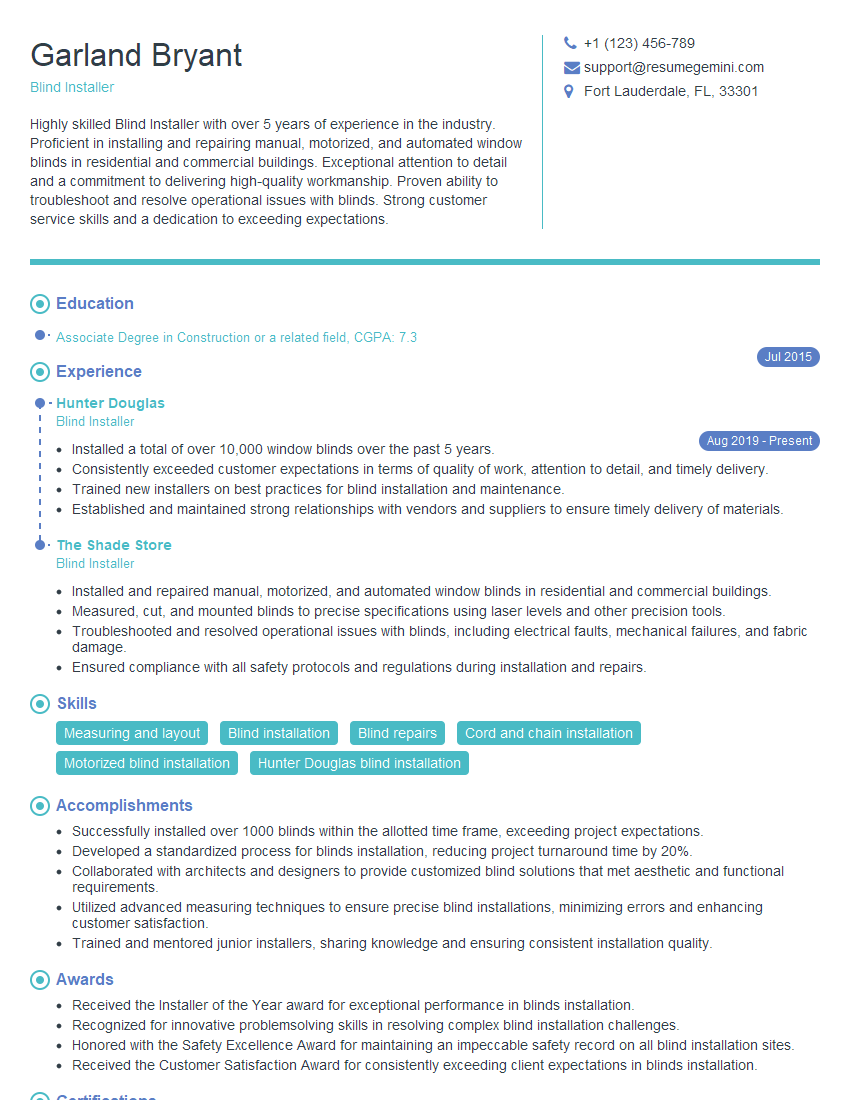
Mastering Door Window Treatment Installation opens doors to exciting career opportunities in a growing industry, offering potential for advancement and specialization. To stand out, create a compelling, ATS-friendly resume that highlights your skills and experience. ResumeGemini is a trusted resource that can help you build a professional resume that gets noticed by recruiters. We provide examples of resumes tailored to Door Window Treatment Installation to guide you through the process. Invest time in crafting a strong resume – it’s your first impression and a key to unlocking your career potential.
Explore more articles
Users Rating of Our Blogs
Share Your Experience
We value your feedback! Please rate our content and share your thoughts (optional).
What Readers Say About Our Blog
Amazing blog
hello,
Our consultant firm based in the USA and our client are interested in your products.
Could you provide your company brochure and respond from your official email id (if different from the current in use), so i can send you the client’s requirement.
Payment before production.
I await your answer.
Regards,
MrSmith
hello,
Our consultant firm based in the USA and our client are interested in your products.
Could you provide your company brochure and respond from your official email id (if different from the current in use), so i can send you the client’s requirement.
Payment before production.
I await your answer.
Regards,
MrSmith
These apartments are so amazing, posting them online would break the algorithm.
https://bit.ly/Lovely2BedsApartmentHudsonYards
Reach out at BENSON@LONDONFOSTER.COM and let’s get started!
Take a look at this stunning 2-bedroom apartment perfectly situated NYC’s coveted Hudson Yards!
https://bit.ly/Lovely2BedsApartmentHudsonYards
Live Rent Free!
https://bit.ly/LiveRentFREE
Interesting Article, I liked the depth of knowledge you’ve shared.
Helpful, thanks for sharing.
Hi, I represent a social media marketing agency and liked your blog
Hi, I represent an SEO company that specialises in getting you AI citations and higher rankings on Google. I’d like to offer you a 100% free SEO audit for your website. Would you be interested?