The thought of an interview can be nerve-wracking, but the right preparation can make all the difference. Explore this comprehensive guide to Electrical System Inspection and Testing interview questions and gain the confidence you need to showcase your abilities and secure the role.
Questions Asked in Electrical System Inspection and Testing Interview
Q 1. Explain the difference between insulation resistance testing and continuity testing.
Insulation resistance testing and continuity testing are both crucial parts of electrical system inspections, but they measure different aspects of electrical safety. Insulation resistance testing measures the resistance of the insulation material separating conductive parts of an electrical system. A high resistance indicates good insulation, while a low resistance suggests a fault and potential shock hazard. Think of it like testing the strength of a wall – a strong wall (high resistance) won’t let anything through, while a weak wall (low resistance) might allow leakage.
Continuity testing, on the other hand, checks for the presence of a continuous, unbroken path for current to flow. It essentially verifies that a circuit is complete. We’re looking for zero resistance or very low resistance. A good analogy here would be checking if a pipe is blocked – if water flows easily (low resistance), the pipe is clear (continuity exists). If the water doesn’t flow (high resistance), the pipe is blocked (no continuity).
In practice, we use a megohmmeter for insulation resistance testing and a multimeter for continuity testing. A low insulation resistance reading might indicate deterioration of the insulation, moisture ingress, or damage, requiring immediate attention. A lack of continuity could signal a broken wire or a faulty connection in the circuit.
Q 2. Describe the process of performing a ground resistance test.
Ground resistance testing assesses the earth’s ability to dissipate electrical current safely. A low ground resistance value is essential for protecting personnel and equipment from electrical shocks and damage. The testing process involves using a specialized instrument called a ground resistance tester or earth tester, which injects a known current into the ground through a test probe and measures the resulting voltage drop. This measurement, along with the known current, is then used to calculate the ground resistance using Ohm’s Law (Resistance = Voltage / Current).
The process typically involves:
- Connecting the ground resistance tester to the grounding electrode under test.
- Driving auxiliary ground stakes (called potential stakes) into the ground at a specified distance from the ground electrode.
- Using the tester to inject current and measure the voltage drop.
- Calculating the ground resistance based on the measured values.
It’s crucial to ensure proper stake placement to avoid inaccurate readings and to always follow the manufacturer’s instructions for the specific equipment being used. High ground resistance poses a serious safety risk as it indicates an increased potential for dangerous voltage build-up.
Q 3. What are the common causes of electrical arcing?
Electrical arcing occurs when a current jumps across an air gap or insulator between two conductors at different electrical potentials. Think of it like a miniature lightning strike. Several factors contribute to this phenomenon:
- High Voltage: The greater the potential difference, the greater the likelihood of arcing.
- Small Air Gaps: Smaller gaps are easier to bridge with an arc.
- Contamination: Dust, moisture, or other contaminants on insulators can reduce their dielectric strength, facilitating arcing.
- Loose Connections: Poorly connected terminals or components increase resistance, generating heat and potentially leading to arcing.
- Overload: Excessive current flow can generate enough heat to cause insulation breakdown and arcing.
- Age and Degradation: Older, worn-out insulation is more susceptible to arcing.
Arcing is dangerous as it can damage equipment, cause fires, and pose a serious shock hazard. Regular inspections, proper maintenance, and using appropriate protective equipment are crucial to mitigate these risks.
Q 4. How do you interpret the results of a thermal imaging inspection?
Thermal imaging inspections use infrared cameras to detect temperature differences. Hot spots in electrical systems, indicating potential problems, appear as bright colors (red, orange) on the thermal image, while cooler areas show up as darker colors (blue, purple). Interpreting the results involves analyzing the temperature readings in relation to the expected operating temperature of the equipment.
For example, a noticeably hotter connector or terminal might indicate a loose connection or high resistance, leading to excessive heat generation. Overheated wires could indicate an overload or impending failure. By comparing the thermal image to the electrical schematics and other test data, we can pinpoint the exact location and potential cause of the problem. It’s essential to understand that merely a higher temperature reading doesn’t automatically indicate a fault. You need context – the acceptable temperature range for the specific component and the surrounding environment.
Q 5. What safety precautions must be followed when conducting high-voltage testing?
High-voltage testing is inherently dangerous and necessitates strict safety protocols. Failure to comply can lead to severe injury or death.
- Lockout/Tagout Procedures: Complete and verified isolation of the circuit under test is paramount. Lockout/Tagout ensures no unexpected energization occurs.
- Personal Protective Equipment (PPE): Appropriate PPE, including insulated gloves, eye protection, and safety footwear, is mandatory.
- Trained Personnel: Only qualified and experienced technicians with proper training should perform high-voltage testing.
- Grounding: Thorough grounding of the test equipment and the system under test minimizes the risk of electric shock.
- Safety Barriers: Establishing a safe working distance and using barriers to prevent unauthorized access to the test area is crucial.
- Emergency Procedures: Having a clear plan for emergency response, including first aid and access to emergency services, is essential.
Always refer to the manufacturer’s instructions for the specific equipment being used and follow established safety regulations. Remember, safety is never a compromise when dealing with high-voltage electricity.
Q 6. Explain the purpose of a breaker panel inspection.
A breaker panel inspection aims to assess the overall health and safety of the electrical distribution system within a building or facility. The inspection’s purpose is to identify potential hazards and ensure the panel operates correctly, protecting the building and occupants from electrical faults.
Inspections involve checking for various factors, including:
- Tightness of Connections: Loose connections can lead to overheating and fire hazards.
- Signs of Overheating: Discoloration, burning marks, or unusual heat indicate potential problems.
- Proper Wiring: Correct wire sizing, insulation, and routing are critical for safety.
- Breaker Functionality: Each breaker should trip properly at its rated amperage.
- Grounding: Effective grounding is crucial for safety and protection against electrical shocks.
- Panel Organization and Labeling: Clear labeling ensures easy identification of circuits and components.
Regular breaker panel inspections are crucial for preventative maintenance, ensuring the electrical system remains safe, efficient, and compliant with applicable codes.
Q 7. Describe the different types of electrical test equipment you are familiar with.
As an electrical system inspection and testing expert, I am proficient in using a wide range of test equipment. Here are some examples:
- Multimeters: Essential for measuring voltage, current, resistance, and continuity.
- Megohmmeters (Insulation Testers): Measure the insulation resistance of cables and other electrical components.
- Ground Resistance Testers (Earth Testers): Measure the resistance of grounding electrodes.
- Clamp Meters: Measure current without breaking the circuit.
- Thermal Imagers: Detect temperature variations indicating potential problems.
- High-Voltage Testers: Used for testing high-voltage insulation and dielectric strength (requires specialized training and safety precautions).
- Loop Impedance Testers: Measure the impedance of the protective earthing conductor in a circuit.
The choice of equipment depends on the specific test being performed and the nature of the electrical system under inspection. Proficiency in using these tools and interpreting the results accurately is crucial for ensuring electrical safety.
Q 8. How do you identify and address potential electrical hazards in a building?
Identifying and addressing electrical hazards requires a systematic approach combining visual inspection, testing, and a thorough understanding of electrical codes. Think of it like a detective investigating a crime scene – you need to carefully examine every clue.
Visual Inspection: This is the first step. Look for frayed wires, damaged insulation, overloaded circuits (too many appliances on one outlet), exposed wiring, and improperly installed equipment. Imagine a frayed wire – it’s like a broken blood vessel; a spark could easily ignite a fire.
Testing: After the visual inspection, we use specialized instruments like multimeters to check voltage levels, insulation resistance, and ground continuity. This helps us identify hidden problems, like a faulty ground connection that may not be immediately visible.
Code Compliance: We verify adherence to relevant electrical codes (like the National Electrical Code, or NEC, in the US) which sets safety standards. These codes are our rulebook, ensuring installations are safe and compliant.
Addressing Hazards: Once hazards are identified, they need immediate correction. This may involve replacing damaged wiring, repairing faulty equipment, or upgrading the electrical system to meet current safety standards. Remember, even seemingly minor issues can escalate into serious problems.
For example, during an inspection, I once found a loose wire connection in a junction box that was sparking intermittently. This was a significant fire hazard, and immediate corrective action was necessary. We replaced the connection, ensuring a secure and safe installation.
Q 9. What are the relevant electrical codes and standards you adhere to?
Adherence to electrical codes and standards is paramount for ensuring safety and compliance. These are the guidelines we follow to protect lives and property. Different regions may use different codes, but the principles remain the same.
National Electrical Code (NEC): In the United States, the NEC is the primary standard. It’s regularly updated to reflect advances in technology and safety best practices.
International Electrotechnical Commission (IEC): Internationally, the IEC provides standards for electrical installations. These provide a framework of international best practices.
Local Codes and Regulations: Beyond national standards, local jurisdictions often have additional regulations that must also be met. Think of these as local additions to the main rulebook.
My work always incorporates these codes; it’s not just about following the rules – it’s about understanding the *why* behind the rules. For instance, the NEC’s requirements for grounding are crucial for protecting against electric shock and preventing fires. I always keep up-to-date with code changes through continuing education to ensure my work remains compliant and safe.
Q 10. Explain the importance of proper grounding and bonding in electrical systems.
Proper grounding and bonding are fundamental to electrical system safety. Imagine a lightning rod – it’s a form of grounding, safely diverting dangerous electrical energy. Grounding and bonding act as safety nets, preventing dangerous voltages from reaching people or causing equipment damage.
Grounding: This connects non-current-carrying metal parts of an electrical system to the earth. If a fault occurs, the ground provides a low-resistance path for fault current to flow to the earth, protecting people from electric shock. Think of it as creating a safe escape route for electricity.
Bonding: This connects metal parts of an electrical system to each other to ensure they are at the same electrical potential. This prevents voltage differences that could cause shock or equipment damage. This is like connecting different parts of a network together to share the same electrical potential.
Poor grounding can lead to dangerous voltage levels on equipment casings, increasing the risk of shock. Improper bonding can create a shock hazard or damage connected devices. I always thoroughly check grounding and bonding during inspections and testing, using a multimeter to measure resistance. A low resistance reading indicates a good ground connection.
Q 11. How do you perform a visual inspection of electrical equipment?
A visual inspection is the initial and crucial step in any electrical system evaluation. It’s like a doctor performing a preliminary examination; you look for any obvious issues.
Overall Condition: I assess the physical condition of all equipment, looking for signs of damage, corrosion, overheating, or loose connections.
Wiring: I examine the wiring for signs of damage, fraying, insulation degradation, improper routing, and overloading. I’ll pay close attention to wire supports and look for any issues.
Panels and Boxes: I check electrical panels for proper labeling, adequate space, and secure wiring connections. I inspect junction boxes for adequate space, proper grounding, and secure wiring.
Connections: I examine all connections for tightness, corrosion, and signs of arcing or burning.
Equipment: I inspect all electrical equipment for damage, proper labeling, and appropriate installation.
I document all findings with photographs and detailed notes to maintain a complete record of the inspection. For example, noticing discoloration around an outlet might suggest overheating and a potential fire hazard. This would lead to further investigation.
Q 12. What are the signs of deteriorated electrical insulation?
Deteriorated electrical insulation is a serious safety hazard, increasing the risk of electric shock and fire. Think of insulation as the protective skin on a wire; when it deteriorates, the wire becomes exposed and dangerous.
Cracking and Brittle Insulation: This is a clear sign of age and degradation. The insulation loses its flexibility and can easily break, exposing the conductor.
Discoloration or Burning Marks: Darkening or burning marks on insulation indicate overheating, which can be a result of overloading, loose connections, or short circuits.
Holes or Cuts in Insulation: Any physical damage to the insulation compromises its protective function and exposes the conductor, increasing the risk of shock.
Sticky or Soft Insulation: This might indicate chemical degradation of the insulation material, compromising its ability to withstand voltage and resist arcing.
I regularly use visual inspection to find such signs. When I find such degradation, I will generally recommend replacement of the affected cable or equipment, as it’s unsafe to continue operation.
Q 13. Describe the process of testing a motor’s insulation resistance.
Testing a motor’s insulation resistance is crucial for ensuring its safety and preventing failures. This tests the integrity of the insulating material protecting the motor windings.
Disconnect the Motor: The first step is to ensure the motor is completely disconnected from the power supply to avoid electric shock.
Use a Megohmmeter: This is also called an insulation resistance tester. It applies a high DC voltage to the motor windings and measures the resistance between the windings and the motor’s frame (ground).
Measure Insulation Resistance: The megohmmeter displays the result in megaohms (MΩ). A high resistance value indicates good insulation, while a low value indicates insulation degradation and potential problems.
Document Results: All measurements are carefully recorded for documentation and comparison against the manufacturer’s specifications or industry standards.
A low insulation resistance value suggests that the motor’s insulation is compromised and requires immediate attention. This might necessitate motor repair or replacement. It’s critical for safety and avoiding costly motor failures.
Q 14. How do you interpret the results of a load test?
A load test assesses the performance of an electrical system under a specific load condition. It’s like putting a car through a stress test – to see how it performs under duress.
Voltage Drop: A significant voltage drop indicates high resistance in the circuit, which can be due to insufficient wire size, loose connections, or faulty equipment. A significant voltage drop can also indicate a problem further down the line.
Overheating: Excessive heating of wires or components can reveal overloading, indicating the circuit is carrying more current than it is designed for.
Circuit Breaker Tripping: Frequent tripping of the circuit breaker may indicate excessive current draw or a short circuit.
Current Measurement: This verifies whether the load is within the circuit’s capacity. A current value significantly higher than the circuit rating shows potential hazards and needs addressing.
For instance, if a load test reveals a significant voltage drop, it might necessitate an upgrade of the wiring to a larger gauge to handle the increased current. By carefully analyzing load test results, we can identify potential problems before they lead to dangerous situations.
Q 15. What are the common causes of electrical fires?
Electrical fires are devastating and often stem from a combination of factors. The most common causes can be categorized as follows:
- Overheating: This is the leading cause. Wires carrying too much current (overloaded circuits), faulty connections generating heat, or malfunctioning appliances can all overheat and ignite nearby flammable materials. Imagine a wire like a straw – if you try to force too much water (electricity) through it, it’ll overheat and potentially burst into flames.
- Short Circuits: These occur when live wires accidentally come into contact, creating a pathway of very low resistance for current to flow. The resulting surge of current generates intense heat, quickly leading to a fire. Think of a short circuit like a dam bursting – a sudden, uncontrolled release of energy.
- Faulty Wiring: Damaged insulation, loose connections, or improperly installed wiring create significant hazards. Old, brittle wiring, for instance, can easily crack and cause a short circuit or overheating.
- Overloaded Outlets: Plugging too many devices into a single outlet can overload the circuit, causing it to overheat and potentially start a fire. It’s like trying to fit too many things into a small suitcase – eventually, something will break.
- Appliance Malfunctions: Defective appliances, especially those with heating elements (like ovens or space heaters), can malfunction and cause fires. Always ensure your appliances are in good working order.
Regular inspections and preventative maintenance are crucial to mitigate these risks. Replacing old wiring, ensuring proper grounding, and using surge protectors are some essential preventative measures.
Career Expert Tips:
- Ace those interviews! Prepare effectively by reviewing the Top 50 Most Common Interview Questions on ResumeGemini.
- Navigate your job search with confidence! Explore a wide range of Career Tips on ResumeGemini. Learn about common challenges and recommendations to overcome them.
- Craft the perfect resume! Master the Art of Resume Writing with ResumeGemini’s guide. Showcase your unique qualifications and achievements effectively.
- Don’t miss out on holiday savings! Build your dream resume with ResumeGemini’s ATS optimized templates.
Q 16. Explain the function of a circuit breaker and how to test it.
A circuit breaker is a safety device designed to protect an electrical circuit from damage caused by overcurrent or short circuits. It acts as a switch that automatically interrupts the flow of electricity when the current exceeds a predetermined limit.
Think of it as a fuse with a reset button. Unlike fuses which melt and need replacing, circuit breakers can be reset after tripping, restoring power once the fault is resolved.
Testing a circuit breaker involves visually inspecting it for any signs of damage (burns, loose connections), then intentionally overloading the circuit to see if it trips. Never attempt to test a circuit breaker without proper safety precautions and knowledge. This should ideally be performed by a qualified electrician. The typical test involves connecting a known load (like a high-wattage appliance) to the circuit to push it beyond its rated capacity; the breaker should trip safely. If it doesn’t trip, it needs replacement as it’s no longer functioning correctly.
Q 17. How do you troubleshoot common electrical problems?
Troubleshooting electrical problems requires a systematic approach. Safety is paramount: always de-energize the circuit before working on it. Here’s a typical process:
- Identify the problem: What’s not working? Is it a single outlet, a whole room, or the entire house?
- Visual inspection: Check for obvious problems like loose wires, damaged outlets, or tripped breakers.
- Test the circuit: Use a voltage tester to verify the presence or absence of voltage at various points in the circuit. This will help pinpoint the location of the fault.
- Check for continuity: A continuity tester can help determine if there’s a break in the wiring.
- Trace the wiring: If necessary, follow the wiring to identify the source of the problem. This may require opening walls or ceilings.
- Isolate the faulty component: Once the problem is identified, isolate the faulty component (e.g., a bad outlet, a damaged wire) before attempting repairs.
- Repair or replace: Repair or replace the faulty component, ensuring proper connections and safety measures.
- Test the repair: After repairs, test the circuit again to ensure the problem is resolved.
For complex problems, it’s best to consult a qualified electrician.
Q 18. What are the different types of electrical wiring and their applications?
Electrical wiring comes in various types, each suited to different applications:
- Copper Wiring: The most common type, known for its excellent conductivity and durability. Used extensively in residential and commercial buildings.
- Aluminum Wiring: Lighter than copper but less conductive and prone to oxidation. It was used more commonly in the past but is less favored now due to safety concerns.
- BX Cable (Armored Cable): A flexible cable with a metallic sheath for protection. Often used in areas where physical damage is a concern.
- NM Cable (Romex): A non-metallic sheathed cable commonly used in residential construction. It’s relatively easy to install but requires careful handling to avoid damage to the insulation.
- MC Cable (Metal-Clad Cable): Similar to BX but with a smoother, more flexible outer covering. It’s used in various applications, including commercial and industrial settings.
- UF Cable (Underground Feeder): Specifically designed for direct burial in the ground. It has a more robust insulation to withstand moisture and soil conditions.
The choice of wiring depends on several factors, including the amperage requirements, the installation environment, and local building codes.
Q 19. Describe the process of performing an arc flash hazard analysis.
An arc flash hazard analysis is a critical safety procedure that determines the potential for an arc flash incident and assesses the associated risks to personnel. Arc flash is a dangerous electrical hazard that can occur when an electrical arc is produced, resulting in intense heat, light, and pressure. The analysis involves:
- System Data Gathering: Collecting information about the electrical system, including equipment ratings, fault currents, and protective device settings. This involves reviewing schematics, one-lines and system protective device coordination schemes.
- Fault Current Calculation: Calculating the available short-circuit current at various points in the system.
- Incident Energy Calculation: Using specialized software, calculating the incident energy levels at different locations, which represents the energy released during an arc flash event. This is typically expressed in calories per square centimeter (cal/cm²).
- Risk Assessment: Evaluating the risk based on the calculated incident energy and the associated potential for injury.
- Arc Flash Boundary Determination: Establishing the distance from energized equipment beyond which the incident energy falls below a safe level, thus defining the arc flash boundary.
- Mitigation Strategy Development: Implementing safety measures to mitigate the risks, such as installing arc flash protective equipment (e.g., arc flash suits, face shields), implementing lockout/tagout procedures, and providing appropriate training.
The results of the arc flash hazard analysis are crucial in determining the appropriate personal protective equipment (PPE) required for workers performing tasks near energized equipment.
Q 20. How do you ensure the safety of yourself and others during electrical inspections?
Safety during electrical inspections is paramount. Here’s how to ensure the safety of yourself and others:
- Lockout/Tagout Procedures: Always follow proper lockout/tagout procedures before working on any electrical equipment. This ensures that the power is completely disconnected and cannot be accidentally re-energized.
- Personal Protective Equipment (PPE): Use appropriate PPE, including insulated gloves, safety glasses, and arc flash suits (where necessary), based on the risk assessment.
- Voltage Testing: Before commencing work, always verify that the circuit is de-energized using a non-contact voltage tester.
- Proper Tools and Equipment: Use properly insulated tools and equipment that are designed for electrical work. Damaged tools should be immediately replaced.
- Awareness of Surroundings: Be aware of your surroundings and potential hazards, such as wet conditions or flammable materials.
- Training and Certification: Ensure you possess the necessary training and certifications to perform electrical inspections and work safely.
- Emergency Procedures: Know and understand emergency procedures in case of an accident.
- Working with a Partner: Never work alone when conducting high-voltage inspections. A partner can provide assistance in case of an emergency.
Remember, safety is not just a suggestion; it’s a non-negotiable requirement when dealing with electricity.
Q 21. Explain the difference between single-phase and three-phase power systems.
The difference between single-phase and three-phase power systems lies primarily in the number of alternating current (AC) phases. Imagine a water wheel:
- Single-Phase Power: This system uses only one phase, meaning the voltage alternates in a single direction. Think of it as a single stream of water hitting the wheel. It’s sufficient for most residential applications, powering lights, appliances, and outlets.
- Three-Phase Power: This system uses three separate phases, each with its own voltage waveform, offset by 120 degrees. Think of it as three streams of water, hitting the wheel in sequence. This provides a more efficient and powerful source of electricity, commonly used for larger industrial equipment, commercial buildings, and power distribution networks.
Three-phase power offers several advantages over single-phase, including higher power capacity, smoother power delivery (reducing motor vibrations), and better efficiency in motors and other equipment. Residential systems generally use single-phase power due to its simpler wiring and lower cost, while industrial and commercial settings often favor three-phase due to the increased power capabilities and efficiency.
Q 22. What are the key components of a grounding system?
A grounding system’s primary purpose is to provide a safe path for fault currents to flow to the earth, preventing dangerous voltage buildup and protecting people and equipment. Key components include:
- Grounding Electrode: This is the primary contact point with the earth. Common examples include ground rods driven into the earth, buried metal water pipes (if suitable), or a combination of both. The effectiveness depends heavily on soil resistivity.
- Grounding Conductor: This is a low-resistance wire or cable that connects the grounding electrode to the electrical system’s grounding point (e.g., the main panel’s grounding busbar).
- Grounding Busbar: A metallic conductor within the electrical panel that provides a common connection point for all grounding conductors. Ensures all grounded components are at the same potential.
- Grounding Connections: These connect various parts of the electrical system (equipment enclosures, conduit, etc.) to the grounding conductor, creating a complete path to earth. These must be mechanically sound and low-resistance.
- Grounding Clamps and Connectors: These are used to secure grounding conductors to various components, ensuring a reliable and durable connection.
Think of it like a safety valve for your electrical system. If a fault occurs, the current flows harmlessly to the ground instead of causing a shock or fire.
Q 23. Describe the process of testing the integrity of a grounding system.
Testing a grounding system’s integrity involves measuring its resistance to earth. The most common method is using a ground resistance tester (also known as a earth ground tester). Here’s the process:
- Equipment Setup: Connect the tester’s probes according to the manufacturer’s instructions. Typically, one probe connects to the grounding electrode, while the others are driven into the ground around the electrode to form a measurement loop.
- Measurement: The tester injects a current into the ground and measures the resulting voltage drop. Using Ohm’s law (Resistance = Voltage / Current), it calculates the ground resistance.
- Interpretation: Compare the measured resistance to acceptable limits. These limits vary depending on local codes and the application (e.g., residential vs. industrial). High resistance indicates a problem that needs addressing.
- Troubleshooting: If resistance is high, investigate possible causes such as corroded connections, poor electrode contact with the earth, or high soil resistivity. Methods to improve grounding might include adding more ground rods, using grounding enhancement compounds, or replacing corroded components.
It’s crucial to follow safety precautions during testing, as you’ll be working with potentially hazardous currents. Always consult relevant safety standards and use appropriate personal protective equipment (PPE).
Q 24. What are the common types of electrical faults and how are they detected?
Common electrical faults include:
- Short Circuits: An unintended low-resistance path between two points of different potential. This can lead to excessive current flow, potentially causing overheating and fires. Detected through increased current draw, blown fuses or tripped circuit breakers, and possibly visible arcing.
- Ground Faults: A connection between a live conductor and earth ground. This poses a shock hazard and can also lead to equipment damage. Detected by ground fault circuit interrupters (GFCIs) or through insulation resistance testing.
- Open Circuits: A break in a conductor, interrupting the flow of electricity. This can result in equipment malfunction or failure. Detected by continuity testing, where a lack of continuity indicates the open circuit.
- Overloads: Excessive current drawn due to too many devices operating on a single circuit. This leads to overheating and can cause fires. Detected by monitoring circuit current draw with clamp meters or through thermal imaging.
- Insulation Failure: Degradation of insulation materials, leading to leakage currents and increased risk of short circuits or ground faults. Detected through insulation resistance testing using a megohmmeter.
Detection methods vary depending on the fault type. Multimeters, clamp meters, megohmmeters, and thermal imaging cameras are all important tools for effective fault finding.
Q 25. How do you document your electrical inspection findings?
Documentation is crucial. I typically use a standardized format, usually a digital checklist or report, including:
- Project Information: Date, location, client information, and inspector’s name.
- Equipment Details: Details of the electrical equipment inspected (panels, wiring, devices etc.).
- Test Results: Recorded readings from all tests performed (ground resistance, insulation resistance, continuity tests etc.). Include photos and sketches to aid clarity.
- Findings: A clear and concise description of any observed deficiencies, including location, severity, and potential safety hazards.
- Recommendations: Detailed suggestions for corrective actions and preventative measures.
- Signatures & Approvals: Signatures from the inspector and client to acknowledge completion and findings.
Photographs and video recordings can be invaluable additions, providing visual evidence of the inspection and findings. Software dedicated to electrical inspection report generation enhances efficiency and consistency.
Q 26. Explain the importance of proper documentation in electrical inspections.
Proper documentation in electrical inspections serves multiple vital purposes:
- Legal Compliance: It proves compliance with relevant safety regulations and standards, protecting both the inspector and the client from legal liability.
- Safety Assurance: Provides a record of the electrical system’s condition, enabling proactive maintenance and reducing the risk of accidents.
- Maintenance Planning: Serves as a basis for developing effective maintenance schedules, allowing for timely repairs and replacements.
- Insurance Purposes: Useful evidence in case of insurance claims related to electrical failures or accidents.
- Historical Record: Provides a valuable history of the electrical system, tracking changes and maintenance over time.
Imagine a scenario where a fire occurs due to an electrical fault. Without proper documentation, it would be very difficult to determine the cause and assign responsibility. Detailed records are your shield against potential issues.
Q 27. How do you handle discrepancies or non-compliance issues found during an inspection?
Handling discrepancies or non-compliance is a critical part of the process. My approach involves:
- Detailed Reporting: Clearly document all discrepancies, including photographs and detailed descriptions of the problem’s location, severity, and potential consequences.
- Prioritization: Classify the issues according to their severity – immediate safety hazards require immediate attention, while minor issues can be addressed later.
- Communication: Clearly communicate the findings to the client, explaining the risks associated with the non-compliance and the recommended corrective actions.
- Corrective Action Plan: Collaborate with the client to develop a plan for addressing the identified issues. This plan should include timelines and assigned responsibilities.
- Follow-up: After the corrective actions have been completed, conduct a follow-up inspection to verify that the issues have been properly addressed.
It’s essential to maintain a professional and collaborative approach throughout this process. Open communication and clear expectations are key to ensuring the client understands the importance of addressing the issues.
Q 28. What are some emerging technologies used in electrical system inspection?
Emerging technologies are transforming electrical system inspection:
- Drones with Thermal Imaging: Drones equipped with thermal cameras can inspect hard-to-reach areas, quickly identifying overheating components or insulation problems. They enhance safety by reducing the need for risky manual inspections in high-voltage environments.
- 3D Laser Scanning: This technology creates accurate 3D models of electrical installations. These models can be used for detailed analysis, helping to identify potential hazards that might be missed during a visual inspection.
- Artificial Intelligence (AI) and Machine Learning: AI algorithms can analyze inspection data (images, sensor readings, etc.) to automatically detect anomalies and potential problems. This improves efficiency and accuracy compared to manual analysis.
- Robotics: Robots can perform inspections in hazardous or confined spaces, reducing risks to human inspectors. They are particularly useful for repetitive tasks, such as checking cable terminations.
- Smart Sensors and IoT: Smart sensors embedded within electrical equipment can monitor its condition in real time, alerting maintenance teams to potential problems before they become major issues.
These advancements are improving the speed, safety, and accuracy of electrical inspections. They also allow for better preventative maintenance, leading to enhanced reliability and safety of electrical systems.
Key Topics to Learn for Electrical System Inspection and Testing Interview
- Electrical Safety Regulations and Codes: Understanding and applying relevant national and local electrical codes (e.g., NEC) is fundamental. This includes knowing the implications of non-compliance.
- Testing Equipment and Procedures: Become proficient with various testing instruments (multimeters, clamp meters, insulation testers, etc.) and their proper usage in different scenarios. Practice documenting test results accurately and comprehensively.
- Fault Finding and Troubleshooting: Develop strong analytical skills to diagnose electrical faults efficiently. This involves understanding circuit diagrams, interpreting test results, and identifying potential hazards.
- Types of Electrical Systems: Familiarize yourself with different types of electrical systems (e.g., low voltage, high voltage, power distribution) and their unique inspection requirements.
- Documentation and Reporting: Master the art of creating clear, concise, and professional inspection reports, including photos and detailed findings. This is crucial for communicating your assessment effectively.
- Safety Procedures and Personal Protective Equipment (PPE): Demonstrate a thorough understanding of safety protocols and the correct use of PPE to ensure a safe working environment. This showcases your commitment to safety.
- Preventive Maintenance and Predictive Maintenance Strategies: Discuss your understanding of preventive and predictive maintenance techniques and their role in minimizing downtime and ensuring system reliability.
- Interpreting Electrical Drawings and Schematics: Practice reading and interpreting electrical drawings to understand system configurations and trace circuits effectively.
Next Steps
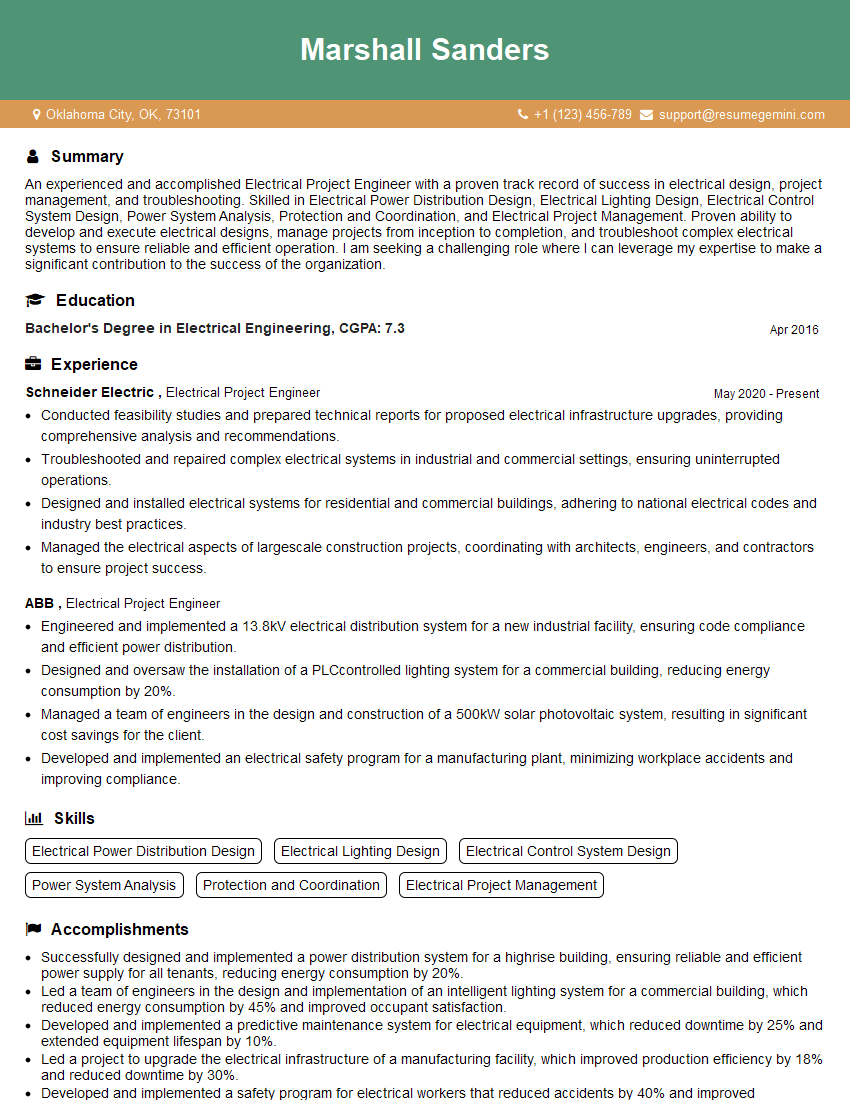
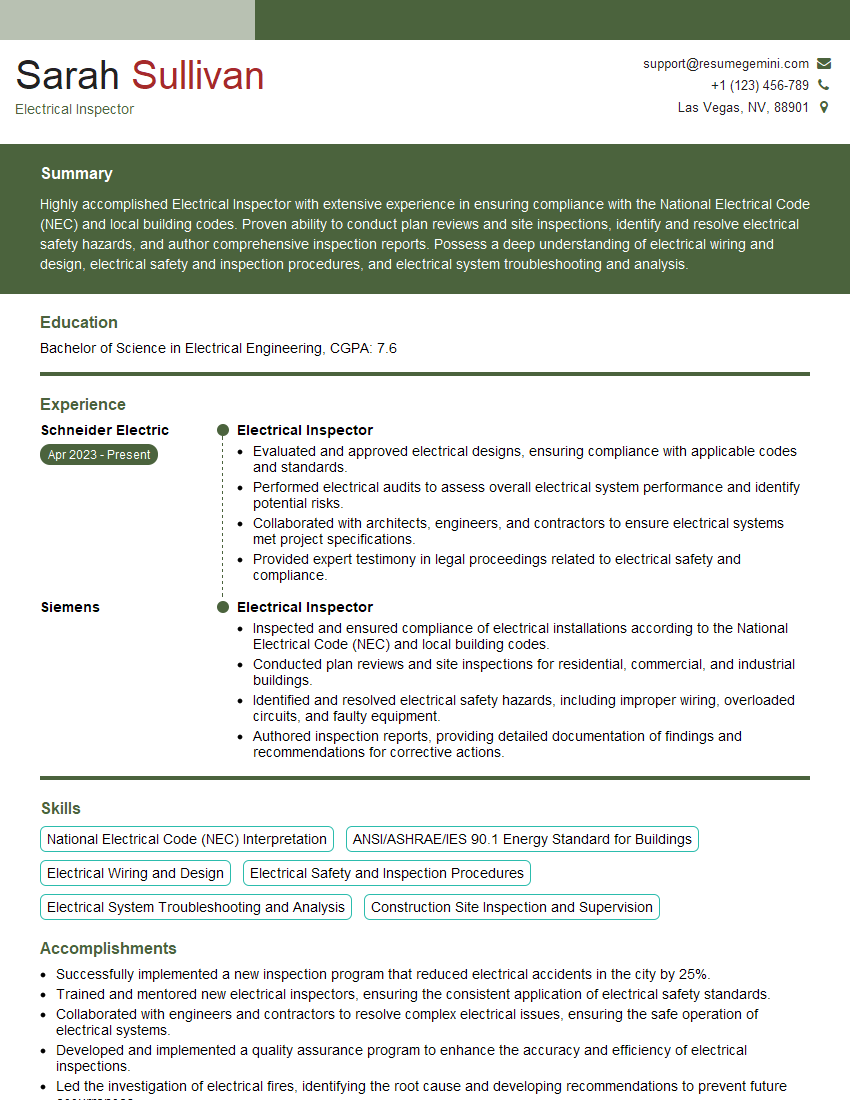
Mastering Electrical System Inspection and Testing opens doors to rewarding careers with excellent growth potential. You’ll be highly sought after by companies valuing safety, efficiency, and regulatory compliance. To maximize your job prospects, it’s crucial to present your skills effectively. Creating an ATS-friendly resume is essential for getting your application noticed by recruiters. ResumeGemini is a trusted resource to help you build a professional and impactful resume, ensuring your qualifications shine. Examples of resumes tailored to Electrical System Inspection and Testing are available to guide you.

Explore more articles
Users Rating of Our Blogs
Share Your Experience
We value your feedback! Please rate our content and share your thoughts (optional).
What Readers Say About Our Blog
Amazing blog
Interesting Article, I liked the depth of knowledge you’ve shared.
Helpful, thanks for sharing.