Cracking a skill-specific interview, like one for Event and News Photography, requires understanding the nuances of the role. In this blog, we present the questions you’re most likely to encounter, along with insights into how to answer them effectively. Let’s ensure you’re ready to make a strong impression.
Questions Asked in Event and News Photography Interview
Q 1. Describe your experience with different types of event photography (e.g., corporate, social, political).
My experience spans a wide range of event photography. Corporate events often involve capturing candid shots of attendees networking, speakers presenting, and showcasing the overall atmosphere of conferences, product launches, or galas. The focus is on professionalism and conveying the success of the event. Social events, such as weddings or birthday parties, require a more emotive approach, concentrating on capturing genuine moments of joy, laughter, and connection between people. Finally, political events demand a different tact altogether. Objectivity and neutrality are paramount. My focus shifts to documenting the event’s progress, capturing key speakers, and the overall public reaction without imposing my personal opinions. I’ve photographed everything from small town council meetings to large political rallies, each requiring a nuanced understanding of the context and the need to remain unobtrusive while still capturing significant moments.
- Corporate: Think sharp images of CEOs shaking hands, detailed shots of product displays, and candid shots of attendees engaging with each other.
- Social: This involves capturing the emotion of a first dance, the laughter of a group of friends, or the tearful joy of a mother watching her child graduate.
- Political: This might include images of a candidate addressing a crowd, protesters demonstrating, or close-ups of significant interactions between individuals.
Q 2. Explain your process for capturing impactful news photographs in a fast-paced environment.
Capturing impactful news photographs in a fast-paced environment requires a combination of anticipation, speed, and decisive action. My process starts with thorough research: understanding the event, the key players, and potential points of interest. This allows me to anticipate key moments and position myself strategically beforehand. Once the event begins, it’s about being alert, reacting quickly to unfolding events, and composing strong shots under pressure. I use a combination of continuous shooting and burst mode to maximize my chances of capturing the perfect moment. Post-event, quick editing and selecting the strongest images are crucial for meeting tight deadlines. Knowing which details to capture is essential – a single, powerful image can often tell a whole story.
For example, during a protest, I’d focus on capturing both the overall scale of the event and the emotions on individual faces. A wide shot showing the crowd’s size, and then close-ups on individuals’ expressions and actions, create a much more complete narrative.
Q 3. How do you manage time constraints and deadlines in event and news photography?
Time management is crucial in event and news photography. Prioritization is key: I identify the most important moments or aspects of the event and focus my efforts there. Efficient workflow – from quickly reviewing shots on the camera’s LCD screen to utilizing fast card readers for transferring images – is essential. I always plan my shooting strategy beforehand to anticipate potential delays. This includes knowing the locations, understanding the event schedule, and having backup plans for unexpected situations. In post-processing, I prioritize speed and efficiency, focusing on editing the most impactful images first. Strong communication with editors and clients is vital for transparently managing expectations and avoiding conflicts.
Q 4. What equipment do you typically use for event and news photography, and why?
My typical equipment includes a professional DSLR or mirrorless camera body, a selection of prime and zoom lenses (covering a wide range of focal lengths for versatility), multiple memory cards, and a robust backup system. I also carry extra batteries, a speedlight or studio strobes (depending on the event’s needs), and a reliable laptop for initial image review and backup. The camera should be reliable and quick, lenses chosen for their ability to handle varying light conditions and distances, and the memory and backup systems are essential to avoid data loss, especially in high-pressure situations. For example, a fast telephoto lens is essential for capturing distant subjects in a news setting, while wider lenses are useful for capturing the ambiance of an event.
Q 5. Describe your workflow from shooting to post-processing in both event and news photography.
My workflow starts with careful image selection on location. I quickly review images on my camera’s LCD screen to identify the best shots and delete obviously unusable ones. Back at my workspace, I import the images, organizing them by event and date, before initial backup onto multiple hard drives. For event photography, the editing focuses on enhancing colors, adjusting exposure, and potentially some minor retouching to remove blemishes or distracting elements. News photography editing often involves more minimal adjustments, focusing on maintaining accuracy and journalistic integrity. In both cases, the final images are exported in high-resolution formats, ready for delivery or publishing.
Q 6. How do you handle challenging lighting conditions in different environments?
Challenging lighting conditions are a constant in event and news photography. My approach combines understanding lighting principles with using the right tools. For low-light situations, I use a fast lens (large maximum aperture like f/1.4 or f/2.8) to maximize light gathering capabilities and increase ISO sensitivity (while managing noise). In harsh sunlight, I utilize fill flash or reflectors to balance the exposure and reduce harsh shadows. Understanding how to utilize natural light – finding open shade or waiting for the golden hour for softer light – is also crucial. In indoor events, I may use speedlights or continuous lighting to augment ambient light. The key is always to adapt to the situation creatively and efficiently.
Q 7. How do you ensure the accuracy and ethical considerations in your news photography?
Accuracy and ethical considerations are paramount in news photography. This involves a commitment to truthful representation. I avoid manipulating images in a way that alters the context or misrepresents the events. I adhere to journalistic ethics, avoiding staging or artificially creating moments. Proper identification of individuals and contextual information is always included whenever possible. In some cases, this might require additional research or fact-checking to ensure the accuracy of captions and descriptions. The integrity of the images is my highest priority, and any post-processing techniques are used solely to enhance, not alter, the original scene.
Q 8. Explain your approach to composing compelling photographs for both event and news contexts.
Composing compelling event and news photographs hinges on understanding the narrative you’re aiming to convey. For events, it’s about capturing the emotion, energy, and key moments. News photography demands accuracy and objectivity, focusing on telling a story visually with impactful details. My approach involves a blend of technical skills and storytelling instincts.
- Event Photography: I prioritize capturing candid moments that reveal genuine emotion. I look for strong compositions using the rule of thirds, leading lines, and other compositional techniques to guide the viewer’s eye. I also pay attention to lighting and background elements to enhance the story. For example, at a concert, I’d focus on capturing the singer’s connection with the audience, the energy of the crowd, and details like the lighting effects.
- News Photography: In news photography, accuracy is paramount. I meticulously document the scene, focusing on capturing decisive moments that convey the story’s essence. Context is key; I aim to capture the overall scene, including relevant background details that provide understanding. For instance, at a protest, I’d capture the scale of the event, the signs and banners, and any significant actions while maintaining journalistic ethics and objectivity.
Regardless of the context, I always strive for sharp focus, appropriate exposure, and a strong visual narrative. Pre-visualization is crucial – anticipating key moments and positioning myself strategically is vital for capturing the best shots.
Q 9. Describe your experience working with different camera systems (DSLR, mirrorless).
I’ve had extensive experience with both DSLR and mirrorless camera systems. Both offer advantages, and my choice depends on the specific assignment. DSLRs, with their optical viewfinders, provide a more immediate and intuitive shooting experience, particularly beneficial in fast-paced environments like sporting events or breaking news situations where speed and reliability are crucial. However, mirrorless cameras offer advantages in terms of size, weight, and advanced features like in-body image stabilization. The superior autofocus systems in many modern mirrorless cameras are game-changers, enabling improved subject tracking and focus accuracy.
For example, I’ve used Canon EOS 1D X Mark III DSLRs extensively for action sports, relying on their robust build and exceptional high-speed continuous shooting capabilities. Conversely, for quieter events or travel assignments where discretion is essential, a Sony Alpha series mirrorless camera would be my preferred choice, owing to their compact form factor and excellent low-light performance.
Ultimately, my expertise lies in understanding the strengths and weaknesses of each system and selecting the most appropriate tool for the job.
Q 10. How do you edit and process your photos for optimal impact?
Editing and processing are crucial steps in transforming raw images into compelling photographs. My approach is non-destructive, preserving the original image data. I prioritize enhancing the story, not manipulating it. My workflow involves:
- Initial Adjustments: I begin with basic adjustments in Lightroom, such as exposure, contrast, white balance, and sharpening, aiming for a natural look that accurately represents the scene.
- Selective Adjustments: I utilize local adjustments, like radial and graduated filters, to fine-tune specific areas of the image without affecting the overall balance.
- Color Grading: I might refine color saturation and vibrancy subtly, ensuring a cohesive color palette across the entire image series.
- Noise Reduction: High ISO shots might require careful noise reduction to maintain detail without compromising sharpness.
- Cropping and Straightening: This step is vital to improve composition and enhance visual impact.
- Final Touches: In rare instances, I may use Photoshop for specific retouching needs, like removing distracting elements or subtly enhancing details, but only when it enhances the narrative without altering facts.
The goal is to enhance the image, not create a false reality. Ethical considerations always guide my post-processing decisions.
Q 11. How familiar are you with photo editing software (e.g., Adobe Photoshop, Lightroom)?
I am highly proficient in Adobe Photoshop and Lightroom. My expertise extends beyond basic functions; I leverage advanced techniques like masking, layering, and color correction to achieve optimal results. I regularly utilize advanced features such as luminosity masks in Photoshop for nuanced tonal adjustments and utilize Lightroom’s cataloging system to manage large photo archives efficiently.
For instance, my understanding of advanced masking techniques allows me to subtly retouch minor imperfections without compromising image quality. My familiarity with Lightroom’s metadata and keywording capabilities aids significantly in organizing and retrieving images quickly.
Q 12. How do you manage large volumes of images effectively?
Managing large volumes of images requires a systematic approach. I rely heavily on Lightroom’s cataloging system to organize and manage my image library. This includes using a consistent folder structure, applying keywords and metadata, and creating collections for specific projects or events. I also utilize rating systems to prioritize high-quality images and cull duplicates or unwanted shots. Regular backups are essential, employing both local and cloud storage to prevent data loss.
Beyond software, a well-organized workflow is paramount. I often download images immediately after a shoot and process them promptly, minimizing the accumulation of unprocessed files. Employing a structured approach ensures efficient retrieval and selection of images, crucial for meeting deadlines and efficiently delivering projects.
Q 13. What is your understanding of copyright and usage rights in photography?
Understanding copyright and usage rights is crucial for any photographer. Copyright protection automatically applies to my original photographs from the moment they’re created. This means I own the exclusive rights to reproduce, distribute, display, or create derivative works from my images. I clearly define usage rights with clients through contracts, specifying the intended use, geographic limitations, and duration of the license.
For example, a client purchasing images for a website might receive a limited license, restricting their use to that specific platform. For broader usage, like a magazine cover, I would typically negotiate a more comprehensive license with appropriate compensation. Furthermore, I’m aware of the implications of using images from other sources and always respect the copyright of other photographers and artists.
Q 14. Describe a time you faced a challenging situation during a shoot. How did you resolve it?
During a breaking news story about a severe storm, I encountered a challenging situation. Heavy rain and strong winds made it nearly impossible to maintain a stable camera position, leading to blurry shots. The intense weather also posed a significant safety risk.
To resolve this, I quickly adapted my approach. I found a sheltered spot to minimize exposure to the elements while still maintaining a clear view of the unfolding events. I switched to a faster shutter speed to compensate for the low light conditions and reduce motion blur. I also carefully prioritized safety, ensuring I didn’t put myself in unnecessary danger.
Though the conditions were far from ideal, I managed to capture several impactful images that accurately portrayed the intensity of the storm and its impact on the community. This experience reinforced the importance of adaptability, resourcefulness, and prioritizing safety in challenging environments.
Q 15. How do you work effectively under pressure?
Working effectively under pressure in event and news photography is crucial. It’s about maintaining composure and efficiency amidst chaos. My approach involves a combination of preparation, mental strategies, and technical proficiency. Before any event, I meticulously plan my gear, anticipating potential challenges. This preemptive planning reduces stress on-site. During the event, I focus on controlled breathing and prioritize tasks methodically. I also rely on my muscle memory; years of experience allow me to operate my equipment instinctively, freeing my mind to focus on capturing the key moments. For example, during a riot, I prioritized capturing the overall scene’s visual narrative before focusing on individual poignant expressions. Staying calm allows me to react quickly to unexpected situations, ensuring I capture critical moments without missing a beat. The key is to train yourself mentally and physically, so the pressure becomes less of a hindrance and more of a challenge to overcome efficiently.
Career Expert Tips:
- Ace those interviews! Prepare effectively by reviewing the Top 50 Most Common Interview Questions on ResumeGemini.
- Navigate your job search with confidence! Explore a wide range of Career Tips on ResumeGemini. Learn about common challenges and recommendations to overcome them.
- Craft the perfect resume! Master the Art of Resume Writing with ResumeGemini’s guide. Showcase your unique qualifications and achievements effectively.
- Don’t miss out on holiday savings! Build your dream resume with ResumeGemini’s ATS optimized templates.
Q 16. How do you prioritize shots when covering a breaking news event?
Prioritizing shots during a breaking news event is paramount. It’s about discerning the most impactful images that tell the story accurately and completely. My approach is a layered strategy. First, I capture the overall scene – the wide shot that sets the context. This establishes the environment and scope of the event. Next, I focus on the key players or subjects involved. Then, I seek out the details – the small, telling gestures or expressions that enhance the narrative. For example, at a protest, I’d first get a shot of the whole crowd, then focus on the leaders, and finally, capture close-ups showing individual emotions. This methodical approach, honed over years of experience, ensures I gather a comprehensive collection of images, even in limited time. Finally, I always keep in mind the overarching narrative and try to capture images that will work well together when telling that story.
Q 17. Describe your experience with different photographic styles (e.g., candid, posed).
My experience spans various photographic styles, each with its own unique challenges and rewards. Candid photography allows for capturing genuine moments, uninfluenced by direction. This is vital for conveying authenticity and raw emotion. I’ve successfully used this style at numerous public gatherings, capturing spontaneous interactions and genuine expressions. Posed photography, on the other hand, offers greater control over composition and subject placement. It’s essential for formal portraits or staged shots. I’ve employed this for press conferences or controlled events, achieving specific visual outcomes. I often blend these styles; for instance, I might start with posed shots of key individuals and then seamlessly transition to capturing candid reactions from the crowd. The ability to adapt between styles makes me a versatile photographer able to meet various journalistic needs.
Q 18. Explain your understanding of composition rules (e.g., rule of thirds, leading lines).
Composition is the backbone of strong photography. Rules like the rule of thirds and leading lines are essential tools. The rule of thirds suggests placing key elements off-center, creating a more visually appealing and balanced image. Imagine a tic-tac-toe grid overlaid on your frame; placing the subject at one of the intersections creates visual interest. Leading lines, such as roads or fences, guide the viewer’s eye through the image, drawing attention to the main subject. For instance, I might use a road leading to a burning building to draw the viewer into the scene and emphasize the event’s scale. Mastering these rules, along with understanding negative space and visual weight, allows me to create impactful and aesthetically pleasing images, even in chaotic environments.
Q 19. How familiar are you with different file formats (RAW, JPEG)? Why are they important?
RAW and JPEG are fundamental file formats in photography. RAW files are uncompressed, retaining all the image data captured by the camera’s sensor. This offers maximum flexibility in post-processing, allowing for extensive adjustments to exposure, white balance, and other parameters without significant quality loss. JPEGs, on the other hand, are compressed, resulting in smaller file sizes but less flexibility in editing. I typically shoot in RAW for news events and important projects because the extra data allows for much better image quality and more options during post-processing. For example, if the lighting is sub-optimal in a critical moment, I’ll be able to salvage the image when working with a RAW file. JPEGs might suffice for less critical situations, prioritizing speed of delivery over maximum editing freedom. The choice depends on the situation’s demands and my post-processing workflow.
Q 20. What is your experience with using flash photography and off-camera lighting?
My experience with flash photography and off-camera lighting is extensive. On-camera flash is useful in situations where I need to quickly illuminate a subject, such as during breaking news events with low light. Off-camera lighting, however, provides significantly greater control, allowing for creative shaping of light and more natural-looking images. I’ve used off-camera flash extensively for portraits and events where I want to manipulate the light for a specific effect. For example, I might use a strobe with a softbox to create even lighting for a portrait or bounce light off a wall to create a softer, more diffused effect. This nuanced control allows me to create more compelling and professional-looking photographs, tailoring the light to best convey the mood and story of the event.
Q 21. How do you interact professionally with subjects during a shoot?
Professional interaction with subjects is essential for ethical and successful photography. I approach each situation with respect and courtesy. Before capturing images, especially if the event is sensitive, I try to establish rapport and explain my intentions clearly and concisely. I ensure individuals are aware they are being photographed and respect their wishes if they decline. In situations requiring immediate action, such as covering a disaster, I prioritize capturing the scene responsibly, balancing the need for impactful images with the sensitivity of the situation. Non-verbal communication is also crucial. A simple smile and respectful posture often help people feel at ease. Building trust fosters cooperation and enhances the quality of images obtained, resulting in both ethical and impactful storytelling.
Q 22. Describe your understanding of storytelling through photography.
Storytelling through photography isn’t just about capturing a moment; it’s about crafting a narrative that evokes emotion and understanding in the viewer. It’s about choosing the right angle, lighting, and subject matter to convey a specific message or feeling. Think of it like writing a story with images instead of words. Each photograph becomes a chapter, building towards a complete narrative.
For example, covering a protest, I wouldn’t just take pictures of the crowd. I’d strategically capture close-ups of individual faces reflecting different emotions—anger, hope, determination. I’d photograph the signs, the interaction between protesters and law enforcement, and the overall atmosphere. These individual images, when sequenced thoughtfully, tell a much richer story than a single, isolated shot.
Another example could be photographing a wedding. It’s not enough to simply capture the ceremony. I aim to capture the moments leading up to it—the nervous anticipation of the bride, the joy of the families, the tender moments between the couple. These images, woven together, convey a narrative of love, commitment, and celebration.
Q 23. How do you ensure image quality and consistency across different shoots?
Maintaining image quality and consistency across different shoots involves a multi-faceted approach. It starts with understanding my equipment inside and out—knowing my cameras’ capabilities and limitations, and how each lens performs in various lighting conditions. Consistent color calibration is crucial. I always shoot in RAW format, which provides much greater flexibility in post-processing and ensures that I can maintain a consistent look and feel across different projects.
Furthermore, I meticulously manage my workflow. This includes consistent white balance settings, controlled aperture and shutter speed to manage depth of field and motion blur, and careful consideration of composition. I always back up my images immediately after each shoot to multiple hard drives, ensuring that my work is safe and accessible.
Finally, I establish a clear pre-shoot plan that outlines the technical requirements and desired aesthetic for each project. This involves discussing the client’s expectations and identifying potential challenges beforehand, which helps maintain a consistent approach throughout the shoot.
Q 24. Describe your proficiency with various lenses and their applications in event and news photography.
My lens collection is tailored to the demands of event and news photography. A wide-angle lens (e.g., 16-35mm) is essential for capturing the overall scene, especially in large venues or during demonstrations. It’s perfect for establishing shots and showing the context of the event. A standard zoom lens (e.g., 24-70mm) is my workhorse, offering versatility for most situations. It’s ideal for portraits and capturing candid moments.
A telephoto lens (e.g., 70-200mm or even longer) is invaluable for capturing subjects from a distance, whether it’s a speaker at a conference, a key player in a sporting event, or details in a crowded scene. This minimizes disruption while still obtaining impactful images. Finally, a macro lens allows for extreme close-ups, capturing intricate details and textures, adding another layer to my storytelling.
Understanding the strengths and weaknesses of each lens—their depth of field capabilities, their light gathering ability—is crucial for making informed decisions in the field. Knowing when to switch lenses quickly and efficiently ensures I never miss a crucial shot.
Q 25. How do you deal with difficult subjects or challenging environments?
Difficult subjects or challenging environments require adaptability and resourcefulness. When dealing with sensitive subjects, I prioritize respect and empathy. Building rapport with the subject is key, taking the time to explain my intentions and gain their trust. If I encounter resistance, I try alternative approaches, perhaps focusing on environmental details instead of direct portraits.
Challenging environments, such as low light or inclement weather, require careful planning and preparation. I invest in high-quality equipment designed to handle difficult conditions, including weather-sealed bodies and fast lenses. Understanding lighting techniques like using available light effectively or employing flash appropriately is critical. I also always have backup plans and equipment, prepared for unforeseen circumstances.
For instance, during a storm, I might find a sheltered spot to wait for a break in the action or adjust my settings to compensate for the changing light. I am always prepared for the worst to ensure capturing the best possible images.
Q 26. Explain your experience with photojournalism ethics and best practices.
Photojournalism ethics are paramount to my work. Accuracy and honesty are fundamental. I never manipulate images in a way that misrepresents reality. This includes refraining from cropping or altering images to change the narrative or create a false impression. Context is also crucial. I always strive to provide enough information to allow the viewer to understand the full story and draw their own conclusions. Privacy and respect for the subjects I photograph are also important considerations.
I fully understand the potential impact of my work and strive to represent my subjects fairly and ethically. I’m always mindful of the potential for my images to be misinterpreted and take steps to ensure that context is clear. Ethical considerations guide every decision I make, from choosing what to photograph to how I present my work.
Q 27. How do you collaborate effectively with other team members (e.g., editors, videographers)?
Collaboration is key in event and news photography. Effective teamwork ensures a smooth and efficient workflow. Before a shoot, I communicate clearly with editors and videographers to understand their requirements and expectations. This includes discussing shot lists, deadlines, and desired coverage. During the event, I maintain open communication, sharing information and images as needed.
I also strive to understand their roles and perspectives to anticipate their needs and contribute effectively to the overall project. For instance, I might coordinate with a videographer to ensure consistent angles and coverage. After the shoot, I cooperate closely in editing and selection processes, ensuring that the final product meets editorial standards and tells a cohesive story.
Q 28. What are your salary expectations for this role?
My salary expectations are commensurate with my experience and expertise in event and news photography, and the specific demands of this role. I am open to discussing a competitive compensation package that reflects my contributions to the team and aligns with industry standards for professionals with my skillset and portfolio.
Key Topics to Learn for Event and News Photography Interview
- Understanding the Assignment Brief: Interpreting client needs, deadlines, and desired style for both event and news photography assignments. Practical application: Analyzing a sample brief and outlining a shooting plan.
- Composition and Storytelling: Mastering techniques like rule of thirds, leading lines, and framing to create compelling narratives within a single image. Practical application: Analyzing award-winning photos and identifying the compositional choices made.
- Technical Proficiency: Demonstrating expertise in camera settings (aperture, shutter speed, ISO), lighting techniques (natural and artificial), and post-processing workflow. Practical application: Describing your experience managing challenging lighting situations and explaining your post-processing philosophy.
- Ethics and Legalities: Understanding copyright laws, model releases, and responsible image capturing, especially in sensitive news situations. Practical application: Discussing ethical dilemmas in photojournalism and outlining your approach to resolving them.
- Workflow and Time Management: Efficiently managing time constraints, especially during fast-paced news events. Practical application: Explaining your system for quickly culling, editing, and delivering images under pressure.
- Gear Knowledge: Demonstrating familiarity with various camera systems, lenses, and accessories relevant to event and news photography. Practical application: Justifying your choice of equipment for different shooting scenarios.
- Image Editing and Post-Processing: Proficiency in using software like Adobe Lightroom and Photoshop for color correction, retouching, and image enhancement. Practical application: Explaining your workflow for preparing images for publication.
- Client Communication and Collaboration: Effectively communicating with clients and editors, understanding their feedback and meeting their expectations. Practical application: Describing a situation where you successfully navigated client feedback.
Next Steps
Mastering Event and News Photography opens doors to exciting and impactful careers, offering opportunities for creative expression and storytelling. To maximize your job prospects, creating a strong, ATS-friendly resume is crucial. ResumeGemini is a trusted resource that can help you build a professional and impactful resume, showcasing your skills and experience effectively. Examples of resumes tailored to Event and News Photography are available, providing a valuable template to guide your own resume creation.
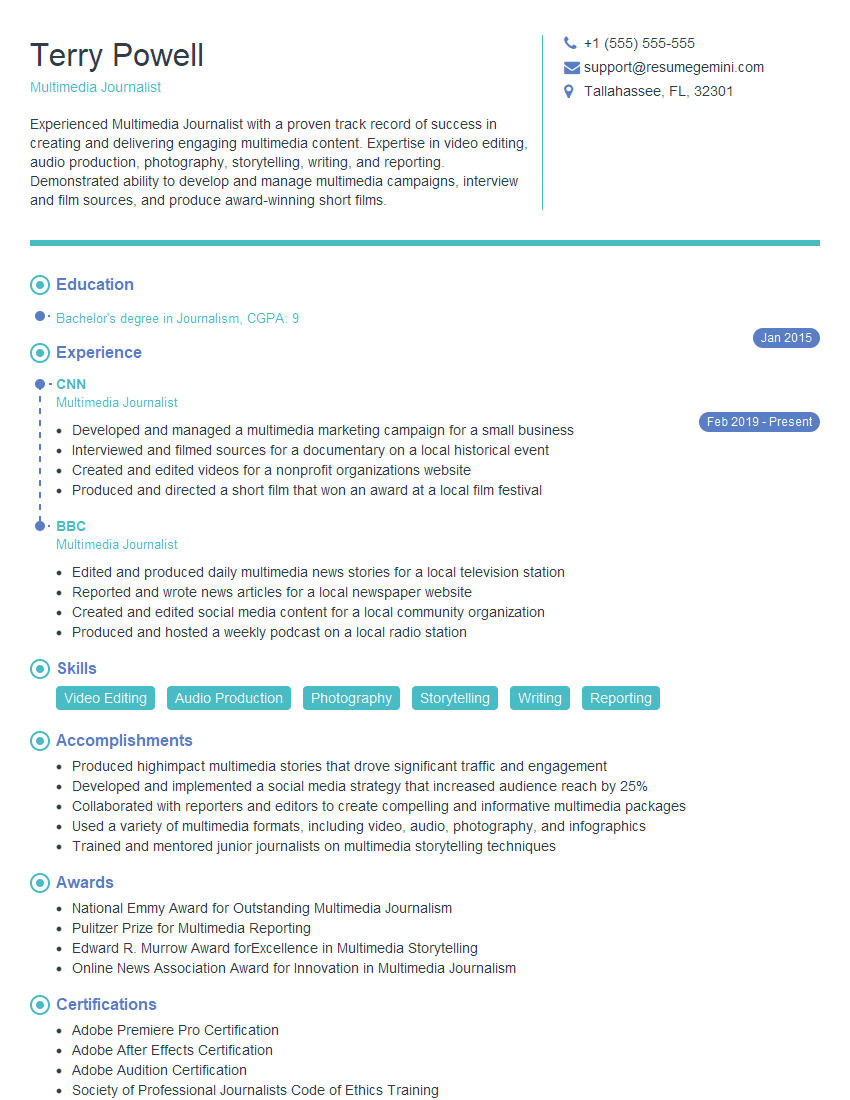
Multimedia Journalist Resume Sample
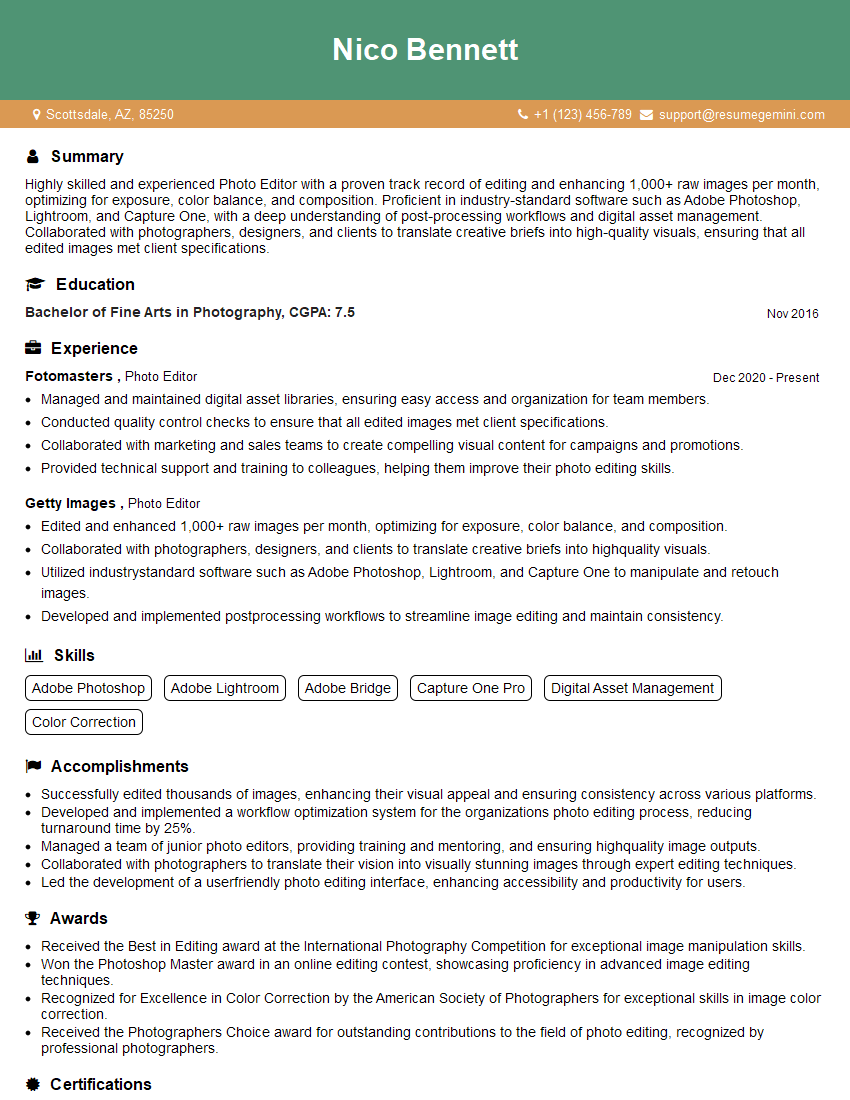
Photo Editor Resume Sample
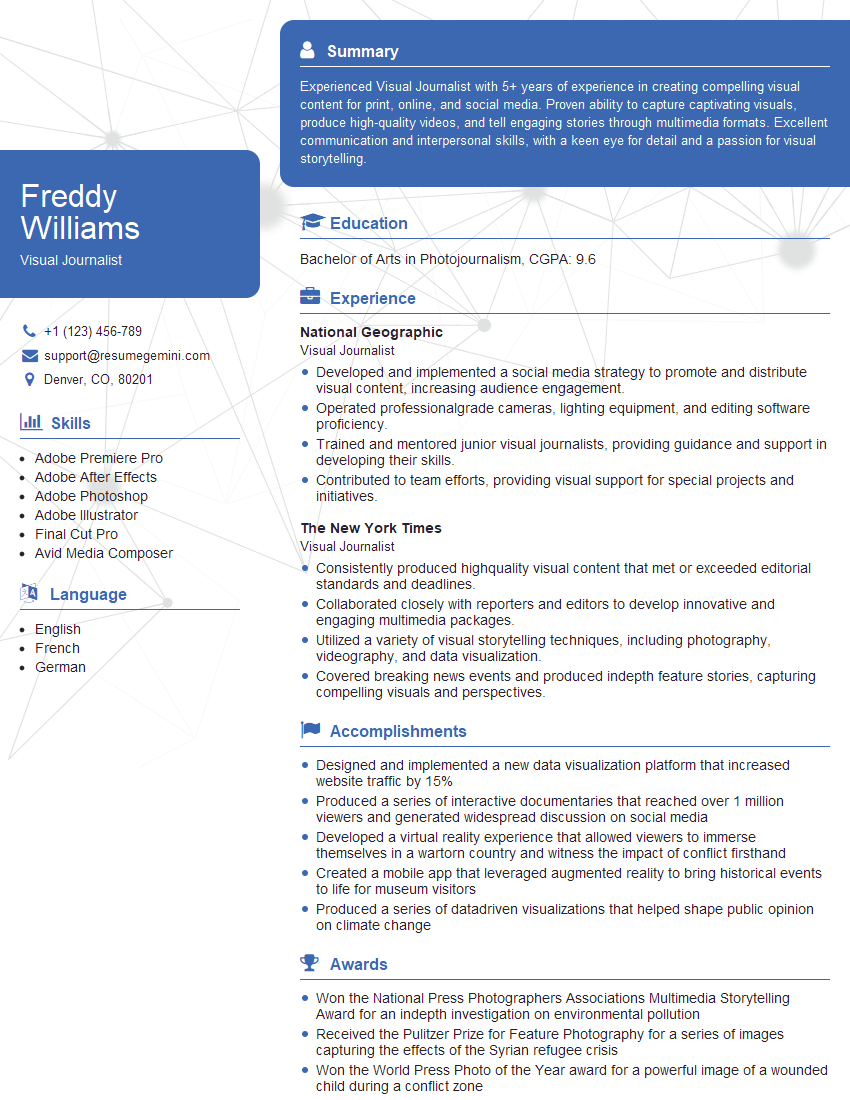
Visual Journalist Resume Sample
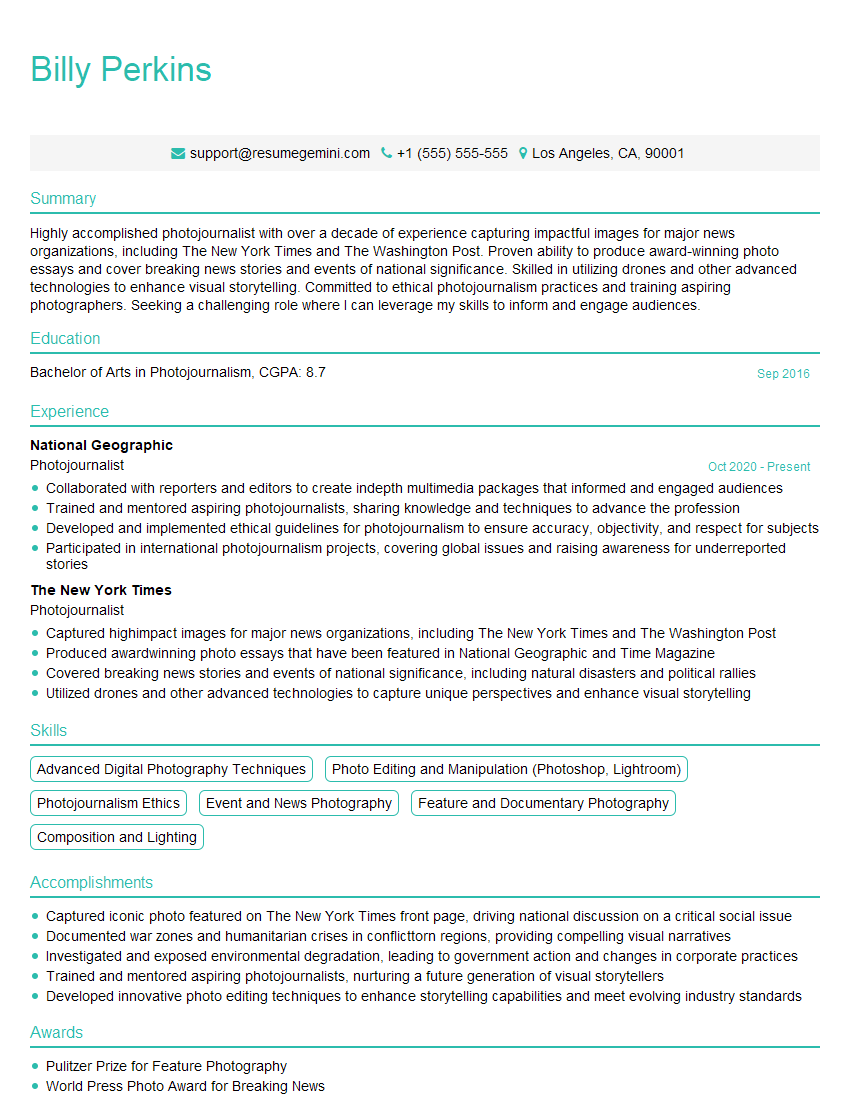
Photojournalist Resume Sample
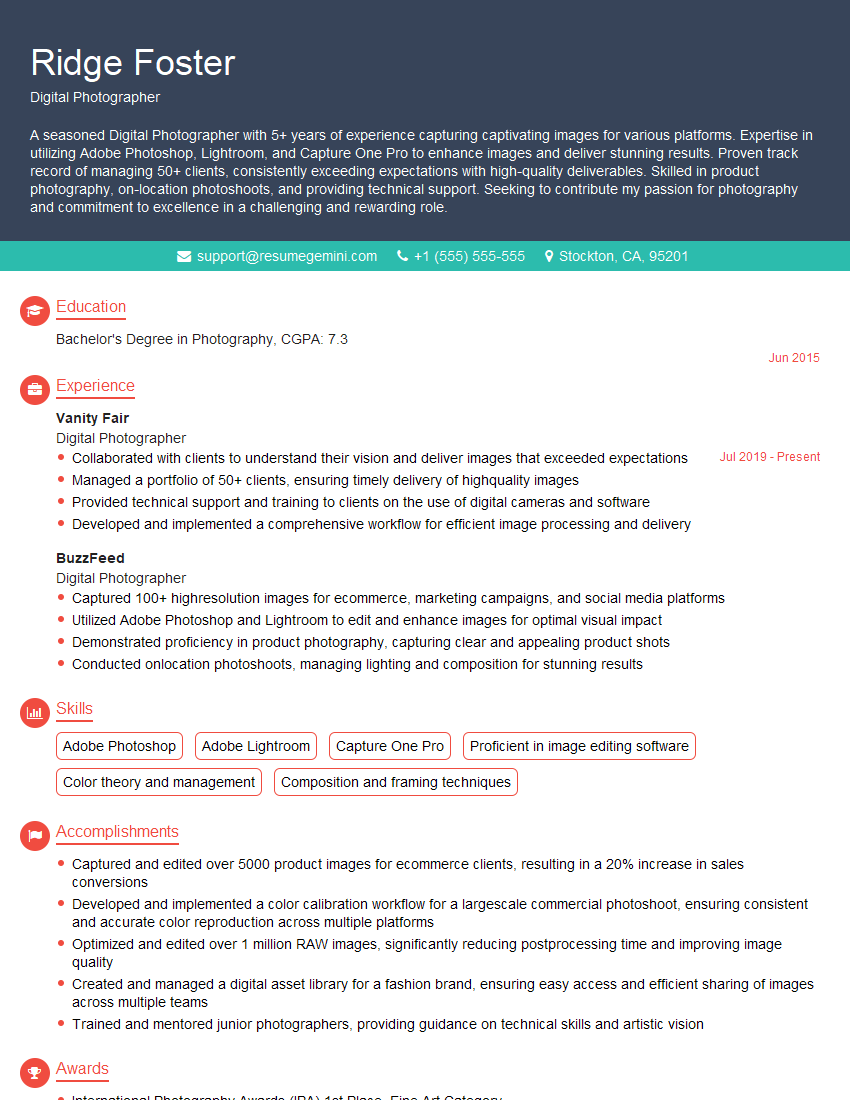
Digital Photographer Resume Sample
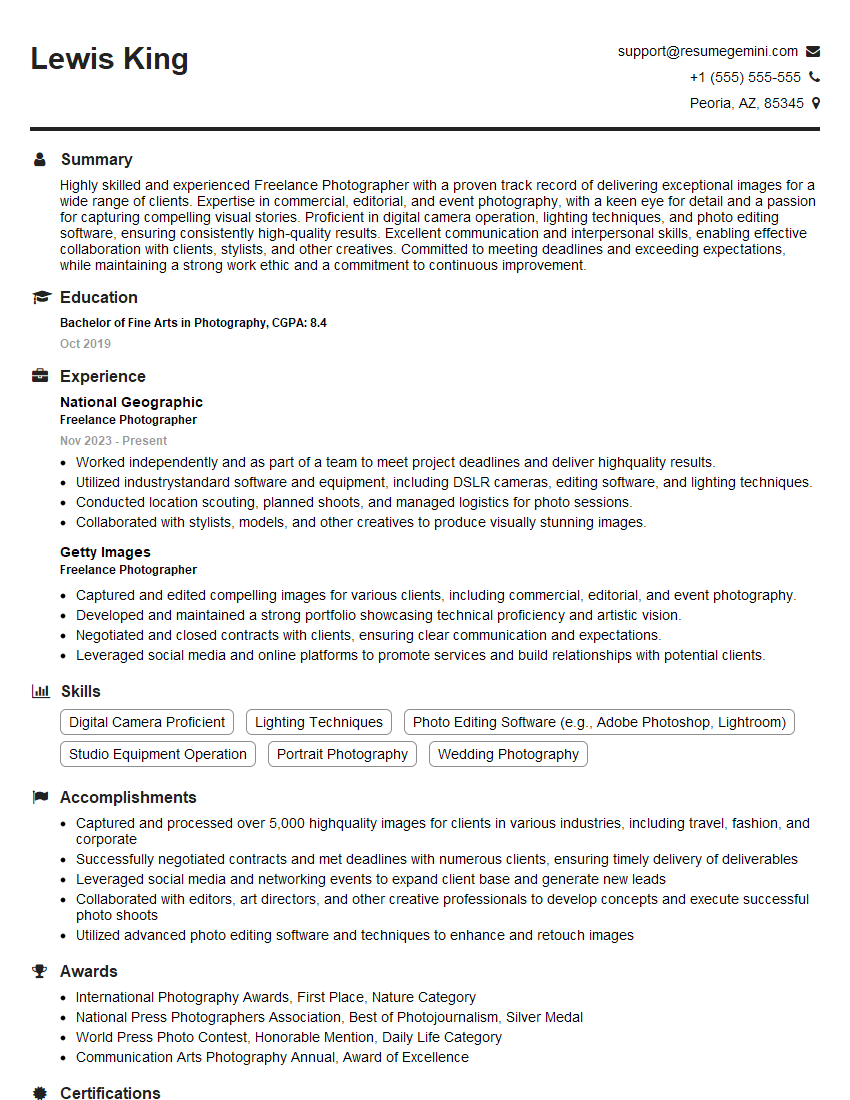
Freelance Photographer Resume Sample
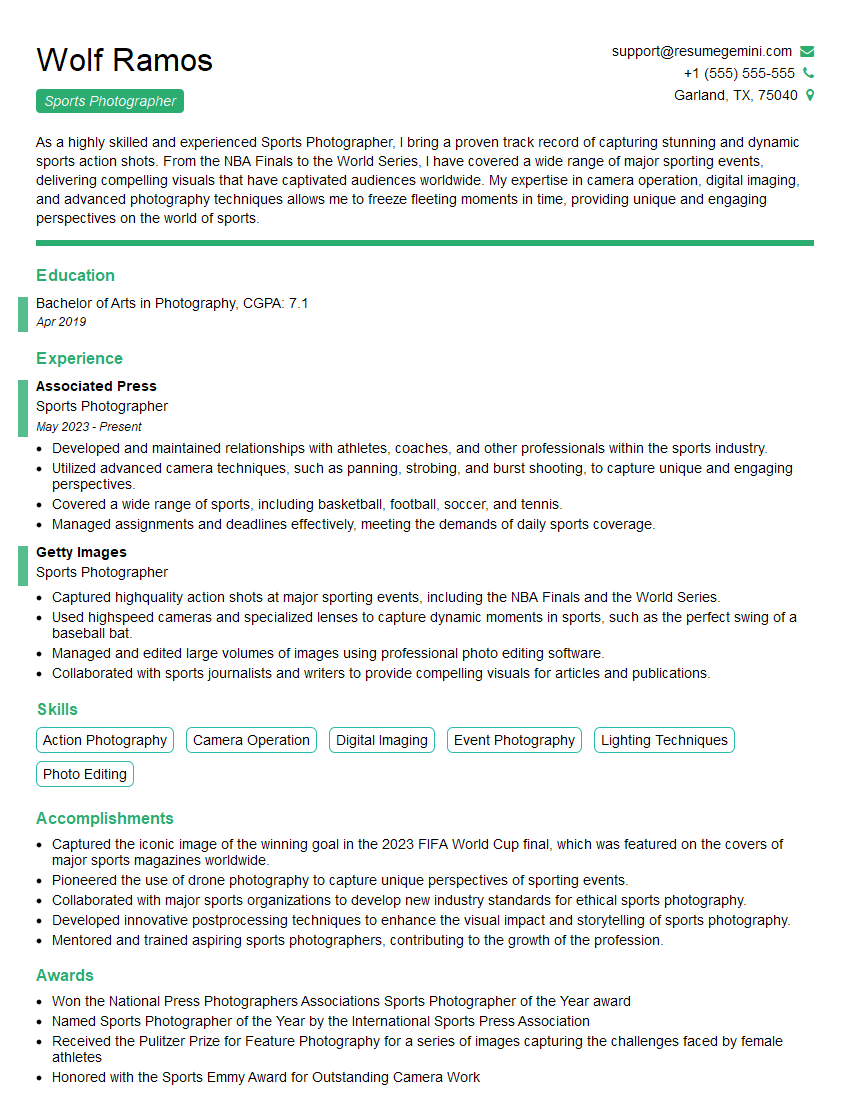
Sports Photographer Resume Sample
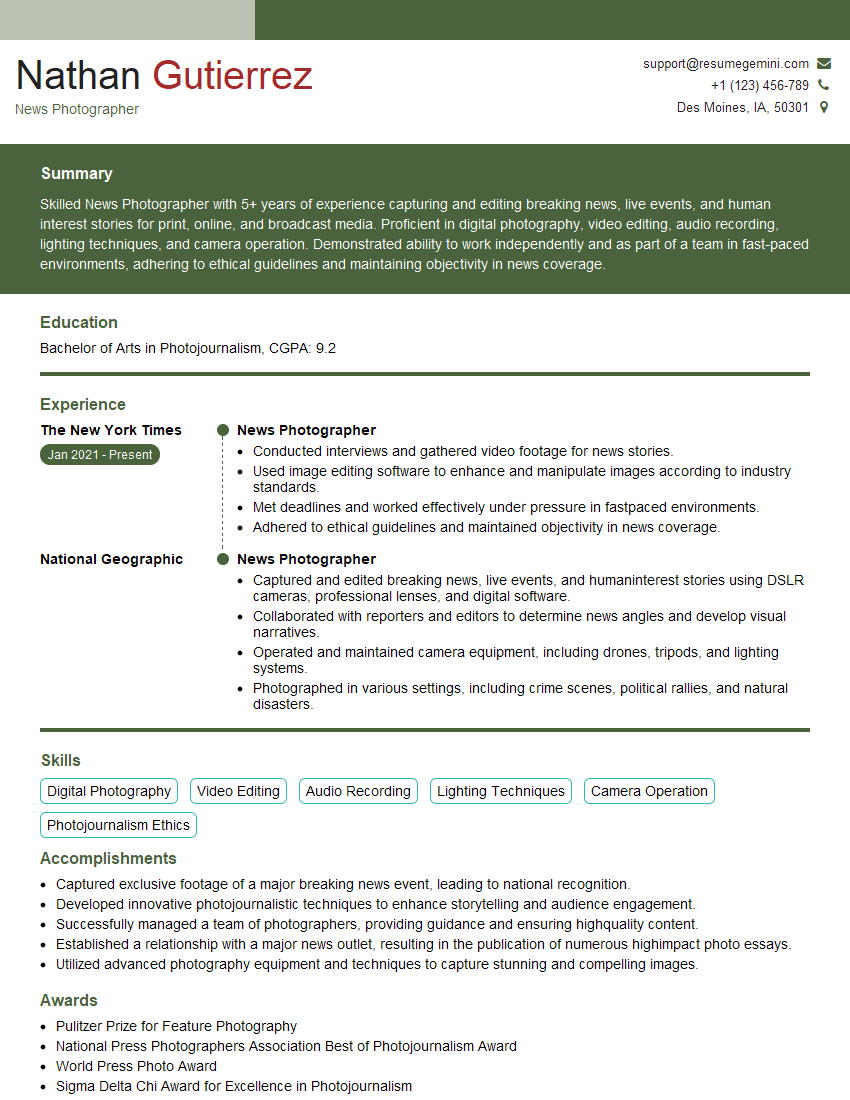
News Photographer Resume Sample
Imaging Specialist Resume Sample
Explore more articles
Users Rating of Our Blogs
Share Your Experience
We value your feedback! Please rate our content and share your thoughts (optional).
What Readers Say About Our Blog
Amazing blog
hello,
Our consultant firm based in the USA and our client are interested in your products.
Could you provide your company brochure and respond from your official email id (if different from the current in use), so i can send you the client’s requirement.
Payment before production.
I await your answer.
Regards,
MrSmith
hello,
Our consultant firm based in the USA and our client are interested in your products.
Could you provide your company brochure and respond from your official email id (if different from the current in use), so i can send you the client’s requirement.
Payment before production.
I await your answer.
Regards,
MrSmith
These apartments are so amazing, posting them online would break the algorithm.
https://bit.ly/Lovely2BedsApartmentHudsonYards
Reach out at BENSON@LONDONFOSTER.COM and let’s get started!
Take a look at this stunning 2-bedroom apartment perfectly situated NYC’s coveted Hudson Yards!
https://bit.ly/Lovely2BedsApartmentHudsonYards
Live Rent Free!
https://bit.ly/LiveRentFREE
Interesting Article, I liked the depth of knowledge you’ve shared.
Helpful, thanks for sharing.
Hi, I represent a social media marketing agency and liked your blog
Hi, I represent an SEO company that specialises in getting you AI citations and higher rankings on Google. I’d like to offer you a 100% free SEO audit for your website. Would you be interested?