Feeling uncertain about what to expect in your upcoming interview? We’ve got you covered! This blog highlights the most important Experience in using color matching tools and techniques interview questions and provides actionable advice to help you stand out as the ideal candidate. Let’s pave the way for your success.
Questions Asked in Experience in using color matching tools and techniques Interview
Q 1. Explain the difference between additive and subtractive color mixing.
Additive and subtractive color mixing are two fundamentally different approaches to creating colors. Think of it like this: additive is like shining lights together, while subtractive is like mixing paints.
Additive color mixing starts with black (the absence of light) and adds colors to create lighter shades. It’s used in screens, projectors, and other light-emitting devices. The primary additive colors are red, green, and blue (RGB). When you combine them at full intensity, you get white light. For example, combining red and green light produces yellow, red and blue creates magenta, and blue and green creates cyan.
Subtractive color mixing begins with white (the reflection of all light) and subtracts colors to create darker shades. This method is used in printing, painting, and other processes that involve pigments or dyes. The primary subtractive colors are cyan, magenta, and yellow (CMY). Mixing all three ideally produces black, though in practice, a black ink (K) is often added to improve the result (CMYK).
The key difference lies in the way colors interact with light: additive colors create light, while subtractive colors absorb light.
Q 2. What is a spectrophotometer and how does it work?
A spectrophotometer is a precision instrument used to measure the spectral reflectance or transmittance of a material. In simpler terms, it tells you exactly how much light a material reflects or transmits at each wavelength across the visible spectrum. This information is crucial for accurate color measurement and matching.
It works by shining a light beam (usually a xenon lamp) onto a sample. A diffraction grating then separates the reflected or transmitted light into its constituent wavelengths. A detector measures the intensity of light at each wavelength, generating a spectral curve that represents the sample’s color signature. This data can then be used to determine the color’s coordinates in various color spaces, like CIELAB.
Imagine it as a sophisticated ‘light fingerprint’ scanner for colors. It’s essential in quality control for industries like printing, textiles, and paints, where consistent color is critical.
Q 3. Describe the CIE color space and its applications.
The CIE (Commission Internationale de l’Éclairage) color space is an internationally standardized system for defining and representing colors. It’s a crucial tool for color communication and management, ensuring that everyone understands what a particular ‘color’ actually means.
The most commonly used CIE color space is CIELAB (L*a*b*), which describes color using three values:
- L*: Lightness, ranging from 0 (black) to 100 (white).
- a*: Represents the green-red axis.
- b*: Represents the blue-yellow axis.
CIELAB provides a more perceptually uniform space than previous systems, meaning that equal distances in the space correspond more closely to equal perceived color differences. This is crucial for color tolerance calculations and quality control.
Applications span across various fields, including:
- Graphic design and printing: Ensuring consistent color reproduction across different devices and media.
- Textile industry: Matching colors in fabrics and yarns.
- Paint and coatings: Formulating colors and maintaining consistency.
- Automotive industry: Defining and matching car paint colors.
Q 4. What are metamerism and how does it affect color matching?
Metamerism refers to the phenomenon where two colors appear identical under one type of light source but different under another. This happens because colors are perceived by the human eye based on the spectral distribution of light reflected from a material, not the exact spectral composition itself. Two materials might reflect different wavelengths of light but still stimulate the same cone cells in our eyes, leading to the same color perception.
In color matching, metamerism presents a major challenge. Two samples might match perfectly under a specific lighting condition used during quality control, but appear different under other lighting conditions such as daylight or incandescent light. This can be a serious problem, especially in industries where consistent color appearance across various light sources is essential (such as fashion or automotive). Careful consideration of metamerism is crucial when specifying and matching colors. It highlights the importance of using standardized light sources and color measurement tools to minimize discrepancies.
Q 5. How do you calibrate a color monitor or printer?
Calibrating a color monitor or printer ensures accurate color representation. It involves adjusting the device’s settings to match a known standard, so that the colors displayed or printed closely reflect the intended colors. This is especially important for professionals who rely on accurate color reproduction, like graphic designers, photographers, and prepress technicians.
Monitor Calibration: Uses a colorimeter or spectrophotometer along with calibration software. The device measures the monitor’s output, and the software adjusts settings (gamma, white point, color balance) to match a standard like sRGB or Adobe RGB. Regular calibration is recommended, as monitors’ characteristics drift over time.
Printer Calibration: Involves creating color profiles that map the printer’s output to a specific color space. This process is typically done using a spectrophotometer and dedicated software. The printer’s color management system (CMS) uses these profiles to translate digital color information into the correct ink combinations for accurate color reproduction. Regular print tests are essential to ensure consistency.
Q 6. What are some common color matching tools and their limitations?
Several tools are used for color matching, each with strengths and limitations:
- Spectrophotometers: Offer the most accurate color measurement, providing spectral data for precise color matching. However, they are expensive and require technical expertise.
- Colorimeters: More affordable than spectrophotometers, offering good accuracy for many applications. They provide color coordinates but lack the detailed spectral information of spectrophotometers.
- Color viewers/light boxes: Provide a controlled lighting environment for visual color comparison, but subjective to individual observer variations. They are useful for simple comparisons but unsuitable for precise color matching.
- Software-based color matching tools: Many software applications offer color matching and simulation capabilities, but their accuracy depends on the quality of input data and the calibration of the connected devices.
Limitations often involve cost, accuracy, complexity of use, and the subjective nature of visual color assessment.
Q 7. Explain the concept of color tolerance and its importance.
Color tolerance defines the acceptable range of variation for a specific color. It is expressed as numerical values (e.g., ΔE) indicating the maximum permissible difference between a target color and an actual color. The smaller the tolerance, the stricter the color matching requirement.
Imagine you’re manufacturing a car. The paint color needs to be consistent across all cars. Color tolerance defines how much variation in the shade is acceptable before it’s considered a defect. Strict tolerances mean higher production costs but greater color consistency. Less strict tolerances reduce costs but might result in more variation in color across different cars.
Its importance lies in quality control and consistency. Defining acceptable color variations ensures that manufactured products meet specific color standards. Color tolerance is crucial across various industries for maintaining product quality and brand consistency.
Q 8. How do you interpret color data from a spectrophotometer?
Interpreting spectrophotometer data involves understanding the resulting spectral curve and colorimetric values. A spectrophotometer measures the reflectance or transmittance of light across the visible spectrum (typically 380-730nm) at numerous wavelengths. The instrument then converts this raw spectral data into various color spaces, such as CIE XYZ, Lab, or LCh, which are more human-interpretable.
For example, a typical output might show L*a*b* values of L*= 60, a*= 10, b*= 20. These values represent lightness (L*), red-green (a*), and yellow-blue (b*) components. A higher L* value indicates greater lightness, while positive a* values represent redness and positive b* values represent yellowness. By comparing these values against a target or standard, we can assess the color difference.
Furthermore, the spectral curve itself provides valuable information about the color’s composition and the potential metamerism – the possibility that two colors might appear identical under one light source but different under another. Analyzing the curve allows for a more complete understanding of the color’s characteristics and helps in predicting its appearance under different lighting conditions.
Q 9. What is Delta E and how is it used in color matching?
Delta E (ΔE) is a single number that represents the perceived difference between two colors. It’s a crucial metric in color matching, quantifying the overall color discrepancy. Different formulas calculate Delta E, such as ΔE76, ΔE94, ΔE00, and ΔEab, each with varying sensitivities to different color aspects. ΔE00 is currently the most widely accepted formula.
In color matching, we aim to minimize Delta E. A ΔE of 0 indicates a perfect match, while a higher ΔE signifies a more noticeable difference. The acceptable ΔE value depends on the application: for critical color matching in printing, a ΔE of less than 1 is often desirable; for less critical applications, a ΔE of 2-3 might be acceptable. Imagine trying to match a specific shade of blue paint – a small ΔE means the matched color will appear almost identical to the original.
Q 10. Describe your experience using color management software (e.g., Adobe Color, X-Rite i1)
I have extensive experience with Adobe Color and X-Rite i1 software. Adobe Color helps in creating and managing color palettes, exploring color harmonies, and converting color spaces. It’s beneficial for design work and ensuring color consistency across various digital platforms.
X-Rite i1 software, paired with the i1 spectrophotometer, is crucial for precise color management in printing and other color-critical applications. I’ve used it to profile monitors, printers, and scanners, ensuring color accuracy throughout the workflow. I can create custom ICC profiles to optimize the color output of specific devices and create accurate color matches for various substrates. For example, I recently used X-Rite i1 to create a custom profile for a new printer, significantly reducing color discrepancies between the design file and printed output.
Q 11. How do you handle discrepancies between color samples and printed output?
Discrepancies between color samples and printed output are common. Troubleshooting involves systematically investigating potential causes:
- Print settings: Check the color profile, ink levels, paper type, and printer settings. A mismatched or outdated profile is a frequent culprit.
- Proofing methods: Compare the printed output to a calibrated soft proof, which simulates the appearance of the printed output on screen.
- Substrate variations: Different paper types absorb ink differently, affecting the final color. Calibrating the color profile for each substrate is crucial.
- Environmental factors: Humidity and temperature can affect the color’s appearance, especially with certain inks and substrates.
- Spectrophotometer calibration: Regular calibration of the spectrophotometer is crucial for obtaining reliable measurements.
By carefully examining these aspects and using tools like a spectrophotometer to measure the color difference, I can identify the source of the discrepancy and adjust the process accordingly. For instance, I once resolved a color mismatch by updating the printer profile and adjusting ink settings based on spectrophotometer measurements.
Q 12. What is your experience with different color standards (e.g., Pantone, RAL)?
I’m proficient in using various color standards, including Pantone, RAL, and other industry-specific systems. Pantone is widely used in graphic design and packaging, providing a standardized color language. RAL is commonly used in the coatings and paints industry. Understanding their differences is key because each system has its own unique color formulations and color space.
The choice of color standard depends on the application. Using Pantone for a logo ensures consistent color reproduction across different print methods and substrates. Employing RAL in the paint industry allows for precise color specification and matching, even between different manufacturers’ products. My experience with these systems ensures I can effectively communicate and achieve consistent color results regardless of the chosen standard.
Q 13. Explain the process of creating a custom color match.
Creating a custom color match usually involves these steps:
- Color specification: Obtain a physical or digital sample of the target color.
- Measurement: Use a spectrophotometer to measure the color’s spectral data and convert it into a color space (e.g., L*a*b*).
- Formula development: Using color matching software or a color matching system, determine the required formulation of pigments or inks to achieve the desired color.
- Trial and error: Produce test batches to evaluate the accuracy of the color match against the original sample.
- Refinement: Adjust the formulation based on spectrophotometer readings and visual assessment, iterating until achieving a satisfactory ΔE value.
- Documentation: Record the final formulation for future reference and consistency.
Throughout this process, precise measurement and careful adjustment are crucial for achieving an accurate match. It’s like a recipe; we start with the desired ‘taste’ (target color), measure the ingredients (pigments), adjust the quantities (formulation), and test the final dish (printed sample) until it perfectly matches the original.
Q 14. How do you troubleshoot color matching problems?
Troubleshooting color matching problems is a systematic process. I approach it by systematically eliminating possible causes:
- Verify measurements: Double-check spectrophotometer readings and ensure it’s properly calibrated.
- Check profiles: Verify that the correct color profiles are used for monitors, printers, and scanners.
- Review formulation: Re-examine the color formulation for any potential errors or inconsistencies.
- Examine substrate: Assess the substrate (paper, fabric, etc.) and ensure it is compatible with the inks or pigments.
- Consider lighting: Evaluate the lighting conditions used for visual assessment, as metamerism can influence color perception.
- Consult data sheets: Refer to the technical data sheets of inks, pigments, and substrates for potential limitations and compatibility issues.
Each step involves careful observation, measurement, and analysis. By using this methodical approach, I can isolate the root cause of the problem and implement the appropriate solution. Remember, successful color matching requires patience, precision, and attention to detail.
Q 15. What are some common color-related issues in printing or textile production?
Common color-related issues in printing and textile production stem from the inherent complexities of translating digital designs into physical materials. These issues can broadly be categorized into:
- Metamerism: Colors that appear identical under one light source may differ significantly under another. This is a frequent problem, especially when transitioning from screen design to print or varying lighting conditions in a retail setting. For example, a fabric that looks perfectly navy blue under fluorescent lighting in a factory might appear almost black under natural sunlight in a store.
- Substrate Variations: The material itself greatly influences color perception. The same ink printed on cotton will appear different than on polyester, due to differences in absorbency and surface texture. Even slight variations in the texture of paper can affect the final printed color.
- Ink Variations: Inconsistent ink formulations or improper ink mixing can lead to batch-to-batch color discrepancies. This is particularly challenging in large-scale production runs.
- Calibration Issues: Inaccurate calibration of printing equipment (printers, presses) or digital monitors can result in colors deviating from the intended design. This could be caused by aging hardware, improper profile setup, or a lack of regular maintenance.
- Color Drift: Color can shift or fade over time due to exposure to UV light, heat, or humidity. This is particularly relevant for textiles and outdoor signage.
Addressing these issues requires a thorough understanding of color science, precise color management workflows, and consistent quality control measures throughout the entire production process.
Career Expert Tips:
- Ace those interviews! Prepare effectively by reviewing the Top 50 Most Common Interview Questions on ResumeGemini.
- Navigate your job search with confidence! Explore a wide range of Career Tips on ResumeGemini. Learn about common challenges and recommendations to overcome them.
- Craft the perfect resume! Master the Art of Resume Writing with ResumeGemini’s guide. Showcase your unique qualifications and achievements effectively.
- Don’t miss out on holiday savings! Build your dream resume with ResumeGemini’s ATS optimized templates.
Q 16. What are your strengths and weaknesses when it comes to color matching?
My strengths in color matching lie in my methodical and analytical approach. I excel at identifying the root cause of color discrepancies, whether it’s metamerism, substrate issues, or equipment malfunctions. I have a knack for translating subjective color descriptions into objective, measurable data using spectrophotometers and color management software. I’m also adept at communicating color specifications effectively to both technical and non-technical team members.
A weakness, if I must admit, lies in the sheer number of color spaces and standards. While I’m proficient in several, keeping completely abreast of every new development and niche standard is a constant learning process. I actively mitigate this by focusing on the most relevant standards for my current projects and regularly reviewing industry publications and attending relevant workshops.
Q 17. Describe your experience working with different color matching technologies.
My experience encompasses a range of color matching technologies. I’m proficient with spectrophotometers (both handheld and benchtop models) for objective color measurement. I use these to capture precise spectral data, which is crucial for identifying and correcting color variations. I’m also experienced with color management software like X-Rite i1Profiler and other similar programs to create and maintain accurate color profiles for different devices and materials. Furthermore, I’ve worked extensively with color communication software which helps in ensuring consistency between design and production.
Beyond digital tools, I have hands-on experience with traditional color matching methods, such as using color charts and color mixing to achieve the desired shade in different materials. This experience is especially valuable when dealing with older or less standardized processes.
Q 18. How do you maintain color accuracy across different production runs?
Maintaining color accuracy across different production runs requires a multi-pronged approach. First, it’s essential to establish a robust color management system using color standards and a controlled environment. This includes using calibrated spectrophotometers to measure and record color data from each batch of materials and inks. I utilize color standards, such as Pantone or other industry-specific references, to ensure consistency. Secondly, regular calibration of printing equipment is paramount. Scheduled maintenance and calibration checks prevent color drift from equipment malfunction.
Moreover, detailed documentation of each production run, including ink formulas, substrate details and machine settings, allows us to identify and rectify any deviations efficiently. Finally, statistical process control techniques help identify trends and potential problems before they impact large batches, enhancing overall color accuracy throughout production runs.
Q 19. Describe your experience with color quality control procedures.
My color quality control procedures follow a structured approach, encompassing pre-press, in-press, and post-press stages. Pre-press involves meticulously reviewing digital designs and approving proofs on calibrated monitors, validating that the digital file accurately reflects the intended colors. In-press, I utilize spectrophotometers to regularly monitor color consistency throughout the printing or dyeing process, adjusting settings as necessary to maintain tolerance levels. Post-press involves final color checks on finished products, with samples being archived for future reference and comparison.
I have experience with implementing and enforcing tolerance levels, usually defined using Delta E (ΔE) values, a quantitative measure of color difference. A low ΔE value indicates a small color difference, ensuring visual consistency. For instance, a ΔE value of less than 1 is typically considered visually imperceptible, while a ΔE of 2 or more indicates a noticeable difference that needs correction.
Q 20. How do you stay updated on the latest advancements in color technology?
Staying current with advancements in color technology is crucial. I achieve this through multiple avenues: I actively subscribe to industry publications and journals, and attend conferences and workshops focused on color science, printing, and textile technology. I also participate in online communities and forums, engaging with other professionals to share knowledge and best practices. Furthermore, I regularly check the websites of leading manufacturers of color measurement equipment and color management software, staying informed about new product releases and updates.
Continuous learning is essential, particularly given the constantly evolving nature of digital printing technologies and material science.
Q 21. Explain the importance of accurate color reproduction in your field.
Accurate color reproduction is paramount in my field because it directly impacts the quality and marketability of the final product. Inconsistency in color can lead to customer dissatisfaction, brand damage, and significant financial losses. For example, imagine a clothing brand launching a new line with a signature shade of blue. If the shade is inconsistent across different production batches or retail environments, customer perceptions about the brand’s quality and trustworthiness will be negatively impacted.
Accurate color reproduction ensures brand consistency, improves customer satisfaction, reduces waste through fewer rejects, and increases overall productivity by streamlining the production process. In short, it is the cornerstone of quality and success.
Q 22. Describe a situation where you had to solve a difficult color matching problem.
One of the most challenging color matching problems I encountered involved matching a specific shade of teal for a high-end automotive paint job. The client provided a small, faded sample, and the color was extremely sensitive to variations in lighting and substrate. The initial attempts using spectrophotometer readings and standard color matching software yielded unsatisfactory results. The problem wasn’t just about finding the correct numerical values; it was about capturing the subtle nuances of the teal, including its slight green undertone and pearlescent quality under different light conditions.
To overcome this, I employed a multi-pronged approach. First, I used a high-quality spectrophotometer to obtain accurate spectral data from the sample, taking multiple readings under various light sources (daylight, incandescent, fluorescent) to account for metamerism – where colors appear identical under one light but different under another. Second, I experimented with different pigment combinations and base coats, adjusting their proportions meticulously. This involved leveraging my understanding of color theory, including additive and subtractive mixing principles. Finally, I created several test batches under controlled conditions and used visual assessment, comparing them to the original sample under standardized lighting. This iterative process of measurement, adjustment, and visual comparison resulted in a successful match that satisfied the client, who was very pleased with the outcome. This project solidified my reliance on combining instrumental data with experienced human judgment in color matching.
Q 23. What are some best practices for managing color consistency across projects?
Maintaining color consistency across multiple projects requires a systematic approach. The key is establishing and consistently adhering to a standardized color workflow. This includes:
- Color Management System (CMS): Implementing a robust CMS is crucial. This involves calibrating monitors, printers, and other devices to ensure accurate color reproduction. Software like Adobe Color Management Modules help achieve this.
- Centralized Color Library: Creating and maintaining a digital library of approved colors, using a format like Pantone or a spectrophotometer’s spectral data, provides a consistent reference point for all projects. This database should include details such as the color name, code, and spectral data.
- Standardized Lighting: Utilizing standardized lighting conditions (e.g., D65 daylight simulator) during color assessment and production is paramount. Inconsistencies in lighting can significantly impact color perception.
- Detailed Specifications: Providing precise color specifications, including color space (e.g., sRGB, Adobe RGB), color mode (e.g., CMYK, RGB), and any special effects (e.g., metallic, pearlescent) to vendors and collaborators. Avoid relying solely on visual descriptions.
- Regular Calibration and Verification: Regularly calibrating equipment and comparing printed samples against the master color library ensures that color accuracy remains consistent throughout the project lifespan.
By diligently following these practices, organizations can significantly reduce color inconsistencies and costly reprints or rework.
Q 24. How do you handle situations where the requested color is impossible to reproduce?
When a requested color is impossible to reproduce, the most crucial step is open communication with the client. Understanding the reasons behind their request is vital. Sometimes, it’s a matter of finding a close approximation rather than a perfect match. A color that cannot be reproduced may be due to limitations in the printing process (e.g., insufficient gamut coverage), the type of substrate (e.g., the paper or fabric’s inherent color), or the chosen ink set.
My approach would be:
- Explain the Limitations: I would clearly explain why the exact color cannot be achieved using the current method or materials. This requires a good understanding of the technical limitations.
- Present Alternatives: I would offer alternative colors that are closest possible visual matches, while ensuring the client understands the differences and compromises.
- Explore Different Processes: It might be necessary to propose using an alternative printing process or material that has a broader gamut or better handles the required color, if budget permits.
- Manage Expectations:Setting realistic expectations with the client from the start is paramount. Transparency is key to avoiding dissatisfaction.
For instance, if a vibrant neon pink is requested for a fabric dye, and the selected dye doesn’t offer the required intensity, I would propose a slightly desaturated yet visually appealing pink, offering a colorimetric analysis to show how close it is to the desired color within feasible limitations.
Q 25. What type of color matching challenges do you enjoy most?
I find the most stimulating color matching challenges to be those involving complex interactions of light and surface texture. These often involve metallic or pearlescent finishes, where the color changes dramatically based on the angle of observation and the lighting conditions. It’s a rewarding challenge to meticulously reproduce the subtle shifts in hue and saturation that define these special effects. This involves an intimate understanding of optics and the interplay of different light wavelengths with surface microstructures. The most enjoyable aspect is the puzzle-solving nature of the process – figuring out the right combination of base coat, pigment, and topcoat to capture the desired effect accurately.
Q 26. Explain your understanding of Munsell color system.
The Munsell color system is a color space that organizes colors based on three perceptual attributes: hue, value (lightness), and chroma (saturation). It’s a three-dimensional system, often represented as a color sphere or a collection of color chips.
Hue represents the pure color (e.g., red, green, blue). Munsell arranges hues in a circular order. Value indicates the lightness or darkness of a color, ranging from black (0) to white (10). Chroma refers to the saturation or intensity of a color, ranging from neutral (0) to the most saturated color at a given value. Each color in the Munsell system can be identified by a notation such as 5R 4/10, where 5R specifies the hue (red), 4 indicates the value, and 10 signifies the chroma.
The Munsell system is valuable because it’s designed to align more closely with human color perception than other systems like RGB or CMYK. It’s often used as a standard for color comparison and is employed in various fields such as soil science, paint manufacturing, and art restoration.
Q 27. Describe different types of color spaces and their uses.
Different color spaces cater to different applications and devices. Here are a few examples:
- RGB (Red, Green, Blue): An additive color space used for displays like monitors and televisions. Each color is represented by the intensity of red, green, and blue light components. sRGB and Adobe RGB are common variations.
- CMYK (Cyan, Magenta, Yellow, Black): A subtractive color space used in printing. Colors are created by subtracting certain colors from white light. CMYK is used because it is the best choice for representing colours on printed media.
- Lab (L*, a*, b*): A device-independent color space based on human color perception. L* represents lightness, a* represents the red-green axis, and b* represents the yellow-blue axis. Lab is useful for comparing colors across different devices and media.
- Pantone Matching System (PMS): A proprietary color system that uses a standardized set of color swatches. It is used to ensure consistent color reproduction across different printing methods and materials.
- HSV (Hue, Saturation, Value): Another cylindrical-coordinate representation of points in an RGB color model, which is intuitive for human users. Useful for applications such as image editing.
The choice of color space depends heavily on the application. For example, RGB is suitable for digital displays, while CMYK is preferred for print media, and Lab is used for color comparisons and quality control.
Q 28. How familiar are you with various light sources and their effect on color perception?
Understanding different light sources and their effect on color perception is critical for accurate color matching. Different light sources emit different spectral power distributions, meaning they emit light of varying intensities at different wavelengths. This impacts how colors appear. For example, a color might appear slightly warmer under incandescent light (rich in yellow and red wavelengths) and cooler under fluorescent light (stronger in blue and green). This phenomenon is known as metamerism, where two colors match under one illuminant but not under another.
My experience includes working with various light sources, including:
- D65 (Daylight): A standard illuminant representing average daylight conditions. It’s often used as a reference for color comparisons.
- Incandescent: A warmer light source with a strong yellow-red bias.
- Fluorescent: A cooler light source, often with a slight greenish or bluish tint.
- LED: LED lighting encompasses a broad range of color temperatures and spectral distributions, thus demanding careful consideration when used for color matching.
To account for these variations, I utilize standardized lighting conditions during color assessment and use spectrophotometers that can measure spectral data under different illuminants. This allows me to predict how a color will appear under different lighting conditions and make necessary adjustments to achieve consistent color rendering.
Key Topics to Learn for Experience in using color matching tools and techniques Interview
- Color Theory Fundamentals: Understanding color models (RGB, CMYK, LAB), color harmonies (complementary, analogous, triadic), and color temperature.
- Color Matching Software Proficiency: Demonstrate experience with specific tools like Adobe Color, Pantone Connect, or similar software. Highlight your skills in adjusting color profiles, achieving color accuracy, and managing color consistency across different media.
- Practical Applications: Describe real-world examples where you’ve used color matching skills. This could include print design, web design, product design, or other relevant fields. Quantify your achievements whenever possible (e.g., “Reduced color discrepancies by 15%”).
- Color Management Workflows: Explain your understanding of creating and implementing color management workflows, including profile creation, calibration, and proofing. Discuss your approach to handling color variations across different devices and printing processes.
- Problem-Solving and Troubleshooting: Describe situations where you encountered color matching challenges and how you successfully resolved them. Showcase your analytical skills and ability to identify and correct color inconsistencies.
- Specific Color Matching Techniques: Discuss your familiarity with techniques like spectrophotometry, visual color matching, and metamerism. Explain your understanding of their strengths and limitations.
Next Steps
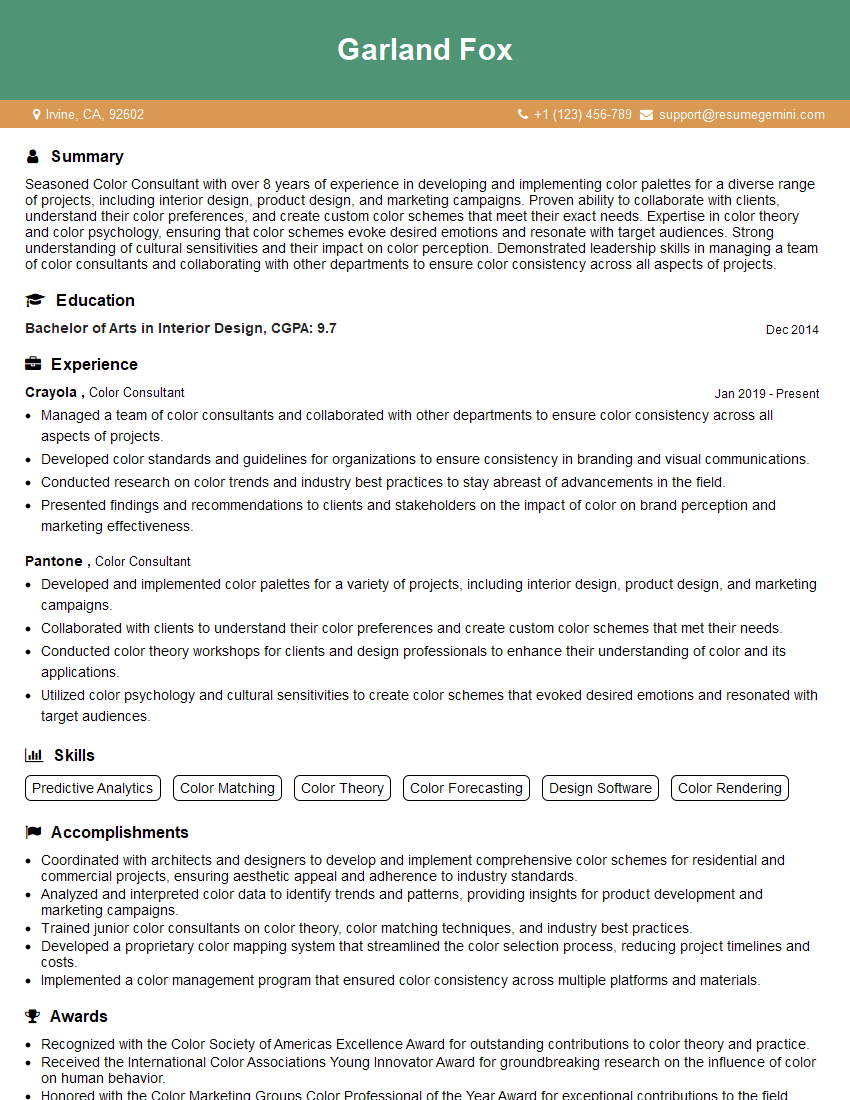
Mastering color matching tools and techniques is crucial for career advancement in many creative and technical fields. A strong understanding of color theory and practical application significantly enhances your value to potential employers. To maximize your job prospects, creating an ATS-friendly resume is essential. ResumeGemini can help you build a professional, impactful resume that highlights your skills effectively. We provide examples of resumes tailored to demonstrate experience in using color matching tools and techniques to give you a head start. Use ResumeGemini to craft a resume that truly showcases your expertise and lands you your dream job.


Explore more articles
Users Rating of Our Blogs
Share Your Experience
We value your feedback! Please rate our content and share your thoughts (optional).
What Readers Say About Our Blog
hello,
Our consultant firm based in the USA and our client are interested in your products.
Could you provide your company brochure and respond from your official email id (if different from the current in use), so i can send you the client’s requirement.
Payment before production.
I await your answer.
Regards,
MrSmith
hello,
Our consultant firm based in the USA and our client are interested in your products.
Could you provide your company brochure and respond from your official email id (if different from the current in use), so i can send you the client’s requirement.
Payment before production.
I await your answer.
Regards,
MrSmith
These apartments are so amazing, posting them online would break the algorithm.
https://bit.ly/Lovely2BedsApartmentHudsonYards
Reach out at [email protected] and let’s get started!
Take a look at this stunning 2-bedroom apartment perfectly situated NYC’s coveted Hudson Yards!
https://bit.ly/Lovely2BedsApartmentHudsonYards
Live Rent Free!
https://bit.ly/LiveRentFREE
Interesting Article, I liked the depth of knowledge you’ve shared.
Helpful, thanks for sharing.
Hi, I represent a social media marketing agency and liked your blog
Hi, I represent an SEO company that specialises in getting you AI citations and higher rankings on Google. I’d like to offer you a 100% free SEO audit for your website. Would you be interested?