The right preparation can turn an interview into an opportunity to showcase your expertise. This guide to FTTH (Fiber to the Home) Deployment interview questions is your ultimate resource, providing key insights and tips to help you ace your responses and stand out as a top candidate.
Questions Asked in FTTH (Fiber to the Home) Deployment Interview
Q 1. Explain the difference between single-mode and multi-mode fiber optic cables.
The core difference between single-mode and multi-mode fiber optic cables lies in the size of their core and how light propagates through them. Think of it like a highway: single-mode is a single-lane highway, allowing only one path for light, while multi-mode is a multi-lane highway, allowing multiple light paths.
- Single-mode fiber: Has a very small core diameter (around 8-10 microns). This allows only a single ray of light to travel down the fiber with minimal dispersion (spreading of the light signal). This makes single-mode fiber ideal for long-distance transmission, high bandwidth applications, and wavelengths exceeding 1310nm and 1550nm. It’s the backbone of long-haul telecommunication networks and is increasingly common in FTTH deployments requiring high speeds and capacity over longer distances.
- Multi-mode fiber: Possesses a larger core diameter (50 or 62.5 microns). This allows multiple light rays to travel along different paths, leading to more signal dispersion. Multi-mode is generally used for shorter distances and lower bandwidth applications. While commonly found in older networks and potentially used for shorter FTTH runs within a building, single-mode is becoming increasingly preferred even in these scenarios due to its future-proofing capabilities.
In FTTH, the choice between single-mode and multi-mode depends on the distance between the central office and the home, and the required bandwidth. For most modern FTTH deployments, single-mode is the preferred choice due to its higher bandwidth capacity and ability to support future upgrades.
Q 2. Describe the process of fiber optic splicing.
Fiber optic splicing is the process of permanently joining two fiber optic cables end-to-end. It’s a crucial step in FTTH deployment that requires precision and specialized equipment. The goal is to create a connection that is as transparent as possible, minimizing signal loss and reflection.
The process typically involves these steps:
- Fiber Preparation: The ends of the fibers are carefully cleaned and cleaved (precisely broken) using a cleaver to create a perfectly flat and perpendicular surface. This is crucial for achieving a good splice. Imperfect cleaves lead to increased losses.
- Splicing: Various splicing techniques exist. Fusion splicing is the most common method. It uses heat and pressure to melt the ends of the fibers together, creating a seamless bond. Mechanical splicing uses mechanical alignment to connect the fibers; though less precise it is useful in certain situations.
- Testing: After splicing, the connection is tested using an Optical Time Domain Reflectometer (OTDR) to measure the loss and reflections at the splice point. Any excessive loss indicates a poor splice that may need to be redone.
Imagine connecting two extremely fine glass threads together seamlessly; that’s the level of precision required. Proper splicing is critical to maintaining signal quality throughout the FTTH network.
Q 3. What are the common causes of fiber optic cable failures?
Fiber optic cable failures can be caused by a variety of factors, ranging from environmental issues to installation errors. Understanding these causes is vital for preventative maintenance and efficient troubleshooting.
- Physical Damage: This is the most common cause. Rodents chewing through cables, accidental cuts during excavation, or excessive bending stress can all lead to fiber breakage.
- Microbending: Repeated, small bends in the fiber can induce micro-fractures, increasing signal attenuation. This often occurs during cable installation or due to vibrations.
- Environmental Factors: Extreme temperatures, humidity, and water ingress can degrade the fiber or its protective jacket, leading to failure. For instance, water can affect the refractive index of the fibre causing significant signal degradation.
- Poor Splices or Connections: Incorrect splicing or damaged connectors introduce loss and reflection, potentially leading to service outages.
- Manufacturing Defects: Although less common, flaws in the manufacturing process can create weak points in the fiber that may eventually fail.
Each of these scenarios requires different strategies for mitigation. Regular inspections, robust cable protection, and proper installation techniques are crucial for minimizing fiber optic cable failures in FTTH networks.
Q 4. How do you troubleshoot fiber optic network connectivity issues?
Troubleshooting fiber optic network connectivity issues requires a systematic approach. It’s a process of elimination, leveraging specialized tools and your knowledge of the network infrastructure.
- Visual Inspection: Start by visually inspecting the cables and connectors for any physical damage or signs of water ingress.
- OTDR Testing: An OTDR pinpoints faults along the fiber’s length, providing precise locations of breaks, splices with high loss, or other anomalies. This is a fundamental step in diagnosing many fibre issues.
- Power Meter Measurements: Power meters measure the optical signal strength at various points in the network, helping identify areas of significant loss or attenuation. This helps to isolate the problem location.
- Connector Inspection: Carefully examine all connectors for cleanliness, damage or improper insertion. Contamination often severely impacts signal transmission.
- Testing Equipment: Use tools such as an optical source and a power meter to verify signal transmission at each point in the network. A faulty piece of equipment can be the source.
- Network Configuration: If the problem seems internal to a device, check network settings. This may involve examining the ONT (Optical Network Terminal) at the home.
Troubleshooting often involves a combination of these techniques. For instance, an OTDR might reveal a break in the cable, and a power meter could confirm the signal loss at that point. A systematic process using the correct tools is key.
Q 5. What are the different types of fiber optic connectors?
Several types of fiber optic connectors are used in FTTH deployments, each with its strengths and weaknesses. The choice often depends on the application and cost considerations.
- SC (Subscriber Connector): A widely used connector known for its reliability and ease of use. It’s relatively inexpensive and a common choice in FTTH.
- LC (Lucent Connector): A smaller, more compact connector than the SC, gaining popularity due to its space-saving nature in high-density applications.
- FC (Ferrule Connector): A robust connector with a threaded coupling, providing excellent mechanical stability. However, it’s generally larger and more expensive.
- ST (Straight Tip): An older connector type, less common in new deployments. Known for its bayonet style locking mechanism.
Each connector type has specific advantages and disadvantages in terms of size, cost, and reliability. Understanding these differences allows technicians to choose the optimal connector for a specific deployment scenario.
Q 6. Explain the importance of OTDR testing in FTTH deployment.
OTDR (Optical Time Domain Reflectometer) testing is indispensable in FTTH deployments for several reasons. It’s a critical tool for ensuring the quality and integrity of the fiber optic network.
- Fault Location: An OTDR can pinpoint the precise location of fiber breaks, splices with high loss, and other faults along the fiber’s length, saving time and resources during troubleshooting.
- Loss Measurement: It measures the signal attenuation (loss) throughout the fiber, helping identify areas that require attention and allowing the assessment of overall network performance.
- Splice Quality: OTDR testing provides information on the quality of fiber splices, enabling technicians to verify that they meet standards and minimise potential issues.
- Network Monitoring: Regular OTDR testing helps monitor the health of the network over time, allowing for proactive maintenance and the prevention of major failures.
- Documentation: The results of OTDR testing provide valuable documentation of the fiber optic network’s condition, aiding in network management and maintenance.
Imagine having a detailed map of your fiber optic network that automatically highlights any problems. That’s what OTDR testing provides, allowing for proactive identification and resolution of issues before they impact service.
Q 7. What safety precautions must be taken when working with fiber optic cables?
Working with fiber optic cables requires strict adherence to safety precautions to prevent eye injury, which is a critical concern, and other hazards.
- Eye Protection: Always wear appropriate eye protection certified to protect against laser light. Never look directly into the end of a fiber cable that might be transmitting light. Even low power lasers can cause irreversible damage.
- Protective Clothing: Use cut-resistant gloves and clothing when working with fibers. The fibers themselves can be sharp and cause cuts.
- Proper Handling: Handle fiber optic cables with care, avoiding excessive bending or twisting. Avoid dropping or stepping on the cables to prevent damage or breakage.
- Grounding: Ensure that all equipment is properly grounded to prevent static electricity discharge, which can damage sensitive fiber optic components.
- Laser Safety Training: All personnel working with fiber optic cables should receive appropriate training on laser safety procedures. It is essential to understand the potential hazards and prevention strategies.
- Safe Working Environment: Maintain a clean and organized working environment to prevent accidental damage or injuries. Ensure proper signage and cautionary procedures.
Fiber optics operate with lasers, which are powerful enough to cause significant injury to the eyes. Proper safety procedures are absolutely paramount.
Q 8. Describe your experience with different FTTH architectures (e.g., point-to-point, PON).
FTTH architectures dictate how fiber optic cables are deployed to reach individual homes. Two primary architectures are point-to-point and Passive Optical Network (PON). Point-to-point uses a dedicated fiber strand for each home, offering exceptional bandwidth and security but proving expensive for large-scale deployment. Think of it like a private phone line for each house. PON, on the other hand, is a shared architecture where multiple homes share a single fiber strand through optical splitters. This significantly reduces cost but might slightly reduce bandwidth per user, especially during peak times. Imagine it like a shared internet line in an apartment building. In my experience, I’ve worked extensively with both. On smaller, high-end projects, point-to-point offered superior performance, but for larger-scale deployments in suburban and rural areas, PON’s cost-effectiveness made it the clear winner. I’ve worked specifically with GPON (Gigabit PON) and XGS-PON (10 Gigabit PON) technologies, selecting the appropriate technology based on bandwidth needs and future-proofing considerations.
Q 9. What are the advantages and disadvantages of different FTTH deployment methods?
FTTH deployment methods vary greatly, impacting cost, timeline, and disruption. Aerial deployment involves stringing fiber along existing utility poles, which is cost-effective but weather-dependent and visually impactful. Underground deployment, burying the fiber, is more expensive and time-consuming but offers better protection and aesthetics. A third method is building integrated, running fiber within existing building structures. This method is optimal for new constructions or building renovations, optimizing cable management and minimizing environmental impact. Each method has its pros and cons. Aerial deployment is quick and cheap for initial rollout but susceptible to damage during storms and less appealing aesthetically. Underground deployment is robust but expensive and requires extensive planning and permits. Building-integrated deployments are clean but are limited to new constructions or extensive renovations. My experience includes all three methods; the optimal choice always depends on factors such as budget, terrain, existing infrastructure, and environmental considerations. For example, in a densely populated urban area with existing underground infrastructure, an underground deployment might be preferred, even with its higher cost. In a rural area with readily available utility poles, aerial deployment becomes more attractive.
Q 10. How do you manage FTTH project timelines and budgets?
Managing FTTH project timelines and budgets requires meticulous planning and strong project management skills. I use a combination of tools and techniques, including critical path method (CPM) analysis, earned value management (EVM), and agile methodologies. First, a detailed work breakdown structure (WBS) is crucial. Then, accurate estimations of task durations and resource allocation are made, considering potential delays. Regular progress monitoring, using EVM, helps track performance against the baseline plan. Any deviation warrants immediate attention and corrective actions. For example, unforeseen delays due to permitting issues can be mitigated by proactively engaging with relevant authorities early on. Budget management involves detailed cost estimations, contingency planning, and regular cost tracking. Regular reporting keeps stakeholders informed of progress and any necessary adjustments. I utilize project management software for tracking tasks, resources, and budgets, keeping a collaborative environment where issues are flagged promptly. A key to success is clear communication and proactive risk management.
Q 11. Describe your experience with fiber optic cable testing equipment.
My experience with fiber optic cable testing equipment is extensive. I’m proficient in using OTDRs (Optical Time-Domain Reflectometers) to locate faults, measure fiber length, and assess fiber attenuation. I also utilize optical power meters to verify signal strength at various points in the network. Additionally, I’m familiar with various types of fiber testing equipment: optical spectrum analyzers (OSA) for measuring wavelength and spectral characteristics, and loss testing equipment for testing connectors and splices. For example, using an OTDR, I can quickly identify the location of a fiber break or a high-loss splice and determine the cause. This knowledge reduces downtime and improves the efficiency of troubleshooting activities, ultimately providing faster solutions to connectivity issues. Proper testing procedures ensure the quality of the deployed fiber network.
Q 12. What are your skills in using GIS mapping software for FTTH planning?
GIS (Geographic Information System) mapping software is essential for FTTH planning. My skills include using GIS to design optimal network layouts, identifying suitable locations for equipment (e.g., central offices, optical distribution points), and analyzing terrain data for optimal cable routing. I leverage GIS to model different deployment scenarios, assessing their feasibility and cost-effectiveness. For instance, I can use GIS to map existing infrastructure, such as utility poles and underground conduits, to identify potential cable routes and minimize disruptions. GIS also enables efficient spatial analysis for identifying areas with high subscriber density to prioritize deployment efforts. Proficiency in GIS ensures efficient planning, cost optimization, and effective resource allocation. Specific software I have experience with includes ArcGIS and QGIS.
Q 13. How do you ensure the quality of FTTH installations?
Ensuring quality FTTH installations is paramount. My approach involves a multi-faceted strategy encompassing rigorous quality control procedures at every stage of the deployment process. This includes careful fiber splicing and connectorization techniques following industry best practices (e.g., IEC standards). Regular testing, using OTDRs and power meters as mentioned previously, is crucial at each stage to identify and address any issues early on. Furthermore, thorough documentation, including as-built drawings, ensures accurate record-keeping and facilitates future maintenance. My team employs strict adherence to safety protocols during all phases of installation, guaranteeing the safety of personnel and preventing equipment damage. Periodic audits and inspections ensure continued high quality standards. In essence, a commitment to quality starts with skilled technicians and robust processes, leading to a reliable, high-performing FTTH network.
Q 14. Explain your experience with FTTH network design and planning.
FTTH network design and planning requires a holistic approach, considering factors such as bandwidth requirements, subscriber density, existing infrastructure, and budget constraints. My experience includes designing both point-to-point and PON networks, optimizing network topology (e.g., star, ring, mesh) to ensure optimal performance and scalability. I use network simulation tools to predict network behavior under various load conditions, enabling proactive identification and mitigation of potential bottlenecks. Furthermore, I incorporate future-proofing considerations into the design, selecting technologies capable of accommodating increasing bandwidth demands. For example, when planning a new FTTH network for a rapidly growing suburb, I’d design a scalable PON architecture with sufficient capacity to handle future growth. This might involve selecting XGS-PON technology instead of GPON to offer sufficient bandwidth for the foreseeable future. The goal is always to design a robust, scalable, and cost-effective network that meets present and future needs.
Q 15. Describe your experience with different types of FTTH termination equipment.
My experience encompasses a wide range of FTTH termination equipment, from simple mechanical splices to sophisticated optical connectors and splitters. I’ve worked extensively with various types of splice closures, designed to protect the fiber optic connections from environmental factors like moisture and rodents. These range from small, single-fiber closures suitable for residential installations to larger, multi-fiber closures used in central offices or street cabinets.
In terms of connectors, I’m proficient with SC, LC, and FC connectors, understanding their respective advantages and applications. For instance, LC connectors are preferred in high-density applications due to their smaller size, while SC connectors are known for their robustness and ease of use. I also possess experience with different types of optical splitters, including PLC splitters (Planar Lightwave Circuit) which are commonly used for distributing fiber signals to multiple homes from a single feeder fiber, and FBT splitters (Fused Biconic Taper) that offer a more cost-effective solution in certain scenarios. Understanding the specific characteristics and limitations of each type is crucial for optimal network performance and efficient troubleshooting.
Furthermore, I’ve worked with various ODFs (Optical Distribution Frames) – the central point for managing fiber optic cables within a building or central office. Proper management within the ODF is key for efficient organization, maintenance, and future expansion. I’m adept at patching, labeling, and maintaining these systems.
Career Expert Tips:
- Ace those interviews! Prepare effectively by reviewing the Top 50 Most Common Interview Questions on ResumeGemini.
- Navigate your job search with confidence! Explore a wide range of Career Tips on ResumeGemini. Learn about common challenges and recommendations to overcome them.
- Craft the perfect resume! Master the Art of Resume Writing with ResumeGemini’s guide. Showcase your unique qualifications and achievements effectively.
- Don’t miss out on holiday savings! Build your dream resume with ResumeGemini’s ATS optimized templates.
Q 16. How do you handle customer complaints related to FTTH service disruptions?
Handling customer complaints regarding FTTH service disruptions requires a systematic approach. My first step is to actively listen to the customer, empathizing with their frustration. I then gather key information: the nature of the disruption (e.g., no internet, slow speeds, intermittent connectivity), the time it started, and any preceding events.
Next, I perform a preliminary troubleshooting check via phone or remote diagnostics tools, if available. This might involve simple steps like checking power to the ONT (Optical Network Terminal), confirming the ONT’s status lights, or performing a basic network test. This helps to quickly identify issues that can be resolved remotely, such as a power outage at the customer’s premises.
If the problem isn’t easily resolved, I escalate the issue internally. This involves using our internal ticketing system to log the problem, assigning it to the appropriate technical team for field investigation. I keep the customer updated throughout the process, providing realistic timelines and explaining the next steps. Effective communication is critical to maintaining customer satisfaction even when dealing with complex issues. Following the resolution, I ensure customer satisfaction by following up and obtaining feedback.
Q 17. What experience do you have with FTTH documentation and reporting?
My experience with FTTH documentation and reporting is extensive. I’m proficient in using various software packages for generating and managing documentation, including GIS mapping systems to track fiber routes and network infrastructure, and specialized network management systems for generating reports on network performance and capacity.
I understand the importance of accurate ‘as-built’ drawings and comprehensive records, reflecting the actual network configuration. This includes detailed documentation of splice points, cable routes, equipment locations, and ONT installations. These drawings are essential for maintenance, troubleshooting, and future network expansions. I also have experience creating reports on KPIs (Key Performance Indicators) such as network availability, latency, and error rates, utilizing this data to identify areas for improvement and optimization.
Furthermore, I’m comfortable creating reports that align with industry standards and regulatory requirements, ensuring compliance with relevant rules and regulations. This includes documentation for audits or for reporting progress on projects to stakeholders. I believe in maintaining a meticulous record-keeping system to allow for accurate and efficient reporting and troubleshooting.
Q 18. Explain your understanding of FTTH network security.
FTTH network security is paramount, encompassing both physical and cyber security aspects. Physically securing the network involves protecting fiber optic cables from unauthorized access, damage, or theft. This might involve securing cabinets and splice closures, utilizing locking mechanisms, and regularly inspecting the network infrastructure for signs of tampering.
Cybersecurity focuses on protecting the network from unauthorized access and malicious attacks. This includes secure configurations of network devices (ONTs, OLTs, etc.), implementing strong passwords and access controls, and employing firewalls and intrusion detection systems. Regular software updates are also critical in mitigating vulnerabilities. Encryption protocols, such as those used for securing data transmission, are crucial.
I’m familiar with various security protocols and best practices for implementing them in an FTTH environment. For example, understanding the importance of utilizing strong authentication mechanisms to control access to the network and regular security audits to detect and address vulnerabilities is critical.
Q 19. Describe your experience with FTTH network maintenance and troubleshooting.
My FTTH network maintenance and troubleshooting experience involves a blend of proactive and reactive measures. Proactive maintenance includes regular inspections of the network infrastructure to identify potential problems before they cause service disruptions. This involves visually inspecting cables, splice closures, and equipment for signs of damage or deterioration. Preventive maintenance also includes cleaning optical connectors and regularly testing network performance.
Reactive troubleshooting involves diagnosing and resolving issues that cause service disruptions. This might involve using OTDRs (Optical Time-Domain Reflectometers) to locate faults in the fiber optic cables, analyzing network performance data to identify bottlenecks, or using specialized test equipment to check the functionality of individual components. I have expertise in isolating and addressing issues efficiently, minimizing downtime for customers. I also utilize remote monitoring tools that alert me to potential problems before customers experience them.
Effective troubleshooting often involves systematically eliminating possibilities. For example, if a customer reports no service, I would first check the power at the ONT, then test the connectivity between the ONT and the customer’s router, before investigating deeper issues such as fiber breaks or equipment malfunctions.
Q 20. What is your experience with FTTH commissioning and testing?
FTTH commissioning and testing is a crucial phase ensuring the network’s readiness for service. It involves a rigorous series of tests to verify the network’s performance and compliance with specifications. This includes testing individual fiber optic cables for attenuation, loss, and reflections using OTDRs, testing the optical power levels at various points in the network, and verifying the functionality of the OLTs and ONTs.
I’m proficient in using various test equipment, including OTDRs, power meters, and optical spectrum analyzers. I understand the importance of detailed test reports, documenting the results of each test and ensuring that the network meets the required performance standards. This documentation is crucial for validating the network’s proper operation and for troubleshooting issues during the warranty period.
The process also involves testing the network’s overall performance, including speed tests, latency measurements, and data throughput. These tests help ensure the network delivers the promised bandwidth and quality of service to customers. A thorough commissioning phase minimizes problems after service launch.
Q 21. How do you manage risk in FTTH projects?
Risk management in FTTH projects is critical to ensure project success and minimize potential disruptions. I utilize a systematic approach that involves identifying potential risks, assessing their likelihood and impact, and developing mitigation strategies.
Common risks include environmental factors (e.g., weather damage to aerial cables), construction issues (e.g., accidental cable damage during excavation), equipment failures, and regulatory hurdles. I develop risk registers, documenting each identified risk, its potential impact, and planned mitigation actions. This involves utilizing historical data, industry best practices, and collaboration with stakeholders across different teams.
My mitigation strategies often include contingency planning (e.g., having backup equipment available), implementing robust quality control procedures, utilizing appropriate construction techniques to minimize cable damage, and building strong relationships with local authorities to navigate regulatory processes. Regular monitoring and review of risks are crucial, adapting mitigation strategies as needed throughout the project lifecycle.
Q 22. Explain your understanding of different FTTH technologies (e.g., GPON, XGSPON).
FTTH networks utilize various technologies to deliver high-speed internet access to homes. Two prominent examples are GPON and XGSPON, both based on passive optical networks (PONs). The key difference lies in their bandwidth capabilities and technological advancements.
- GPON (Gigabit Passive Optical Network): GPON is a mature technology offering downstream speeds up to 2.5 Gbps and upstream speeds up to 1.25 Gbps. It uses wavelength-division multiplexing (WDM) to transmit data on multiple wavelengths over a single fiber. Think of it like a highway with multiple lanes, each carrying different data streams simultaneously. This allows a single fiber to serve multiple homes (typically 64). GPON’s relatively lower cost and wide deployment make it a prevalent choice.
- XGSPON (10G GPON): XGSPON represents a significant upgrade, delivering downstream speeds of up to 10 Gbps and upstream speeds of up to 2.5 Gbps. It’s essentially a faster, more capacity-rich version of GPON, capable of supporting higher bandwidth demands like 4K video streaming and online gaming. It uses similar principles to GPON but with enhanced capacity and more advanced modulation techniques to achieve these higher speeds. It’s ideal for areas expecting future bandwidth growth.
Other technologies like EPON (Ethernet PON) also exist, but GPON and XGSPON dominate the market due to their superior performance and scalability.
Q 23. Describe your experience with working in a team environment on FTTH projects.
My experience in team environments on FTTH projects has been extensive. I’ve collaborated with engineers, technicians, project managers, and even marketing teams to successfully deliver large-scale deployments. One project involved coordinating a team of 20 to deploy FTTH in a rural area with challenging terrain. Effective teamwork was crucial. We used agile methodologies, breaking down the project into manageable sprints, holding daily stand-up meetings, and utilizing project management software to track progress and resource allocation. Open communication, constructive feedback, and a clear division of responsibilities were vital in overcoming challenges such as logistical issues and unexpected site conditions. My role involved not only technical contributions but also mentoring junior engineers and facilitating collaboration across different departments.
Q 24. What is your understanding of FTTH regulations and compliance requirements?
FTTH deployments are subject to a range of regulations and compliance requirements, varying by country and region. These regulations generally cover areas such as:
- Safety Standards: Compliance with safety standards for fiber optic cable installation and maintenance is paramount. This includes adhering to regulations on trenching, cable routing, and working at heights.
- Environmental Regulations: Regulations concerning environmental impact, such as minimizing disturbance to natural habitats during cable laying, are important considerations.
- Data Privacy: Regulations regarding the protection of user data transmitted over the network must be strictly followed. This involves implementing appropriate security measures and complying with data privacy laws.
- Accessibility and Affordability: In some regions, there are regulatory frameworks promoting broad access and affordability of FTTH services, aiming for universal coverage.
Understanding and adhering to these regulations is crucial for ensuring successful and legally compliant project execution. Non-compliance can lead to significant penalties and reputational damage.
Q 25. How do you stay up-to-date on the latest advancements in FTTH technology?
Keeping up-to-date with the latest FTTH advancements is a continuous process. I utilize several strategies:
- Industry Publications and Journals: I regularly read publications such as the Lightwave, Fiber Optics Technology, and other industry-specific journals.
- Conferences and Trade Shows: Attending industry events such as OFC (Optical Fiber Communication Conference) and others allows direct interaction with experts and access to the latest technology demonstrations.
- Online Resources and Webinars: I actively participate in online forums and webinars hosted by manufacturers and industry organizations.
- Professional Organizations: Membership in professional organizations keeps me updated through newsletters, white papers, and access to expert networks.
- Manufacturer Websites and Documentation: Staying informed on the latest products and specifications directly from manufacturers.
This multi-faceted approach helps me maintain a comprehensive understanding of the evolving landscape of FTTH technologies.
Q 26. Describe a challenging FTTH project and how you overcame the challenges.
One challenging project involved deploying FTTH in a densely populated urban area with limited access to underground infrastructure. The existing infrastructure was congested, posing difficulties in cable routing. The solution involved a phased approach:
- Detailed Site Surveys: We conducted thorough site surveys utilizing advanced mapping tools and GIS to identify optimal cable routes and minimize disruption to existing utilities.
- Collaboration with Utility Companies: Close collaboration with local utility companies was crucial to secure permissions and coordinate around existing infrastructure.
- Innovative Cable Routing: We employed innovative techniques like micro-trenching and aerial cable deployment where underground access was limited.
- Optimized Resource Allocation: We developed an optimized deployment schedule, allocating resources effectively to balance speed with minimization of disruption.
- Real-time Monitoring and Adjustment: Throughout the project, we implemented a system for real-time monitoring, adjusting plans as needed to mitigate unexpected issues.
Through proactive planning, collaboration, and adaptability, we successfully completed the project on time and within budget, demonstrating my ability to manage complexities and deliver successful outcomes in demanding situations.
Q 27. What are your salary expectations for this FTTH role?
My salary expectations for this FTTH role are commensurate with my experience and the responsibilities involved. Based on my research and understanding of current market rates for similar roles with my expertise, I am targeting a salary range of [Insert Salary Range]. I am open to discussing this further based on the specifics of the role and the overall compensation package.
Q 28. What are your long-term career goals related to FTTH?
My long-term career goals involve becoming a leading expert in FTTH network design and optimization. I aim to contribute to the expansion of high-speed internet access, particularly in underserved communities. This includes developing innovative solutions for cost-effective and sustainable FTTH deployment, focusing on emerging technologies and sustainable practices. Ultimately, I aspire to a leadership role where I can mentor and guide future generations of FTTH professionals, shaping the future of high-speed connectivity.
Key Topics to Learn for FTTH (Fiber to the Home) Deployment Interview
- Fiber Optic Cable Types and Properties: Understand the different types of fiber optic cables used in FTTH deployments (e.g., single-mode, multi-mode) and their respective characteristics, advantages, and limitations. Consider practical applications like choosing the right cable for different deployment scenarios.
- FTTH Network Architectures: Familiarize yourself with common FTTH architectures (e.g., point-to-point, point-to-multipoint, passive optical networks – PONs). Be prepared to discuss the pros and cons of each architecture and their suitability for various deployment environments. Consider real-world examples of successful and unsuccessful deployments and the reasons why.
- Optical Network Terminators (ONTs) and Optical Line Terminals (OLTs): Gain a thorough understanding of the function and operation of ONTs and OLTs. Be able to discuss their technical specifications, troubleshooting common issues, and their role in ensuring network performance. This should include practical application of maintenance procedures.
- Splicing and Termination Techniques: Master the skills and techniques involved in splicing and terminating fiber optic cables. Understand the importance of precision and the potential consequences of errors. Prepare to discuss different splicing methods and their applications.
- Testing and Troubleshooting: Become proficient in using OTDRs (Optical Time Domain Reflectometers) and other testing equipment to identify and resolve network faults. Be ready to discuss troubleshooting methodologies and your experience in identifying and resolving common problems in FTTH deployments. This also includes understanding different types of fiber optic testing.
- Deployment Strategies and Planning: Understand the various aspects of planning and executing an FTTH deployment, including site surveys, route planning, and permitting. This includes practical applications like optimizing routes to minimize costs and disruption.
- Safety Regulations and Procedures: Familiarize yourself with relevant safety regulations and procedures related to working with fiber optic cables and equipment. This is crucial for ensuring workplace safety and avoiding potential hazards.
Next Steps
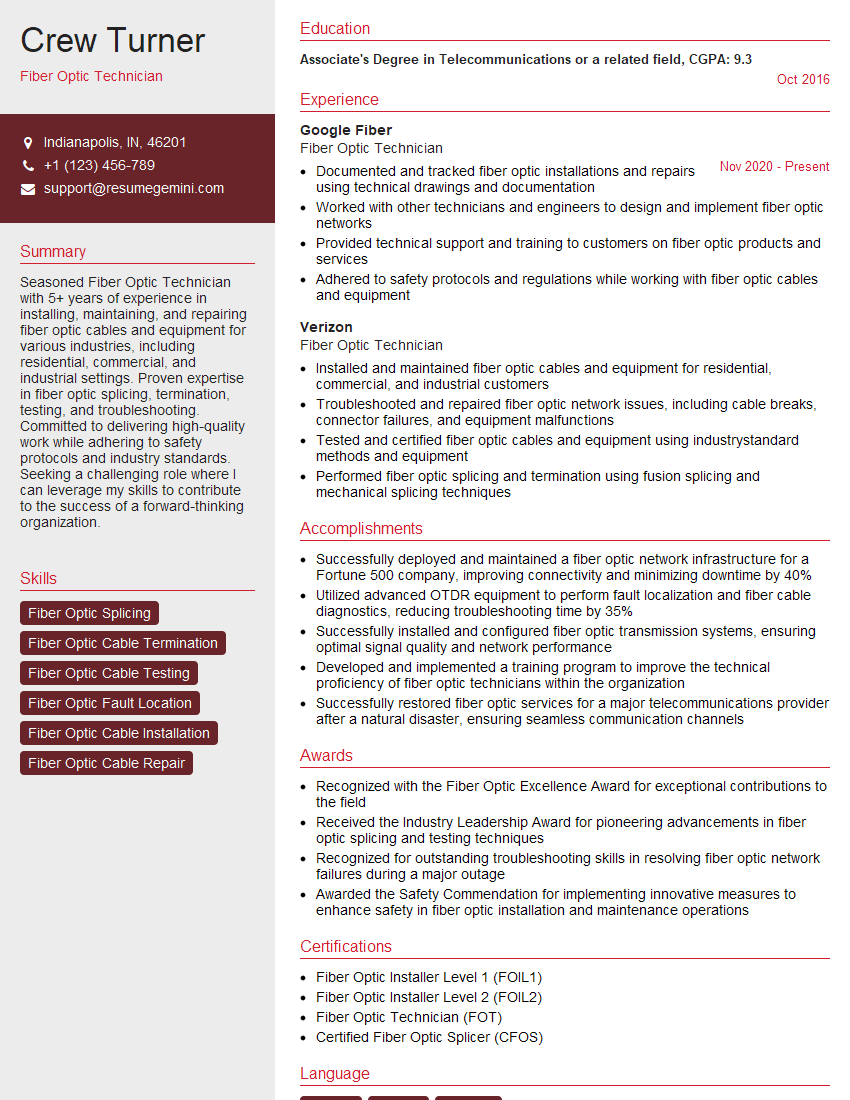
Mastering FTTH deployment opens doors to exciting career opportunities in a rapidly growing industry. A strong understanding of these concepts significantly enhances your job prospects. To further improve your chances, invest time in creating an ATS-friendly resume that highlights your skills and experience effectively. ResumeGemini is a trusted resource that can help you build a professional and impactful resume. Examples of resumes tailored to FTTH (Fiber to the Home) Deployment are available to guide you, ensuring your application stands out.
Explore more articles
Users Rating of Our Blogs
Share Your Experience
We value your feedback! Please rate our content and share your thoughts (optional).
What Readers Say About Our Blog
hello,
Our consultant firm based in the USA and our client are interested in your products.
Could you provide your company brochure and respond from your official email id (if different from the current in use), so i can send you the client’s requirement.
Payment before production.
I await your answer.
Regards,
MrSmith
hello,
Our consultant firm based in the USA and our client are interested in your products.
Could you provide your company brochure and respond from your official email id (if different from the current in use), so i can send you the client’s requirement.
Payment before production.
I await your answer.
Regards,
MrSmith
These apartments are so amazing, posting them online would break the algorithm.
https://bit.ly/Lovely2BedsApartmentHudsonYards
Reach out at [email protected] and let’s get started!
Take a look at this stunning 2-bedroom apartment perfectly situated NYC’s coveted Hudson Yards!
https://bit.ly/Lovely2BedsApartmentHudsonYards
Live Rent Free!
https://bit.ly/LiveRentFREE
Interesting Article, I liked the depth of knowledge you’ve shared.
Helpful, thanks for sharing.
Hi, I represent a social media marketing agency and liked your blog
Hi, I represent an SEO company that specialises in getting you AI citations and higher rankings on Google. I’d like to offer you a 100% free SEO audit for your website. Would you be interested?