The thought of an interview can be nerve-wracking, but the right preparation can make all the difference. Explore this comprehensive guide to Furniture Carving interview questions and gain the confidence you need to showcase your abilities and secure the role.
Questions Asked in Furniture Carving Interview
Q 1. What types of wood are best suited for intricate carving?
Choosing the right wood is paramount for intricate carving. The ideal wood needs to be hard enough to hold detail without chipping, yet soft enough to carve without excessive force or tool breakage. Some excellent choices include:
- Limewood (Tilia): A classic choice, limewood is relatively soft, fine-grained, and easily carved, making it perfect for delicate details and high-relief work. It’s my go-to for most projects involving intricate patterns.
- Basswood (Tilia americana): Similar to limewood in its properties, basswood is another excellent option, known for its smooth texture and ability to hold fine details. It’s particularly good for projects requiring a consistent, even carving surface.
- Mahogany (Swietenia): Offers a beautiful reddish-brown hue and a slightly harder texture than limewood or basswood. While it requires a bit more skill and effort to carve intricate details, the resulting piece possesses a luxurious finish and durability. I often use mahogany for pieces where both aesthetic appeal and strength are crucial.
- Pearwood (Pyrus communis): A harder wood with a fine grain, pearwood takes a beautiful polish and is very strong. It’s ideal for smaller, highly detailed carvings that need to withstand wear and tear, perhaps small figurines or decorative elements.
The choice ultimately depends on the specific project, desired aesthetic, and the carver’s skill level. For a beginner, limewood or basswood are recommended; more experienced carvers can tackle harder woods like mahogany or pearwood.
Q 2. Describe your experience with various carving tools.
My experience spans a wide range of carving tools, each suited to different tasks. I’m proficient with both hand tools and power tools, understanding the strengths and limitations of each. Hand tools allow for greater control and precision, especially in intricate work.
- Chisels: From detail chisels (very small, for fine work) to gouges (U-shaped, for shaping curves), I use a wide variety of chisels, selecting them based on the size and shape of the carving element. Maintaining sharp chisels is essential for clean cuts and preventing damage to the wood.
- Mallet: Essential for striking chisels accurately and efficiently. I use a mallet made of a softer material (like wood or rawhide) to prevent damage to the chisel handles.
- Knives: Various types of knives, including detail knives and carving knives, are used for creating sharp lines and removing fine shavings. A very sharp knife is needed here for precision work.
- Power Carving Tools (rotary tools): I use these for initial shaping, removing large amounts of wood quickly and for detailed sculpting. The speed control is critical, to avoid burning the wood.
Proper tool maintenance—sharpening, honing, and cleaning—is crucial for efficient and safe carving. A dull tool requires more force, increasing the risk of injury and causing imprecise cuts.
Q 3. Explain the process of creating a carving pattern.
Creating a carving pattern involves several steps, starting with the initial concept. This might be a sketch, a photograph, a 3D model, or even a mental image.
- Concept and Sketching: I begin by sketching the design, experimenting with different compositions and refining the details. This phase is crucial in identifying areas of complexity and potential challenges.
- Full-Scale Drawing: Once the sketch is finalized, I create a full-scale drawing on paper, precisely measuring proportions and details. This detailed drawing acts as my guide during the carving process.
- Transferring the Pattern: I transfer the design onto the wood using various methods, such as tracing paper, carbon paper, or direct freehand drawing. The method chosen depends on the complexity of the design and my personal preference.
- Template Creation (for repetitive elements): If the design includes repeating elements, I might create templates from durable materials like acrylic or thin plywood to ensure consistent shape and size.
The accuracy of the pattern is fundamental to the success of the carving; taking time to meticulously plan and execute this stage is always worth the effort.
Q 4. How do you ensure the accuracy and precision of your carvings?
Accuracy and precision are paramount in carving. I use a combination of techniques to ensure high-quality results.
- Sharp Tools: As mentioned earlier, sharp tools are fundamental. Dull tools lead to uneven cuts and inaccuracies.
- Careful Planning and Marking: Precise measurements and markings on the wood guide the carving process. Using marking gauges and dividers helps maintain consistent measurements.
- Gradual Removal of Wood: Instead of aggressively removing large amounts of wood at once, I work in stages, gradually shaping the form. This allows for greater control and helps avoid errors.
- Frequent Checks and Adjustments: Throughout the process, I regularly compare the carving to the pattern, making adjustments as needed. This prevents small errors from compounding into bigger issues.
- Use of Measuring Tools: Calipers and rulers are used to ensure accurate dimensions and consistent shapes throughout the piece.
Experience and practice are invaluable in developing the eye and hand coordination required for precise carving. Precision comes from a combination of skilled techniques and careful attention to detail.
Q 5. What are the different carving techniques you are proficient in?
My carving repertoire encompasses several techniques, each with its own advantages:
- Relief Carving: This involves carving a design that projects from a flat background. It can range from low relief (slightly raised) to high relief (deeply carved). I often use this technique for decorative panels and architectural elements.
- In-the-Round Carving: This technique involves carving a three-dimensional form, such as a statue or figurine. It’s more complex and requires a deep understanding of form and anatomy.
- Chip Carving: This is a geometric carving technique that uses a series of V-shaped cuts to create patterns on a flat surface. It allows for the creation of sharp, detailed designs.
- Whittling: A versatile technique using a knife to create a wide variety of shapes and forms. Often employed for smaller carvings or preparatory shaping.
I adapt my approach based on the project’s demands, seamlessly integrating different techniques for the best results. For example, I might use chip carving to add decorative elements to a relief carving.
Q 6. How do you handle complex, three-dimensional carving projects?
Handling complex, three-dimensional projects requires a structured approach:
- Detailed Planning: Thorough planning is crucial. I create multiple views of the design (front, side, top) and consider the internal structure before starting.
- Step-by-Step Approach: I break down the project into manageable stages, focusing on one area at a time. This prevents overwhelming the process and allows for regular checks of progress.
- Careful Removal of Wood: The sequence of removing wood is very important. Working from larger shapes to finer details ensures less chance of damaging the piece during the carving process.
- Reference Points: Establishing reference points on the wood helps maintain proportions and accurate placement of features.
- Use of Tools: Choosing the right tools for each stage is essential. I might use power tools for initial shaping and hand tools for finer details.
- Regular Assessments: I regularly assess the carving from different angles, comparing it to the design and making adjustments as needed. This iterative process ensures accuracy.
Patience and persistence are key to completing complex 3D carvings successfully. I often use armatures for larger, intricate pieces, supporting their form as I remove wood.
Q 7. Describe your experience with wood restoration techniques related to carving.
Wood restoration related to carving requires a delicate touch and specific skills. My experience includes:
- Cleaning: Removing dirt, grime, and insect damage through careful cleaning and gentle brushing.
- Repairing Cracks: Filling cracks using wood filler or consolidants, carefully matching the color and texture of the surrounding wood. This step must be done carefully to not negatively impact the integrity of the original carving.
- Re-attaching Broken Pieces: Repairing broken pieces using specialized adhesives and clamping techniques to ensure a stable and lasting repair.
- Color Matching: Restoring faded or damaged areas by carefully applying pigments and finishing techniques to match the original color. This requires an expert’s eye and knowledge of wood finishes.
- Surface Refinishing: Carefully sanding and polishing the surface to restore the original luster, taking care not to remove details.
Restoration necessitates a deep understanding of wood properties, carving techniques, and appropriate finishing materials. Ethical restoration prioritizes preserving the original carving’s integrity while stabilizing and enhancing its longevity. It’s crucial to understand what can be ethically restored versus what should be left alone.
Q 8. How do you maintain the sharpness and condition of your carving tools?
Maintaining sharp carving tools is paramount for both efficiency and safety. Think of it like a chef maintaining their knives – dull tools lead to frustration, poor results, and increased risk of injury.
Honing: I regularly hone my tools using a honing steel before and even during a carving session. This aligns the edge, removing minor burrs and keeping it keen. It’s a preventative measure, not a sharpening method.
Sharpening: For more significant dulling, I use sharpening stones, progressing through different grits (coarse to fine) to achieve a razor-sharp edge. This is a more involved process and requires patience and a steady hand.
Storage: Proper storage is crucial. I keep my tools in a designated case or rack, individually sheathed or protected to prevent damage to the blades and accidental cuts.
Tool Selection: Using the right tool for the job minimizes wear and tear. I have a variety of chisels, gouges, and knives, each designed for specific carving tasks, preventing overuse of any single tool.
Regular maintenance ensures smooth, clean cuts, reduces effort, and extends the lifespan of my valuable carving tools. Neglecting this leads to frustrating work and potential injury.
Q 9. What safety precautions do you take while carving?
Safety in furniture carving is non-negotiable. A single slip can have severe consequences. My approach is layered, incorporating several crucial aspects:
Sharp Tools: Ironically, sharp tools are safer than dull ones. A dull tool requires more force, increasing the risk of slippage. Regular honing and sharpening are vital.
Proper Posture and Grip: I maintain a comfortable and stable posture, ensuring a secure grip on my tools. This minimizes strain and increases control.
Protective Gear: I always wear safety glasses to protect my eyes from flying wood chips, and cut-resistant gloves to shield my hands. For larger projects, a dust mask is also essential.
Work Area: My workspace is well-lit, clutter-free, and has a stable work surface. I keep tools within easy reach but not in a position where they can be knocked over easily.
Awareness: I remain fully focused on my work, avoiding distractions. I take breaks to rest and refocus before continuing. Carving requires concentration and mental alertness.
Carving involves sharp instruments, and I prioritize safety at every step, viewing it not just as a rule, but as an integral part of the creative process.
Q 10. How do you estimate the time required for a carving project?
Estimating time for a carving project is a blend of experience and careful planning. It’s not an exact science, but rather a refined estimation based on several factors.
Design Complexity: Highly detailed and intricate designs naturally take longer than simpler ones. I break down complex designs into smaller, manageable sections to better estimate each part.
Wood Type and Grain: Harder woods, such as ebony or lignum vitae, require more time and effort to carve than softer woods like basswood. The wood grain itself can influence the carving time; figuring grain can be challenging.
Tooling and Technique: My proficiency with different carving tools significantly impacts the speed. More efficient techniques reduce time spent. I’ll also estimate time based on the tools I plan to use, and if they are ideal for the project.
Previous Experience: My past experience with similar projects provides a baseline. I keep a log of past projects, noting time spent on different aspects, assisting future estimates.
I often overestimate initially, building in a buffer for unexpected challenges or refinements. It’s better to have extra time than to rush the project and compromise quality.
Q 11. Explain your experience working with different wood grains.
Working with various wood grains is a core aspect of furniture carving. Each grain presents unique challenges and opportunities.
Hardwoods: Hardwoods like oak, mahogany, and cherry offer strength and durability, but require sharper tools and more effort to carve. The close grain allows for fine detail. For example, carving detailed acanthus leaves in mahogany requires precision and patience.
Softwoods: Softwoods such as pine or basswood are easier to carve, ideal for beginners or for projects requiring rapid prototyping. However, they are less durable and may not hold fine details as well. They are good for practice pieces and quicker projects.
Figured Woods: Woods with striking grain patterns, like burl wood or curly maple, add visual interest. Carving into these requires awareness of the grain direction to prevent splitting or tear-out. The grain itself often dictates the design.
Exotic Woods: Working with exotic woods like ebony or rosewood introduces new considerations regarding tool maintenance, cost and the potential for allergic reactions. They offer striking aesthetic qualities but require specialized knowledge.
Understanding wood properties is crucial for selecting the appropriate wood for a project and adapting carving techniques accordingly. Experience allows me to anticipate and overcome grain-related challenges.
Q 12. How do you transfer a design onto wood for carving?
Transferring a design onto wood is crucial for accuracy. I employ several methods depending on the complexity of the design.
Tracing: For simpler designs, I trace the pattern onto carbon paper, placing it between the pattern and the wood. Tracing then reveals the pattern on the wood’s surface.
Projector: For more intricate designs, a projector allows me to enlarge and project the design directly onto the wood. This method requires a well-lit area and a stable surface for the wood.
Rubbing: I can also use a rubbing technique, carefully rubbing a pencil or charcoal along the back of the pattern, transferring the outline to the wood’s surface. This technique requires a delicate hand.
Digital Transfer: If I create the design digitally, I can use a laser printer to print the design onto transfer paper. This paper can then be applied to the wood.
Choosing the appropriate method depends on design complexity, scale, and my personal preference. Accuracy is vital at this stage to ensure the carving accurately reflects the intended design.
Q 13. Describe your process for finishing a carved piece.
Finishing a carved piece elevates it from raw wood to a polished masterpiece. My finishing process is meticulous and involves several steps:
Sanding: I start by sanding the piece, progressing through various grits of sandpaper, from coarse to fine, to smooth out any imperfections and create a uniform surface. This is crucial for an even finish.
Cleaning: Thorough cleaning removes sawdust and debris before applying any finish. Compressed air is useful for this step.
Applying Finish: I choose a finish based on the wood and desired aesthetic. Options include oil, varnish, shellac, or wax. I apply multiple thin coats, allowing each to dry completely before applying the next for a durable and attractive finish.
Buffing (Optional): After the finish dries, buffing enhances the luster and smoothness. This final touch brings out the natural beauty of the wood and the intricacy of the carving.
The finishing process transforms the raw carving, protecting it from the elements and enhancing its beauty. It is as essential as the carving itself.
Q 14. What software or CAD programs are you familiar with for designing carvings?
While traditional methods are still my preference, I am proficient in using digital design tools to assist in the design phase of my furniture carving projects.
SketchUp: I use SketchUp for 3D modeling, visualizing the carving in three dimensions before I begin. This helps in planning, especially with complex or large-scale projects. It allows me to refine the design digitally before committing to the wood.
Adobe Illustrator: I use Illustrator for 2D vector design, creating clean, scalable line art that can be easily transferred to the wood. It allows me to refine patterns and details that are then projected or printed for transfer.
Other software: I am familiar with other CAD software such as Fusion 360 but primarily prefer SketchUp and Illustrator for their ease of use and suitability for organic forms.
Digital tools are valuable for planning and design but should complement, not replace, the hands-on skill required for quality furniture carving.
Q 15. How do you address imperfections or mistakes during carving?
Addressing imperfections in wood carving is a crucial aspect of the craft. It’s not about avoiding mistakes entirely – even the most experienced carvers make them – but about learning to correct them effectively and, sometimes, creatively incorporate them into the piece.
My approach is multi-faceted. For minor flaws like small chips or scratches, I might use wood filler carefully matched to the wood’s color and grain. I meticulously apply it, let it dry completely, and then sand it smooth, blending it seamlessly into the surrounding wood. This requires patience and a light touch to avoid creating more noticeable imperfections.
For more significant errors, the solution depends on the severity. If a section is deeply gouged or damaged, I might carefully remove the surrounding wood to create a more manageable repair area. This could involve using a chisel or even a small router to re-shape the area before applying filler and sanding.
Sometimes, a mistake provides an opportunity for creative problem-solving. I may be able to incorporate the flaw into a new design element, perhaps transforming a chip into part of a textured surface or using the variation in grain to add character to the piece. The key is to view ‘mistakes’ as potential design solutions rather than failures.
Career Expert Tips:
- Ace those interviews! Prepare effectively by reviewing the Top 50 Most Common Interview Questions on ResumeGemini.
- Navigate your job search with confidence! Explore a wide range of Career Tips on ResumeGemini. Learn about common challenges and recommendations to overcome them.
- Craft the perfect resume! Master the Art of Resume Writing with ResumeGemini’s guide. Showcase your unique qualifications and achievements effectively.
- Don’t miss out on holiday savings! Build your dream resume with ResumeGemini’s ATS optimized templates.
Q 16. How do you manage your time and workflow when working on multiple projects?
Managing time and workflow across multiple projects demands meticulous organization and prioritization. I rely heavily on a project management system, both physical and digital. A detailed sketchbook helps me visualize each piece, outlining the design, materials, and estimated timeline. I use a digital calendar to schedule specific tasks for each project, allocating specific time blocks to dedicated tasks—from initial design sketches to final sanding and finishing.
I prioritize projects based on deadlines and client needs. Sometimes, I’ll break down larger projects into smaller, more manageable tasks. This allows me to make progress on multiple projects simultaneously without feeling overwhelmed. For instance, while one piece might be drying after a coat of finish, I can focus on the detailed carving for another. This staggered approach maximizes efficiency.
Regular reviews of my progress are essential. I assess each project’s status regularly, adjusting my schedule if needed to ensure deadlines are met and that I’m maintaining a healthy work-life balance. Learning to say ‘no’ to additional projects when my workload is already full is a vital skill I’ve learned over time.
Q 17. Describe a challenging carving project and how you overcame the obstacles.
One particularly challenging project involved carving a full-sized replica of a Baroque-style cherub for a high-end restoration project. The intricacy of the cherub’s wings, the delicate folds of its clothing, and the realistic facial features presented significant difficulties. The client also required a specific type of limewood, which is notoriously challenging to carve due to its tendency to split.
The initial obstacle was the wood itself; to prevent splitting, I had to carefully select the grain and pre-treat the wood with a stabilizing solution. The carving itself was a painstaking process requiring many hours of work with various sizes and shapes of chisels. I used multiple reference images and worked in stages, carefully shaping each section before moving to the next. The biggest challenge was achieving the balance between delicate detail and maintaining the structural integrity of the piece.
I overcame these challenges through meticulous planning, careful execution, and constant attention to detail. I started with larger cuts to establish the basic form, gradually refining the details with progressively smaller tools. Frequent checks against the reference images ensured accuracy. I used specialized clamps to support the piece during carving, preventing unwanted stress and breakage. The final result was a strikingly realistic cherub that met the client’s exacting standards.
Q 18. What are the common challenges you encounter in furniture carving?
Furniture carving presents several common challenges. One of the biggest is working with different types of wood. Each wood species has unique properties impacting how it responds to carving tools. Some are harder and more resistant to cutting, while others are softer and prone to chipping or splitting. This necessitates adjusting carving techniques for each type of wood.
Another challenge is maintaining consistent precision and detail, particularly in intricate designs. This requires patience, steady hands, and the ability to use various carving tools effectively. The sharp tools themselves present a safety hazard that necessitates constant vigilance.
Lastly, accurately interpreting and translating a design into three dimensions can be complex. Sketching, planning, and utilizing proper tools are crucial for overcoming this challenge. A good understanding of wood grain direction helps avoid causing structural weakness. Achieving smooth transitions between different areas of the carving is also a common challenge. Proper planning and gradual shaping stages are essential here.
Q 19. How do you adapt your techniques to different furniture styles?
Adapting techniques to different furniture styles requires a thorough understanding of each style’s characteristics. For instance, the delicate, flowing lines of Art Nouveau require a different approach than the robust, geometric forms of Art Deco. Similarly, the ornate detailing of Baroque furniture differs significantly from the simpler, cleaner lines of Shaker pieces.
My adaptation involves studying historical examples of the style, researching appropriate tools and techniques, and understanding the underlying aesthetic principles. For instance, I might use finer chisels and more delicate carving techniques for intricate designs in Rococo furniture, whereas broader tools and more forceful strokes might be appropriate for the heavy, imposing forms of Gothic furniture.
I often adapt the depth and sharpness of carving based on the style. Some styles favor shallow, subtly textured surfaces, while others demand deep relief and dramatic contrasts. The choice of wood itself influences the technique; a hard wood will need different treatment compared to a soft one. The overall style and context of the furniture dictate how bold or subtle my carving techniques will be. This adaptation is an ongoing learning process that requires continuous practice and refinement.
Q 20. How do you stay updated on the latest trends and techniques in furniture carving?
Staying updated in the ever-evolving world of furniture carving requires a multi-pronged approach. I regularly attend workshops and seminars presented by renowned carvers, where I learn both new techniques and gain insights from seasoned professionals. These interactions provide hands-on experience and the chance to network with other carvers.
I am an active member of several online and offline carving communities. These forums provide opportunities to learn from other experts, share my knowledge, and stay informed about new developments, tools, and techniques. Online tutorials, articles, and books also offer invaluable educational resources. Exploring museums and historical sites displaying antique furniture helps to inspire creativity and provide insights into traditional techniques.
Experimentation is also a vital component of my continuing education. I often try new tools and techniques on smaller practice pieces before applying them to larger projects, allowing me to refine my skills and assess their effectiveness. The field of furniture carving is dynamic; continued learning is essential to remain competitive and adapt to new trends and styles.
Q 21. What is your approach to collaborating with other craftspeople (e.g., designers)?
Collaboration with other craftspeople, especially designers, is crucial for successful projects. My approach is centered around clear communication and mutual respect for each other’s expertise. I believe in starting the collaborative process early in the design phase. This allows me to offer my insights on the feasibility and practicality of design elements from a carving perspective.
I find it essential to listen attentively to the designers’ vision and provide feedback that is both constructive and solution-oriented. This might involve suggesting material choices that are more suitable for carving or proposing modifications to the design that enhance its carvability without compromising its aesthetic appeal.
Throughout the project, I maintain open communication, sharing progress updates and seeking feedback. This proactive approach ensures that the final product accurately reflects the designer’s vision while also being technically sound and aesthetically pleasing. Effective collaboration often leads to innovative designs and outstanding results, building mutual trust and respect between the collaborators.
Q 22. How do you handle feedback on your carvings?
Feedback is crucial for growth in any craft, and carving is no exception. I actively solicit feedback from clients, fellow artisans, and even casual observers. I find that constructive criticism, even if it points out flaws, is invaluable. I analyze the feedback, separating subjective opinions from objective observations about the piece’s proportions, detail execution, or overall aesthetic impact. For instance, if a client finds a particular element too subtle, I analyze whether this is a matter of personal preference or if the element truly needs enhancement. If it’s the latter, I incorporate this feedback into future projects and might even refine the existing piece (if feasible and agreed upon). For me, feedback is not about ego; it’s about continuous improvement and creating work that truly resonates with others.
Q 23. Describe your experience working with different types of carving chisels?
My experience spans a wide range of carving chisels, from the basic gouges and V-tools to more specialized tools like fishtail chisels and parting tools. Each chisel type has a unique profile and application. For example, gouges are excellent for removing larger volumes of wood, creating curves, and shaping forms, while V-tools are ideal for creating sharp lines, details, and textures. I’ve worked with chisels made from high-carbon steel, offering exceptional sharpness and durability, as well as those with different handle designs—from traditional wooden handles to more ergonomic ones. The choice of chisel depends entirely on the specific aspect of the carving, the type of wood, and the desired effect. A shallow, broad gouge might be ideal for initial roughing out of a bird’s body, while a smaller, deeper gouge is better for carving fine details such as feathers. The right tool for the job maximizes efficiency and precision.
Q 24. What is your understanding of wood anatomy and how it relates to carving?
Understanding wood anatomy is fundamental to successful carving. Knowing the grain direction—the orientation of wood fibers—is crucial for avoiding splits and ensuring a clean cut. For instance, carving against the grain can lead to chipping and splintering. The density of the wood also dictates the chisel selection and carving technique. Hardwoods like mahogany and cherry require sharper chisels and more controlled cuts than softer woods like basswood or pine. Understanding the presence of knots, grain variations, and potential weaknesses within the wood allows for preemptive planning and avoidance of structural damage during the carving process. I carefully assess the wood before beginning, mapping out the grain and planning the carving path to minimize risk.
Q 25. How do you ensure the structural integrity of your carved pieces?
Maintaining structural integrity is paramount, particularly in larger or more intricate carvings. Several strategies ensure this. Firstly, proper wood selection is critical; choosing wood free from significant defects is essential. Secondly, the carving process itself needs to be deliberate, avoiding excessive removal of material from critical areas. For instance, I would avoid carving too deeply near joints or thin sections. Thirdly, I might incorporate dowels, joinery techniques, or other hidden supports, especially in pieces with complex, cantilevered elements. Consider a large, elaborate relief carving: strategically placed dowels might be unseen but crucial for its structural strength and stability. Finally, proper finishing techniques help to protect the wood and add to its durability.
Q 26. Describe your experience with mold-making for repetitive carvings.
Mold-making is invaluable for producing repetitive carvings, allowing for consistent quality and efficiency. I typically use silicone rubber for mold-making due to its flexibility, durability, and ease of use. The process involves creating a mother mold (typically from plaster) of the original carving, then using this to create the silicone mold. The silicone mold is then used to cast replicas from resin, polyurethane, or even wax, depending on the final application. This method is especially useful when producing multiple identical components for a larger piece or creating consistent elements for a series of carvings. For instance, if I’m carving a series of identical decorative corbels, using a mold drastically reduces production time and ensures uniformity across the set.
Q 27. How would you approach a repair of a damaged antique carving?
Repairing a damaged antique carving requires a delicate and conservative approach. The priority is preservation of the original work; adding new material should be minimized. The initial step involves careful assessment of the damage, documenting its extent and nature. Depending on the extent of damage, it may involve techniques like consolidating loose fibers using consolidants, filling minor losses with carefully matched wood fillers, or employing traditional joinery methods to re-attach broken fragments. The goal is not to create a seamless ‘repair,’ but to stabilize the artifact, maintain its integrity, and ensure that future deterioration is minimized. The use of UV-resistant adhesives and finishes is crucial to maintain the aesthetic integrity and longevity of the repair. Every step necessitates careful attention to detail and a respect for the historical significance of the piece.
Q 28. What are some ways you maintain quality control throughout the carving process?
Maintaining quality control involves a multi-stage approach. It begins with meticulous planning and careful selection of materials. Regularly checking the carving against the design throughout the process helps catch errors early. I use digital tools to create accurate scale models and detailed drawings. During carving, I constantly assess the piece for accuracy of proportions and detail. I’ll often step back, rotate the piece, and view it from different angles to identify any inconsistencies. Final sanding and finishing are also critical steps for achieving a polished and consistent result. A systematic approach, combined with an experienced eye, helps maintain the highest standards throughout the carving process.
Key Topics to Learn for Your Furniture Carving Interview
- Wood Selection and Preparation: Understanding different wood types, their properties (hardness, grain, workability), and appropriate preparation techniques for carving (seasoning, drying, stabilization).
- Carving Tools and Techniques: Familiarity with various carving tools (chisels, gouges, mallets), their proper use, sharpening, and maintenance. Understanding different carving techniques (relief carving, chip carving, whittling) and their applications.
- Design and Pattern Transfer: Ability to interpret and translate designs onto wood, using techniques like tracing, projecting, and freehand sketching. Understanding the importance of scale and proportion.
- Safety Procedures and Practices: Demonstrating knowledge of safe workshop practices, including proper tool handling, dust control, and personal protective equipment (PPE).
- Finishing Techniques: Understanding various finishing methods (sanding, staining, sealing, polishing) and their impact on the final appearance and durability of the carved piece.
- Historical and Contemporary Styles: Familiarity with different furniture carving styles throughout history and current trends in design. Ability to discuss the influences and evolution of techniques.
- Troubleshooting and Problem Solving: Demonstrating the ability to identify and resolve common carving challenges, such as wood splitting, tool breakage, or design inconsistencies.
- Project Management and Time Estimation: Understanding the process of planning and executing a carving project, including material estimation, time management, and efficient workflow.
Next Steps
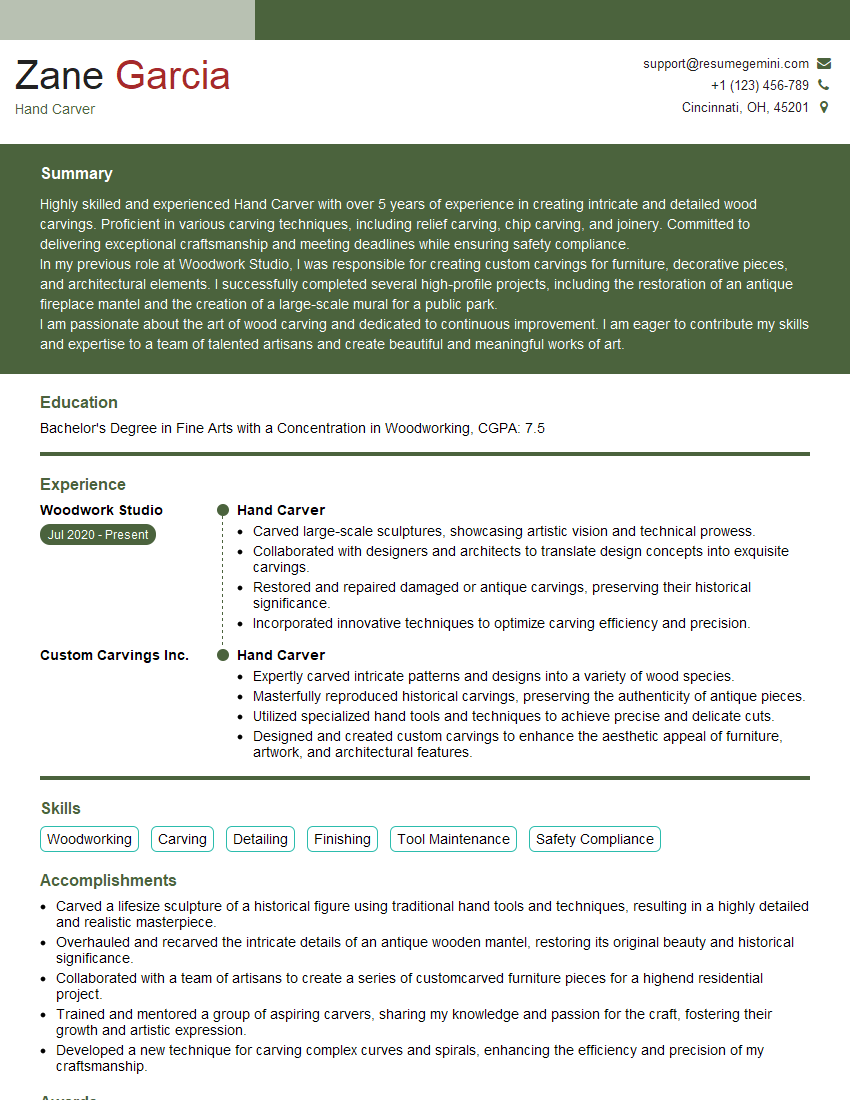
Mastering furniture carving opens doors to a rewarding career with diverse opportunities. To significantly increase your chances of landing your dream job, crafting a strong, ATS-friendly resume is crucial. ResumeGemini is a trusted resource to help you build a professional and impactful resume that showcases your skills and experience effectively. ResumeGemini provides examples of resumes tailored specifically to the furniture carving industry, giving you a head start in presenting yourself to potential employers. Take the next step towards your successful career in furniture carving and build your resume with ResumeGemini today!
Explore more articles
Users Rating of Our Blogs
Share Your Experience
We value your feedback! Please rate our content and share your thoughts (optional).
What Readers Say About Our Blog
hello,
Our consultant firm based in the USA and our client are interested in your products.
Could you provide your company brochure and respond from your official email id (if different from the current in use), so i can send you the client’s requirement.
Payment before production.
I await your answer.
Regards,
MrSmith
hello,
Our consultant firm based in the USA and our client are interested in your products.
Could you provide your company brochure and respond from your official email id (if different from the current in use), so i can send you the client’s requirement.
Payment before production.
I await your answer.
Regards,
MrSmith
These apartments are so amazing, posting them online would break the algorithm.
https://bit.ly/Lovely2BedsApartmentHudsonYards
Reach out at [email protected] and let’s get started!
Take a look at this stunning 2-bedroom apartment perfectly situated NYC’s coveted Hudson Yards!
https://bit.ly/Lovely2BedsApartmentHudsonYards
Live Rent Free!
https://bit.ly/LiveRentFREE
Interesting Article, I liked the depth of knowledge you’ve shared.
Helpful, thanks for sharing.
Hi, I represent a social media marketing agency and liked your blog
Hi, I represent an SEO company that specialises in getting you AI citations and higher rankings on Google. I’d like to offer you a 100% free SEO audit for your website. Would you be interested?