Every successful interview starts with knowing what to expect. In this blog, we’ll take you through the top Glass Cutting and Measuring interview questions, breaking them down with expert tips to help you deliver impactful answers. Step into your next interview fully prepared and ready to succeed.
Questions Asked in Glass Cutting and Measuring Interview
Q 1. What types of glass cutting tools are you familiar with?
My experience encompasses a wide range of glass cutting tools, from the basic hand tools used in smaller projects to more sophisticated automated systems for large-scale operations. Let’s start with the hand tools:
- Glass cutter: This is the fundamental tool, using a hardened wheel or a scoring tip to create a precise scratch on the glass surface, initiating the break. Different types exist, including oil-fed cutters for smoother scoring and carbide tip cutters for harder glasses.
- Running pliers (or grozing pliers): These pliers are used to snap the glass along the scored line. They apply even pressure, preventing chipping and ensuring a clean break.
- Safety glasses: These are absolutely essential for eye protection against flying glass fragments.
- Measuring tape and ruler: Accurate measurement is crucial before cutting.
- Glass breaker: Used for making specific breaks or for breaking irregular pieces.
Beyond hand tools, I’m also proficient with automated glass cutting machines, including CNC (Computer Numerical Control) systems which allow for highly precise and intricate cuts on larger sheets, and water-jet cutters that offer versatile capabilities for cutting various materials including glass. My expertise spans all these tools, allowing me to select the most appropriate method for any given project.
Q 2. Explain the process of measuring glass for a custom window.
Measuring glass for a custom window is a critical step requiring precision and attention to detail. It’s not just about getting the overall dimensions right; it also involves accounting for factors such as the frame, any glazing beads used to hold the glass, and desired overlaps. I always use two methods to cross check and guarantee accuracy:
- Direct Measurement: I measure the window frame’s opening carefully, using a metal measuring tape for optimal accuracy. I record measurements of width, height, and depth. I usually take multiple measurements at different points to ensure consistency. This includes carefully checking for any irregularities in the frame itself that might impact the glass sizing.
- Template Method: Often, especially when the window frame shape is irregular or complex, I create a template. This involves carefully placing a material like cardboard directly onto the window frame opening and tracing its outline. The resulting cardboard template is then used as a guide for cutting the glass, ensuring a perfect fit.
After recording the measurements from both methods, I compare to identify any discrepancies. Then I calculate the final dimensions required for the glass panel, usually deducting a small margin of allowance to accommodate the glazing bead or any framing element.
Q 3. How do you ensure accurate measurements to avoid waste?
Avoiding waste in glass cutting is paramount, both economically and environmentally. Here’s how I ensure accurate measurements:
- Multiple Measurements: As mentioned earlier, taking multiple measurements at different points is crucial for identifying any inconsistencies. I typically take at least three measurements for each dimension.
- Double-Checking: Before any cutting begins, I meticulously double-check all measurements against the original plans or template to identify potential errors early on.
- Careful Planning: I strategize the cutting process to minimize waste. This involves carefully arranging the pieces on the glass sheet to maximize material utilization and reduce the number of cuts required.
- Using Templates: Templates (as described above) drastically reduce measurement errors and offer a visually clear guide, aiding accurate cutting.
- Proper Tool Usage: Using properly maintained tools such as sharp glass cutters leads to clean breaks, reducing the risk of errors and chipping that necessitates larger cuts.
By combining these strategies, I significantly reduce material waste and enhance overall project efficiency.
Q 4. Describe your experience with different types of glass (e.g., tempered, laminated).
My experience extends to a variety of glass types, each with its unique properties and cutting requirements:
- Annealed Glass (Float Glass): This is the most common type, relatively inexpensive, and easily cut using standard glass cutters. However, it is prone to breakage under stress.
- Tempered Glass (Safety Glass): This is much stronger than annealed glass because it undergoes a heat-treating process. Cutting tempered glass is considerably more challenging and requires specialized tools and techniques because once cut, it shatters. Therefore, it’s almost always cut to size by the manufacturer.
- Laminated Glass: This consists of two or more layers of glass bonded together with an interlayer of polyvinyl butyral (PVB). It’s highly impact-resistant and provides enhanced safety. Cutting laminated glass is similar to annealed glass, though the interlayer makes the cutting process slightly more difficult. The process needs to consider the additional thickness and prevent separation of the layers.
Understanding the characteristics of each glass type is essential to selecting the appropriate tools, techniques, and safety measures. For instance, the force applied when snapping tempered glass is significantly more dangerous and needs to be avoided entirely. I always ascertain the type of glass before beginning any cutting process.
Q 5. What safety precautions do you take when cutting glass?
Safety is paramount in glass cutting. My safety procedures are unwavering:
- Eye Protection: Safety glasses are always worn, providing protection against flying glass fragments. Often, I use a face shield for added protection.
- Gloves: Cut-resistant gloves protect my hands from sharp edges and potential cuts.
- Proper Work Area: A clean, well-lit workspace, free from obstructions, is essential. This ensures I maintain full control during the cutting process.
- Cutting Technique: I use smooth, controlled movements with the cutter to minimize the risk of chipping or snapping uncontrollably.
- Waste Disposal: Glass fragments are disposed of carefully in a sturdy container to prevent injury.
- Appropriate Tools: Using tools in good condition is essential. A dull glass cutter can lead to uncontrolled snapping.
I never compromise on safety; it’s an integral part of my process. I’ve seen firsthand how quickly accidents can happen, so maintaining a rigorous safety protocol is non-negotiable.
Q 6. How do you handle challenging cuts or intricate designs?
Challenging cuts and intricate designs require careful planning and skilled execution. I utilize several strategies:
- Detailed Templates: For complex shapes, highly accurate templates are paramount. These could be made from multiple pieces of material fitting together or using computer-aided design (CAD) software and laser cutting for precision.
- Multiple Cuts: Instead of attempting a single, difficult cut, it is often easier and safer to make multiple smaller, simpler cuts.
- Specialized Tools: For curves or intricate shapes, I might employ a wet saw or a specialized glass cutting tool designed for precision curves.
- Practice and Skill: Years of experience allow me to visualize and execute these cuts effectively and efficiently.
For instance, I recently worked on a project involving a glass panel with a complex, organic shape. I used CAD software to design the pattern, then had a laser cutter create a precise template. I followed the template, making multiple small cuts to create the desired form. The result was an exquisite piece with clean, precise edges.
Q 7. What are the common causes of glass breakage during cutting or installation?
Glass breakage during cutting or installation can be caused by several factors:
- Incorrect Cutting Techniques: Applying too much pressure, using a dull cutter, or applying uneven pressure during snapping can lead to chipping or cracking.
- Improper Handling: Dropping or mishandling the glass after cutting can easily cause damage.
- Stress and Pressure: Even small imperfections in the glass sheet can lead to breakage under stress during installation, especially in larger panes.
- Temperature Fluctuations: Extreme temperature changes can cause stress fractures in the glass, particularly in tempered glass.
- Poor Installation Practices: Using incorrect glazing techniques or applying too much pressure during installation can lead to cracking or breakage.
- Defective Glass: Internal flaws or manufacturing defects in the glass itself can make it more prone to breakage.
Understanding these causes allows for preventative measures. For instance, using proper handling techniques and appropriate tools minimizes the risk of breakage, while careful inspection for defects before installation helps identify potential problems early on.
Q 8. Describe your experience with glass beveling and edging techniques.
Glass beveling and edging are crucial finishing techniques that enhance a glass piece’s aesthetics and functionality. Beveling involves creating a sloped edge, softening the sharp 90-degree angle. This not only improves safety but also adds a touch of elegance. Edging, on the other hand, focuses on refining the raw edge of the glass, removing any imperfections and creating a polished, finished look. There are various techniques for both, ranging from hand-grinding for smaller, intricate pieces to automated machinery for mass production.
- Hand Beveling/Edging: This method involves using specialized grinding wheels and tools to carefully shape and polish the edges. It’s ideal for intricate designs and smaller projects requiring precision. I’ve frequently used this technique for custom-designed mirrors and stained glass projects. It requires a steady hand and considerable skill to achieve consistent bevels and a smooth finish.
- Machine Beveling/Edging: For larger-scale projects or when consistency is paramount, automated machinery is employed. These machines offer precise control over the bevel angle, width, and polish. I have extensive experience operating CNC-controlled bevelling and edging machines, allowing for high-volume production with minimal variation.
- Types of Edging: Beyond beveling, other edging techniques include polishing, which creates a smooth, reflective edge; flat polishing, for a simple, clean look; and various decorative edges like ogee or pencil edges which add architectural interest. I’m proficient in all these techniques, choosing the most appropriate one based on project specifications and desired aesthetic.
Q 9. How do you calculate the amount of glass needed for a specific project?
Calculating the amount of glass needed for a project requires careful consideration of several factors. It’s more than just measuring the surface area; it involves accounting for waste, cutouts, and the specific glass type.
My process usually begins with detailed drawings and specifications. I’ll measure each individual piece, accounting for any bevels or other design elements that might increase the overall dimensions. Once all the individual pieces are accounted for, I add a percentage for waste – this percentage varies depending on the complexity of the project and the pattern of the cuts. For example, a project with many small, intricate pieces will likely have a higher waste percentage than one consisting of a few large panels. Additionally, I consider the type of glass; some glasses come in standard sizes, while others might require custom ordering, affecting the overall quantity and potential waste. The final calculation ensures sufficient material to complete the project without unexpected shortages.
For example, if I’m working on a project that requires 10 panels, each measuring 2 ft x 3 ft, I’d calculate that I need 60 square feet of glass (10 x 2 ft x 3 ft). Adding a 10% waste factor (to account for cutting and potential breakage) brings the total needed to roughly 66 square feet. However, if intricate shapes are involved, I might increase this waste percentage to as much as 20-30%.
Q 10. Explain your experience with different glass installation methods.
Glass installation methods vary greatly depending on the type of glass, its application, and the structural requirements of the project. My experience encompasses a wide range of techniques, from simple applications to complex, high-precision installations.
- Silicone Sealant: This is a common method for smaller projects, attaching glass to frames or other surfaces. The key is to ensure proper sealant selection and application for durability and water tightness.
- Structural Glazing: For large-scale projects like curtain walls or storefronts, structural glazing techniques involve bonding glass panels directly to the building’s frame without visible fasteners. This creates a sleek, modern aesthetic but requires specialized expertise in sealant selection, application, and structural engineering principles.
- Mechanical Fasteners: Certain installations use mechanical fasteners like clips, screws, or rivets to hold glass in place. The choice of fastener depends on the glass type, thickness, and the weight it needs to support. It is critical to ensure appropriate spacing and secure fastening to prevent breakage or stress on the glass.
- Custom Installation Methods: I have significant experience with custom installation methods, such as working with specialized glass types (laminated, tempered, etc.), curved glass, or unique designs that require specialized handling and attachment techniques. This often includes collaboration with architects, engineers and other specialists.
Q 11. How do you ensure the proper sealing and insulation of glass units?
Proper sealing and insulation of glass units are critical for energy efficiency, weather resistance, and preventing condensation. This involves meticulous attention to detail and careful material selection.
For sealed insulating glass units (IGUs), the air or gas-filled space between the panes is hermetically sealed using butyl and polysulfide sealants. This prevents moisture ingress, maintaining the insulating properties. The quality of these sealants and the precision of the sealing process are paramount. I always inspect IGUs carefully to ensure there are no leaks or defects. For larger projects or areas with specific climate considerations, I carefully specify the gas fill (argon or krypton) inside the IGU to maximize its thermal performance.
In other applications, appropriate sealants are chosen based on the materials being joined and environmental conditions. It’s essential to select sealants that provide sufficient adhesion, weather resistance, and UV protection. Proper application techniques ensure a durable, watertight seal. Thorough cleaning of surfaces before application is also critical to maximize adhesion.
Q 12. What are your troubleshooting skills when dealing with glass installation problems?
Troubleshooting glass installation problems requires a systematic approach, combining practical experience with problem-solving skills. My approach generally involves:
- Careful Inspection: A thorough visual inspection identifies the problem’s nature and location. This might involve checking for cracks, sealant failures, improper installation, or other visible issues.
- Understanding the Cause: Once identified, the root cause must be determined. Is it a material failure, an installation error, or a design flaw? This often requires understanding the material properties, the installation methods, and the environmental conditions.
- Developing a Solution: Depending on the cause, the solution might involve repairing damaged components, replacing faulty materials, correcting installation errors, or even adjusting the design if necessary.
- Testing and Verification: Once the problem is addressed, I always test the installation to ensure the solution is effective and that the glass is securely fixed and properly sealed. This may involve checking for leaks, strength, or other relevant performance parameters.
For example, if a window leaks, I might initially inspect the sealant for cracks or gaps. If the sealant is intact, I’d investigate whether the installation was performed correctly and whether the window frame was adequately prepared. I have experience in diagnosing and resolving issues ranging from simple sealant repairs to more complex structural problems, always ensuring that the safety and integrity of the glass installation are maintained.
Q 13. What software or tools do you use for measuring and cutting glass?
Accurate measuring and cutting are crucial in glass work. I utilize a combination of tools and software to ensure precision and efficiency.
- Measuring Tools: Precise measuring tapes, steel rules, and digital calipers are essential for obtaining accurate dimensions. For larger projects, laser measuring tools provide even greater accuracy and speed.
- Cutting Tools: I’m proficient in using both manual and automated glass cutting tools, including glass cutters with various scoring wheels for different glass types. For straight cuts, a well-maintained straight edge is essential. For curved cuts, specialized tools and templates are used.
- Software: While not always used for smaller projects, CAD software (Computer-Aided Design) can be invaluable for complex projects, allowing for precise design, measurement, and pattern generation. This significantly reduces errors and material waste.
For instance, in a recent project involving a complex stained-glass window, I used CAD software to create a detailed pattern, ensuring all the pieces fit together perfectly. This digital design was then used to create accurate cutting templates, minimizing errors and waste, and resulting in a flawless final product.
Q 14. Describe your experience with automated glass cutting machinery.
Automated glass cutting machinery significantly increases efficiency and precision, particularly for large-scale projects. My experience includes operating several types of automated systems.
- CNC Glass Cutters: These machines use computer numerical control to cut glass with exceptional accuracy and speed. Programming the machine with the exact dimensions and cutting pattern is crucial. I am skilled in both operating these machines and programming them for various cutting tasks, from simple straight cuts to intricate designs.
- Water Jet Cutters: For more intricate designs and various materials beyond glass, water jet cutters offer superior cutting capabilities and minimal material waste. Their use requires knowledge of water pressure, nozzle selection, and material properties for optimal cutting parameters.
- Automated Edging and Beveling Machines: These machines automate the finishing processes, ensuring consistent and high-quality edges. Proper setup and calibration are crucial for achieving desired results.
Working with these machines requires a strong understanding of safety procedures, as well as regular maintenance to ensure optimal performance and prevent damage. My experience allows me to diagnose and resolve potential mechanical issues efficiently.
Q 15. How do you maintain and care for glass cutting tools?
Maintaining glass cutting tools is crucial for precision and safety. Think of your tools as precision instruments – a surgeon wouldn’t use a dull scalpel! Proper care extends their lifespan and prevents costly replacements.
- Cleaning: After each use, clean the glass cutter wheel with a soft cloth and a mild solvent to remove any glass dust or debris. A build-up of debris can dull the wheel and lead to inaccurate cuts. For oil-fed cutters, regularly lubricate the wheel according to the manufacturer’s instructions.
- Storage: Store your tools in a dry, safe place, away from extreme temperatures and humidity. This prevents rust and corrosion, particularly important for metal tools. Consider using a protective case to prevent damage during storage and transport.
- Sharpening: Glass cutters, especially wheel cutters, will eventually require sharpening. This is best done professionally to maintain the precision of the wheel. Knowing when to sharpen is crucial; a dull cutter leads to chipping and uneven cuts.
- Inspection: Regularly inspect your tools for any damage, such as cracks or chips in the cutting wheel or handle. Damaged tools should be replaced immediately to avoid accidents.
For example, I once had a student incorrectly store a diamond glass cutter, leading to corrosion and rendering it unusable. This highlights the importance of proper cleaning and storage.
Career Expert Tips:
- Ace those interviews! Prepare effectively by reviewing the Top 50 Most Common Interview Questions on ResumeGemini.
- Navigate your job search with confidence! Explore a wide range of Career Tips on ResumeGemini. Learn about common challenges and recommendations to overcome them.
- Craft the perfect resume! Master the Art of Resume Writing with ResumeGemini’s guide. Showcase your unique qualifications and achievements effectively.
- Don’t miss out on holiday savings! Build your dream resume with ResumeGemini’s ATS optimized templates.
Q 16. What are the different types of glass sealants and adhesives you are familiar with?
The world of glass sealants and adhesives is vast, each with its own properties and applications. The choice depends heavily on the type of glass, the application, and the environment.
- Silicone Sealants: These are extremely versatile and are commonly used for both interior and exterior applications. They offer good adhesion, flexibility, and weather resistance. They come in various colors to match the frame or glass.
- Polyurethane Sealants: These offer superior strength and adhesion compared to silicone, often preferred for structural glazing or applications requiring high durability. They are less forgiving of surface imperfections, though.
- Acrylic Sealants: These are typically easier to clean up than silicone or polyurethane, but they may not be as durable or weather-resistant, thus limiting their outdoor use. Often used for interior projects.
- Epoxies: Epoxies are two-part adhesives known for their exceptional strength and bonding capabilities. They are frequently used for laminating glass or bonding glass to other materials like metal or wood. They require careful mixing and handling.
For instance, when installing a shower enclosure, I’d use a high-quality silicone sealant to ensure a waterproof seal. For a structural glass facade, however, a polyurethane sealant would be necessary for its superior strength.
Q 17. Explain your knowledge of glass thickness and its impact on applications.
Glass thickness significantly impacts its structural integrity and applications. Imagine trying to build a skyscraper with thin window panes – it wouldn’t last! Thickness is measured in millimeters (mm).
- Thin Glass (2-5mm): Commonly used for picture frames, decorative items, and shelving. It’s lightweight but fragile.
- Medium Glass (6-12mm): Ideal for windows, tabletops, and some partitions. Provides a good balance of strength and weight.
- Thick Glass (15mm and above): Used in situations requiring significant strength and impact resistance such as storefront windows, balustrades, and even certain types of flooring. Often laminated or tempered for added safety.
The thickness is usually specified on the blueprints and affects the type of cutting tools, supporting structures, and installation methods required. For example, thicker glass requires more robust cutting tools and may necessitate specialized equipment for handling and installation.
Q 18. How do you work with blueprints and specifications for glass cutting and installation?
Working with blueprints and specifications is fundamental to accurate and successful glass installation. It is the roadmap to the project.
My process involves:
- Thorough Review: Carefully examine the blueprints, noting glass type, dimensions, thickness, quantity, and any special requirements (e.g., tempered, laminated, coated). Verify all measurements. A simple oversight can be costly.
- Detailed Measurement: Precise measurements are critical. I use calibrated tools to measure the glass pieces based on the blueprint specifications, accounting for any tolerances mentioned.
- Cutting and Fabrication: Use the measurements to cut and fabricate the glass according to the specifications. This may involve specialized techniques like beveling or drilling holes, as indicated in the blueprints.
- Quality Check: Before installation, inspect the cut glass for any defects or inconsistencies. Compare it to the blueprint to ensure it meets the requirements.
Imagine cutting a glass panel for a museum display case—an inaccurate cut would be catastrophic. The blueprint provides a guide to ensure a perfect fit and appearance.
Q 19. Describe your experience working with different types of frames and hardware.
Experience with diverse frames and hardware is essential for a glass installer. Just like a carpenter needs different tools for different wood types, I need different approaches based on the frame material.
- Aluminum Frames: Common for commercial buildings, these are usually robust and require precise measurements and often specific fasteners. They may need sealing to protect from water penetration.
- Wooden Frames: Provide a classic and often customized look for residential applications. Accurate measurements are needed to ensure a snug fit. The type of wood influences the installation technique.
- Vinyl Frames: Popular for their low maintenance, they often come with pre-installed channels for the glass. It’s important to understand the specific installation method recommended by the frame manufacturer.
- Hardware: This includes clips, screws, spacers, and sealants. The proper hardware is crucial for secure and safe installation. The incorrect hardware could lead to glass breakage or structural instability.
For example, while installing glass in a historical building with ornate wooden frames, I had to employ specialized techniques and hardware to preserve the integrity of the woodwork. The knowledge of the material’s behavior and appropriate hardware is paramount.
Q 20. What quality control measures do you implement during the glass cutting and installation process?
Quality control is paramount in glass cutting and installation. It’s about delivering a perfect product that’s both visually appealing and structurally sound.
- Material Inspection: Before starting, I inspect the glass for defects like chips, scratches, or bubbles. This prevents installation of faulty glass.
- Precise Measurement and Cutting: Double-checking measurements and ensuring sharp, clean cuts minimize errors and prevent unnecessary waste.
- Proper Tool Use and Maintenance: Using the right tools in the right manner and keeping them maintained ensures accurate and efficient work.
- Safe Handling: Following appropriate handling procedures reduces the risk of breakage during transit and installation.
- Final Inspection: A thorough inspection before handing over the project ensures the glass is properly installed, the sealant is properly applied, and there are no visible imperfections. I use a checklist to guarantee nothing is overlooked.
One time, during a large-scale window replacement project, a small crack was discovered after installation. Due to our rigorous quality control processes, we caught it early and rectified the situation without jeopardizing the entire project.
Q 21. How do you handle customer inquiries or complaints regarding glass installation?
Handling customer inquiries and complaints is a critical aspect of providing excellent service.
My approach involves:
- Active Listening: Patiently listen to the customer’s concerns and try to understand their perspective. Empathy is key.
- Professionalism: Maintain a professional and respectful demeanor, even when facing difficult situations.
- Thorough Investigation: Investigate the complaint thoroughly. If it’s a valid complaint, I will explain how I plan to address it. If the issue is a result of customer misuse, I will explain this clearly and professionally.
- Problem-Solving: Offer a practical and effective solution to resolve the issue. This might involve repairs, replacements, or adjustments.
- Follow-up: Follow up with the customer to ensure they are satisfied with the resolution. Good communication keeps everyone informed.
For instance, once a customer complained about a small chip in the glass after installation. Although it was minor and not affecting functionality, I replaced the panel to maintain customer satisfaction. Addressing concerns promptly and professionally builds trust and loyalty.
Q 22. Explain your experience with working at heights during glass installation.
Safety is paramount when working at heights. My experience includes extensive training in fall protection techniques, utilizing harnesses, lanyards, and anchor points appropriate for the specific building and glass installation. I’m proficient in using scaffolding, swing stages, and other elevated work platforms, always ensuring compliance with all relevant safety regulations and best practices. For example, on a recent high-rise project, we meticulously planned each lift, using a detailed risk assessment to identify potential hazards and implement preventative measures, such as securing the glass with multiple tie-downs before hoisting. This methodical approach ensured the safety of both the team and the materials.
Q 23. What are your preferred methods for cleaning and maintaining installed glass?
Cleaning and maintaining installed glass depends heavily on the type of glass and its location. For exterior installations, I recommend regular cleaning using specialized glass cleaners and soft cloths or squeegees to prevent streaking. Avoid abrasive cleaners that can scratch the surface. For interior glass, a simple solution of water and mild detergent often suffices. Specific maintenance depends on factors such as the environment (e.g., coastal areas may necessitate more frequent cleaning due to salt spray) and the type of glass (e.g., laminated glass may need more delicate handling). Regular inspection for chips, cracks, or sealant degradation is also crucial for proactive maintenance and to prevent safety issues.
Q 24. How do you determine the appropriate type of glass for a specific application?
Selecting the right glass involves careful consideration of several factors, including the application’s requirements and environmental conditions. For example, a storefront window needs high visibility and impact resistance, making tempered or laminated glass a good choice. A shower enclosure, on the other hand, needs moisture resistance and safety, so I’d recommend tempered glass to minimize the risk of injury from shattering. Other factors to consider are energy efficiency (low-E coatings), sound insulation (laminated glass with acoustic interlayers), and aesthetic preferences (e.g., color, texture). I always consult the client and relevant building codes to ensure the glass selection meets both functional and regulatory requirements.
- High-traffic areas: Tempered glass for strength and safety.
- Bathrooms: Tempered or laminated glass for moisture resistance and safety.
- Energy efficiency: Low-E coated glass.
Q 25. Describe your experience with working on large-scale glass projects.
I have significant experience working on large-scale projects, including the recent installation of a glass curtain wall for a 20-story building. Such projects demand meticulous planning, detailed coordination, and a strong emphasis on safety. My role involved overseeing the fabrication, transportation, and installation of thousands of square feet of glass. We used specialized lifting equipment, including cranes and suction cups, to handle the large glass panels safely and efficiently. The success of these large projects relies heavily on teamwork, clear communication, and a robust quality control process throughout all stages, from initial design to final installation. Each panel’s precise measurements and installation were crucial to ensure structural integrity and a seamless final aesthetic.
Q 26. How do you manage your time effectively when working on multiple glass cutting and installation tasks?
Effective time management is essential in this profession. I use a combination of project management tools, such as scheduling software and detailed task lists, to prioritize tasks and allocate sufficient time for each project. Breaking down large projects into smaller, manageable tasks with deadlines helps keep the process organized and avoids delays. I also regularly communicate with clients and my team to identify potential roadblocks and adjust the schedule accordingly. Proactive communication minimizes unexpected issues and maintains the project timeline.
Q 27. Describe your experience with handling and transporting large glass sheets safely.
Handling and transporting large glass sheets requires careful attention to detail and adherence to strict safety procedures. We use specialized equipment, including suction cups, straps, and protective padding, to secure the glass during transport. The loading and unloading process is meticulously planned to avoid any sudden movements or impacts. The use of appropriate vehicles with adequate suspension systems and securing mechanisms is crucial. I always ensure the team is thoroughly briefed on safe handling procedures, and we conduct regular safety checks throughout the process. For example, when transporting oversized glass, we employ specialized trailers with air-ride suspensions to minimize the risk of damage during transit.
Q 28. What are your salary expectations for this role?
My salary expectations are in line with the industry standards for a professional with my level of experience and expertise. I am open to discussing a competitive compensation package that reflects my skills and contributions to the team. I’m happy to review the salary range for this role and negotiate based on the responsibilities and overall compensation package.
Key Topics to Learn for Glass Cutting and Measuring Interview
- Understanding Glass Types and Properties: Learn the characteristics of different glass types (e.g., annealed, tempered, laminated) and how these properties influence cutting and measuring techniques.
- Safe Glass Handling and Safety Procedures: Master safe handling practices to prevent injuries. Understand and be prepared to discuss relevant safety regulations and equipment.
- Precise Measuring Techniques: Demonstrate proficiency in using various measuring tools (e.g., rulers, tape measures, calipers) and understanding tolerances and accuracy requirements.
- Glass Cutting Methods and Tools: Explain different glass cutting techniques (e.g., scoring, snapping, using specialized tools) and the selection of appropriate tools for various glass thicknesses and types.
- Practical Application: Pattern Creation and Transfer: Describe how to accurately transfer patterns onto glass and the importance of precise measurements in achieving desired outcomes.
- Troubleshooting Common Issues: Be prepared to discuss common problems encountered during glass cutting and measuring (e.g., chipping, cracking, inaccurate cuts) and how to resolve them.
- Quality Control and Inspection: Explain the importance of quality control in glass cutting and measuring and how to inspect finished products for defects.
- Waste Minimization and Material Efficiency: Discuss strategies for minimizing glass waste and maximizing material efficiency during the cutting process.
Next Steps
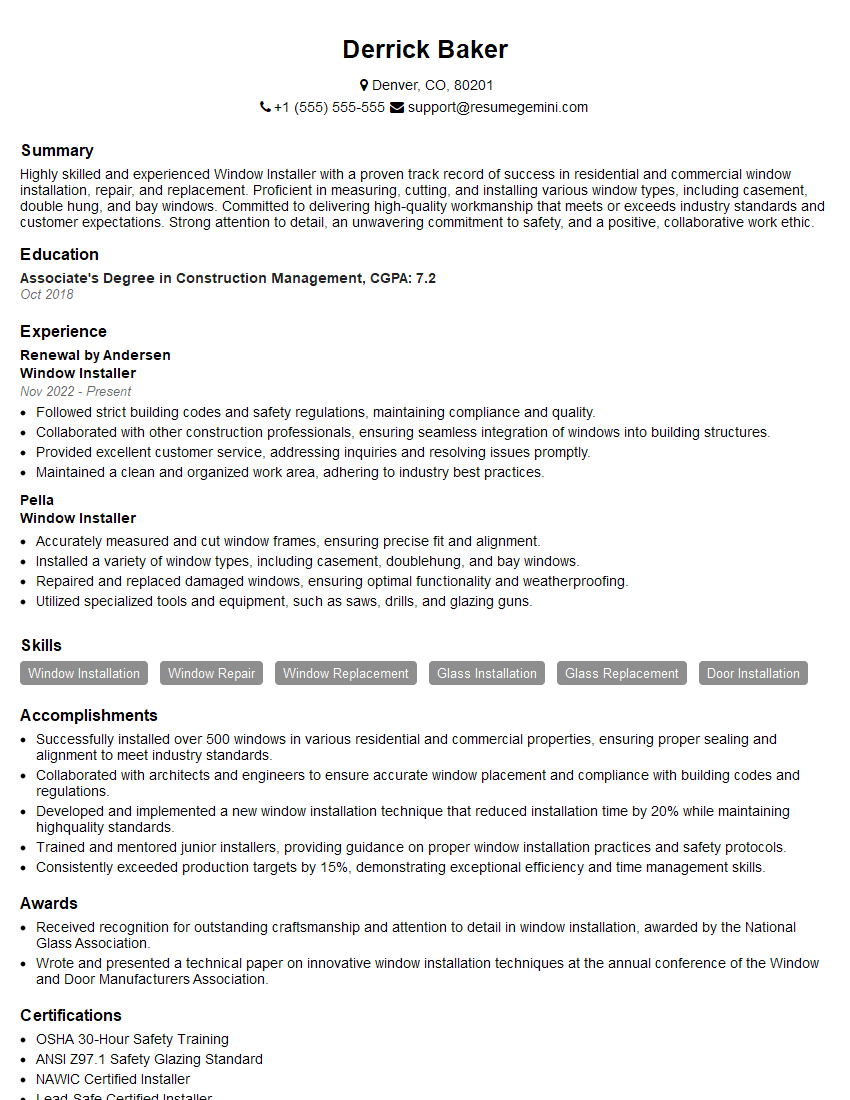
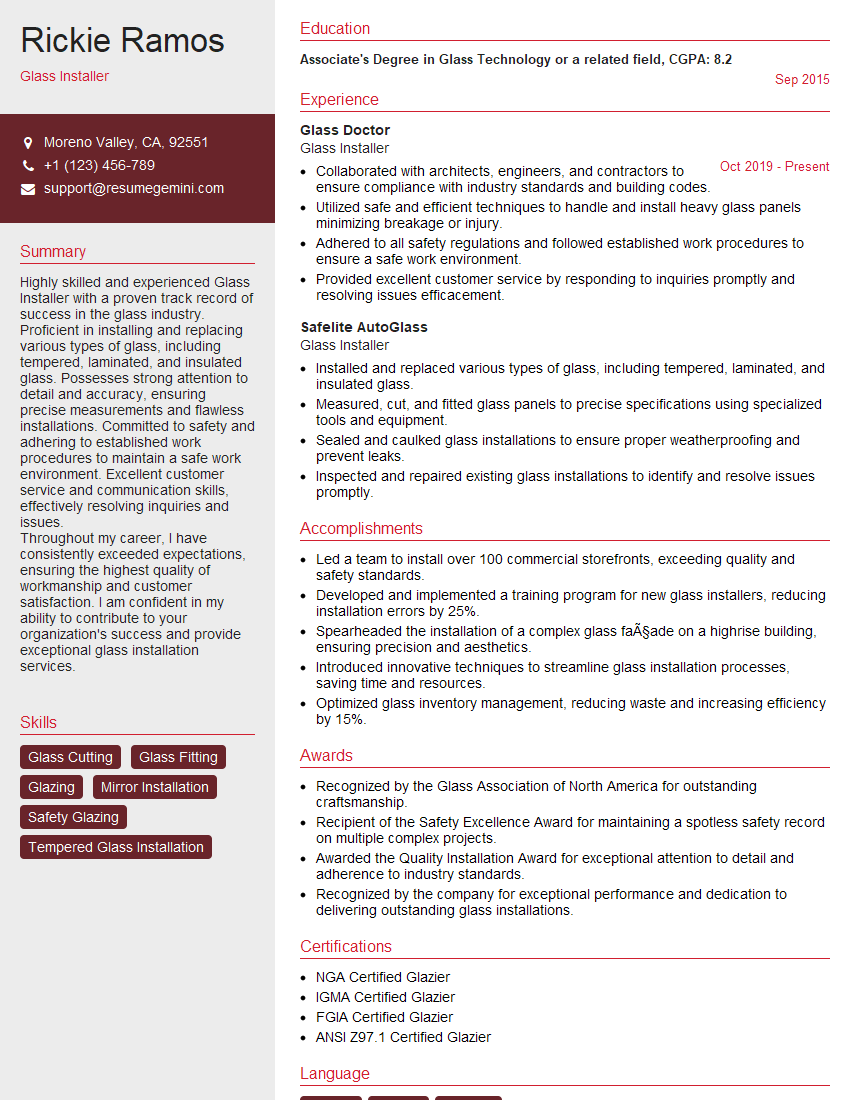
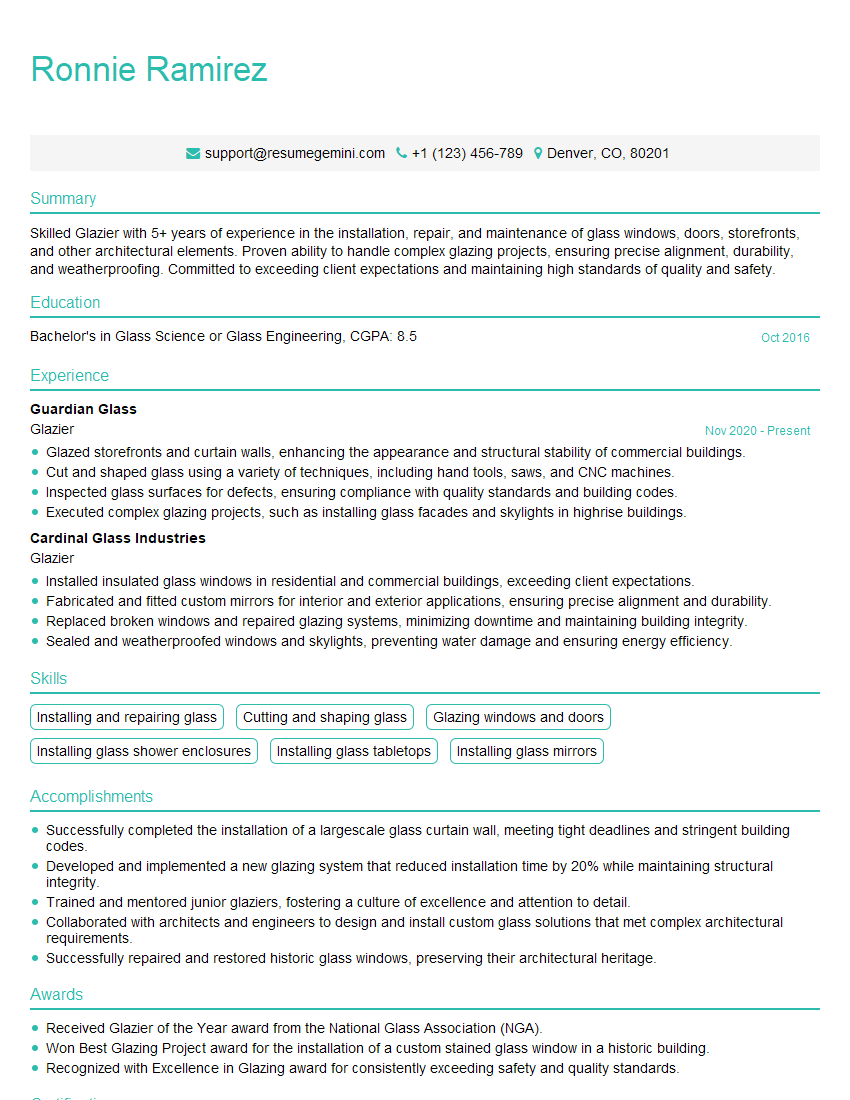
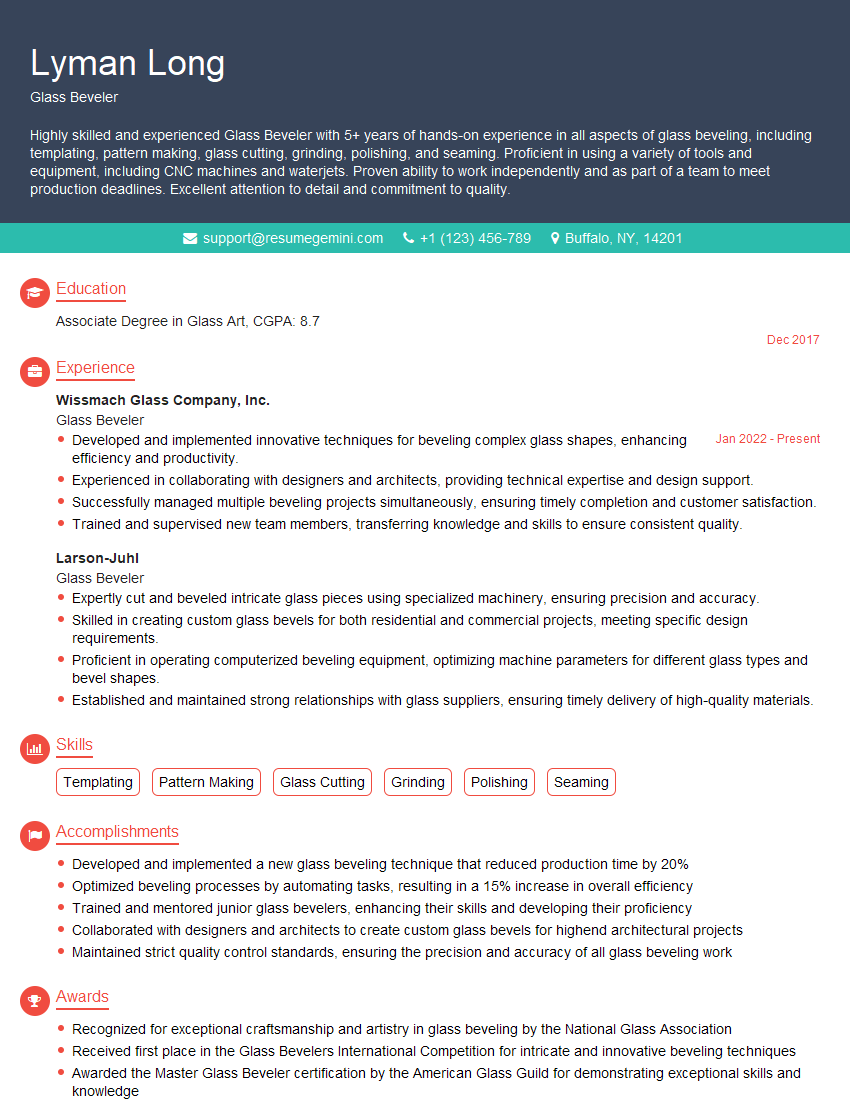
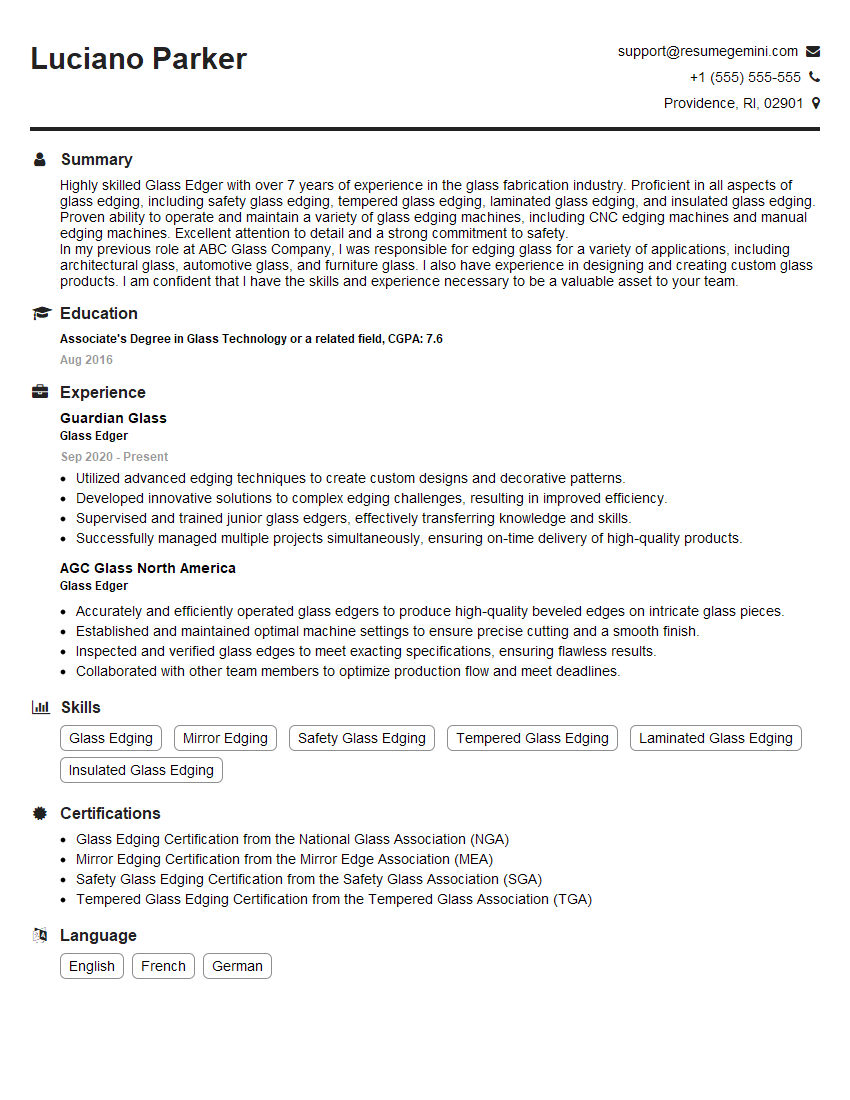
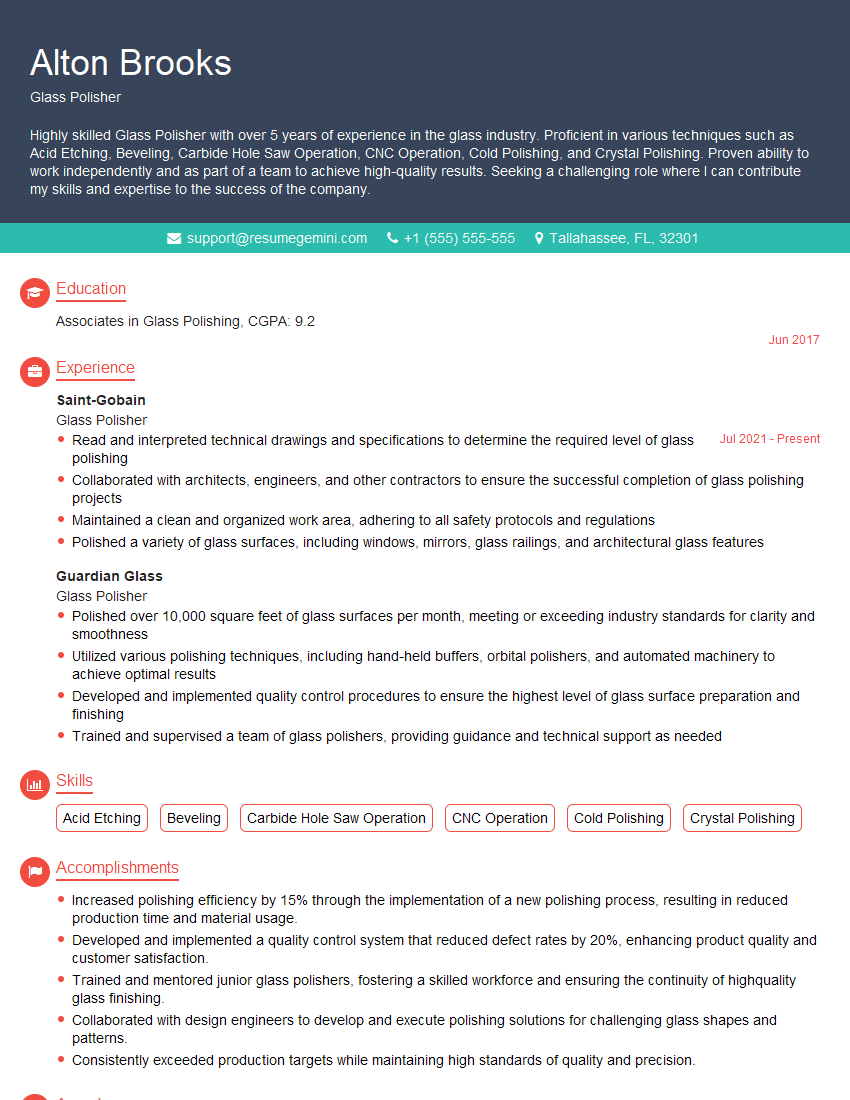
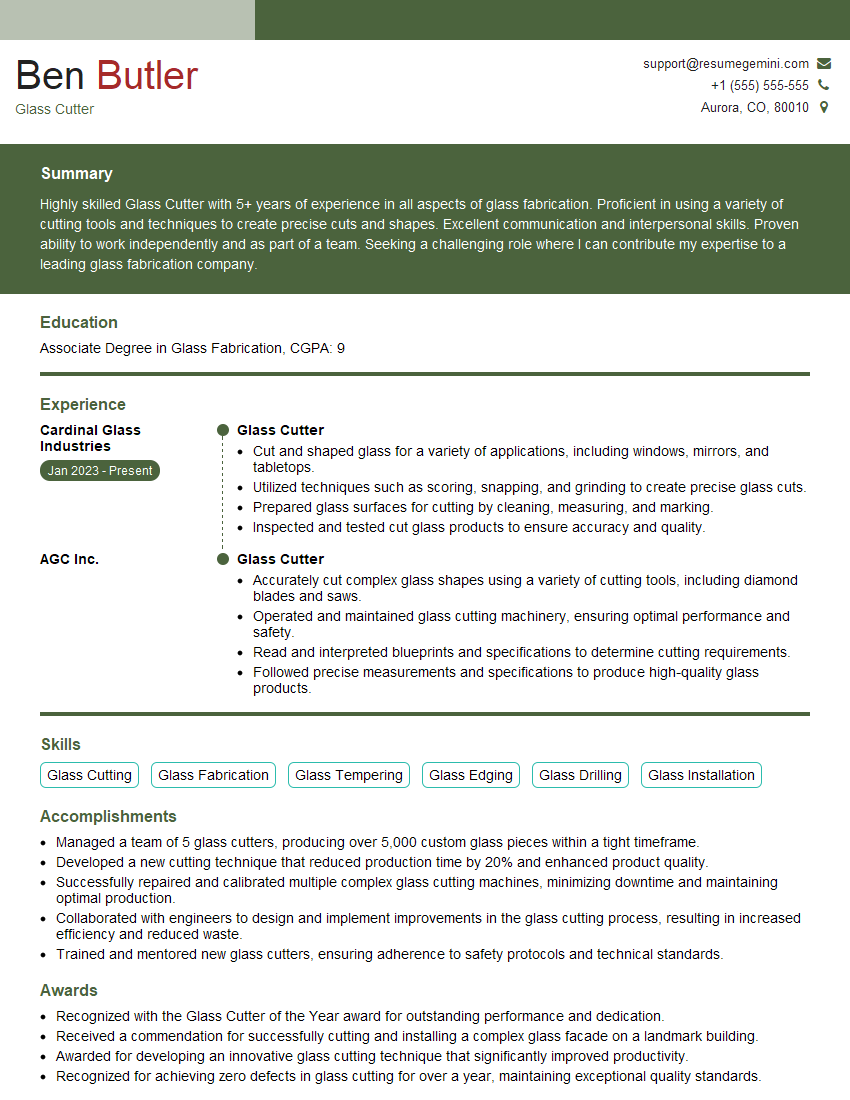
Mastering glass cutting and measuring skills opens doors to exciting career opportunities in various industries, offering potential for growth and specialization. A strong resume is crucial for showcasing your abilities to potential employers. To increase your chances of getting noticed by Applicant Tracking Systems (ATS), create an ATS-friendly resume that highlights your key skills and experience. ResumeGemini is a trusted resource to help you build a professional and impactful resume. They offer examples of resumes tailored to Glass Cutting and Measuring, guiding you towards crafting a document that effectively presents your qualifications.
Explore more articles
Users Rating of Our Blogs
Share Your Experience
We value your feedback! Please rate our content and share your thoughts (optional).
What Readers Say About Our Blog
Amazing blog
hello,
Our consultant firm based in the USA and our client are interested in your products.
Could you provide your company brochure and respond from your official email id (if different from the current in use), so i can send you the client’s requirement.
Payment before production.
I await your answer.
Regards,
MrSmith
hello,
Our consultant firm based in the USA and our client are interested in your products.
Could you provide your company brochure and respond from your official email id (if different from the current in use), so i can send you the client’s requirement.
Payment before production.
I await your answer.
Regards,
MrSmith
These apartments are so amazing, posting them online would break the algorithm.
https://bit.ly/Lovely2BedsApartmentHudsonYards
Reach out at BENSON@LONDONFOSTER.COM and let’s get started!
Take a look at this stunning 2-bedroom apartment perfectly situated NYC’s coveted Hudson Yards!
https://bit.ly/Lovely2BedsApartmentHudsonYards
Live Rent Free!
https://bit.ly/LiveRentFREE
Interesting Article, I liked the depth of knowledge you’ve shared.
Helpful, thanks for sharing.
Hi, I represent a social media marketing agency and liked your blog
Hi, I represent an SEO company that specialises in getting you AI citations and higher rankings on Google. I’d like to offer you a 100% free SEO audit for your website. Would you be interested?