The right preparation can turn an interview into an opportunity to showcase your expertise. This guide to Knowledge of GIS principles and applications interview questions is your ultimate resource, providing key insights and tips to help you ace your responses and stand out as a top candidate.
Questions Asked in Knowledge of GIS principles and applications Interview
Q 1. Explain the difference between vector and raster data.
Vector and raster data are two fundamental ways to represent geographic information in GIS. Think of it like drawing a map: vector uses points, lines, and polygons to define features, while raster uses a grid of cells (pixels) to represent data.
- Vector Data: Imagine drawing a precise outline of a building. Vector data stores this as a polygon, defined by its vertices (points) and edges (lines). Attributes, like building address or owner, are associated with each polygon. This approach is excellent for representing discrete features with clear boundaries.
- Raster Data: Now imagine a satellite image. It’s composed of a grid of pixels, each with a specific value representing, for example, the color or elevation at that location. Raster data is great for representing continuous phenomena like temperature or elevation, but can be less precise for discrete features.
Example: A map of roads (vector: lines with attributes like road names and speed limits) overlaid on a satellite image of the area (raster: grid of pixels showing land cover).
Q 2. What are the common coordinate reference systems (CRS) used in GIS?
Coordinate Reference Systems (CRS) define how geographic coordinates (latitude and longitude) are projected onto a 2D map. Choosing the right CRS is crucial for accuracy. Some common ones include:
- Geographic Coordinate Systems (GCS): Use latitude and longitude, based on a spherical model of the Earth (e.g., WGS 84, a widely used global standard). These are useful for global applications.
- Projected Coordinate Systems (PCS): Transform latitude and longitude onto a flat surface, introducing distortion. Examples include UTM (Universal Transverse Mercator), which divides the Earth into zones, and State Plane Coordinate Systems, designed for specific states or regions. PCS minimize distortion within their defined areas and are better for local or regional analyses.
The choice depends on the scale and area of your project. Global projects use GCS, while local projects benefit from PCS.
Q 3. Describe the process of georeferencing an image.
Georeferencing is the process of aligning a digital image (like an aerial photo or scan of a map) to a known coordinate system. It’s like ‘pinning’ the image to the real world.
- Identify Control Points: Select easily identifiable features on the image that also appear on a reference map with known coordinates (e.g., intersections, building corners).
- Obtain Coordinates: Find the coordinates of these control points from the reference map (e.g., using a GIS or online mapping tool).
- Transform the Image: Use GIS software to apply a transformation (like a polynomial transformation) to the image, using the control points to mathematically link the image’s pixels to their real-world coordinates.
- Assess Accuracy: Evaluate the accuracy of the georeferencing by checking the residual errors (differences between the expected and transformed coordinates of the control points). Iterate if necessary to improve accuracy.
Georeferencing is crucial for integrating historical maps or aerial photos into modern GIS applications.
Q 4. What are the different types of map projections and their applications?
Map projections are mathematical methods to represent the Earth’s curved surface on a flat map. All projections introduce some distortion, which varies depending on the projection type.
- Cylindrical Projections (e.g., Mercator): Project the Earth onto a cylinder. Preserves direction but distorts area and shape at higher latitudes. Often used for navigation.
- Conical Projections (e.g., Albers Equal-Area): Project the Earth onto a cone. Suitable for mid-latitude regions, minimizes distortion of area and shape.
- Azimuthal Projections (e.g., Stereographic): Project the Earth onto a plane tangent to a point. Preserves direction from the central point, used for polar regions or mapping small areas.
The choice of projection depends on the application. Navigational charts often use Mercator, while thematic maps emphasizing area might use Albers Equal-Area.
Q 5. Explain the concept of spatial autocorrelation.
Spatial autocorrelation describes the degree to which features that are spatially close to each other are more similar than features farther apart. It’s like saying ‘birds of a feather flock together,’ but geographically.
Example: House prices. Houses in the same neighborhood tend to have more similar prices than houses in different neighborhoods. This spatial clustering shows positive spatial autocorrelation.
Understanding spatial autocorrelation is vital for spatial analysis. Ignoring it can lead to incorrect statistical inferences because spatial dependency violates the assumption of independence in many statistical tests.
Q 6. How do you handle spatial data errors and inconsistencies?
Handling spatial data errors and inconsistencies is a crucial aspect of GIS work. Sources of error include positional inaccuracies, attribute errors, and topological errors.
- Data Cleaning: Identify and correct obvious errors like misplaced points or inconsistent attribute values.
- Data Validation: Use GIS tools to check for topological errors (e.g., overlapping polygons, dangling lines) and inconsistencies in attribute data.
- Data Transformation: Apply coordinate transformations to correct for positional inaccuracies (e.g., converting between different coordinate systems).
- Error Propagation Assessment: Estimate how errors in input data will affect the results of spatial analyses.
- Data Fusion: Combine data from different sources to improve accuracy and completeness.
Strategies include using error propagation models and applying data quality assessments throughout the workflow.
Q 7. What are the different types of spatial analysis techniques?
Spatial analysis techniques use location-based data to answer geographic questions.
- Overlay Analysis: Combining different layers (e.g., finding areas where land use is residential and soil type is suitable for building).
- Buffering: Creating zones around features (e.g., finding all houses within 1km of a school).
- Proximity Analysis: Measuring distances and finding nearest neighbors (e.g., identifying the closest hospital to an accident site).
- Network Analysis: Analyzing movement along networks (e.g., finding the shortest route between two points on a road network).
- Spatial Interpolation: Estimating values at unsampled locations (e.g., estimating rainfall across a region based on measurements at weather stations).
- Geostatistics: Analyzing spatial patterns and dependencies (e.g., modeling the spread of a disease).
The choice of technique depends on the research question and the type of spatial data.
Q 8. Describe your experience with spatial interpolation methods.
Spatial interpolation is a crucial GIS technique used to estimate values at unsampled locations based on known values at sampled points. Imagine you have temperature readings from a few weather stations; interpolation helps predict the temperature at locations without stations. Several methods exist, each with strengths and weaknesses.
- Inverse Distance Weighting (IDW): This is a simple method where the estimated value is a weighted average of nearby known values. The weight is inversely proportional to the distance – closer points have more influence. It’s easy to understand and implement but can be sensitive to outliers.
- Kriging: A more sophisticated geostatistical method that considers both the distance and spatial autocorrelation (the correlation between values at different locations). It provides an estimate and a measure of uncertainty (variance). Kriging requires careful consideration of the underlying spatial structure of the data.
- Spline Interpolation: This method fits a smooth surface through the known points, minimizing curvature. It’s good for creating visually appealing surfaces but might oversmooth details.
In my experience, I’ve used IDW for quick estimations of pollution levels based on monitoring station data and Kriging for creating more accurate soil property maps, taking into account the spatial correlation of soil properties. The choice of method depends on the data characteristics, desired accuracy, and computational resources.
Q 9. How do you perform buffer analysis in GIS?
Buffer analysis creates zones around geographic features. Imagine you want to find all houses within a kilometer of a school. You would buffer the school polygon by 1 kilometer, creating a circular buffer zone. Any features (houses in this case) falling within this buffer are selected.
In GIS software, this is typically done through a geoprocessing tool. You select the input feature (e.g., the school), specify the buffer distance, and choose the output buffer type (e.g., circular, polygon). The result is a new layer containing the buffer zones.
I’ve used buffer analysis extensively in projects involving environmental impact assessments, identifying areas at risk from natural hazards (e.g., floodplains), and analyzing proximity to infrastructure.
Q 10. Explain the concept of topology in GIS.
Topology in GIS defines the spatial relationships between geographic features. It’s like defining rules for how features connect and interact. For instance, it ensures that lines connect properly at nodes, polygons don’t overlap, and areas are consistently defined.
Topological data models improve data integrity and allow for more sophisticated spatial analysis. For example, network analysis (finding shortest routes) relies on topology to understand connections between roads. A properly defined topology ensures that polygons share common boundaries, preventing sliver polygons or gaps.
Consider a road network: Topology ensures that roads meet at intersections correctly, preventing inconsistencies that could lead to errors in navigation or route optimization. Without a topological model, you might have disconnected segments or overlapping roads.
Q 11. What are the advantages and disadvantages of using different GIS software (e.g., ArcGIS, QGIS)?
ArcGIS and QGIS are popular GIS software packages, each with its strengths and weaknesses.
- ArcGIS: A commercial, industry-standard software with extensive functionality, a large user base, and robust support. It’s powerful but can be expensive. Its advanced analytical capabilities are unmatched, but it might have a steeper learning curve.
- QGIS: A free and open-source alternative with a growing user community. It provides many of the capabilities of ArcGIS but lacks some of the more advanced functions. It’s a cost-effective option for individuals and organizations with limited budgets, and its open-source nature encourages collaboration and customization.
The best choice depends on the project’s budget, complexity, and the user’s experience. I’ve used both extensively. ArcGIS for large, complex projects requiring advanced geoprocessing tools and QGIS for smaller projects, teaching, and when a cost-effective solution was needed.
Q 12. Describe your experience with database management in a GIS context.
Database management is critical in GIS. Geospatial data is often large and complex, requiring efficient storage and retrieval. I have experience working with both spatial and attribute databases. Spatial databases store geometric data (points, lines, polygons), while attribute databases store descriptive information associated with the spatial features (e.g., population, land use).
I’ve worked with relational databases (like PostgreSQL/PostGIS) and file geodatabases (in ArcGIS). My experience includes designing database schemas, importing and exporting data, querying spatial data using SQL, and ensuring data integrity through appropriate indexing and data validation. For example, in a project analyzing crime patterns, I designed a database to effectively store crime incident locations and related attributes (crime type, date, time), allowing for efficient spatial queries and analysis.
Q 13. How do you ensure data quality and accuracy in a GIS project?
Data quality is paramount in GIS. Inaccurate data leads to flawed analyses and incorrect decisions. Ensuring data quality involves a multi-step process:
- Data Source Evaluation: Carefully assessing the reliability and accuracy of the data sources. This includes checking metadata, understanding data collection methods, and considering potential errors.
- Data Cleaning: Identifying and correcting errors, inconsistencies, or outliers in the data. This may involve using GIS tools to identify spatial errors (e.g., overlapping polygons) or attribute errors (e.g., incorrect values).
- Data Validation: Checking the data against known standards or other datasets to ensure consistency and accuracy. This can involve using spatial joins, comparisons, and error checking tools.
- Metadata Creation and Maintenance: Documenting the data’s origin, processing steps, and limitations to ensure transparency and reproducibility.
For instance, in a land cover mapping project, I used image classification accuracy assessment techniques to quantify the errors in the map and then implemented corrections to improve the data quality.
Q 14. Explain your experience with remote sensing data analysis.
Remote sensing data analysis involves extracting information from remotely sensed imagery (satellite and aerial photos). My experience encompasses various stages:
- Image Preprocessing: This includes geometric correction (to align the image to a known coordinate system), atmospheric correction (to remove the effects of the atmosphere), and radiometric correction (to correct for sensor variations).
- Image Classification: Categorizing pixels into different land cover classes (e.g., forest, water, urban) using supervised or unsupervised classification techniques. This involves training the classifier using reference data and then applying it to the entire image.
- Image Enhancement: Applying techniques to improve the visual quality or information content of the imagery (e.g., filtering, sharpening).
- Change Detection: Comparing images from different times to detect changes in land cover or other features.
I’ve used remote sensing data to monitor deforestation, assess urban sprawl, and map flood damage. For example, in a project on deforestation monitoring, I used time-series satellite imagery to identify areas of forest loss and calculate deforestation rates.
Q 15. What are your experiences working with different data formats (e.g., shapefiles, GeoTIFF, GeoJSON)?
Throughout my career, I’ve extensively worked with various GIS data formats, each with its strengths and weaknesses. Shapefiles, for instance, are a classic vector format storing geographical features like points, lines, and polygons. I’ve used them extensively for representing road networks, building footprints, and administrative boundaries. Their simplicity makes them widely compatible, but managing multiple files (.shp, .shx, .dbf, .prj) can be cumbersome for large datasets.
GeoTIFF, on the other hand, is a raster format ideal for handling imagery and elevation data. I’ve utilized GeoTIFFs for analyzing satellite imagery, digital elevation models (DEMs), and orthophotos, leveraging their ability to store geospatial metadata directly within the file. The efficiency of single-file storage is a significant advantage.
Finally, GeoJSON is a lightweight, text-based format increasingly popular for web mapping applications. Its JSON structure makes it easy to parse and integrate with web services and APIs. I’ve used GeoJSON for creating interactive maps and sharing geospatial data across different platforms. Its flexibility and openness are key reasons for its growing use.
Career Expert Tips:
- Ace those interviews! Prepare effectively by reviewing the Top 50 Most Common Interview Questions on ResumeGemini.
- Navigate your job search with confidence! Explore a wide range of Career Tips on ResumeGemini. Learn about common challenges and recommendations to overcome them.
- Craft the perfect resume! Master the Art of Resume Writing with ResumeGemini’s guide. Showcase your unique qualifications and achievements effectively.
- Don’t miss out on holiday savings! Build your dream resume with ResumeGemini’s ATS optimized templates.
Q 16. How do you handle large datasets in GIS?
Handling large datasets in GIS requires strategic approaches. Simply loading massive datasets directly into memory can crash even high-powered computers. My typical workflow involves a multi-pronged strategy. Firstly, I leverage spatial databases like PostGIS (integrated with PostgreSQL) or file geodatabases to store and manage large volumes of data efficiently. These systems provide robust indexing and query capabilities, allowing me to quickly retrieve specific subsets of the data instead of loading the entire dataset.
Secondly, I utilize techniques like data tiling or data pyramids. Large datasets are divided into smaller, manageable tiles, which are processed and analyzed individually. This reduces the memory footprint and processing time significantly. Think of it like a jigsaw puzzle – you don’t need to look at all the pieces at once to solve it.
Finally, I employ parallel processing whenever possible. Modern GIS software allows for distributing the processing workload across multiple cores or even clusters of computers, drastically shortening processing times for operations such as raster analysis or vector overlay.
Q 17. Describe your experience with geoprocessing tools and scripting (e.g., Python, ModelBuilder).
Geoprocessing is the backbone of much of my work. I’m proficient in using both ModelBuilder (ArcGIS’s visual programming environment) and Python scripting. ModelBuilder is excellent for creating repeatable workflows visually, particularly useful for tasks with multiple steps that require consistent parameterization. For example, I’ve used ModelBuilder to automate the process of clipping raster datasets to specific areas of interest, followed by statistical analysis and report generation.
Python, however, provides a greater level of flexibility and control. I’ve extensively utilized libraries like arcpy (for ArcGIS integration), geopandas (for vector data manipulation), and rasterio (for raster data processing) to build customized geoprocessing tools and automate complex analyses. For instance, a recent project involved automating the generation of thematic maps from large-scale survey data using custom Python scripts.
# Example Python code snippet (geopandas):import geopandas as gpd
data = gpd.read_file('input.shp')
result = data.dissolve(by='field_name')
result.to_file('output.shp')
Q 18. Explain your experience using GPS technology in data collection.
My experience with GPS technology spans various aspects of data collection, from using handheld GPS receivers for precise point location to integrating GPS data from mobile devices into GIS projects. I’ve worked with different GPS technologies, including DGPS (Differential GPS) for centimeter-level accuracy in surveys and real-time kinematic (RTK) GPS for highly accurate positional information during fieldwork.
I’m familiar with post-processing techniques to improve data accuracy and correct for errors resulting from atmospheric interference or satellite geometry. This often involves using specialized software to process the raw GPS data and align it with reference points. For instance, during a recent land use mapping project, RTK GPS data was used to create accurate vector features representing individual land parcels, enhancing the precision and reliability of the spatial information.
Beyond hardware, I understand the significance of metadata and data quality control. Properly documenting the accuracy, precision, and limitations of GPS data is crucial for ensuring the reliability of any GIS project that incorporates GPS-derived measurements.
Q 19. What is your experience with map design and cartographic principles?
Map design and cartographic principles are fundamental aspects of effective GIS communication. I understand the importance of visual hierarchy, symbolization, labeling, and general design principles in creating clear and understandable maps. My approach emphasizes conveying information efficiently and avoiding visual clutter. I use color palettes strategically to highlight key features and variations in data values while maintaining accessibility for those with color vision deficiencies.
I’m familiar with different map projections and understand how the choice of projection affects the accuracy and distortion of spatial information. This knowledge allows me to select the most appropriate projection for a given task and geographic area. For example, when mapping a large region spanning multiple continents, I would likely choose a projection that minimizes distortion across the entire region, such as a cylindrical projection.
Furthermore, I’m proficient in using GIS software to create various map types such as thematic maps, choropleth maps, isopleth maps, and cartograms, each tailored to represent different types of geospatial data effectively.
Q 20. How do you present GIS data effectively to a non-technical audience?
Presenting GIS data to a non-technical audience demands a clear and engaging approach. Jargon should be avoided, and the focus should be on the story that the data tells. I use visual aids extensively – maps, charts, and infographics – to convey information concisely and effectively. Instead of focusing on technical details, I highlight the key insights and conclusions derived from the analysis.
For instance, instead of describing complex spatial statistics, I might present a summary map showing the areas most affected by a specific phenomenon. I may also use analogies and real-world examples to make the information relatable. Effective storytelling is key; I structure my presentations to build a narrative that guides the audience through the findings, making the data relevant and understandable to those without a GIS background.
Interactive dashboards and web maps are also valuable tools in this context. They allow the audience to explore the data dynamically, fostering deeper engagement and understanding.
Q 21. Describe a challenging GIS project you worked on and the solution you implemented.
One challenging project involved developing a flood risk assessment model for a coastal community. The challenge stemmed from the sheer volume and diversity of data: high-resolution elevation data, hydrological models, historical flood data, and land-use information. Integrating these datasets accurately and efficiently was a significant hurdle.
My solution involved a phased approach. First, I created a geodatabase to store and manage the different datasets. Then, I used Python scripting to preprocess and clean the data, ensuring consistency and compatibility across different sources. This included georeferencing, data transformation, and error correction. I then leveraged geoprocessing tools to perform hydrological modelling, simulating various flood scenarios based on different rainfall intensities and sea level rise predictions.
Finally, I developed interactive web maps to visualize the flood risk zones and communicate the results to stakeholders. The maps were designed to be user-friendly and easy to interpret, even for those lacking specialized GIS knowledge. The project successfully delivered a comprehensive flood risk assessment that was both scientifically rigorous and readily usable by the community and emergency management agencies.
Q 22. How do you stay current with new technologies and trends in GIS?
Staying current in the rapidly evolving field of GIS requires a multi-pronged approach. It’s not just about knowing the latest software release; it’s about understanding the underlying principles and how new technologies integrate with existing workflows.
- Conferences and Workshops: Attending industry events like Esri UC, FOSS4G, and specialized GIS conferences allows me to network with experts and learn about the newest advancements directly from developers and leading practitioners. I actively participate in workshops to gain hands-on experience with new tools and techniques.
- Online Resources and Publications: I regularly read industry publications like GISCafe, GeoWorld, and peer-reviewed journals. I also follow leading GIS blogs and online communities (like GIS Stack Exchange) to keep up with discussions and emerging trends. Online courses on platforms like Coursera and edX offer structured learning opportunities on specialized topics.
- Professional Development: I actively seek out certifications and training courses offered by software vendors (Esri, QGIS) to enhance my skills in specific areas like spatial analysis, Python scripting for GIS, or cloud-based GIS platforms. This ensures my expertise remains relevant and competitive.
- Experimentation and Personal Projects: I often dedicate time to personal projects, experimenting with new software and applying my skills to real-world datasets. This hands-on approach solidifies my understanding of new technologies and helps me identify innovative applications.
This combination of formal learning, networking, and self-directed exploration ensures that my GIS skills remain at the forefront of the industry.
Q 23. Explain your understanding of spatial statistics.
Spatial statistics is the application of statistical methods to spatially referenced data. Unlike traditional statistics, it considers the location of observations and the spatial relationships between them. This is crucial because spatial data often exhibits spatial autocorrelation – values at nearby locations tend to be more similar than values further apart.
Understanding spatial statistics is vital for analyzing patterns, identifying clusters, and making predictions based on location. For example, imagine analyzing crime rates in a city. Simple statistical analysis might show an overall average crime rate, but spatial statistics allows us to identify crime hotspots, understanding the spatial distribution and potentially predicting future crime locations based on factors like proximity to schools or public transport.
Common spatial statistical methods include:
- Spatial autocorrelation analysis (Moran’s I): Measures the degree of clustering or dispersion of spatial data.
- Geostatistics (Kriging): Used for spatial interpolation – predicting values at unobserved locations.
- Point pattern analysis: Investigates the distribution of points in space, identifying clusters or randomness.
- Spatial regression: Incorporates spatial autocorrelation in regression models to account for spatial dependencies.
Software packages like ArcGIS Spatial Analyst, R with spatial packages (spdep, gstat), and GeoDa are commonly used for performing spatial statistical analyses.
Q 24. What is your experience with 3D GIS?
My experience with 3D GIS encompasses both data creation and visualization. I’ve worked on projects involving the creation and manipulation of 3D spatial data, including terrain modeling, building modeling, and the integration of point cloud data from LiDAR surveys.
I am proficient in using software such as ArcGIS Pro, CityEngine, and potentially other 3D GIS platforms, depending on the project needs. For example, in a recent project, I used LiDAR data to create a detailed 3D model of a river basin to assess flood risk. This involved processing the point cloud data, classifying different land cover types, and generating high-resolution digital elevation models (DEMs). This 3D model allowed for much more accurate estimations of water flow and potential inundation compared to a 2D model. I then used this to create visualizations for effective communication of the risk to the stakeholders.
Beyond visualization, I understand the complexities of 3D spatial data management, including data storage, processing, and analysis. I’m comfortable working with various 3D data formats and have experience integrating 3D data with other spatial datasets (e.g., roads, buildings).
Q 25. Describe your experience with web mapping technologies (e.g., ArcGIS Online, Leaflet, OpenLayers).
I have extensive experience with web mapping technologies, utilizing platforms like ArcGIS Online, Leaflet, and OpenLayers to create interactive and shareable maps.
ArcGIS Online: I’m adept at using ArcGIS Online to publish maps, create web apps, and manage geospatial data within the cloud-based environment. I’ve leveraged its capabilities to create user-friendly web maps for public access, integrating various data layers and interactive elements to facilitate data exploration.
Leaflet and OpenLayers: My proficiency extends to using open-source JavaScript libraries like Leaflet and OpenLayers. I use these to develop custom web maps with more control over functionality and aesthetics. For example, I’ve used Leaflet to create a custom map application that displays real-time data feeds for traffic conditions. The open-source nature allows for greater flexibility and customization compared to proprietary solutions. This is particularly useful for applications where specific requirements need to be met that are not readily available in commercial platforms.
I understand the importance of user experience (UX) design in web mapping, ensuring that maps are intuitive and accessible to a wide range of users. My approach to web mapping prioritizes responsiveness, efficiency, and maintainability.
Q 26. Explain your understanding of cloud-based GIS solutions (e.g., AWS, Azure).
Cloud-based GIS solutions, such as those offered by AWS and Azure, offer significant advantages in terms of scalability, cost-effectiveness, and accessibility. I understand the architecture and capabilities of these platforms and have experience implementing GIS workflows in cloud environments.
AWS: I’ve worked with AWS services like Amazon S3 for data storage, EC2 for processing large datasets, and other relevant services. This experience includes managing data security, access control, and cost optimization within the AWS ecosystem. I have familiarity with serverless technologies that optimize computation needs while reducing operational overhead.
Azure: Similarly, I’m familiar with Azure’s offerings, including Azure Blob Storage, Azure Virtual Machines, and other relevant geospatial tools. My knowledge includes the configuration and management of cloud-based GIS services on Azure, adapting existing GIS workflows to this cloud environment.
The benefits of cloud-based GIS include: increased accessibility for collaborative projects, scalability to handle large datasets efficiently, reduced infrastructure costs, and automated backup and recovery mechanisms that improve data security.
Q 27. How do you ensure data security and privacy in a GIS project?
Data security and privacy are paramount in any GIS project. My approach is multi-faceted and proactive, adhering to best practices and relevant regulations.
- Access Control: Implementing robust access control mechanisms is crucial. This involves assigning roles and permissions based on the principle of least privilege – users only have access to the data and functionality they need to perform their tasks. This is enforced through user authentication and authorization, utilizing secure protocols like HTTPS.
- Data Encryption: Data encryption, both at rest and in transit, is essential to protect sensitive information. This includes encrypting data stored in databases, cloud storage, and during data transmission. I choose strong encryption algorithms that comply with industry best practices.
- Data Anonymization and De-identification: For sensitive data, I apply techniques such as data anonymization and de-identification to remove or mask personally identifiable information while preserving the data’s spatial utility.
- Regular Security Audits and Penetration Testing: Regular security audits and penetration testing help identify vulnerabilities and ensure the effectiveness of security measures. This proactive approach reduces the risk of data breaches.
- Compliance with Regulations: I ensure compliance with all relevant data privacy regulations, such as GDPR, CCPA, and other location-specific regulations. This includes implementing data governance policies and procedures.
These strategies ensure data is protected and privacy is respected, meeting the ethical and legal obligations of handling sensitive geospatial data.
Q 28. What are your salary expectations?
My salary expectations are commensurate with my experience and skills in the GIS field, and aligned with the market rates for similar roles. I am open to discussing a competitive compensation package that reflects the value I bring to the organization.
To provide a more precise figure, I would need more information about the specific role, responsibilities, and benefits offered. A detailed discussion of the compensation package during the offer stage would be greatly appreciated.
Key Topics to Learn for Your GIS Principles and Applications Interview
Ace your next interview by mastering these essential GIS concepts. We’ve broken down the key areas to focus on, blending theory with practical application to ensure you’re fully prepared.
- Spatial Data Models: Understand vector and raster data, their strengths and weaknesses, and when to apply each. Consider how different data models influence analysis and visualization.
- Geoprocessing Techniques: Familiarize yourself with common geoprocessing operations like buffering, overlay analysis, spatial joins, and network analysis. Be ready to discuss real-world scenarios where these techniques are applied.
- Coordinate Systems and Projections: Grasp the importance of choosing the correct coordinate system and projection for your project. Understand the implications of different projections on spatial analysis and accuracy.
- GIS Software Proficiency: Demonstrate your experience with leading GIS software (e.g., ArcGIS, QGIS). Be prepared to discuss your workflow and problem-solving skills within these platforms.
- Data Management and Quality: Discuss your understanding of data quality issues, metadata creation and management, and strategies for ensuring data accuracy and consistency.
- Cartography and Visualization: Explain your knowledge of map design principles, effective data visualization techniques, and how to create clear and informative maps for different audiences.
- Spatial Analysis and Modeling: Prepare to discuss your understanding of spatial statistical methods and their application in solving real-world problems. Examples might include suitability analysis, spatial autocorrelation, or interpolation techniques.
- Remote Sensing Principles (if applicable): If relevant to the role, review fundamental remote sensing concepts, image processing, and applications in GIS.
Next Steps: Maximize Your Job Prospects
Mastering GIS principles and applications is crucial for a successful and rewarding career in this dynamic field. A strong understanding of these concepts will significantly improve your interview performance and open doors to exciting opportunities.
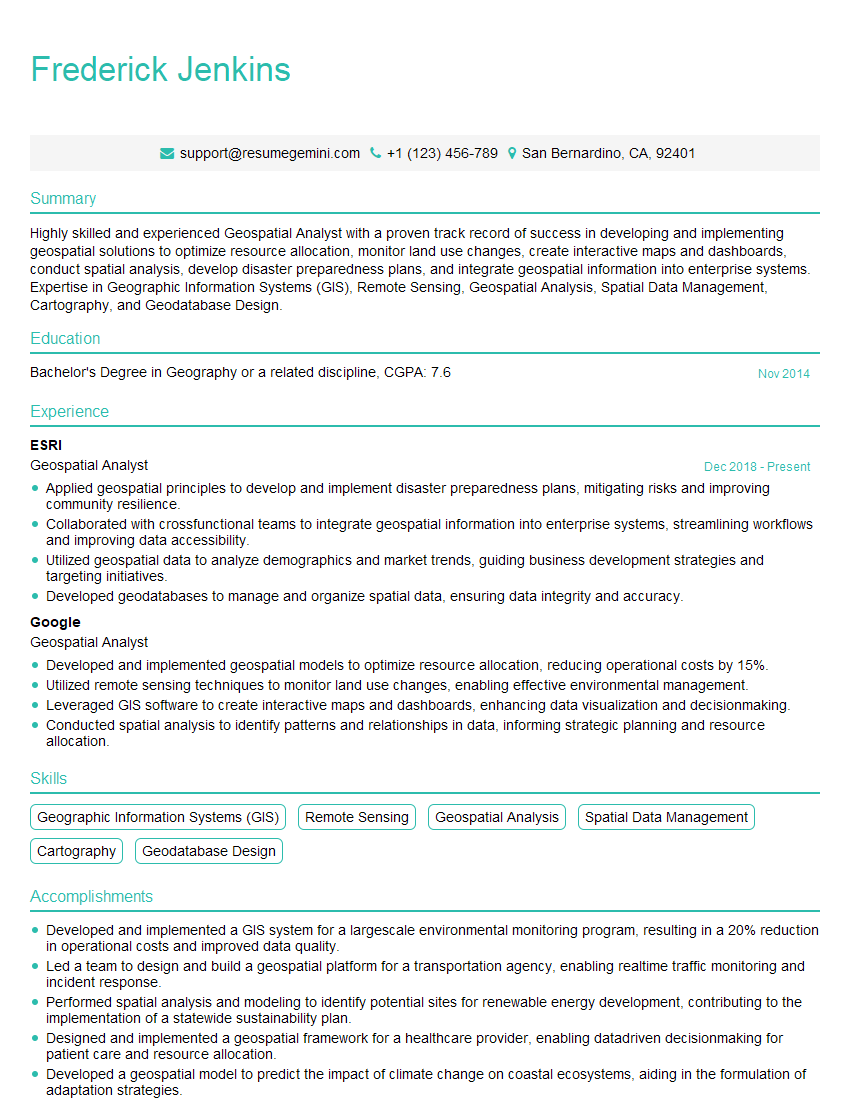
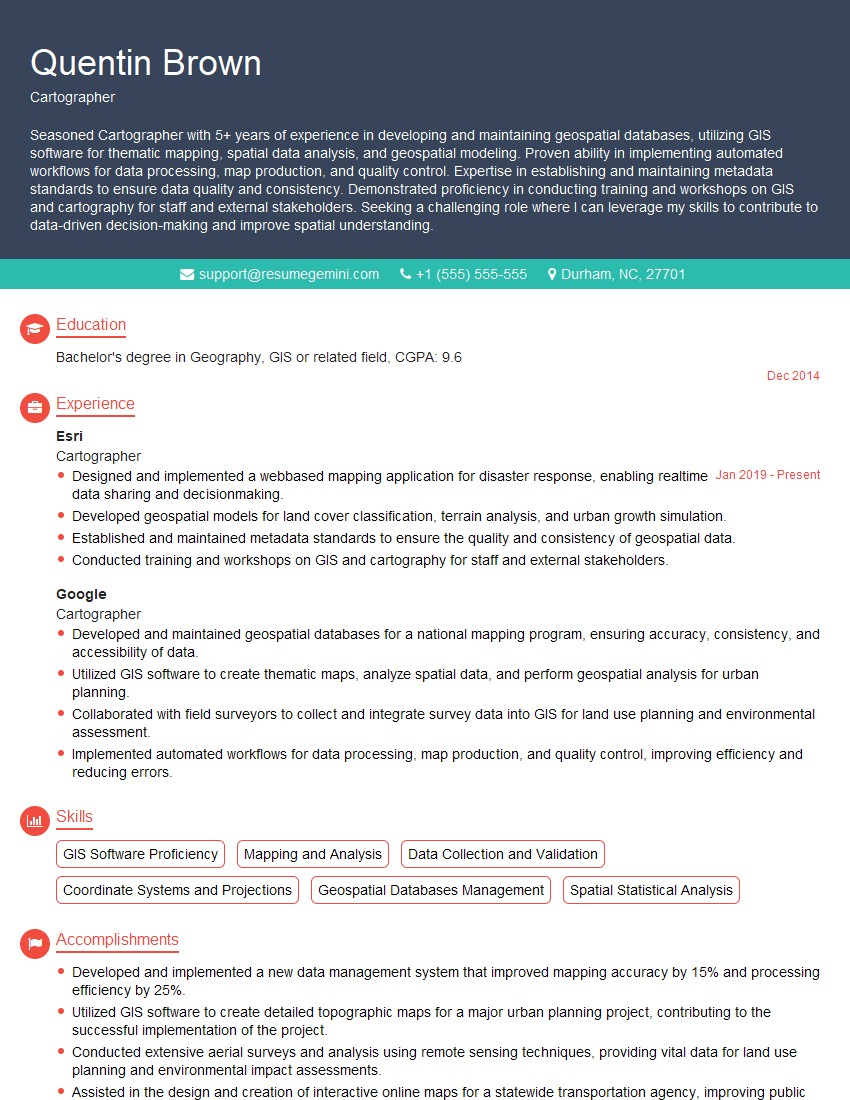
To increase your chances of landing your dream job, focus on creating a compelling and ATS-friendly resume that highlights your skills and experience effectively. ResumeGemini is a trusted resource to help you build a professional and impactful resume tailored to the specific requirements of GIS roles. We provide examples of resumes tailored to showcasing expertise in GIS principles and applications – check them out to get inspired!
Explore more articles
Users Rating of Our Blogs
Share Your Experience
We value your feedback! Please rate our content and share your thoughts (optional).
What Readers Say About Our Blog
Amazing blog
hello,
Our consultant firm based in the USA and our client are interested in your products.
Could you provide your company brochure and respond from your official email id (if different from the current in use), so i can send you the client’s requirement.
Payment before production.
I await your answer.
Regards,
MrSmith
hello,
Our consultant firm based in the USA and our client are interested in your products.
Could you provide your company brochure and respond from your official email id (if different from the current in use), so i can send you the client’s requirement.
Payment before production.
I await your answer.
Regards,
MrSmith
These apartments are so amazing, posting them online would break the algorithm.
https://bit.ly/Lovely2BedsApartmentHudsonYards
Reach out at BENSON@LONDONFOSTER.COM and let’s get started!
Take a look at this stunning 2-bedroom apartment perfectly situated NYC’s coveted Hudson Yards!
https://bit.ly/Lovely2BedsApartmentHudsonYards
Live Rent Free!
https://bit.ly/LiveRentFREE
Interesting Article, I liked the depth of knowledge you’ve shared.
Helpful, thanks for sharing.
Hi, I represent a social media marketing agency and liked your blog
Hi, I represent an SEO company that specialises in getting you AI citations and higher rankings on Google. I’d like to offer you a 100% free SEO audit for your website. Would you be interested?