Are you ready to stand out in your next interview? Understanding and preparing for Matching and blending colors interview questions is a game-changer. In this blog, we’ve compiled key questions and expert advice to help you showcase your skills with confidence and precision. Let’s get started on your journey to acing the interview.
Questions Asked in Matching and blending colors Interview
Q 1. Explain the difference between additive and subtractive color mixing.
Additive and subtractive color mixing are two fundamentally different approaches to creating colors. Think of it like this: additive mixing is like shining lights together, while subtractive mixing is like layering pigments.
Additive Color Mixing: This occurs when light sources are combined. The primary colors are red, green, and blue (RGB). When you combine these primary colors at full intensity, you get white light. This is how your computer monitor or television displays colors. Combining red and green makes yellow, red and blue makes magenta, and blue and green makes cyan. The absence of all light results in black.
Subtractive Color Mixing: This happens when you mix pigments, inks, or dyes. The primary colors are cyan, magenta, and yellow (CMY). These colors absorb certain wavelengths of light, and the reflected light determines the perceived color. Combining all three primary colors ideally results in black; however, in practice, this often yields a muddy brown, necessitating a fourth color, black (K), hence the CMYK model. The more pigments you add, the darker the color becomes; therefore, the absence of pigment results in white.
In essence, additive mixing starts with black and adds light to create color, while subtractive mixing starts with white and subtracts light through absorption to create color.
Q 2. Describe the Munsell color system.
The Munsell color system is a color space that organizes colors based on three perceptual color attributes: hue, value, and chroma.
- Hue: This refers to the pure color, such as red, green, blue, etc. It’s represented as a circular scale.
- Value: This represents the lightness or darkness of a color, ranging from black (0) to white (10).
- Chroma: This describes the color’s saturation or intensity, ranging from neutral (0) to highly saturated (varies depending on the hue).
Munsell colors are denoted with a specific notation like 5R 4/10, where ‘5R’ indicates the hue (red), ‘4’ is the value, and ’10’ represents the chroma. The system uses a three-dimensional color solid, making it a powerful tool for understanding and specifying colors objectively. It is particularly valuable in fields requiring precise color communication and control, such as paint manufacturing and art conservation.
Q 3. How do you match a color using a spectrophotometer?
Matching a color using a spectrophotometer involves measuring the spectral reflectance or transmittance of the target color and then finding a matching color that has a similar spectral curve.
- Measure the Target Color: Place the sample of the color you want to match into the spectrophotometer. The instrument measures how much light is reflected or transmitted at each wavelength across the visible spectrum.
- Obtain Spectral Data: The spectrophotometer provides a spectral curve, a graph plotting reflectance/transmittance against wavelength. This data represents the color’s unique spectral signature.
- Compare to Database or Formulas: The spectrophotometer software compares this spectral data with a database of known colors or uses color matching algorithms to predict what combination of pigments or dyes will create a visually similar color.
- Adjust and Refine: Based on the comparison, you may need to adjust the formulation (e.g., pigment ratios) of the matching color. You re-measure with the spectrophotometer after each adjustment, repeating steps 1-3 until you reach an acceptable color match.
- Visual Verification: While the spectrophotometer provides objective data, it’s essential to visually verify the match under various lighting conditions to account for metamerism (explained in the next question).
The accuracy of the match depends on the spectrophotometer’s quality, the database’s comprehensiveness, and the skill of the operator. It’s a precise, quantitative method that surpasses subjective visual estimations.
Q 4. What are metamerism and how does it affect color matching?
Metamerism is a phenomenon where two colors appear to match under one light source but differ under another. This happens because different colorants can reflect or transmit different spectrums of light that, when combined, result in the same perceived color under a specific light. However, under a different light source, the spectral distribution of the reflected light changes differently, causing the apparent color difference.
Impact on Color Matching: Metamerism significantly affects color matching because a match obtained under one set of lighting conditions might not hold under another. This makes accurate color reproduction challenging, especially in industries where consistent color appearance across different environments is crucial. For example, a dress that perfectly matches under a store’s lighting might appear slightly different under natural sunlight.
Mitigation Strategies: To mitigate metamerism issues, color matching should ideally be done under multiple illuminants that represent the likely viewing conditions. Selecting colorants with similar spectral curves minimizes the likelihood of metameric failure. Using a spectrophotometer with multiple illuminant settings and specifying color values in a color space that accounts for metamerism, like CIELAB, are important strategies for reducing the occurrence of metameric color discrepancies.
Q 5. Explain the concept of color space (e.g., RGB, CMYK, LAB).
A color space is a mathematical model that describes how colors are represented and manipulated. It defines a range of colors and specifies how these colors can be numerically described. Different color spaces suit different applications.
- RGB (Red, Green, Blue): This is an additive color model used for screen displays (monitors, TVs). It represents colors using the intensities of red, green, and blue light. Each color is assigned a value between 0 and 255 (or 0 and 1), defining its contribution to the overall color. For example,
(255, 0, 0)is pure red,(0, 255, 0)is pure green, and(0, 0, 255)is pure blue. - CMYK (Cyan, Magenta, Yellow, Black): This is a subtractive color model used for printing. It represents colors by subtracting colors from white. Each color has a percentage value from 0% to 100%. For example,
C=100%, M=0%, Y=0%, K=0%is pure cyan. - LAB (L*, a*, b*): This is a device-independent color space designed to mimic human color perception. ‘L*’ represents lightness, ‘a*’ represents the green-red axis, and ‘b*’ represents the blue-yellow axis. It’s useful for ensuring consistent color appearance across different devices and substrates. For example, a specific LAB value represents the same color regardless of whether it’s viewed on screen or printed.
The choice of color space depends on the application. RGB is suitable for digital displays, CMYK for print media, and LAB for color management and consistency across different devices and materials.
Q 6. How do you handle inconsistencies in color matching across different substrates?
Inconsistencies in color matching across different substrates are common because the substrate’s properties (texture, porosity, opacity, etc.) affect how light interacts with the colorant, resulting in different color appearances. For example, a color printed on matte paper will look different from the same color printed on glossy paper.
Strategies for Handling Inconsistencies:
- Substrate Characterization: Thoroughly understand the substrate’s optical properties. Consider factors such as brightness, opacity, smoothness, and color of the substrate itself. This information is crucial for adjusting the color formulation.
- Color Formulation Adjustment: Often, the color formulation needs adjustment for different substrates. This might involve changing pigment ratios, adding undercoats, or selecting specific colorants known for their good performance on the target substrate. Often, specialized formulations are created for a particular material to accommodate its characteristics.
- Proofing: Color proofing on the target substrate is essential to evaluate the final color appearance before large-scale production. Proofing ensures that you match not only the numerical color values but also the actual visual color outcome.
- Calibration and Profiling: Calibrating printing equipment and creating ICC profiles for the substrate will significantly improve color accuracy and consistency.
- Color Management Software: Utilizing color management software helps in converting color data between different color spaces and accounts for the substrate’s characteristics. This allows for more accurate predictions of the printed color.
By implementing a comprehensive approach that includes substrate analysis, thoughtful color formulation, and rigorous proofing, it is possible to minimize the discrepancies in color matching across various substrates.
Q 7. Describe your experience with different color matching software.
Throughout my career, I’ve gained extensive experience with various color matching software packages. My proficiency includes both standalone applications and software integrated into spectrophotometers and RIP (Raster Image Processor) systems.
I am adept at using software from major manufacturers that offer color formulation, spectral analysis, and color space conversion tools. For example, I’m familiar with X-Rite’s Color iMatch and Pantone Connect, as well as other industry-standard applications like Datacolor’s spectrophotometer software and various RIP software packages from different vendors. My experience extends to the use of both proprietary and open-source color management systems.
My practical experience extends beyond basic software operation. I understand the theoretical underpinnings of color science, including color spaces, color difference metrics, and metamerism, allowing me to interpret software outputs effectively and make informed decisions regarding color matching methodologies, selecting the best options for the specific project or substrate requirements.
Q 8. What are the challenges of matching colors under different lighting conditions?
Matching colors under different lighting conditions is notoriously challenging because light sources emit different spectral power distributions. This means that the same color, viewed under incandescent light (warm, yellowish), fluorescent light (cooler, sometimes greenish), or daylight (a complex mix), will appear subtly or dramatically different. This is due to metamerism, where two colors appear identical under one light source but different under another.
For instance, a fabric that appears perfectly matched to a sample under the showroom’s halogen spotlights might look significantly off when viewed in natural sunlight. This is a major problem in industries like textiles, printing, and paint manufacturing, where consistent color is crucial.
To mitigate this, we rely on standardized light sources (like D65, simulating daylight) during color assessment using spectrophotometers. These instruments measure the spectral reflectance of a color, giving a more objective measure than relying on human perception under variable lighting. Additionally, specifying color using a robust color space, like CIELAB, which is less susceptible to lighting variations than RGB, is vital.
Q 9. How do you assess the color accuracy of a batch of paint/dye?
Assessing color accuracy of a paint or dye batch involves a combination of visual inspection and instrumental measurement. Visual assessment, while subjective, provides a quick initial check for gross discrepancies. However, relying solely on human vision is unreliable because of individual variations in color perception.
Instrumental measurement is crucial for objective and quantitative analysis. Spectrophotometers are used to measure the spectral reflectance or transmittance of the sample. This data is then used to calculate color coordinates in a standardized color space (like CIELAB) and compared against the target color coordinates. The difference between the measured and target values is expressed as a Delta E (ΔE) value; a lower ΔE indicates better color accuracy. Acceptable ΔE values vary by industry and application, but generally, values below 1 are considered a good match.
For example, in automotive paint, the tolerance is much tighter (ΔE below 0.5) compared to something like household paint (ΔE below 2 might be acceptable).
Q 10. What methods do you use to adjust color formulations for consistency?
Maintaining color consistency across batches requires precise control over the color formulation and manufacturing process. Adjustments are often made using color matching software, which utilizes algorithms to predict the changes in color resulting from adding or subtracting different pigments.
- Spectral Adjustment: Based on spectrophotometer readings, the software can recommend specific adjustments to pigment ratios. For instance, if a batch is slightly too red, the software might suggest reducing the red pigment and increasing a blue or green pigment to achieve the desired hue.
- Iterative Process: The process often involves several iterations of adjustment, measurement, and comparison. Each adjustment is small to avoid overcorrection.
- Quality Control: Regular quality control checks during the manufacturing process are crucial to ensure that the color remains consistent throughout the batch and across subsequent batches.
Imagine baking a cake – you need to follow the recipe precisely to achieve the desired result. Color matching is similar; even small variations in ingredient (pigment) ratios can lead to noticeable color differences.
Q 11. Explain your understanding of color tolerances and acceptance standards.
Color tolerances define the acceptable range of color variation around a target color. These tolerances are specified using ΔE values. Acceptance standards are industry-specific and depend on factors like the application, cost, and visual sensitivity of the end product.
For high-end applications, like automotive paint or cosmetics, tighter tolerances (ΔE < 1) are essential for ensuring an aesthetically pleasing and consistent product. In less demanding applications, such as construction materials, larger tolerances might be acceptable (ΔE < 2 or even higher).
These tolerances are usually defined using ellipsoids or cubes in the CIELAB color space, defining the volume around the target color within which a measurement is considered acceptable. Understanding these standards is critical for both manufacturers and clients to ensure that the produced color meets the required quality.
Q 12. Describe your experience with colorimetric analysis.
Colorimetric analysis is the cornerstone of my work. I extensively use spectrophotometers to measure the spectral reflectance or transmittance of materials. This data provides objective information about the color, independent of human perception. The data obtained can then be utilized to determine the CIELAB coordinates, which represent color in a mathematically defined and universally understood format.
My experience includes using various types of spectrophotometers – including 0/45° and sphere spectrophotometers – each with its advantages depending on the nature of the sample (glossy vs. matte surfaces). I’m also familiar with analyzing color data using various software packages that allow for detailed color difference calculations (ΔE), color formulation adjustments, and quality control checks.
For example, in a recent project involving a textile manufacturer, using colorimetric analysis helped us pinpoint the source of a color variation between production runs by precisely comparing the spectral curves of samples from different batches.
Q 13. How do you manage discrepancies between visual and instrumental color measurements?
Discrepancies between visual and instrumental color measurements are common and often stem from metamerism (as discussed earlier), observer variation, or instrument calibration issues.
Addressing these discrepancies requires a systematic approach:
- Verify Instrument Calibration: Regular calibration of spectrophotometers against certified standards is essential.
- Controlled Lighting: Ensure that visual assessment occurs under standardized lighting conditions matching those used in instrumental measurement.
- Understanding Metamerism: Recognize that small differences in spectral reflectance, undetectable to the instrument but visible to the eye under different light sources, are possible.
- Observer Variation: Minimize the subjectivity by using multiple observers for visual evaluation, and prioritize the instrumental measurements as the most objective data.
Often, a combination of visual and instrumental data is used. Instrumental data provides objective quantitative values, while visual assessment contributes qualitative feedback regarding appearance which might not be fully captured by the instrument.
Q 14. How do you troubleshoot color matching problems?
Troubleshooting color matching problems is a systematic process that involves a combination of methodical investigation and problem-solving skills.
- Identify the Problem: Precisely define the color difference. Is it hue, saturation, or lightness? Use instrumental measurements (ΔE) to quantify the issue.
- Review Formulation: Check the recipe and manufacturing process for any variations from previous successful batches.
- Analyze Raw Materials: Ensure that the raw materials (pigments, dyes, resins) meet the required specifications and haven’t degraded or changed.
- Inspect Equipment: Check the condition and calibration of mixing and application equipment.
- Environmental Factors: Consider environmental factors such as temperature and humidity that could affect the final color.
- Iterative Adjustments: Make small, controlled adjustments to the formulation, re-measure, and repeat until the desired color is achieved.
For example, if the color is consistently off in one specific area of a product, it might point to a problem with application equipment or an uneven distribution of pigment. A careful analysis of the entire process is necessary to find the root cause.
Q 15. What are your preferred methods for documenting color recipes and standards?
Accurate color documentation is paramount for consistency and reproducibility. My preferred methods involve a multi-pronged approach combining digital and physical records. I utilize a dedicated digital database, ideally a Color Management System (CMS), to store color recipes with precise pigment percentages, base materials, and associated metadata like batch numbers and dates. This allows for easy search, retrieval, and version control. Simultaneously, I maintain physical color standards – small, carefully labeled samples of the actual mixed color – stored under controlled environmental conditions to prevent fading or degradation. These physical samples act as a crucial visual reference, especially when dealing with subtle metameric effects that might not be perfectly captured digitally.
For example, if I’m working on a bespoke paint color for a client, the digital record will contain precise weight measurements of each pigment, the type of binder used, and any relevant notes regarding the mixing process. The physical standard allows for quick visual verification during production runs, ensuring we stay within the acceptable tolerance range.
Career Expert Tips:
- Ace those interviews! Prepare effectively by reviewing the Top 50 Most Common Interview Questions on ResumeGemini.
- Navigate your job search with confidence! Explore a wide range of Career Tips on ResumeGemini. Learn about common challenges and recommendations to overcome them.
- Craft the perfect resume! Master the Art of Resume Writing with ResumeGemini’s guide. Showcase your unique qualifications and achievements effectively.
- Don’t miss out on holiday savings! Build your dream resume with ResumeGemini’s ATS optimized templates.
Q 16. Explain your experience with different types of pigments and dyes.
My experience spans a wide range of pigments and dyes, including organic, inorganic, and synthetic varieties. Organic pigments, derived from natural sources or chemical synthesis, tend to be vibrant but can be less lightfast than their inorganic counterparts. Inorganic pigments, often metallic oxides, are generally more durable and fade-resistant but offer a more limited color palette. Synthetic pigments bridge the gap, offering a diverse range of colors and performance characteristics. Understanding the properties of each is key – factors like transparency, tinting strength, and lightfastness significantly influence color matching and longevity. For example, phthalocyanine blue is a powerful synthetic pigment, offering exceptional brightness and color strength, ideal for vibrant hues. In contrast, titanium dioxide, a white inorganic pigment, is frequently used as an extender and for its opacity.
The same principles apply to dyes, which differ from pigments primarily in their solubility. Acid dyes, direct dyes, and reactive dyes, to name a few, each exhibit unique application methods and characteristics suitable for different substrates (e.g., fabric, paper).
Q 17. How do you ensure consistency in color matching across multiple batches?
Maintaining color consistency across multiple batches is crucial. This is achieved through rigorous control of the entire process, starting with the source materials. I rely on precise weighing and measuring instruments, using calibrated scales and volumetric tools. Using standardized mixing protocols, often automated if possible, minimizes variability introduced during the manual process. Careful control of environmental factors like temperature and humidity is vital, especially for certain types of pigments and substrates. Regular calibration and maintenance of color measurement instruments are non-negotiable.
As an example, if I’m creating a large quantity of a specific paint color, I’ll initially mix a master batch and then use that master batch as a reference for subsequent smaller batches, ensuring close monitoring of color readings at every stage. This minimizes the accumulated errors that might arise from producing every batch independently from scratch.
Q 18. How do you interpret a color formula?
A color formula represents a precise recipe for achieving a specific color. It typically lists the individual components and their proportions, expressed either by weight or volume. Understanding the formula involves grasping the roles of each ingredient. For example, a typical paint formula might include a pigment (for color), a binder (for adhesion and cohesion), a solvent (for adjustability and application), and additives (for properties like gloss or texture).
Example: Pigment A: 25%, Pigment B: 15%, Binder: 50%, Solvent: 10%
Interpreting this formula means recognizing that Pigment A contributes more to the overall color than Pigment B. The binder provides the medium for the pigment to be dispersed in, while the solvent alters the viscosity. The percentages must be carefully measured to ensure consistency.
Q 19. What are some common color matching errors and how do you avoid them?
Common color matching errors include metamerism (colors appearing the same under one light source but different under another), instrumental limitations (inaccuracies in color measurement devices), and operator error (incorrect weighing or mixing procedures). Avoiding these errors requires attention to detail and best practices. Metamerism is addressed by measuring colors under multiple illuminants (e.g., D65, A) and ensuring they match under each. Instrumental limitations are mitigated through regular calibration and maintenance of spectrometers and colorimeters. Operator error is minimized through careful training, standardized procedures, and the use of automated mixing systems when feasible.
For instance, a frequently encountered error is relying on visual assessment alone. Our eyes can be easily fooled under varying lighting conditions, so a reliance on spectrophotometric data is critical for accuracy.
Q 20. What is your experience with different types of color measurement instruments?
I am proficient in using various color measurement instruments, including spectrophotometers (both handheld and benchtop), colorimeters, and densitometers. Spectrophotometers provide detailed spectral data, offering comprehensive color information and enabling precise color matching. Colorimeters offer a simpler and often more cost-effective way to measure color, providing values in CIELAB or other color spaces. Densitometers are used primarily in printing to measure ink densities.
Choosing the right instrument depends on the application. For critical color matching in high-stakes projects, a spectrophotometer is necessary for its precision. For less demanding tasks, a colorimeter may suffice. I also have experience using software to manage and analyze the data obtained from these instruments.
Q 21. Explain your understanding of color psychology.
Color psychology is the study of how colors affect human behavior, emotions, and perceptions. Understanding color psychology is crucial for effective color matching, particularly in design and branding. Certain colors evoke specific emotions and associations. For example, blue is often associated with calmness and trust, while red can represent excitement or urgency. In my work, I consider these associations when selecting colors for a project, tailoring the color palette to achieve the desired psychological effect.
For instance, if I am designing a packaging for a calming tea blend, I might select a palette of muted blues and greens, while for an energy drink, brighter, bolder colors would be more appropriate. A sound understanding of color psychology allows me to translate a client’s abstract vision into a concrete color scheme that achieves the desired effect on their target audience.
Q 22. How do you maintain accurate color standards in your workflow?
Maintaining accurate color standards is crucial for consistent and reliable results. My workflow relies heavily on a combination of standardized tools and meticulous practices. First, I always utilize calibrated monitors and colorimeters to ensure accurate color representation on screen and in print. This involves regular profiling and calibration using industry-standard software. Second, I work with established color spaces like sRGB or Adobe RGB, depending on the final output medium, to ensure consistency across different devices and software. Third, I meticulously document all color specifications, including color codes (e.g., Pantone, Hex), and reference samples, creating a traceable record for every project. Finally, I always maintain a controlled environment to minimize the influence of ambient light on color perception.
For example, if I’m matching a client’s existing logo, I’ll obtain a physical sample of the logo’s color and use a spectrophotometer to measure its precise values. These values are then used as a target for matching across different substrates and print processes. This layered approach guarantees accuracy and reproducibility, which is paramount in professional color matching.
Q 23. Describe a situation where you had to resolve a color matching issue.
One challenging situation involved matching a specific shade of teal for a high-end fashion brand. The client provided a fabric swatch, but the color appeared slightly different under various lighting conditions. Initial attempts at color matching using the spectrophotometer values yielded inconsistencies. We realized that the fabric had a subtle sheen that wasn’t captured by the initial measurements. To solve this, we used a multi-angle spectrophotometer which accounted for the light reflection at different angles, providing a more accurate representation of the color’s appearance. We then adjusted the color formula based on this data, meticulously testing iterations on the target material until the color matched perfectly across different lighting conditions. This experience highlighted the importance of understanding the complexities of color perception and the need for sophisticated measurement tools.
Q 24. What techniques do you use for achieving specific color effects (e.g., metallic, pearlescent)?
Achieving specific color effects like metallic or pearlescent finishes requires a deeper understanding of material science and specialized techniques. For metallic effects, we often use metallic pigments, such as aluminum or bronze powders, incorporated into a base color. The concentration and particle size of these pigments significantly impact the final appearance, influencing the intensity and sheen of the metallic effect. For pearlescent finishes, we utilize pearlescent pigments that contain mica or other layered materials. These pigments interact with light, creating an iridescent effect. The angle and intensity of the light source greatly affect the appearance of these finishes. The choice of binder, pigment dispersion techniques, and application method also play a critical role in the final result. For example, achieving a smooth, consistent metallic finish might involve careful grinding and dispersion to prevent clumping, resulting in a smoother, more even metallic appearance. Careful control of these factors allows for a customized outcome.
Q 25. How do you stay current with the latest advances in color technology?
Staying current in color technology requires continuous learning and engagement with the industry. I regularly attend industry conferences and workshops, read trade publications, and participate in online forums and communities dedicated to color science and technology. I actively follow the research being conducted on new colorants, printing technologies, and color measurement instruments. I also make use of online resources and tutorials to expand my knowledge of new software and techniques. Subscription to relevant journals and participation in online communities focused on color management are integral to my professional development. This proactive approach keeps my skills sharp and allows me to adapt to the evolving demands of the industry.
Q 26. What is your experience with color management systems (CMS)?
I have extensive experience with various color management systems (CMS), including X-Rite i1Profiler and ColorSync. A CMS is crucial for ensuring color accuracy across the entire workflow, from capture to output. I understand how to profile monitors, printers, and scanners to create accurate color representations. I’m proficient in using CMS software to convert colors between different color spaces and to manage color transformations throughout the production process. For instance, when working with digital files, I carefully manage color profiles to avoid color shifts during printing. I’m very familiar with ICC profiles and their importance in maintaining color consistency.
Q 27. How do you handle client feedback regarding color matches?
Handling client feedback on color matches is a critical aspect of the job. I actively encourage open communication and collaboration. I begin by carefully listening to the client’s concerns and understanding their perspective on the color match. If there are discrepancies, I then use a methodical approach involving re-evaluation of the initial color target, revisiting the color measurement data, and performing further testing. I will often demonstrate the color match under various lighting conditions, explaining any potential variations due to factors like metamerism. Finally, I work collaboratively with the client to reach a solution that meets their expectations while adhering to industry best practices.
Q 28. Describe your experience with quality control procedures in color matching.
Quality control procedures are integral to my color matching process. My workflow incorporates several steps to ensure consistency and accuracy. This starts with the initial verification of the color target using calibrated instruments. Each stage of the matching process—from initial measurement to final production—is meticulously documented. I conduct regular checks throughout the process, using spectrophotometers to verify color consistency between batches. Furthermore, I maintain a detailed record of all color formulas and production parameters for future reference and auditing. This comprehensive approach to quality control ensures that the final product meets the client’s specifications and maintains the highest level of quality.
Key Topics to Learn for Matching and Blending Colors Interview
- Color Theory Fundamentals: Understanding the color wheel, primary, secondary, and tertiary colors, and color harmonies (complementary, analogous, triadic, etc.). This forms the theoretical basis for all your color decisions.
- Color Space and Models: Familiarity with RGB, CMYK, LAB, and HSL color spaces and their applications in different contexts (e.g., digital vs. print). Understanding how colors translate across different mediums is crucial.
- Blending Techniques: Exploring various blending methods, including additive and subtractive blending, and their impact on the final color outcome. This includes understanding transparency and opacity.
- Practical Applications: Understanding how color matching and blending is applied in different fields, such as graphic design, web development, fashion, and painting. Consider specific examples from your own experience or studies.
- Color Perception and Psychology: Learn how color impacts human emotions and perceptions. Understanding this allows you to make informed decisions based on the desired effect.
- Digital Color Tools and Software: Demonstrate familiarity with relevant software (Photoshop, Illustrator, etc.) and their color tools. Practice using these tools to showcase your skills.
- Problem-Solving Approaches: Be prepared to discuss scenarios where color matching is challenging (e.g., matching colors across different devices or materials). Highlight your ability to troubleshoot and find solutions.
- Color Management and Calibration: Discuss the importance of maintaining consistent color across different stages of a project, from design to printing or display. Show your awareness of color profiles and calibration techniques.
Next Steps
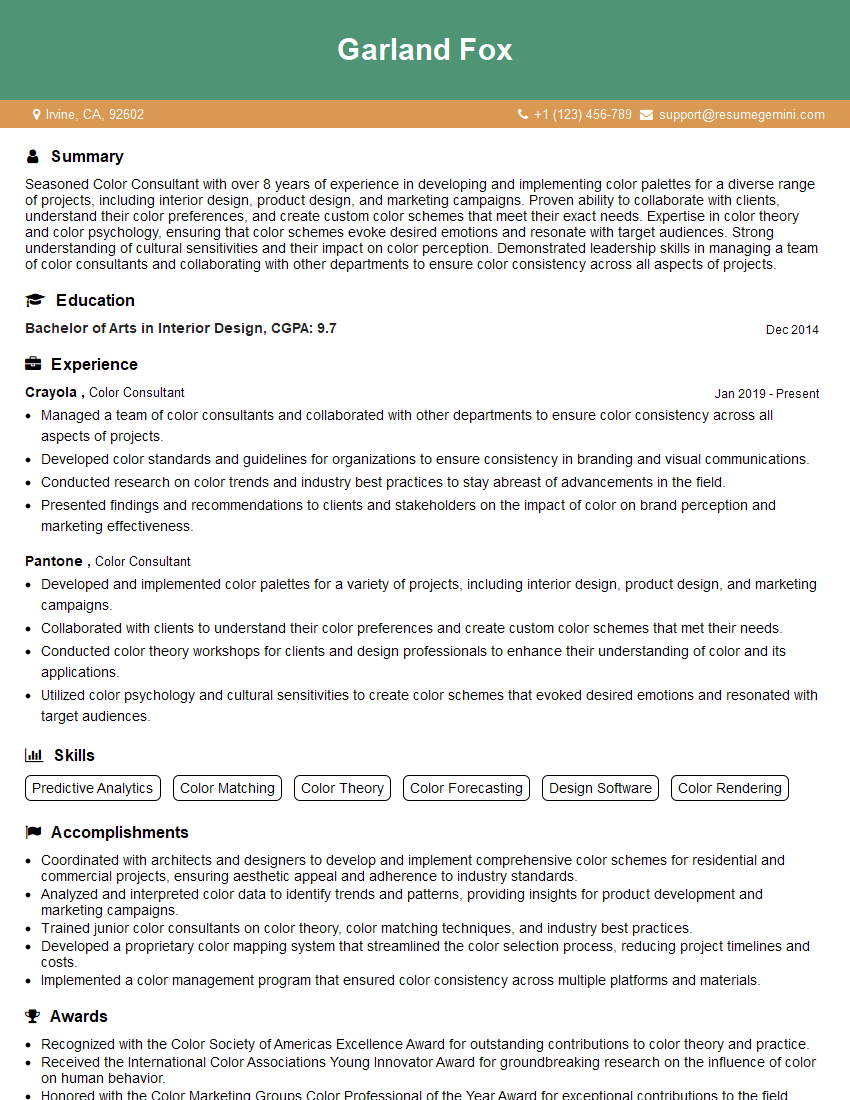
Mastering color matching and blending is essential for success in many creative and technical fields, opening doors to exciting career opportunities and higher earning potential. An ATS-friendly resume is key to getting your foot in the door. To significantly boost your job prospects, leverage ResumeGemini to create a professional and impactful resume that highlights your skills and experience in color theory and application. ResumeGemini provides examples of resumes tailored to the Matching and blending colors field, ensuring your resume stands out from the competition. Take the next step and build a resume that reflects your expertise!



Explore more articles
Users Rating of Our Blogs
Share Your Experience
We value your feedback! Please rate our content and share your thoughts (optional).
What Readers Say About Our Blog
Amazing blog
hello,
Our consultant firm based in the USA and our client are interested in your products.
Could you provide your company brochure and respond from your official email id (if different from the current in use), so i can send you the client’s requirement.
Payment before production.
I await your answer.
Regards,
MrSmith
hello,
Our consultant firm based in the USA and our client are interested in your products.
Could you provide your company brochure and respond from your official email id (if different from the current in use), so i can send you the client’s requirement.
Payment before production.
I await your answer.
Regards,
MrSmith
These apartments are so amazing, posting them online would break the algorithm.
https://bit.ly/Lovely2BedsApartmentHudsonYards
Reach out at BENSON@LONDONFOSTER.COM and let’s get started!
Take a look at this stunning 2-bedroom apartment perfectly situated NYC’s coveted Hudson Yards!
https://bit.ly/Lovely2BedsApartmentHudsonYards
Live Rent Free!
https://bit.ly/LiveRentFREE
Interesting Article, I liked the depth of knowledge you’ve shared.
Helpful, thanks for sharing.
Hi, I represent a social media marketing agency and liked your blog
Hi, I represent an SEO company that specialises in getting you AI citations and higher rankings on Google. I’d like to offer you a 100% free SEO audit for your website. Would you be interested?