Preparation is the key to success in any interview. In this post, we’ll explore crucial Participation in Opera Festivals and Conferences interview questions and equip you with strategies to craft impactful answers. Whether you’re a beginner or a pro, these tips will elevate your preparation.
Questions Asked in Participation in Opera Festivals and Conferences Interview
Q 1. Describe your experience managing logistics for an opera festival or conference.
Managing logistics for an opera festival or conference is like orchestrating a complex symphony – every element must be in perfect harmony. It involves meticulous planning and execution across various areas.
- Venue Management: This includes securing the performance space, managing backstage areas, coordinating with stagehands and technicians, and ensuring appropriate accessibility for audience members and performers.
- Travel and Accommodation: Arranging travel for performers, conductors, directors, and other personnel; booking hotels and providing transportation to and from the airport and venues. This requires careful consideration of budgets and individual needs.
- Catering and Hospitality: Organizing meals, refreshments, and any special events for performers, staff, and VIP guests. Dietary restrictions and preferences need to be carefully managed.
- Ticketing and Box Office: Handling ticket sales, managing seating arrangements, and addressing any ticketing inquiries. This often involves using ticketing software to track sales and manage inventory.
- Security and Safety: Ensuring the safety and security of all attendees, performers, and staff. This may involve coordinating with security personnel and implementing emergency procedures.
For example, during the ‘Verdi in Venice’ festival, I was responsible for coordinating the transportation of over 50 performers from various countries, ensuring their timely arrival and comfortable accommodation. This involved negotiating contracts with airlines and hotels, meticulously tracking flight details, and managing any unforeseen delays.
Q 2. Detail your role in a specific opera production, highlighting your responsibilities.
My role in the production of Puccini’s ‘La Bohème’ was as the Assistant Stage Manager. This involved a wide range of responsibilities, acting as a vital link between the director, the technical crew, and the performers.
- Rehearsal Coordination: Scheduling and managing rehearsals, ensuring all performers and technical elements are ready on time. This included tracking attendance and relaying directorial notes to the cast.
- Cueing and Communication: During the performance, I was responsible for giving cues to the technical crew (lighting, sound, set changes) and coordinating with the prompter to ensure the smooth flow of the performance.
- Problem Solving: Dealing with any unforeseen issues that arose during rehearsals or performances – a forgotten prop, a costume malfunction, or a performer’s sudden illness. Quick thinking and resourcefulness are key.
- Stage Management: Overseeing the running of the stage during both rehearsals and performances, ensuring that props, costumes, and sets are in their correct places at the right time.
- Communication: Maintaining constant communication with all members of the production team, ensuring that everyone is informed and working efficiently towards a common goal.
One memorable challenge was managing a sudden power outage during a critical scene. I immediately coordinated with the lighting and sound technicians to implement backup systems, minimizing the disruption to the audience and maintaining the integrity of the performance.
Q 3. Explain your understanding of opera production budgeting and cost management.
Opera production budgeting is a delicate balance between artistic ambition and financial reality. It’s crucial to create a detailed budget encompassing all aspects of the production.
- Personnel Costs: Salaries for performers, directors, conductors, musicians, stagehands, and other crew members.
- Venue Rental: Costs associated with renting the performance venue, including any special requirements or setup fees.
- Set and Costume Design: Costs associated with designing, constructing, and maintaining the sets and costumes. This includes materials, labor, and potential rentals.
- Marketing and Promotion: Costs associated with advertising and promoting the production to attract audiences.
- Technical Costs: Costs associated with lighting, sound, special effects, and other technical elements of the production.
- Contingency Funds: A crucial element to account for unforeseen expenses or potential problems.
Effective cost management requires meticulous tracking of expenses, negotiating favorable contracts with vendors, and exploring potential cost-saving measures without compromising artistic quality. For instance, utilizing existing props or costumes instead of purchasing new ones can significantly reduce costs. Regular budget reviews and reporting are essential to maintaining control and identifying potential overruns.
Q 4. How would you handle a scheduling conflict during an opera festival?
Scheduling conflicts during an opera festival require a calm and efficient approach. My strategy involves:
- Identify the Conflict: Clearly define the nature of the conflict – overlapping performance times, venue clashes, or conflicting artist schedules.
- Assess the Impact: Evaluate the severity of the conflict. How many people are affected? What is the potential impact on the festival’s program?
- Explore Solutions: Brainstorm potential solutions, prioritizing options that minimize disruption and maintain the overall quality of the festival. This might include rescheduling performances, finding alternative venues, or making adjustments to individual artist contracts.
- Communicate Effectively: Clearly and promptly communicate the situation and the proposed solution to all affected parties – artists, technical crew, and audience members. Transparency is key in managing expectations.
- Document Everything: Maintain clear records of the conflict, the solutions implemented, and any communication with relevant parties. This helps to prevent similar issues in the future.
For instance, during a festival, I successfully resolved a scheduling conflict between two different productions by negotiating a slight shift in rehearsal times, allowing both productions to proceed without overlapping schedules and minimizing disruption to the artists’ schedules.
Q 5. Describe your experience working with diverse teams in an opera environment.
Working with diverse teams in opera is not only common but essential for success. The opera world brings together people from a variety of backgrounds, skills, and cultures – singers, musicians, technicians, designers, administrators, and marketing professionals. My approach to working with diverse teams focuses on:
- Respect and Inclusivity: Creating a work environment that values each individual’s unique contribution and perspective.
- Clear Communication: Utilizing clear and concise communication strategies, ensuring everyone understands their roles and responsibilities.
- Effective Collaboration: Establishing collaborative processes that encourage open dialogue, mutual respect, and creative problem-solving.
- Conflict Resolution: Developing strategies for addressing and resolving conflicts in a constructive and respectful manner.
- Cultural Sensitivity: Being mindful of cultural differences and adapting communication styles and approaches to ensure effective collaboration.
For example, during the production of a Mozart opera, our team included performers from several European countries. By understanding and respecting their cultural differences, and by using clear communication channels, we were able to successfully navigate any language barriers and achieve a collaborative and harmonious work environment that led to a critically acclaimed performance.
Q 6. How do you ensure the smooth running of technical aspects during an opera performance?
Ensuring the smooth running of technical aspects during an opera performance demands meticulous planning, proactive problem-solving, and excellent communication. My approach encompasses:
- Pre-Production Planning: Detailed technical rehearsals that address all aspects of lighting, sound, set changes, and special effects.
- Technical Run-Throughs: Conducting thorough technical run-throughs to identify and resolve any potential technical issues before the performance.
- Communication with Technicians: Maintaining clear and constant communication with the technical crew, ensuring everyone is aware of their cues and responsibilities.
- Backup Systems: Having backup systems in place to deal with any unforeseen technical problems – power outages, equipment malfunctions, etc.
- Monitoring Performance: Closely monitoring the technical aspects of the performance to identify and quickly address any issues that may arise during the show.
A critical incident I handled involved a malfunctioning lighting system during a performance. By quickly communicating with the lighting technician and deploying a backup system, the disruption to the performance was minimized, maintaining audience engagement and the integrity of the show.
Q 7. How familiar are you with opera-specific software or technologies?
I’m proficient in various opera-specific software and technologies. My experience includes:
- Ticketing and Box Office Software: Experience with various ticketing systems, including Ticketmaster and Eventbrite, for managing ticket sales, seating charts, and box office operations.
- Stage Management Software: Proficiency in using stage management software for cue sheets, rehearsal scheduling, and communication within the production team. This frequently involves programs tailored to handling complex scheduling needs for multiple performers and technical elements.
- Lighting and Sound Consoles: Familiarity with operating and troubleshooting lighting and sound consoles, understanding the intricacies of cueing and programming. This includes experience with both analog and digital systems.
- Project Management Software: Experience using project management tools such as Asana or Trello for organizing tasks, timelines, and communication within the production team.
Additionally, I possess a strong understanding of various audio-visual technologies, including sound reinforcement systems, lighting rigs, and video projection systems. This knowledge enables me to effectively collaborate with technical teams and troubleshoot any issues that might arise during rehearsals or performances.
Q 8. How would you troubleshoot a technical problem during an opera performance?
Troubleshooting technical problems during an opera performance requires a calm, systematic approach and a strong understanding of the technical aspects of the production. My approach is threefold: immediate response, diagnosis, and solution.
Immediate Response: The first step involves quickly assessing the nature and severity of the problem. Is it a complete blackout? A microphone malfunction? A costume issue? This rapid assessment dictates the urgency of the response. For instance, a sudden power outage requires immediate communication with the stage manager and electricians, while a minor sound glitch might only require a quick adjustment by the sound technician.
Diagnosis: Once the problem is identified, the next stage is pinpointing the cause. This often involves questioning the relevant personnel – lighting technicians, sound engineers, stagehands – to gather information. I’d also check equipment logs and run diagnostics where possible. For example, if a spotlight fails, we need to determine if it’s a bulb issue, a wiring problem, or a control console malfunction.
Solution: This phase involves implementing a solution, ranging from simple fixes (replacing a blown bulb) to more complex measures (switching to backup systems). A crucial part of this stage is contingency planning. Opera productions should always have backup plans in place. Perhaps a secondary microphone or a different lighting setup. Having rehearsed these backup solutions beforehand is key to ensuring a smooth, uninterrupted performance. During a recent performance, a sudden power surge caused a temporary blackout. Thanks to a well-rehearsed emergency protocol and our backup generator, we minimized the disruption to under five minutes.
Q 9. How would you handle a crisis situation during an opera festival or conference?
Handling a crisis during an opera festival or conference demands a proactive, multi-faceted approach. My strategy hinges on preparedness, communication, and decisive action.
- Preparedness: Before the event, a comprehensive risk assessment identifying potential crises (medical emergencies, security breaches, severe weather) is crucial. We develop detailed contingency plans for each scenario, assigning responsibilities and outlining procedures. This includes identifying key personnel, emergency contact lists, and designated meeting points.
- Communication: During a crisis, clear and efficient communication is paramount. This involves using a variety of methods (e.g., radio communication, text messaging, dedicated emergency phone lines) to keep all stakeholders informed and coordinated. I believe in establishing a central command center to facilitate communication and decision-making.
- Decisive Action: Once a crisis occurs, decisive action is necessary. I focus on prioritizing the safety and well-being of attendees and performers. This might involve evacuating a building, administering first aid, or contacting emergency services. A recent example was a severe thunderstorm that caused a power outage during a conference. Following our pre-planned procedures, we relocated attendees to a safe area, providing updates and refreshments. By utilizing our communication plan, we kept panic to a minimum and ensured everyone’s safety.
Q 10. What is your experience with audience management and engagement?
Audience management and engagement are critical for a successful opera experience. My approach focuses on creating a welcoming and enjoyable atmosphere, managing expectations, and fostering a sense of community.
- Pre-Show Engagement: This starts well before the curtain rises. I believe in utilizing pre-show materials like program notes and engaging introductions to build anticipation and provide context for the opera. Interactive elements such as Q&A sessions with the cast or pre-show talks by experts enhance the audience’s understanding and appreciation.
- During the Performance: During the performance itself, managing audience behavior is key. This involves ensuring comfortable seating, addressing any disruptions promptly and respectfully, and creating an environment conducive to attentive listening.
- Post-Show Engagement: Post-show engagement involves encouraging discussion and feedback. Meet-and-greets with the cast, post-performance talks, or even online forums create opportunities for interaction and allow audiences to share their experiences. I believe in leveraging social media to continue the conversation and build a loyal following. In one instance, we introduced a post-show ‘Opera Chat’ allowing audience members to connect with the singers and discuss the performance, enhancing audience engagement considerably.
Q 11. Describe your experience with marketing and promotion of opera events.
Marketing and promotion of opera events require a multi-platform approach targeting diverse audiences. My strategy focuses on creating compelling narratives and utilizing a variety of channels.
- Understanding your Audience: The first step is understanding the target audience. Are we aiming for seasoned opera-goers or newcomers? This understanding dictates the marketing message and chosen channels.
- Compelling Narrative: Creating a captivating story around the opera is vital. Highlighting the unique aspects of the production—the cast, the director’s vision, the music—is key to attracting interest.
- Multi-Platform Approach: We leverage various channels including social media, website marketing, email campaigns, print advertising, and partnerships with local organizations. Targeting specific demographic groups through tailored campaigns is crucial for maximum reach. For example, we utilized Instagram for reaching younger audiences, while partnering with local radio stations helped us connect with older generations. For a recent production, a visually striking promotional video on YouTube significantly boosted ticket sales.
Q 12. How do you prioritize tasks and manage time effectively in a fast-paced opera environment?
Prioritizing tasks and managing time effectively in a fast-paced opera environment is crucial for success. I utilize a combination of techniques, including prioritization matrices, time blocking, and delegation.
- Prioritization Matrices: I use Eisenhower Matrix (Urgent/Important) to categorize tasks, focusing on high-impact activities first. This ensures that critical tasks are addressed promptly, avoiding last-minute rushes.
- Time Blocking: I allocate specific time slots for different tasks, ensuring focused work periods. This technique prevents distractions and helps maintain momentum. For example, I might allocate two hours on Monday morning for reviewing contracts and three hours on Tuesday afternoon for meeting with the marketing team.
- Delegation: Delegating tasks to capable team members is essential for efficient time management. This allows me to concentrate on higher-level strategic planning and problem-solving. Trusting my team to handle their responsibilities effectively is paramount.
This structured approach prevents feeling overwhelmed and allows for proactive problem-solving, minimizing the impact of unexpected events.
Q 13. Explain your understanding of health and safety regulations in opera production.
Health and safety regulations are paramount in opera production. My understanding covers a range of areas, from occupational health and safety for staff to audience safety and emergency procedures.
- Occupational Health and Safety (OHS): This includes ensuring safe working practices for all personnel, providing appropriate personal protective equipment (PPE), and adhering to regulations concerning stage machinery, lighting, and sound equipment.
- Audience Safety: This involves risk assessments for the venue, implementing clear evacuation procedures, providing appropriate first-aid facilities, and ensuring accessibility for individuals with disabilities. Regular safety checks of the venue before each performance are critical.
- Emergency Procedures: Having detailed emergency plans for various scenarios—fire, medical emergencies, power outages—is vital. These plans should include clearly defined roles, communication protocols, and designated assembly points. Regular safety drills ensure everyone is familiar with the procedures.
Compliance with all relevant regulations and maintaining thorough documentation are non-negotiable. A proactive approach, prioritizing safety above all else, ensures a safe and enjoyable experience for everyone involved.
Q 14. How familiar are you with copyright and licensing agreements related to opera performances?
My familiarity with copyright and licensing agreements related to opera performances is extensive. Understanding these legal frameworks is crucial for avoiding infringement and ensuring the smooth execution of performances.
- Performance Rights: Securing performance rights for the chosen opera is essential. This involves obtaining licenses from the relevant copyright holders, ensuring that the production has the legal right to perform the work publicly.
- Musical Arrangements: If any musical arrangements or adaptations are used, licenses must be obtained for these as well. The legal implications of unauthorized use can be severe, including hefty fines and legal action.
- Libretto and Translation Rights: Similar licenses are required for the use of the libretto (the text of the opera) and any translations. Depending on the opera and its age, multiple copyright holders might be involved, necessitating careful research and negotiation.
- Recording and Distribution Rights: If the performance is to be recorded and distributed (live streaming, DVD release), separate rights need to be acquired. These rights specify the allowed methods and territories for distribution.
Careful management of these agreements is not only legally sound but also essential for preventing costly delays and disputes, ensuring the production proceeds without legal complications.
Q 15. Describe your experience working with singers, conductors, and other artistic personnel.
My experience working with singers, conductors, and other artistic personnel spans over fifteen years, encompassing various roles from stage management to production coordination. I’ve found that successful collaboration hinges on clear communication, mutual respect, and a shared artistic vision.
For example, during the production of Carmen at the [Name of Opera House], I worked closely with the director to ensure the singers’ interpretations aligned with the overall staging concept. This involved facilitating rehearsals, mediating creative disagreements (sometimes involving passionate debates about character motivations!), and ensuring everyone felt heard and valued. With the conductor, the coordination was crucial for timing and pacing, bridging the gap between the musical score and the visual spectacle. I’ve learned to anticipate challenges and proactively address them, fostering a productive atmosphere where artistic excellence can flourish.
Beyond the artistic personnel, I have also fostered strong working relationships with costume designers, lighting technicians, and set builders, understanding that a successful opera production is a collaborative effort requiring seamless integration across all departments.
Career Expert Tips:
- Ace those interviews! Prepare effectively by reviewing the Top 50 Most Common Interview Questions on ResumeGemini.
- Navigate your job search with confidence! Explore a wide range of Career Tips on ResumeGemini. Learn about common challenges and recommendations to overcome them.
- Craft the perfect resume! Master the Art of Resume Writing with ResumeGemini’s guide. Showcase your unique qualifications and achievements effectively.
- Don’t miss out on holiday savings! Build your dream resume with ResumeGemini’s ATS optimized templates.
Q 16. How would you ensure accessibility for all attendees at an opera event?
Ensuring accessibility for all attendees is paramount. It’s not just about compliance; it’s about creating an inclusive and welcoming environment for everyone to enjoy the magic of opera. My approach involves a multi-pronged strategy:
- Audio Description: Providing audio descriptions for visually impaired patrons, narrating the visual elements of the performance.
- Captioned Performances: Offering surtitles or closed captions for hearing-impaired patrons, projecting translations above the stage or providing individual devices.
- Wheelchair Accessibility: Ensuring adequate wheelchair spaces with clear sightlines, accessible restrooms, and designated drop-off zones.
- Assistive Listening Devices: Offering assistive listening devices to amplify sound for hearing-impaired patrons, available upon request.
- Sensory-Friendly Performances: Creating performances designed to be more accommodating to people with autism spectrum disorder or other sensory sensitivities, including adjusted lighting and sound levels.
- Accessible Website and Ticketing System: Designing user-friendly online platforms with clear accessibility features for purchasing tickets and accessing information.
For instance, at the [Name of Opera Festival], we introduced tactile maps of the venue and implemented a buddy system, pairing volunteers with patrons requiring assistance. This ensured a positive experience for everyone.
Q 17. What experience do you have with grant writing or fundraising for opera projects?
I have extensive experience in grant writing and fundraising for opera projects. I understand the nuances of securing funding from various sources, including governmental bodies, private foundations, and corporate sponsors.
My approach is strategic, starting with identifying potential funding opportunities that align with the project’s goals. I then meticulously craft compelling grant proposals, highlighting the artistic merit, community impact, and financial sustainability of the project. I’ve successfully secured funding for several opera productions, including a recent grant from the [Name of Foundation] that supported the staging of Aida, which allowed us to employ a renowned costume designer and invest in innovative stage technology.
Beyond grants, I’ve also spearheaded fundraising initiatives, such as gala events and patron drives, showcasing the value proposition of supporting the arts and fostering relationships with key stakeholders. Building a strong narrative and showcasing a clear return on investment are crucial aspects of successful fundraising.
Q 18. Describe your experience with volunteer management in an opera setting.
Effective volunteer management is critical for the success of any opera production. My approach involves a structured system that encompasses recruitment, training, scheduling, and appreciation.
I begin by clearly defining roles and responsibilities, ensuring each volunteer understands their contribution to the overall production. Comprehensive training sessions are conducted, equipping volunteers with the necessary skills and knowledge. Effective scheduling tools, such as online platforms, facilitate efficient allocation of tasks, minimizing conflicts and maximizing volunteer engagement. Finally, regular feedback and appreciation are essential to maintain morale and foster a sense of community.
During the [Name of Opera] festival, I managed a team of 50 volunteers, encompassing ushers, backstage assistants, and box office personnel. I implemented a system of regular check-ins and feedback, resulting in high volunteer satisfaction and a smooth-running event.
Q 19. How familiar are you with various opera styles and periods?
My familiarity with various opera styles and periods is extensive. My knowledge encompasses everything from the Baroque operas of Handel and Monteverdi to the bel canto masterpieces of Rossini and Bellini, the romantic works of Wagner and Verdi, and the modernist and contemporary compositions of Britten and Adams.
This understanding extends beyond mere familiarity with the composers; it includes a nuanced appreciation of the historical, social, and cultural contexts that shaped each style. I understand the stylistic differences in vocal techniques, orchestration, staging conventions, and dramatic approaches that define each period, allowing me to contribute effectively to any opera production regardless of its era.
For example, my work on a recent production of L’Orfeo required a deep understanding of Baroque performance practices, informing my approach to staging, costuming, and instrumentation. This allowed for an authentic and engaging presentation of this early opera masterpiece.
Q 20. How do you ensure the quality control of an opera production?
Quality control in an opera production is a continuous process, starting from the initial concept and extending through the final performance. My approach involves a series of checkpoints, ensuring consistency and excellence throughout every stage.
This includes regular rehearsals, meticulous attention to detail in set design, costume creation, and lighting, and thorough sound checks. I incorporate feedback from various stakeholders, including singers, conductors, directors, and technical staff, to identify and address potential issues early on. The process is iterative, embracing flexibility and adapting to the evolving needs of the production. Maintaining open communication and fostering a collaborative environment ensures that everyone is invested in producing the highest-quality performance.
For instance, during a recent production, we identified a lighting issue during a technical rehearsal. Addressing this issue promptly prevented it from impacting the final performance, demonstrating the importance of proactive quality control measures.
Q 21. Describe your understanding of stagecraft and theatrical techniques.
My understanding of stagecraft and theatrical techniques is comprehensive, encompassing aspects of set design, lighting, sound, costume, and prop management. I am familiar with various stage technologies, including fly systems, automated lighting rigs, and sound reinforcement systems. My expertise allows me to collaborate effectively with technical crews to create visually stunning and aurally captivating productions.
For example, I’ve worked with designers to utilize innovative technologies, such as projections, to enhance the visual storytelling of several operas. My knowledge of stage mechanics allows me to identify potential safety concerns and ensure the smooth execution of complex stage movements. Ultimately, my understanding of stagecraft contributes to a unified and cohesive artistic vision, delivering a truly immersive experience for the audience.
Q 22. What is your experience with post-performance analysis and feedback?
Post-performance analysis and feedback are crucial for continuous improvement in opera productions. It’s not just about critiquing the performance itself, but understanding the entire audience experience. My approach involves a multi-faceted strategy:
- Collecting Data: This includes gathering feedback through surveys (both digital and paper), focus groups, and informal post-show discussions with audience members. We analyze audience demographics to understand who’s attending and what resonates with them.
- Performance Analysis: We review recordings of the performance, focusing on vocal delivery, stage presence, orchestral synchronization, and the overall flow of the narrative. Detailed notes are taken and shared among the director, conductor, and performers.
- Technical Review: The technical aspects, including lighting, sound, set design, and costume functionality, are meticulously examined. Any technical glitches or areas for improvement are noted and addressed.
- Feedback Synthesis: All collected data and observations are synthesized to identify recurring themes, both positive and negative. This often involves identifying patterns in audience feedback and correlating them with observations from the performance and technical review.
- Actionable Improvements: The analysis culminates in creating an actionable plan for improvement. This might involve further rehearsals focusing on specific aspects of the performance, technical adjustments, or even revisions to the staging or production design for future performances.
For example, in a recent production of Carmen, audience feedback highlighted a slightly unclear projection of the dialogue during certain scenes. Our analysis confirmed this through review of audio recordings, prompting us to adjust the microphone placement and sound mixing for subsequent performances.
Q 23. How do you manage performer contracts and agreements?
Managing performer contracts and agreements is a critical aspect of opera production, requiring meticulous attention to detail and legal compliance. My experience involves:
- Standardized Contract Templates: We utilize well-drafted contract templates that clearly outline the scope of work, payment schedules, rehearsal requirements, performance dates, cancellation policies, and intellectual property rights. These templates are reviewed and updated regularly by legal counsel.
- Negotiation and Agreement: I carefully negotiate contracts with performers, ensuring fair compensation and addressing any individual concerns or requests within the budgetary constraints. This often involves understanding the artist’s specific needs and negotiating a mutually beneficial agreement.
- Clear Communication: Open communication throughout the contract period is key. We provide regular updates to performers and promptly address any questions or concerns.
- Contract Management System: We utilize a specialized software system to track contract deadlines, payments, and performance schedules. This system helps streamline the process and minimizes the risk of oversight.
- Legal Compliance: We ensure all contracts comply with relevant labor laws and industry best practices. This includes adhering to regulations related to minimum wage, working hours, and any specific clauses concerning artist’s rights.
For instance, we’ve developed templates that specifically address the unique needs of internationally renowned singers, accounting for travel expenses, visa requirements, and potential language barriers.
Q 24. How would you address complaints or negative feedback from attendees?
Addressing complaints or negative feedback is an essential part of providing excellent customer service. My strategy is to treat each complaint as an opportunity for improvement:
- Acknowledgement and Empathy: First, we acknowledge the complaint and express empathy for the negative experience. We thank the attendee for bringing the issue to our attention.
- Investigation and Understanding: We investigate the complaint thoroughly, collecting as much information as possible, including the details of the performance, the nature of the complaint, and the attendee’s contact information.
- Resolution and Action: Based on our investigation, we propose a resolution. This may involve a refund, an offer to attend a future performance, or a written apology. We take appropriate action to prevent similar issues from occurring in future performances.
- Documentation and Review: We document the complaint, our response, and the resolution. We review these cases to identify trends and make necessary improvements to our processes.
- Proactive Communication: If several similar complaints emerge, we might proactively communicate improvements to our audiences via newsletters, social media, or program notes.
For example, if an attendee complained about poor sightlines, we might reassess seating arrangements or explore solutions like offering HD video screens for overflow audiences.
Q 25. Describe your experience with risk assessment and mitigation in opera production.
Risk assessment and mitigation are paramount in opera production. These involve identifying potential hazards and implementing strategies to minimize their impact:
- Identifying Hazards: We conduct thorough risk assessments across various aspects of the production, including stage safety (set collapses, falls, fire hazards), performer health (vocal strain, injuries), audience safety (crowd control, emergency exits), and technical risks (power outages, equipment malfunctions).
- Developing Mitigation Strategies: Based on identified hazards, we develop mitigation strategies. These can range from providing adequate safety training to performers and stagehands, to having backup power generators, to establishing clear emergency procedures.
- Insurance and Contingency Plans: We maintain appropriate insurance coverage to protect against unforeseen circumstances and create detailed contingency plans to address potential disruptions, such as cast replacements or technical difficulties.
- Regular Inspections and Maintenance: We conduct regular inspections of the venue and equipment to ensure everything is in optimal working condition. We also perform routine maintenance to reduce the likelihood of malfunctions.
- Emergency Response Training: All staff members are trained in emergency response procedures, and we conduct regular drills to ensure preparedness.
For instance, during a large-scale production, we identified the risk of stagehands being injured by heavy set pieces. Our mitigation strategy involved implementing a rigorous rigging system, providing comprehensive safety training, and using specialized lifting equipment.
Q 26. How would you collaborate with external stakeholders to achieve event success?
Collaboration with external stakeholders is crucial for successful opera productions. This involves coordinating effectively with a wide range of individuals and organizations:
- Venue Management: Close communication with venue managers ensures seamless access to the facility, coordination of technical requirements, and adherence to venue policies.
- Marketing and Public Relations: We work closely with marketing and PR teams to develop effective promotional strategies, manage media relations, and reach target audiences.
- Sponsors and Funders: We collaborate with sponsors and funders to secure financial support, managing their expectations and ensuring appropriate recognition.
- Performers and Agents: Maintaining positive relationships with performers and their agents is essential for securing talented artists and ensuring smooth operations.
- Technical Teams: Effective communication with lighting, sound, and stage management teams ensures flawless execution of technical elements.
For example, building a strong relationship with local hotels allows us to offer discounted rates for visiting artists, improving both their experience and reducing overall costs for the production.
Q 27. How would you leverage technology to enhance the opera experience?
Technology plays a significant role in enhancing the opera experience. I have experience leveraging technology in several ways:
- Digital Ticketing and Audience Management: Utilizing online ticketing systems simplifies the process for attendees and provides valuable data for audience analysis. We employ CRM software to manage attendee information.
- Interactive Program Guides: Providing digital program guides with multimedia content, such as artist biographies, production notes, and behind-the-scenes footage, enriches the audience experience.
- Enhanced Audio/Visual Technology: Utilizing high-quality sound systems and projection technology can provide more immersive and dynamic performances. For instance, incorporating subtitles or supertitles for broader audience accessibility.
- Social Media Engagement: Social media platforms allow us to engage with audiences before, during, and after the performance, increasing promotion and creating a vibrant online community.
- Live Streaming and On-Demand Content: Live streaming or recording performances for on-demand viewing expands our audience reach and allows access to those who may not be able to attend in person.
For instance, we’ve integrated interactive elements into our program guides using QR codes that link to supplementary content, creating a more engaging experience for our audience.
Q 28. Describe your experience working within a defined budget and timeline.
Working within a defined budget and timeline is a cornerstone of successful project management in opera production. My approach involves:
- Detailed Budgeting: We develop a comprehensive budget that meticulously outlines all anticipated expenses, including performer fees, venue rental, production costs, marketing, and administrative expenses. We use budgeting software to create realistic and transparent budgets.
- Project Scheduling and Timeline: We create a detailed project schedule, breaking down the project into manageable tasks with assigned deadlines. We use project management software to track progress and identify potential delays. Gantt charts are particularly useful in visualizing the timeline.
- Cost Control and Monitoring: We closely monitor expenses throughout the production, comparing actual costs to the budget and implementing cost-saving measures where appropriate.
- Risk Mitigation: We identify potential risks that could impact the budget or timeline, developing contingency plans to minimize their impact.
- Regular Reporting and Communication: We provide regular progress reports to stakeholders, keeping them informed of budget and timeline progress and addressing any emerging issues promptly.
In a recent production, we were able to stay within budget by negotiating favorable terms with vendors and securing additional sponsorship opportunities. The use of project management software allowed us to efficiently track progress and keep all team members aligned.
Key Topics to Learn for Participation in Opera Festivals and Conferences Interview
- Networking Strategies: Cultivating professional relationships with conductors, singers, stage managers, and other industry professionals at festivals and conferences. Practical application: Developing concise and engaging elevator pitches highlighting your skills and aspirations.
- Professional Conduct and Etiquette: Understanding appropriate behavior in formal and informal settings within the opera world. Practical application: Demonstrating professionalism through punctual attendance, respectful communication, and appropriate attire.
- Festival/Conference Organization and Logistics: Understanding the inner workings of opera festivals and conferences, including scheduling, budgeting, and event management. Practical application: Analyzing a festival program and identifying potential logistical challenges and solutions.
- Performance Analysis and Critique: Developing the ability to articulate insightful observations and constructive feedback on opera performances. Practical application: Preparing a well-structured critique of a recent opera performance you attended.
- Collaboration and Teamwork: Highlighting experience in collaborative projects within an opera setting. Practical application: Describing your role and contributions in a successful collaborative project, emphasizing your teamwork skills.
- Cultural Sensitivity and Awareness: Demonstrating understanding of diverse cultural perspectives within the international opera community. Practical application: Providing examples of how you have adapted your communication style to work effectively with individuals from diverse backgrounds.
Next Steps
Mastering the nuances of participation in opera festivals and conferences significantly enhances your career prospects, opening doors to exciting opportunities in production, management, and artistic collaboration. An ATS-friendly resume is crucial for navigating the competitive job market. To create a compelling resume that effectively showcases your skills and experience, we strongly recommend using ResumeGemini, a trusted resource for building professional resumes. ResumeGemini provides examples of resumes tailored specifically to roles involving participation in opera festivals and conferences, helping you present your qualifications in the most impactful way.
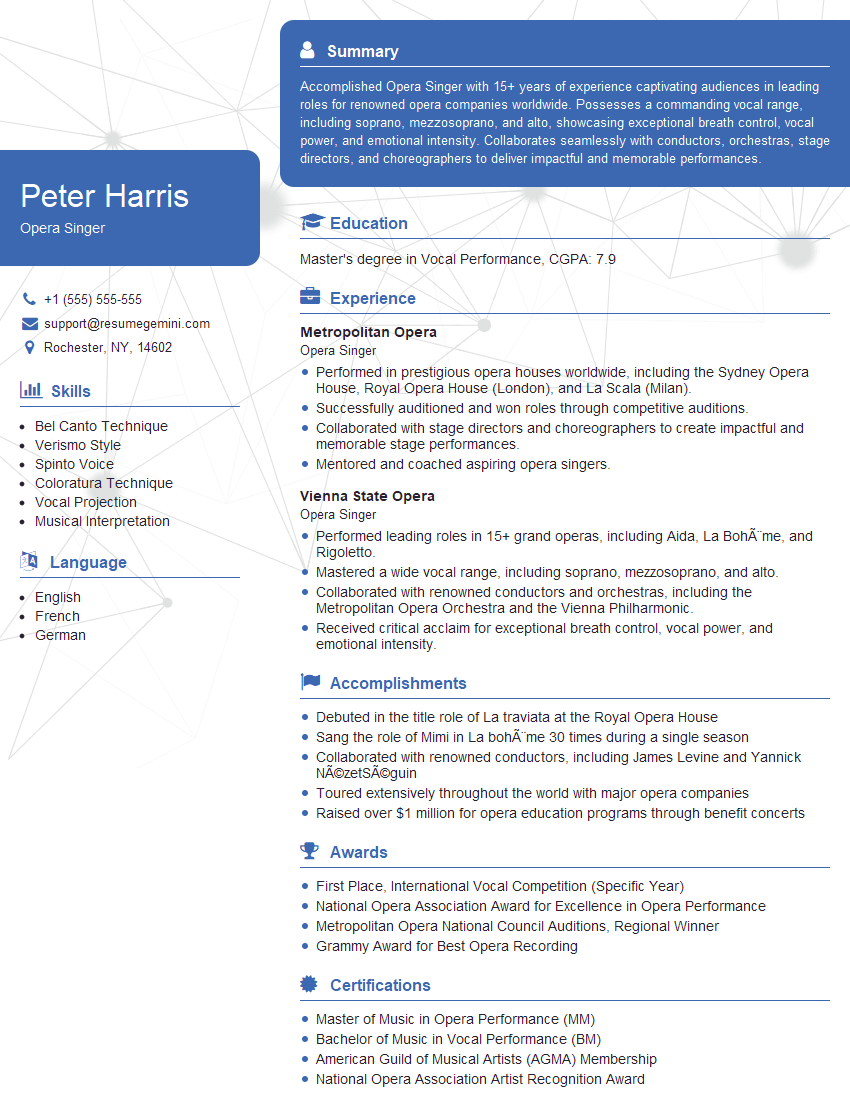
Explore more articles
Users Rating of Our Blogs
Share Your Experience
We value your feedback! Please rate our content and share your thoughts (optional).
What Readers Say About Our Blog
hello,
Our consultant firm based in the USA and our client are interested in your products.
Could you provide your company brochure and respond from your official email id (if different from the current in use), so i can send you the client’s requirement.
Payment before production.
I await your answer.
Regards,
MrSmith
hello,
Our consultant firm based in the USA and our client are interested in your products.
Could you provide your company brochure and respond from your official email id (if different from the current in use), so i can send you the client’s requirement.
Payment before production.
I await your answer.
Regards,
MrSmith
These apartments are so amazing, posting them online would break the algorithm.
https://bit.ly/Lovely2BedsApartmentHudsonYards
Reach out at [email protected] and let’s get started!
Take a look at this stunning 2-bedroom apartment perfectly situated NYC’s coveted Hudson Yards!
https://bit.ly/Lovely2BedsApartmentHudsonYards
Live Rent Free!
https://bit.ly/LiveRentFREE
Interesting Article, I liked the depth of knowledge you’ve shared.
Helpful, thanks for sharing.
Hi, I represent a social media marketing agency and liked your blog
Hi, I represent an SEO company that specialises in getting you AI citations and higher rankings on Google. I’d like to offer you a 100% free SEO audit for your website. Would you be interested?