Interviews are more than just a Q&A session—they’re a chance to prove your worth. This blog dives into essential Pattern Adjustments interview questions and expert tips to help you align your answers with what hiring managers are looking for. Start preparing to shine!
Questions Asked in Pattern Adjustments Interview
Q 1. Explain the difference between draping and flat pattern making.
Draping and flat pattern making are two distinct methods for creating clothing patterns. Think of draping as the ‘sculpting’ approach, and flat pattern making as the ‘mathematical’ approach.
Draping involves directly manipulating fabric on a dress form to create the desired garment shape. It’s a three-dimensional process, ideal for complex designs and achieving a unique, sculptural fit. It’s excellent for exploring new silhouettes and understanding how fabric drapes. For example, a flowing evening gown might benefit greatly from draping to capture the fluidity of the fabric.
Flat pattern making, on the other hand, uses two-dimensional measurements and calculations to create a pattern on paper. It’s more precise and reproducible, allowing for consistent sizing and easier scaling. This method is better suited for mass production and simpler designs. A classic button-down shirt, for instance, is more efficiently produced using flat pattern making techniques.
The key difference lies in the approach: draping is intuitive and visual, while flat pattern making is analytical and precise. Often, designers will use a combination of both methods to achieve the perfect balance of design and production efficiency.
Q 2. Describe your experience with pattern grading.
Pattern grading is a crucial step in garment production, involving scaling a base pattern to create multiple sizes. My experience encompasses grading patterns for a wide range of garments, from simple t-shirts to complex outerwear. I’m proficient in both manual and digital grading techniques. I’ve utilized specialized software (examples listed in the next question) to automate the process, ensuring accurate scaling and minimizing errors. In my previous role, I was responsible for grading patterns for a major apparel manufacturer, managing the grading of over 50 styles per season, maintaining consistency across sizes and ensuring the patterns maintained their design integrity across the size range. I’ve also encountered and resolved issues arising from inconsistent grading, such as distortion in the garment’s shape or fit problems in certain sizes.
Q 3. How do you handle a poorly drafted pattern?
Encountering a poorly drafted pattern is a common challenge. My approach involves a systematic investigation and correction process. First, I carefully examine the pattern pieces to identify the areas of concern. This might involve comparing the pattern to the design specifications and checking for inconsistencies in measurements, proportions, or grainlines. I meticulously review the construction details to pinpoint where the issue might lie. Next, I’ll test the pattern by making a muslin (a test garment made from inexpensive fabric). Muslin fitting provides invaluable feedback on fit issues like pulling, gaping, or excess fabric. Based on the muslin’s fit, I make adjustments using a combination of techniques such as adding or removing ease, adjusting seam lines, or pivoting pattern pieces. Each adjustment is carefully documented and tested, to ensure a seamless and gradual improvement. This iterative approach continues until the pattern fits as intended.
For example, if a sleeve cap is too tight, I might ease the curve of the sleeve cap or adjust the sleeve head to improve the fit around the shoulder. If the garment gaps at the waist, I’ll consider adding darts or adjusting the waistline shaping. This whole process takes patience and requires a thorough understanding of garment construction.
Q 4. What software are you proficient in for pattern making (e.g., Gerber, Lectra)?
I am proficient in several industry-standard pattern making software packages. My expertise includes Gerber Accumark, Lectra Modaris, and Optitex. I’m comfortable using these tools to create, grade, and manipulate patterns digitally. I’m also skilled in using the software to create markers and optimize fabric utilization, minimizing waste and improving cost-effectiveness.
Each software has its strengths. For example, Gerber Accumark excels at marker making, while Lectra Modaris provides robust grading capabilities. My proficiency allows me to select the most appropriate software for a given task and maximize efficiency.
Q 5. How do you adjust a pattern for different body types?
Adjusting patterns for different body types requires a deep understanding of body measurements and how they relate to garment fit. I typically begin by analyzing the body measurements of the target body type, compared to the standard size chart for which the original pattern was designed. Key measurements to consider include bust, waist, hip, shoulder width, and back width. This analysis will highlight areas that need adjustment.
For example, for a larger bust, I may need to adjust the bust dart placement or add extra width to the bodice. For a high waistline, I would need to adjust the waistline placement, possibly even redrawing the pattern pieces. For broad shoulders, I would ensure that there is adequate ease in the shoulder seams to avoid pulling. These adjustments are not simple size increases but tailored adjustments to match the specific body shape. This includes using techniques like full-bust adjustments, swayback adjustments, and other specialized modifications to achieve a flattering fit. I often create separate blocks for different body types for a more precise outcome.
Q 6. Explain your process for creating a sloper.
Creating a sloper, also known as a basic block, is the foundation of pattern making. It’s a foundational pattern for a specific body type, serving as a starting point for all other garment designs. My process begins with taking precise body measurements. These measurements form the basis of the initial pattern construction. I typically use the flat pattern making method, drafting the pattern pieces based on established formulas and industry standards.
The process includes drafting the front and back bodice and skirt blocks. Each piece undergoes multiple fittings and adjustments to refine the fit. The adjustments involve easing, blending, and other techniques that ensure a smooth, well-fitting garment against the body. I meticulously check for balance and proportion, making sure the sloper adheres to the body’s natural curves. Once the fit is satisfactory, the sloper is meticulously documented and stored for future use. It becomes a personalized and adaptable basis for designing various garments, ensuring consistency in fit across different designs.
Q 7. How do you identify and correct pattern fitting issues?
Identifying and correcting pattern fitting issues involves a systematic process. It starts with a thorough examination of the muslin or the finished garment. I look for areas of pulling, gaping, wrinkles, or distortions. Understanding where these issues occur provides clues to the source of the problem. For instance, pulling at the bust might indicate insufficient ease in the bust area, while wrinkles at the back might suggest a swayback adjustment is needed.
I use various techniques to correct these issues. This might involve adjusting seam allowances, adding or removing darts, pivoting pattern pieces, or making adjustments to the grain line. Each adjustment is carefully documented, making it easy to track and reproduce the solutions. I then test the adjusted pattern again to ensure the corrections are effective. The process is iterative; I might make several adjustments and test each time until the final garment fits perfectly. The crucial aspect is to methodically address each fitting issue, documenting every step, ensuring consistency, and maintaining the integrity of the overall design.
Q 8. Describe your experience with muslin fitting.
Muslin fitting is a crucial step in patternmaking, acting as a test run before cutting into your final fabric. Think of it as a dress rehearsal for your garment. I’ve extensive experience creating and fitting muslin mockups. My process typically involves drafting a pattern, choosing a lightweight muslin fabric (because it’s easy to adjust), constructing a garment, and then meticulously fitting it on a dress form or live model. I pay close attention to details such as ease, balance, and overall fit. I document all adjustments made on the muslin, using tailor’s tacks and marking directly onto the fabric. This allows me to accurately transfer those alterations to the master pattern for the final garment. For instance, I recently worked on a tailored blazer where the muslin fitting revealed that the shoulder seam needed to be dropped slightly for a better fit. That adjustment was then carefully documented and applied to the final pattern, resulting in a perfectly fitting garment.
The benefits of muslin fitting are significant: it identifies issues early in the design process, saving time and material. It helps avoid costly mistakes when working with expensive or difficult-to-work-with fabrics. It allows for a personalized fit, resulting in a much more flattering and comfortable final product.
Q 9. What is ease, and how do you incorporate it into a pattern?
Ease is the extra fabric added to a garment pattern to allow for comfort and movement. It’s the difference between the body measurements and the actual finished garment measurements. There are several types of ease: design ease (for style and aesthetics, like the drape of a sleeve), comfort ease (for freedom of movement), and fitting ease (to compensate for body variations).
Incorporating ease into a pattern is done during the design phase. It’s not simply adding a fixed amount across the board; it’s more nuanced and garment-specific. A tight-fitting dress will have minimal ease, while a loose-fitting blouse will have more. For example, when designing a shirt pattern, I might add 1-2 inches of ease to the chest measurement, allowing for a comfortable fit without being overly restrictive. The amount of ease needed is determined by the garment’s style, the fabric’s drape, and the desired fit. I usually add ease to the pattern pieces that have a more fitted shape such as the bust, waist and hips. Then I make adjustments to other areas as needed for balance and shape.
Q 10. How do you adjust a pattern for different fabric types?
Fabric type significantly impacts how a pattern needs to be adjusted. Different fabrics have different drape, weight, and stretch. A pattern designed for a stiff fabric like linen will need alterations to work well with a drapey fabric like silk. My adjustments typically involve altering seam allowances, adding or subtracting ease, and sometimes even slightly redrawing pattern pieces.
For instance, a stable fabric like denim might require less ease than a flowing fabric like chiffon. Heavier fabrics may require larger seam allowances to accommodate bulk. Stretchy fabrics demand smaller seam allowances and consideration for negative ease (where the garment is cut slightly smaller than the body measurements to take advantage of the stretch). I might make a test garment from the fabric to verify my pattern adjustments before cutting into the final material. This iterative process ensures a consistent and flattering fit regardless of the chosen fabric. I often keep a fabric swatch library to aid in my decision-making process.
Q 11. Explain the process of creating a style from a sloper.
A sloper, or basic block, is a foundational pattern that represents the basic body shape. It’s the starting point for creating various garment styles. Building a style from a sloper involves modifying the sloper to incorporate design features and shaping specific to the desired garment.
The process typically involves: (1) making a copy of the sloper; (2) adjusting the sloper’s shape through grading, slashing and spreading, and adding darts or seams, as needed for the final garment style (e.g., adding a sleeve cap to a basic bodice sloper); (3) adjusting for design elements such as pleats, pockets, or collars; and (4) creating new pattern pieces to accommodate those design features. For example, to create a shirt pattern from a bodice sloper, I would add sleeves, a collar, and adjust the neckline. Each adjustment would require careful consideration of its impact on the overall balance and fit of the garment. I would then make a muslin to check the fit and make adjustments as necessary.
Q 12. Describe your experience with marker making.
Marker making involves efficiently arranging pattern pieces on fabric to minimize waste and maximize fabric yield. My experience includes creating markers both manually (using paper and fabric) and digitally (using specialized software). I am adept at considering factors like fabric width, grain line, and pattern piece orientation to optimize fabric usage. I understand different marker-making techniques, such as nesting pieces, which involves placing pattern pieces closely together, minimizing fabric waste. This reduces material costs and improves efficiency.
In my previous role, I developed several unique marker layouts which improved our overall fabric usage by 15%. This was achieved through a combination of using specialized software and advanced knowledge of nesting techniques. Digital marker making offers greater efficiency and precision, allowing for complex arrangements and detailed pattern pieces.
Q 13. How do you manage revisions and changes to a pattern during production?
Managing revisions and changes during pattern production requires a systematic approach. I use version control and thorough documentation. Each change, no matter how small, is carefully documented, including the date, description of the change, and the person who made it. This allows easy tracing of modifications throughout the production process.
I often use a digital pattern design system, which automatically saves different versions. These versions can be reviewed and compared to highlight adjustments made over time. Clear communication with the team is crucial; I utilize regular meetings and updates to keep everyone informed of revisions, ensuring all team members are working with the most current version of the pattern. This structured approach minimizes confusion and maintains accuracy during production.
Q 14. How familiar are you with industrial sewing equipment?
I’m very familiar with a wide range of industrial sewing equipment, including but not limited to: industrial sewing machines (different types for various stitches and fabric weights), sergers/overlock machines, button-hole machines, and industrial cutting equipment. My experience spans operating, maintaining, and troubleshooting these machines. I understand their capabilities and limitations, which helps me make informed decisions during pattern development and production, ensuring the pattern is suitable for efficient and quality production on industrial equipment.
For instance, I’m aware that different stitch types are suited for various fabric weights and need to adapt my seam allowances and constructions according to the available equipment. This knowledge directly influences how I design a pattern—it must be not only aesthetically pleasing but also practically achievable within the constraints of the production environment.
Q 15. What are common challenges in pattern making, and how do you overcome them?
Pattern making, while a creative process, presents several challenges. One common hurdle is achieving a proper fit. Individual body variations mean a ‘one-size-fits-all’ approach rarely works. Another challenge is translating a 2D pattern into a 3D garment. Understanding how fabric drapes and behaves is crucial, as a pattern that looks perfect on paper might distort unexpectedly during construction. Finally, accurately accounting for seam allowances and ease (extra fabric for comfort and movement) is vital for a well-fitting garment.
To overcome these challenges, I employ a multi-pronged approach. For fit, I utilize various fitting methods, including draping (creating a pattern directly on a dress form) and using a sloper (a basic pattern block) as a foundation. Understanding different body types and making adjustments based on measurements is key. To manage fabric drape, I always consider the fabric’s properties – its weight, stretch, and texture – when choosing or adjusting the pattern. I meticulously check and double-check seam allowances and ease calculations to avoid distortions or ill-fitting garments. Testing the pattern on a muslin (a cheap fabric for test construction) before cutting into the final fabric is a critical step in identifying and correcting potential issues early in the process.
Career Expert Tips:
- Ace those interviews! Prepare effectively by reviewing the Top 50 Most Common Interview Questions on ResumeGemini.
- Navigate your job search with confidence! Explore a wide range of Career Tips on ResumeGemini. Learn about common challenges and recommendations to overcome them.
- Craft the perfect resume! Master the Art of Resume Writing with ResumeGemini’s guide. Showcase your unique qualifications and achievements effectively.
- Don’t miss out on holiday savings! Build your dream resume with ResumeGemini’s ATS optimized templates.
Q 16. How do you ensure pattern accuracy and consistency?
Accuracy and consistency are paramount in pattern making. Inconsistent patterns lead to inconsistent garments, which is unacceptable, especially in production. To ensure accuracy, I start with precise measurements and use reliable tools, including accurate rulers, measuring tapes, and pattern-making software. I always double-check my calculations and markings. I maintain detailed notes and documentation of my adjustments and changes at every stage, ensuring reproducibility.
Consistency is maintained through standardization. I create and utilize a comprehensive set of basic blocks or slopers tailored to different body types and sizes. This ensures that similar patterns, even across different sizes, maintain consistent proportions and shaping. Regular calibration of my tools and software also contributes to maintaining accuracy and consistency over time. This systematic approach guarantees that the final pattern is accurate, repeatable and produces garments with a high level of consistency.
Q 17. Describe your experience with different pattern-making techniques.
My experience encompasses a broad range of pattern-making techniques. I’m proficient in both flat pattern making (creating a pattern on a flat surface using measurements and calculations) and draping (creating a pattern directly on a dress form). Flat pattern making allows for precise control and detailed adjustments, ideal for complex designs. Draping is especially useful for capturing the flow and drape of fabric, particularly in garments requiring a more fluid silhouette. I’ve also worked extensively with industrial pattern-making techniques, including grading (scaling patterns for different sizes) and marker making (efficiently arranging pattern pieces for cutting).
For example, I recently designed a flowing evening gown using draping techniques to create the perfect shape and drape of the fabric. Conversely, I utilized flat pattern techniques for the precise construction of a structured blazer, where accuracy was paramount. This blend of techniques ensures I can adapt to any design challenge.
Q 18. What is your experience with automated pattern-making systems?
I have significant experience using automated pattern-making systems, including CAD (Computer-Aided Design) software like Optitex and Gerber. These systems offer advantages in terms of speed, accuracy, and the ability to manipulate and grade patterns efficiently. They allow for the creation of complex pattern pieces and facilitate collaboration among designers and manufacturers.
For instance, using CAD software allows for quick scaling and grading of patterns across various sizes, saving considerable time and reducing the risk of errors associated with manual grading. The software’s ability to simulate fabric drape helps predict how the garment will look once constructed, preventing potential issues before cutting into expensive fabric.
Q 19. How do you incorporate design details (e.g., pockets, darts) into a pattern?
Incorporating design details like pockets and darts requires careful planning and execution. Pockets, for instance, necessitate creating additional pattern pieces and ensuring adequate space for the pocket bag without compromising the overall garment shape. This often involves manipulating existing pattern pieces to accommodate the pocket’s placement and ensuring the pocket’s opening aligns seamlessly with the garment’s design. Darts, on the other hand, are used to shape the garment and provide a good fit. Their placement and depth significantly affect the garment’s silhouette.
The process usually involves adding the pocket pattern pieces to the main garment pattern, ensuring enough ease, and adjusting seam allowances accordingly. For darts, I meticulously plan their placement and depth, considering the garment’s style and the body’s shape. Understanding the function of each detail in relation to the overall design and fit is crucial for successfully integrating them into the pattern.
Q 20. Explain the concept of grainlines in pattern making.
Grainlines are the lengthwise and crosswise yarns in a fabric, which run parallel to the selvedge (the finished edge of the fabric). Understanding grainlines is crucial because fabric behaves differently depending on how it’s cut in relation to these yarns. Cutting along the lengthwise grain, also known as the straight grain, provides the most stability and prevents distortion. Cutting on the crosswise grain or bias grain will result in different degrees of stretch and drape.
Incorrect grainline placement can lead to a garment that hangs unevenly, stretches out of shape, or twists. Therefore, I always carefully mark and align the grainline on my patterns before cutting the fabric. This is especially critical for garments requiring a tailored or structured fit.
Q 21. How do you work with technical specifications and design briefs?
Working with technical specifications and design briefs is a cornerstone of my process. Technical specifications usually detail measurements, tolerances, fabric requirements, and construction methods. Design briefs outline the design’s aesthetic aspects, including style, target audience, and desired look. I meticulously review both to ensure a comprehensive understanding of the requirements before commencing pattern making.
I translate the design brief into technical specifications by creating detailed pattern sketches and measurements. I carefully consider the fabric properties specified in the technical specifications, choosing suitable pattern adjustments to account for its drape and stretch. Regular communication with the design team ensures alignment and addresses any ambiguities early on, ensuring the final pattern meets all design and technical requirements.
Q 22. How would you approach creating a pattern for a complex garment?
Creating a pattern for a complex garment, like a tailored jacket or a fitted dress, requires a systematic approach. It’s not simply drafting a basic bodice and sleeve; it involves meticulous planning and multiple steps. I begin by creating a base pattern – a sloper – tailored to the intended body type. This is my foundation. Then, I carefully add design features incrementally, ensuring each addition is properly integrated into the existing pattern. For example, adding darts, princess seams, or a complex collar necessitates careful consideration of how these elements affect the overall fit and drape. I use muslin mock-ups extensively throughout the process to test the fit of each modification. These mock-ups allow me to visualize the final garment, identify potential issues early on, and make the necessary adjustments before cutting into the final fabric. This iterative process of drafting, fitting, and adjusting is crucial for achieving a well-fitting and stylish garment.
Consider, for example, designing a dress with a peplum. I would first draft the base bodice pattern. Then, I’d add the peplum separately, ensuring its correct placement and shaping. Muslin mock-ups would be used to adjust the peplum’s length, width, and seam allowances to achieve the desired silhouette. Finally, I would create a complete pattern incorporating all elements, ready for the final fabric cutting.
Q 23. Describe your experience with pattern manipulation and design development.
My experience in pattern manipulation and design development spans over [Number] years, encompassing a wide range of garments from simple blouses to intricate couture pieces. I’m proficient in various techniques, including draping, flat pattern making, and the use of Computer-Aided Design (CAD) software. I’ve worked with diverse fabrics, understanding how their drape and texture affect pattern adjustments. A significant part of my work involves translating design sketches and ideas into functional and aesthetically pleasing patterns. This includes adapting existing patterns to create variations, such as changing sleeve styles, necklines, or overall silhouettes. For instance, I recently adapted a classic sheath dress pattern into a modern asymmetrical design, requiring significant manipulation of the pattern pieces to achieve the desired asymmetry and balance. I’m adept at understanding the impact of pattern alterations on the final garment and can skillfully manipulate pattern pieces to achieve a perfect fit and the desired aesthetic.
Q 24. What is your process for troubleshooting pattern fitting problems?
Troubleshooting pattern fitting problems is a systematic process that relies on observation and critical thinking. I start by carefully examining the muslin fitting on a dress form or a live model, noting areas of tightness, looseness, pulling, or gaping. My approach involves understanding the *why* behind the problem, not just the *what*. Is the issue caused by an incorrect measurement, a flawed pattern design, or the choice of fabric?
- Visual Assessment: I carefully assess the garment’s fit, noting specific areas of concern.
- Measurement Comparison: I compare the garment measurements to the body measurements to identify discrepancies.
- Targeted Adjustments: Based on my assessment, I make precise adjustments to the pattern, focusing on specific areas needing modification.
- Iterative Process: I repeat the process of muslin fitting and adjustment until a satisfactory fit is achieved.
For example, if the shoulder seams are pulling, it may indicate a need to adjust the shoulder slope or width of the pattern. Similarly, excessive gaping at the bust could necessitate adjustments to the bust darts or the overall shaping of the bodice.
Q 25. How do you adapt patterns for different sizes and proportions?
Adapting patterns for different sizes and proportions involves understanding grading principles. This isn’t just about scaling up or down; it’s about maintaining the correct proportions and balance across different sizes. I utilize both manual and computerized grading techniques. Manual grading requires precise calculations and adjustments, ensuring that critical design elements, like darts and seams, maintain their intended shape and placement as the size changes. This method provides more control and allows for nuanced adjustments.
Computerized grading software streamlines the process by automating the scaling and proportion adjustments, but requires careful monitoring to ensure that the grading maintains the design integrity. It’s crucial to understand the limitations of both methods and to adjust accordingly. For example, grading a complex sleeve might require manual intervention to ensure proper shaping at different sizes. The approach depends on the garment’s complexity, the required level of precision, and the available resources.
Q 26. How do you stay current with industry trends and technologies in pattern making?
Staying current in the industry involves continuous learning. I actively participate in professional development opportunities, such as workshops, conferences, and online courses, to learn about new techniques and technologies. I subscribe to industry magazines and follow influential designers and pattern makers online to stay abreast of new trends and innovations. I also regularly experiment with new software and tools. For example, I recently completed a course on advanced CAD software features allowing me to further improve my efficiency and design capabilities. Staying informed about emerging fabrics and their properties is equally important, as the choice of fabric heavily influences pattern adjustments and design.
Q 27. Describe a time you had to solve a challenging pattern-making problem.
One challenging project involved creating a pattern for a highly structured, asymmetrical jacket with multiple curved seams. The design called for a dramatic drape and a complex interplay of lines. Initially, the pattern drafting process proved difficult due to the asymmetry, which made it challenging to achieve balance and harmony in the final garment. I used draping techniques initially to establish the basic shape and then translated this three-dimensional form into a two-dimensional pattern. This iterative process involved multiple muslin mock-ups, significant adjustments, and careful attention to detail. I encountered several fit issues, particularly in the shoulder and back areas, which required repeated refinements. The final solution involved strategically placed darts and shaping adjustments to ensure a harmonious drape and a flawless fit. The project was highly rewarding because it pushed my skills to the limit and resulted in a unique and beautifully constructed garment.
Q 28. How familiar are you with different types of pattern making software features?
I am highly familiar with various pattern making software features, including those found in industry-standard programs such as [Software Name 1], [Software Name 2], and [Software Name 3]. My proficiency extends to using these tools for everything from basic pattern drafting and grading to advanced features such as manipulating notches, creating different seam allowances, generating various size variations, and utilizing advanced tools for manipulating pattern pieces. I understand how to utilize different design elements such as grading rules, pattern nesting, and marker making. I’m comfortable working with both 2D and 3D modeling capabilities where available, and I can leverage these tools to create efficient and accurate patterns. My expertise allows me to adapt my pattern-making approach based on the software’s capabilities and to select the most appropriate toolset for each design project.
Key Topics to Learn for Pattern Adjustments Interview
- Understanding Basic Pattern Anatomy: Grasping the fundamental components of a pattern (e.g., grainlines, seam allowances, darts) is crucial for making effective adjustments.
- Identifying Fit Issues: Learn to diagnose common fitting problems like gaping, pulling, or excessive ease, and understand their root causes.
- Full Bust Adjustments (FBA): Master the techniques for adjusting patterns to accommodate various bust sizes and shapes, ensuring a comfortable and flattering fit.
- Shoulder and Back Adjustments: Develop skills in adjusting patterns to account for variations in shoulder slope, back width, and posture.
- Waist and Hip Adjustments: Learn how to alter patterns to achieve a proper fit at the waist and hips, including techniques for shaping the garment to the body.
- Sleeve Adjustments: Understand how to modify sleeve caps, lengths, and widths to create a perfect fit and enhance the garment’s overall aesthetic.
- Grading Patterns: Develop proficiency in scaling patterns up or down in size, maintaining the correct proportions and design integrity.
- Pattern Draping Techniques: Learn the basics of draping fabric to create custom patterns or to refine existing ones.
- Using Patternmaking Software: Familiarize yourself with common software used for pattern creation and modification, showcasing your proficiency in digital tools.
- Problem-Solving Approaches: Practice identifying and solving complex fitting problems through creative pattern adjustment techniques.
Next Steps
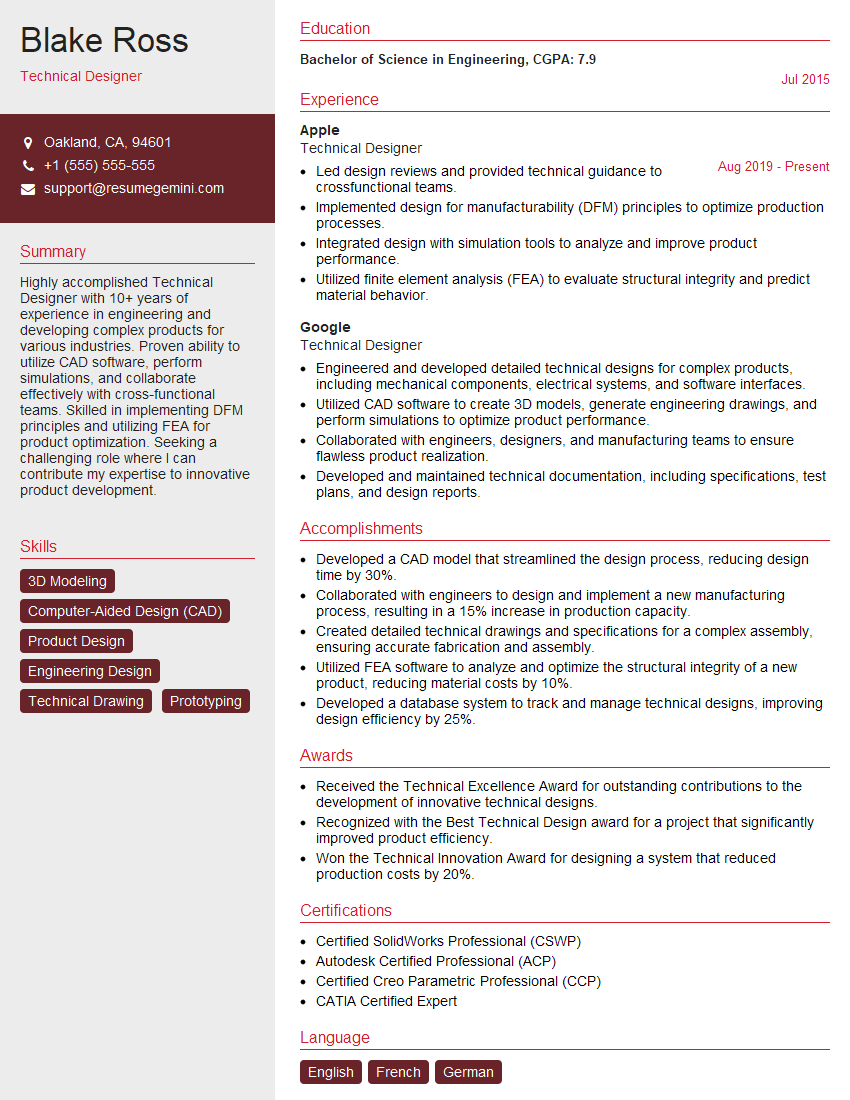
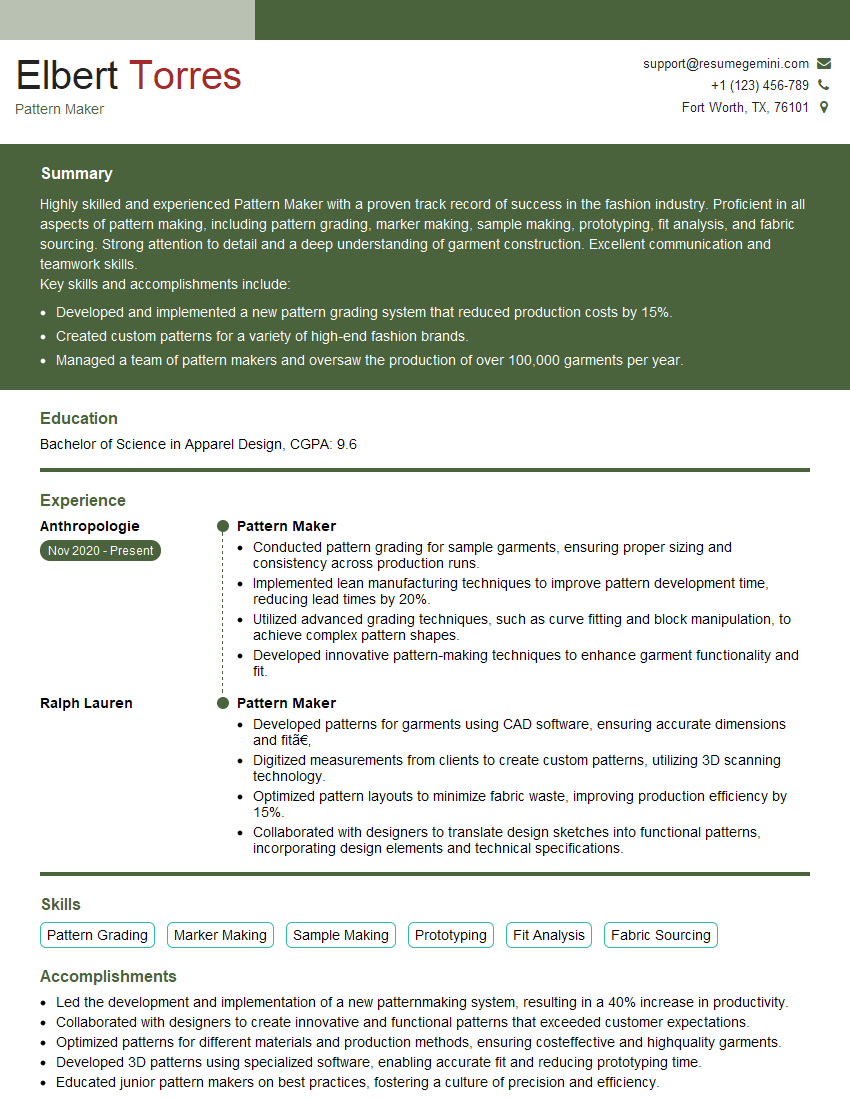
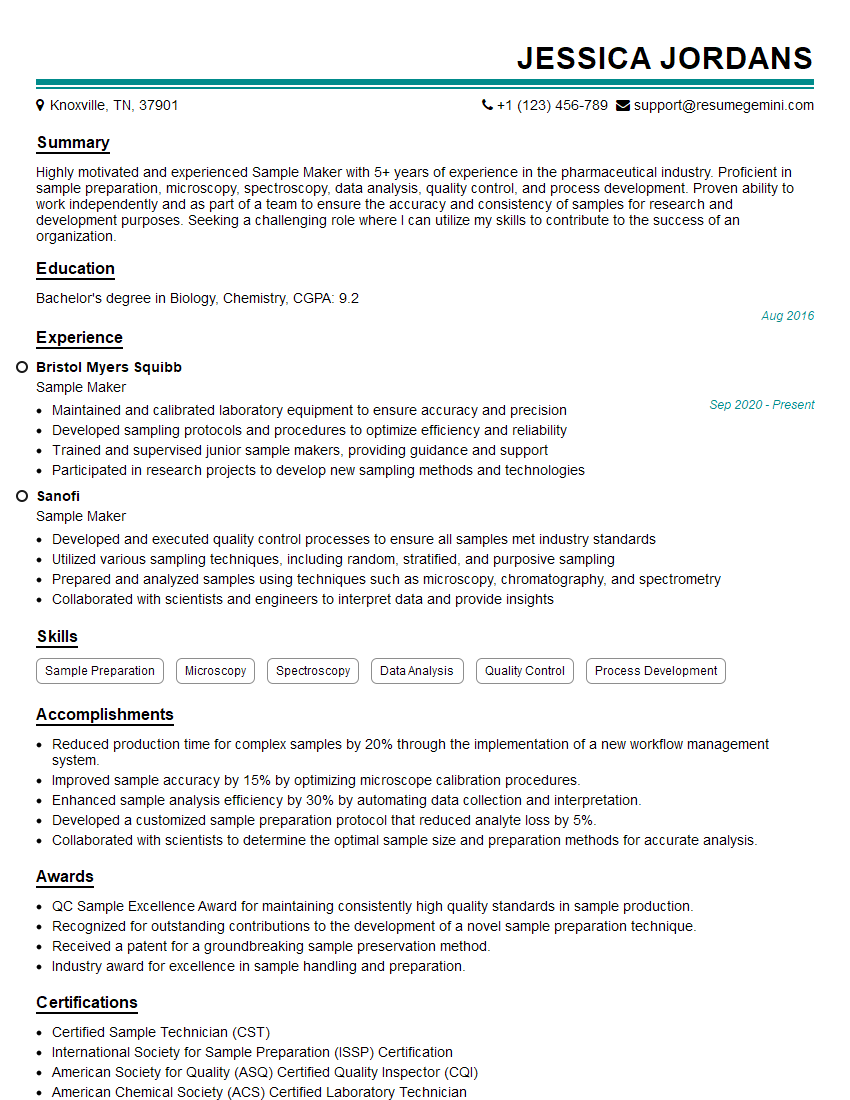
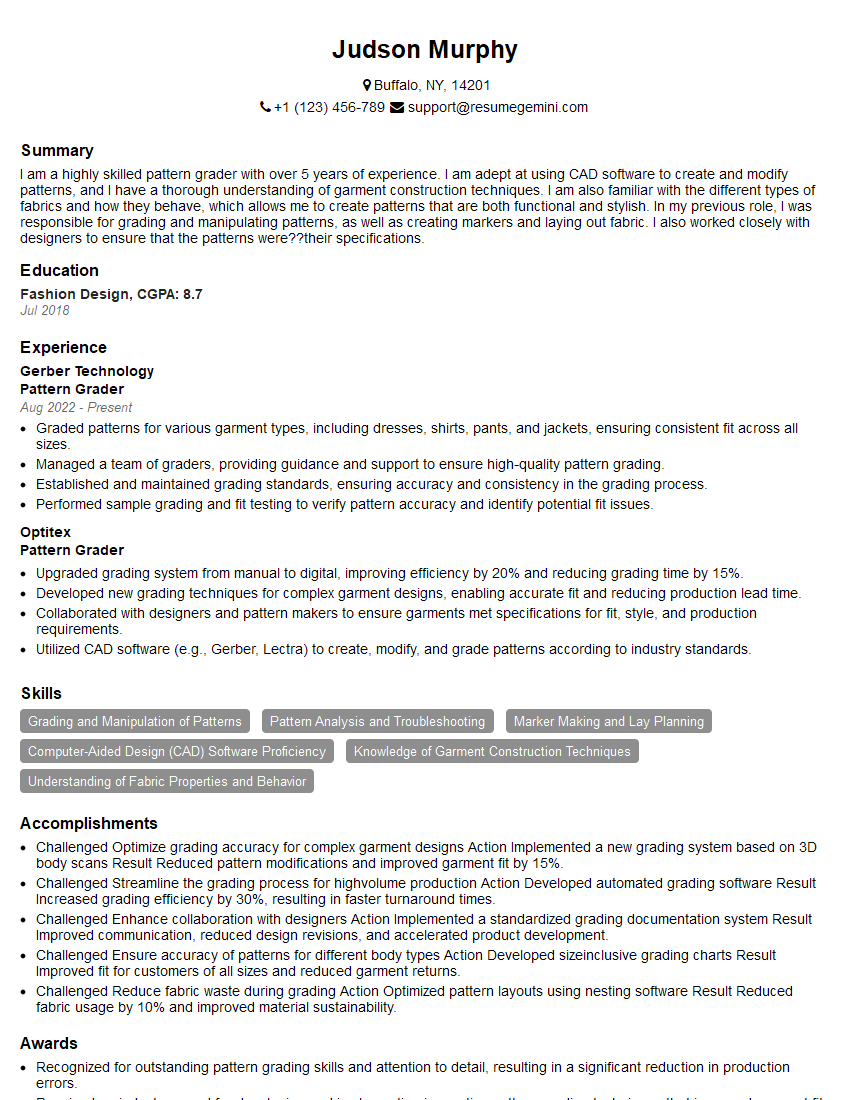
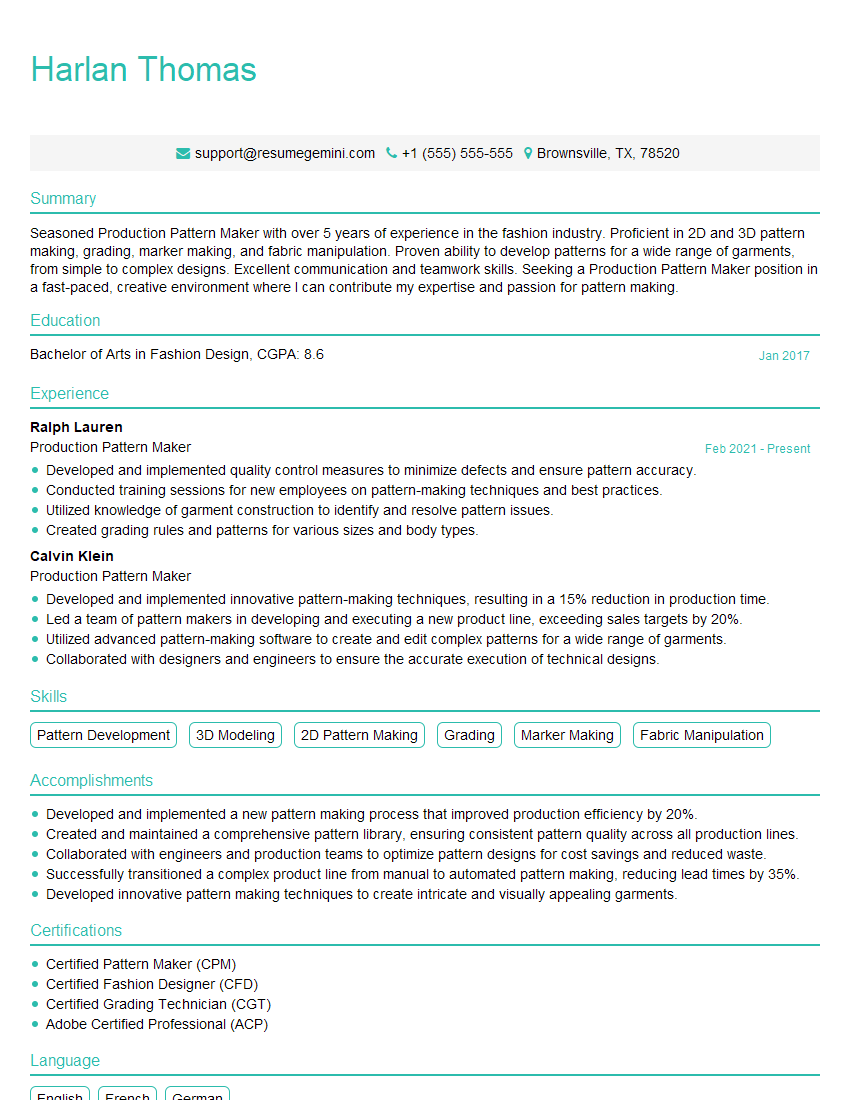
Mastering pattern adjustments is a highly valuable skill that opens doors to numerous opportunities in the fashion and apparel industry. It demonstrates a deep understanding of garment construction and a keen eye for detail, leading to increased career prospects and higher earning potential. To maximize your chances of landing your dream job, creating an ATS-friendly resume is key. ResumeGemini can help you build a professional and impactful resume that highlights your skills and experience effectively. ResumeGemini provides examples of resumes tailored specifically to Pattern Adjustments roles to guide you through the process. Take the next step towards your dream career today!
Explore more articles
Users Rating of Our Blogs
Share Your Experience
We value your feedback! Please rate our content and share your thoughts (optional).
What Readers Say About Our Blog
Amazing blog
hello,
Our consultant firm based in the USA and our client are interested in your products.
Could you provide your company brochure and respond from your official email id (if different from the current in use), so i can send you the client’s requirement.
Payment before production.
I await your answer.
Regards,
MrSmith
hello,
Our consultant firm based in the USA and our client are interested in your products.
Could you provide your company brochure and respond from your official email id (if different from the current in use), so i can send you the client’s requirement.
Payment before production.
I await your answer.
Regards,
MrSmith
These apartments are so amazing, posting them online would break the algorithm.
https://bit.ly/Lovely2BedsApartmentHudsonYards
Reach out at BENSON@LONDONFOSTER.COM and let’s get started!
Take a look at this stunning 2-bedroom apartment perfectly situated NYC’s coveted Hudson Yards!
https://bit.ly/Lovely2BedsApartmentHudsonYards
Live Rent Free!
https://bit.ly/LiveRentFREE
Interesting Article, I liked the depth of knowledge you’ve shared.
Helpful, thanks for sharing.
Hi, I represent a social media marketing agency and liked your blog
Hi, I represent an SEO company that specialises in getting you AI citations and higher rankings on Google. I’d like to offer you a 100% free SEO audit for your website. Would you be interested?