Feeling uncertain about what to expect in your upcoming interview? We’ve got you covered! This blog highlights the most important Pattern weaving interview questions and provides actionable advice to help you stand out as the ideal candidate. Let’s pave the way for your success.
Questions Asked in Pattern weaving Interview
Q 1. Describe the different types of looms used in pattern weaving.
Looms are the fundamental tools in pattern weaving, each designed to facilitate different weaving techniques and complexities. The choice of loom depends heavily on the project’s scale and the desired pattern intricacy.
- Floor Looms: These are large, sturdy looms typically used for weaving wide fabrics or tapestries. They offer excellent control and are ideal for complex patterns requiring many warp threads. Think of the grand tapestries in museums – many were created on floor looms.
- Table Looms: Smaller and more portable than floor looms, table looms are suitable for smaller projects like scarves or narrow bands. They are easier to set up and maneuver, making them great for learning and smaller-scale projects.
- Rigid Heddle Looms: These simple looms utilize a rigid heddle, a single piece of wood or plastic with slots that lift and lower warp threads. While limited in pattern complexity compared to other looms, they are perfect for beginners and simple patterns, particularly plain weave and some simple variations.
- Inkle Looms: Specialized for creating narrow bands, inkle looms are excellent for creating intricate patterns with limited warp threads but allowing for elaborate weft manipulation.
- Multi-Shaft Looms: These advanced looms have multiple shafts (typically 4, 6, 8, or more) allowing for the creation of intricate and multi-layered patterns through the controlled lifting of different warp threads. Jacquard looms, a sophisticated subtype of multi-shaft looms, use punched cards or electronic controls to create incredibly complex designs.
Choosing the right loom is crucial. For instance, a simple rigid heddle loom wouldn’t be appropriate for a large, intricate tapestry, while a multi-shaft loom might be overkill for a simple scarf.
Q 2. Explain the process of warp preparation for a complex pattern.
Warp preparation for complex patterns is a meticulous process requiring careful planning and execution. It’s the foundation upon which the entire woven piece is built.
- Designing the Pattern: This involves creating a weaving draft (a chart showing the pattern’s thread sequence) and calculating the necessary number of warp threads based on the design’s repeat and width.
- Warping the Loom: This step involves winding the warp threads onto a warp beam or other warping device. For complex patterns, this might involve using a warping board to precisely arrange threads according to the draft. Precise spacing and tension are critical here.
- Sley Reed Preparation: The warp threads are then passed through the dents of a reed, which spaces the threads evenly and provides structural support during weaving. The reed’s dent spacing (sett) must be carefully chosen to accommodate the yarn and desired fabric density.
- Warp Thread Sequencing: For multi-shaft looms or Jacquard looms, the warp threads need to be carefully threaded through the heddles (harness shafts) according to the weaving draft. Each heddle controls a specific set of threads, creating the pattern by raising and lowering groups of threads during weaving.
- Threading the Healds: This is perhaps the most crucial step for complex designs. A mistake at this stage can result in a completely different pattern or even a weaving error that would require significant rework. Careful attention to the weaving draft and systematic threading are paramount.
Imagine building a skyscraper – the warp preparation is equivalent to carefully laying the foundation and erecting the supporting structure. Any error at this stage would be incredibly difficult to rectify later.
Q 3. How do you calculate the sett and weft density for a specific pattern?
Calculating sett (warp threads per inch/cm) and weft density (weft threads per inch/cm) are critical for achieving the desired fabric characteristics. These calculations depend on several factors.
- Yarn Type: Thicker yarns require a lower sett and weft density. Finer yarns allow for higher values.
- Pattern Complexity: Intricate patterns might require a higher sett to accommodate their details. A simple pattern might allow for a more relaxed sett.
- Desired Fabric Hand: A looser fabric (more drape) will have a lower sett and weft density, while a firmer fabric will require higher values.
There’s no single formula, but a general approach involves considering the yarn’s thickness (measured in denier or tex) and the desired fabric drape. Experienced weavers often rely on experience and sample swatches to fine-tune these values. For example, a fine linen yarn might have a sett of 24 epi (ends per inch) and weft density of 20 ppi (picks per inch) for a crisp fabric, whereas a bulky wool might use a sett of 12 epi and weft density of 10 ppi for a softer, drapier feel.
Experimentation and calculating these based on your yarn and desired outcome are key.
Q 4. What are the common challenges encountered during pattern weaving and how do you overcome them?
Pattern weaving presents numerous challenges, from technical issues to design considerations.
- Broken Warp Threads: These are common and require careful attention to prevent further damage. Techniques like splicing or using extra warp threads can mitigate this. Prevention is better than cure; careful warp preparation and proper tension control minimizes this risk.
- Inconsistent Tension: This can lead to uneven fabric and distorted patterns. Maintaining consistent tension throughout the weaving process is crucial and requires practice.
- Pattern Errors: Mistakes in the weaving draft, threading the heddles, or following the pattern can result in significant errors. Careful planning, checking and double-checking the draft and slow, methodical weaving helps reduce these.
- Yarn Choice Issues: Choosing unsuitable yarns can lead to difficulties in weaving and undesired fabric qualities. Thorough yarn selection based on fiber content, thickness, and properties is crucial.
- Difficulty with Complex Patterns: Multi-shaft patterns, especially intricate ones, present significant challenges. Careful planning, practice, and often the use of a weaving draft are paramount.
Overcoming these challenges requires patience, careful attention to detail, and a problem-solving approach. Regular checking of the work, keeping meticulous notes, and seeking advice from experienced weavers are all essential.
Q 5. Explain the difference between plain weave, twill weave, and satin weave.
These are three fundamental weaves, each with distinct characteristics:
- Plain Weave: The simplest weave structure, where the weft thread passes over and under each warp thread alternately. Think of a checkerboard pattern – it’s both simple and durable. This is a great starting point for beginner weavers.
- Twill Weave: This weave creates diagonal lines or patterns through a specific over-under sequence of warp and weft threads. The angle of the twill is determined by the number of warp and weft threads involved in the pattern repeat. Common examples include denim and gabardine. Twill weaves tend to be stronger and have a good drape.
- Satin Weave: Characterized by a smooth, lustrous surface with long floats (weft threads that go over several warp threads before going under). This produces a glossy effect and is often used in luxury fabrics like satin. Satin weaves tend to be less durable than plain or twill weaves because of the long floats, making them more prone to snagging.
The differences lie in the interlacing pattern of the warp and weft threads. These differences lead to distinct visual and textural qualities in the final fabric.
Q 6. How do you read and interpret a weaving draft?
A weaving draft is a chart that visually represents the pattern sequence. It’s essential for understanding and creating a particular woven design.
Reading a draft involves understanding its symbols and notation. Typically, each symbol represents a different warp thread or group of threads controlled by a particular heddle. The horizontal axis often represents the weft threads, showing how they interlace with the warp threads. The vertical axis represents the warp threads or a series of weft passes.
For instance, a simple draft might show a ‘1’ for the first warp thread and a ‘2’ for the second, indicating which heddle will lift each thread during a specific weft pass. More complex drafts might involve multiple symbols, representing different thread groups controlled by several heddles in a multi-shaft loom. Many drafts also include additional information, such as sett, weft density, and yarn type. The key is to understand the specific notation used in the given draft.
Imagine a musical score – the weaving draft is like the sheet music, guiding the weaver through the pattern’s creation.
Q 7. Describe your experience with different types of yarns and their suitability for various patterns.
My experience encompasses a wide range of yarns, each with its own unique characteristics impacting pattern suitability. The choice of yarn is as critical as the pattern itself.
- Cotton: Durable, versatile, and relatively easy to work with, cotton is suitable for a wide variety of patterns. Its strength makes it ideal for plain and twill weaves, but its tendency to shrink can be a factor in complex projects.
- Wool: Provides warmth and excellent drape, but its properties vary considerably depending on the breed of sheep and processing. Different wools are suitable for various patterns, from the softest cashmere for delicate designs to robust, tightly spun wools ideal for structural tapestries.
- Linen: Known for its strength, crispness, and luster, linen is well-suited for patterns that benefit from its inherent texture. Its strength makes it suitable for tightly woven patterns.
- Silk: Luxurious and lustrous, silk is ideal for intricate patterns where its sheen adds to the fabric’s elegance. However, its delicacy necessitates careful handling and weaving.
- Synthetic Fibers (e.g., Acrylic, Polyester): Offer affordability, durability, and varied properties that can be tailored to suit specific patterns and project needs. Acrylic mimics wool’s warmth for less cost, while polyester’s durability might be preferred for high-use items.
Yarn selection involves considering not only its fiber content but also its twist, ply, thickness, and overall characteristics. A fine, tightly spun yarn might be best for detailed patterns, whereas a bulky yarn works better for simpler designs that benefit from texture.
Q 8. How do you troubleshoot problems like broken warp threads or uneven weft density?
Troubleshooting broken warp threads or uneven weft density requires a systematic approach. Think of the loom as a finely tuned instrument; any disruption needs careful attention.
Broken Warp Threads: First, I identify the location of the break. If it’s near the warp beam, I carefully re-thread the broken thread, ensuring it’s properly tensioned and secured to prevent further breakage. If the break is in the weaving area, I might need to carefully mend the thread using a needle and matching yarn, or in some cases, I may need to replace a section of the warp, depending on the severity. Preventing this is key: regular checks of warp tension and the avoidance of knots are crucial.
Uneven Weft Density: This usually results from inconsistent shuttle throws or tension on the weft yarn. I address this by paying close attention to my shuttle technique and maintaining consistent tension with my hand. Some looms have features like tension controls which help greatly. Using a consistent weft yarn also helps, and regularly inspecting the finished piece is key. A good weaver is conscious of the feel of their work; uneven density feels immediately off.
For both issues, preventative measures are more effective than cures. Regular loom maintenance, careful yarn selection, and conscious weaving technique are vital. Think of it like baking – you wouldn’t get a good cake without consistent ingredients and technique!
Q 9. Explain your experience with different weaving software or CAD programs.
I have extensive experience using several weaving design software programs. These programs greatly streamline the design and planning stages, taking some of the heavy lifting out of pattern creation. I’m proficient in WeavePoint, which allows for precise control over thread counts, drafts, and pattern manipulation. I’ve also worked with Inkle Weaver, especially for creating simple yet elegant patterns. My experience extends to Knutsson Weaving Design Software, excellent for more complex weaves and structures. These programs allow me to experiment with different patterns and create highly detailed designs before I even touch the loom, saving both time and materials. They’re also invaluable for documenting designs and sharing them with others.
Q 10. How do you create a complex pattern from a design sketch?
Translating a design sketch into a complex weaving pattern involves a multi-step process. It’s like translating a musical score into a performance.
First, I analyze the sketch, breaking down the design into its basic elements – shapes, colors, and textures. Next, I determine the appropriate weave structure to best represent these elements. Will it be plain weave, twill, satin, or something more intricate? This depends heavily on the sketch and the desired visual effect. For example, complex geometrical patterns might benefit from a twill weave, whereas a more painterly effect could use plain weave with color changes.
Then, I create a draft (the technical plan of the weave), often using weaving software. This draft meticulously outlines the order of warp and weft yarns. I might create several drafts, experimenting until I find the optimal representation of my sketch. Finally, I create a detailed threading plan that shows how to thread the warp yarns through the heddles. Then comes the weaving itself where I carefully execute the plan.
Q 11. Describe your experience with different weaving techniques (e.g., tapestry, double weave).
My experience encompasses a range of weaving techniques, each with its own unique challenges and rewards. Think of it like a painter choosing between oil, watercolor, or acrylics.
Tapestry Weaving: I’m skilled in tapestry weaving, known for its rich textures and detailed imagery. It’s a technique requiring precision and careful yarn manipulation. My work includes various tapestry projects, some small and intricate, others large-scale, with many employing complex color changes and gradients.
Double Weave: This technique allows for the creation of reversible fabrics, where two layers are woven simultaneously. It demands a high level of skill and planning, due to the increased complexity in threading and weaving. I’ve created double weave pieces featuring intricate patterns and unique textural effects; it’s a challenging but rewarding process.
Beyond these, I have experience with other techniques including plain weave, twill weave, and various supplementary weft techniques.
Q 12. How do you maintain and repair a loom?
Loom maintenance is crucial for optimal performance and to prevent damage. Just like a well-maintained car will run smoother, a well-maintained loom will produce better results. This includes regular cleaning, oiling, and adjustments.
Cleaning: I regularly clean my loom, removing any dust, lint, or yarn debris that could impede its functionality. I use brushes and compressed air to ensure a thorough cleaning of all parts.
Oiling: Moving parts like shuttles and heddles require regular oiling to reduce friction and wear. I use a specialized loom oil sparingly, ensuring even distribution to prevent the build-up of excess oil.
Adjustments: I frequently inspect the loom’s tensioning system, reed, and beater, making necessary adjustments to maintain proper alignment and tension. This ensures smooth operation during weaving.
Q 13. What are your methods for quality control during the weaving process?
Quality control is an ongoing process throughout the weaving process, not just at the end. It’s like baking a cake – you wouldn’t just check it when it comes out of the oven. You monitor everything from the beginning.
Yarn Inspection: I begin by carefully inspecting the yarn for any flaws or inconsistencies in color, texture, or thickness. This sets a strong foundation for the weaving process.
Warp Tension: Consistent warp tension is crucial. I regularly check for irregularities and make adjustments as needed to maintain uniformity.
Weft Density: I monitor weft density throughout the weaving process, making sure it remains even and consistent across the piece. This influences drape, stability, and evenness.
Final Inspection: After completing the weaving, I perform a thorough final inspection for any flaws or imperfections, including loose threads, uneven weaving, or color inconsistencies. This ensures the final piece is of the highest quality.
Q 14. How do you manage time and deadlines in a fast-paced weaving environment?
Managing time and deadlines in a fast-paced weaving environment requires organization and efficient work habits. It is similar to conducting an orchestra; every part needs to be played in sync.
Planning and Prioritization: I prioritize tasks based on deadlines and complexity, creating a detailed schedule to manage my time effectively. This helps avoid rushing and ensures consistent quality.
Efficient Techniques: I use efficient weaving techniques that optimize my workflow, minimizing wasted time and effort. Experience helps here.
Break Down Tasks: I break down complex projects into smaller, manageable tasks, making them less overwhelming and easier to track progress on. This creates smaller, achievable goals.
Regular Review: I regularly review my progress, adjusting my schedule as needed to ensure I meet deadlines without compromising quality. This prevents surprises down the line.
Q 15. Describe your experience working with different types of fabrics.
My experience spans a wide range of fabrics, from the delicate intricacies of silk and linen to the robust textures of wool and cotton. I’ve worked extensively with blends as well, combining natural fibers like cotton and silk with synthetics like polyester to achieve specific drape, durability, and cost-effectiveness. Understanding the properties of each fiber is crucial – its strength, elasticity, drape, and propensity to dye – as this directly informs the weaving process and the final outcome. For example, a loosely woven silk requires a gentler approach than a tightly woven wool. I’ve also worked with specialty fabrics incorporating metallic threads, creating luxurious and visually striking effects. Each fabric presents unique challenges and opportunities, demanding a nuanced understanding of its characteristics to achieve the desired results.
Career Expert Tips:
- Ace those interviews! Prepare effectively by reviewing the Top 50 Most Common Interview Questions on ResumeGemini.
- Navigate your job search with confidence! Explore a wide range of Career Tips on ResumeGemini. Learn about common challenges and recommendations to overcome them.
- Craft the perfect resume! Master the Art of Resume Writing with ResumeGemini’s guide. Showcase your unique qualifications and achievements effectively.
- Don’t miss out on holiday savings! Build your dream resume with ResumeGemini’s ATS optimized templates.
Q 16. What is your understanding of color theory and its application in pattern weaving?
Color theory is fundamental to pattern weaving. My understanding encompasses the color wheel, color harmonies (complementary, analogous, triadic, etc.), and the impact of different color combinations on the overall aesthetic. I use this knowledge to create visually appealing and impactful patterns. For example, understanding complementary colors allows me to create strong contrasts, while analogous colors provide a sense of harmony and subtlety. I consider the psychological effects of color too, using vibrant colors to create energy and softer hues to produce tranquility. The application involves careful selection of yarns in various colors, and precise planning of their placement within the weave structure to achieve the desired visual outcome. Sometimes I even use specific dye techniques, like ikat, to manipulate color within the yarn itself before weaving, adding another layer of complexity and visual interest.
Q 17. How do you work with clients or designers to translate their vision into woven fabric?
Collaborating with clients and designers is a highly iterative process. I begin by actively listening to their vision, discussing their goals, and asking clarifying questions to ensure a thorough understanding of their expectations. We discuss the fabric’s intended use, the desired aesthetic, and any technical limitations. I then provide input based on my expertise in feasibility and practicality. We might explore different yarn types, weave structures, and color palettes. I often create preliminary sketches or small-scale samples (what we call ‘trials’) to visualize the pattern and allow for revisions and fine-tuning. This back-and-forth ensures that the final product perfectly reflects their vision while adhering to the practical constraints of the weaving process. For example, a client might initially envision a highly intricate design that is too complex for the chosen fabric or loom, requiring a collaborative solution to simplify the design while retaining its essence.
Q 18. Explain your experience with different finishing techniques for woven fabrics.
My experience encompasses a variety of finishing techniques, essential for enhancing the quality, durability, and aesthetic appeal of woven fabrics. These include processes like washing, dyeing (post-weaving), heat setting to improve dimensional stability, and various treatments for water resistance, stain resistance, or wrinkle resistance. I also have experience with specialized finishes such as mercerization (for cotton to enhance luster), and calendaring (for a smooth finish). The choice of finishing techniques depends on the fabric type, the desired final look, and the intended use of the fabric. For instance, a delicate silk might require a gentle wash and careful handling to avoid damage, while a durable outdoor fabric might need a water-repellent finish. Understanding the interplay between weaving techniques and finishing techniques is essential to achieve a consistent and high-quality end product.
Q 19. How do you adapt your weaving techniques to different pattern complexities?
Adapting to pattern complexity requires careful planning and execution. Simple patterns, like plain weave or twill, are relatively straightforward. More intricate designs, however, involve detailed preparation. This includes creating precise drafts (technical diagrams showing the arrangement of warp and weft yarns), using specialized software for complex designs, and selecting appropriate loom techniques. For intricate patterns, I might employ supplementary weft techniques, double cloth construction, or other advanced weaving methods. For example, a highly detailed tapestry-like pattern would require a completely different approach compared to a simple plaid. The key is to break down complex patterns into manageable sections and meticulously track the yarn paths throughout the weaving process. Careful planning and attention to detail are crucial for success with complex weaves.
Q 20. What is your experience with handloom vs. powerloom weaving?
I have extensive experience with both handloom and powerloom weaving. Handloom weaving offers unparalleled control and allows for the creation of unique, highly intricate patterns, but it is labor-intensive and thus more costly and slower. Powerloom weaving, on the other hand, is faster, more efficient, and suitable for mass production of simpler designs. The choice between handloom and powerloom depends heavily on the project’s scale, budget, and the level of design intricacy. For bespoke, high-end fabrics with highly complex patterns, handloom weaving is the preferred method, whereas for large-scale production of standard patterns, powerloom weaving is more practical. My proficiency in both allows me to cater to a wider range of projects and client needs.
Q 21. How do you ensure consistency in pattern reproduction?
Consistency in pattern reproduction is paramount. I achieve this through meticulous record-keeping, starting with detailed drafts and meticulous yarn specifications. For handloom weaving, maintaining consistent tension and meticulous yarn handling is crucial. For powerloom weaving, regular machine maintenance and precise settings are vital. I frequently create control samples or ‘standards’ that serve as benchmarks for color, pattern density, and overall quality. These standards are compared against the production runs to ensure uniformity. Digital technologies, such as CAD software, can also play a significant role in maintaining consistency by creating precise electronic drafts that are then transferred to the loom electronically. Using such methods, I can confidently reproduce complex patterns with remarkable accuracy across multiple runs.
Q 22. Describe your experience with different types of pattern structures (e.g., jacquard, dobby).
My experience encompasses a wide range of pattern structures, primarily focusing on Jacquard and Dobby weaving. Jacquard weaving, using punched cards or digital systems, allows for incredibly complex and intricate designs, almost limitless in their detail. I’ve worked extensively with this technique, creating everything from highly detailed pictorial representations to subtle, textural patterns. Think of the intricate tapestries you see in museums – many are created using the Jacquard technique. Dobby weaving, on the other hand, uses a simpler mechanism with fewer heddles, resulting in more repetitive, geometric, or smaller-scale designs. It’s often favored for its efficiency in producing simpler, yet visually appealing fabrics. I’ve used dobby weaving for creating elegant damasks, basket weaves, and various twill variations. The choice between Jacquard and Dobby often depends on the complexity of the design and the desired production speed and cost.
- Jacquard: Ideal for photorealistic images, large-scale patterns, and intricate details. Example: A tapestry depicting a landscape.
- Dobby: Suitable for repeating geometric patterns, textured fabrics, and designs requiring less intricate detail. Example: A classic damask tablecloth.
Q 23. How do you handle errors or mistakes during the weaving process?
Error handling in weaving is crucial. My approach is multifaceted. First, I meticulously plan my projects, creating detailed drafts and employing weft-faced techniques where appropriate to minimize the impact of errors. Before starting a project on the loom, I thoroughly check the warp threads for any inconsistencies, and I always have extra warp and weft yarns on hand. During weaving, I frequently inspect my work, ensuring the pattern is correct and the tension is consistent.
If a mistake does occur, I employ several techniques depending on the type and severity of the error. Minor errors, like a dropped weft thread, can usually be corrected by carefully weaving it back in. More serious errors, like a dropped warp thread or a significant pattern flaw, might require frogging (unweaving) a section of the fabric. Frogging is time-consuming, so I try to prevent it by being vigilant during the process. Finally, and importantly, I always document my fixes so I can learn from them and avoid similar mistakes in the future.
Q 24. What are your methods for documenting your weaving process and patterns?
Thorough documentation is integral to my weaving process. I utilize a combination of methods. For the initial design, I use digital design software to create detailed drafts. This allows me to visualize the final product, experiment with color and pattern variations, and to even simulate the weaving process. These drafts are then printed and annotated with notes on yarn choices, weaving techniques, and any adjustments made during the process.
In addition to digital records, I keep a physical notebook documenting every step, including yarn details, warp and weft counts, loom settings, weaving techniques used, and any adjustments or modifications made. Finally, I always take detailed photographs of the work in progress and the finished piece, which are crucial for reference and archiving. This multi-pronged approach ensures comprehensive documentation, enabling efficient reproduction or adaptation of my designs, troubleshooting, and sharing my knowledge with others.
Q 25. Describe your approach to problem-solving in a weaving context.
My approach to problem-solving is systematic. When faced with a weaving challenge, I begin by clearly defining the problem. Is it a technical issue (e.g., incorrect loom tension)? A design flaw? Or a material issue (e.g., yarn breakage)? Then, I carefully analyze the root cause, using my experience and knowledge base to identify potential solutions. I often consult my reference materials, both physical and digital, for guidance and inspiration.
Next, I test my hypotheses systematically. I might try small-scale adjustments or experiments before implementing a solution on a larger scale. This approach minimizes wasted time and material. Finally, I evaluate the results, documenting both successes and failures. This continuous feedback loop helps me refine my techniques and become a more efficient problem solver. For example, if I’m struggling with achieving a specific color blend, I’ll systematically try different dyeing techniques or yarn combinations before seeking external help.
Q 26. What are your strengths and weaknesses as a pattern weaver?
My strengths lie in my meticulous attention to detail, my problem-solving skills, and my ability to translate complex designs into woven fabrics. I’m also a very creative and resourceful weaver, able to adapt to different situations and challenges. I thrive in environments where precision and patience are highly valued. I am adept at using both traditional and contemporary weaving techniques, and I continually seek opportunities to expand my skills.
A potential weakness might be my perfectionism. Sometimes, this can lead to spending excessive time on details, which can impact project timelines. However, I’m actively working on balancing my attention to detail with effective time management. I’m always striving for improvement, and I actively seek feedback to address this aspect.
Q 27. Where do you see yourself in 5 years in the field of pattern weaving?
In five years, I envision myself as a highly skilled and sought-after pattern weaver with a strong reputation for innovative and high-quality work. I aim to be proficient in a wider range of weaving techniques and explore digital design and manufacturing technologies to enhance my capabilities. I also hope to be mentoring aspiring weavers, sharing my knowledge and experience to foster the next generation of textile artists. Ultimately, I would like to be contributing to the wider textile community through collaboration and innovation.
Key Topics to Learn for Pattern Weaving Interview
- Fundamental Weaving Structures: Understanding plain weave, twill weave, satin weave, and their variations. Explore the characteristics and applications of each.
- Yarn Properties and Selection: Knowledge of different yarn types (fibers, ply, twist), their impact on drape, texture, and the final fabric properties. Learn how to select appropriate yarns for desired pattern effects.
- Weave Drafting and Design Software: Familiarity with designing and drafting patterns using specialized software or manual drafting techniques. Practice creating different weave structures and understanding their resulting fabrics.
- Pattern Repetition and Structure: Mastering the concept of repeat length and how it affects the overall design. Understand how to manipulate repeats to create complex patterns.
- Troubleshooting and Problem-Solving: Developing the ability to identify and resolve weaving defects like floats, broken ends, and other common issues. Demonstrate your understanding of cause-and-effect in the weaving process.
- Fabric Calculations and Efficiency: Understanding warp and weft calculations, yarn consumption, and waste reduction techniques to optimize the weaving process.
- Advanced Weaving Techniques: Explore more complex techniques such as double cloth, jacquard weaving, or other specialized methods relevant to your target role.
Next Steps
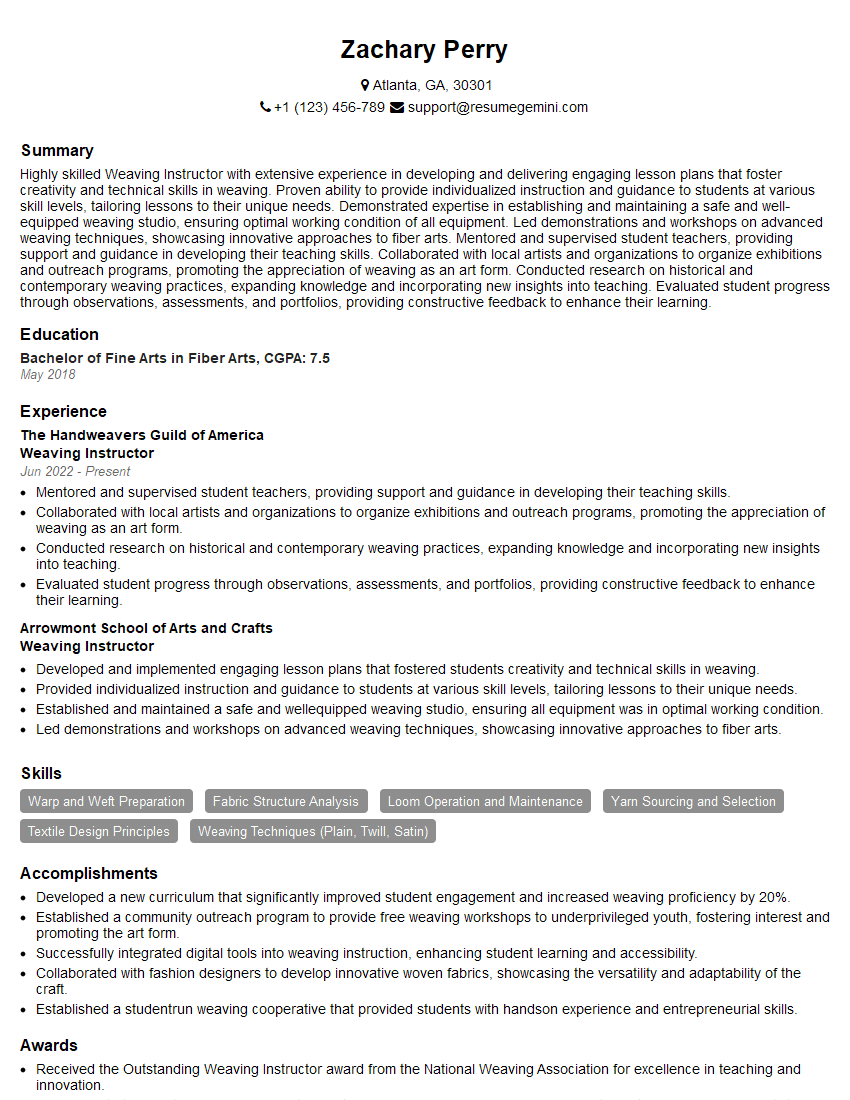
Mastering pattern weaving opens doors to exciting career opportunities in textiles, fashion, and design. To make the most of your skills, crafting a strong, ATS-friendly resume is crucial. A well-structured resume highlights your abilities and increases your chances of landing your dream job. ResumeGemini is a trusted resource for building professional, impactful resumes, and we provide examples of resumes tailored specifically to the Pattern Weaving field to help you get started. Take the next step towards your successful career in pattern weaving today!
Explore more articles
Users Rating of Our Blogs
Share Your Experience
We value your feedback! Please rate our content and share your thoughts (optional).
What Readers Say About Our Blog
Amazing blog
hello,
Our consultant firm based in the USA and our client are interested in your products.
Could you provide your company brochure and respond from your official email id (if different from the current in use), so i can send you the client’s requirement.
Payment before production.
I await your answer.
Regards,
MrSmith
hello,
Our consultant firm based in the USA and our client are interested in your products.
Could you provide your company brochure and respond from your official email id (if different from the current in use), so i can send you the client’s requirement.
Payment before production.
I await your answer.
Regards,
MrSmith
These apartments are so amazing, posting them online would break the algorithm.
https://bit.ly/Lovely2BedsApartmentHudsonYards
Reach out at BENSON@LONDONFOSTER.COM and let’s get started!
Take a look at this stunning 2-bedroom apartment perfectly situated NYC’s coveted Hudson Yards!
https://bit.ly/Lovely2BedsApartmentHudsonYards
Live Rent Free!
https://bit.ly/LiveRentFREE
Interesting Article, I liked the depth of knowledge you’ve shared.
Helpful, thanks for sharing.
Hi, I represent a social media marketing agency and liked your blog
Hi, I represent an SEO company that specialises in getting you AI citations and higher rankings on Google. I’d like to offer you a 100% free SEO audit for your website. Would you be interested?