Every successful interview starts with knowing what to expect. In this blog, we’ll take you through the top Payroll Data Analysis interview questions, breaking them down with expert tips to help you deliver impactful answers. Step into your next interview fully prepared and ready to succeed.
Questions Asked in Payroll Data Analysis Interview
Q 1. Explain the difference between gross pay and net pay.
Gross pay and net pay represent different stages of employee compensation. Gross pay is the total amount earned by an employee before any deductions. Think of it as the total sum of money earned for work performed during a pay period. Net pay, also known as take-home pay, is what the employee actually receives after all deductions have been made. These deductions can include taxes (federal, state, local), social security and Medicare contributions, health insurance premiums, retirement plan contributions, and other pre-tax or post-tax deductions.
Example: If an employee’s gross pay is $5,000, and their total deductions are $1,000, their net pay would be $4,000.
Q 2. Describe your experience with payroll software (e.g., ADP, Workday).
I have extensive experience with various payroll software systems, including ADP and Workday. With ADP, I’ve managed employee onboarding, processed bi-weekly payroll for over 200 employees, generated comprehensive payroll reports for tax filing and financial analysis, and integrated ADP with our HRIS system for seamless data flow. My experience with Workday involved configuring the system to accommodate complex compensation structures, such as bonuses and commissions, managing employee self-service features, and utilizing Workday’s reporting capabilities to identify trends in payroll costs and compensation. In both cases, I focused on system optimization to ensure accurate and efficient payroll processing while minimizing manual intervention.
Q 3. How do you ensure data accuracy in payroll processing?
Ensuring data accuracy in payroll processing is paramount. My approach involves a multi-layered strategy. First, data validation is crucial. This includes using data entry validation rules within the payroll system to prevent incorrect data entry. For instance, enforcing data type validation (e.g., only numbers for salary) and range checks. Second, I implement regular reconciliation processes. I compare payroll data against timekeeping data, employee information databases, and benefit records. Discrepancies are immediately investigated and corrected. Third, I leverage automated checks and reports. The system generates reports that highlight potential issues like discrepancies in hours worked or unusual deductions. Fourth, I encourage employee self-service functionalities where employees can review and verify their pay information. Finally, regular audits and reviews are conducted to pinpoint areas needing improvement in the accuracy of our procedures.
Q 4. What are common payroll errors and how do you prevent them?
Common payroll errors include incorrect wage calculations (overtime, bonuses), misapplied tax rates, inaccurate deductions, and data entry mistakes. Prevention involves clear and concise procedures for data entry. Regular training for payroll staff on these procedures is also vital. Implementing robust data validation rules in the payroll system automatically flags many potential errors. Reconciliation processes, as previously mentioned, help catch any discrepancies. Automated checks and reports generated by the payroll software highlight potential issues proactively. Moreover, a system of checks and balances, where multiple people review payroll data before final processing helps catch errors that might slip through.
Q 5. How familiar are you with payroll tax regulations?
I possess a strong understanding of payroll tax regulations at both the federal and state levels. I am familiar with changes in tax laws and their impact on payroll processing. I understand the complexities of various tax forms (W-2, W-4, 941, etc.) and the requirements for accurate reporting. I stay updated on changes in legislation through professional development courses and subscription to relevant publications. I’m also adept at navigating tax-related challenges, ensuring compliance and minimizing the risk of penalties.
Q 6. Explain your experience with data mining and analysis in a payroll context.
My experience in payroll data mining and analysis involves extracting insights from payroll data to inform strategic decisions. For example, I’ve used data mining techniques to identify trends in employee turnover by analyzing compensation data, performance reviews and tenure. This helped the organization to understand the reasons behind attrition and develop retention strategies. I’ve also analyzed salary data to identify potential pay inequities based on factors like gender and race. Furthermore, I’ve used payroll data to forecast future payroll expenses, enabling better budgeting and financial planning.
Q 7. Describe your experience with SQL and its application in payroll data analysis.
I am proficient in SQL and have extensive experience applying it to payroll data analysis. I use SQL to query large payroll databases to extract specific information, such as employee compensation, deductions, and tax information. For instance, I might use a query to identify all employees who earned overtime pay in the last quarter: SELECT employee_id, employee_name, SUM(overtime_pay) FROM payroll_data WHERE pay_period BETWEEN '2023-07-01' AND '2023-09-30' GROUP BY employee_id, employee_name;. I utilize SQL to create customized reports for management, analyze trends, and identify potential issues within the payroll data. My SQL skills enable me to efficiently process and analyze large volumes of data, providing valuable insights for decision-making.
Q 8. How do you handle discrepancies in payroll data?
Discrepancies in payroll data are a common challenge, but addressing them systematically is crucial for accuracy and compliance. My approach involves a multi-step process:
- Identification: I begin by using data validation techniques like comparing payroll data against time and attendance records, employee master files, and benefit enrollment information. Automated checks for inconsistencies in gross pay, deductions, net pay, and tax calculations are also essential. For example, if an employee’s reported hours don’t match their pay, or if tax deductions are incorrect according to tax brackets, an immediate investigation is needed.
- Investigation: Once discrepancies are identified, I investigate their root cause. This may involve checking source documents, verifying data entry accuracy, contacting employees, or consulting with HR or accounting departments. A detailed log of every investigation step is maintained.
- Correction: After determining the cause, the corrections are made, ensuring all supporting documentation is updated. This might involve adjusting employee records, correcting data entry errors, or updating tax information.
- Reconciliation: Once corrections are made, a final reconciliation is performed to ensure that the updated payroll data aligns with all relevant source data. This prevents further discrepancies from occurring.
- Prevention: Finally, I work to prevent future discrepancies through process improvements and better data controls. This might include implementing better data validation rules, improving data entry procedures, or providing additional training to staff involved in data entry.
For instance, in a previous role, we identified a recurring discrepancy in overtime calculations. By investigating, we found an error in the system’s overtime calculation formula. The formula was corrected, and a recalculation of past payrolls was performed to ensure fairness and accuracy.
Q 9. How would you identify and resolve payroll processing bottlenecks?
Identifying and resolving payroll processing bottlenecks requires a systematic approach. My strategy typically involves:
- Performance Monitoring: I use tools to monitor key performance indicators (KPIs) such as processing time, error rates, and resource utilization. This data highlights areas where bottlenecks are most likely to occur.
- Process Mapping: Once potential bottlenecks are identified, I use process mapping techniques to visualize the payroll processing workflow. This helps identify inefficient steps or areas with excessive manual intervention. For example, a process map might reveal that manual data entry is taking up significant time.
- Root Cause Analysis: To resolve bottlenecks, I perform root cause analysis using methods like the ‘5 Whys’ to dig deep into the underlying issues. For example, if the bottleneck is slow data entry, the ‘5 Whys’ might reveal a lack of proper training or inadequate technology.
- Solution Implementation: Based on the root cause analysis, I develop and implement solutions. This might include automating manual tasks, upgrading software or hardware, improving data quality, or providing additional training. Automating data entry, for instance, could significantly reduce processing time.
- Continuous Improvement: I continually monitor KPIs after implementing solutions to ensure the improvements are sustained and further refinements can be made. Regular review of processes helps in proactively identifying and addressing potential bottlenecks before they become major issues.
In a past project, I discovered a significant bottleneck in the reconciliation process due to outdated software. By upgrading to a more efficient system, we reduced processing time by 40% and eliminated manual reconciliation steps, greatly improving accuracy and efficiency.
Q 10. What methods do you use to ensure data security and compliance in payroll?
Data security and compliance are paramount in payroll. My approach involves a layered security model:
- Access Control: I implement strict access control measures, using role-based access control (RBAC) to ensure that only authorized personnel have access to sensitive payroll data. This includes strong password policies, multi-factor authentication, and regular audits of user access rights.
- Data Encryption: Both data at rest (stored data) and data in transit (data moving across networks) are encrypted using industry-standard encryption algorithms. This protects the data from unauthorized access, even if a security breach occurs.
- Regular Security Audits: Regular security audits and penetration testing are conducted to identify and mitigate potential vulnerabilities. These audits help ensure systems remain up-to-date with the latest security patches and that all compliance requirements are met.
- Compliance Adherence: I ensure that all payroll processes adhere to relevant regulations like GDPR, CCPA, and SOX, depending on the jurisdiction. This includes proper data retention policies and procedures for handling data breaches.
- Employee Training: Employees are trained on data security best practices, including phishing awareness and secure data handling protocols. This is crucial to prevent human error from compromising security.
For example, we implemented end-to-end encryption for all payroll data transfers in my previous role, ensuring data confidentiality throughout the entire processing lifecycle.
Q 11. What is your experience with payroll reporting and generating key performance indicators (KPIs)?
I have extensive experience in payroll reporting and KPI generation. My approach focuses on providing stakeholders with meaningful insights into payroll operations. I use a variety of reporting techniques to achieve this:
- Standard Reports: I develop and deliver standard reports such as payroll summaries, cost-to-company analyses, and compensation benchmarking reports.
- Custom Reports: I create custom reports based on specific business requirements or stakeholder requests. For instance, a custom report might track overtime costs per department or analyze salary trends over time.
- KPIs: I define and track key performance indicators (KPIs) relevant to payroll efficiency and accuracy. This might include metrics such as payroll processing time, error rates, compliance adherence, and cost per employee.
- Data Analysis: I use data analysis techniques to identify trends, patterns, and anomalies in the data. For example, analyzing payroll data might reveal unexpectedly high overtime costs in a specific department, prompting further investigation.
- Dashboarding: I utilize dashboards to present key findings and KPIs in a clear and concise manner, enabling stakeholders to quickly grasp the overall health of the payroll function.
In a previous role, I created a dashboard that tracked key payroll metrics, allowing management to easily monitor processing times, error rates, and compliance status. This enhanced transparency and accountability within the payroll department.
Q 12. Describe your experience with data visualization tools (e.g., Tableau, Power BI).
I’m proficient in various data visualization tools, including Tableau and Power BI. These tools are invaluable for transforming raw payroll data into actionable insights. My experience includes:
- Data Preparation: I’m adept at cleaning, transforming, and preparing payroll data for visualization. This often involves handling missing values, dealing with inconsistencies, and ensuring data accuracy.
- Data Visualization: I use these tools to create interactive dashboards, charts, and graphs that effectively communicate key findings to both technical and non-technical audiences. Techniques include using bar charts for comparing payroll costs across departments, line charts for visualizing salary trends, and geographic maps to show employee distribution.
- Interactive Dashboards: I build interactive dashboards that allow users to explore payroll data dynamically, filtering and drilling down to specific details as needed.
- Data Storytelling: I leverage data visualization to create compelling narratives around payroll data, highlighting key trends and insights that support decision-making. For instance, visualizing the distribution of salaries across different job grades can help in salary benchmarking and compensation planning.
In a recent project, I used Tableau to create an interactive dashboard that allowed HR to track employee compensation, benefits, and performance data in one central location, streamlining their decision-making processes.
Q 13. How do you prioritize tasks when handling multiple payroll data requests?
Prioritizing multiple payroll data requests requires a structured approach. I typically use a system that considers several factors:
- Urgency: Requests with immediate deadlines or critical implications are prioritized higher. For example, a request for a critical payroll correction takes precedence over a routine data analysis request.
- Impact: I assess the impact of each request on the organization. Requests with a broader impact on employees or the business get higher priority.
- Dependencies: Requests that depend on the completion of other tasks are sequenced appropriately.
- Resource Availability: I consider the resources required to complete each request (time, skills, tools) and prioritize those that are feasible given the available resources.
- Communication: I keep stakeholders informed about the priority levels of their requests and provide estimated completion times. This ensures transparency and manages expectations.
I often use a project management tool to track tasks and their dependencies, visualize the workload, and ensure tasks are completed efficiently and effectively.
Q 14. Explain your experience with payroll audits and compliance requirements.
My experience with payroll audits and compliance requirements is extensive. I understand the importance of ensuring that payroll processes are compliant with all applicable laws and regulations. My experience includes:
- Preparation for Audits: I assist in preparing for internal and external payroll audits, ensuring all necessary documentation is readily available and accurately reflects payroll processes.
- Audit Support: I actively participate in audits, responding to auditor inquiries, providing supporting documentation, and explaining payroll procedures. I make sure I understand the audit’s scope and thoroughly prepare the relevant data for review.
- Compliance Monitoring: I continuously monitor payroll processes for compliance with current regulations and best practices, identifying and addressing any potential non-compliance issues proactively.
- Corrective Actions: If non-compliance issues are identified, I work to implement appropriate corrective actions, ensuring that future payroll processing adheres to regulatory standards.
- Documentation: I maintain detailed and up-to-date documentation of all payroll policies, procedures, and processes to support audits and demonstrate compliance.
In a previous role, I successfully guided the payroll department through a major compliance audit, resulting in a clean audit report. This involved comprehensive preparation, meticulous documentation, and proactive collaboration with auditors.
Q 15. How do you stay updated on changes in payroll regulations and best practices?
Staying current in the dynamic world of payroll regulations and best practices is crucial. I employ a multi-faceted approach. Firstly, I subscribe to reputable professional organizations like the American Payroll Association (APA) and actively participate in their webinars and conferences. These events offer invaluable insights into legislative changes, emerging trends, and best practices shared by industry experts. Secondly, I regularly review publications like industry journals and government websites dedicated to employment law and tax regulations. This ensures I’m abreast of any updates to federal, state, and local laws impacting payroll processing. Finally, I actively network with other payroll professionals through online forums and professional groups, allowing for a constant exchange of knowledge and experiences. This combined strategy ensures I’m not only informed but also proactively adapt to evolving payroll landscapes.
Career Expert Tips:
- Ace those interviews! Prepare effectively by reviewing the Top 50 Most Common Interview Questions on ResumeGemini.
- Navigate your job search with confidence! Explore a wide range of Career Tips on ResumeGemini. Learn about common challenges and recommendations to overcome them.
- Craft the perfect resume! Master the Art of Resume Writing with ResumeGemini’s guide. Showcase your unique qualifications and achievements effectively.
- Don’t miss out on holiday savings! Build your dream resume with ResumeGemini’s ATS optimized templates.
Q 16. Describe your experience with process improvement in payroll data analysis.
In my previous role, we were facing significant challenges with our payroll processing time – it was taking nearly three times longer than industry benchmarks. I spearheaded an initiative to streamline the process. We began by analyzing the current workflow using process mapping techniques. This revealed several bottlenecks, including manual data entry points and outdated software. To address these issues, we implemented a new payroll system that automated several key processes. We also trained our team on more efficient data entry techniques and developed standardized procedures. The result? We reduced processing time by 60%, decreased errors by 40%, and freed up valuable employee time to focus on higher-value tasks. This experience underscored the importance of data-driven decision making and the power of process optimization in enhancing payroll efficiency and accuracy.
Q 17. How would you handle a situation where payroll data is incomplete or inaccurate?
Incomplete or inaccurate payroll data is a serious issue that requires immediate attention. My approach is systematic and thorough. First, I would identify the extent of the problem, pinpointing which data points are missing or incorrect. This often involves cross-referencing the payroll data with other sources, such as timekeeping records, employee files, and benefit enrollment forms. Next, I’d investigate the root cause of the problem. Was it a data entry error? A system malfunction? Or a failure in data collection processes? Once the cause is determined, I develop a plan of action to correct the data. This might involve contacting employees for clarification, reconciling discrepancies with other departments, or implementing corrective measures to prevent future occurrences. Finally, I’d implement preventative measures to improve data quality going forward, perhaps via improved data validation rules or employee training. The key is to not only fix the immediate problem but to address the underlying causes to prevent future issues.
Q 18. How do you interpret and communicate complex payroll data to non-technical stakeholders?
Communicating complex payroll data to non-technical stakeholders requires clear, concise, and visually engaging presentations. Instead of using technical jargon, I focus on using plain language and relatable analogies. For example, when discussing variance in payroll expenses, I might compare it to a household budget, explaining how overspending in certain categories can impact the overall financial picture. I often utilize dashboards and charts to visually represent key data points, making complex information easily digestible. These visuals help to highlight trends and patterns quickly, enabling stakeholders to grasp the key insights without needing deep technical knowledge. Finally, I always ensure the presentation is tailored to the audience’s specific needs and level of understanding, making sure to answer their questions and address their concerns directly.
Q 19. Explain your experience with different payroll systems and their integration.
Throughout my career, I’ve worked with various payroll systems, including ADP, Paychex, and Workday. My experience spans both on-premise and cloud-based solutions. I’m proficient in importing and exporting data between different systems, ensuring data integrity during the migration process. I’m also experienced in integrating payroll systems with other HR and financial applications, such as HRIS (Human Resource Information Systems) and general ledger software. This integration is crucial for maintaining accurate and consistent data across various business functions. My familiarity extends to understanding the nuances of each system’s functionalities, from data security and compliance to reporting and analysis capabilities. In each case, my focus has always been on optimizing the system to meet the specific needs of the organization and to ensure seamless payroll processing.
Q 20. What are the key metrics you track to evaluate payroll data quality?
Several key metrics are crucial for evaluating payroll data quality. These include:
- Accuracy Rate: This measures the percentage of payroll data entries that are free from errors. A high accuracy rate is essential for avoiding costly corrections and legal issues.
- Completeness Rate: This assesses whether all necessary data points are captured for each employee. Missing data can lead to delays and inaccuracies.
- Timeliness: This metric examines how quickly payroll data is processed and delivered. Prompt processing minimizes disruptions and ensures employees receive their paychecks on time.
- Compliance Rate: This determines whether payroll processes adhere to all relevant regulations and laws, minimizing the risk of penalties or legal action.
- Duplicate Rate: This indicates the frequency of duplicate data entries, which can cause overpayments or other discrepancies.
Q 21. How do you identify trends and patterns in payroll data?
Identifying trends and patterns in payroll data requires employing various analytical techniques. I typically start by visualizing the data using charts and graphs, which can reveal underlying trends quickly. For example, a line graph can illustrate changes in payroll expenses over time, while a bar chart can compare payroll costs across different departments. Then, I apply statistical methods to analyze the data more deeply, identifying correlations between variables. For example, I might look for relationships between overtime hours and employee turnover. Advanced techniques like regression analysis can help to predict future payroll trends, which is valuable for budgeting and forecasting. Data mining techniques can uncover hidden patterns that might not be immediately apparent. The goal is to use these insights to optimize payroll processes, improve forecasting, and make more data-driven decisions.
Q 22. Describe a time you had to solve a complex problem related to payroll data.
One particularly challenging problem involved reconciling discrepancies between our payroll system and the general ledger. We had a significant mismatch in year-end bonuses, affecting a large number of employees. Initially, the issue seemed insurmountable, with data spanning multiple systems and several months. My approach was systematic. First, I identified the exact discrepancy amount and the number of affected employees. Then, I meticulously compared data fields across both systems, including employee IDs, bonus rates, payment dates, and tax deductions. I used SQL queries to extract relevant data points and create detailed comparison reports. I discovered the root cause was a bug in the payroll system’s bonus calculation module that incorrectly applied a certain tax rate for specific employee categories. After documenting the problem, I collaborated with the IT department to fix the bug. Finally, I implemented a data validation process to prevent similar errors in the future using automated checks and cross-referencing across the systems. This process resulted in a fast and accurate resolution. The problem taught me the importance of comprehensive data validation and proactive error prevention.
Q 23. How do you ensure the confidentiality and security of payroll data?
Ensuring the confidentiality and security of payroll data is paramount. We employ a multi-layered approach incorporating physical, technical, and administrative controls. Physically, access to payroll data is restricted to authorized personnel only, within secured facilities with restricted access. Technically, we utilize robust encryption protocols (like AES-256) to safeguard data both at rest and in transit. We also employ strong password policies, multi-factor authentication, and regular security audits to minimize risks. From an administrative standpoint, we adhere strictly to data privacy regulations like GDPR and CCPA, implementing strict access control policies and regular employee training programs emphasizing data security best practices. Data is anonymized wherever possible for analytical purposes. Access logs are meticulously monitored, and any suspicious activities immediately trigger an investigation. We also conduct regular penetration testing to identify vulnerabilities and enhance our security posture. Think of it like a fortress – multiple layers protecting a valuable asset.
Q 24. What is your experience with using data to identify cost-saving opportunities in payroll?
I have extensive experience leveraging payroll data for cost-saving initiatives. In a previous role, I analyzed overtime data to pinpoint departments with consistently high overtime costs. Using data visualization tools, I identified patterns indicating inefficiencies in workflow processes. Through regression analysis, I correlated overtime with specific projects and staffing levels, revealing bottlenecks and areas for process improvement. The findings led to the implementation of more efficient scheduling practices, reducing overtime costs by 15% within six months. Further analysis of compensation data helped identify salary discrepancies and areas of potential salary compression, leading to more effective compensation strategies and cost savings in recruitment and retention. Data analysis also helped us optimize benefits packages, negotiating better rates with insurance providers based on aggregate employee usage data.
Q 25. What is your familiarity with different types of payroll data analysis techniques?
My experience encompasses a wide range of payroll data analysis techniques. I’m proficient in descriptive statistics to summarize and visualize key payroll metrics like average salary, turnover rate, and compensation costs. I utilize inferential statistics such as regression analysis to identify correlations between variables and predict future trends (e.g., predicting future compensation costs based on historical data and projected headcount). I’m adept at time series analysis to identify seasonal patterns in payroll expenses or employee attrition. I’m familiar with predictive modeling techniques, including machine learning algorithms, to forecast payroll needs, optimize staffing, and even predict potential risks like wage and hour compliance issues. Moreover, I am skilled in data mining techniques to discover hidden patterns or anomalies in the data. Each technique offers valuable insights depending on the specific business question being addressed.
Q 26. Explain your understanding of different data formats commonly used in payroll (CSV, XML, etc.).
Payroll data comes in various formats. CSV (Comma Separated Values) is a common, simple format easily imported into spreadsheet software and databases. Each row represents a record (e.g., an employee), and columns represent data fields (e.g., employee ID, pay rate, hours worked). XML (Extensible Markup Language) is more structured, using tags to define data elements, offering better organization and metadata support. This is useful for more complex payroll systems. JSON (JavaScript Object Notation) is another popular format, similar to XML but often preferred for its simpler syntax and ease of parsing by programming languages. Understanding the structure of each format is critical for efficient data extraction, transformation, and loading (ETL) processes. For example, if data is received in XML, I’d use an XML parser in Python or R to extract specific data elements before analysis. Choosing the right format depends on the complexity of the data and the tools being used for analysis.
Q 27. How do you handle large datasets in payroll data analysis?
Handling large payroll datasets requires efficient data management strategies. Techniques like data sampling can reduce computational costs without significantly impacting analytical insights, particularly for descriptive analyses. For more complex analyses, I utilize distributed computing frameworks like Hadoop or Spark, enabling parallel processing across multiple machines to handle vast datasets effectively. Database management systems (DBMS) such as SQL Server or Oracle are crucial for storing and querying large datasets, employing optimized indexing and querying techniques. Furthermore, data compression and partitioning techniques reduce storage requirements and improve query performance. Understanding the limitations of my hardware and choosing appropriate tools are essential. For instance, for very large datasets, I might opt for a cloud-based solution like AWS Redshift or Google BigQuery, which offer scalable and cost-effective processing capabilities.
Q 28. Describe your experience in using statistical methods for payroll data analysis.
Statistical methods are integral to payroll data analysis. I frequently use regression analysis to model relationships between variables, such as predicting salary based on experience and education level. Hypothesis testing helps determine whether observed differences in payroll metrics are statistically significant. For instance, I might test if there’s a statistically significant difference in average salaries between two departments. Time series analysis helps to identify trends and seasonality in payroll data, allowing us to forecast future payroll needs more accurately. I utilize ANOVA (Analysis of Variance) to compare the means of multiple groups (e.g., comparing average salaries across different job titles). Furthermore, I regularly use descriptive statistics (mean, median, standard deviation) to summarize and visualize key payroll metrics, providing valuable insights into the overall payroll landscape. The specific statistical method chosen depends entirely on the research question and the nature of the data.
Key Topics to Learn for Payroll Data Analysis Interview
- Payroll Data Integrity and Validation: Understanding data cleansing techniques, error detection, and correction methods crucial for accurate analysis. Practical application: Identifying and resolving discrepancies in payroll data to ensure accurate reporting and payments.
- Payroll Reporting and Metrics: Mastering the creation and interpretation of key payroll reports (e.g., cost-per-employee, compensation analysis). Practical application: Analyzing payroll trends to identify cost-saving opportunities or areas needing improvement.
- Statistical Analysis of Payroll Data: Utilizing statistical methods (e.g., regression analysis, hypothesis testing) to identify patterns and trends in payroll data. Practical application: Forecasting future payroll costs based on historical data and projected growth.
- Payroll Systems and Software: Familiarity with various payroll software and systems (e.g., ADP, Workday). Practical application: Demonstrating proficiency in extracting, manipulating, and analyzing data from different payroll systems.
- Data Visualization: Creating clear and insightful visualizations (e.g., charts, graphs) to effectively communicate payroll data findings. Practical application: Presenting payroll analysis results to stakeholders in a concise and understandable manner.
- Compliance and Regulations: Understanding relevant payroll laws and regulations (e.g., tax withholding, minimum wage). Practical application: Ensuring payroll processes adhere to legal requirements and minimizing compliance risks.
- Advanced Analytical Techniques: Exploring more advanced techniques such as predictive modeling or machine learning for payroll forecasting and anomaly detection (depending on the seniority of the role).
Next Steps
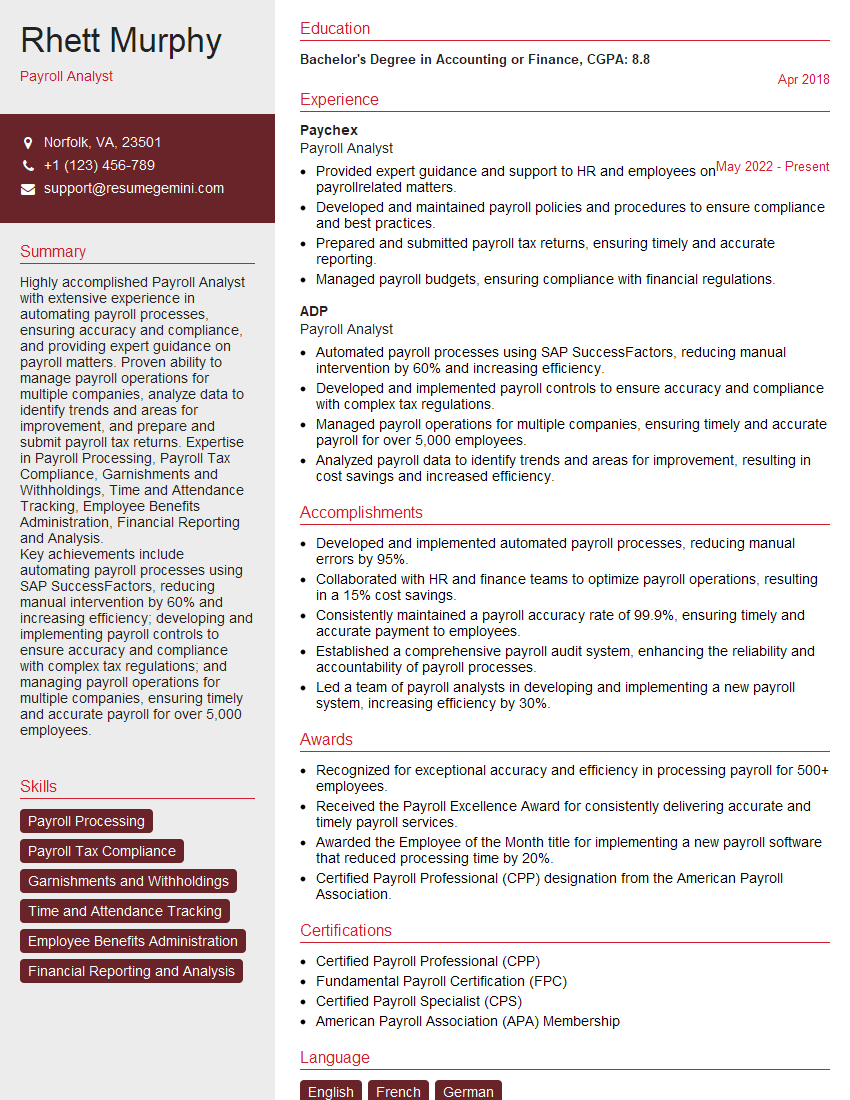
Mastering Payroll Data Analysis significantly boosts your career prospects, opening doors to more challenging and rewarding roles within finance and HR. A strong understanding of this field demonstrates valuable analytical and problem-solving skills highly sought after by employers. To maximize your chances of landing your dream job, create an ATS-friendly resume that highlights your skills and experience effectively. ResumeGemini is a trusted resource to help you build a professional and impactful resume. Examples of resumes tailored specifically for Payroll Data Analysis positions are available to guide you. Take advantage of these resources to showcase your capabilities and make a strong impression on potential employers.
Explore more articles
Users Rating of Our Blogs
Share Your Experience
We value your feedback! Please rate our content and share your thoughts (optional).
What Readers Say About Our Blog
Amazing blog
Interesting Article, I liked the depth of knowledge you’ve shared.
Helpful, thanks for sharing.