Are you ready to stand out in your next interview? Understanding and preparing for Personal Projects or Hobbies in Basketry interview questions is a game-changer. In this blog, we’ve compiled key questions and expert advice to help you showcase your skills with confidence and precision. Let’s get started on your journey to acing the interview.
Questions Asked in Personal Projects or Hobbies in Basketry Interview
Q 1. What types of weaving techniques are you proficient in (e.g., coil, twining, plaiting)?
I’m proficient in several basket weaving techniques, each offering unique aesthetic and structural properties. My expertise includes:
- Coiling: This technique involves spiraling a continuous length of material around a center, creating a sturdy, often three-dimensional form. I’ve used coiling extensively to craft round baskets and decorative bowls, employing both flat and round coils. The variations within coiling, such as using different coil thicknesses and stitching techniques, provide a wide range of design possibilities.
- Twining: Twining uses two or more weaving elements to wrap around a series of vertical warp elements. It results in a tightly woven, strong structure, particularly suited for creating containers with a close weave. I often use twining for smaller, more delicate baskets where strength and evenness are paramount.
- Plaiting: Plaiting, also known as braiding, is a simpler method where three or more strands are interwoven. It’s excellent for creating decorative elements or handles for baskets. While seemingly basic, complex patterns and variations in strand thickness and color can yield stunning results. I’ve used plaiting extensively to create intricate basket handles and decorative borders.
Q 2. Describe your experience with different basketry materials (e.g., willow, rattan, reed, raffia).
My experience with basketry materials is extensive, and each material presents unique challenges and rewards. I’ve worked with:
- Willow: A classic and versatile material, willow offers a wide range of colors and thicknesses, perfect for both rustic and refined designs. I particularly enjoy working with it for its pliability and ability to create smooth curves.
- Rattan: Known for its strength and flexibility, rattan is ideal for creating intricate designs and tight weaves. Its natural sheen adds an elegant touch to finished pieces. I find its natural resistance to moisture makes it perfect for outdoor baskets.
- Reed: Reed’s smooth texture and consistent diameter make it easy to work with, especially for beginners. It’s perfect for creating tightly woven containers that are both durable and aesthetically pleasing. I’ve used reed for everything from simple storage baskets to more complex decorative pieces.
- Raffia: This natural fiber is wonderfully versatile, available in a wide variety of colours. I often use raffia for decorative accents, embellishments, and binding, adding texture and color to my basket designs. It’s also great for smaller projects.
Q 3. How do you select appropriate materials for a specific basket design?
Selecting the right material is crucial for achieving the desired aesthetic and functional outcome. My process involves considering:
- Basket design: A tightly woven basket requires a material with sufficient strength and flexibility, like rattan or reed. A more open weave can tolerate less-durable materials such as raffia or certain types of willow.
- Intended use: A basket for carrying heavy items needs strong materials, while a decorative basket prioritizes aesthetics and may use more delicate materials. For example, a sturdy picnic basket might use rattan, while a decorative wall hanging might utilize raffia or dyed willow.
- Desired aesthetic: The color, texture, and sheen of the material significantly influence the overall look. For a rustic look, I might choose natural willow; for a more refined look, I might opt for polished rattan or dyed reed.
Q 4. Explain your process for designing a new basket, from concept to completion.
Designing a new basket is a multi-stage process that blends creativity and technical skill:
- Conceptualization: I start with a sketch, considering the intended use, size, shape, and desired aesthetic. I might find inspiration from nature, architecture, or existing basketry techniques.
- Material Selection: Based on my sketch and intended use, I select the appropriate material, considering its color, texture, and strength.
- Structure Planning: I determine the weaving technique best suited to the design and create a detailed plan, possibly including diagrams or templates to ensure accuracy and consistency.
- Material Preparation: I prepare the materials, soaking them as needed to make them pliable and easy to work with.
- Weaving: This is where the design comes to life. Following my plan, I carefully weave the basket, paying close attention to tension and consistency.
- Finishing: Once the weaving is complete, I finish the basket, addressing any loose ends and applying any needed treatments like oil or varnish to protect the material.
Q 5. What tools and equipment are essential for your basketry practice?
Essential tools for my basketry practice include:
- Sharp knife or secateurs: For preparing and cutting materials.
- Basketry awl: For piercing holes and separating strands.
- Scissors: For trimming ends and cutting raffia.
- Measuring tape: For accurate measurements and planning.
- Wooden mallets: For gently tapping in stakes or forming coils.
- Various clamps and tools: To hold pieces in place.
In addition, a well-lit workspace is vital, and I also find a variety of containers useful for organizing materials.
Q 6. How do you maintain and care for your tools?
Maintaining my tools is essential for their longevity and my safety. I regularly:
- Clean my tools after each use, removing any residue of material or sap. This prevents rust and keeps them functioning correctly.
- Sharpen blades and awls as needed, ensuring they are always efficient and safe to use.
- Store tools in a dry, safe place to prevent damage or rust.
- Oil wooden handles periodically to keep them from drying out and cracking.
Q 7. Describe your process for preparing basketry materials before weaving.
Material preparation is a critical step that greatly impacts the final product’s quality and longevity. My process varies depending on the material:
- Willow and Reed: These materials often require soaking in water for several hours or even overnight to increase their pliability and reduce breakage during weaving. The soaking time depends on the thickness and dryness of the material.
- Rattan: Rattan is naturally more pliable, but steaming may be necessary for particularly stiff pieces. This softens it and makes it easier to work with.
- Raffia: Raffia usually doesn’t require soaking, but it’s beneficial to gently comb out any tangled strands before weaving to maintain a smooth and even finish.
Proper preparation ensures the materials are easier to handle, reducing the risk of damage and leading to a more consistent and high-quality finished basket.
Q 8. How do you troubleshoot common issues during the weaving process (e.g., uneven weaving, broken strands)?
Troubleshooting weaving issues is a crucial skill in basketry. Uneven weaving often stems from inconsistent tension in your weaving strands. Imagine trying to build a wall with bricks of varying sizes – it’ll be wobbly! To fix this, consciously tighten or loosen your strands as needed, paying close attention to the spacing between each row. Broken strands are more straightforward. Always have extra material on hand. If a strand breaks, carefully thread the new one through, ensuring it’s securely woven into the existing structure. A useful trick is to use a needle to aid in weaving the new strand through tightly and seamlessly.
For example, if I notice a section becoming wider, I’ll go back and tighten the previous rows, subtly adjusting the tension to create a uniform appearance. Similarly, if a strand breaks mid-weave, I’ll carefully splice in a new one using a whip stitch or other joining method appropriate for the material.
Q 9. How do you finish and seal a completed basket to ensure durability?
Finishing and sealing a basket protects it from the elements and extends its lifespan. Think of it like applying a protective coat of armor! The method depends on the material. For willow or reed baskets, I often use a paste of boiled linseed oil and beeswax. This mixture penetrates the fibers, strengthening them and creating a water-resistant barrier. For baskets made from other materials, such as grasses or raffia, a water-based varnish or sealant can be applied, but it’s essential to test this on a small, hidden area first to ensure it doesn’t damage the material. I always allow the sealant to dry completely before using the basket.
Q 10. What are the different finishing techniques you use?
Finishing techniques go beyond sealing. They are about enhancing the basket’s aesthetic appeal and functionality. I use several techniques depending on the basket’s design and intended use. These include:
- Finishing the edges: Carefully weaving in the ends of the strands to prevent fraying and create a clean, professional finish.
- Adding decorative elements: Incorporating beads, dyed strands, or other embellishments to add visual interest.
- Applying a varnish or oil finish (as discussed above): To enhance durability and water resistance.
- Burnishing: Gently polishing the surface to improve the sheen and smoothness.
For a sturdy market basket, the focus might be on strong edges and a protective sealant. For a decorative wall hanging, intricate edge work and embellishments would be priorities.
Q 11. What are some common design elements in basketry, and how do you incorporate them?
Basketry design elements are incredibly varied. Common elements include:
- Shape: From simple cylindrical forms to complex geometric shapes or freeform designs.
- Weaving patterns: Different techniques create diverse textures and visuals; for example, plain weave, twill weave, and spiral weave.
- Color and texture: Natural variations in materials, along with dyes or bleaching, provide interesting contrasts.
- Handles and embellishments: Carefully integrated handles enhance function, while decorative elements add personality.
For instance, I might incorporate a spiral weave pattern for visual interest in a wastepaper basket, or use a contrasting color in the rim of a picnic basket for a pop of visual excitement. The key is to select elements appropriate for the basket’s purpose and style.
Q 12. How do you determine the appropriate size and shape for a given basket?
Determining the right size and shape begins with the intended use. A bread basket will be smaller and shallower than a laundry basket. I typically sketch out initial designs and make small scale models or prototypes to refine the shape and size before committing to the final piece. This allows for adjustments and ensures that the proportions are pleasing to the eye and functional. I’ll consider ergonomics – a comfortable handle for carrying a picnic basket is crucial. I’ll also consider the available material, ensuring I have enough to complete the project to the size I envisioned.
Q 13. What are the key considerations for creating a structurally sound basket?
Structural soundness is paramount. It’s like building a house – a solid foundation is key. Key considerations include:
- Material selection: Choosing appropriately strong and flexible materials based on the basket’s size and intended use. Stronger materials are needed for larger or heavier baskets.
- Foundation: Building a robust base is crucial. This could involve a tightly woven base or a sturdy frame.
- Weaving technique: Employing appropriate weaving techniques to ensure uniform tension and prevent gaps or weaknesses.
- Proper joining of materials: Securing the joining points to prevent fraying or separation.
For instance, a large storage basket might require a stronger base made from thicker reeds, while a small fruit basket might use a tightly woven base of finer material. The goal is a strong, balanced piece that can withstand daily use without structural compromise.
Q 14. Describe your experience working with complex basketry patterns.
I have extensive experience with complex basketry patterns, ranging from intricate twill weaves to challenging spiral constructions. One project I particularly enjoyed involved creating a large, hexagonal-shaped basket using a combination of open and closed weaves to create visual depth. This project required meticulous planning, precise execution, and a high level of attention to detail. It pushed my skills and understanding of structural integrity within a complex geometrical form. Working with complex patterns isn’t just about following instructions; it’s about understanding the underlying principles of weave structure and adapting them to create unique and beautiful pieces.
Q 15. How do you adapt your techniques to work with different scales and sizes of baskets?
Adapting basketry techniques to different scales involves adjusting material choices, weaving patterns, and overall construction methods. Think of it like building with LEGOs – you can use the same basic bricks to create a small car or a large castle, but you need to change the design and number of bricks.
Material Selection: For smaller baskets, I might use finer reeds or raffia, allowing for intricate details. Larger baskets often benefit from sturdier materials like willow or bamboo, capable of handling the increased tension and weight.
Weaving Patterns: Simple patterns are ideal for smaller projects, allowing for precision and delicate work. Larger baskets can incorporate more complex weaves, creating visual interest while maintaining structural integrity. For example, a small, tightly woven coil basket might use a simple spiral, while a large market basket could utilize a stronger, open weave like a twill.
Construction Methods: The base construction technique needs careful consideration. A small basket might employ a simple coiled base, while a larger one might require a more robust foundation built with spokes and a weaving.
For instance, I recently created a miniature basket for holding jewelry using fine raffia and a tightly woven spiral. In contrast, I crafted a large picnic basket using thick willow branches and a twill weave, requiring a different approach to base construction and a different weaving style to accommodate the size and weight.
Career Expert Tips:
- Ace those interviews! Prepare effectively by reviewing the Top 50 Most Common Interview Questions on ResumeGemini.
- Navigate your job search with confidence! Explore a wide range of Career Tips on ResumeGemini. Learn about common challenges and recommendations to overcome them.
- Craft the perfect resume! Master the Art of Resume Writing with ResumeGemini’s guide. Showcase your unique qualifications and achievements effectively.
- Don’t miss out on holiday savings! Build your dream resume with ResumeGemini’s ATS optimized templates.
Q 16. What are some common challenges in basketry, and how have you overcome them?
Basketry presents several challenges, particularly concerning material consistency, maintaining tension, and achieving a pleasing shape.
Inconsistent Materials: Natural materials like reeds and willow vary in thickness, color, and flexibility. To overcome this, I meticulously select and prepare my materials, often soaking them to equalize their moisture content and ensure evenness. I also learn to work *with* the natural variations, incorporating them creatively into the design.
Maintaining Tension: Even tension is crucial for a strong and visually appealing basket. Over-tightening can lead to cracking, while insufficient tension results in a loose, wobbly structure. Practice and experience are key here, developing a feel for the appropriate tension. I often use tools like weaving awls and clamps to assist in managing tension, particularly in intricate weaves.
Achieving Shape: Achieving the desired shape, especially in complex forms, can be challenging. Careful planning and the use of forms (molds) are essential. I often create my own forms from readily available materials like wood or even plastic containers, adjusting them as needed throughout the weaving process.
For example, I once struggled with a large, oval basket. The tension kept shifting, causing distortion. I solved this by using a wooden form and strategically adding extra weaving where needed to reinforce the shape and prevent warping.
Q 17. How do you maintain consistency in your weaving throughout a project?
Maintaining consistency in weaving requires careful planning, attention to detail, and diligent practice. It’s like playing a musical instrument – consistent practice leads to smooth execution.
Consistent Material Preparation: As mentioned earlier, preparing materials uniformly is critical. Soaking, drying, and sorting reeds ensures that I work with consistently sized and flexible materials.
Counting and Measuring: For structured weaves, meticulously counting and measuring each weave ensures uniformity. This is especially important when transitioning between sections or changing weave patterns.
Regular Checks: I regularly check my work for consistency in tension, spacing, and overall evenness. Stopping periodically to assess the overall shape and alignment of the weaving prevents small inconsistencies from accumulating into larger problems.
Using Templates: For more complex patterns, templates or diagrams can be used as a guide to maintain consistency.
For instance, in creating a tightly woven basket, I count each weave and make sure the spacing between the elements is consistent throughout the process. I will often use a gauge to check the spacing as I go.
Q 18. What are some sustainable practices you incorporate into your basketry?
Sustainability is paramount in my basketry practice. I prioritize sourcing materials responsibly and minimizing waste.
Locally Sourced Materials: Whenever possible, I source my materials locally, reducing the environmental impact of transportation. I often forage for suitable reeds and willow from sustainable sources or work with local growers who practice responsible harvesting techniques.
Using Recycled Materials: I sometimes incorporate recycled materials, such as reclaimed wood or newspaper, into my basketry projects.
Minimizing Waste: I strive to minimize waste by carefully planning my projects and utilizing leftover materials in smaller projects or for repairs.
Avoiding Harmful Treatments: I avoid using harmful chemicals or dyes, opting for natural alternatives or leaving the materials in their natural state whenever possible.
For example, instead of buying commercially produced reeds, I work with a local farmer who sustainably harvests reeds from his land, minimizing transportation and supporting local agriculture.
Q 19. How do you stay updated on new techniques and trends in basketry?
Staying current in basketry involves engaging with the broader community and seeking out new knowledge.
Workshops and Classes: I regularly attend workshops and classes to learn new techniques and expand my skillset. This exposes me to different styles and approaches from experienced basket weavers.
Books and Publications: I read books and magazines dedicated to basketry, both for technical information and design inspiration. These provide detailed instructions and creative ideas.
Online Communities: I engage with online forums, social media groups, and websites dedicated to basketry. These provide opportunities to share ideas, ask questions, and stay informed about current trends and techniques.
Museum Exhibitions: Visiting museums and galleries featuring basketry exhibits provides opportunities to see historical and contemporary works, inspiring new ideas and approaches.
For example, I recently participated in a workshop on Scandinavian basket weaving, learning new techniques and expanding my creative repertoire.
Q 20. Describe your experience with teaching or mentoring others in basketry.
I’ve had extensive experience teaching and mentoring others in basketry. I find teaching extremely rewarding, as it helps others discover the joy of creating functional art.
Structured Workshops: I conduct structured workshops focusing on specific techniques, from basic weaving to advanced patterns. These workshops provide a hands-on learning experience, allowing students to learn by doing.
Personalized Mentoring: I also offer personalized mentoring sessions to individuals, tailoring the instruction to their specific needs and interests. This allows for a more individualized learning approach.
Community Engagement: I occasionally teach basketry at community centers, introducing this craft to a wider audience and sharing the rich traditions.
My approach emphasizes patience, clear explanations, and encouragement. I believe that fostering a creative and supportive learning environment is crucial for the success of my students.
Q 21. Have you ever collaborated with other artists or designers on a basketry project?
Yes, I have collaborated with other artists on basketry projects. These collaborations have been enriching experiences, combining different perspectives and skills to create unique works of art.
Fiber Artists: I’ve collaborated with fiber artists to integrate textiles, yarns, and other fibers into my baskets, creating intricate and multi-textured pieces.
Potters: I’ve worked with potters, combining my baskets with their ceramic vessels to create hybrid artworks.
Landscape Architects: I’ve even collaborated with landscape architects, integrating my large-scale basketry installations into outdoor settings.
These collaborations have expanded my creative horizons and allowed me to explore new ways of expressing myself through basketry.
Q 22. How do you price your finished baskets?
Pricing my baskets involves a multifaceted approach, combining material costs, labor time, and market value. First, I meticulously track the cost of all materials: the reeds, willow, rattan, or other fibers; any dyes or finishes; and even the cost of tools that wear down over time. Then, I calculate the time investment. This isn’t just the actual weaving time, but also includes design work, prep work like soaking and preparing the materials, finishing touches, and packaging. I use a time tracker to get an accurate picture. Finally, I research comparable baskets in the market to understand current pricing and adjust my price to be competitive while reflecting the uniqueness and quality of my work. For example, a simple, small basket might cost $20, reflecting relatively low material and labor costs, while a complex, intricately designed piece might cost $200 or more.
A formula I often use is: (Material Cost + (Labor Hours * Hourly Rate)) * Markup Percentage. The markup percentage depends on factors like complexity, brand recognition, and market demand.
Q 23. How do you market and sell your basketry work?
Marketing and selling my basketry involves a multi-channel strategy. My website is crucial, acting as an online storefront, and showcasing my work through high-quality photography. I also utilize Etsy and similar online marketplaces to reach a wider audience. Participating in local craft fairs and farmers’ markets provides a direct connection with customers and allows for immediate feedback. Social media, especially Instagram, plays a significant role in highlighting my process and finished pieces, building a brand identity, and creating engagement. I actively participate in relevant online communities and forums to connect with other artisans and potential clients. Word-of-mouth referrals remain powerful; satisfied customers often become my best advertising.
Q 24. Describe your experience with exhibiting your work at craft shows or galleries.
Exhibiting my work at craft shows and galleries has been an invaluable experience. Craft shows offer direct interaction with potential buyers, providing immediate feedback on my work and a chance to understand customer preferences. I’ve learned a lot about display techniques, presentation, and marketing strategies through participating in these events. Galleries, on the other hand, provide a more formal setting and reach a different clientele. I’ve found that carefully curating my selection based on the gallery’s aesthetic is key. The biggest challenge is managing the time commitment involved in setting up, attending, and packing up at these events. For example, I once exhibited at a prestigious regional craft fair and sold more than 75% of my inventory. That experience reinforced the value of these public exhibitions and encouraged me to develop an efficient setup and packing system for future events.
Q 25. What is your creative process and how do you find inspiration?
My creative process begins with inspiration, often sparked by natural forms like leaves, flowers, or the patterns in wood grain. I also draw inspiration from historical basketry styles and techniques, and sometimes from architecture or even abstract art. Once an idea takes shape, I sketch initial designs, experimenting with different weaves and shapes. I select materials based on their suitability for the design and desired aesthetic. The actual weaving process is a meditative act; I find myself completely absorbed in the rhythmic movements, allowing the design to evolve organically as I work. I often use sample weaving to test different weaves and techniques before committing to the final piece. I carefully consider the finish; some baskets require no additional treatment, while others might benefit from a natural oil or wax to protect and enhance the fibers.
Q 26. Explain your understanding of different basketry styles and traditions.
Basketry boasts a rich tapestry of styles and traditions. I have experience with several techniques, including coil basketry (using coils of material sewn together), twining (interweaving two or more strands around a core), and plaiting (braiding). Different cultures have unique approaches. For example, Native American basketry often employs intricate designs and diverse natural materials, while Scandinavian basketry might feature simpler forms and functional designs using readily available materials like willow. Understanding these historical and cultural aspects deepens my appreciation for the art form and allows me to incorporate diverse influences into my own work. I find that studying historical examples provides a vast source of inspiration and techniques.
Q 27. How do you assess the quality of materials?
Assessing material quality is crucial. I look for several key factors. For reeds and willow, I check for flexibility, color consistency, and the absence of disease or insect damage. Rattan should be strong and free from cracks. I examine the fibers for evenness and smoothness. The color and texture should be consistent throughout the material. I also consider the source of the materials; ethically sourced and sustainably harvested materials are paramount for me. I often inspect each piece of material before starting a project to avoid encountering hidden flaws during the weaving process. Experience has taught me that using quality materials directly impacts the final basket’s strength, durability, and overall aesthetic appeal.
Q 28. How do you handle customer requests or special orders?
Handling customer requests and special orders is a rewarding aspect of my work. I begin by having a detailed conversation with the client, understanding their needs, budget, and desired aesthetic. We discuss materials, dimensions, and any specific design elements. I provide sketches or visual examples to ensure clarity. Once we agree on the design and details, I provide a firm quote, including any additional costs for customized elements. Throughout the process, I keep the client updated on the progress and address any concerns. Open communication is key to ensuring customer satisfaction. For instance, a recent client requested a custom basket for a wedding gift, incorporating specific colors and a personalized monogram. Collaborating closely with them through the entire process resulted in a piece that exceeded their expectations and created a strong, positive relationship.
Key Topics to Learn for Personal Projects or Hobbies in Basketry Interview
- Materials and Techniques: Understanding various basketry materials (e.g., willow, rattan, reed, raffia) and their properties. Explore different weaving techniques (e.g., coil, twining, plaiting) and their suitability for different projects and aesthetics. Discuss the impact of material choice on the final product’s durability and visual appeal.
- Design and Planning: Explain your approach to designing basketry projects. This includes sketching, pattern creation, and considering structural integrity. Discuss how you translate ideas into functional and aesthetically pleasing designs. Highlight problem-solving related to design challenges and adjustments during the creation process.
- Project Management and Execution: Describe your process from initial concept to finished product, including time management, resource allocation, and overcoming obstacles. Showcase your ability to manage complex projects, adapt to unexpected issues, and deliver high-quality results within a timeframe.
- Tools and Equipment: Discuss the tools and equipment you use, their proper maintenance, and safety precautions. Explain how the choice of tools impacts the efficiency and precision of your work. Highlight any specialized tools or techniques you’ve mastered.
- Creativity and Innovation: Discuss how you approach innovation in your basketry. Share examples of how you’ve experimented with new materials, techniques, or designs. Highlight your ability to think outside the box and create unique and original pieces.
- Troubleshooting and Problem Solving: Describe situations where you encountered challenges during a project (e.g., material breakage, design flaws). Explain your problem-solving approach and how you adapted to overcome these difficulties. Showcase your ability to learn from mistakes and improve your techniques.
Next Steps
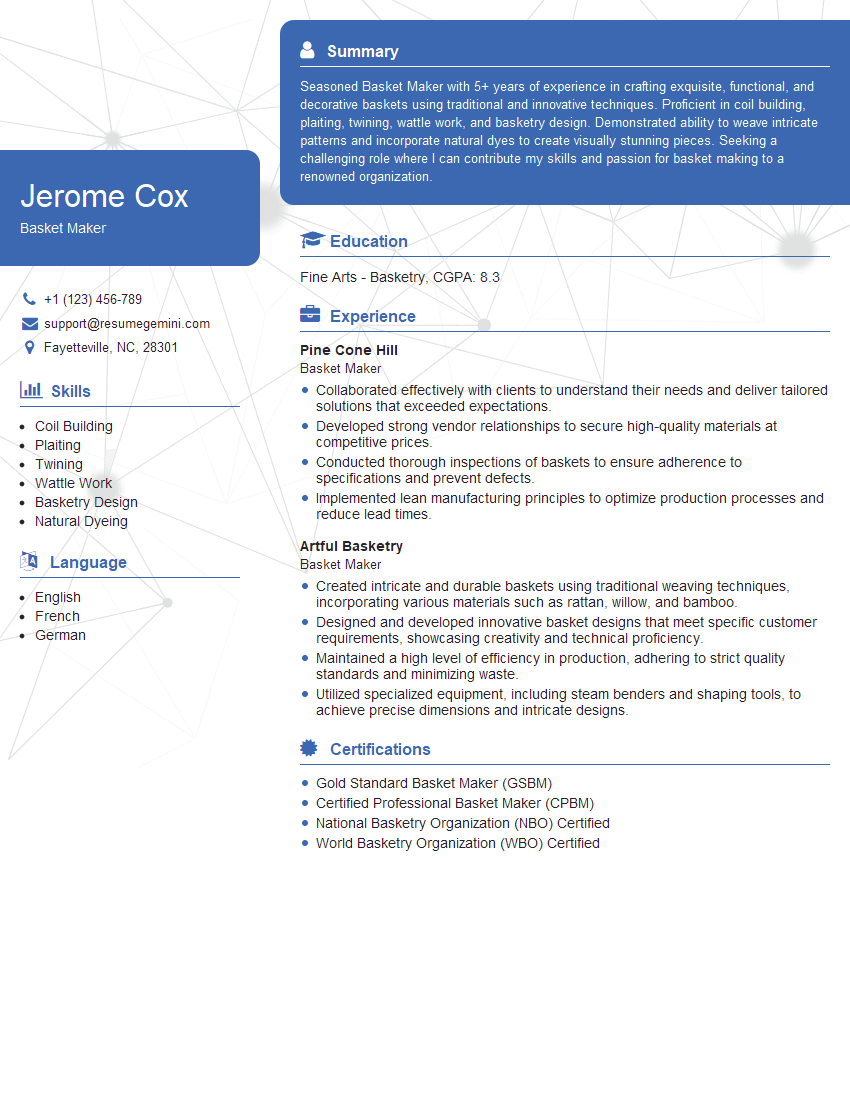
Mastering the art of basketry and effectively communicating your skills during an interview can significantly enhance your career prospects, showcasing your creativity, problem-solving abilities, and dedication. Building a strong, ATS-friendly resume is crucial for increasing your visibility to potential employers. ResumeGemini is a trusted resource that can help you craft a professional and impactful resume highlighting your basketry skills and achievements. Examples of resumes tailored to showcase experience in Personal Projects or Hobbies in Basketry are available to guide you through the process.
Explore more articles
Users Rating of Our Blogs
Share Your Experience
We value your feedback! Please rate our content and share your thoughts (optional).
What Readers Say About Our Blog
Amazing blog
hello,
Our consultant firm based in the USA and our client are interested in your products.
Could you provide your company brochure and respond from your official email id (if different from the current in use), so i can send you the client’s requirement.
Payment before production.
I await your answer.
Regards,
MrSmith
hello,
Our consultant firm based in the USA and our client are interested in your products.
Could you provide your company brochure and respond from your official email id (if different from the current in use), so i can send you the client’s requirement.
Payment before production.
I await your answer.
Regards,
MrSmith
These apartments are so amazing, posting them online would break the algorithm.
https://bit.ly/Lovely2BedsApartmentHudsonYards
Reach out at BENSON@LONDONFOSTER.COM and let’s get started!
Take a look at this stunning 2-bedroom apartment perfectly situated NYC’s coveted Hudson Yards!
https://bit.ly/Lovely2BedsApartmentHudsonYards
Live Rent Free!
https://bit.ly/LiveRentFREE
Interesting Article, I liked the depth of knowledge you’ve shared.
Helpful, thanks for sharing.
Hi, I represent a social media marketing agency and liked your blog
Hi, I represent an SEO company that specialises in getting you AI citations and higher rankings on Google. I’d like to offer you a 100% free SEO audit for your website. Would you be interested?