The thought of an interview can be nerve-wracking, but the right preparation can make all the difference. Explore this comprehensive guide to Press Photography interview questions and gain the confidence you need to showcase your abilities and secure the role.
Questions Asked in Press Photography Interview
Q 1. Describe your experience with DSLR cameras and their settings in a fast-paced news environment.
My experience with DSLRs in fast-paced news environments is extensive. I’ve relied on their speed, versatility, and image quality for over a decade. In breaking news situations, the ability to quickly adjust settings is paramount. I typically shoot in Aperture Priority mode (Av) to maintain consistent depth of field, particularly useful in crowded scenes where I need both the subject and the background to be sharp. My camera is always set to continuous shooting mode to capture the action as it unfolds. I also frequently utilize a high ISO setting to cope with low-light situations, accepting some grain in exchange for a fast shutter speed to freeze motion. For example, at a recent protest, I used an ISO of 3200 to get clear shots of individuals amidst the chaos, prioritizing the action over image noise.
I customize my camera’s settings menu to prioritize quick access to essential features. For instance, I’ve assigned custom buttons for frequently used functions like white balance adjustments and exposure compensation. This reduces time wasted fiddling with menus during critical moments. I also frequently check my settings before every assignment to ensure they’re optimized for the specific conditions expected.
Q 2. Explain your workflow from capturing an image to delivering it for publication.
My workflow begins with capturing the image, ensuring sharp focus and a well-composed frame. Immediately after, I review the shot on the camera’s LCD screen, checking for technical issues (blur, exposure problems) before moving on. In the field, I often use a card reader to offload images to a backup hard drive to prevent data loss. Back at the office, I use Adobe Lightroom to cull through the images, selecting the best shots and performing initial adjustments such as white balance, exposure, and contrast. Then, I move to Adobe Photoshop for more detailed edits, cropping, retouching, and color grading, all while maintaining the integrity of the image. This is followed by resizing and compressing the images according to the publication’s specifications before sending it digitally.
For example, at a recent political rally, I captured hundreds of images. My initial cull reduced this number to about 30 strong candidates for publication. After editing, I delivered 5 final images to my editor, each tailored to the different platforms they were intended for.
Q 3. How do you manage image compression and resolution for different media outlets?
Managing image compression and resolution is crucial for delivering images to various media outlets. Newspapers usually require high-resolution images (often 300 DPI) for print, while online platforms necessitate smaller file sizes for faster loading times. I always shoot in RAW format to preserve maximum image quality, giving me flexibility during post-processing. For print, I export JPEGs at the required high resolution, optimizing the compression for minimal loss of quality. For online publications, I export smaller, web-optimized JPEGs, adjusting the resolution and compression to balance quality and file size. I understand the nuances in optimizing for different platforms like Instagram, Twitter, or a news website, tailoring my settings accordingly.
For example, a large-format newspaper will request a high-resolution, 300 DPI image for print while their website may only require a 72 DPI image for optimal online viewing. Using software like Lightroom, these adjustments can be automated to maintain consistency and speed.
Q 4. What are your preferred photo editing techniques and software?
My preferred photo editing techniques center around non-destructive editing, primarily using Adobe Lightroom and Photoshop. Lightroom is my go-to for initial adjustments like exposure, contrast, white balance, and basic color grading. I avoid heavy-handed edits, striving to maintain a natural and truthful representation of the event. Photoshop is used for more advanced tasks such as retouching (removing small distractions, but never altering the content of the image), advanced color corrections, and compositing if absolutely necessary. I employ techniques like masking and layering to isolate areas of the image for targeted edits and always aim for subtlety. I am particularly attentive to skin tones in portrait shots, ensuring realistic color and avoiding artificial enhancement.
Q 5. How do you handle difficult lighting conditions, such as low light or harsh sunlight?
Handling difficult lighting is a core skill in press photography. In low-light situations, I increase my ISO, while carefully adjusting my shutter speed to avoid motion blur. I often use a fast lens (wide aperture) to maximize the available light. In harsh sunlight, I use fill flash to soften shadows and maintain detail in the subject’s face. I also use reflectors to bounce light back onto the subject, or find shade to reduce the intensity of the light. Understanding how to use available light creatively is key. For example, I once used backlighting to create a silhouette of a protester against a setting sun, which conveyed the mood more powerfully than a brightly-lit image would have.
Alternatively, I have learned to utilize the camera’s metering modes effectively. Spot metering allows me to measure the light precisely on my subject, achieving accurate exposure even when dealing with contrast issues. Understanding light is essential for capturing impactful and communicative images.
Q 6. Describe your experience with different types of lenses and their applications in press photography.
My lens kit is carefully chosen for versatility in press photography. I always have a wide-angle lens (24-70mm) for capturing the overall context of an event, a telephoto lens (70-200mm or longer) for capturing detail from a distance, and possibly a macro lens for close-up shots of smaller details if appropriate to the story. Understanding the strengths of each lens is crucial. The wide-angle lens allows for capturing a greater range of perspective and often imbues a scene with more depth, while the telephoto lens brings distant subjects closer, often useful in sports or protests. A macro lens offers a completely different approach to visual communication, allowing you to focus on small details for a story that might not be apparent otherwise.
For example, at a sporting event, I would use my telephoto lens to capture individual athletes’ expressions, but my wide-angle lens to showcase the crowd’s excitement or the grandeur of the stadium.
Q 7. How do you ensure the accuracy and ethical considerations in your press photographs?
Accuracy and ethical considerations are paramount. I never manipulate images in a way that misrepresents the event. This means avoiding any alterations that change the narrative or deceive the viewer. I am careful not to crop images in a way that removes context or suggests a different meaning. I always strive for factual accuracy in my photographs. In instances where editing is necessary, it’s limited to minor adjustments that enhance the image without changing its core message. Furthermore, in cases involving people, I am always mindful of their privacy and obtain consent when appropriate or needed. For example, if I photograph someone in a sensitive or potentially compromising situation, I would assess the ethical implications and refrain from publishing if necessary, prioritizing their well-being.
Integrity in photojournalism is vital; I never fabricate or stage images. The photograph should always represent what happened in reality.
Q 8. Explain your understanding of copyright laws and image usage rights.
Copyright law protects the intellectual property rights of photographers. It grants the creator exclusive rights to reproduce, distribute, display, and create derivative works from their images. Understanding image usage rights is crucial; they dictate how an image can be legally used. For press photography, this often involves licensing agreements specifying usage rights (editorial, commercial, etc.), geographical limitations, and durations. For example, a news agency might license an image to a newspaper for one-time publication only, while a commercial license would grant broader usage rights, often at a higher fee.
Think of it like this: you wouldn’t borrow a neighbor’s car and then sell it without their permission. Similarly, you can’t use a photographer’s work without their consent or a proper license. Ignoring copyright can result in legal action, including hefty fines.
- Editorial Use: Typically allows use in news publications, but not for advertising or commercial purposes.
- Commercial Use: Permits use in advertising, marketing, and promotional materials. This usually commands a significantly higher fee.
- Royalty-Free: Often misunderstood. While you pay a one-time fee, it usually still has limitations on usage and often requires attribution to the photographer.
As a press photographer, I meticulously track the usage rights of every image I capture, ensuring compliance with copyright laws and contractual obligations. Proper licensing is essential for maintaining ethical standards and avoiding potential legal issues.
Q 9. How do you prioritize shots in a breaking news situation?
Prioritizing shots in breaking news is about identifying the most impactful visual narrative elements quickly. It’s a high-pressure environment demanding rapid decision-making. My process typically involves:
- Assessing the Scene: Immediately identify the core elements of the story – the key players, the overall situation, the emotional impact.
- Capturing the ‘Hero Shot’: This is the single image that best encapsulates the event. It should tell a story instantly.
- Detail Shots: Supplement the ‘hero shot’ with supporting images that add context and depth to the story. These could include reactions of people involved or specific details that are relevant.
- Wide Shots & Environmental Context: Capture the broader scene to show the environment and scale of the event.
- Emotional Impact: Look for images that convey the emotions of those involved – joy, sorrow, anger, etc.
For instance, at a protest, the ‘hero shot’ might be a compelling image of a key speaker addressing the crowd. Detail shots could capture signs held by protestors, while a wide shot would show the scale of the demonstration. Finally, capturing the emotional reactions of participants provides crucial context and depth.
Speed and accuracy are paramount. It’s about instinct, experience, and a clear understanding of visual storytelling.
Q 10. How familiar are you with image management systems (e.g., Adobe Lightroom, DAM systems)?
I’m highly proficient in several image management systems, including Adobe Lightroom and various DAM (Digital Asset Management) systems. Lightroom is my primary tool for organizing, editing, and color-correcting RAW files. Its non-destructive editing capabilities are invaluable for maintaining the integrity of my original images. DAM systems, like those offered by various cloud services, are crucial for managing large image libraries, metadata, and keywording for efficient retrieval and distribution to clients and publications.
For example, I use Lightroom’s cataloging features to organize thousands of images from assignments, applying keywords and metadata that allow for easy searching later. A DAM system would then be used to share selected images with my editors, clients, or archives, while ensuring proper security and version control. My experience spans both cloud-based DAM solutions and in-house systems, allowing me to adapt to any workflow.
Q 11. Describe your experience working under pressure and meeting tight deadlines.
Press photography inherently involves working under pressure and meeting tight deadlines. I thrive in fast-paced environments; in fact, it’s where my skills truly shine. Deadlines are often unforgiving, requiring efficient workflow management and the ability to prioritize tasks effectively. Experience working on daily newspapers provided extensive training in meeting aggressive deadlines. I remember one instance where I had to cover a major city-wide power outage. I had to shoot, edit, transmit images, and write captions within an hour to meet the print deadline – that’s where the adrenaline really kicks in.
My approach involves a combination of:
- Efficient Workflow: Streamlined processes for shooting, editing, and transferring images.
- Prioritization: Focusing on the most critical images first.
- Time Management: Working quickly and efficiently without compromising quality.
- Adaptability: Responding effectively to unforeseen challenges and changes in the situation.
It’s not just about speed, but also maintaining accuracy and upholding journalistic integrity even under immense pressure.
Q 12. How do you handle interactions with subjects and maintain professionalism?
Interaction with subjects requires a delicate balance of professionalism and empathy. Building rapport is key, but it’s crucial to respect their boundaries and avoid intruding on their privacy. While capturing the moment is paramount, I always ensure I act ethically and respectfully. Before shooting, I introduce myself clearly, explaining my purpose and the intended use of the images. I always obtain consent whenever possible, especially for sensitive situations or images featuring individuals in a vulnerable state.
For instance, when photographing someone grieving, I maintain a respectful distance and avoid being intrusive. Transparency builds trust; letting people know my intentions ensures they are informed participants, not unwitting subjects of my work. In addition to verbal communication, my body language communicates respect, making people feel more comfortable and allowing me to capture more authentic and less staged images.
Q 13. How do you ensure the safety of your equipment in challenging environments?
Protecting equipment in challenging environments requires careful planning and practical precautions. The nature of press photography often leads me into unpredictable and potentially hazardous locations. My strategies involve:
- Weatherproofing: Using weather-sealed camera bodies and lenses is crucial. Rain covers and protective cases further safeguard the equipment.
- Carrying Cases: Utilizing sturdy, well-padded carrying cases prevents damage during transport.
- Backups: Having multiple memory cards and backing up images regularly to cloud storage or external hard drives mitigates the risk of data loss.
- Insurance: Comprehensive insurance coverage is essential to protect against theft, damage, or loss of equipment.
- Awareness: Maintaining situational awareness is critical in potentially dangerous settings, avoiding putting myself or my equipment at unnecessary risk.
For example, while covering a natural disaster, I’d use waterproof bags for my gear and ensure my backups are stored separately, ideally off-site. I always prioritize safety first. A damaged camera can be replaced, but a compromised safety situation can have far more serious consequences.
Q 14. What is your experience with different file formats (JPEG, RAW, TIFF)?
I’m experienced with various file formats, including JPEG, RAW, and TIFF. Each serves a specific purpose. JPEG is a compressed format suitable for web use and quick distribution due to its small file size. However, it results in some loss of image data during compression. RAW files, on the other hand, are uncompressed, capturing all the data from the sensor, offering greater flexibility in post-processing and preserving image quality. TIFF is a high-quality, lossless format, often preferred for archiving or print applications, though its file size is considerably larger.
My workflow typically involves shooting in RAW format to maximize image quality and post-processing options. I then process the RAW files in Lightroom, making adjustments to exposure, contrast, white balance, and other aspects. The final images intended for web use or immediate distribution are then exported as high-quality JPEGs. TIFF is usually reserved for archiving important images and high-resolution print jobs. The choice of format depends on the project’s specific requirements and the intended use of the images.
Q 15. Describe your understanding of composition rules and principles (e.g., rule of thirds, leading lines).
Composition is the art of arranging elements within a frame to create a visually appealing and impactful image. It’s like arranging ingredients in a recipe – each element contributes to the overall effect. Key principles include:
- Rule of Thirds: Instead of placing your subject in the center, imagine dividing your frame into thirds both horizontally and vertically. Placing your subject at one of the intersections of these lines creates a more dynamic and engaging composition. Think of it as adding a touch of visual spice. For example, photographing a lone tree against a sunset with the tree at one of the intersections.
- Leading Lines: Use natural lines like roads, rivers, or fences to draw the viewer’s eye towards your main subject. This creates depth and guides the narrative. A perfect example is using a winding road leading to a distant mountain range.
- Symmetry and Patterns: Symmetrical compositions can be incredibly striking, creating a sense of balance and harmony. Likewise, repeating patterns draw the viewer in, revealing a sense of order and rhythm. Think of a symmetrical building reflection or a repeating pattern in a market.
- Framing: Use elements within the scene, like arches, doorways, or branches, to frame your subject, drawing attention to it and adding depth. A classic example is using a tree branch to frame a portrait.
- Negative Space: This refers to the empty space surrounding your subject. Using negative space effectively can highlight your subject and create a sense of tranquility or isolation. Imagine a lone figure standing in a vast field.
Career Expert Tips:
- Ace those interviews! Prepare effectively by reviewing the Top 50 Most Common Interview Questions on ResumeGemini.
- Navigate your job search with confidence! Explore a wide range of Career Tips on ResumeGemini. Learn about common challenges and recommendations to overcome them.
- Craft the perfect resume! Master the Art of Resume Writing with ResumeGemini’s guide. Showcase your unique qualifications and achievements effectively.
- Don’t miss out on holiday savings! Build your dream resume with ResumeGemini’s ATS optimized templates.
Q 16. How do you ensure the quality of your images when working with limited time and resources?
Working under pressure is a common reality in press photography. Maintaining quality with limited time and resources requires strategic thinking and efficient workflow. Here’s how I approach it:
- Prioritize shots: Identify the key moments and shots needed. I work efficiently by focusing on the most impactful images, rather than shooting everything.
- Master your equipment: Knowing your camera inside and out is crucial. Quick adjustments are essential, so practice until it becomes second nature. I ensure my settings are pre-configured and ready for action.
- Shoot in RAW: This format gives maximum flexibility in post-processing, allowing for corrections that might not be possible with JPEG. Although larger files make managing and transferring more challenging.
- Efficient editing: Use efficient editing techniques and tools that maximize image quality with minimal time invested. Quick cropping, adjustments for exposure and white balance, and selective sharpening can often do wonders in post-production without excessive work.
- Plan ahead: Understanding the assignment and anticipating potential challenges can help me save time. Doing a quick location scout, if possible, enables better planning.
Q 17. What is your experience with different types of camera equipment (e.g., flash, lighting)?
My experience spans various camera equipment, and I’m comfortable adapting to different situations. I have extensive experience using:
- DSLR and Mirrorless cameras: From full-frame to APS-C sensor sizes, my experience encompasses various brands and models, including Canon and Nikon.
- Different Lenses: I’m proficient with various lenses including wide-angle, telephoto, and macro lenses, which allow me to capture different perspectives and details.
- Flash Photography: I’m skilled in using both on-camera and off-camera flash techniques, including strobe lighting, to control lighting and capture compelling images in various conditions. I know how to modify the light (diffusers, reflectors) to control harsh shadows.
- Lighting Equipment: My experience extends to working with continuous lighting setups, which is essential for video and certain types of still photography.
Choosing the right equipment is pivotal to successful photography. I always assess the specific environment and needs of the assignment before making my selection. For example, a wide-angle lens for a large group photo, a telephoto lens for capturing a distant event, and a macro lens for close-up work.
Q 18. Describe your experience with color correction and white balance adjustments.
Color correction and white balance are critical for achieving accurate and consistent color representation. A poor white balance can make an image look overly warm (orange) or cool (blue).
White Balance: I typically shoot in RAW to retain maximum color information and adjust white balance later. I’ll use a custom white balance setting if there’s a specific light source I need to balance. In post-processing, software like Adobe Lightroom allows for precise white balance adjustments to achieve a natural-looking image.
Color Correction: This involves adjusting individual color channels, contrast, saturation and vibrance, to enhance the image’s overall appeal and accuracy. It’s about correcting for deviations from reality, not altering the mood. For example, correcting an overly yellow cast in a photo taken under incandescent lighting. I often use tools like curves and split toning within editing software. Careful, subtle changes are key to avoiding an unnatural or artificial look.
Q 19. How do you select and edit images for a specific publication?
Selecting and editing images for a specific publication requires understanding the publication’s style and target audience. It’s about choosing the pictures that best suit the story’s message.
- Understanding the publication’s style: Is it a tabloid, a news magazine, or a lifestyle publication? Each has its own aesthetic. Knowing the style guide helps to choose images that fit. For example, a news publication needs sharp, clear, unbiased pictures.
- Image selection: I select images based on their composition, technical quality, and narrative impact. Some images are great technically, but don’t serve the story, which means they might not be used.
- Editing for consistency: I edit images to maintain a consistent look and feel. This includes adjusting brightness, contrast, saturation, and sharpness, while maintaining the journalistic integrity of the photograph.
- Captioning: Accurate and informative captions are essential. They give context to the images and complete the story.
- Metadata: Ensuring correct metadata (keywords, date, location) makes the images easily searchable and manageable.
Q 20. What is your understanding of storytelling through photography?
Storytelling through photography is about more than just capturing a moment; it’s about conveying emotions, information, and a narrative through a visual medium. It involves creating a sequence of images that tell a compelling story.
- Sequence and Context: A series of images can tell a story from beginning to end, even without words. The order of photos is key. For example, photos depicting a protest starting, escalating, and concluding convey a narrative.
- Emotions and expressions: The most impactful photos often capture raw emotion. Facial expressions can speak volumes and greatly enhance a story.
- Details: Small details that might not be apparent at first glance can add depth and context to the story.
- Composition and perspective: A well-composed image guides the viewer’s eye and draws attention to key details within the story.
- Unity and Flow: Using a consistent style and editing process across the series of photos helps the story feel unified and cohesive.
Q 21. How do you deal with negative feedback on your work?
Negative feedback is an inevitable part of any creative profession. I approach it constructively, using it as an opportunity for growth:
- Listen and reflect: I take the time to listen to the feedback objectively, even if it’s difficult. What are the specific criticisms? Are they valid? Where could I have improved?
- Separate emotion from critique: It’s important to differentiate between personal attacks and constructive criticism. Focus on what can be learned from the critique.
- Seek clarification if needed: If the feedback is unclear, I ask clarifying questions to ensure I understand the points raised.
- Apply the feedback to future work: I learn from my mistakes and try to incorporate the suggestions into my future work, refining my skills and approach.
- Remember success is a process: Not every image will be a masterpiece. Continuous improvement comes through learning from constructive criticism.
Q 22. Explain your experience using photo editing software for enhancing images.
My photo editing workflow centers around enhancing, not manipulating, images. I primarily use Adobe Lightroom and Photoshop. In Lightroom, I focus on non-destructive edits: adjusting exposure, contrast, white balance, and sharpening to achieve a consistent look and feel across my portfolio. This is crucial for maintaining the integrity of the moment captured. For example, if I’m shooting a protest, I might slightly boost the shadows to reveal details in the crowd without altering the overall mood or factual representation. In Photoshop, I primarily use spot healing to remove minor distractions and cloning tools for more delicate retouching, always maintaining journalistic ethics and avoiding alterations that could misrepresent the event. For instance, I might remove a distracting object like a trash can, but I would never alter facial expressions or remove individuals from a scene. The goal is to present the purest version of the image, technically enhanced but factually honest.
Q 23. Describe your understanding of different news photography styles (e.g., photo essay, spot news).
News photography employs various styles, each serving a distinct purpose. Spot news photography captures the immediacy of a breaking event—a fire, accident, or arrest. The focus is on capturing the decisive moment, often under pressure, demanding quick thinking and technical proficiency. For instance, I remember covering a flash flood; speed and capturing the raw emotion of people being rescued were paramount. Photo essays tell a more in-depth story over time, exploring a theme or event with a series of images. They demand a narrative structure, carefully selecting images that build a compelling narrative. A photo essay I worked on documented the daily lives of street vendors in a local market. Each photograph was chosen to highlight aspects of their work, struggles, and community.
Other styles include portraiture, focusing on individuals, and environmental portraiture, which shows the subject within their environment to contextualize the story. Understanding the nuances of these styles is vital in choosing the most effective approach for each assignment.
Q 24. How do you ensure the technical quality of your images (sharpness, focus, exposure)?
Ensuring technical quality starts before I even press the shutter. I meticulously check my camera settings: ensuring sharp focus by using a fast shutter speed and appropriate aperture, and managing exposure using my understanding of light metering and exposure compensation. I also prioritize using a high-resolution setting to allow for cropping and enlargement without sacrificing image quality. Post-processing plays a crucial role in fine-tuning technical aspects. In Lightroom, sharpening tools help enhance detail without introducing artifacts. I carefully evaluate image noise, particularly when shooting in low light, and apply noise reduction techniques judiciously. Regular camera calibration and lens maintenance are essential preventative steps.
For instance, shooting in bright sunlight might require adjusting my exposure compensation to avoid overexposure, while shooting a low-light indoor event requires me to use a higher ISO and potentially a wider aperture, accepting a tradeoff in depth of field. I always shoot in RAW format, providing maximum flexibility during post-processing.
Q 25. Explain your experience working with different photo agencies or publications.
Throughout my career, I’ve collaborated with various photo agencies and publications, including [mention specific agencies/publications, replace bracketed information with actual names, avoiding specifics that could reveal personal information]. Working with these organizations has exposed me to diverse assignments, editorial styles, and deadlines. Each publication has its unique preferences regarding image style and editing, which I adapt to seamlessly. For example, some publications might favor a more photojournalistic, documentary style, emphasizing realism, while others prefer a slightly more stylized approach. This adaptability and responsiveness are vital in navigating the dynamic landscape of press photography.
Q 26. Describe your experience using social media to share and promote your press photography work.
Social media is an essential tool for sharing and promoting press photography. I primarily use Instagram and Twitter. Instagram allows showcasing visually compelling work through high-quality images and concise captions that highlight the story behind the photograph. I ensure my captions are informative, accurately representing the context and events depicted. Twitter is excellent for sharing news updates and engaging with discussions related to my field. I actively use relevant hashtags to reach a broader audience. I also actively engage with comments and participate in professional conversations, building connections and extending my network.
It’s crucial to maintain a professional presence, adhering to ethical guidelines and ensuring image copyright is respected. The platforms are powerful for both self-promotion and networking within the industry.
Q 27. How do you stay updated with the latest trends and technology in press photography?
Staying current in press photography involves continuous learning. I subscribe to photography magazines, attend workshops and conferences, and actively engage with online communities and forums. Following leading photographers on social media and exploring their work provides inspiration and insights into new techniques and technologies. Experimentation is also key; I regularly try new equipment and software, exploring their potential applications in my workflow. I find keeping abreast of technological advancements, such as improved camera sensors and AI-powered editing tools, crucial for maintaining a competitive edge in a constantly evolving field.
Q 28. Describe your experience in working collaboratively with other journalists or press teams.
Collaboration is fundamental in press photography. I’ve worked extensively with reporters, editors, and other photographers in various newsrooms and on independent projects. Effective collaboration entails clear communication, shared understanding of the story’s aims, and mutual respect for each team member’s expertise. For instance, when working on a feature story, a close collaboration with the reporter ensures that my images align with their narrative and that I am aware of the specific angles they are exploring. Respecting deadlines and actively sharing information about what I’m shooting, ensuring coordination and a smooth workflow. This approach leads to more impactful and cohesive storytelling.
Key Topics to Learn for Press Photography Interview
- News Judgment and Storytelling: Understanding the importance of selecting impactful images that convey a compelling narrative. Practical application: Analyzing news events and identifying key photographic moments that capture the essence of the story.
- Technical Proficiency: Mastering camera operation (DSLR/Mirrorless), lens selection, lighting techniques (natural and artificial), and image composition principles. Practical application: Demonstrating a strong understanding of aperture, shutter speed, ISO, and their interplay in various shooting scenarios.
- Ethics and Legal Considerations: Understanding copyright laws, obtaining consent, respecting privacy, and avoiding misrepresentation. Practical application: Discussing ethical dilemmas faced in press photography and outlining appropriate solutions.
- Photo Editing and Post-Processing: Proficiency in using software like Adobe Lightroom and Photoshop for image enhancement, color correction, and retouching, while maintaining journalistic integrity. Practical application: Explaining your workflow for editing images for publication.
- Workflow and Time Management: Efficiently managing time under pressure, meeting deadlines, and organizing large volumes of images. Practical application: Describing strategies for managing a fast-paced news environment.
- Digital Asset Management (DAM): Understanding the importance of organizing, archiving, and retrieving digital images effectively. Practical application: Describing experience with different DAM systems or strategies.
- Working with Editors and Clients: Communicating effectively, understanding editorial direction, and delivering high-quality images on time. Practical application: Sharing examples of collaborative projects and how you adapted to editorial feedback.
Next Steps
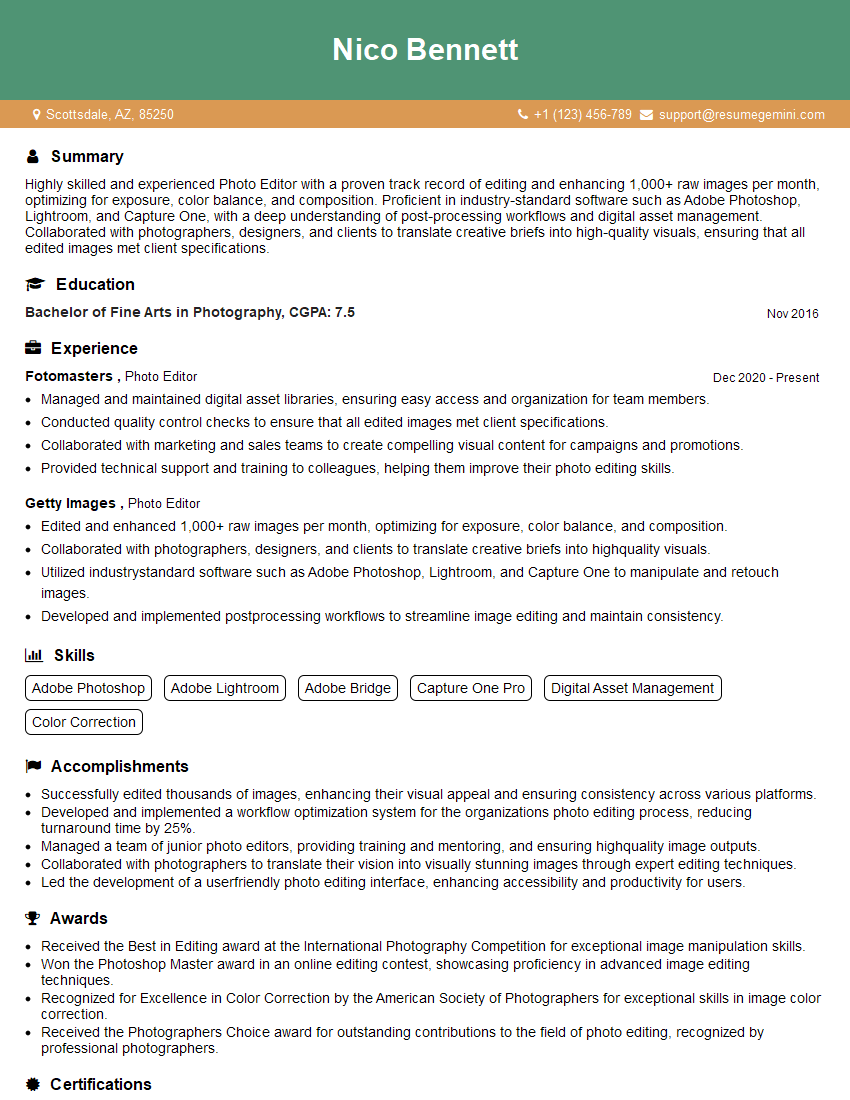
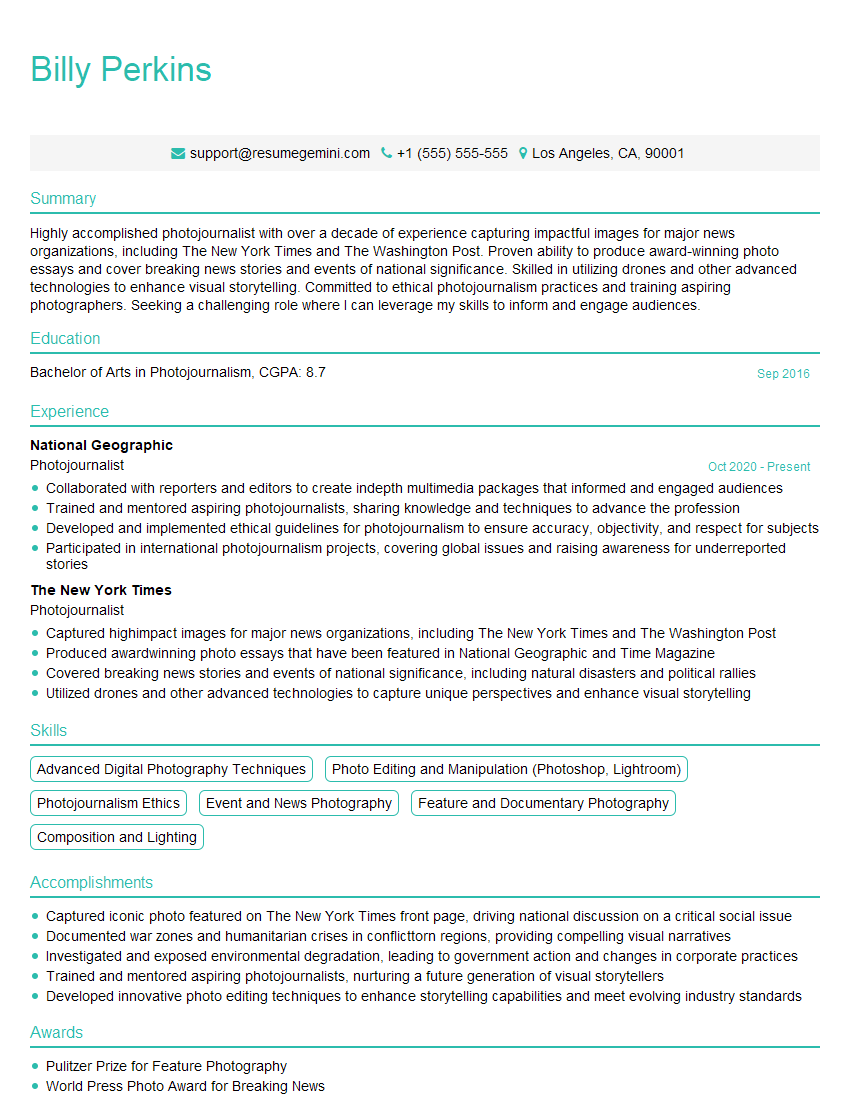
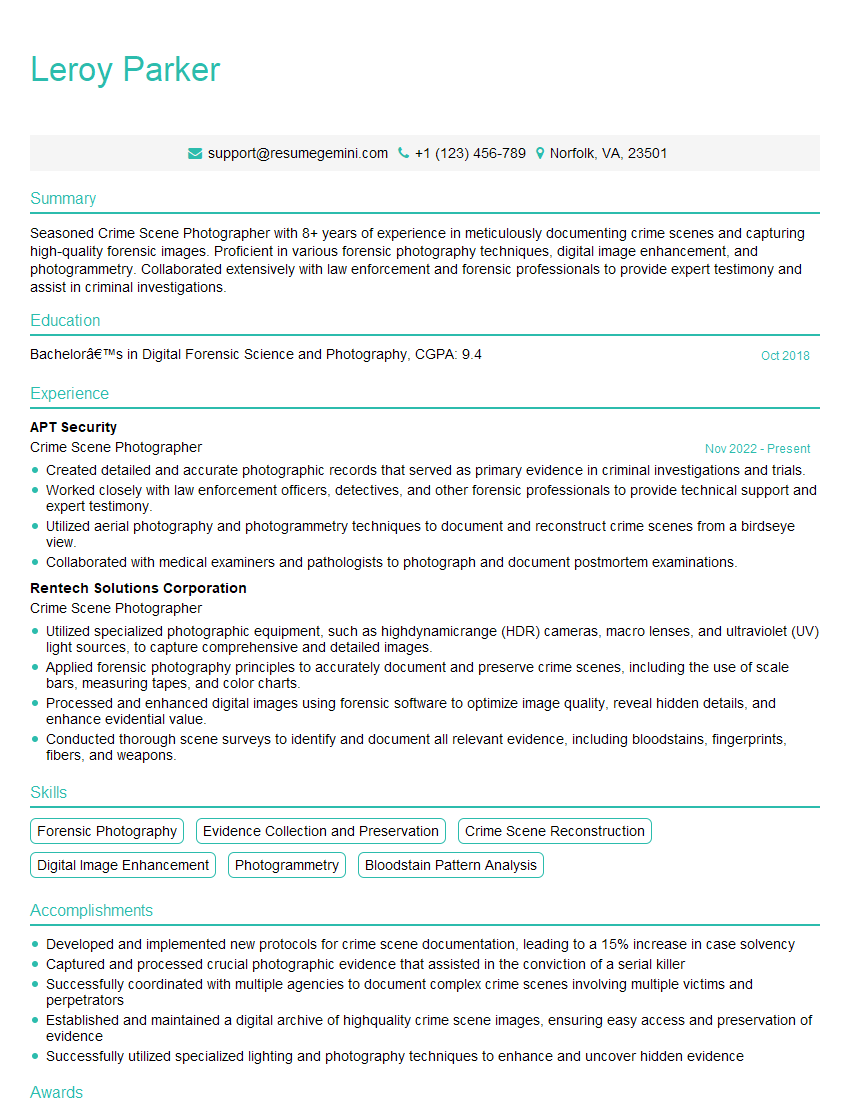
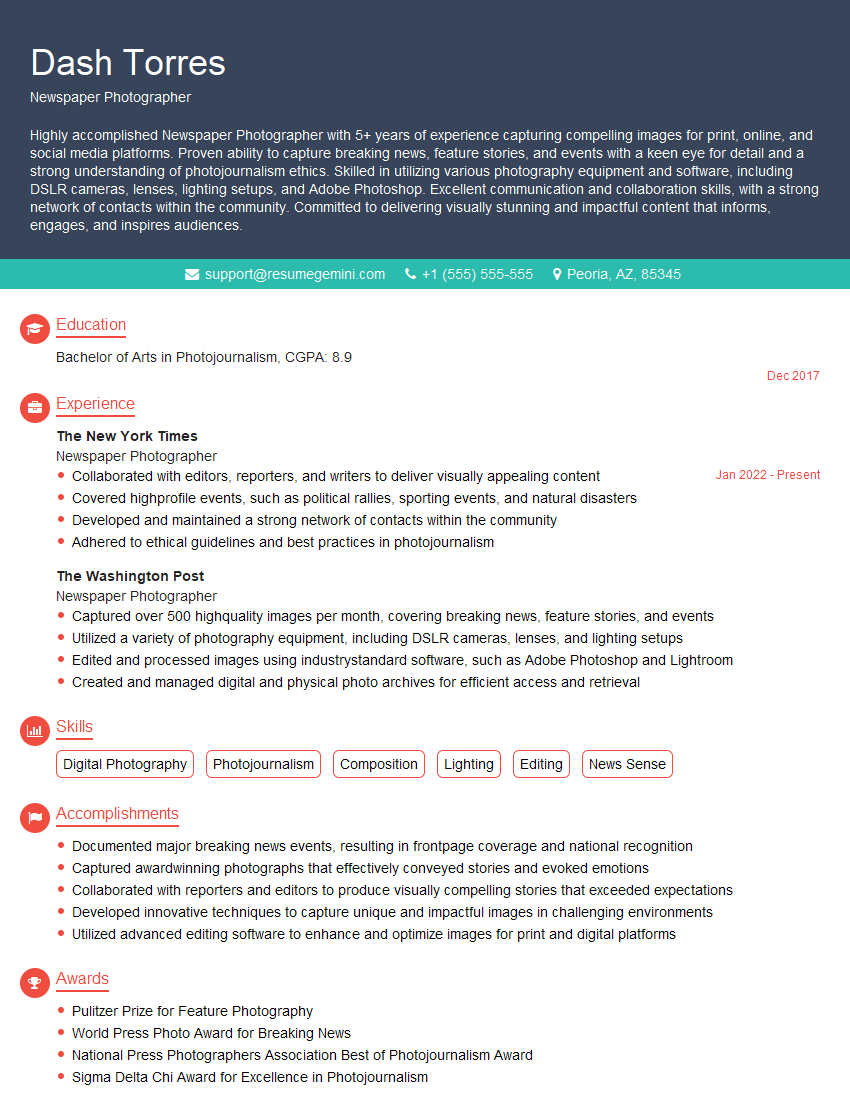
Mastering press photography opens doors to exciting careers in journalism, media, and communications. To maximize your job prospects, creating a strong, ATS-friendly resume is crucial. ResumeGemini is a trusted resource that can help you build a professional resume that highlights your skills and experience effectively. We provide examples of resumes tailored specifically for press photography professionals to help you get started. Invest the time in crafting a compelling resume – it’s your first impression with potential employers.
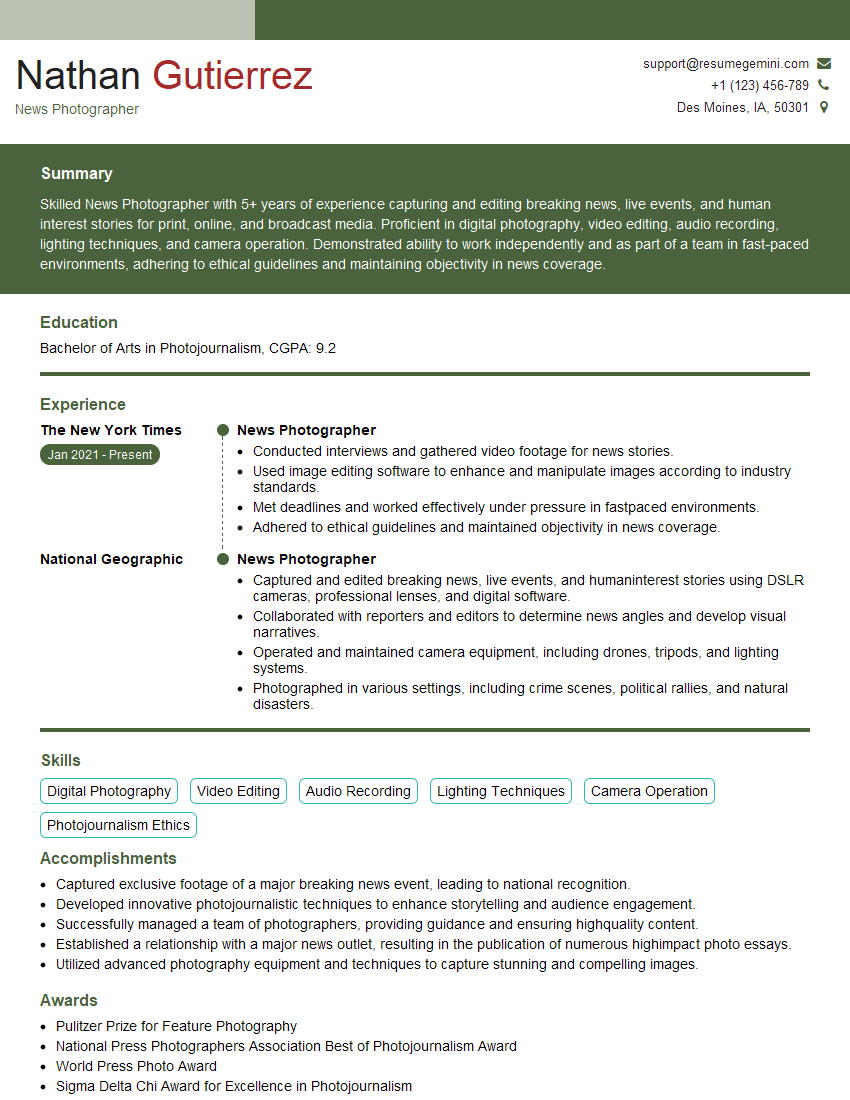
Explore more articles
Users Rating of Our Blogs
Share Your Experience
We value your feedback! Please rate our content and share your thoughts (optional).
What Readers Say About Our Blog
hello,
Our consultant firm based in the USA and our client are interested in your products.
Could you provide your company brochure and respond from your official email id (if different from the current in use), so i can send you the client’s requirement.
Payment before production.
I await your answer.
Regards,
MrSmith
hello,
Our consultant firm based in the USA and our client are interested in your products.
Could you provide your company brochure and respond from your official email id (if different from the current in use), so i can send you the client’s requirement.
Payment before production.
I await your answer.
Regards,
MrSmith
These apartments are so amazing, posting them online would break the algorithm.
https://bit.ly/Lovely2BedsApartmentHudsonYards
Reach out at [email protected] and let’s get started!
Take a look at this stunning 2-bedroom apartment perfectly situated NYC’s coveted Hudson Yards!
https://bit.ly/Lovely2BedsApartmentHudsonYards
Live Rent Free!
https://bit.ly/LiveRentFREE
Interesting Article, I liked the depth of knowledge you’ve shared.
Helpful, thanks for sharing.
Hi, I represent a social media marketing agency and liked your blog
Hi, I represent an SEO company that specialises in getting you AI citations and higher rankings on Google. I’d like to offer you a 100% free SEO audit for your website. Would you be interested?