Interviews are more than just a Q&A session—they’re a chance to prove your worth. This blog dives into essential Protein Characterization interview questions and expert tips to help you align your answers with what hiring managers are looking for. Start preparing to shine!
Questions Asked in Protein Characterization Interview
Q 1. Explain the principle behind SDS-PAGE.
SDS-PAGE, or sodium dodecyl sulfate-polyacrylamide gel electrophoresis, is a fundamental technique used to separate proteins based on their molecular weight. It works by denaturing proteins – unfolding them into linear chains – using the detergent SDS. SDS binds to the protein, giving it a uniform negative charge, masking the protein’s intrinsic charge. This ensures separation is solely based on size.
The negatively charged proteins are then electrophoresed through a polyacrylamide gel matrix. Smaller proteins migrate faster through the pores of the gel than larger proteins. This results in a separation of proteins by size, which can be visualized by staining the gel with a dye like Coomassie Brilliant Blue.
Imagine it like a race: smaller runners (proteins) navigate a crowded obstacle course (gel) faster than larger runners. The final position reflects the protein’s size. SDS-PAGE is crucial for assessing protein purity, estimating molecular weight, and monitoring protein expression levels.
Q 2. Describe the different types of chromatography used in protein purification.
Chromatography is a powerful family of techniques for separating and purifying proteins based on differences in their physical and chemical properties. Several common types are used in protein purification:
- Size Exclusion Chromatography (SEC): Separates proteins based on their size. Larger proteins elute first, while smaller proteins are retained longer in the column.
- Ion Exchange Chromatography (IEX): Separates proteins based on their net charge. Proteins are retained on a resin with opposite charge and eluted by changing the salt concentration or pH.
- Affinity Chromatography: Separates proteins based on their specific binding to a ligand immobilized on a resin. Only the target protein binds, providing high purity.
- Hydrophobic Interaction Chromatography (HIC): Separates proteins based on their hydrophobicity. Proteins bind to a hydrophobic resin and eluted by decreasing the salt concentration.
- Reverse-Phase High-Performance Liquid Chromatography (RP-HPLC): Separates proteins based on their hydrophobicity, offering very high resolution.
The choice of chromatography technique depends on the protein’s properties and the desired purity level. For example, if you have a highly specific antibody, affinity chromatography is ideal. If you’re separating proteins based solely on size, SEC is suitable.
Q 3. What are the advantages and disadvantages of using mass spectrometry for protein identification?
Mass spectrometry (MS) is a powerful tool for protein identification. It measures the mass-to-charge ratio of ions, allowing the precise determination of protein molecular weight and sequence.
Advantages:
- High sensitivity: Can identify proteins present at low concentrations.
- High specificity: Accurate identification of proteins based on peptide mass fingerprinting.
- High throughput: Can analyze numerous proteins simultaneously.
- Post-translational modification detection: Identifies modifications such as phosphorylation or glycosylation.
Disadvantages:
- High cost: MS instruments are expensive to purchase and maintain.
- Sample preparation complexity: Requires meticulous sample preparation and digestion.
- Data analysis complexity: Data analysis requires specialized software and expertise.
- Potential for artifacts: Improper sample handling can lead to inaccurate results.
In summary, while MS offers unparalleled power for protein identification, its high cost and complexity need careful consideration. A successful experiment requires careful planning and expertise in both experimental techniques and data analysis.
Q 4. How does circular dichroism (CD) spectroscopy help in determining protein secondary structure?
Circular dichroism (CD) spectroscopy measures the difference in absorption of left and right circularly polarized light by a molecule. This difference is related to the secondary structure of proteins.
Proteins exhibit characteristic CD spectra depending on their secondary structural elements (alpha-helices, beta-sheets, random coils). Alpha-helices produce a distinct negative peak around 208 nm and 222 nm, while beta-sheets exhibit a negative peak around 210-220 nm and a positive peak around 195 nm. The random coil structure has a less-defined spectral signature. By comparing the measured CD spectrum to reference spectra or using deconvolution algorithms, the proportions of different secondary structures can be estimated.
Imagine the protein’s backbone as a flexible ribbon. The way this ribbon folds into specific shapes (alpha-helices, beta-sheets) affects how it interacts with light. CD spectroscopy detects these differences, providing insights into the protein’s secondary structure.
Q 5. Explain the principles of X-ray crystallography in protein structure determination.
X-ray crystallography is a powerful technique to determine the three-dimensional structure of proteins at atomic resolution. It involves several key steps:
- Protein Crystallization: Obtaining high-quality, well-ordered protein crystals is crucial. This often involves trial and error, optimizing conditions such as temperature, pH, and precipitant concentration.
- Data Collection: X-ray diffraction patterns are collected by exposing the crystals to a beam of X-rays. The diffraction patterns contain information about the arrangement of atoms in the protein crystal.
- Structure Determination: Sophisticated computational methods are employed to analyze the diffraction data and build a three-dimensional model of the protein structure. This involves phasing, model building, and refinement to obtain an accurate representation.
The technique relies on the diffraction of X-rays by the atoms in the protein crystal. The resulting diffraction pattern is a unique fingerprint of the protein’s structure. It’s akin to a jigsaw puzzle where the diffraction pattern provides the pieces, and computational methods help assemble the puzzle into the final 3D structure. While powerful, it requires a well-diffracting crystal, and for some proteins, this can be a significant challenge.
Q 6. Describe the different methods used for protein quantification.
Several methods exist for quantifying protein concentration:
- UV-Vis Spectroscopy: Measures the absorbance of protein solutions at 280 nm due to the aromatic amino acids (tryptophan, tyrosine, phenylalanine). Requires a known extinction coefficient for accurate quantification.
- Bradford Assay: A colorimetric method that uses Coomassie Brilliant Blue G-250 dye, which changes color upon binding to proteins. Simple and widely used, but can be less accurate for proteins with high non-polar content.
- Bicinchoninic Acid (BCA) Assay: Another colorimetric method that uses a copper-based reaction. More accurate than Bradford for diverse proteins, but generally slower.
- Lowry Assay: Combines Biuret and Folin-Ciocalteu reactions for higher sensitivity, but more complex and susceptible to interference.
The choice of method depends on the specific application and the type of proteins being analyzed. UV-Vis spectroscopy is rapid and does not require reagents when the extinction coefficient is known. Colorimetric assays are easier for samples with interfering substances, but require a standard curve.
Q 7. How would you troubleshoot a low yield in protein purification?
Troubleshooting low protein yield in purification requires a systematic approach. Consider these steps:
- Assess initial protein expression: Ensure sufficient protein is produced in the first place. Check cell culture conditions (e.g., cell density, growth media, induction time). Verify expression using SDS-PAGE or Western blotting.
- Optimize lysis conditions: Optimize the cell lysis procedure to ensure efficient protein extraction. This may involve adjusting buffer conditions (pH, ionic strength, detergents) or sonication parameters.
- Analyze each purification step: Monitor protein yield and purity at each step using appropriate methods (e.g., SDS-PAGE, chromatography). Identify the step causing the major loss.
- Check for protein degradation: Proteinases can degrade the target protein during purification. Include protease inhibitors in your buffers or optimize purification time to minimize degradation.
- Optimize chromatography conditions: Adjust the column volume, flow rate, and elution gradient in chromatographic steps for better recovery. Explore different chromatography types if needed.
- Consider protein aggregation: Check for protein aggregation by analyzing the samples using techniques such as dynamic light scattering. Optimize the buffer conditions to minimize aggregation.
Systematic investigation helps pin-point the bottleneck. For example, if substantial protein loss occurs during the initial lysis, optimization of this step is vital. If losses occur during a specific chromatography step, fine-tuning the chromatographic parameters can help.
Q 8. What are some common artifacts that can occur during protein crystallization?
Protein crystallization, while a powerful technique for structural determination, is prone to artifacts. These are essentially imperfections or errors that arise during the process and can lead to misinterpretations of the protein’s structure. They can manifest in several ways.
Incomplete Crystallization: This can result in poorly ordered crystals with significant disorder, leading to poor diffraction data and an inaccurate structural model. Imagine trying to build a LEGO castle with some pieces missing – the final product won’t be true to the original design.
Twinning: This occurs when multiple crystal lattices intergrow, resulting in overlapping diffraction patterns. This complicates data processing and structure determination significantly. Think of it like taking a photo of two slightly misaligned identical objects – it’s difficult to separate them clearly.
Protein Degradation: Proteases (enzymes that break down proteins) can be present in your sample, leading to partial or complete degradation of the protein during crystallization. This alters the protein’s structure and results in an inaccurate representation.
Non-isomorphism: This refers to the presence of different conformations or states of the protein within a single crystal, leading to ambiguity in the structural model. Like capturing multiple poses of a person in a single snapshot, making it challenging to interpret the dominant pose.
Salt Precipitation: Excess salt in the crystallization condition might precipitate in the crystal lattice, influencing its diffraction pattern.
Careful optimization of crystallization conditions, including protein purity and buffer composition, is crucial to minimize artifacts. Techniques like seeding and microseeding can also help.
Q 9. Explain the concept of protein stability and its importance.
Protein stability refers to a protein’s ability to maintain its native three-dimensional structure and function under various conditions. It’s a critical factor influencing protein’s lifespan, activity, and therapeutic potential. Factors such as temperature, pH, and the presence of denaturants (like urea or guanidinium chloride) can significantly impact a protein’s stability.
The importance of protein stability cannot be overstated. In pharmaceutical applications, for example, a stable protein therapeutic will have a longer shelf-life, maintain its activity, and be less susceptible to degradation in the body. In industrial settings, stable enzymes are essential for efficient biocatalysis. Understanding and improving protein stability often involves techniques such as site-directed mutagenesis (altering the protein’s amino acid sequence) or the addition of stabilizing agents.
For instance, consider a therapeutic antibody. If it’s not stable, it might lose its ability to bind to its target, rendering it ineffective. Conversely, a stable antibody ensures consistent efficacy and reduces the need for frequent administration.
Q 10. Discuss different strategies for improving protein solubility.
Improving protein solubility is often a crucial step in protein characterization and downstream applications. Insoluble proteins are difficult to purify, characterize, and use in applications like crystallization or enzymatic assays. Several strategies can be employed to enhance solubility:
Buffer Optimization: Adjusting the pH of the buffer can significantly influence protein solubility. Finding the protein’s isoelectric point (pI) and using a buffer at a pH different from the pI is a common strategy.
Salt Addition: The addition of salts like NaCl or ammonium sulfate can increase protein solubility through the shielding of charges. However, excessive salt can also precipitate the protein.
Chaotropic Agents: These agents disrupt the ordered water structure around the protein, enhancing its solubility. Examples include guanidinium chloride and urea.
Cosolvents: Organic solvents such as glycerol or dimethylsulfoxide (DMSO) can improve solubility by altering the protein’s interactions with water. However, caution should be exercised as these solvents can also denature proteins.
Protein Engineering: Introducing mutations to the protein sequence can alter its surface charge and hydrophobicity, thereby increasing its solubility. This is a powerful technique but requires significant expertise and resources.
Fusion Tags: Adding a solubility-enhancing tag to the protein (e.g., maltose-binding protein (MBP) or glutathione-S-transferase (GST)) can make it more soluble. The tag can be removed later if necessary.
The choice of strategy will depend on the specific protein and the intended application. Often, a combination of methods is required to achieve optimal solubility.
Q 11. How do you assess protein purity?
Assessing protein purity is critical for ensuring reliable experimental results. Impurities can interfere with downstream analyses, such as crystallization or mass spectrometry. Several methods can be used:
SDS-PAGE (Sodium Dodecyl Sulfate-Polyacrylamide Gel Electrophoresis): This is a widely used technique to separate proteins based on their size. A pure protein will show a single band on the gel. The presence of multiple bands indicates impurities.
HPLC (High-Performance Liquid Chromatography): HPLC offers higher resolution than SDS-PAGE and allows for more precise quantification of protein purity. Different HPLC methods exist, utilizing size exclusion, ion exchange, or reverse-phase separation techniques.
Mass Spectrometry: Mass spectrometry provides highly accurate molecular weight determination and can identify impurities present in the sample.
Spectroscopic Methods: UV-Vis spectroscopy can be used to assess purity by monitoring absorbance at specific wavelengths. This method is typically used in conjunction with other techniques.
A combination of these methods is generally employed to obtain a comprehensive assessment of protein purity. The required level of purity will depend on the intended application.
Q 12. Describe the process of protein digestion for mass spectrometry analysis.
Protein digestion is a crucial step before mass spectrometry (MS) analysis. Proteins are too large to be directly analyzed by MS; therefore, they need to be broken down into smaller peptides. This is achieved through enzymatic digestion.
The most common enzyme used is trypsin, a serine protease that cleaves peptide bonds after lysine (K) or arginine (R) residues, unless followed by proline (P). Other enzymes like chymotrypsin (cleaves after aromatic residues) or pepsin (cleaves at various sites) are also employed depending on the specific application and the nature of the protein.
The process typically involves:
Protein Denaturation: The protein is first denatured using heat, reducing agents (e.g., dithiothreitol (DTT)), or detergents (e.g., SDS) to disrupt its tertiary and secondary structure and expose the cleavage sites for the enzyme.
Enzymatic Digestion: The denatured protein is incubated with the chosen protease under optimal conditions (specific pH, temperature, and time).
Peptide Separation and Purification: The resulting peptides are then separated and purified using techniques like HPLC to ensure only peptides are sent to the mass spectrometer.
Mass Spectrometry Analysis: The purified peptides are analyzed by MS to determine their mass-to-charge ratio, enabling the identification and quantification of the protein.
The resulting peptide mass fingerprint can be compared against databases to identify the protein and determine post-translational modifications.
Q 13. What are the common challenges encountered in protein characterization?
Protein characterization is a complex process rife with challenges. Some common issues include:
Low Protein Yield: Obtaining sufficient quantities of pure protein for characterization can be challenging, especially for proteins that are difficult to express or purify.
Protein Instability: Many proteins are inherently unstable and prone to degradation or aggregation. This makes characterization difficult and requires careful handling and stabilization strategies.
Heterogeneity: Proteins can exist in multiple forms (e.g., different isoforms or post-translational modifications), making analysis more complex.
Aggregation: Proteins may aggregate into large insoluble complexes, hindering characterization using many techniques.
Limited Availability of Suitable Analytical Techniques: Certain protein characteristics may be difficult to characterize with currently available technologies.
Data Interpretation Complexity: Integrating data from various characterization methods and interpreting the results can be challenging and requires significant expertise.
Overcoming these challenges requires a multi-faceted approach involving careful experimental design, optimization of sample preparation, judicious selection of analytical techniques, and expert data analysis.
Q 14. Explain the difference between native and denatured proteins.
The difference between native and denatured proteins lies in their conformational state. A native protein is in its functional, three-dimensional conformation, which is crucial for its biological activity. It’s like a perfectly folded origami figure.
A denatured protein, on the other hand, has lost its native conformation due to disruption of non-covalent interactions (hydrogen bonds, hydrophobic interactions, and electrostatic interactions). This usually leads to unfolding and loss of biological activity. Imagine the same origami figure being unfolded and crumpled; it no longer resembles its original shape and doesn’t perform its intended function.
Denaturation can be caused by various factors, including:
Heat: High temperatures disrupt weak interactions.
pH extremes: Changes in pH alter the charge distribution on the protein, affecting electrostatic interactions.
Chaotropic agents: These agents disrupt the water structure around the protein, interfering with its interactions.
Organic solvents: These solvents can compete for interactions with the protein.
While denaturation is often undesirable, understanding the factors that cause it is crucial for optimizing protein stability and handling. In some instances, controlled denaturation and renaturation can be useful techniques in protein studies.
Q 15. What are the different types of post-translational modifications (PTMs) and their impact on protein function?
Post-translational modifications (PTMs) are chemical modifications of proteins after their synthesis, significantly impacting their function, localization, and interactions. Think of it like adding accessories to a pre-made dress – it changes the overall look and how it’s worn.
- Phosphorylation: The addition of a phosphate group (PO43-), often to serine, threonine, or tyrosine residues. This is a crucial regulatory mechanism, frequently switching protein activity on or off. For example, phosphorylation of enzymes can activate or deactivate their catalytic function.
- Glycosylation: The attachment of sugar molecules (glycans). This impacts protein folding, stability, solubility, and recognition by other molecules. Many cell surface receptors are glycosylated, influencing cell-cell interactions and immune responses.
- Ubiquitination: The addition of ubiquitin, a small protein, which acts as a tag, targeting proteins for degradation by the proteasome. This is vital for regulating protein levels and eliminating damaged or misfolded proteins. Think of it as marking a protein for recycling.
- Acetylation: Addition of an acetyl group (CH3CO), often to lysine residues. This can alter protein-protein interactions or affect protein stability and function, such as in histone modification, influencing gene expression.
- Methylation: Addition of a methyl group (CH3). Similar to acetylation, this often modifies lysine or arginine residues, often affecting gene expression through chromatin remodeling.
Understanding PTMs is crucial in many areas of biology and medicine. For example, aberrant glycosylation is implicated in various diseases, while changes in phosphorylation cascades are central to many signaling pathways.
Career Expert Tips:
- Ace those interviews! Prepare effectively by reviewing the Top 50 Most Common Interview Questions on ResumeGemini.
- Navigate your job search with confidence! Explore a wide range of Career Tips on ResumeGemini. Learn about common challenges and recommendations to overcome them.
- Craft the perfect resume! Master the Art of Resume Writing with ResumeGemini’s guide. Showcase your unique qualifications and achievements effectively.
- Don’t miss out on holiday savings! Build your dream resume with ResumeGemini’s ATS optimized templates.
Q 16. How can you determine the oligomeric state of a protein?
Determining the oligomeric state (the number of subunits in a protein complex) is essential for understanding protein function. Several techniques can be employed:
- Size-Exclusion Chromatography (SEC): Separates proteins based on size. Larger oligomers elute earlier than smaller ones. By comparing the elution volume to known standards, the approximate molecular weight and thus oligomeric state can be estimated.
- Analytical Ultracentrifugation (AUC): Measures the sedimentation rate of proteins in a centrifugal field. The sedimentation coefficient is directly related to the molecular weight, enabling determination of the oligomeric state. This is a powerful technique offering high accuracy.
- Dynamic Light Scattering (DLS): Measures the Brownian motion of particles in solution. The diffusion coefficient is related to the hydrodynamic radius, which can be used to estimate the size and hence the oligomeric state.
- Native PAGE: Electrophoresis under non-denaturing conditions allows separation based on size and charge. Oligomeric forms migrate differently compared to monomers.
- Cross-linking followed by mass spectrometry: Chemical cross-linking agents can covalently link protein subunits, enabling identification of interacting subunits by mass spectrometry. This method provides direct evidence of subunit interactions.
Choosing the optimal method depends on factors such as protein abundance, size, and the presence of other macromolecules in the sample.
Q 17. Describe the principles of surface plasmon resonance (SPR) and its applications in protein characterization.
Surface Plasmon Resonance (SPR) is an optical technique that measures the interaction of biomolecules in real-time without labeling. Imagine two dancers interacting on a dance floor – SPR measures the strength and duration of their ‘interaction’.
It works by utilizing a thin gold film on a sensor chip. When light shines on this film at a specific angle, surface plasmons (oscillations of electrons on the gold surface) are generated. The refractive index near the gold surface changes when biomolecules bind, altering the angle at which surface plasmons are excited. This change in angle is proportional to the mass bound to the surface, providing a direct measure of the interaction.
Applications in protein characterization include:
- Affinity measurements: Determining the binding affinity (KD) and kinetics (kon and koff) of protein-protein, protein-ligand, or protein-DNA interactions.
- Epitope mapping: Identifying specific regions of an antigen that are recognized by antibodies.
- Enzyme kinetics: Studying the kinetics of enzyme-substrate interactions.
- Drug discovery: Screening and characterizing potential drug candidates.
SPR is a powerful tool for studying biomolecular interactions due to its label-free nature and ability to provide real-time kinetic and equilibrium data.
Q 18. What are the limitations of different protein characterization techniques?
Every protein characterization technique has its limitations. It’s crucial to be aware of these limitations to interpret data correctly and choose the appropriate method.
- SDS-PAGE: Disrupts protein structure, not suitable for studying native protein conformation or oligomeric state.
- Mass Spectrometry: Requires sample purification and can be expensive, may not be suitable for large proteins or complexes.
- X-ray crystallography: Requires protein crystallization, which can be challenging for some proteins. Provides a static picture of the protein structure, may not represent all conformations.
- NMR spectroscopy: Limited to relatively small proteins, requires high protein concentrations, data analysis can be complex.
- Circular Dichroism (CD) Spectroscopy: Provides information about secondary structure but limited information about tertiary structure.
- SPR: Sensitivity can be limited, surface effects can influence the results, may not be suitable for all types of interactions.
Often, a combination of techniques is used to obtain a comprehensive characterization of a protein.
Q 19. How do you interpret a Western blot?
A Western blot, or immunoblot, is a technique used to detect specific proteins in a sample using antibodies. Think of it as a highly specific fishing expedition, targeting a specific ‘fish’ (protein) in a large ‘pond’ (sample).
Interpretation:
- Bands: A band indicates the presence of the target protein at a specific molecular weight. The intensity of the band reflects the abundance of the protein.
- Molecular weight: The position of the band relative to molecular weight markers indicates the protein’s size.
- Absence of bands: The absence of a band suggests the target protein is either absent or below the detection limit.
- Multiple bands: Multiple bands may indicate post-translational modifications, proteolytic cleavage, or the presence of isoforms.
- Controls: Appropriate positive and negative controls are essential to validate the results. A positive control should show a clear band, whereas a negative control should not.
Careful analysis considering all these aspects is crucial for drawing accurate conclusions from a Western blot.
Q 20. Explain the use of fluorescence spectroscopy in protein studies.
Fluorescence spectroscopy is a powerful technique used to study protein structure, dynamics, and interactions. It relies on the ability of certain molecules (fluorophores) to absorb light at a specific wavelength and emit light at a longer wavelength. Imagine a glow-in-the-dark sticker; it absorbs light and then re-emits it, and we use a similar principle to study proteins.
Applications in protein studies:
- Protein folding and conformational changes: Changes in protein conformation affect the fluorescence properties of intrinsic tryptophan residues or attached extrinsic fluorophores.
- Protein-protein interactions: Fluorescence resonance energy transfer (FRET) can be used to measure the distance between two fluorophores attached to interacting proteins. A decrease in fluorescence from the donor and increase in the acceptor confirms proximity.
- Protein dynamics: Fluorescence anisotropy can be used to measure the rotational motion of proteins, providing information about their flexibility.
- Protein localization: Fluorescently labeled proteins can be used to study their localization within cells or tissues using microscopy.
Fluorescence spectroscopy offers high sensitivity and can provide valuable insights into protein behavior under various conditions.
Q 21. Describe your experience with different protein databases and bioinformatics tools.
Throughout my career, I’ve extensively utilized various protein databases and bioinformatics tools for protein characterization and analysis. My experience includes:
- UniProt: A comprehensive database of protein sequences and annotations. I use it routinely for retrieving protein sequences, identifying conserved domains, and accessing information on protein function and localization.
- PDB (Protein Data Bank): The primary repository for 3D protein structures determined by X-ray crystallography, NMR, and cryo-EM. I use it to visualize protein structures, analyze their properties, and compare structures of homologous proteins.
- BLAST: A sequence alignment tool used to identify homologous proteins and assess sequence similarity. I employ this frequently for homology modeling and phylogenetic analysis.
- InterPro: A database of protein families, domains, and functional sites. I use this for functional annotation of novel proteins and for identifying conserved regions.
- STRING: A database of known and predicted protein-protein interactions. Helpful for constructing interaction networks and understanding protein function within pathways.
My proficiency extends to various bioinformatics software packages, including those used for sequence alignment, molecular modeling, phylogenetic analysis, and pathway analysis. I’m also comfortable using scripting languages such as Python to automate tasks and analyze large datasets.
Q 22. How would you design an experiment to determine the kinetic parameters of an enzyme?
Determining an enzyme’s kinetic parameters, specifically the Michaelis constant (Km) and the maximum reaction velocity (Vmax), is crucial for understanding its catalytic efficiency. We typically use the Michaelis-Menten equation to model this. The experiment design involves varying the substrate concentration while measuring the initial reaction rate. A common method is to perform a series of assays with different substrate concentrations, keeping the enzyme concentration constant. The initial rates are then plotted against substrate concentrations.
Here’s a step-by-step approach:
- Prepare enzyme solutions: Dilute the enzyme to a suitable concentration, considering its specific activity and the assay sensitivity.
- Prepare substrate solutions: Create a range of substrate concentrations, ideally spanning at least two orders of magnitude, from well below to well above the expected Km value. It’s good practice to include several replicates for each concentration to enhance data reliability.
- Perform the assay: Mix the enzyme and substrate solutions and monitor the reaction over time, measuring the product formation or substrate depletion. Choose an appropriate method for your specific enzyme and reaction, for instance, spectrophotometry, fluorometry, or chromatography. Focus on measuring the initial rate of the reaction to avoid complications from product inhibition or enzyme inactivation.
- Data analysis: Plot the initial rates (v) against the corresponding substrate concentrations ([S]). Use non-linear regression fitting software or a Michaelis-Menten plot to determine Km and Vmax. A Lineweaver-Burk plot (double reciprocal plot) can also be used, but it gives less weight to data points at higher substrate concentrations, potentially introducing error.
Example: Let’s say we’re characterizing an enzyme that hydrolyzes a specific substrate. We’d prepare a series of substrate solutions (e.g., 0.1 mM, 0.2 mM, 0.5 mM, 1 mM, 2 mM, 5 mM, 10 mM). We would then run the enzyme assay at each concentration and measure the rate of product formation. Using non-linear regression, we’d fit the data to the Michaelis-Menten equation and extract Km and Vmax values.
Q 23. What is the importance of proper sample preparation in protein characterization?
Proper sample preparation is paramount in protein characterization as it directly impacts the accuracy and reliability of the results. Poorly prepared samples can lead to erroneous interpretations of protein properties, such as size, conformation, and activity. The goal is to maintain protein integrity and avoid artifacts such as degradation, aggregation, or denaturation.
Key aspects include:
- Appropriate buffers: The choice of buffer is critical; its pH, ionic strength, and the presence of reducing agents or protease inhibitors will significantly influence protein stability and behavior. For example, using a reducing agent like DTT prevents disulfide bond formation, crucial for maintaining the native state of many proteins.
- Avoiding protease degradation: Proteases can rapidly degrade proteins, leading to inaccurate results. Including protease inhibitors during sample preparation is vital to prevent this.
- Maintaining low temperatures: Proteins are susceptible to thermal denaturation. Keeping samples cold throughout preparation minimizes the risk of structural changes.
- Proper handling and storage: Avoid repeated freeze-thaw cycles, which cause protein aggregation. Opt for storage at ultra-low temperatures (-80°C) to preserve protein quality over extended periods.
- Removal of contaminants: Depending on the sample source, contaminants like salts, nucleic acids, or lipids might interfere with the analysis. Various purification techniques, such as chromatography, can be used to remove contaminants.
Example: If you’re working with a membrane protein, the choice of detergent for solubilization is critical. An improper choice could lead to protein aggregation or denaturation, affecting subsequent characterization studies.
Q 24. How do you validate a new protein characterization method?
Validating a new protein characterization method involves rigorous testing to ensure its accuracy, reproducibility, and reliability compared to established methods. This often requires a multi-step process.
Steps for validation:
- Specificity: The method should specifically measure the target protein without interference from other components in the sample.
- Sensitivity: The method should be sensitive enough to detect the protein at relevant concentrations.
- Linearity: The response should be linearly proportional to the protein concentration within a defined range.
- Accuracy: The method should provide results close to the true value. This often involves comparing results obtained using the new method to those obtained using a well-established, gold-standard method for the same proteins.
- Precision/Reproducibility: The method should produce consistent results when repeated measurements are performed on the same sample. This is determined using measures such as coefficient of variation.
- Robustness: The method should provide consistent results even with slight variations in experimental conditions. This is evaluated by deliberately varying parameters like temperature, pH, or reagent concentration and monitoring the impact on the results.
Example: If developing a new mass spectrometry-based method for protein quantification, we would compare its results to those obtained using a well-established method like Bradford assay on a set of standard proteins, including both those easy to measure and some more challenging ones. Statistical analysis would then confirm the accuracy and precision of the new method.
Q 25. Describe your experience with different types of protein assays.
My experience encompasses a broad range of protein assays, each with its strengths and limitations. I’ve worked extensively with:
- Spectrophotometric assays: These are widely used, offering speed and simplicity. Examples include the Bradford, Lowry, and BCA assays, which measure protein concentration based on colorimetric changes upon binding to protein. I’m familiar with their limitations, such as interference from certain chemicals and variations in response for different proteins.
- Chromatographic methods: Methods like size-exclusion chromatography (SEC) and ion-exchange chromatography (IEC) are invaluable for protein purification and characterization. SEC determines molecular weight, while IEC separates proteins based on their charge. I have experience in optimizing separation conditions, analyzing chromatograms, and quantifying purified proteins.
- Electrophoretic techniques: SDS-PAGE (sodium dodecyl sulfate-polyacrylamide gel electrophoresis) is essential for assessing protein purity and molecular weight. I’ve used 2D-PAGE to analyze complex protein mixtures, separating proteins by both isoelectric point and molecular weight. Western blotting allows for the identification of specific proteins.
- Mass spectrometry (MS)-based methods: MS is a powerful tool for identifying and quantifying proteins, providing high-resolution data on their molecular weight and post-translational modifications. I have experience designing and interpreting MS experiments, including bottom-up proteomics (trypsin digestion and peptide analysis) and top-down proteomics (intact protein analysis).
The choice of assay depends heavily on the research question, the nature of the protein sample, and the available resources. I always consider these factors when designing a protein characterization experiment.
Q 26. Discuss the ethical considerations related to protein research.
Ethical considerations in protein research are paramount, spanning several areas:
- Data integrity and reproducibility: Maintaining rigorous experimental design, accurate data recording, and transparent reporting is crucial. Falsification or fabrication of data is unethical and undermines the scientific process. We must also ensure our experiments can be replicated by other researchers.
- Use of human or animal samples: Research using human or animal tissues or cells must adhere to strict ethical guidelines, including informed consent (for humans), ethical treatment of animals (following the 3Rs: Replacement, Reduction, Refinement), and approval from institutional review boards (IRBs) or equivalent ethics committees.
- Intellectual property: Proper attribution of authorship and intellectual property rights is vital. Plagiarism or misappropriation of research results is unethical.
- Data sharing and transparency: Sharing data and research findings promotes collaboration and accelerates scientific progress. However, data must be shared responsibly, considering potential confidentiality concerns.
- Responsible use of genetically modified organisms: Research involving genetically modified organisms (GMOs) must be conducted responsibly, taking into account potential environmental and health impacts. Appropriate safety measures and regulatory approvals are needed.
For example, in a study involving human samples, obtaining informed consent from participants and ensuring anonymity of their data are crucial aspects of ethical research conduct.
Q 27. Explain the impact of different buffer conditions on protein stability.
Buffer conditions profoundly impact protein stability. Factors like pH, ionic strength, and the presence of specific ions or additives can affect protein solubility, conformation, and activity. Proteins have an optimal pH range within which their native structure and function are preserved. Deviating from this range can lead to denaturation.
Impact of different parameters:
- pH: Changes in pH can alter the charge distribution on the protein’s surface, affecting electrostatic interactions that stabilize its structure. Extreme pH values can disrupt these interactions, leading to unfolding and aggregation.
- Ionic strength: High ionic strength can shield electrostatic interactions, potentially destabilizing the protein. Low ionic strength can also be problematic, leading to aggregation due to increased hydrophobic interactions.
- Specific ions: Certain ions can interact specifically with protein functional groups, either stabilizing or destabilizing the protein. For instance, chaotropic ions like guanidinium chloride can disrupt protein structure, while kosmotropic ions like sulfate ions can stabilize it.
- Additives: Additives like glycerol, detergents, or sugars can increase protein stability by reducing aggregation or protecting against denaturation. Glycerol, for example, can act as a cryoprotectant, preventing damage during freezing.
Example: A protein might be stable in a phosphate buffer at pH 7.4 but prone to aggregation in a low-ionic strength buffer or at pH values significantly above or below the optimal range. Careful optimization of buffer conditions is essential to maintain protein integrity during experiments.
Q 28. How would you approach troubleshooting issues related to protein aggregation?
Protein aggregation, the formation of insoluble protein clusters, is a common challenge in protein research. It can significantly affect the properties and function of the protein. Troubleshooting aggregation requires a systematic approach.
Strategies for troubleshooting:
- Optimize buffer conditions: Experiment with different buffers, pH values, and ionic strengths to identify conditions that minimize aggregation. Adding additives such as glycerol or arginine can also be beneficial.
- Reduce protein concentration: High protein concentrations can promote aggregation. Diluting the protein solution can help prevent this.
- Decrease temperature: Protein aggregation often accelerates at higher temperatures. Working at lower temperatures during purification and storage can reduce aggregation.
- Use of chaperones: Molecular chaperones are proteins that assist in proper protein folding and prevent aggregation. Introducing chaperones (e.g., in vitro) might prevent or reduce aggregation.
- Assess protein purity: Contaminants can induce aggregation. Careful purification techniques, like chromatography, can ensure the sample is free of contaminants.
- Change purification method: Some purification methods, especially those that involve harsh conditions, may promote aggregation. Consider a gentler method.
- Add stabilizers: Adding specific stabilizers tailored to the protein and its tendency for aggregation, such as osmolytes, may enhance the solubility and prevent the protein from aggregating.
- Assess protein modifications: Post-translational modifications can sometimes be the root cause of aggregation. Investigate the possibility of specific modifications that could affect solubility.
Example: If a protein consistently aggregates during purification, I might systematically test different buffers (phosphate, Tris, etc.), varying the pH and ionic strength, while also testing the effect of additives like glycerol or arginine. If the problem persists, I might explore gentler purification methods or consider using molecular chaperones.
Key Topics to Learn for Protein Characterization Interview
- Protein Purification Techniques: Understand principles and applications of various methods like chromatography (size exclusion, ion exchange, affinity), electrophoresis (SDS-PAGE, native PAGE, 2D-PAGE), and ultracentrifugation. Consider the advantages and limitations of each technique and how to select the appropriate method for a specific protein.
- Spectroscopic Methods: Master the theoretical basis and practical applications of UV-Vis, fluorescence, and circular dichroism spectroscopy in determining protein concentration, purity, secondary structure, and conformational changes. Be prepared to interpret spectra and troubleshoot common issues.
- Mass Spectrometry (MS): Familiarize yourself with different MS techniques (e.g., MALDI-TOF, ESI) used for protein identification, quantification, and post-translational modification analysis. Understand the workflow, data interpretation, and limitations of MS-based proteomics.
- Protein Structure Determination: Gain a solid understanding of techniques like X-ray crystallography, NMR spectroscopy, and cryo-electron microscopy used to determine protein 3D structures. Be able to discuss the strengths and weaknesses of each method and how structural information contributes to understanding protein function.
- Protein-Protein Interactions: Explore methods used to study protein interactions, including co-immunoprecipitation, surface plasmon resonance (SPR), yeast two-hybrid assays, and fluorescence resonance energy transfer (FRET). Be able to discuss the principles and limitations of each approach.
- Data Analysis and Interpretation: Develop strong analytical skills to process and interpret data generated from various characterization techniques. Practice presenting data clearly and concisely, drawing meaningful conclusions, and identifying potential sources of error.
- Practical Application: Be ready to discuss how these techniques are applied in various fields, such as drug discovery, disease diagnostics, and biotechnology. Think about real-world examples and case studies.
Next Steps
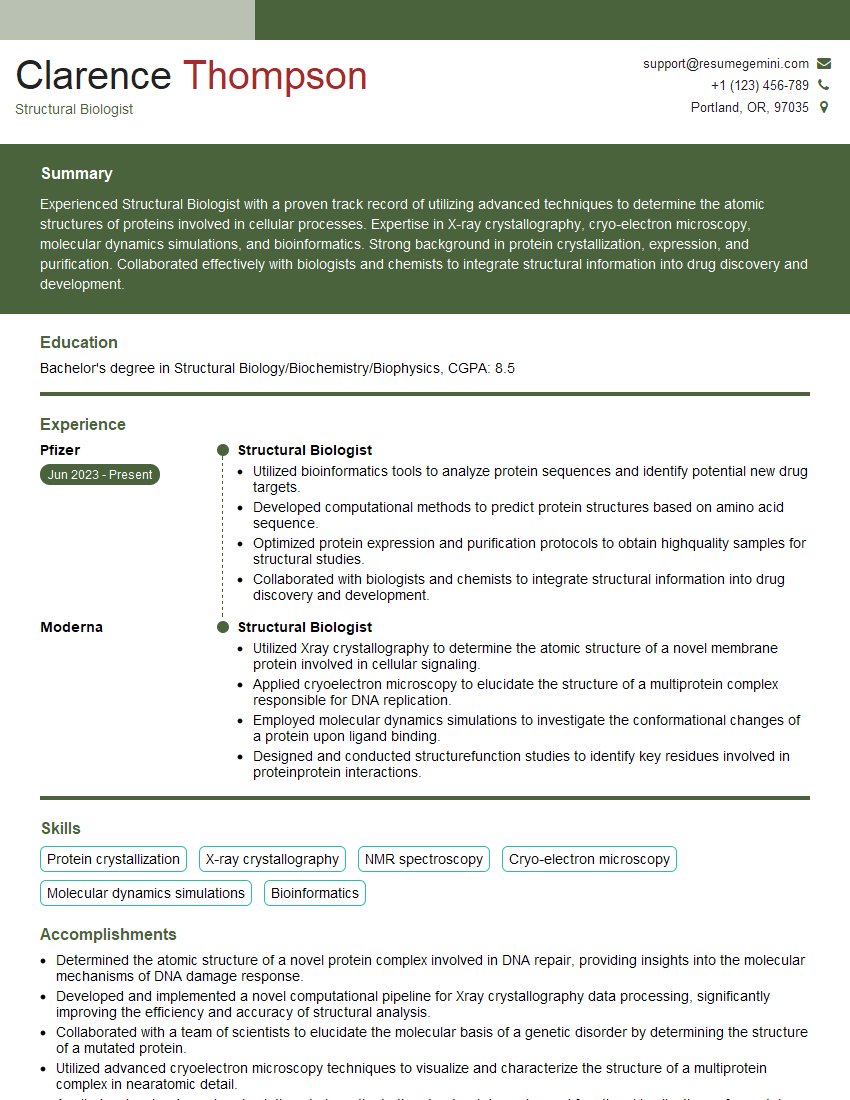
Mastering protein characterization is crucial for a successful career in various scientific and biotechnological fields. A strong understanding of these techniques opens doors to exciting opportunities in research, development, and quality control. To maximize your job prospects, create an ATS-friendly resume that highlights your skills and experience effectively. ResumeGemini is a trusted resource that can help you build a professional and impactful resume. We provide examples of resumes tailored to Protein Characterization to guide you in crafting your own compelling application.




Explore more articles
Users Rating of Our Blogs
Share Your Experience
We value your feedback! Please rate our content and share your thoughts (optional).
What Readers Say About Our Blog
Amazing blog
hello,
Our consultant firm based in the USA and our client are interested in your products.
Could you provide your company brochure and respond from your official email id (if different from the current in use), so i can send you the client’s requirement.
Payment before production.
I await your answer.
Regards,
MrSmith
hello,
Our consultant firm based in the USA and our client are interested in your products.
Could you provide your company brochure and respond from your official email id (if different from the current in use), so i can send you the client’s requirement.
Payment before production.
I await your answer.
Regards,
MrSmith
These apartments are so amazing, posting them online would break the algorithm.
https://bit.ly/Lovely2BedsApartmentHudsonYards
Reach out at [email protected] and let’s get started!
Take a look at this stunning 2-bedroom apartment perfectly situated NYC’s coveted Hudson Yards!
https://bit.ly/Lovely2BedsApartmentHudsonYards
Live Rent Free!
https://bit.ly/LiveRentFREE
Interesting Article, I liked the depth of knowledge you’ve shared.
Helpful, thanks for sharing.
Hi, I represent a social media marketing agency and liked your blog
Hi, I represent an SEO company that specialises in getting you AI citations and higher rankings on Google. I’d like to offer you a 100% free SEO audit for your website. Would you be interested?