Are you ready to stand out in your next interview? Understanding and preparing for Prototyping Experience interview questions is a game-changer. In this blog, we’ve compiled key questions and expert advice to help you showcase your skills with confidence and precision. Let’s get started on your journey to acing the interview.
Questions Asked in Prototyping Experience Interview
Q 1. What prototyping tools are you most proficient in and why?
My proficiency lies primarily in Figma, Adobe XD, and Axure RP. The choice depends on the project’s needs and team preferences. Figma’s collaborative features make it ideal for team projects and its vector-based nature ensures scalability. Adobe XD excels in its integration with the Adobe Creative Suite, which is beneficial when working with designers already familiar with the platform. Axure RP, though steeper learning curve, provides unparalleled power for complex interactions and prototyping advanced functionalities, particularly for highly interactive web applications.
For instance, for a quick, low-fidelity prototype for a mobile app, Figma’s ease of use and collaborative features make it my go-to. However, for a more complex SaaS application requiring intricate workflows, I’d likely choose Axure RP for its robust prototyping capabilities.
Q 2. Describe your process for creating a low-fidelity prototype.
My low-fidelity prototyping process prioritizes speed and concept validation. I typically start with sketching on paper, quickly capturing the core user flows and screen layouts. This allows for rapid iteration and brainstorming. These sketches then get translated into a digital format using tools like Figma or even simple tools like PowerPoint or Google Slides. The focus remains on the functionality and user journey, not pixel-perfect visuals. I prioritize using basic shapes, placeholder text, and minimal styling.
For example, when prototyping a new e-commerce checkout flow, I’d initially sketch out the different steps (add to cart, shipping details, payment, confirmation) on paper, indicating key interactions like buttons and input fields. Then I’d quickly translate this into a digital prototype using basic shapes and placeholder text in Figma, focusing on the flow and interaction rather than visual design. This allows me to quickly test the core functionality with users and identify any usability issues before investing time in high-fidelity design.
Q 3. How do you balance fidelity and speed when prototyping?
Balancing fidelity and speed is crucial. The key is to understand the prototyping goal. Early in the design process, low-fidelity prototypes are ideal for quickly testing core functionality and user flows. High-fidelity prototypes, with their detailed visuals and polished interactions, are better suited for later stages when the design is more solidified and the focus is on micro-interactions and visual details. I often use a ‘just enough’ approach—creating a prototype with sufficient fidelity to answer the specific questions at hand without over-investing in unnecessary details. For example, I might create a mid-fidelity prototype with basic visuals but realistic interactions to test a critical user flow. This strikes a balance between speed and sufficient detail for meaningful feedback.
Q 4. Explain the difference between low, mid, and high-fidelity prototypes.
The fidelity of a prototype refers to its level of detail and visual polish. Low-fidelity prototypes are basic representations, often using sketches or wireframes. They emphasize functionality and user flow over visual design. Mid-fidelity prototypes include more visual elements, like basic colors and imagery, but still lack polished details. High-fidelity prototypes are highly detailed and visually polished, closely resembling the final product. They are often used for testing the final user interface and user experience.
- Low-fidelity: Think paper sketches or simple wireframes—fast to create, ideal for early-stage testing.
- Mid-fidelity: Basic visuals, functional interactions, placeholder images—a good balance between speed and detail.
- High-fidelity: Near-final visuals, polished animations and interactions—used for late-stage testing and stakeholder reviews.
Q 5. How do you incorporate user feedback into your prototyping process?
User feedback is paramount. I incorporate it throughout the prototyping process, not just at the end. I use various methods, including usability testing sessions, user interviews, and surveys. During usability testing, I observe users interacting with the prototype, noting their pain points and areas of confusion. I then analyze this feedback to identify areas for improvement and iterate on the design. I use A/B testing on specific design elements to compare user responses and make data-driven decisions.
For example, in a recent project, user testing revealed that users struggled to locate the ‘add to cart’ button on a product page. Based on that feedback, we revised the button’s placement and visual prominence, making it much clearer and resulting in significantly increased conversion rates in subsequent testing.
Q 6. How do you choose the right prototyping method for a given project?
Choosing the right prototyping method depends on several factors: project goals, timeline, budget, and the level of detail needed. For quick concept validation and early user testing, low-fidelity methods like paper prototyping or basic digital wireframing are most efficient. For more detailed interaction design, mid-fidelity prototypes are ideal. When the focus is on micro-interactions and visual polish, high-fidelity prototypes are necessary. If the project needs robust interactive features, Axure RP may be beneficial; if collaboration is key, Figma is preferable.
Essentially, I always start by defining the key questions I need to answer with the prototype. This guides my choice of fidelity and tools. A simple prototype is always preferred unless more detail is absolutely required to address those key questions.
Q 7. Describe a time you had to iterate on a prototype based on user testing.
During a project for a mobile banking app, we created a high-fidelity prototype of the account transfer feature. Initial user testing revealed that users found the process confusing and the interface overwhelming. Specifically, the selection of recipient accounts was cumbersome and unclear. Users frequently made mistakes due to a poorly organized account list. Based on this feedback, we completely redesigned this section of the app. We implemented a clearer account selection flow, simplified the visual design, and added visual cues to aid navigation. Subsequent user testing demonstrated a significant improvement in task completion rates and user satisfaction.
Q 8. How do you handle conflicting feedback from stakeholders?
Conflicting stakeholder feedback is inevitable in prototyping. It’s a sign of diverse perspectives, which, when managed effectively, can lead to a better product. My approach involves a structured process:
- Prioritize Feedback: I categorize feedback based on its source (e.g., user testing, client feedback, internal team). User testing feedback often carries more weight as it represents the target audience’s actual experience.
- Document Everything: I maintain a detailed record of all feedback, including the source, the specific issue, and the proposed solution. This helps track progress and prevent overlooking crucial points.
- Facilitate Discussion: I organize meetings or workshops to discuss conflicting feedback. I actively encourage dialogue, aiming to understand the reasoning behind each perspective. The goal isn’t necessarily to reach a unanimous decision immediately, but to find common ground or identify underlying needs.
- Decision Matrix: For highly conflicting opinions, I use a decision matrix, weighing feedback based on factors like impact, feasibility, and user value. This provides a structured and objective way to prioritize changes.
- Iterative Refinement: Prototyping is an iterative process. I address feedback incrementally, testing each change and gathering more user feedback before finalizing the design. This allows for continuous improvement and minimizes the risk of implementing a solution that creates new problems.
For example, in a recent project, stakeholders had differing views on the navigation structure. After documenting the feedback, I organized a collaborative session, resulting in a hybrid approach that satisfied both parties’ core concerns and improved overall usability.
Q 9. Explain your experience with A/B testing prototypes.
A/B testing prototypes is crucial for validating design choices. It allows comparing different design iterations to determine which performs better based on measurable metrics. My experience involves using tools like Optimizely or VWO (Visual Website Optimizer) to conduct A/B tests on clickable prototypes.
In a past project, we tested two versions of a checkout page: one with a streamlined design and one with more detailed product information. We used A/B testing to measure conversion rates, task completion times, and user drop-off points. The streamlined design ultimately performed significantly better, demonstrating the value of a minimalist approach in this context. We also ensure that the variations being tested are meaningful and address specific hypotheses. For instance, if we are testing different button colors, we need a clear hypothesis, such as “A green button will lead to higher click-through rates than a blue button.” The data collected informs design decisions, ultimately leading to a more effective user experience.
Q 10. How do you measure the success of a prototype?
Measuring prototype success depends heavily on the prototype’s purpose. However, some common metrics include:
- Task Completion Rate: How successfully users complete key tasks within the prototype.
- Task Completion Time: How long it takes users to complete tasks, indicating efficiency.
- Error Rate: The frequency of user errors, highlighting potential usability issues.
- User Satisfaction: Typically measured through post-test questionnaires or feedback sessions, reflecting overall user experience.
- Qualitative Feedback: Open-ended questions and observations from user testing provide valuable insights into user behavior and pain points.
For example, if the goal is to test the usability of a new checkout flow, I’d focus on the task completion rate and time, alongside user feedback about any pain points encountered. A high completion rate with short completion times and positive feedback would indicate a successful prototype.
Q 11. How do you manage version control for your prototypes?
Version control is paramount to managing multiple iterations of a prototype. I use Git for version control, often in conjunction with a platform like GitHub or GitLab.
Each design iteration is committed as a separate version, allowing me to track changes, revert to previous versions if needed, and collaborate effectively with the team. Meaningful commit messages are essential, describing the changes made in each version (e.g., “Updated navigation bar design based on user feedback”). This ensures that the entire team can easily track changes and understand the evolution of the prototype. Branching is also critical for exploring different design concepts simultaneously without interfering with the main development branch.
Q 12. How do you ensure accessibility in your prototypes?
Accessibility is not an afterthought; it’s integral to good design. I ensure accessibility in my prototypes by adhering to WCAG (Web Content Accessibility Guidelines) and following these principles:
- Sufficient Color Contrast: Using tools to ensure adequate contrast between text and background colors for users with visual impairments.
- Alternative Text for Images: Providing descriptive alternative text for all images, allowing screen readers to convey image content to visually impaired users.
- Keyboard Navigation: Ensuring all interactive elements are accessible via keyboard navigation for users who cannot use a mouse.
- Clear and Concise Language: Using simple and straightforward language to avoid confusing users with cognitive disabilities.
- Captions and Transcripts: Providing captions for videos and transcripts for audio content for users with hearing impairments.
For instance, when designing a button, I would verify that the text-to-background color contrast is sufficient and that the button is appropriately sized and easily focusable using a keyboard.
Q 13. Describe your experience with interactive prototyping.
Interactive prototyping is at the heart of my design process. I extensively use tools like Figma, Adobe XD, and Axure to create prototypes with a high degree of interactivity. This allows users to experience a more realistic simulation of the final product, providing valuable feedback on functionality and flow.
Interactive prototypes go beyond static mockups; they allow users to click buttons, fill in forms, navigate menus, and interact with various elements, mimicking real-world interactions. This dynamic engagement yields richer and more accurate feedback compared to static designs. For instance, in a recent project, I created an interactive prototype of an e-commerce website, allowing users to add items to a cart, proceed to checkout, and experience the entire purchasing process. This gave us significant insights into potential usability issues and areas of improvement.
Q 14. How do you prototype for different devices (e.g., mobile, desktop, tablet)?
Prototyping for different devices requires a responsive design approach. I ensure compatibility and optimal user experience across various devices (mobile, desktop, tablet) through a combination of techniques:
- Responsive Design Principles: Employing responsive design principles (fluid grids, flexible images, media queries) to ensure the layout adapts seamlessly to different screen sizes and resolutions.
- Device-Specific Prototyping: Creating separate prototypes for each target device (or at least using separate artboards within a single file) if significant design variations are necessary.
- Testing Across Devices: Thoroughly testing prototypes on various devices during user testing to identify and fix any device-specific issues.
- Using Design Tools with Responsive Features: Leveraging features within design tools (such as Figma’s responsive design features or Adobe XD’s device presets) to facilitate the creation of responsive prototypes.
For instance, when designing a mobile app, I would ensure that the interface is optimized for touch interaction and the content is easily readable on smaller screens. Meanwhile, the desktop version might incorporate features that make sense only on a larger display.
Q 15. How do you handle unexpected challenges during prototyping?
Unexpected challenges are inevitable in prototyping. My approach involves a combination of proactive planning and agile adaptation. Before starting, I thoroughly analyze requirements and potential roadblocks. This helps anticipate issues like data integration problems or limitations in the prototyping tool.
During the process, if I encounter an unexpected challenge, I follow a structured problem-solving approach:
- Identify the problem: Clearly define the nature of the challenge. Is it a technical limitation, a design flaw, or a change in requirements?
- Analyze the impact: Assess the severity of the issue. Does it block progress, or can it be addressed later?
- Explore solutions: Brainstorm potential solutions, considering both quick fixes and long-term solutions. This might involve adjusting the prototype’s scope, finding alternative tools, or collaborating with other team members.
- Implement and test: Choose the best solution and implement it, followed by thorough testing to ensure functionality and user experience are not compromised.
- Document the issue and solution: Keeping a record of the problem and its resolution is crucial for future projects and for informing team discussions.
For example, during a recent project prototyping a complex data visualization, I encountered difficulties integrating the data source. Instead of abandoning the prototype, I decided to use placeholder data to show the interaction flow and design, addressing the actual data integration later. This allowed me to continue iterating on the design aspects while simultaneously tackling the technical problem.
Career Expert Tips:
- Ace those interviews! Prepare effectively by reviewing the Top 50 Most Common Interview Questions on ResumeGemini.
- Navigate your job search with confidence! Explore a wide range of Career Tips on ResumeGemini. Learn about common challenges and recommendations to overcome them.
- Craft the perfect resume! Master the Art of Resume Writing with ResumeGemini’s guide. Showcase your unique qualifications and achievements effectively.
- Don’t miss out on holiday savings! Build your dream resume with ResumeGemini’s ATS optimized templates.
Q 16. What are the limitations of your preferred prototyping tool?
My preferred prototyping tool is Figma, a powerful collaborative platform. However, like any tool, it has limitations. One key limitation is its reliance on internet connectivity; offline prototyping isn’t seamless. This can be problematic during presentations or in areas with unreliable internet access.
Another limitation is the potential for fidelity mismatches. While Figma excels at creating high-fidelity prototypes, complex animations and interactions might need external tools or workarounds, and pushing the visual limits could hinder performance. Finally, Figma’s strength lies in the UI/UX domain; for tasks like backend functionality simulation, it may require integration with other platforms, adding complexity to the workflow.
Despite these limitations, Figma’s collaborative features and extensive design capabilities far outweigh these drawbacks for most projects. Understanding the boundaries of the tool is crucial for efficient prototyping.
Q 17. How do you communicate your prototype’s design choices to stakeholders?
Communicating design choices to stakeholders effectively is crucial for successful prototyping. I use a multi-faceted approach to ensure clarity and understanding. First, I prepare a concise design rationale document explaining the reasoning behind each significant design decision, referring to user research, design principles, and business goals.
Next, I conduct interactive walkthroughs of the prototype. This allows me to demonstrate the functionality, highlight key features, and address stakeholder questions in real-time. I use clear and concise language, avoiding jargon wherever possible. Visual aids like flowcharts, wireframes, and style guides accompany the prototype presentation, providing additional context.
Finally, I solicit feedback. I encourage active participation, asking specific questions related to the design choices to gauge understanding and identify potential areas for improvement. Following the presentation, I gather feedback through surveys or informal discussions, facilitating further iteration and refinement of the prototype.
Q 18. Describe your process for documenting your prototyping workflow.
My prototyping workflow is documented meticulously for both personal reference and team collaboration. This includes:
- Project initiation document: This outlines the project goals, target audience, and key features. It serves as a roadmap for the entire process.
- Wireframes and low-fidelity prototypes: These capture initial design concepts and user flows, enabling quick iteration and feedback incorporation. I typically use Figma’s wireframing features for this phase.
- Design specifications: Detailed documentation of style guides, components, and interaction patterns for consistency throughout the prototyping process.
- Version control: Utilizing Figma’s version history feature to track changes, facilitating collaboration and rollback capabilities if required.
- Meeting notes: Records of design review meetings and discussions with stakeholders, which include feedback, changes, and decisions made.
- Prototype annotations: Adding comments and notes directly within the prototype itself helps clarify design intent and highlight specific aspects.
This comprehensive documentation ensures that the prototyping process is transparent, reproducible, and easily understood by others, even if I am not directly involved in later stages of development.
Q 19. How do you ensure consistency across different prototypes?
Consistency across different prototypes is paramount for maintaining a unified brand experience. I achieve this through a combination of design system implementation and meticulous process management.
First, I create and maintain a centralized design system. This encompasses reusable components (buttons, icons, typography styles), interaction patterns, and visual elements. This system ensures that all prototypes, regardless of their specific functionality, share a common visual language and behavior.
Next, I utilize prototyping tools that support component libraries and design systems effectively. Figma’s component management feature facilitates easy implementation and updates. Changes made to a component in the design system are automatically reflected across all prototypes using that component.
Lastly, I encourage consistent naming conventions, folder structures, and documentation practices across all projects. This contributes to better organization and ease of understanding, promoting consistency across different prototyping efforts.
Q 20. How do you balance creativity and practicality when prototyping?
Balancing creativity and practicality in prototyping is a constant juggling act. Creativity allows for exploration of innovative solutions, while practicality keeps the project grounded in feasibility and user needs. I approach this balance through a phased approach.
The initial phase focuses on brainstorming and exploration, allowing for maximal creativity. I encourage experimentation with unconventional ideas and user flows, generating multiple concepts. However, from the outset, I ensure these ideas are assessed for their practical feasibility.
As the prototyping process moves towards higher fidelity, the focus shifts towards practicality. The most promising creative concepts are refined, taking into account constraints such as development time, budget, and technical limitations. User testing throughout the process validates creative decisions against practical user needs, ensuring the final prototype is both engaging and usable.
Q 21. What is your experience with prototyping for responsive design?
Prototyping for responsive design is crucial for creating user experiences that adapt seamlessly across various devices. My approach involves using tools that facilitate responsive prototyping, primarily Figma’s auto layout and resizing capabilities.
I start by defining key breakpoints that represent different screen sizes (e.g., mobile, tablet, desktop). Then, I create responsive layouts using auto layout features, ensuring that the interface adjusts gracefully to different screen dimensions.
Furthermore, I pay close attention to the user interface elements. For instance, I consider how navigation menus collapse on smaller screens, how text reflows to avoid horizontal scrolling, and how interactive elements adapt to various resolutions. Testing on actual devices across different screen sizes is integral to validating the responsiveness of the prototype. During this testing, I note any adjustments needed to the layout or functionality to maintain usability and consistency across different viewports. This iterative process ensures a consistent and engaging user experience across all devices.
Q 22. How do you integrate prototyping with other design phases?
Prototyping isn’t an isolated activity; it’s deeply intertwined with other design phases. It acts as a bridge between initial ideation and the final product. Ideally, it starts early, even during the research and user needs definition phase, to quickly test core concepts and assumptions. For instance, early paper prototypes can validate the overall flow and user interaction before investing time in high-fidelity digital prototypes. During the design phase, prototyping helps refine the user interface (UI) and user experience (UX) by iteratively testing different design elements and interactions. Post-prototyping, the feedback informs the design iteration process, and the final prototype serves as a blueprint for developers.
- Research & Ideation: Low-fidelity prototypes (e.g., sketches, paper prototypes) validate core concepts.
- Design: Mid-fidelity prototypes (e.g., wireframes, interactive prototypes) test UI/UX flows and functionality.
- Development: High-fidelity prototypes (e.g., near-final product mockups) are used for user acceptance testing and developer handoff.
Think of it like building a house: You wouldn’t start constructing walls without a blueprint (research/ideation), and you certainly wouldn’t lay the foundation without checking the soil (prototyping). Each phase informs and refines the next.
Q 23. Describe a time you had to pivot your prototyping approach mid-project.
In a project for a financial app, we initially focused on creating a highly detailed, high-fidelity prototype showcasing complex financial charts and graphs. However, during user testing, we discovered that participants were overwhelmed by the visual complexity and struggled with the core navigation. We were presented with valuable feedback highlighting the priority of a simplified, intuitive user experience over flashy visuals. Instead of persisting with our original approach, we pivoted. We shifted to a simpler, lower-fidelity prototype emphasizing the core user flow, reducing the visual noise, and focusing on clear, concise information architecture. This allowed us to test the fundamental usability issues efficiently. This pivot, though initially frustrating, allowed us to create a significantly more user-friendly and successful final product.
Q 24. How do you handle feedback that contradicts your design decisions?
Handling contradictory feedback requires a thoughtful approach. It’s crucial to avoid defensiveness and instead view the feedback as an opportunity for improvement. First, I analyze the feedback to understand the underlying concerns. Sometimes, the contradiction stems from a misinterpretation of the design, in which case I clarify the design intent. If the feedback points to a legitimate usability issue, I carefully evaluate its validity within the larger design context. Does this feedback align with broader user needs or is it an isolated observation? I might conduct further user research to understand the prevalence of the issue. Documenting all feedback, even contradictory points, is key to facilitating informed decision-making. The goal is to create a solution that respects both the original design vision and the valuable insights gained from the feedback.
Q 25. What are your favorite resources for learning about new prototyping techniques?
My favorite resources for learning new prototyping techniques are diverse and constantly evolving. I regularly explore online communities like UX Collective and articles on sites like Interaction Design Foundation. I find attending industry conferences and workshops invaluable for networking and learning about the latest tools and techniques. Books focusing on interaction design and UX are also a great source of knowledge, providing deeper theoretical understanding. I also look to designers’ portfolios and case studies to see how others apply different techniques in real-world projects.
Q 26. How do you stay current with the latest trends in prototyping tools and techniques?
Staying current involves actively engaging with the design community. I subscribe to newsletters from industry leaders and follow key influencers on social media platforms. Attending webinars and online courses helps me stay updated on new software releases and features. Experimenting with new tools and techniques on personal projects is another effective approach; this hands-on experience consolidates my learning. Regularly reviewing industry publications and attending design meetups helps me grasp evolving trends and best practices.
Q 27. Describe your experience with collaborative prototyping.
Collaborative prototyping is essential for successful projects. I’ve extensively utilized tools like Figma and Miro, which facilitate real-time collaboration. These platforms allow multiple designers, developers, and stakeholders to work on the same prototype concurrently, providing immediate feedback and reducing design inconsistencies. Effective collaboration relies on clear communication and a well-defined workflow. We use shared documentation, regular check-ins, and version control to ensure everyone is on the same page. For instance, using Figma’s commenting features, stakeholders can pinpoint specific areas needing refinement, greatly enhancing efficiency and ensuring the prototype accurately reflects collective design decisions.
Q 28. How do you use prototyping to validate design decisions?
Prototyping is a core method for validating design decisions. By testing different design approaches with real users, we gather crucial data on usability, user satisfaction, and overall effectiveness. This iterative process enables us to identify and address potential problems early. For example, testing a prototype revealed that users found a particular button placement confusing, leading us to redesign the interface for better clarity. Qualitative data from user interviews and quantitative metrics from usability testing, such as task completion rates and error rates, provide valuable insights into the design’s strengths and weaknesses. This data-driven approach allows us to make informed adjustments, ultimately leading to a better user experience. We use A/B testing in prototypes to compare different design solutions objectively.
Key Topics to Learn for Prototyping Experience Interview
- Understanding User Needs: Analyzing user research to inform design decisions and prototype iterations. This includes understanding different user research methodologies and their application in the prototyping process.
- Low-Fidelity Prototyping: Creating quick and simple prototypes (e.g., paper prototypes, wireframes) to test core functionality and user flows early in the design process. Practical application involves sketching interfaces and testing interactions with potential users.
- High-Fidelity Prototyping: Developing detailed, interactive prototypes (e.g., using Figma, Adobe XD, InVision) to simulate the final product’s look and feel. Consider exploring advanced techniques like micro-interactions and animations.
- Prototyping Tools & Techniques: Gaining proficiency with various prototyping tools and understanding their strengths and weaknesses. This includes comparing and contrasting different platforms based on project requirements.
- Iterative Design & Testing: Understanding the importance of iterative prototyping, incorporating user feedback, and refining prototypes based on testing results. This includes outlining methods for effectively collecting and analyzing user feedback.
- Accessibility in Prototyping: Designing inclusive prototypes that consider accessibility guidelines and cater to users with disabilities. Explore the WCAG guidelines and their impact on prototyping.
- Communication & Collaboration: Effectively communicating design decisions and prototype iterations to stakeholders. This involves presenting your work clearly and convincingly, and incorporating feedback from team members.
- Problem-Solving & Critical Thinking: Applying critical thinking skills to identify and solve design challenges during the prototyping process. This includes analyzing user testing data to inform design iterations and overcome limitations of the prototyping process.
Next Steps
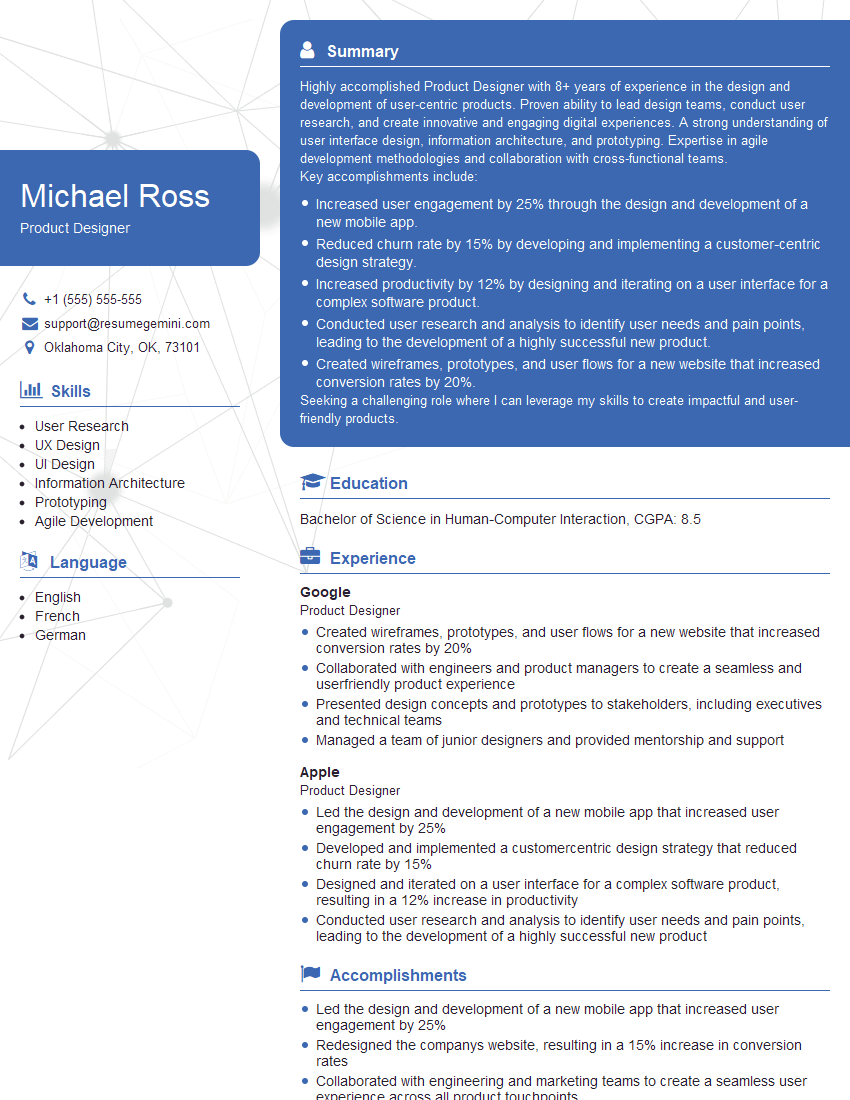
Mastering prototyping experience is crucial for career advancement in UX/UI design and related fields. It demonstrates your ability to translate ideas into tangible experiences, iterate based on feedback, and ultimately deliver user-centered solutions. To maximize your job prospects, create an ATS-friendly resume that highlights your skills and achievements. ResumeGemini is a trusted resource to help you build a professional and impactful resume. Examples of resumes tailored to Prototyping Experience are available to guide you through this process.
Explore more articles
Users Rating of Our Blogs
Share Your Experience
We value your feedback! Please rate our content and share your thoughts (optional).
What Readers Say About Our Blog
Amazing blog
hello,
Our consultant firm based in the USA and our client are interested in your products.
Could you provide your company brochure and respond from your official email id (if different from the current in use), so i can send you the client’s requirement.
Payment before production.
I await your answer.
Regards,
MrSmith
hello,
Our consultant firm based in the USA and our client are interested in your products.
Could you provide your company brochure and respond from your official email id (if different from the current in use), so i can send you the client’s requirement.
Payment before production.
I await your answer.
Regards,
MrSmith
These apartments are so amazing, posting them online would break the algorithm.
https://bit.ly/Lovely2BedsApartmentHudsonYards
Reach out at BENSON@LONDONFOSTER.COM and let’s get started!
Take a look at this stunning 2-bedroom apartment perfectly situated NYC’s coveted Hudson Yards!
https://bit.ly/Lovely2BedsApartmentHudsonYards
Live Rent Free!
https://bit.ly/LiveRentFREE
Interesting Article, I liked the depth of knowledge you’ve shared.
Helpful, thanks for sharing.
Hi, I represent a social media marketing agency and liked your blog
Hi, I represent an SEO company that specialises in getting you AI citations and higher rankings on Google. I’d like to offer you a 100% free SEO audit for your website. Would you be interested?