Preparation is the key to success in any interview. In this post, we’ll explore crucial Safe Slinging and Rigging Practices interview questions and equip you with strategies to craft impactful answers. Whether you’re a beginner or a pro, these tips will elevate your preparation.
Questions Asked in Safe Slinging and Rigging Practices Interview
Q 1. What are the different types of slings used in rigging?
Slings are the critical components connecting the load to the lifting equipment. Choosing the right sling type is crucial for safety and efficiency. Different materials and configurations cater to various load characteristics and lifting scenarios. Common sling types include:
- Round Slings: Made from synthetic fibers like polyester or nylon, these are versatile, easy to handle, and relatively lightweight. They conform to the load shape, reducing stress points. Think of them as a strong, flexible rope.
- Flat Web Slings: These consist of multiple layers of synthetic webbing stitched together. They offer high strength-to-weight ratios and are suitable for heavier loads and sharp-edged objects (with proper protection). Imagine a strong fabric strap.
- Chain Slings: Made from high-strength alloy steel, chain slings are durable and resistant to abrasion, making them ideal for heavy, abrasive loads. However, they can be heavier and more prone to damage from sharp edges than webbing.
- Wire Rope Slings: These are strong and durable, well-suited for heavy and bulky loads. Their construction requires careful attention to avoid kinking or damage.
- Synthetic Web Slings: Offer a good balance of strength, flexibility, and lightweight properties.
The selection depends on the load’s weight, shape, and material, as well as the lifting environment. Always consult manufacturer specifications and relevant safety standards.
Q 2. Explain the importance of proper sling angle in load lifting.
Sling angle significantly impacts the load’s weight distribution and the stress on the sling. The more acute the angle (closer to a straight line), the greater the force on each sling leg. This is because the vertical lifting force is distributed across the two sling legs. Imagine two people lifting a heavy box using ropes; if they hold the ropes close together, each person carries almost half the weight. If they spread far apart, each person will carry much more than half the weight.
For example, if you lift a 1000kg load with two slings at a 30-degree angle, the force on each sling is approximately 1000kg / cos(30°) ≈ 1155kg. At a 60-degree angle, the force increases to approximately 2000kg per sling. This increased force could exceed the sling’s SWL, leading to failure. As a rule of thumb, maintaining a sling angle as close to vertical as practically possible (ideally 60 degrees or less) reduces stress and increases safety.
Incorrect sling angles can cause the sling to fail under load, leading to accidents. Always aim for the most vertical arrangement possible and make sure to calculate the actual load on each sling leg accordingly.
Q 3. How do you calculate the safe working load (SWL) of a sling?
Calculating the Safe Working Load (SWL) of a sling isn’t a simple calculation; it’s more of a selection process based on the sling’s manufacturer’s specifications, taking several factors into account. The SWL is the maximum load a sling can safely lift under ideal conditions. This information is always clearly marked on the sling.
The calculation is not a simple formula, but rather a selection process based on the sling’s manufacturer’s data sheet. You must consult this data sheet. The data sheet will provide the SWL for various sling configurations (e.g., vertical, choker hitch, basket hitch). The SWL will be listed for different angles.
The critical factor is to never exceed the SWL specified by the manufacturer. You must also factor in the sling angle, the type of hitch used, and any potential damage to the sling.
Using a sling beyond its SWL is extremely dangerous and can lead to catastrophic failure. Therefore, always err on the side of caution and use a sling with a SWL that significantly exceeds the expected load.
Q 4. Describe the different types of rigging hardware and their applications.
Rigging hardware is essential for creating secure lifting configurations. These components are subjected to significant stress, so quality and proper inspection are crucial.
- Shackles: These are U-shaped metal links with a threaded pin or screw pin to secure the connection. They connect slings to hooks, other shackles, or other rigging points. Choose shackles with a SWL exceeding the expected load.
- Hooks: These provide a point of attachment for slings and loads. They come in various types (e.g., Clevis hooks, Slip hooks, Eye bolts). Each hook is rated for a maximum load.
- Rings: Similar to shackles but without a pin, rings create a loop for sling attachment.
- Swivels: Prevent twisting and tangling in the slings, reducing stress on the equipment.
- Earrings: These are metal rings used in lifting and rigging operations.
- Turnbuckles: Allow for adjustment of tension in a lifting arrangement. They enable fine-tuning the position of loads and are particularly useful when precise positioning is critical.
The choice of rigging hardware depends on the specific lifting task, the load, and the working environment. Always use hardware with a SWL exceeding the expected load and inspect it carefully before each use.
Q 5. What are the common causes of rigging accidents?
Rigging accidents can have devastating consequences. Common causes include:
- Using damaged or worn-out equipment: This is the most frequent cause. Regular inspections are vital.
- Improper sling angles: As previously discussed, acute angles greatly increase the load on the slings.
- Incorrect hitches and knots: Using unsuitable knots for the load or sling can lead to slippage or failure.
- Exceeding the SWL of equipment: This is a major cause of catastrophic failures.
- Inadequate training and supervision: Insufficient knowledge and poor supervision can lead to risky practices.
- Environmental factors: Weather conditions, ground instability, and obstructions can create hazardous situations.
- Poor communication: Miscommunication between team members during lifting operations can have dangerous consequences.
A strong safety culture, emphasizing thorough inspections, training, and risk assessments, is crucial in preventing rigging accidents.
Q 6. How do you inspect rigging equipment before use?
Rigging equipment inspection is non-negotiable for safety. Before each use, a thorough visual inspection must be performed. Look for:
- Wear and tear: Examine slings for fraying, cuts, burns, or any signs of weakening.
- Damage: Check for kinks, distortions, or other damage to metal components like shackles and hooks.
- Corrosion: Look for rust or corrosion, especially on metal parts. Corrosion weakens the material and reduces its SWL.
- SWL markings: Verify that the SWL markings are clearly visible and legible.
- Proper functionality: Ensure all moving parts function smoothly and securely.
If any damage or wear is detected, the equipment should be immediately removed from service and replaced. Documentation of inspections is also crucial for maintaining records and compliance with regulations.
Regular, thorough inspections are not just a good practice – they are a legal requirement in most workplaces. These inspections are a critical part of a comprehensive safety program for any rigging operation.
Q 7. What are the safety regulations and standards related to rigging?
Rigging safety is governed by numerous regulations and standards that vary by location and industry. However, some common themes include:
- Compliance with national and international standards: Adherence to standards like those set by OSHA (Occupational Safety and Health Administration) in the US, or similar organizations in other countries, is crucial. These standards outline safe practices, equipment requirements, and inspection procedures.
- Proper training and certification: Riggers should be properly trained and certified to handle the equipment safely and correctly.
- Regular equipment inspections: As previously discussed, regular inspections are mandated by regulations.
- Load capacity limits: Never exceed the SWL of any component in the rigging system.
- Risk assessment and safe work procedures: Each rigging operation requires a risk assessment to identify and mitigate potential hazards. Safe work procedures, including communication protocols, should be developed and followed.
- Record-keeping: Maintain detailed records of inspections, training, and accidents.
Staying current with the applicable regulations and standards is essential for ensuring compliance and preventing accidents. It’s vital to consult the relevant authorities in your area to confirm the specific requirements. Ignoring these regulations can lead to serious penalties and, more importantly, severe injury or death.
Q 8. Explain the concept of load stability and its importance in rigging.
Load stability refers to the secure and balanced arrangement of a load during lifting and moving operations. It’s paramount because an unstable load can shift, swing, or even fall, causing serious accidents, property damage, and injuries. Think of it like balancing a stack of books – if they’re not carefully arranged, the whole stack can topple.
Maintaining load stability involves several key factors: proper sling placement to distribute weight evenly, using the correct type and capacity of slings, securing the load to prevent movement, and ensuring the load’s center of gravity is correctly positioned. For instance, a long, narrow object needs to be lifted with multiple slings to prevent it from twisting or swinging during the lift, unlike a compact, evenly weighted object.
Imagine lifting a heavy steel beam. If only one sling is used at one end, the beam will likely rotate or swing dangerously during the lift. By using two slings placed evenly along the beam, we achieve better load distribution and stability, significantly reducing the risk of accidents.
Q 9. Describe the different types of hitches used in rigging.
Rigging employs various hitches to secure and control loads. They’re essentially different ways to tie knots or fasten slings to a load or lifting point. Choosing the right hitch depends on the load’s shape, weight, and the type of lifting equipment being used.
- Basket Hitch: A common hitch for lifting bundles or irregularly shaped objects, using multiple slings to evenly distribute the load. Think of lifting a pile of lumber.
- Choker Hitch: Used when only one sling is required, creating a loop around a load. It’s important to ensure proper load distribution and reduce risk of slippage. This is useful for lifting a single pipe or cylinder.
- Vertical Hitch: The sling directly supports the load vertically, creating minimal load stress. This is perfect for lifting things like simple buckets or containers.
- Bridle Hitch: Uses multiple slings attached to a single point of lift, creating a more stable and controlled lift for heavy or unwieldy loads. Imagine lifting a large engine block.
Selecting the right hitch is crucial for safety. An improperly chosen hitch can lead to load slippage, sling failure, and serious accidents.
Q 10. How do you select the appropriate sling for a specific load?
Sling selection is crucial for a safe lift. It depends on several factors: the load’s weight, shape, and material; the lifting environment; and the type of lifting equipment. The sling’s rated capacity must always exceed the load weight by a substantial margin (often a safety factor of at least 5:1 is applied).
- Weight: The sling’s Working Load Limit (WLL) must be higher than the load’s weight.
- Shape: Irregularly shaped loads might require multiple slings or special hitches for stability.
- Material: Consider load characteristics (sharp edges, abrasive materials) when selecting sling material. Wire rope slings are good for harsh conditions, while synthetic slings are lighter and easier to handle.
- Environment: High temperatures or chemical exposure may necessitate specific sling materials.
For example, lifting a heavy steel plate with sharp edges would require a wire rope sling due to its abrasion resistance, while lifting a delicate piece of equipment might call for a soft synthetic sling to prevent damage.
Q 11. What are the limitations of different sling materials (e.g., synthetic, wire rope)?
Different sling materials have distinct limitations:
- Synthetic slings (Nylon, Polyester, etc.): Susceptible to damage from sharp edges, abrasion, and high temperatures. They are also vulnerable to UV degradation over time, and strength is affected by moisture and chemicals. However, they are lighter and easier to handle than wire rope.
- Wire rope slings: More resistant to abrasion and sharp edges, they can withstand higher temperatures. However, they are heavier, less flexible, and can suffer from corrosion, fatigue, and kinking. Regular inspection is vital for wire rope slings.
Understanding these limitations is critical. Using a synthetic sling on a load with sharp edges could lead to sling failure; using a corroded wire rope sling could result in sudden breakage.
Q 12. How do you handle unexpected situations during a rigging operation?
Unexpected situations during rigging require immediate and calm response. A clear emergency plan and practiced procedures are essential.
- Load slippage: Secure the load immediately using additional slings or blocks. Stop the lift, re-evaluate sling placement, and ensure stability before resuming.
- Equipment malfunction: Immediately stop the operation and report the issue. Do not attempt to repair equipment during a lift.
- Weather changes (e.g., high winds): Stop the operation and reassess risk. High winds can affect load stability and create hazardous conditions.
A key element in handling unexpected situations is effective communication among the rigging crew. The designated rigger should have the authority to halt operations if necessary.
Q 13. What are the procedures for lifting and lowering heavy loads?
Lifting and lowering heavy loads necessitates a systematic approach:
- Pre-lift checks: Verify load weight, sling capacity, hitch type, equipment functionality, and clear area around the load.
- Lifting: Slowly and smoothly lift the load, observing for any instability or unusual movement. Maintain clear communication throughout the lift.
- Moving: Carefully maneuver the load to its destination, maintaining stability and avoiding obstacles.
- Lowering: Slowly and controlled lowering is vital. Keep an eye on the load to ensure no unexpected sway or shifting.
- Post-lift checks: Ensure the load is properly placed and the equipment is secure before disassembling the rigging.
Imagine lifting a very large piece of machinery. A slow, controlled lift, with constant observation and communication, minimizes the risk of accidents compared to a hurried or careless operation.
Q 14. What are the communication protocols during rigging operations?
Clear and concise communication protocols are crucial for safe rigging operations. A pre-determined hand signal system should be used in noisy environments. A designated signal person should direct the crane operator.
- Hand Signals: Standardized hand signals communicate directions (up, down, left, right), stops, and any other necessary instructions.
- Verbal Communication: Clearly and concisely communicate load weight, sling type, hitch arrangement, and any potential hazards.
- Radio Communication: For large operations or when visibility is limited, two-way radios allow constant communication between team members.
Miscommunication is a frequent cause of rigging accidents. Implementing and adhering to these communication protocols minimizes these risks. For example, a simple misunderstanding of hand signals could lead to dropping a load.
Q 15. Describe different methods for securing loads.
Securing loads effectively is paramount in safe slinging and rigging. The method chosen depends heavily on the load’s characteristics (weight, shape, fragility), the environment (weather conditions, available space), and the lifting equipment being used. Here are some common methods:
- Choker Hitch: A single sling leg wrapped around the load. Simple but requires careful consideration of sling angle to avoid excessive stress. Think of it like tying a rope around a package – you wouldn’t want it to slip!
- Basket Hitch: Two or more legs of a sling forming a cradle around the load. Distributes weight evenly and is suitable for many shapes. Imagine cradling a large, delicate piece of machinery – this provides excellent stability.
- Vertical Hitch: Sling legs attached directly to the load’s lifting points. Provides direct lift but requires strong and appropriate lifting points on the load itself. This is similar to lifting a heavy bucket – directly from its handle.
- Bridle Sling: Multiple slings attached to a single point on the load, converging to a single lifting point. Distributes weight efficiently and allows for lifting loads with a center of gravity that is not directly centered. This is like using multiple ropes to lift a large, irregularly shaped object.
The choice of hitch and the number of sling legs are critical for load stability and safe weight distribution. Riggers always perform calculations to ensure the sling capacity is sufficient for the load and the angle of the lift.
Career Expert Tips:
- Ace those interviews! Prepare effectively by reviewing the Top 50 Most Common Interview Questions on ResumeGemini.
- Navigate your job search with confidence! Explore a wide range of Career Tips on ResumeGemini. Learn about common challenges and recommendations to overcome them.
- Craft the perfect resume! Master the Art of Resume Writing with ResumeGemini’s guide. Showcase your unique qualifications and achievements effectively.
- Don’t miss out on holiday savings! Build your dream resume with ResumeGemini’s ATS optimized templates.
Q 16. How do you address potential hazards during rigging?
Hazard identification and mitigation are fundamental to safe rigging. Before any lift, a thorough risk assessment is mandatory. This involves:
- Identifying potential hazards: This includes load instability, environmental factors (wind, rain, uneven ground), equipment malfunction (worn slings, damaged hooks), and human error (improper communication, lack of training).
- Implementing control measures: These measures can be engineering controls (using appropriate equipment, secure load placement), administrative controls (work permits, training programs), and personal protective equipment (PPE) like hard hats and safety glasses.
- Regular inspections: Rigging equipment needs regular visual inspections for wear and tear. Any damaged equipment must be immediately removed from service.
- Communication and coordination: Clear communication between the rigger, crane operator, and ground crew is essential to ensure a smooth and safe lift. Using standardized hand signals is crucial.
For example, if lifting in a windy environment, we might need to postpone the lift or implement additional securing measures. If the ground is uneven, we might need to use cribbing (wooden blocks) to create a stable base.
Q 17. Explain the importance of using proper signaling techniques.
Proper signaling is the lifeline of safe rigging operations. Miscommunication can lead to accidents with potentially fatal consequences. Standardized hand signals, universally understood by the rigger, crane operator, and ground crew, prevent misunderstandings.
These signals clearly communicate instructions like:
- Hoist/Lower: Clear and distinct signals for raising and lowering the load.
- Swing: Precise control over load movement horizontally.
- Emergency Stop: An easily recognizable signal to immediately halt all operations.
Imagine a scenario where a miscommunication leads to a load swinging unexpectedly – the consequences could be catastrophic. That’s why standardized and unambiguous signaling is non-negotiable. Training on these signals is mandatory for everyone involved.
Q 18. What are the consequences of using damaged or worn-out rigging equipment?
Using damaged or worn-out rigging equipment is incredibly dangerous and can have severe consequences, ranging from minor damage to catastrophic failure resulting in serious injury or death.
Consequences include:
- Equipment failure: A worn sling might break under stress, causing the load to fall.
- Load instability: Damaged equipment can compromise load stability, leading to tipping or swinging.
- Injury or death: Falling loads, collapsing equipment, or uncontrolled movement can cause severe injuries or fatalities.
- Property damage: Damage to the load itself or surrounding structures and equipment.
- Legal repercussions: Companies and individuals can face significant legal and financial penalties for negligence.
Regular inspection and preventative maintenance are key. Any sign of wear, damage (e.g., cuts, fraying, deformation), or exceeding the equipment’s safe working load (SWL) necessitates immediate replacement.
Q 19. How do you ensure compliance with safety regulations during rigging?
Ensuring compliance with safety regulations is crucial. This involves:
- Knowing and following relevant standards: This includes OSHA regulations (in the US) or equivalent standards in other countries.
- Regular equipment inspections: Maintaining detailed records of equipment inspections and maintenance schedules.
- Maintaining certifications: Riggers and crane operators should have the necessary certifications and training.
- Risk assessments: Conducting thorough risk assessments before each lifting operation.
- Documentation: Maintaining proper documentation of all procedures, inspections, and incidents.
- Incident Reporting: Promptly reporting any accidents or near misses to investigate root causes and prevent future occurrences.
Compliance isn’t merely a checklist; it’s a continuous process requiring vigilance and commitment to safety.
Q 20. What are the responsibilities of a rigger regarding safety?
A rigger’s responsibilities concerning safety are paramount. They are responsible for:
- Selecting appropriate equipment: Choosing the correct slings, shackles, and other equipment based on the load’s weight, size, and shape.
- Planning the lift: Developing a safe lifting plan that details procedures and potential hazards.
- Inspecting equipment: Thoroughly inspecting all equipment before use for any signs of damage or wear.
- Ensuring safe working practices: Following all safety procedures and regulations.
- Communicating effectively: Clear communication with the crane operator and ground crew.
- Monitoring the lift: Supervising the lifting operation and addressing any potential issues that might arise.
Ultimately, a rigger is responsible for the safety of the load, personnel, and surrounding property during every lift. It’s a heavy responsibility but absolutely critical for a safe work environment.
Q 21. Describe your experience with different types of cranes and their applications.
My experience encompasses a range of crane types and applications. I’ve worked extensively with:
- Tower Cranes: Used extensively in large-scale construction projects for lifting heavy materials to significant heights. I’ve been involved in projects involving high-rise buildings and infrastructure development where precise positioning and heavy lifting capabilities were essential.
- Mobile Cranes: Highly versatile cranes suitable for various applications, from industrial settings to construction sites. I’ve utilized them in factory environments for moving heavy equipment and in infrastructure projects involving bridge construction and pipeline installation.
- Overhead Cranes: Used within workshops and factories for moving materials within a confined space. I’m familiar with the safety procedures and limitations specific to these systems, ensuring safe operations within indoor environments.
- Rough Terrain Cranes: These cranes are designed to navigate challenging terrain, making them ideal for projects in difficult-to-access locations. I’ve participated in projects involving off-shore work and terrain requiring high maneuverability and stability.
My experience isn’t limited to just operating these cranes; it also includes understanding their limitations, maintenance requirements, and integration into safe lifting procedures. I’m always updating my knowledge to stay current with the latest industry standards and best practices.
Q 22. How do you perform a pre-lift assessment?
A pre-lift assessment is crucial for ensuring a safe and successful lift. It’s a systematic evaluation of all aspects of the lifting operation before it begins. Think of it as a pre-flight checklist for a crane – vital for preventing accidents.
- Identify the Load: Determine the load’s weight, dimensions, center of gravity, and any unusual characteristics (e.g., fragility, uneven weight distribution). I always use calibrated scales and take detailed measurements. For example, if lifting a large steel beam, I’d measure its length, width, and thickness to accurately calculate the center of gravity.
- Assess the Environment: This includes checking for overhead obstructions, sufficient headroom, ground conditions (is the ground level and stable?), and the presence of any hazards like underground utilities or nearby personnel. I’d use a site survey checklist and always cordon off the area to prevent unauthorized access.
- Evaluate the Equipment: Inspect the crane, slings, shackles, and other rigging hardware for any signs of damage, wear, or defects. This involves checking certification dates, conducting visual inspections, and performing load tests when necessary. A damaged sling is simply unacceptable and would immediately halt the operation.
- Plan the Lift: This involves determining the lifting points, the lifting path, the best crane configuration, and the appropriate lifting technique. I use specialized lifting plans with detailed diagrams showing the positioning of all equipment and personnel. A clear plan ensures a smooth, safe lift.
- Develop a Communication Plan: Clear communication is key. I’d establish a communication protocol among the crane operator, riggers, and signal persons to coordinate the lift and address any unexpected issues. We always use hand signals and two-way radios for efficient communication.
By meticulously completing this pre-lift assessment, we significantly reduce the risk of accidents and ensure a smooth operation. Skipping this step is simply not an option.
Q 23. Explain your understanding of load charts and their use in rigging.
Load charts are essential documents provided by the sling manufacturer that specify the safe working load (SWL) limits for each sling configuration and type. They are absolutely critical for safe rigging practices. Think of it as an instruction manual for your slings.
Each chart shows the SWL for different angles of sling attachment. For example, a sling with a 10-ton SWL when used vertically might only have a 5-ton SWL when used at a 30-degree angle. Using a sling beyond its rated capacity for any configuration is unsafe and illegal.
We use load charts to determine the appropriate sling type and size for each lift, ensuring we never exceed the safe working load. This is done before any lifting begins and the data is documented along with the pre-lift assessment.
Ignoring load charts puts lives and equipment at risk. It’s a fundamental part of safe rigging, and I always ensure everyone involved in the lift understands and adheres to the information on the relevant load charts.
Q 24. What is your experience with different types of knots used in rigging?
My experience encompasses a wide range of knots frequently used in rigging, each with its specific application and limitations. Knot selection is not arbitrary; it’s critical for safety and efficiency.
- Bowline: Forms a strong, easily adjustable loop that won’t slip. Ideal for creating a running end to attach a sling to a load.
- Clove Hitch: Quick and simple knot for temporarily securing a rope or sling around an object. Useful for light loads and temporary fastenings, but not suitable for heavy loads under tension.
- Figure Eight Knot: A stopper knot used to prevent the end of a rope from running through a pulley or other device. Essential for securing ends and preventing slippage.
- Eye Splice: Permanent loop created by weaving the rope’s strands back into themselves. Provides exceptional strength and durability for heavy-duty applications and forms a crucial component of many slings.
I always ensure that knots are correctly tied, properly seated, and inspected for security before any weight is applied. In fact, proper knot tying is a core competency in our company’s training program. A poorly tied knot can lead to catastrophic failure.
Q 25. How do you deal with load shifting during a lifting operation?
Load shifting during a lift is a serious hazard, potentially causing the load to swing, collide with obstructions, or even fall. Immediate action is required.
The first step is to stop the lift immediately. The crane operator must lower the load slowly and carefully to the ground. Then, I’d investigate the cause of the shift. Was it due to an uneven load distribution, improper sling placement, or other factors?
After addressing the underlying issue – which might involve repositioning the slings, securing the load more effectively, or adjusting the crane configuration – we’d perform a thorough re-assessment before resuming the lift. This includes a careful re-inspection of all equipment and a check for any damage. Safety is paramount, and we would never compromise on this.
I’ve encountered load shifting on several occasions, often due to unforeseen weight distribution. Each time, immediate action, investigation, and a thorough re-assessment were key to resolving the issue safely.
Q 26. Describe your experience with emergency procedures during rigging accidents.
Emergency procedures are an integral part of my rigging experience. We follow a strict protocol developed to handle all types of accidents, from minor equipment malfunctions to serious incidents.
- Immediate Action: Stop the lift immediately. Secure the area to prevent further accidents.
- First Aid & Emergency Services: Administer first aid if necessary and contact emergency services immediately. We have established direct lines to emergency responders.
- Secure the Scene: Isolate the accident area to prevent further injury and preserve evidence.
- Accident Investigation: A thorough investigation is mandatory, focusing on the root cause of the accident. This includes gathering evidence, interviewing witnesses, and analyzing data logs from any equipment involved. The data is carefully documented and included in the accident report.
- Reporting & Documentation: Detailed accident reports are filed with the relevant authorities and management. This helps to prevent similar accidents in the future.
I have been involved in several emergency situations, both minor and more serious. In every case, our swift response based on established procedures was critical to minimizing the impact and preventing further accidents. I have been directly involved in these reports, as well as training others on emergency protocols.
Q 27. What are your preferred methods for documenting rigging activities?
Thorough documentation is paramount in ensuring accountability and traceability. It also aids in future planning and safety analysis.
- Pre-Lift Assessments: These are always documented using detailed checklists, including load calculations, equipment inspections, and environmental assessments.
- Lifting Plans: These are drawn up before every lift and include detailed diagrams, specifications, and safety precautions.
- Equipment Inspections: Inspection reports are filed for all equipment used, noting any defects or maintenance requirements. These reports include photos when necessary.
- Post-Lift Reports: These provide a summary of the lift, noting any issues or deviations from the plan. This is always completed, even for seemingly mundane lifts.
- Digital Records: I utilize digital systems, including project management software, to record all aspects of the rigging process. This ensures records are secure and readily accessible.
My approach emphasizes a comprehensive and auditable record-keeping system. The goal is to create a clear and detailed history of every lifting operation, facilitating continuous improvement and accident prevention.
Q 28. How do you stay updated on the latest safety regulations and best practices in rigging?
Staying updated on safety regulations and best practices is a continuous process. It’s not a one-time event; it’s a commitment to lifelong learning.
- Professional Organizations: I’m an active member of relevant professional organizations, attending conferences, webinars, and workshops to keep up with industry developments and best practices. These offer valuable insight into new standards and advancements in safety.
- Regulatory Updates: I monitor changes in relevant safety regulations and standards to ensure that all of our operations are compliant. Staying on top of legal requirements prevents fines and keeps everyone safe.
- Manufacturer Information: I review equipment manufacturer updates, safety bulletins, and technical documentation to remain knowledgeable about the equipment we use. Manufacturers frequently update guidance, and accessing these details ensures we’re using their gear safely.
- Industry Publications: I regularly read trade journals and publications dedicated to rigging and lifting to learn about new techniques and safety innovations.
Safety is a dynamic field. Continuous learning through various channels helps me maintain my expertise and ensure we are always using the safest and most effective methods.
Key Topics to Learn for Safe Slinging and Rigging Practices Interview
- Understanding Sling Types and Capacities: Learn to identify different sling types (e.g., chain, wire rope, synthetic), their limitations, and how to correctly determine their weight capacities based on angles and load distribution.
- Proper Hitches and Knots: Master the techniques for creating secure and safe hitches and knots appropriate for various lifting situations. Understand the limitations and dangers of improper knotting.
- Load Centering and Stability: Develop a strong understanding of how to center loads to maintain stability during lifting operations and prevent potential swings or imbalances.
- Inspection and Maintenance of Lifting Equipment: Learn to thoroughly inspect slings, rigging hardware, and other lifting equipment for damage, wear, and tear. Understand the importance of regular maintenance and the procedures for reporting defects.
- Safe Lifting Techniques and Procedures: Grasp the principles of safe lifting practices, including pre-lift planning, communication protocols with the rigging crew, and emergency procedures.
- Hazard Identification and Risk Assessment: Learn to identify potential hazards associated with slinging and rigging operations and apply appropriate risk mitigation strategies. This includes understanding environmental factors and potential obstacles.
- Regulations and Standards Compliance: Familiarize yourself with relevant safety regulations and industry standards (e.g., OSHA guidelines) related to safe slinging and rigging practices.
- Practical Problem Solving: Be prepared to discuss real-world scenarios and explain how you would approach and solve potential problems related to safe slinging and rigging, considering different variables and constraints.
Next Steps
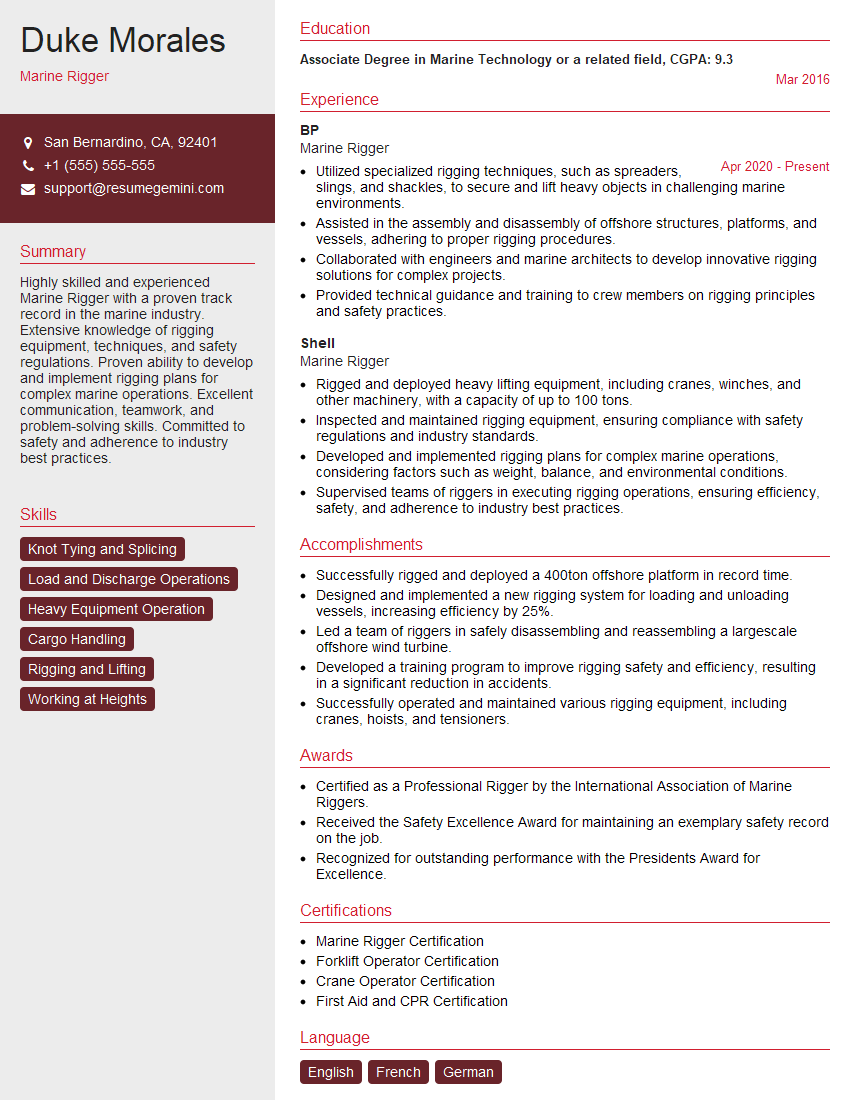
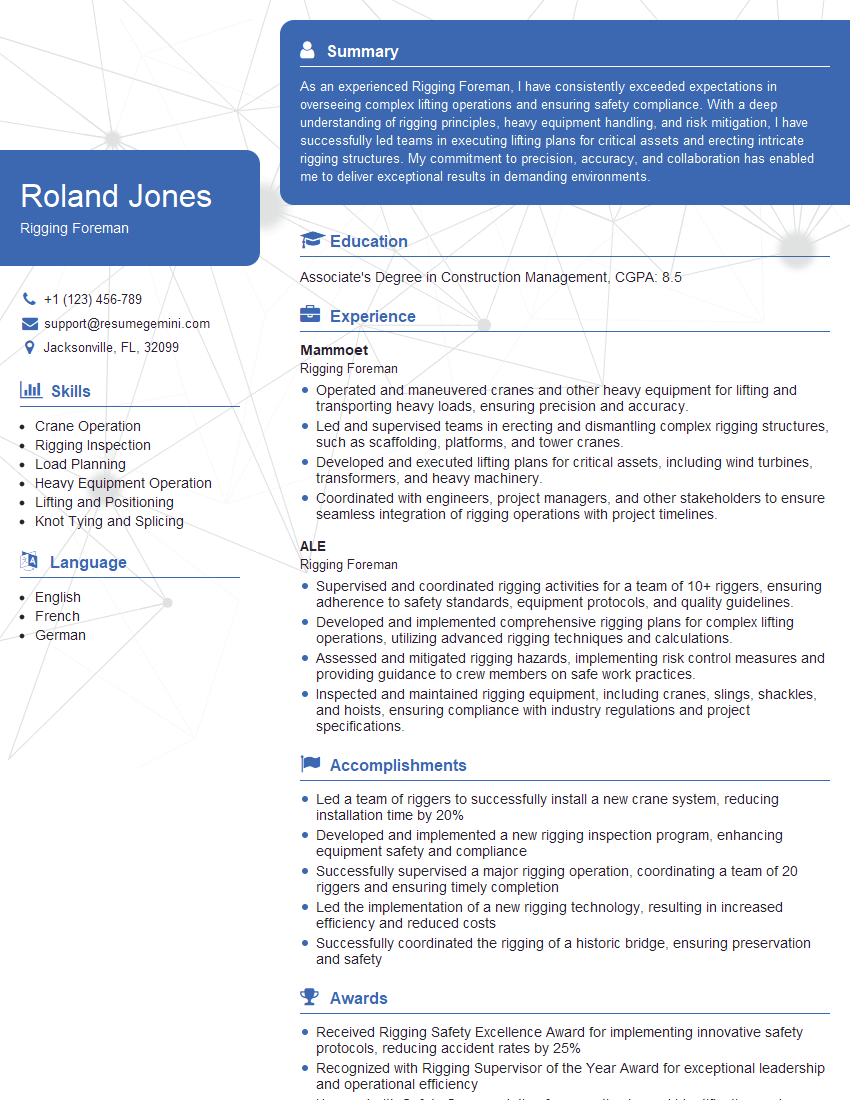
Mastering safe slinging and rigging practices is crucial for career advancement in many industries. It demonstrates your commitment to safety, a highly valued trait by employers. To significantly improve your job prospects, focus on building an ATS-friendly resume that effectively highlights your skills and experience. ResumeGemini is a trusted resource for creating professional and impactful resumes. They provide examples of resumes tailored specifically to Safe Slinging and Rigging Practices, helping you present yourself in the best possible light to potential employers.





Explore more articles
Users Rating of Our Blogs
Share Your Experience
We value your feedback! Please rate our content and share your thoughts (optional).
What Readers Say About Our Blog
hello,
Our consultant firm based in the USA and our client are interested in your products.
Could you provide your company brochure and respond from your official email id (if different from the current in use), so i can send you the client’s requirement.
Payment before production.
I await your answer.
Regards,
MrSmith
hello,
Our consultant firm based in the USA and our client are interested in your products.
Could you provide your company brochure and respond from your official email id (if different from the current in use), so i can send you the client’s requirement.
Payment before production.
I await your answer.
Regards,
MrSmith
These apartments are so amazing, posting them online would break the algorithm.
https://bit.ly/Lovely2BedsApartmentHudsonYards
Reach out at [email protected] and let’s get started!
Take a look at this stunning 2-bedroom apartment perfectly situated NYC’s coveted Hudson Yards!
https://bit.ly/Lovely2BedsApartmentHudsonYards
Live Rent Free!
https://bit.ly/LiveRentFREE
Interesting Article, I liked the depth of knowledge you’ve shared.
Helpful, thanks for sharing.
Hi, I represent a social media marketing agency and liked your blog
Hi, I represent an SEO company that specialises in getting you AI citations and higher rankings on Google. I’d like to offer you a 100% free SEO audit for your website. Would you be interested?