The thought of an interview can be nerve-wracking, but the right preparation can make all the difference. Explore this comprehensive guide to Sound FX Design interview questions and gain the confidence you need to showcase your abilities and secure the role.
Questions Asked in Sound FX Design Interview
Q 1. Explain your workflow for creating a realistic gunshot sound effect.
Creating a realistic gunshot sound effect involves more than just finding a recording of a real gunshot. It’s about understanding the physics and the nuances of the sound to build a believable and impactful effect. My workflow typically starts with source material – I might use recordings of blanks fired from different types of firearms, or even carefully controlled recordings of various percussion hits that emulate the initial blast.
- Capturing the Initial Blast: This is the most crucial part. I often layer different recordings of blanks, carefully adjusting their levels and EQ to create the initial, powerful impact. Think about the ‘crack’ of the bullet leaving the barrel, the ‘boom’ of the explosion, and the resonance of the gun itself.
- Adding Ambience: The environment plays a huge role. A gunshot in a small room will sound drastically different than one fired in a wide-open field. I’d incorporate reverberation (reverb) effects to simulate the environment; using a longer reverb time and decay for larger spaces.
- Subtle Details: To enhance realism, I often add subtle details like high-frequency crackles and pops representing the energy of the blast. I might also use low-frequency rumbles to simulate the ground shaking from the impact.
- Compression and Limiting: Finally, I use compression and limiting to control the dynamic range and ensure the sound sits well in the mix without being overly loud or harsh.
For example, I recently created a gunshot for a Western game. I started with a recording of a .357 Magnum blank, then added a layer of a smaller-caliber pistol for a ‘snap’ sound, and finished with a touch of reverb to simulate a desert canyon.
Q 2. Describe your experience with Foley recording techniques.
Foley recording is an art form! It’s the process of creating sound effects by performing actions in a studio to match the picture. My experience encompasses a wide range of Foley work, from the subtle creak of a door to the thunderous impact of a collapsing building.
- Preparation: It all begins with careful planning. I study the visuals closely, identifying the key sounds to recreate.
- Material Selection: Finding the right props is crucial. We might use anything from bags of rice (for footsteps on snow) to metal sheets (for a metallic clang). The creative use of everyday objects is a defining element of Foley work.
- Performance and Recording: The performance itself is key. I carefully synchronize my actions to the picture, ensuring precise timing and appropriate intensity. The mics need to capture the nuances of the sounds with clarity.
- Post-Production: After the recording, I typically perform some cleaning and editing, sometimes subtly adding EQ to enhance certain frequencies.
I once worked on a project where we had to create the sound of a character running across a cobblestone street. We used a combination of different materials, such as leather, gravel, and wood, meticulously layering and manipulating the recordings to achieve the desired effect.
Q 3. How do you handle sound design for different genres (e.g., horror, comedy, drama)?
Sound design dramatically changes depending on the genre. The sonic palette and the overall approach must be carefully tailored to fit the emotional landscape of the film, game, or project.
- Horror: Horror relies on unsettling soundscapes. I would utilize distorted sounds, low frequencies to create a sense of dread and unease, often employing techniques like reverse reverb to create a sense of unease and the uncanny.
- Comedy: Comedy often involves exaggerated and playful sounds. I might use cartoonish sound effects, or even quirky manipulations of everyday sounds to add to the humor. Think of over-the-top slapstick sounds.
- Drama: Drama often focuses on realism and emotional depth. The sounds need to be subtle yet effective, creating a believable and immersive atmosphere. I would focus on natural-sounding elements.
The key is understanding the genre’s conventions and then using your creativity to push the boundaries while remaining true to the narrative.
Q 4. What software and hardware are you proficient in?
My proficiency spans a range of both software and hardware, crucial for comprehensive sound design.
- Software: I’m highly proficient in DAWs (Digital Audio Workstations) like Pro Tools, Ableton Live, and Logic Pro X. I also utilize sound design tools like iZotope RX for audio repair and manipulation, and plugins from various developers for effects processing and synthesis.
- Hardware: My hardware includes high-quality microphones (both condenser and dynamic), audio interfaces with low latency, and studio monitors for accurate playback.
Staying up-to-date on the latest software and hardware is crucial to maintain a competitive edge in the field.
Q 5. How do you approach designing sounds for specific game mechanics or events?
Designing sounds for specific game mechanics requires a close collaboration with the game developers. It’s about creating sounds that are not only engaging but also clearly communicate information to the player.
- Understanding the Mechanics: My first step is to thoroughly understand the game mechanics, the intended player experience, and the overall tone of the game.
- Designing for Feedback: Sound is crucial for providing feedback. For example, the sound of a successful attack needs to be instantly gratifying and clearly different from a failed attempt.
- Consistency and Clarity: The sounds must be consistent and easily identifiable within the game’s context. Ambiguity can lead to player confusion.
For example, in a fantasy RPG, a magical spell might involve layers of whooshes, crackles, and energy bursts—clearly different from the sounds of sword clashing.
Q 6. Describe your process for layering and manipulating sound effects.
Layering and manipulating sound effects is fundamental to creating rich, complex, and believable soundscapes. It’s similar to painting a picture, where you start with the basic colors and gradually add layers of detail and texture.
- Layering: I often begin with a foundation layer, usually a relatively dry and clean recording. I then add layers of supporting sounds – reverb, ambience, additional textures – to create depth and complexity.
- Manipulation: This involves using EQ, compression, reverb, delay, and other effects to shape the sound, enhance certain frequencies, and create a cohesive whole. Techniques like pitch shifting and time stretching are often utilized to add interesting variations.
- Automation: For dynamic sounds, I use automation within my DAW to change various parameters over time, creating evolving sonic textures.
For instance, creating a realistic explosion involves layering recordings of various blasts, adding room tone, and using EQ to shape the frequency response, making the overall sound convincing.
Q 7. How do you manage large sound libraries and organize your assets?
Managing large sound libraries requires a well-organized system. Chaos leads to inefficiency and frustration.
- Folder Structure: My libraries are meticulously organized using a hierarchical folder structure. This typically involves categories like ‘SFX’, ‘Music’, ‘Ambience’ and then subcategories by type (e.g., ‘Weapons’, ‘Footsteps’, ‘Environment’).
- Metadata: Each sound file is tagged with comprehensive metadata, including keywords, descriptions, and usage notes. This helps with easy searching and retrieval.
- Database Software: For very large libraries, dedicated database software can be immensely helpful. This allows for sophisticated searching and organization, as well as tagging and management of sound files.
A well-organized sound library is a crucial asset, saving hours of searching and greatly improving efficiency in sound design workflows.
Q 8. Explain your understanding of sound spatialization and 3D audio.
Sound spatialization and 3D audio are techniques used to create the illusion of sound coming from specific locations in a three-dimensional space. This goes beyond simple stereo, where sound is merely panned left or right. Instead, 3D audio uses multiple channels and sophisticated processing to create a sense of depth and distance, allowing sounds to be positioned accurately around the listener.
Imagine listening to a scene in a video game where a helicopter approaches from behind. With 3D audio, you’d not only hear the helicopter’s sound, but you would also perceive its location as it moves from behind you, to the side, and finally overhead. This is achieved through techniques like binaural recording, where microphones mimic the human ear’s ability to localize sound, or by using algorithms that calculate the delay and intensity differences to create the spatial illusion. Ambisonics is another common technique which represents sound as a field of sound directions.
The implementation varies based on the platform. In gaming, it might utilize head-tracking to adjust the audio based on the player’s head movements. In a cinema, it relies on a sophisticated speaker setup, often involving overhead speakers, to precisely locate the source of sound.
Q 9. How do you handle the challenges of matching sounds to lip sync in post-production?
Matching sounds to lip sync in post-production is crucial for believable dialogue. It’s a delicate balancing act of visual and auditory cues. The first step is meticulous planning. Ideally, production audio is recorded with a clear view of the performers, to assist in the sync process later on. If not, creative problem solving is required.
Often, it isn’t about perfectly matching the *exact* moment the mouth opens but rather about aligning the sound with the overall *feeling* of the speech. Minor adjustments are made to account for subtle differences in pronunciation, and the timing of vowel and consonant sounds are critically assessed. Software like Pro Tools allows for precise adjustments. I usually employ a combination of visual and audio analysis – meticulously scrutinizing the waveform of the audio and comparing it with the video, frame by frame. Advanced techniques involve using advanced software such as RX which can align audio files automatically with high accuracy based on visual references.
Challenges arise when the original audio is poor quality or the actor’s performance has unexpected variations in delivery. In such cases, sound replacement might be necessary – a process where a new audio recording of the dialogue is made, carefully matched to the lip movements. It’s a time-consuming but essential process.
Q 10. Describe your experience with sound design for virtual reality (VR) or augmented reality (AR).
My experience in VR/AR sound design focuses heavily on creating immersive and believable soundscapes. It differs significantly from traditional sound design due to the listener’s increased sense of presence within the environment. The key lies in leveraging spatial audio techniques extensively and adding interactive elements. A listener’s head orientation and movement directly affects what they hear.
For example, in a VR game set in a jungle, the sounds of insects and birds should not just be present but should also move and change relative to the user’s position and direction of movement. A sound of a branch breaking should appear precisely where the user looks and should seem to fade out as they walk away from it. I also used algorithms that simulate the propagation of sounds in 3D spaces, taking into account reflections, reverberations, and the absorption of sound by different materials.
Realistic spatial cues are critical – a sound originating from behind should reach the ears with a subtle delay and slight attenuation compared to a sound coming from the front. This is often achieved using HRTF (Head-Related Transfer Functions), which simulates the way the shape of the head and ears affect sound reception.
Q 11. How do you ensure consistency in sound design across a project?
Maintaining consistency in sound design across a large project requires meticulous planning and a well-defined sound design bible. This ‘bible’ acts as a central repository for all sound elements, including character sounds, object sounds, and ambient atmospheres. It will define each sound’s sonic characteristics (frequency range, intensity, timbre, etc.), how it changes over time and across the states of gameplay, its location, how it interacts with other sounds, as well as defining the soundscape design of various sections of the project.
Using a consistent set of audio editing and processing techniques is also crucial. Establishing a standardized workflow ensures uniformity in elements such as equalization, compression, and reverb application. Regular review sessions, where the sound team plays back and evaluates sound elements against the established specifications, is invaluable. Version control in the audio files is also important for maintaining track of changes, identifying issues, and enabling easy rollback if necessary.
Q 12. What are some common pitfalls to avoid when designing sound effects?
Several pitfalls can compromise the effectiveness of sound design. One common mistake is using sounds that are too ‘clean’ or ‘perfect’. Real-world sounds are rarely pristine; they contain imperfections, variations, and background noise. Overly polished sounds can create an artificial and unconvincing effect.
- Lack of variation: Repetitive use of the same sound effect without variation in pitch, timing or intensity can lead to monotony.
- Ignoring the context: Sound design needs to be tightly integrated with the visuals and narrative. Sounds that don’t align with the scene’s visual elements or story create a jarring and distracting effect.
- Excessive use of reverb: Overusing reverb can make the sounds muddy and indistinct. Reverb should be used selectively to simulate space and distance appropriately.
- Poor sound layering: Sounds should be layered to create realistic and full-bodied effects. Simple sounds often lack depth and punch. Layering several complimentary sounds helps to create a more believable and powerful impact.
- Ignoring the frequency balance: A good mix needs to balance low, mid, and high frequencies to prevent muddiness, harshness, or lack of clarity.
Q 13. How do you create believable impacts and collisions?
Creating believable impacts and collisions involves understanding the physics of sound and using appropriate sound design techniques. The impact sound isn’t just one sound, but often a layered combination of several sounds:
- Initial impact: A short, sharp sound indicating the initial collision. This often involves using percussive elements.
- Resonance/vibration: The objects involved will often vibrate, creating a longer resonant tail. This is typically achieved through layering with low-frequency sounds and using EQ to shape the response.
- Surface interaction: The sound will be affected by the surface the objects are colliding with. A metallic clang sounds much different from a wooden thud. This is carefully achieved through the selection of specific sounds and the usage of reverb to simulate the soundscape.
By combining these sounds and creatively using EQ, compression, and reverb, you can build up layers of complexity and realism. To enhance the realism, recording your own impact sounds (from small to large scale) is highly recommended. These recordings offer authentic detail and complexity which are difficult to replicate digitally.
Q 14. How do you incorporate ambient sounds to enhance the atmosphere of a scene?
Ambient sounds are crucial for establishing the atmosphere of a scene. They’re the subtle background sounds that create a sense of place and time. They should be carefully selected and layered to create a believable and immersive soundscape.
For a bustling city street, for example, the ambient layer might include distant car horns, the rumble of traffic, the chatter of people, and the rhythmic tapping of footsteps. In a quiet forest, it could involve the gentle rustling of leaves, the chirping of crickets, and the distant call of birds. The key is to create a sense of depth and realism without overpowering the foreground sounds.
Often, ambient sounds are recorded in real-world locations using high-quality microphones to capture a naturalistic sense of presence. If recording isn’t feasible, using a library of high-quality ambient sound effects is acceptable; it is essential to use a variety of sources to create variability in frequency and timbre, which helps prevent the sounds from becoming repetitive and dull.
The volume and intensity of ambient sounds are crucial; they need to be subtly blended to form a cohesive background texture, not distracting from the primary audio. Carefully layering sounds and using equalization can help to avoid masking elements.
Q 15. Explain your understanding of different audio file formats and their uses.
Understanding audio file formats is crucial for sound design. Different formats offer varying levels of compression, audio quality, and file size. The choice depends on the project’s needs and workflow.
- WAV (Waveform Audio File Format): A lossless format, meaning no audio data is lost during encoding. Ideal for high-quality masters and projects where pristine audio is paramount, but file sizes can be large. Think of it as the ‘master copy’ of your work.
- AIFF (Audio Interchange File Format): Another lossless format, similar to WAV, often used on Apple systems. It’s essentially a very close cousin to WAV.
- MP3 (MPEG Audio Layer III): A lossy format that compresses audio files significantly, reducing file size at the cost of some audio quality. Widely used for distribution and online streaming due to its smaller file size. It’s perfect for sharing your work, but not for the original master files.
- AAC (Advanced Audio Coding): A lossy format offering better quality than MP3 at comparable bitrates. Becoming increasingly popular for online streaming and digital distribution. Often favored by platforms like Apple Music and iTunes.
- Ogg Vorbis: A royalty-free, open-source lossy format known for its good compression and audio quality. A solid alternative to MP3.
In my workflow, I usually work with lossless formats (WAV or AIFF) during production to maintain audio quality. Once the project is finalized, I’ll convert to a lossy format (MP3 or AAC) for delivery or distribution as needed.
Career Expert Tips:
- Ace those interviews! Prepare effectively by reviewing the Top 50 Most Common Interview Questions on ResumeGemini.
- Navigate your job search with confidence! Explore a wide range of Career Tips on ResumeGemini. Learn about common challenges and recommendations to overcome them.
- Craft the perfect resume! Master the Art of Resume Writing with ResumeGemini’s guide. Showcase your unique qualifications and achievements effectively.
- Don’t miss out on holiday savings! Build your dream resume with ResumeGemini’s ATS optimized templates.
Q 16. How do you handle feedback from directors or other stakeholders?
Feedback is essential. I approach it as a collaborative process, aiming to understand the director’s or stakeholder’s vision. I actively listen, ask clarifying questions, and offer alternative solutions if necessary. My process typically involves:
- Active Listening: I pay close attention to their specific concerns, identifying the core issues.
- Clarification: I ask questions to ensure I fully understand their critique and the intended outcome. For example, ‘When you say “too intense,” can you elaborate on what specifically feels too intense?’
- Demonstration: If necessary, I’ll demonstrate different approaches to address their feedback. This shows my understanding and facilitates a quicker resolution.
- Iteration and Refinement: I make the necessary adjustments, provide updates, and invite further feedback to iterate towards the desired result. It’s a loop of refinement.
- Documentation: I maintain detailed notes on changes made to ensure clarity and maintain consistency across all revisions.
For example, on a recent horror project, the director felt the suspenseful music was too prominent during a crucial scene. Instead of arguing, I showed them adjusted versions with a reduced music volume and subtly enhanced sound effects to amplify the tension. We settled on a revised version that perfectly supported the scene’s emotional intent.
Q 17. Describe your experience with using sound to create emotional responses in the audience.
Sound is incredibly powerful in evoking emotion. I leverage this by carefully selecting and manipulating sounds to create specific emotional responses. The key is to understand the psychological impact of different sounds. For instance:
- High-pitched sounds often create a sense of tension, anxiety, or even fear, while low-pitched sounds can suggest power, dread, or calmness.
- Reverb and delay can emphasize space and create feelings of vastness, loneliness, or claustrophobia.
- Dynamic shifts in volume and intensity can build suspense, intensify action, or create a sense of overwhelming emotion.
- Dissonance and consonance in music and sound effects can significantly influence emotional impact; dissonance often conveying unease or discomfort.
In a recent project, we needed to create a scene where the protagonist felt overwhelming sadness and despair. We used low, sustained drones in combination with muted, distant sounds of city life, creating a subtle yet effective sense of melancholy and isolation.
Q 18. Explain your understanding of dynamic range and its importance in sound design.
Dynamic range refers to the difference between the quietest and loudest parts of an audio signal. It’s crucial because it affects the perceived clarity, impact, and overall quality of the sound. A wide dynamic range means significant differences between loud and soft sounds, while a narrow dynamic range lacks this contrast.
In a sound design context, a wide dynamic range is generally preferred, especially in cinematic work. This is because a wide range offers more depth and realism, allowing for more nuanced transitions and emotional impact. Imagine the contrast between a quiet whisper and a sudden explosion – that’s dynamic range at work. However, many modern media, especially for streaming services, often compress the dynamic range to make it sound consistently loud.
My approach involves balancing creative intent with the technical requirements. I’ll strive to maintain a wide dynamic range in the initial mix and then use compression strategically to control peaks and ensure clarity without sacrificing much of the dynamic range unless specifically required by the project specifications.
Q 19. How do you design sounds that fit within the overall sonic palette of a project?
Maintaining sonic consistency is paramount. I approach this by carefully considering the overall sonic palette early in the process. This involves analyzing existing sound design elements (if any), considering the genre, and the director’s vision.
My approach:
- Analysis of Existing Sounds: If the project already has existing sounds, I carefully examine their tonal characteristics, textures, and timbres. This helps establish a sonic baseline to build upon.
- Mood Board: I create a mood board or reference tracks to define the project’s desired sonic landscape. This ensures consistency throughout the sound design process.
- Careful Sound Selection: I focus on choosing sounds that harmoniously integrate with the existing sonic environment, avoiding jarring juxtapositions.
- Processing and Treatment: EQ, compression, and other audio processing techniques are used to create a cohesive sound with consistent frequencies and volume levels.
For instance, if a game features a whimsical, cartoonish aesthetic, I’d avoid using harsh, realistic sounds and instead opt for exaggerated, playful, and often synthesized sounds that reflect the visual style.
Q 20. How do you use EQ, compression, and reverb to enhance sound effects?
EQ (Equalization), compression, and reverb are fundamental tools for enhancing sound effects. They’re used to shape and manipulate sound in specific ways.
- EQ: Shapes the frequency balance of a sound. By boosting or cutting specific frequencies, I can emphasize certain aspects of a sound effect while reducing unwanted elements. For example, boosting higher frequencies on a footstep sound can make it crisper and more distinct, while cutting muddy low frequencies adds clarity.
- Compression: Reduces the dynamic range of a sound, making quieter parts louder and louder parts quieter. This creates a more consistent level, adds punch, and prevents audio from peaking too loudly. It’s extremely useful for sound effects like explosions that may have very wide dynamic range.
- Reverb: Simulates the natural reverberation of sound within a space. Adding reverb can create a sense of atmosphere, depth, and realism. A large room might require a longer, more diffuse reverb, while a small room would benefit from a shorter, drier reverb.
Let’s say I’m designing a sword clash. I might use EQ to emphasize the metallic clang of the swords, using compression to make the impact sharper, and adding reverb to place the sound within a specific environment (a castle courtyard, for instance).
Q 21. What are your strategies for creating believable character voices?
Creating believable character voices involves more than just changing pitch and tone; it’s about embodying the character’s personality, background, and emotional state. My approach is multifaceted:
- Voice Acting Collaboration: I often work closely with voice actors to understand their interpretation of the character and guide their performance based on my understanding of the character’s traits.
- Vocal Manipulation: I use audio processing techniques to subtly alter the actor’s voice to better suit the character. This might involve altering pitch, adding vocal effects like distortion or reverb, or even layering sounds to create a unique vocal texture.
- Character Research: I thoroughly research the character’s background and personality to inform my approach to voice design. For instance, an elderly character may have a raspy, breathy voice compared to a young athlete.
- Sound Design Enhancement: I might add subtle background noises (such as breathing, coughing, or rustling clothes) to the character’s voice to further enhance realism and authenticity.
For a gruff, aging pirate character, I might work with a voice actor to achieve a gravelly, deeper tone. Then, I’d use compression to add some grit and a hint of reverb to suggest the character’s weathered voice. Finally, I could add the subtle sound of the sea breeze to create an added layer of authenticity.
Q 22. How do you approach sound design for animation?
Sound design for animation is a collaborative process that hinges on understanding the visual narrative. I begin by carefully reviewing the animatic or storyboards, paying close attention to the characters’ actions, emotions, and the overall tone of the scene. This helps me conceptualize the sonic landscape needed to enhance the storytelling. For example, a lighthearted chase scene will require a completely different sound palette than a tense, suspenseful moment. I then build a sound design plan, outlining the types of sounds needed (footsteps, environmental ambience, character sounds, etc.), their emotional impact, and their timing in relation to the visuals.
My process often involves creating a wide range of sound options, exploring different sonic textures and timbres before selecting the best fit. I might use foley techniques to create realistic sounds (like recording the sound of fabric rustling for a character’s movement), synthesize sounds to create unique effects, or layer existing sound effects to create a richer and more nuanced auditory experience. The final step is careful integration and mixing, ensuring the sounds are balanced and work harmoniously with the picture and music.
Q 23. Describe your familiarity with different microphone types and their applications.
Microphone selection is crucial for capturing high-quality audio. My familiarity spans various types, each suited for different applications:
- Condenser Microphones: These are highly sensitive and capture a wide frequency range, making them ideal for recording delicate sounds like dialogue, ambience, and musical instruments in a studio environment. Their sensitivity, however, requires careful handling to avoid unwanted noise. I’ve frequently used large-diaphragm condensers for voiceovers and smaller condenser mics for detailed sound effects.
- Dynamic Microphones: These are robust and handle high sound pressure levels well, making them perfect for capturing loud sounds like drums, amplified instruments, or sounds from noisy environments on location. Their lower sensitivity also makes them less susceptible to handling noise. I’ve often used them for foley recording.
- Ribbon Microphones: These microphones offer a unique warm and smooth sound with a distinctive figure-8 polar pattern, perfect for capturing subtle nuances and adding depth to recordings. I often utilize them for specific instruments or ambience capturing in controlled spaces.
Choosing the right microphone depends on the specific sound being recorded, the environment, and the desired sonic quality. I always consider factors like proximity effect, frequency response, and polar pattern when selecting a microphone.
Q 24. Explain your understanding of psychoacoustics and how it impacts sound design.
Psychoacoustics is the study of how humans perceive sound. Understanding this is fundamental to effective sound design. For instance, the Haas effect, where two identical sounds arriving within 30 milliseconds create the perception of a single sound emanating from the first source, is crucial in creating a believable soundscape. I use this to add depth and realism to sounds and avoid confusing the listener with multiple, conflicting sound sources.
Another important concept is the precedence effect, which means that our brains focus on the first sound heard, making it the primary source while treating later, similar sounds as reflections or ambience. This helps me strategically place sound effects to convey distance and space. Frequency masking is also crucial – understanding how louder sounds can mask quieter ones at certain frequencies helps in balancing the mix, making crucial details heard while mitigating unwanted noise. Essentially, by understanding how the brain processes sound, I can craft sound designs that are not only technically sound but are also perceptually impactful and emotionally engaging.
Q 25. How do you troubleshoot sound design issues during post-production?
Troubleshooting in post-production is a critical skill. It often involves a systematic approach. My process typically involves:
- Identifying the issue: Is it a lack of clarity? A distracting noise? A tonal imbalance? Precise identification is the first step.
- Isolating the problem source: Using various mixing techniques, I pinpoint the problematic audio track or element. This often requires examining waveforms and using spectral analysis.
- Applying solutions: Depending on the issue, I might use EQ (equalization) to adjust frequencies, compression to control dynamics, noise reduction tools, or even rerecording specific sounds. Sometimes, creative problem-solving is needed; a carefully placed ambience sound might mask a minor imperfection.
- Testing and refining: I constantly monitor the changes to ensure the fix doesn’t introduce new problems. I often do this with the picture and music present, to check for context.
Documentation throughout this process is essential. Keeping track of changes made allows for easier collaboration and revision if required. A well-documented workflow minimizes confusion and streamlines the whole process, saving time and resources.
Q 26. Describe your experience with automated dialogue replacement (ADR).
Automated Dialogue Replacement (ADR), or looping, is a crucial part of post-production, especially in animation. My experience encompasses all aspects: from pre-production coordination with the voice actors and directors to the technical setup and implementation. I’m proficient in using ADR software to synchronize new dialogue with lip-sync, managing the technical parameters of recording, and ensuring consistency of performance.
I find that effective ADR requires strong communication with the director to achieve the desired emotional tone and timing. Clear instructions to the actors and a comfortable recording environment are also key to getting quality performances. Post-processing often involves meticulous cleaning and editing to refine the audio, ensuring seamless integration with the rest of the soundtrack. Success in ADR hinges on meticulous preparation and attention to detail.
Q 27. How do you manage your time effectively on large-scale projects?
Managing time on large-scale projects demands a structured approach. I use project management software to create detailed schedules, breaking down tasks into manageable units with deadlines. This allows for efficient workflow tracking and prevents bottlenecks. Prioritization is crucial, I often use a system like the Eisenhower Matrix (urgent/important) to focus my efforts on the most critical tasks.
Communication and collaboration are equally vital. Regular meetings with the team keep everyone informed and helps identify potential problems early on. I maintain clear documentation of my progress and any challenges encountered, which is essential for smooth collaboration. Batching similar tasks together, such as all foley recording or all sound effect design, enhances efficiency. Finally, planning for unexpected delays is crucial; building buffer time into the schedule allows for flexibility when problems inevitably arise.
Q 28. What are some of your favorite sound libraries and why?
My favorite sound libraries are diverse, reflecting the variety of projects I undertake.
- Sound Ideas: This library is a classic, offering a vast and well-organized collection of high-quality sound effects, from everyday sounds to more fantastical ones. Its breadth is invaluable for a wide range of projects.
- Boom Library: Known for its meticulously crafted sound effects, Boom Library stands out for its cutting-edge processing and unique sounds. I frequently use it for creating unique sonic textures.
- Spitfire Audio (for orchestral elements): While not strictly a sound effects library, Spitfire Audio provides incredibly realistic and expressive orchestral samples, essential for enhancing cinematic scenes and providing a more immersive experience.
My choice depends on the specific need of a project. Sometimes a library’s extensive catalog is crucial, other times I need a highly specialized set of sounds. I often combine elements from different libraries, and use field recordings to add a unique personalized touch to every project. It is crucial to select and use libraries that enhance the quality and uniqueness of the projects and do not detract from them, even the best library needs careful implementation and use.
Key Topics to Learn for Sound FX Design Interview
- Sound Design Fundamentals: Understanding the principles of acoustics, sound waves, and psychoacoustics. This forms the bedrock of effective sound design.
- Software Proficiency: Demonstrate expertise in industry-standard audio editing software (e.g., Pro Tools, Ableton Live, Audacity) and familiarity with relevant plugins.
- Audio Manipulation Techniques: Mastering techniques like EQ, compression, reverb, delay, and other effects processing to shape and enhance sounds.
- Sound Library Management: Discuss your experience organizing, searching, and utilizing sound libraries effectively for efficient workflow.
- Creating Foley Effects: Understanding the art of Foley and the ability to recreate realistic sounds for various media applications.
- Sound Design for Different Media: Highlight experience in designing sound for video games, film, animation, or other relevant platforms. Showcase adaptability to different styles and genres.
- Workflow and Collaboration: Demonstrate understanding of collaborative workflows and communication within a team environment.
- Problem-Solving and Creative Approaches: Discuss how you approach creative challenges, overcome technical hurdles, and implement innovative solutions in sound design.
- Audio Mixing and Mastering Basics: Understanding the fundamentals of audio mixing and mastering within the context of sound design will be beneficial.
Next Steps
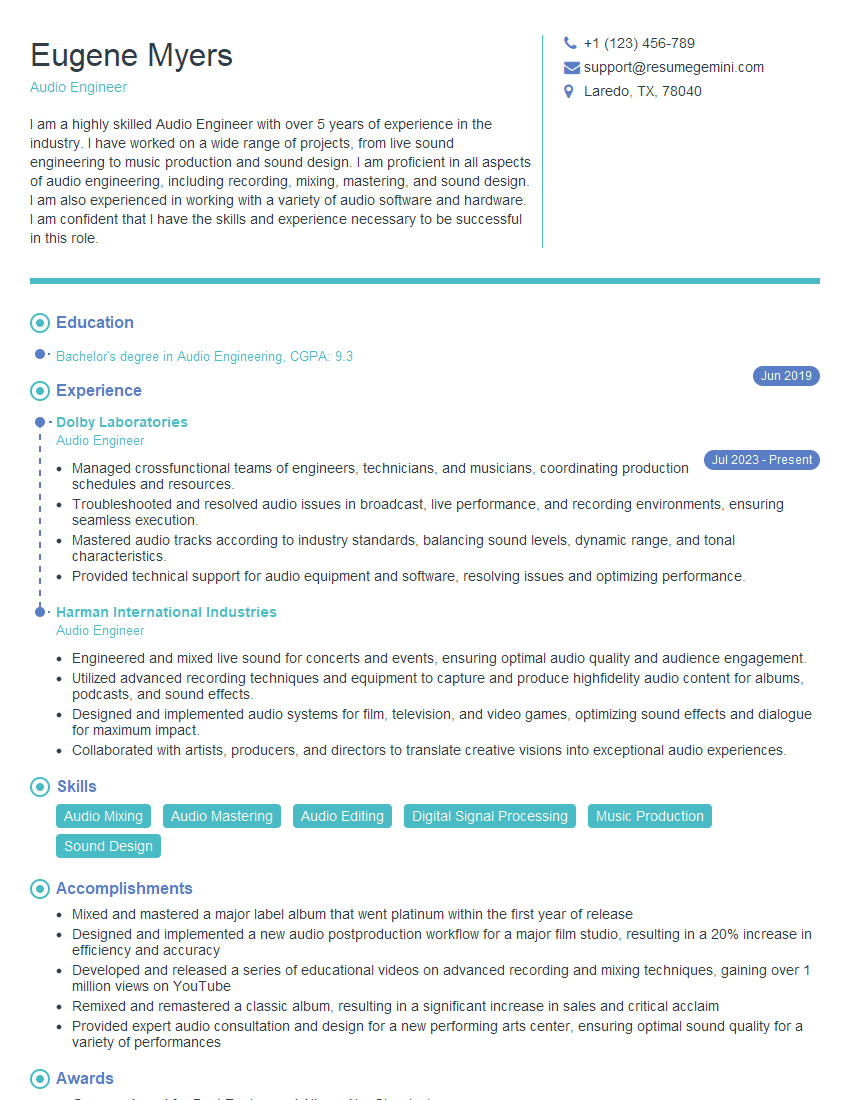
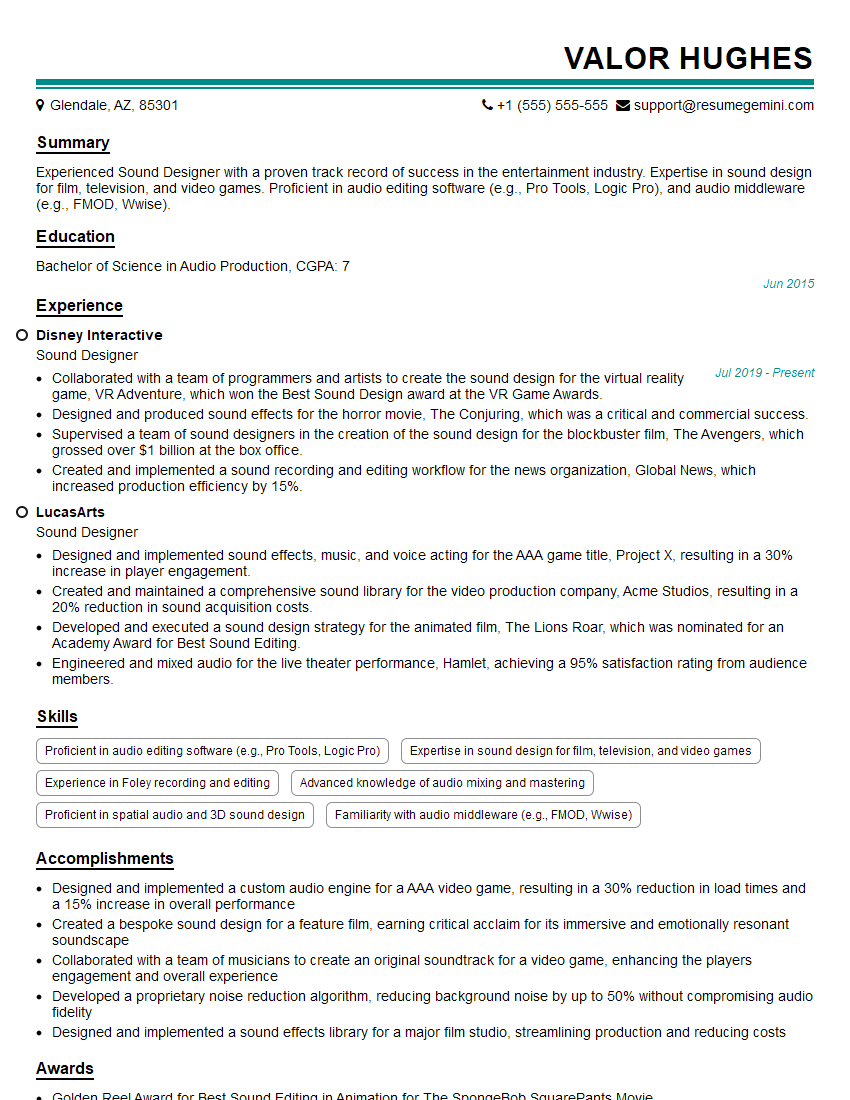
Mastering Sound FX Design opens doors to exciting and diverse career opportunities in the media and entertainment industries. Your skills are in high demand! To maximize your job prospects, crafting a compelling and ATS-friendly resume is crucial. ResumeGemini is a trusted resource to help you build a professional resume that showcases your abilities effectively. We provide examples of resumes tailored to Sound FX Design to help you get started. Invest time in your resume – it’s your first impression!
Explore more articles
Users Rating of Our Blogs
Share Your Experience
We value your feedback! Please rate our content and share your thoughts (optional).
What Readers Say About Our Blog
hello,
Our consultant firm based in the USA and our client are interested in your products.
Could you provide your company brochure and respond from your official email id (if different from the current in use), so i can send you the client’s requirement.
Payment before production.
I await your answer.
Regards,
MrSmith
hello,
Our consultant firm based in the USA and our client are interested in your products.
Could you provide your company brochure and respond from your official email id (if different from the current in use), so i can send you the client’s requirement.
Payment before production.
I await your answer.
Regards,
MrSmith
These apartments are so amazing, posting them online would break the algorithm.
https://bit.ly/Lovely2BedsApartmentHudsonYards
Reach out at [email protected] and let’s get started!
Take a look at this stunning 2-bedroom apartment perfectly situated NYC’s coveted Hudson Yards!
https://bit.ly/Lovely2BedsApartmentHudsonYards
Live Rent Free!
https://bit.ly/LiveRentFREE
Interesting Article, I liked the depth of knowledge you’ve shared.
Helpful, thanks for sharing.
Hi, I represent a social media marketing agency and liked your blog
Hi, I represent an SEO company that specialises in getting you AI citations and higher rankings on Google. I’d like to offer you a 100% free SEO audit for your website. Would you be interested?