Every successful interview starts with knowing what to expect. In this blog, we’ll take you through the top Surface Pattern Design interview questions, breaking them down with expert tips to help you deliver impactful answers. Step into your next interview fully prepared and ready to succeed.
Questions Asked in Surface Pattern Design Interview
Q 1. Describe your experience with Adobe Illustrator and Photoshop for surface pattern design.
Adobe Illustrator and Photoshop are my primary tools for surface pattern design. Illustrator is invaluable for creating the initial vector artwork, ensuring crisp lines and scalability for various applications. Its precision is essential for building complex repeating patterns. I use its powerful tools like the Pathfinder panel for manipulating shapes, the Pen tool for precise drawing, and the Pattern Options to create seamless repeats. Photoshop, on the other hand, is crucial for color correction, texture addition, and final artwork refinement. I frequently utilize Photoshop’s layer blending modes to achieve unique effects, its powerful brush tools for adding texture and detail, and its color adjustment layers for fine-tuning the palette. For example, I might create a repeating floral pattern in Illustrator, then bring it into Photoshop to add subtle watercolor texture or adjust the overall color harmony for a specific application like fabric printing.
Q 2. Explain your process for developing a surface pattern from concept to final artwork.
My pattern development process is iterative and involves several key stages. It begins with ideation and sketching, where I explore various concepts and translate them into rough hand-drawn designs. I then digitally refine my chosen sketch in Illustrator, creating clean vector artwork. This phase focuses on perfecting individual elements and establishing a foundational repeat. Next, I build the repeat within Illustrator’s pattern options, carefully adjusting elements to ensure seamless transitions. This often requires playing with scale and arrangement to achieve the desired visual impact. The subsequent stage is color palette development, often informed by color theory principles (explained further in the next answer). I experiment with various color schemes to determine the optimal aesthetic. Once I’m satisfied with the design and color, I move to final refinements in Photoshop, adding textures, subtle details, and making color adjustments for maximum impact. Finally, I prepare the artwork for print, ensuring correct file formats and resolutions for the intended printing method. This entire process is marked by constant evaluation and adjustment, ensuring a polished and professional final product.
Q 3. How do you incorporate color theory effectively into your designs?
Color theory is fundamental to successful surface pattern design. I utilize several key principles: Understanding the color wheel helps me choose harmonious combinations, like analogous (colors next to each other) or complementary (colors opposite each other). For instance, a calming palette might use analogous blues and greens, while a more vibrant design could employ complementary blues and oranges. I also consider the value (lightness or darkness) of colors to create depth and visual interest. A good balance of light and dark shades prevents the pattern from appearing flat. Saturation is another crucial factor; I use varying levels of saturation to create focal points and visual hierarchy. A highly saturated element will naturally draw the eye. Finally, I often use temperature, contrasting warm and cool colors to create dynamic effects. Think of a pattern with warm oranges and reds against cool blues and greens – this contrast creates energy and excitement. For example, in a recent project designing a pattern for children’s fabric, I used a bright, high-saturation palette of analogous colors to evoke a sense of playfulness and vibrancy.
Q 4. Describe your understanding of different print techniques (e.g., screen printing, digital printing).
Understanding different print techniques is crucial for creating designs that translate effectively onto different substrates (e.g., fabric, wallpaper). Screen printing offers a tactile, slightly imperfect look that’s ideal for certain aesthetics. It involves creating screens for each color, allowing for layering and achieving textured effects. However, screen printing can be less precise for complex designs and is often less cost-effective for large-scale production. Digital printing, on the other hand, offers incredible precision, allowing for intricate details and vibrant colors. It’s also more efficient for large-scale projects and is suitable for a wider range of materials. Each technique has its own unique characteristics influencing my design choices. For example, I might choose bolder, simpler designs for screen printing, while leveraging the capabilities of digital printing for intricate patterns requiring a multitude of colors and fine details. The decision of which method to use is always based on the client’s needs, budget, and the desired final aesthetic.
Q 5. How do you handle revisions and feedback on your designs?
Handling revisions and feedback is an integral part of the design process. I actively encourage client feedback throughout the development process, preferring regular check-ins rather than one large review at the end. I carefully consider all feedback and ensure I understand the client’s vision before making any changes. My approach is to document all revisions clearly and efficiently, often using version control systems or detailed notes. I believe in a collaborative approach and will explain my design choices to the client, ensuring they understand the reasoning behind my work. Through open communication and a clear understanding of the design brief, I aim to deliver designs that meet the client’s expectations and exceed their brief.
Q 6. Show me examples of your work that demonstrate your understanding of scale and repeat.
Unfortunately, I can’t directly *show* examples here. However, I can describe some projects. One recent design for a textile client involved a repeating geometric pattern using hexagonal shapes. Careful consideration was given to the scale of each hexagon relative to the overall repeat to create a visually balanced and dynamic pattern. The seamless repeat was achieved by meticulously aligning the hexagons across the pattern’s boundaries. Another project, a floral design for wallpaper, used a larger scale repeat to ensure the individual elements remained visually prominent without appearing crowded. The scale of the flowers and leaves was carefully chosen to balance the positive and negative space within the repeat, creating a visually pleasing and elegant design. The success in both projects was directly due to a strong understanding of scale and repeat, ensuring the patterns were both visually appealing and suitable for their intended applications.
Q 7. How do you stay current with the latest trends in surface pattern design?
Staying current in surface pattern design requires a multi-faceted approach. I regularly browse design blogs, online publications, and social media platforms like Instagram and Pinterest, paying close attention to emerging trends and color palettes. Attending industry conferences and workshops offers invaluable insights into new techniques and technologies. I also follow influential designers on various platforms, gaining inspiration from their work and learning from their creative processes. Furthermore, actively engaging with the design community through online forums and groups fosters a constant exchange of ideas and feedback, keeping me abreast of the latest developments. This commitment to ongoing learning and engagement ensures my designs remain innovative, contemporary, and commercially relevant.
Q 8. Explain your approach to creating patterns with different levels of complexity.
Creating surface patterns involves a spectrum of complexity, from simple motifs to intricate, layered designs. My approach hinges on a phased process. I begin with brainstorming and sketching, exploring basic shapes and repeating elements for simpler patterns. For more complex designs, I might employ techniques like tessellation (fitting shapes together without gaps) or incorporate multiple layers of motifs with varying scales and opacities. This allows me to build intricacy gradually. For instance, a simple pattern might be a single repeating flower, while a complex one might involve that flower, plus leaves, stems, and a background texture, all interacting to create visual depth. I always consider the intended application; a simple design might be perfect for children’s fabric, while a more elaborate design might suit high-end wallpaper.
- Simple: Repeating geometric shapes or a single, uncomplicated motif.
- Medium: Combination of several motifs with variations in scale and color, creating a more dynamic visual.
- Complex: Layered motifs, intricate tessellations, gradients, and potentially even digital illustration elements.
Q 9. How would you adapt a design for different applications (e.g., fabric, wallpaper, packaging)?
Adapting a design across different applications requires careful consideration of the material’s properties and the intended use. For example, a pattern designed for fabric needs to account for drape and potential distortion during sewing. A design for wallpaper needs to be suitable for seamless repetition across large walls, often demanding a larger repeat size than fabric. Packaging design necessitates thinking about the shape and size of the container, and how the pattern will interact with the product’s branding. I always adjust the scale, color saturation, and even the motifs themselves to optimize the design for its specific application. A floral pattern might be vibrant and large-scale for a summer dress, but more muted and smaller for sophisticated wallpaper. The level of detail might be reduced for packaging to ensure legibility at a smaller scale.
Q 10. Describe your experience with color palettes and their impact on design aesthetics.
Color palettes are fundamental to a design’s success. My experience has shown me that the right palette can dramatically alter a pattern’s mood and aesthetic. I often start by identifying a core mood or theme—rustic, modern, playful, luxurious—and then select colors that evoke that feeling. I might use color theory principles, like complementary or analogous color schemes, to create harmony and visual interest. For example, using analogous colors (colors next to each other on the color wheel) creates a sense of calmness, while complementary colors (opposite each other on the color wheel) provide a more vibrant contrast. I also consider the intended audience and the cultural context. The color choices would differ drastically between a pattern for children’s clothing and a pattern for high-end home furnishings. Sometimes, I even create multiple color palettes for a single design, giving clients options to choose from.
I also use color tools to explore different options and test the palettes in different lighting conditions to see how the colors would look in the final product. A tool like Adobe Color is invaluable in this process.
Q 11. How do you approach creating designs for a specific target market?
Designing for a specific target market necessitates thorough market research. I investigate demographics, lifestyle, and existing trends related to the target audience. This informs my color palette, motif choices, and overall style. For example, patterns for children often feature bright, playful colors and simple, recognizable shapes, while patterns for a more mature audience might lean toward more sophisticated colors and intricate designs. I also consider cultural sensitivities; certain motifs or colors might hold different meanings in different cultures, and avoiding unintended connotations is crucial.
For example, a pattern for teenage girls might incorporate trendy geometric shapes and bold, vibrant colors, contrasting with a more minimalist and subdued design for a sophisticated adult clientele.
Q 12. Explain your process for translating a sketch into a digital pattern.
My process of translating a sketch into a digital pattern involves several steps. First, I carefully scan my sketch at a high resolution. Then, I use digital design software, primarily Adobe Illustrator, to trace and refine the sketch. This involves vectorizing the artwork, ensuring clean lines and precise shapes. I often use layers to organize the different elements of the design, making it easier to adjust individual components. Once the individual motifs are complete, I arrange them to create a repeating pattern using Illustrator’s pattern-making tools. This allows me to easily adjust the repeat size and view how the pattern will look when tiled. Finally, I refine the color palette and details to ensure that the digital version matches my original creative vision.
Q 13. How do you handle technical aspects of pattern design, such as repeat sizes and color separations?
Technical aspects are paramount. The repeat size is crucial—it determines how the pattern tiles seamlessly. The choice depends on the application; larger repeats work well for wallpaper, while smaller repeats are suitable for textiles. I use software features to ensure the pattern repeats flawlessly. Color separations are essential for printing. For instance, if a design uses multiple colors, I create separate files for each color, ensuring accurate color reproduction during printing. This is where understanding CMYK and Pantone color systems is essential. I frequently check my work by creating mock-ups to visually verify the pattern’s repeat and ensure color accuracy.
Q 14. How do you balance creative vision with client requirements?
Balancing creative vision with client requirements is a crucial skill. I begin by thoroughly understanding the client’s needs, including their target market, budget, and any existing brand guidelines. This information informs my initial design concepts. I then present several design options, each reflecting my creative vision while incorporating the client’s specifications. This collaborative approach ensures that the final design meets both aesthetic and practical requirements. I’m prepared to iterate and refine the designs based on client feedback, always aiming for a harmonious blend of artistic expression and client satisfaction. Open communication and a willingness to compromise are key to achieving this balance.
Q 15. What are your preferred methods for presenting your work to clients?
Presenting my work to clients is a crucial part of the design process, and I approach it strategically. I believe in showcasing my designs in a way that highlights both their aesthetic appeal and their practical applications. My preferred methods include creating mood boards that contextualize the patterns within a broader design concept. This allows clients to visualize how the patterns might be used in a specific product or collection. I also utilize digital presentations with high-resolution images and animated sequences, demonstrating the patterns’ movement and adaptability on different surfaces. This method is especially effective for showcasing seamless repeats and how the design performs across various applications. Finally, I always offer physical samples – printed on the intended fabric or material – allowing the client to experience the texture and drape of the final product firsthand. This tactile element is incredibly important, as it allows for a more complete understanding of the design’s potential.
Career Expert Tips:
- Ace those interviews! Prepare effectively by reviewing the Top 50 Most Common Interview Questions on ResumeGemini.
- Navigate your job search with confidence! Explore a wide range of Career Tips on ResumeGemini. Learn about common challenges and recommendations to overcome them.
- Craft the perfect resume! Master the Art of Resume Writing with ResumeGemini’s guide. Showcase your unique qualifications and achievements effectively.
- Don’t miss out on holiday savings! Build your dream resume with ResumeGemini’s ATS optimized templates.
Q 16. What software are you proficient in, beyond Adobe Illustrator and Photoshop?
Beyond Adobe Illustrator and Photoshop, I’m proficient in a range of software crucial for surface pattern design and its various applications. This includes CorelDRAW, which is excellent for vector illustration and its unique handling of color palettes. I also use Adobe InDesign for creating comprehensive design presentations and mock-ups. Furthermore, I’m experienced with textile design software like Textile Designer, which offers specialized tools for creating realistic fabric simulations and pattern repeats. This software is invaluable for predicting how a pattern might look and behave on different fabrics.
Q 17. Describe your experience working with different types of fabric textures.
Working with various fabric textures is a fundamental aspect of surface pattern design. The texture of the fabric significantly impacts how a pattern appears and feels. For example, a bold geometric pattern might look crisp and defined on a smooth cotton, but it could appear softer and more diffused on a textured linen. I’ve worked extensively with natural fibers like cotton, linen, silk, and wool, each demanding a unique approach to design. With cotton, I might focus on designs with sharp lines and bold colors. Linen’s texture often inspires more organic and flowing designs. Silk’s sheen might require subtler patterns that complement its luminosity. Understanding the drape and weight of the fabric is also crucial – a heavy wool might need a larger scale design than a lightweight silk. I meticulously consider these aspects during the design phase, adapting my style and scale accordingly. I also have experience working with synthetic fabrics, each with its own unique characteristics and requiring a different consideration for color and print.
Q 18. How do you ensure your designs are commercially viable?
Commercial viability is a key consideration throughout my design process. I approach it by staying informed about current market trends through industry publications, trade shows, and competitive analysis. This informs my design decisions, ensuring that my creations resonate with current consumer preferences. I also consider the practical aspects of production, such as repeat size, color palettes (limiting colors to reduce printing costs), and the adaptability of the design across various applications. For instance, a design created for a dress might be easily adapted for scarves or home textiles, maximizing its commercial potential. Finally, I always factor in the cost-effectiveness of printing techniques and fabric choices. This holistic approach ensures my designs are not only aesthetically pleasing but also commercially feasible and profitable.
Q 19. What is your approach to creating seamless patterns?
Creating seamless patterns is a specialized skill requiring precision and an understanding of repetition. My approach starts with sketching and exploring potential motifs. I then carefully construct my designs in vector software like Illustrator, ensuring the pattern elements seamlessly connect at the edges. For digital creation, I leverage the software’s ’tile’ or ‘repeat’ function, meticulously checking for any gaps or misalignments. I use different techniques depending on the desired repeat, for example, I might use the ‘offset’ repeat for a more dynamic feel, or a ‘half-drop’ repeat for a more traditional look. Throughout the process, I continually zoom in and out to check for imperfections, ensuring the pattern works at various scales. Finally, I create multiple mock-ups on simulated fabric to visualize the pattern’s impact on different textures and application.
Q 20. Describe a time you had to solve a design challenge.
In one project, a client approached me requiring a pattern that combined elegance with a sense of playfulness for a children’s clothing line. The initial designs were deemed too childish, failing to capture the desired sophistication. To solve this, I decided to incorporate elegant elements such as subtle floral patterns, but instead of using realistic flowers, I opted for stylized, almost cartoonish versions. The combination of whimsical shapes with elegant color palettes yielded a final design that met both criteria. This involved several iterations and involved testing different color combinations and levels of abstraction to find the perfect balance. It demonstrated the importance of understanding the client’s needs while creatively navigating design constraints.
Q 21. Explain your understanding of pattern repeats (half-drop, offset, etc.).
Pattern repeats are crucial for surface design, determining how a design is replicated across a surface. Understanding these repeats is essential for ensuring a visually appealing and functionally sound design. A straight repeat is the simplest, where the pattern replicates directly, vertically and horizontally. A half-drop repeat shifts each row of the pattern half the width of the repeat unit, creating a staggered effect. This is commonly used to add visual interest and dynamism. An offset repeat is similar but can involve a more complex shift, sometimes even a quarter or three-quarter drop. The choice of repeat significantly affects the final look of the design. For instance, a half-drop repeat can work beautifully with organic shapes, while a straight repeat might be ideal for geometric patterns. The understanding of different types of repeats is crucial to achieve the desired aesthetic and ensure the pattern is suitable for a given application.
Q 22. How do you manage your time effectively when working on multiple projects?
Effective time management is crucial when juggling multiple surface pattern design projects. I employ a project management system that combines detailed planning with flexible adaptation. This involves several key strategies:
- Prioritization: I use a prioritized task list, ranking projects based on deadlines, client urgency, and project complexity. This ensures that the most pressing tasks receive immediate attention.
- Time Blocking: I allocate specific time blocks for each project, scheduling them into my day or week. This dedicated time helps minimize distractions and maximizes focused work. For instance, I might dedicate Monday mornings to sketching, Tuesday afternoons to digital painting, and Wednesday to client communication.
- Regular Review and Adjustment: I regularly review my progress, adjusting my schedule as needed. Unexpected delays or changes in client requirements are common, so flexibility is key. This involves re-prioritizing tasks and adjusting time blocks to stay on track.
- Utilizing Project Management Tools: Tools like Trello or Asana help me visualize project progress, manage deadlines, and collaborate effectively with clients or teams, if applicable.
For example, recently I was working on three projects simultaneously: a children’s book illustration, a textile print for a fashion brand, and wallpaper design for a home décor company. By using this system, I successfully met all deadlines and delivered high-quality work for each client.
Q 23. What are your strengths as a surface pattern designer?
My strengths as a surface pattern designer lie in my combination of artistic skill, technical proficiency, and a strong understanding of market trends. Specifically:
- Creative Vision and Concept Development: I excel at generating fresh, innovative designs, translating abstract ideas into visually appealing and marketable patterns.
- Proficiency in Software and Techniques: I am highly proficient in Adobe Illustrator, Photoshop, and other relevant design software. I’m comfortable working with various printing techniques, understanding the technical limitations and possibilities of each, from screen printing to digital textile printing.
- Trend Awareness and Market Research: I stay updated on current design trends through industry publications, attending trade shows, and analyzing competitor products. This allows me to create designs that are both aesthetically pleasing and commercially viable.
- Adaptability and Collaboration: I can adapt my style to suit different clients and projects, and I am a strong collaborator, effectively working with other designers, manufacturers, and clients.
For instance, I recently created a collection of textile prints inspired by vintage botanical illustrations, successfully blending classic aesthetics with modern color palettes and a unique design language. This combined my artistic vision with a market understanding of current design preferences.
Q 24. How do you handle constructive criticism?
I view constructive criticism as an invaluable tool for professional growth. My approach to handling it involves several steps:
- Active Listening: I listen carefully to the feedback, seeking to understand the critic’s perspective and the reasoning behind their comments.
- Objective Assessment: I objectively evaluate the criticism, separating subjective opinions from factual observations about the design’s strengths and weaknesses.
- Seeking Clarification: If aspects of the criticism are unclear, I ask clarifying questions to ensure I fully understand the points raised.
- Implementation and Iteration: I thoughtfully incorporate the constructive feedback into my design process, making necessary revisions and iterations to improve the final product. I document all changes for future reference.
For example, I once received feedback on a design that the color palette was too muted for the target market. I used that feedback to create a bolder, more vibrant version which ultimately resonated better with the client and the intended audience.
Q 25. What are your salary expectations?
My salary expectations are commensurate with my experience, skills, and the specifics of the role. I am open to discussing a competitive salary range based on the market rate for experienced surface pattern designers with my skill set and the responsibilities involved in this position. I am also open to considering benefits packages.
Q 26. Describe your understanding of copyright and intellectual property.
Copyright and intellectual property are crucial aspects of my work. I understand that copyright protects original works of authorship, including surface pattern designs. This protection automatically exists from the moment a design is created in a tangible form (e.g., a digital file or a physical sketch). This means that I own the copyright to my designs unless I have explicitly transferred that right to a client through a legally binding contract.
I am aware of the importance of obtaining proper licenses for any third-party imagery or elements I incorporate into my designs. This includes obtaining permission from photographers, illustrators, or other rights holders. I also understand the concept of fair use, but I apply it cautiously and only when appropriate.
Furthermore, I actively protect my intellectual property by registering my designs with relevant organizations whenever appropriate, especially when dealing with mass production or licensing agreements.
Q 27. How do you ensure the technical feasibility of your designs for mass production?
Ensuring the technical feasibility of my designs for mass production is a critical part of my design process. This involves understanding the limitations and capabilities of different manufacturing techniques, such as screen printing, digital printing, and textile weaving.
- Color Palette Considerations: I choose colors that are readily available and reproducible by the chosen printing method.
- Repeatability: My designs are created with carefully considered repeats to ensure seamless pattern alignment across different materials and surfaces. The repeat size is optimized to minimize waste and maximize efficiency during production.
- File Preparation: I prepare my artwork using the correct file formats and resolutions appropriate for the specific printing technique. This minimizes any issues during the manufacturing process.
- Collaboration with Manufacturers: Early and ongoing communication with manufacturers is key. I regularly consult with them during the design process to address any potential production challenges and to ensure that my designs are technically feasible.
For instance, when designing for screen printing, I would avoid overly complex patterns with many small details, opting for simpler, clearer designs that are easy to reproduce and achieve high-quality results.
Q 28. What are your long-term career goals in surface pattern design?
My long-term career goals involve establishing myself as a respected and sought-after surface pattern designer. This includes:
- Building a Strong Portfolio: Continuously developing my portfolio with diverse and high-quality designs across various applications, such as textiles, wallpaper, and stationery.
- Client Relationship Building: Cultivating long-term relationships with clients by consistently delivering high-quality work and building strong professional relationships.
- Expanding into Licensing: Exploring opportunities to license my designs to manufacturers and retailers, increasing the reach and impact of my work.
- Potential for Teaching/Mentoring: I would like to share my knowledge and experience by potentially teaching or mentoring aspiring surface pattern designers in the future.
- Exploring new mediums: I want to constantly push boundaries and experiment with new design tools and techniques in the field.
Ultimately, my aim is to create beautiful and functional designs that bring joy and value to people’s lives while establishing a successful and fulfilling career in the field.
Key Topics to Learn for Your Surface Pattern Design Interview
- Color Theory and Application: Understanding color palettes, harmonies, and their impact on design aesthetics. Practical application includes demonstrating how you choose colors for different target audiences and project requirements.
- Pattern Design Principles: Mastering repetition, rhythm, balance, and contrast in pattern creation. Practical application involves showcasing your understanding through portfolio examples demonstrating these principles in action.
- Software Proficiency: Demonstrating expertise in industry-standard software like Adobe Illustrator, Photoshop, and potentially others relevant to your target role. Be prepared to discuss your workflow and problem-solving skills within these programs.
- Trend Analysis and Forecasting: Understanding current and emerging design trends and their influence on pattern design. Practical application involves discussing how you stay updated on industry trends and incorporate them into your work.
- Textile Printing Techniques: Familiarity with various printing methods (screen printing, digital printing, etc.) and their impact on pattern design and final product. Practical application involves discussing the choices you make based on the project’s needs and budget.
- Design Process and Workflow: Articulating your approach to design projects, from initial concept to final output. Highlight your problem-solving skills and ability to adapt to client feedback.
- Portfolio Presentation: Effectively showcasing your best work and explaining the design choices made in each piece. Prepare to discuss your creative process and the challenges you overcame.
Next Steps
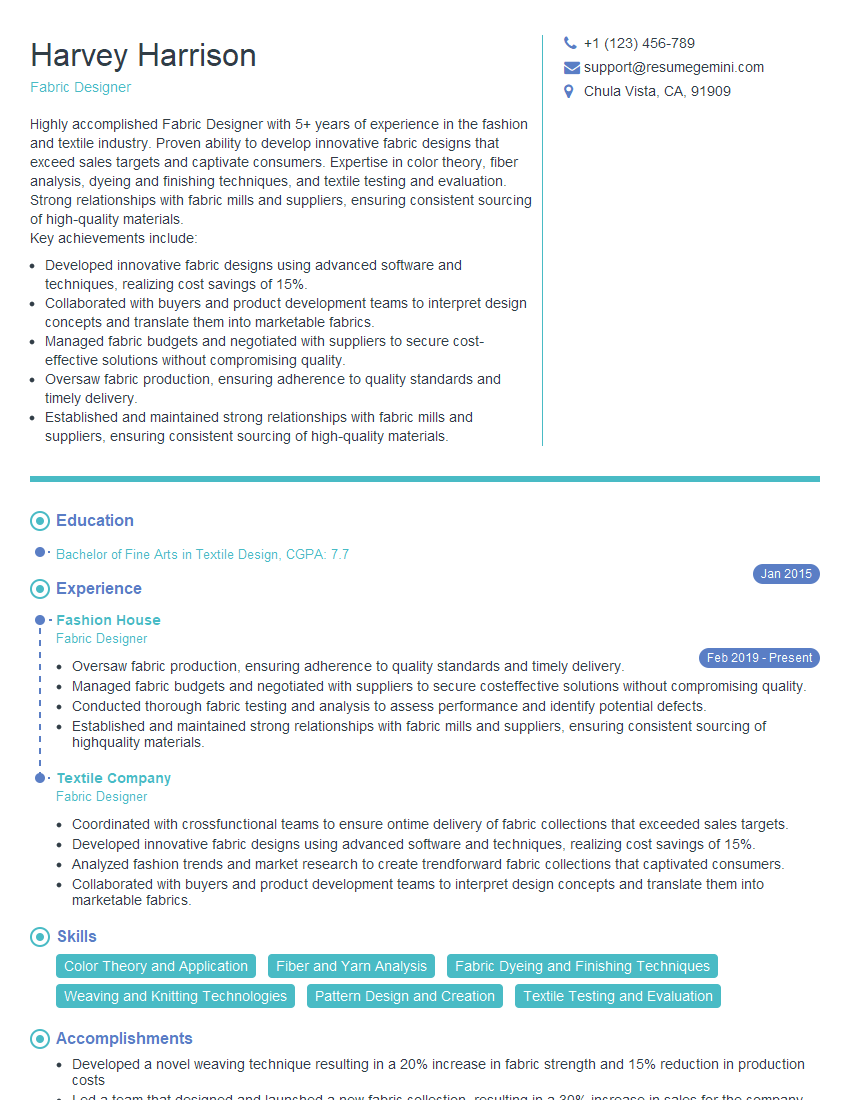
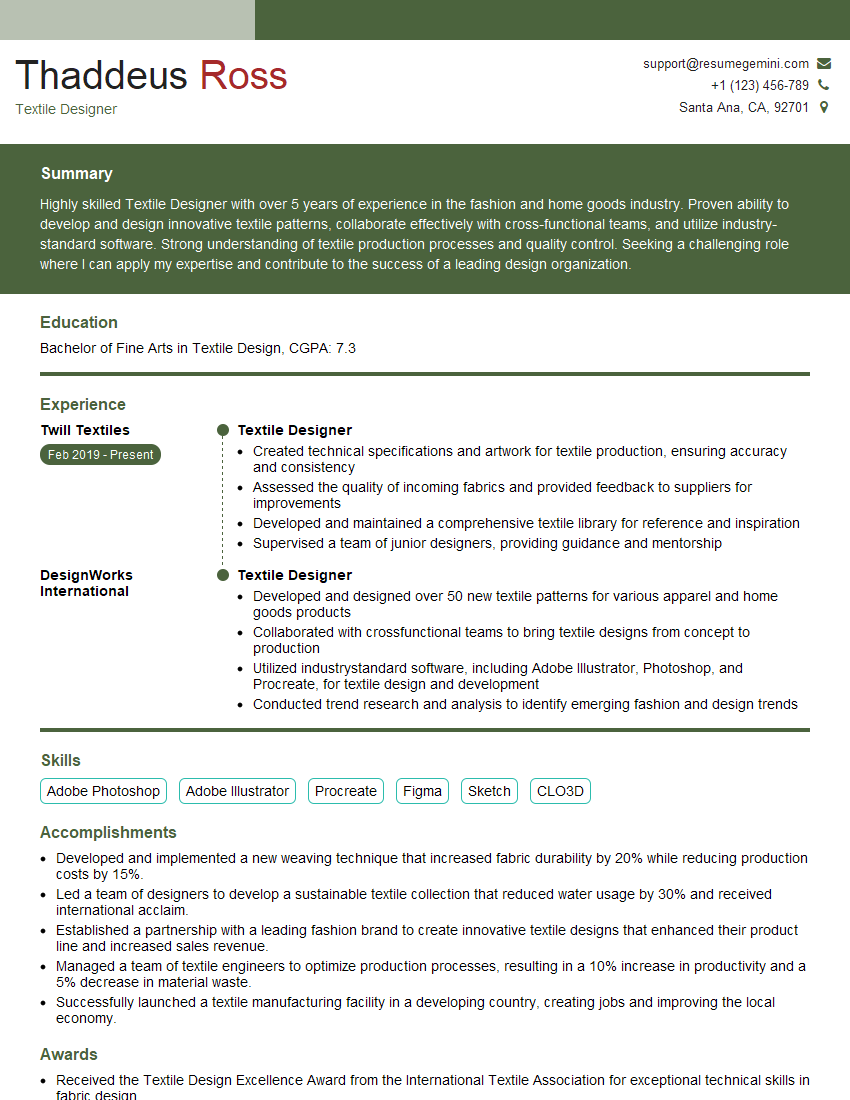
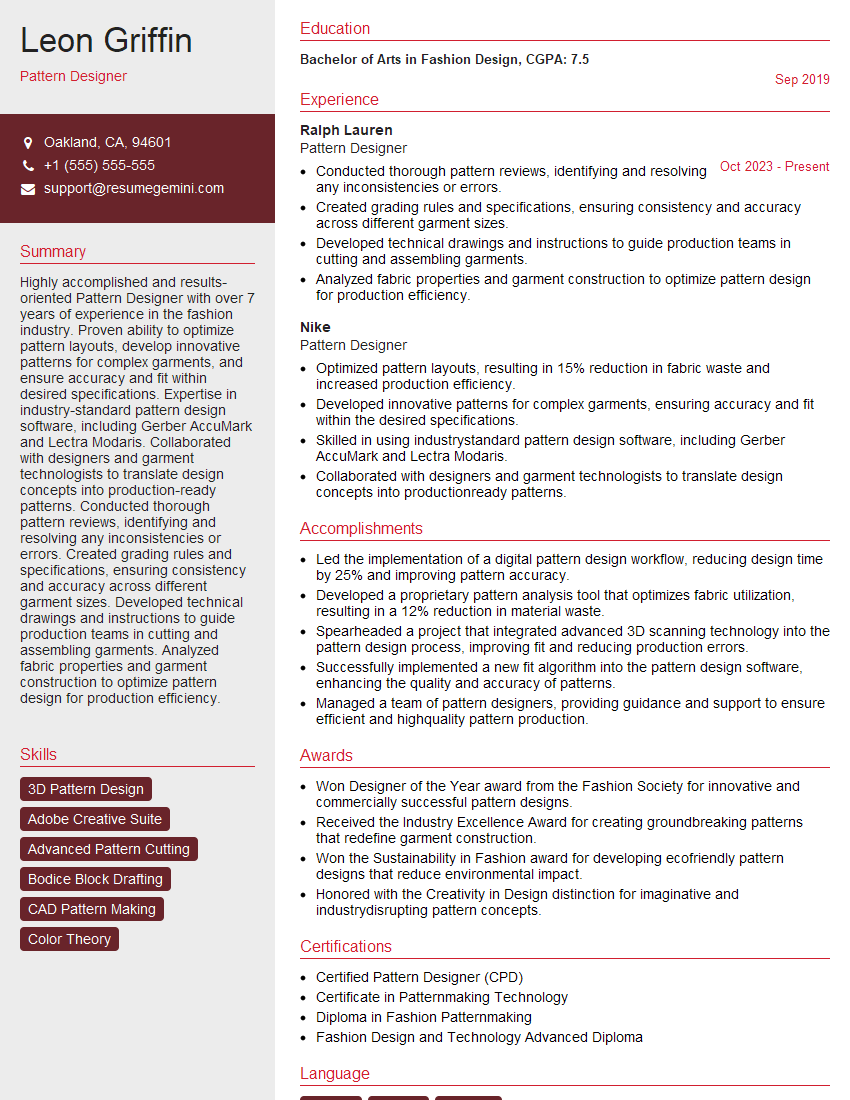
Mastering Surface Pattern Design opens doors to exciting opportunities in various creative industries, from fashion and textiles to home decor and beyond. A strong portfolio is essential, but a well-crafted resume is your first impression. An ATS-friendly resume significantly increases your chances of getting your application noticed. To help you create a compelling and effective resume, we recommend using ResumeGemini. ResumeGemini provides tools and resources to build a professional resume, and we offer examples of resumes tailored specifically for Surface Pattern Design professionals to guide you. Invest time in crafting a strong resume – it’s your key to unlocking your career potential.
Explore more articles
Users Rating of Our Blogs
Share Your Experience
We value your feedback! Please rate our content and share your thoughts (optional).
What Readers Say About Our Blog
hello,
Our consultant firm based in the USA and our client are interested in your products.
Could you provide your company brochure and respond from your official email id (if different from the current in use), so i can send you the client’s requirement.
Payment before production.
I await your answer.
Regards,
MrSmith
hello,
Our consultant firm based in the USA and our client are interested in your products.
Could you provide your company brochure and respond from your official email id (if different from the current in use), so i can send you the client’s requirement.
Payment before production.
I await your answer.
Regards,
MrSmith
These apartments are so amazing, posting them online would break the algorithm.
https://bit.ly/Lovely2BedsApartmentHudsonYards
Reach out at [email protected] and let’s get started!
Take a look at this stunning 2-bedroom apartment perfectly situated NYC’s coveted Hudson Yards!
https://bit.ly/Lovely2BedsApartmentHudsonYards
Live Rent Free!
https://bit.ly/LiveRentFREE
Interesting Article, I liked the depth of knowledge you’ve shared.
Helpful, thanks for sharing.
Hi, I represent a social media marketing agency and liked your blog
Hi, I represent an SEO company that specialises in getting you AI citations and higher rankings on Google. I’d like to offer you a 100% free SEO audit for your website. Would you be interested?