Feeling uncertain about what to expect in your upcoming interview? We’ve got you covered! This blog highlights the most important Surveying and Levelling Techniques interview questions and provides actionable advice to help you stand out as the ideal candidate. Let’s pave the way for your success.
Questions Asked in Surveying and Levelling Techniques Interview
Q 1. Explain the difference between leveling and surveying.
Surveying and leveling are closely related but distinct surveying techniques. Surveying is the broader field encompassing the determination of the relative positions of points on or near the Earth’s surface, encompassing many methods like traversing, triangulation, and GPS. Leveling, on the other hand, is a specific surveying technique focused on determining the difference in elevation between points. Think of it this way: surveying tells you where things are horizontally and vertically, while leveling specifically focuses on the vertical aspect.
Imagine you’re building a house. Surveying would determine the overall location of the house and its boundaries. Leveling would be crucial for ensuring the foundation is perfectly level, otherwise, your house might be leaning!
Q 2. Describe the various types of leveling instruments.
Several types of leveling instruments exist, each with varying precision and application:
- Optical Level: The most common type, using a telescope and a level vial to establish a horizontal line of sight. They’re relatively inexpensive and easy to use for most leveling tasks.
- Digital Level: These levels incorporate electronic sensors to directly measure the elevation difference. They offer faster data acquisition and reduce human error in reading the rod. Many modern digital levels also include data logging capabilities.
- Automatic Level (self-leveling): These levels automatically compensate for small tilting using a compensator mechanism. This greatly simplifies the leveling process and increases efficiency.
- Precise Level: Designed for high-precision work, such as precise leveling for large engineering projects. These instruments have very high magnification and minimal collimation error.
The choice of instrument depends on the required accuracy and the complexity of the project. For basic leveling around a building site, an optical or automatic level may suffice. High-precision engineering projects usually require a precise level.
Q 3. What are the different methods of traversing?
Traversing is a surveying method used to establish a network of points by measuring angles and distances. Different methods exist:
- Open Traversing: This involves traversing from a known point to an unknown point. Accuracy is dependent on the accuracy of the initial known position and the measurements taken along the traverse.
- Closed Traverse: The traverse starts and ends at the same point, forming a closed loop. This allows for error detection and adjustment as the final point should theoretically coincide with the starting point.
- Closed-Connection Traverse: This traverse connects two known points, providing a check on the accuracy of the measurements.
The choice of traversing method depends on the context. Open traversing is often used for route surveys, whereas closed traverses are preferred where high accuracy is essential.
Q 4. How do you perform a closed traverse and adjust for errors?
In a closed traverse, after measuring all angles and distances, the traverse is adjusted to minimize errors. Errors arise from several factors including instrument limitations and human error. The adjustment process ensures the angles sum to the correct total and the traverse closes geometrically.
Steps in performing a closed traverse and adjusting for errors:
- Measurement: Measure all the angles and distances with the appropriate instrument.
- Angle Adjustment: If the sum of interior angles doesn’t equal the theoretical sum ((n-2)*180 where n is the number of sides), distribute the error proportionally among the angles.
- Coordinate Calculation: Using the adjusted angles and measured distances, compute the coordinates of each point using coordinate geometry. This will typically involve traversing calculations using trigonometry.
- Linear Misclosure: Calculate the linear misclosure (the difference between the calculated coordinates of the closing point and the known coordinates of the starting point).
- Error Adjustment: Use appropriate methods to adjust the coordinates of the points to minimize the misclosure. Common methods involve using the Bowditch method or the least squares adjustment.
The Bowditch method is a simple method, while least squares provides a more rigorous and statistically sound adjustment.
Q 5. Explain the principle of least squares adjustment.
The principle of least squares adjustment is a mathematical technique used to minimize the sum of the squares of the residuals (the differences between observed values and calculated values). In surveying, it’s employed to adjust measurements to obtain the most probable values of the unknowns. This principle ensures that no single measurement has an unduly large influence on the final adjusted values.
Imagine you have several measurements of the same distance, each slightly different due to measurement error. The least squares method finds the ‘best-fit’ value that minimizes the overall error across all measurements. It’s based on the assumption that errors are normally distributed. Sophisticated software packages are typically used to implement least-squares adjustments in surveying projects.
Q 6. What are the sources of errors in leveling?
Several sources can contribute to errors in leveling:
- Instrumental Errors: Collimation error (the telescope not being perfectly aligned), curvature of the level vial, and inaccurate leveling of the instrument.
- Personal Errors: Incorrect reading of the leveling rod, improper setting of the instrument, and mistakes in recording data.
- Natural Errors: Curvature of the Earth and atmospheric refraction affect the line of sight. Temperature variations can also affect instrument performance.
- Environmental Errors: Ground settlement or movement during the leveling process can introduce errors.
Careful procedures and meticulous attention to detail are crucial to minimizing these errors.
Q 7. How do you compensate for curvature and refraction in leveling?
Curvature and refraction affect leveling measurements because the line of sight is not perfectly straight. Curvature causes the line of sight to curve downwards, while refraction bends the light upwards. These effects are significant over longer distances.
Compensation for curvature and refraction is usually done using correction formulas. These formulas calculate the correction based on the distance between instrument and rod. Alternatively, modern leveling instruments may include software to automatically apply these corrections based on the measured distance. Many times, the effects are negligible over short distances but become increasingly important in longer-distance leveling. The combined correction is often applied to ensure accurate elevation determination, especially in precise leveling work.
Q 8. Describe the process of setting out a building using coordinates.
Setting out a building using coordinates involves precisely locating the building’s corners and key points on the ground based on their known coordinates in a chosen coordinate system. This is crucial for ensuring the building aligns with its design and legal boundaries. Think of it like drawing a perfect square on a giant piece of graph paper – the ground!
The process typically involves:
- Obtaining Coordinates: The architect or engineer provides the coordinates of the building’s corners and other significant points in a suitable coordinate system (e.g., UTM, State Plane). These are usually part of the building’s design plans.
- Establishing a Control Network: We set up a control network of known points on the site, accurately surveyed beforehand. These points will serve as reference points for our setting-out process. Think of these points as the main axes of that giant graph paper.
- Using a Total Station or GPS: A total station or a GPS receiver is used to measure the distances and angles from the control points to the desired building corners. The instrument is precisely positioned over one of the control points, and then measurements are taken to the new points.
- Calculating and Setting Out: Based on the known coordinates of the control points and the measured distances and angles, the coordinates of the building corners are calculated. Then we use the instrument to pinpoint the exact location of each corner point on the ground by precisely setting the correct distances and angles.
- Verification and Adjustment: After setting out the main corners, we perform checks to ensure accuracy and make any small adjustments needed. This is critical for maintaining the integrity of the building’s structure and to ensure that the building fits its intended location.
For example, imagine setting out a corner of a building with coordinates (1000.00 N, 2000.00 E) relative to a known benchmark. The total station or GPS system will guide the surveyor to place a marker precisely at this location on the ground.
Q 9. What are the different types of surveying equipment?
Surveying equipment encompasses a wide range of tools designed for precise measurement and data acquisition. These tools have evolved significantly over time, and some of the key types include:
- Total Stations: These highly sophisticated electronic instruments measure distances, angles, and elevations simultaneously. They’re essential for various surveying tasks, from setting out buildings to creating topographic maps.
- GPS Receivers: Global Positioning System (GPS) receivers use signals from satellites to determine precise three-dimensional coordinates. They’re extensively used for large-scale mapping and control surveys.
- Levels: Levels are used for determining elevations, ensuring a consistent horizontal plane for construction and other works. They range from simple hand levels to highly precise automatic levels.
- Theodolites: These instruments measure horizontal and vertical angles with high accuracy. They are often combined with EDM (electronic distance measurement) systems for complete measurements.
- EDM (Electronic Distance Measurement) Instruments: These devices measure distances accurately using infrared or laser technology. They are often used in conjunction with theodolites or total stations.
- Measuring Tapes: Although less technologically advanced, measuring tapes are essential for shorter distances and verifying measurements.
- Prisms/Targets: These are reflectors used with total stations and EDM instruments to improve accuracy and range of measurements.
- Data Collectors: These devices record and store survey data, often with field computing capabilities.
The choice of equipment depends heavily on the survey’s purpose, scale, and required precision. A small-scale site survey might only require a level and measuring tape, whereas a large-scale infrastructure project would involve total stations, GPS, and data collectors working in tandem.
Q 10. Explain the function of a total station.
A total station is a highly versatile and precise surveying instrument that combines the functions of an electronic theodolite (for measuring angles), an electronic distance meter (EDM) (for measuring distances), and an electronic data recorder. Imagine it as a highly intelligent and accurate three-in-one tool.
Its main functions include:
- Measuring Horizontal and Vertical Angles: It precisely measures angles in both horizontal and vertical planes with extreme accuracy.
- Measuring Distances: Using either infrared or laser technology, it measures the distance to a target (prism) with high precision.
- Recording Data: The collected angle, distance, and height data are automatically recorded and stored within the instrument or on a data collector.
- Calculating Coordinates: It can process the measurements to calculate the three-dimensional coordinates of points, facilitating precise mapping and setting-out tasks.
- Stakeout/Setting Out: By inputting coordinates, the total station can guide the surveyor to set out points in the field with great accuracy.
Total stations are used in a wide array of surveying applications, including topographic surveys, construction setting out, and cadastral surveys. Their accuracy and efficiency have revolutionized the surveying industry.
Q 11. How do you perform a resection?
Resection is a surveying technique used to determine the coordinates of an instrument’s position by measuring angles to at least two (but preferably three or more) points with known coordinates. Imagine you are lost in a forest but know the location of three distinct landmarks; resection allows you to figure out your precise location.
Here’s how it’s performed:
- Identify Control Points: Select at least three points with known coordinates (control points). These should be visible from the instrument’s location and be well-defined. The better the distribution of the control points, the more reliable the results.
- Set up the Total Station: Set up the total station at the unknown point.
- Measure Angles: Measure the horizontal angles between the control points, starting with the instrument pointing to the first selected control point.
- Calculate Coordinates: Use the measured angles and the known coordinates of the control points, and solve the intersection equations to compute the coordinates of the total station’s location. Specialized software packages or mathematical formulas are used for this calculation.
- Check for Accuracy: Multiple Resections with different points should be performed to check for accuracy and consistency. If possible, conduct a third resection and take the average, discarding any results that are notably disparate. This helps ensure reliability and detect any mistakes.
Resection is especially useful when establishing control points in inaccessible locations. However, it’s important to ensure that the measured angles are accurate and the known coordinates of the control points are reliable.
Q 12. What are the different coordinate systems used in surveying?
Various coordinate systems are used in surveying, each with its own advantages and disadvantages depending on the application and geographic area. The selection of the right coordinate system significantly impacts the accuracy and applicability of the survey results.
- Geographic Coordinate System (GCS): This system uses latitude and longitude to define locations on the Earth’s surface. It’s based on a spherical or ellipsoidal model of the Earth, making it suitable for large-scale mapping and global positioning systems (GPS).
- Projected Coordinate System (PCS): A PCS transforms the curved surface of the Earth into a flat plane, making it suitable for local or regional surveying applications. This is done using map projections that minimize distortion in the area of interest. Common examples include Universal Transverse Mercator (UTM) and State Plane Coordinate Systems.
- Local Coordinate Systems: These systems are defined for specific projects or local areas and are often based on arbitrary origins and orientations. This is particularly useful for smaller surveys where simplicity and ease of computation are prioritized. An example might be a local coordinate system set up on a construction site.
The choice between these coordinate systems involves understanding the project’s requirements and geographic extent. Large-scale projects that involve global coverage typically use a GCS like WGS84 (World Geodetic System 1984) as a reference, while smaller projects utilize a PCS for ease of use in local calculations.
Q 13. Explain the concept of datum.
A datum is a reference surface or point from which elevations and coordinates are measured. It’s like a foundation upon which the entire system of spatial positioning is built. Think of it as the zero point on a ruler—without a datum, distances and locations are meaningless in a surveying context.
Different types of datums exist:
- Horizontal Datum: Defines the location of points on the Earth’s surface and determines the origin and orientation of coordinate systems. It is essentially a reference ellipsoid approximating the shape of the Earth.
- Vertical Datum: Defines the elevation of points relative to a specific reference surface, often mean sea level. It is a reference surface of the geoid, which is closely related to mean sea level but accounts for variations in gravitational pull.
It is critical to use a consistent datum throughout a survey project to avoid errors and inconsistencies. Choosing the appropriate datum is dependent on the project’s scale, geographic location, and required accuracy. Different countries and regions may utilize different datums, necessitating careful coordination between various projects.
Q 14. How do you use GPS for surveying?
GPS (Global Positioning System) is a satellite-based navigation system that provides precise three-dimensional coordinates of any point on Earth. It’s become an invaluable tool for surveying, allowing for rapid and accurate data acquisition, even in challenging terrain.
Here’s how GPS is used in surveying:
- Establishing Control Points: GPS receivers are used to precisely determine the coordinates of control points that form the basis of a survey network. This is commonly known as GPS surveying.
- Real-time Kinematic (RTK) GPS: This advanced technique provides centimeter-level accuracy by using two or more receivers in tandem, one at a known location and one at an unknown location. The difference in the signals received helps improve the precision. This is very useful in construction, mapping and other applications requiring high accuracy.
- Post-Processed GPS: Multiple GPS measurements are taken over time, and the data is processed later using specialized software to improve accuracy. This is especially useful where RTK may not be practical due to terrain or other limitations.
- Data Collection: GPS receivers can be integrated with data collectors to automatically record and store coordinates, improving the efficiency of data collection. The data is then post-processed and analyzed to yield precise coordinates.
- Mapping and GIS: The GPS coordinates acquired are used to create maps and integrate into Geographic Information Systems (GIS) for analysis and visualization.
However, factors such as atmospheric conditions, satellite geometry, and multipath effects can affect GPS accuracy. Advanced processing techniques and careful planning are necessary to mitigate these factors and achieve the desired level of precision.
Q 15. What are the challenges of GPS surveying?
GPS surveying, while incredibly powerful, faces several challenges. One major hurdle is the impact of atmospheric conditions. Signals from GPS satellites can be delayed or weakened by the ionosphere and troposphere, leading to inaccuracies in positioning. Think of it like trying to see a star through a hazy night – the further the star, the more distorted the view. Another significant challenge is multipath error, where signals bounce off buildings or other surfaces before reaching the receiver, resulting in false readings. Imagine trying to measure a distance by bouncing a tape measure off a wall; the result will be wrong. Obstructions like dense foliage or tall buildings can also block satellite signals, limiting the number of satellites available for positioning and thus reducing accuracy. Finally, the precision of GPS can be affected by receiver limitations, the quality of the GPS antenna, and the processing software used. Each of these factors needs to be considered and mitigated using appropriate techniques, such as differential GPS (DGPS) or Real-Time Kinematic (RTK) GPS, to improve accuracy.
Career Expert Tips:
- Ace those interviews! Prepare effectively by reviewing the Top 50 Most Common Interview Questions on ResumeGemini.
- Navigate your job search with confidence! Explore a wide range of Career Tips on ResumeGemini. Learn about common challenges and recommendations to overcome them.
- Craft the perfect resume! Master the Art of Resume Writing with ResumeGemini’s guide. Showcase your unique qualifications and achievements effectively.
- Don’t miss out on holiday savings! Build your dream resume with ResumeGemini’s ATS optimized templates.
Q 16. Describe different types of surveying errors and their mitigation.
Surveying errors can be broadly classified into three categories: instrumental errors, natural errors, and personal errors. Instrumental errors arise from imperfections or maladjustments in the surveying equipment, like a poorly calibrated level or a damaged measuring tape. For example, a misaligned theodolite can lead to significant angular errors. We mitigate these through regular calibration and maintenance of instruments. Natural errors are caused by external factors such as temperature fluctuations, atmospheric refraction, and earth curvature. Temperature affecting a measuring tape’s length is a common example. Mitigation strategies include using temperature correction factors and employing appropriate surveying techniques for longer distances. Finally, personal errors stem from human limitations, such as mistakes in reading instruments or recording data. For instance, parallax error during leveling can be significant. Double checking readings, careful recording of data, and following standardized procedures help mitigate personal errors. In essence, a robust survey balances careful planning and methodology with the use of quality equipment and meticulous data handling.
Q 17. What are the safety procedures you follow during surveying?
Safety is paramount in surveying. We always prioritize risk assessment before starting any fieldwork. This includes identifying potential hazards like uneven terrain, traffic, proximity to power lines, and weather conditions. We always wear appropriate Personal Protective Equipment (PPE), including safety boots, high-visibility vests, hard hats, and safety glasses. When working near traffic, we utilize traffic control measures and ensure sufficient separation from moving vehicles. If working near water bodies, safety harnesses and life jackets are used. We follow strict communication protocols, using radios or other communication systems to maintain contact between team members. A clear understanding of emergency procedures is also crucial, including knowing how to contact emergency services and the location of first-aid kits. Regular training on safety procedures keeps everyone informed and alert to potential risks. The overall goal is a safe, efficient, and incident-free operation.
Q 18. How do you handle conflicting survey data?
Conflicting survey data is a common challenge. The first step is to identify the source and nature of the discrepancy. This involves a careful review of the field notes, instrument readings, and calculations. Sometimes, the conflict is due to simple errors in recording or computation which can be corrected through double-checking the data. If the discrepancy persists after thorough review, we might investigate the potential influence of external factors such as atmospheric conditions, equipment malfunctions, or even errors in the original control data. In more complex situations, we may need to conduct additional field surveys to resolve the conflict. For example, we may conduct independent surveys using different methods or instruments to cross-validate our findings. Documenting all the steps taken, including data analysis, and any decisions made, is crucial. The goal is to determine the most reliable data set, taking into account all sources of potential error and uncertainty.
Q 19. Explain the importance of field notes in surveying.
Field notes are the backbone of any survey project. They provide a detailed and permanent record of all observations, measurements, and other relevant information collected during fieldwork. This includes sketches of the survey area, instrument settings, readings, and weather conditions. Imagine a chef without a recipe – a disastrous outcome! Similarly, without detailed field notes, it’s impossible to reproduce the survey, perform calculations, or detect potential errors. Well-maintained field notes allow for independent verification and ensure the accuracy and integrity of the survey data. They serve as legal documentation of the survey process and are invaluable in dispute resolution. Clear, concise, and well-organized field notes are essential for efficient data processing, accurate analysis, and the overall success of the project.
Q 20. What software are you proficient in for data processing and analysis?
I am proficient in several data processing and analysis software packages commonly used in surveying. These include AutoCAD Civil 3D for 3D modeling, design, and analysis. I am also skilled in Leica Geo Office, a powerful software for post-processing GPS data, and Terramodel for terrain modeling and analysis. My experience also extends to using various data management and analysis tools within ArcGIS, as well as other specialized software depending on the nature of the project. This broad proficiency enables me to handle diverse data sets and complete projects efficiently and accurately.
Q 21. Describe your experience with CAD software in the context of surveying.
My experience with CAD software, primarily AutoCAD Civil 3D, is extensive and integral to my surveying practice. I use it for a variety of tasks, from creating digital terrain models (DTMs) from survey data to designing roads, pipelines, and other infrastructure. This involves importing survey data, creating contours, and generating cross-sections. Civil 3D allows for the precise design and analysis of engineering projects, enabling the creation of detailed construction plans. I utilize the software’s features for volume calculations, earthwork estimations, and generating detailed drawings for construction purposes. Furthermore, I use CAD software to integrate various data sources, such as GPS data, aerial photography, and scanned maps, into a single, unified model. The ability to visualize and analyze data in 3D significantly improves accuracy and efficiency throughout the design and construction phases of projects.
Q 22. How do you ensure the accuracy of your survey measurements?
Ensuring accurate survey measurements is paramount. It’s a multifaceted process involving meticulous planning, precise instrument handling, and rigorous data processing. We begin by carefully selecting appropriate equipment based on project requirements – for instance, using high-precision total stations for demanding projects and GPS receivers for larger areas.
Before any measurements, we thoroughly calibrate all equipment according to manufacturer guidelines. This ensures readings are consistent and free from systematic errors. During measurement, we employ multiple redundant observations – taking readings from different positions and angles to reduce random errors. For example, we might measure a distance three times and average the results. We also maintain a detailed field book, meticulously documenting every measurement, including instrument settings, atmospheric conditions (temperature, pressure), and any potential error sources.
Post-processing is equally crucial. We analyze the data using robust software that identifies and corrects for systematic errors like instrument misalignment or atmospheric refraction. We also perform statistical analysis to determine the accuracy and precision of our results, employing techniques such as least squares adjustment to minimize errors. Finally, thorough quality control checks, including comparisons with existing data, are conducted to identify any inconsistencies or outliers.
Q 23. Explain the concept of error propagation in surveying calculations.
Error propagation refers to how uncertainties in individual measurements accumulate and affect the accuracy of the final calculated values. Imagine measuring the sides of a triangle to calculate its area. A small error in measuring just one side will influence the calculated area. In surveying, errors can propagate through various calculations like coordinate transformations, leveling, and volume computations.
The magnitude of error propagation depends on the type of calculation and the uncertainty of the individual measurements. For instance, adding measurements will result in smaller error propagation than multiplying them. We use mathematical tools, such as standard error propagation formulas, to estimate the uncertainty in the final results. These formulas consider the variances and covariances of the input measurements. For example, if we’re calculating the area of a rectangle, the uncertainty in the area will be a function of the uncertainties in length and width.
Understanding error propagation is vital for proper interpretation of survey results. It helps to determine the reliability and precision of our calculations and allows us to assess whether the level of accuracy meets the project’s requirements. We often use statistical analysis software to help track and manage error propagation effectively.
Q 24. Describe your experience with different types of surveying projects.
My experience spans a wide range of surveying projects. I’ve worked on large-scale infrastructure projects, including highway alignments and railway surveys, where precision and accuracy were critical for safe and efficient construction. These projects involved extensive use of GPS, total stations, and leveling instruments.
I’ve also been involved in smaller-scale projects such as boundary surveys for property delineation, topographical surveys for site development, and as-built surveys for construction verification. These required different techniques and levels of detail. For instance, boundary surveys involved careful adherence to legal guidelines and precise measurements using a total station or robotic total station for increased efficiency.
Additionally, I have experience in volumetric calculations for earthwork projects and hydrographic surveys for underwater mapping. This diversity has broadened my understanding of different surveying methodologies and the appropriate equipment selection for varying tasks. Each project has presented unique challenges and opportunities to expand my skillset.
Q 25. How do you manage your time effectively during a survey project?
Effective time management during a survey project hinges on meticulous planning and efficient execution. It begins with a thorough review of project specifications, including scope, deliverables, and deadlines. This allows me to develop a realistic schedule, breaking down the project into manageable tasks and allocating appropriate time for each stage.
I prioritize tasks based on their urgency and importance, using tools like Gantt charts or project management software to track progress and identify potential delays. On-site, I ensure the team works collaboratively and efficiently, optimizing workflows to minimize downtime. For example, we might have one team member setting up the equipment while another starts data collection.
Regular communication with the client and project team is crucial to manage expectations and address any issues promptly. This includes regular updates on progress, potential challenges, and adjustments to the schedule as needed. Proactive problem-solving and contingency planning are essential for dealing with unexpected delays or difficulties, preventing them from derailing the entire project.
Q 26. What is your experience with working with different surveying teams?
I’ve had the pleasure of working with diverse surveying teams throughout my career, from small, close-knit groups to larger, multidisciplinary teams. Each team dynamic has presented unique challenges and learning opportunities. In smaller teams, the emphasis was on collaboration and flexibility, requiring each member to wear multiple hats. In larger teams, the focus shifted towards specialized roles and clear communication channels.
Regardless of the team size, effective teamwork relies on open communication, mutual respect, and a shared commitment to achieving project goals. I value constructive feedback and actively participate in team discussions to ensure everyone feels heard and understood. I’ve learned to adapt my communication style to suit the individuals and team dynamics, fostering a positive and productive work environment. My leadership style emphasizes empowerment, collaboration, and mentoring, supporting team members to develop their skills and reach their full potential.
Q 27. How do you handle difficult situations or challenges in the field?
Handling difficult situations requires a calm, methodical approach. For instance, I once encountered unexpected ground conditions during a site survey – unstable terrain that made setting up equipment challenging. My response was to first assess the situation thoroughly, ensuring the safety of the team was paramount. Then, I collaborated with the team to brainstorm solutions, considering alternative measurement techniques and safety protocols.
We ultimately decided to use a combination of methods, including GPS to measure inaccessible areas and careful manual measurements in stable areas. We also implemented additional safety measures like using ropes and harnesses. Open and honest communication with the client was crucial to keep them informed about the challenges and revised timeline. Successfully navigating this situation highlighted the importance of adaptability, problem-solving skills, and strong communication within the team and with external stakeholders.
In general, my approach involves maintaining a positive attitude, actively seeking solutions, and maintaining clear communication to prevent misunderstandings. I believe that challenges are opportunities for learning and growth, allowing us to enhance our problem-solving abilities and reinforce teamwork.
Q 28. Describe a time when you had to troubleshoot a problem with surveying equipment.
During a large-scale construction project, our total station suddenly stopped responding. Initially, I suspected a battery issue, but after replacing the batteries, the problem persisted. My troubleshooting began with a systematic approach, checking each component individually. I verified the correct connections, inspected the cables for any damage, and confirmed the instrument was properly configured.
After ruling out these possibilities, I reviewed the instrument’s logs, which revealed an internal software error. Fortunately, I had prior experience with similar issues, and I was able to resolve the problem by performing a software reset and updating the firmware according to the manufacturer’s instructions. To prevent this from recurring, we implemented a regular equipment maintenance schedule, including software updates and calibration checks. This experience reinforced the importance of regular maintenance and the need for a systematic troubleshooting process.
Key Topics to Learn for Surveying and Levelling Techniques Interview
- Fundamental Surveying Principles: Understanding horizontal and vertical control, coordinate systems (e.g., UTM, State Plane), and datums.
- Levelling Techniques: Mastering different levelling methods (e.g., spirit levelling, trigonometric levelling), error analysis, and instrument calibration.
- Total Station Operation: Practical experience with total stations, including data collection, processing, and error mitigation strategies.
- GPS/GNSS Surveying: Knowledge of GPS/GNSS principles, data processing software (e.g., RTK), and applications in surveying projects.
- Surveying Computations and Adjustments: Proficiency in calculations related to distances, angles, areas, and volume estimations; understanding of least squares adjustment techniques.
- Cartography and Map Production: Familiarity with map projections, scale, and the creation of various types of survey maps (e.g., topographic maps, contour maps).
- Legal Aspects of Surveying: Understanding property boundaries, land surveying regulations, and ethical considerations.
- Practical Applications: Be prepared to discuss real-world applications such as construction layout, land development, route surveying, and topographic mapping.
- Problem-Solving and Data Analysis: Demonstrate your ability to identify and solve surveying problems, analyze data, and draw meaningful conclusions.
- Software Proficiency: Highlight your expertise in relevant surveying software packages (mention specific software you’re familiar with).
Next Steps
Mastering Surveying and Levelling Techniques is crucial for a successful and rewarding career in this dynamic field. It opens doors to diverse opportunities and allows you to contribute significantly to infrastructure projects and spatial data management. To enhance your job prospects, create a compelling and ATS-friendly resume that effectively showcases your skills and experience. ResumeGemini is a trusted resource that can help you build a professional resume that stands out. They provide examples of resumes tailored to Surveying and Levelling Techniques to help you get started. Invest the time to create a strong resume – it’s your first impression and a critical step in securing your dream job.

Cartographer Resume Sample

Photogrammetrist Resume Sample

Surveyor Resume Sample
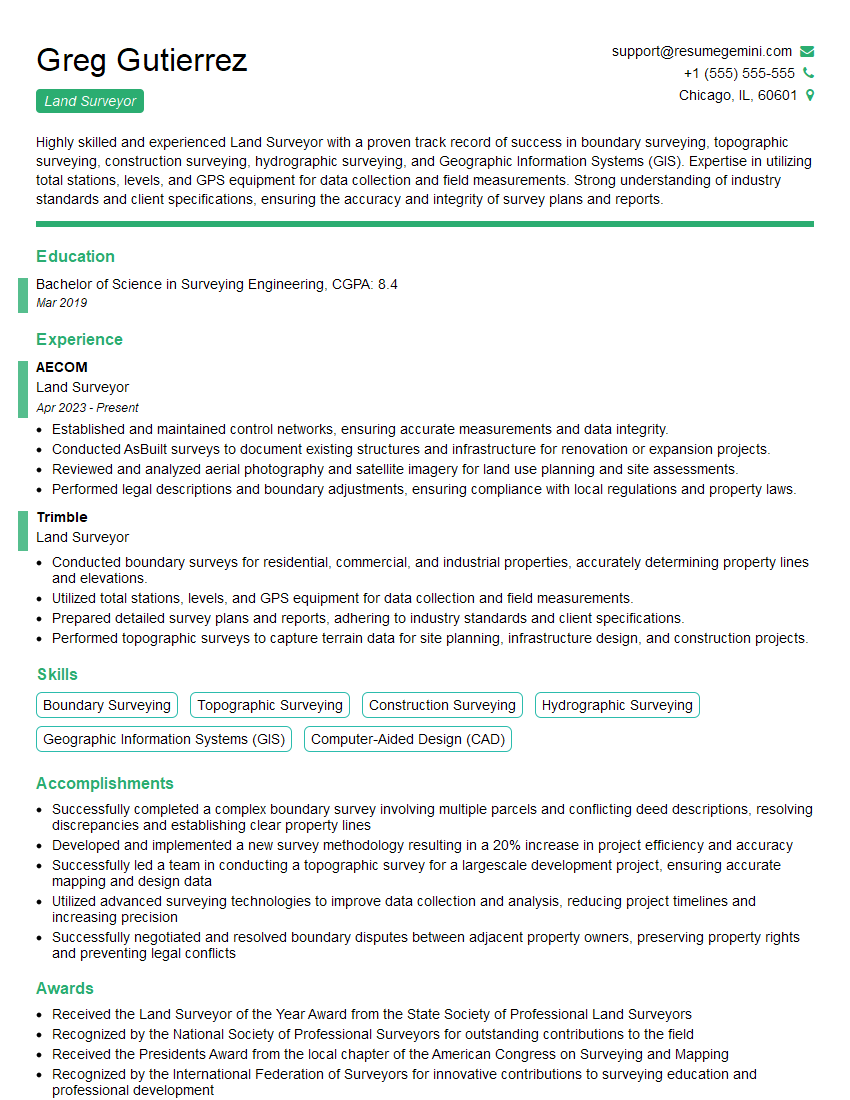
Land Surveyor Resume Sample

Mine Surveyor Resume Sample

Project Surveyor Resume Sample

Site Surveyor Resume Sample

Survey Party Chief Resume Sample

Instrument Technician Resume Sample

Survey Crew Chief Resume Sample

Remote Sensing Specialist Resume Sample
Explore more articles
Users Rating of Our Blogs
Share Your Experience
We value your feedback! Please rate our content and share your thoughts (optional).
What Readers Say About Our Blog
hello,
Our consultant firm based in the USA and our client are interested in your products.
Could you provide your company brochure and respond from your official email id (if different from the current in use), so i can send you the client’s requirement.
Payment before production.
I await your answer.
Regards,
MrSmith
hello,
Our consultant firm based in the USA and our client are interested in your products.
Could you provide your company brochure and respond from your official email id (if different from the current in use), so i can send you the client’s requirement.
Payment before production.
I await your answer.
Regards,
MrSmith
These apartments are so amazing, posting them online would break the algorithm.
https://bit.ly/Lovely2BedsApartmentHudsonYards
Reach out at [email protected] and let’s get started!
Take a look at this stunning 2-bedroom apartment perfectly situated NYC’s coveted Hudson Yards!
https://bit.ly/Lovely2BedsApartmentHudsonYards
Live Rent Free!
https://bit.ly/LiveRentFREE
Interesting Article, I liked the depth of knowledge you’ve shared.
Helpful, thanks for sharing.
Hi, I represent a social media marketing agency and liked your blog
Hi, I represent an SEO company that specialises in getting you AI citations and higher rankings on Google. I’d like to offer you a 100% free SEO audit for your website. Would you be interested?