Every successful interview starts with knowing what to expect. In this blog, we’ll take you through the top System Integration and Design interview questions, breaking them down with expert tips to help you deliver impactful answers. Step into your next interview fully prepared and ready to succeed.
Questions Asked in System Integration and Design Interview
Q 1. Explain the difference between system integration and system design.
System design and system integration are closely related but distinct phases in building a complex software solution. Think of building a house: system design is like creating the blueprints – specifying the architecture, components, and how they interact. System integration is the actual construction process, where you bring together the pre-built components (walls, plumbing, electrical) and connect them according to the blueprint.
System Design focuses on the individual components, their functionalities, and how they should interact to achieve the overall system goals. It involves detailed specifications, diagrams (like UML diagrams), and choosing appropriate technologies.
System Integration, on the other hand, is concerned with connecting and coordinating pre-existing or newly developed systems. This includes data mapping, protocol conversion, error handling, and ensuring seamless data flow between systems. It’s about making disparate systems work together harmoniously.
In essence, design precedes integration; a well-defined design greatly simplifies the integration process.
Q 2. Describe your experience with different integration patterns (e.g., message queues, REST APIs, ETL).
I’ve extensive experience with various integration patterns, tailoring my approach to the specific needs of the project.
- Message Queues (e.g., RabbitMQ, Kafka): I’ve used message queues extensively for asynchronous communication between systems. This is particularly useful when dealing with high volumes of data or when systems have varying processing speeds. For example, in an e-commerce platform, order processing might be handled asynchronously using a message queue, decoupling the order placement system from the inventory management and shipping systems. This improves resilience and scalability.
- REST APIs: RESTful APIs are a cornerstone of my integration strategy. I’m proficient in designing and consuming REST APIs using various technologies (e.g., Spring Boot, Node.js). For example, I integrated a CRM system with a marketing automation platform using REST APIs to seamlessly transfer customer data, enabling targeted marketing campaigns.
- ETL (Extract, Transform, Load): I’ve utilized ETL processes for data warehousing and migrating data between systems. In one project, we used Informatica PowerCenter to extract data from multiple legacy systems, transform it into a consistent format, and load it into a data warehouse for business intelligence reporting. This involved careful data cleansing, transformation rules, and error handling.
Choosing the right integration pattern depends on factors such as performance requirements, data volume, system complexity, and security considerations.
Q 3. How do you handle conflicts between different systems’ data formats?
Data format conflicts are a common challenge in system integration. My approach involves a multi-pronged strategy:
- Data Transformation: Using ETL tools or custom code, I transform data from its source format into a standardized target format. This often involves data mapping, data type conversion, and data cleansing. For example, converting dates from MM/DD/YYYY to YYYY-MM-DD or handling different encoding schemes.
- Data Mapping: Creating a detailed mapping document that outlines the correspondence between fields in different systems. This document serves as a guide for the transformation process and helps to prevent data loss or corruption.
- Message Brokers/ESBs: Employing a message broker or Enterprise Service Bus (ESB) that handles data transformation and routing. These tools provide built-in capabilities for handling different data formats and protocols.
- API Adapters: Using API adapters to handle communication between systems with different data formats and protocols. These adapters act as intermediaries, converting data on the fly.
The choice of approach depends on the complexity and volume of data being integrated. For simple cases, custom code might suffice; for complex scenarios, ETL tools or ESBs are more appropriate.
Q 4. What are the key considerations for designing a scalable and robust integration solution?
Designing a scalable and robust integration solution requires careful consideration of several key factors:
- Loose Coupling: Systems should be designed to interact with minimal dependencies. Message queues are a great way to achieve this, as they decouple the sending and receiving systems.
- Asynchronous Communication: Using asynchronous communication patterns (like message queues) allows systems to operate independently and handle failures gracefully. This significantly improves scalability and resilience.
- Error Handling and Logging: Implementing comprehensive error handling and logging mechanisms is crucial for monitoring the health of the integration solution and identifying and resolving issues quickly. Robust logging helps in troubleshooting and tracing data flow.
- Monitoring and Alerting: Setting up monitoring and alerting systems to track key metrics (e.g., message processing time, error rates) helps identify and address performance bottlenecks or failures promptly.
- Scalability Strategy: Choosing technologies and architectural patterns (e.g., microservices, cloud-based solutions) that support scalability and allow for easy scaling up or down based on demand.
- Security: Implementing appropriate security measures such as authentication, authorization, and data encryption to protect sensitive data during transmission and at rest.
A well-designed integration solution should be able to handle increased load and adapt to changing requirements with minimal disruption.
Q 5. Explain your experience with API gateways and their role in system integration.
API gateways are essential components in modern system integration architectures. They act as a central point of entry for all API requests, providing several key benefits:
- Centralized Management: An API gateway simplifies the management of APIs by providing a single point of access for all clients. This centralizes security policies, routing rules, and rate limiting.
- Security: API gateways provide a layer of security by enforcing authentication, authorization, and other security policies. They can protect backend systems from unauthorized access.
- Load Balancing: API gateways can distribute traffic across multiple backend servers, improving scalability and performance. They can handle spikes in demand and prevent overload.
- Protocol Transformation: API gateways can translate between different communication protocols (e.g., REST to SOAP), simplifying integration between systems with different communication styles.
- Rate Limiting and Throttling: API gateways can prevent abuse by implementing rate limiting and throttling mechanisms, ensuring fair access to resources.
In a recent project, we used Kong as an API gateway to manage access to multiple microservices. This provided centralized security, load balancing, and request routing, significantly simplifying the integration landscape.
Q 6. Describe your approach to testing integrated systems.
Testing integrated systems is crucial to ensure seamless functionality and data integrity. My approach employs a multi-layered strategy:
- Unit Testing: Testing individual components (e.g., API endpoints, data transformation routines) to verify their functionality in isolation.
- Integration Testing: Testing the interactions between different components to ensure data flows correctly and systems communicate seamlessly. This often involves simulating different scenarios and edge cases.
- System Testing: End-to-end testing of the entire integrated system to ensure it meets all requirements. This involves simulating real-world use cases and verifying that the system functions as expected.
- Performance Testing: Testing the system’s performance under different load conditions to identify bottlenecks and ensure it meets performance requirements.
- Security Testing: Testing the system’s security to identify vulnerabilities and ensure sensitive data is protected. This might involve penetration testing and security audits.
I use a combination of automated testing frameworks and manual testing to ensure comprehensive coverage. Automated tests are essential for regression testing as new features are added or systems are updated.
Q 7. How do you ensure data integrity and security during system integration?
Data integrity and security are paramount during system integration. My approach involves several key measures:
- Data Validation: Implementing strict data validation rules to ensure data consistency and accuracy. This includes data type validation, range checks, and consistency checks.
- Data Encryption: Encrypting sensitive data both in transit (using HTTPS) and at rest (using database encryption) to protect it from unauthorized access.
- Access Control: Implementing robust access control mechanisms to restrict access to sensitive data and systems based on roles and permissions.
- Auditing: Maintaining detailed audit logs to track data changes and access attempts. This helps to identify security breaches and ensure accountability.
- Data Governance: Establishing clear data governance policies and procedures to ensure data quality, consistency, and compliance with relevant regulations.
- Secure Communication Protocols: Using secure communication protocols such as HTTPS, TLS, and SSH to protect data during transmission.
By employing these security measures, we aim to maintain data integrity, confidentiality, and availability, building trust and ensuring regulatory compliance.
Q 8. What are some common challenges you’ve faced during system integration projects?
System integration projects, while rewarding, often present significant hurdles. One common challenge is the lack of clear communication and collaboration between different teams working on disparate systems. This can lead to mismatched expectations, duplicated efforts, and ultimately, integration failures. Another major obstacle is dealing with data inconsistencies. Different systems may use varying data formats, structures, and naming conventions, making data exchange and transformation a complex process. Finally, unexpected technical issues, such as unforeseen compatibility problems or performance bottlenecks, frequently arise and require creative solutions.
For example, in a recent project integrating an ERP system with a CRM, we encountered discrepancies in customer data formats. The ERP used a complex hierarchical structure, while the CRM relied on a simpler, flatter schema. Resolving this required careful data mapping, transformation using ETL (Extract, Transform, Load) processes, and robust testing to ensure data integrity.
Q 9. How do you manage dependencies between different systems?
Managing dependencies between systems is critical for successful integration. I utilize a combination of approaches to effectively handle this. First, detailed dependency mapping is essential. This involves creating a comprehensive visual representation of all systems, their interactions, and their interdependencies. Tools like dependency visualization software or even simple diagrams are invaluable here. Second, I employ a phased integration approach, focusing on integrating smaller, less dependent modules first. This minimizes risk and allows for early identification and resolution of issues. Finally, version control and rigorous testing are crucial to avoid conflicts and ensure compatibility between different versions of systems. This includes unit testing, integration testing, and system testing to validate the interactions between dependent components.
Imagine integrating a payment gateway with an e-commerce platform. The dependency is straightforward: the e-commerce platform relies on the payment gateway to process transactions. A phased approach would first involve testing the integration with simulated transactions before going live with actual payments. Version control ensures that updates to either system don’t disrupt the existing integration.
Q 10. Describe your experience with different integration tools (e.g., MuleSoft, IBM Integration Bus, Oracle SOA Suite).
I have extensive experience with several integration tools. MuleSoft is a powerful platform for building API-led connectivity, particularly useful for complex integrations and microservices architectures. Its Anypoint Platform provides robust capabilities for designing, deploying, and managing APIs. I’ve used IBM Integration Bus (IIB) for robust enterprise-level integrations, leveraging its messaging and transformation capabilities for high-throughput scenarios. Finally, I’ve worked with Oracle SOA Suite, primarily for orchestrating complex business processes spanning multiple systems. Its BPEL (Business Process Execution Language) engine is powerful for defining and managing workflows. The choice of tool depends heavily on the project’s specific requirements, including scale, complexity, and existing infrastructure.
For instance, in a project requiring high-volume, real-time data processing, IBM Integration Bus’s message broker proved invaluable. On the other hand, MuleSoft’s API-centric approach was ideal for a project that needed to expose existing systems as reusable APIs for other applications.
Q 11. How do you handle legacy systems during integration projects?
Integrating legacy systems presents unique challenges due to their age, often outdated technology, and lack of comprehensive documentation. My approach involves a multi-pronged strategy. First, I conduct a thorough assessment of the legacy system to understand its functionality, data structures, and potential integration points. Second, I prioritize a wrapper or facade approach, rather than completely refactoring the legacy system. This involves creating a new layer of integration that sits between the legacy system and the modern systems, abstracting away the complexities of the legacy code. Third, I leverage ETL processes to extract, transform, and load data from the legacy system into the modern systems, ensuring data compatibility and consistency. Finally, I implement rigorous monitoring and alerting to detect any issues arising from the integration with the legacy system.
In a recent project, we integrated a COBOL-based legacy billing system with a new cloud-based CRM. We created a wrapper service using MuleSoft to expose the necessary functionality of the COBOL system as REST APIs, thus abstracting away the legacy system’s complexities from the new CRM.
Q 12. What are your preferred methods for monitoring and managing integrated systems?
Monitoring and managing integrated systems is crucial for ensuring performance, availability, and security. My preferred methods involve a combination of approaches. Real-time monitoring dashboards provide a centralized view of system health, performance metrics, and error rates. I leverage logging and tracing tools to track message flows, identify bottlenecks, and diagnose errors effectively. Furthermore, automated alerts and notifications are essential for proactively addressing potential issues before they impact users. Finally, regular health checks and performance testing help ensure that the integrated system remains resilient and responsive to changing demands.
For example, using tools like Grafana and Prometheus, we create dashboards that visually represent key performance indicators (KPIs) like transaction latency, error rates, and message queue lengths. This allows for proactive identification and mitigation of performance issues.
Q 13. Explain your experience with different message queuing systems (e.g., RabbitMQ, Kafka).
My experience with message queuing systems includes both RabbitMQ and Kafka. RabbitMQ, a robust and flexible message broker, is well-suited for a wide range of applications. Its AMQP protocol provides a standard way to communicate between different systems. Kafka, on the other hand, is a distributed streaming platform, ideal for high-throughput, real-time data streaming. Its ability to handle large volumes of data makes it suitable for big data applications. The choice between these systems depends on the specific requirements of the project, particularly the volume and velocity of data being processed.
For instance, in an application requiring real-time updates to a user dashboard based on data from multiple sources, Kafka’s streaming capabilities would be ideal. However, for a system with lower data volume but needing more sophisticated message routing and handling, RabbitMQ would be more appropriate.
Q 14. Describe your understanding of microservices architecture and its impact on system integration.
Microservices architecture significantly impacts system integration by promoting modularity, scalability, and independent deployments. Instead of one large monolithic application, we have smaller, independent services communicating through APIs. This simplifies integration as individual services can be integrated and updated independently. However, it also introduces new complexities. Managing the interactions between numerous microservices requires careful planning and the use of appropriate integration patterns, such as API gateways and message queues. Proper service discovery and orchestration mechanisms are crucial. Thorough testing and monitoring are vital given the increased number of interacting components.
Consider an e-commerce platform built using a microservices architecture. Each microservice (e.g., catalog, shopping cart, payment) can be integrated and updated separately without impacting other services. An API gateway manages routing and aggregation of requests, making the overall integration easier to manage, while message queues handle asynchronous communication between the services.
Q 15. How do you ensure the performance and availability of integrated systems?
Ensuring the performance and availability of integrated systems is paramount. It’s like building a well-oiled machine where each part works seamlessly with others. We achieve this through a multi-pronged approach focusing on proactive measures and reactive strategies.
- Performance Monitoring and Tuning: We utilize comprehensive monitoring tools to track key metrics like response times, resource utilization (CPU, memory, network), and error rates. This allows us to proactively identify bottlenecks and optimize performance. For example, if a database query is slowing down the entire system, we can optimize the query or add indexing.
- Capacity Planning: We predict future resource needs based on historical data and projected growth. This prevents unexpected performance degradation. Think of it like planning for peak hours at a restaurant – you need enough staff and resources to handle the rush.
- Redundancy and Failover Mechanisms: Implementing redundancy, such as load balancing and failover clusters, ensures that if one component fails, the system continues to operate. This is crucial for high availability. Imagine a website with multiple servers; if one goes down, others seamlessly take over.
- Automated Scaling: Cloud-based solutions often allow for automatic scaling based on demand. If traffic spikes unexpectedly, the system automatically adds more resources to handle the load, ensuring performance doesn’t suffer.
- Regular Maintenance and Updates: Patching security vulnerabilities, upgrading software, and performing routine maintenance are essential for preventing outages and improving system performance. It’s like regularly servicing your car to prevent breakdowns.
Career Expert Tips:
- Ace those interviews! Prepare effectively by reviewing the Top 50 Most Common Interview Questions on ResumeGemini.
- Navigate your job search with confidence! Explore a wide range of Career Tips on ResumeGemini. Learn about common challenges and recommendations to overcome them.
- Craft the perfect resume! Master the Art of Resume Writing with ResumeGemini’s guide. Showcase your unique qualifications and achievements effectively.
- Don’t miss out on holiday savings! Build your dream resume with ResumeGemini’s ATS optimized templates.
Q 16. What are your strategies for troubleshooting integration issues?
Troubleshooting integration issues is a detective game, requiring a systematic approach. My strategy involves a structured process:
- Identify the problem: Clearly define the symptom. Is it a performance issue, data inconsistency, or complete system failure?
- Isolate the source: Use logging and monitoring tools to pinpoint the specific component causing the problem. This might involve examining logs from different systems, databases, or message queues.
- Reproduce the issue: If possible, try to reproduce the issue in a controlled environment (e.g., a test or staging system) to isolate the root cause without affecting production.
- Analyze the data: Examine relevant logs, metrics, and data to identify patterns or anomalies that explain the behavior.
- Test solutions: Implement potential solutions in a controlled environment before deploying them to production. This mitigates the risk of introducing further problems.
- Document the resolution: Thoroughly document the issue, its cause, and the solution implemented. This is crucial for preventing similar issues in the future and assisting others who might encounter similar problems.
For example, if a data transformation fails, I might check the data mapping, the transformation script, and the source and target data formats to identify the cause.
Q 17. How do you handle versioning and change management in an integration environment?
Versioning and change management are critical for maintaining stability and traceability in an integration environment. It’s akin to carefully managing versions of a software project. We use several techniques:
- Version Control Systems (e.g., Git): All integration artifacts (code, configurations, scripts) are stored in a version control system, allowing us to track changes, revert to previous versions, and collaborate effectively.
- Configuration Management Tools (e.g., Ansible, Puppet): These tools automate the deployment and configuration of integrated systems. They ensure consistency across different environments (development, testing, production).
- Change Management Processes: We establish a formal process for requesting, reviewing, approving, and implementing changes. This often involves a change request form, code reviews, testing, and documentation.
- Continuous Integration/Continuous Deployment (CI/CD): Automated pipelines build, test, and deploy changes, ensuring faster releases and reducing the risk of errors.
- Rollback Plans: We have detailed plans for reverting to previous versions in case of deployment issues or unexpected behavior. This is like having a backup plan in place.
Q 18. Describe your experience with different data integration techniques (e.g., ETL, ELT).
I have extensive experience with various data integration techniques. The choice depends on the specific needs of the project.
- Extract, Transform, Load (ETL): This traditional approach involves extracting data from various sources, transforming it into a consistent format, and then loading it into a target data warehouse or data lake. It’s suitable for large-scale batch processing.
- Extract, Load, Transform (ELT): This newer approach loads raw data into the target data warehouse first and then performs transformations within the data warehouse. It leverages the processing power of the data warehouse and is better suited for cloud-based environments where scalability is crucial.
- Change Data Capture (CDC): This technique focuses on capturing only the changes made to source data instead of processing the entire dataset. It’s highly efficient for incremental updates.
- Message Queues (e.g., Kafka, RabbitMQ): These asynchronous messaging systems are used for real-time data integration, ensuring loosely coupled architecture and improved scalability.
For example, in one project, we used ETL for a large batch process involving millions of records from various databases, while in another, we used ELT in a cloud environment to take advantage of the cloud’s massive processing capabilities.
Q 19. Explain your understanding of cloud-based integration platforms (e.g., AWS Integration Services, Azure Integration Services).
Cloud-based integration platforms offer scalability, flexibility, and managed services that simplify integration tasks. I’m familiar with both AWS Integration Services (e.g., AWS MSK, SQS, Step Functions) and Azure Integration Services (e.g., Azure Service Bus, Logic Apps, Azure Data Factory).
- AWS Integration Services: These provide a range of services for building serverless applications and connecting different systems. For instance, AWS Step Functions orchestrates complex workflows, making it easy to manage complex integration processes.
- Azure Integration Services: Azure provides similar capabilities, with Azure Logic Apps offering a visual workflow designer to simplify the creation of integration flows. Azure Data Factory excels at ETL/ELT operations in the cloud.
These platforms simplify development, deployment, and management of integration solutions, allowing us to focus on business logic rather than infrastructure.
Q 20. How do you ensure the security of integrated systems, including authentication and authorization?
Security is non-negotiable in integrated systems. We use a layered security approach:
- Authentication and Authorization: We implement robust authentication mechanisms (e.g., OAuth 2.0, OpenID Connect) to verify user identities and authorization mechanisms (e.g., Role-Based Access Control (RBAC)) to control access to resources. This is like having a secure door with a key and access codes.
- Data Encryption: Data at rest and in transit should be encrypted to protect sensitive information. This ensures that even if data is compromised, it’s unreadable without the decryption key.
- Input Validation and Sanitization: We carefully validate all inputs to prevent injection attacks (e.g., SQL injection, cross-site scripting). This is like checking packages before bringing them into your house to prevent unwanted elements.
- Security Auditing and Monitoring: We regularly monitor the system for suspicious activity and maintain detailed audit logs to track access and changes. This ensures we can quickly detect and respond to security incidents.
- Network Security: We use firewalls, intrusion detection/prevention systems, and virtual private networks (VPNs) to protect the network from unauthorized access.
Q 21. What is your experience with containerization and orchestration tools (e.g., Docker, Kubernetes) in relation to integration?
Containerization and orchestration tools like Docker and Kubernetes are game-changers for integration. They provide several benefits:
- Portability and Consistency: Containers package applications and their dependencies into isolated units, ensuring consistent behavior across different environments. This makes deployments easier and more reliable.
- Scalability and Elasticity: Kubernetes orchestrates the deployment, scaling, and management of containers, allowing us to easily scale up or down based on demand.
- Improved Resource Utilization: Containers share resources efficiently, leading to better utilization of infrastructure.
- Microservices Architecture: Containers are well-suited for microservices architectures, enabling the development and deployment of smaller, independent services that can be integrated more easily.
For example, we might use Docker to containerize different integration components (e.g., message brokers, data transformers) and Kubernetes to orchestrate their deployment and scaling across a cluster of servers. This approach enables greater agility, resilience, and efficiency in our integration projects.
Q 22. Explain your understanding of service-level agreements (SLAs) in the context of system integration.
Service Level Agreements (SLAs) are formal contracts defining the performance expectations between a service provider and a customer in a system integration project. They’re crucial because they establish clear, measurable targets for aspects like uptime, response times, and data accuracy. Think of it like a legally binding promise from your internet provider: they guarantee a certain speed and reliability, and you’ll pay them accordingly. In system integration, the ‘service’ is the integrated system itself or a specific component within it.
An SLA typically includes:
- Metrics: Specific, quantifiable measures of performance (e.g., 99.9% uptime, response time under 200ms).
- Targets: The desired levels for each metric.
- Reporting: How performance against the targets will be monitored and reported.
- Penalties: Consequences for failing to meet the agreed-upon targets (e.g., service credits, financial penalties).
- Escalation Procedures: A defined process for resolving issues when performance falls below the agreed-upon levels.
For example, in integrating an e-commerce platform with a payment gateway, an SLA might specify a 99.99% success rate for transaction processing, a maximum response time of 1 second, and a reporting mechanism detailing daily transaction success rates. Without well-defined SLAs, integration projects risk failure due to unmet expectations and disputes between parties.
Q 23. Describe a time you had to integrate two incompatible systems. What was your approach?
I once had to integrate a legacy customer relationship management (CRM) system built on a bespoke database with a modern marketing automation platform. The challenge was that the legacy CRM lacked a standard API and used a proprietary data format. The marketing automation platform, on the other hand, expected data in a standardized JSON format via RESTful APIs.
My approach was a phased integration using an ETL (Extract, Transform, Load) process. First, I extracted data from the legacy CRM using custom scripts that understood its proprietary data structure. Then, I transformed this data into the JSON format required by the marketing automation platform. Finally, I loaded the transformed data into the marketing automation platform using its REST API. This involved:
- Data Mapping: Identifying the correspondence between data fields in both systems.
- Data Cleaning: Handling inconsistencies and errors in the legacy data.
- Custom Scripting: Writing scripts (e.g., Python with relevant libraries) to handle the extraction, transformation, and loading process.
- Testing: Rigorous testing at each stage to ensure data integrity and accuracy.
This phased approach allowed for incremental progress, easier debugging, and a manageable migration. Although more time-consuming than a direct integration, it significantly reduced the risk and ensured a higher-quality final result. We also documented the ETL process thoroughly to facilitate future updates and maintenance.
Q 24. How do you balance speed of development with quality of integration?
Balancing speed and quality in system integration is a constant challenge. It’s like building a house: you could build it quickly using cheap materials, but it won’t last, or you can build it slowly using high-quality materials, making it strong and durable. The optimal approach lies in finding the right balance.
Here’s how I approach this:
- Agile Methodology: Employing agile methodologies like Scrum allows for iterative development, incorporating feedback and adapting to changing requirements along the way. This provides speed while maintaining quality through continuous testing and refinement.
- Automated Testing: Implementing a comprehensive automated testing suite (unit, integration, and system tests) ensures early detection of issues and reduces the time spent on manual testing. This improves speed and quality concurrently.
- Modular Design: Breaking down the integration into smaller, independent modules allows for parallel development, reducing the overall timeline. Each module can be thoroughly tested before integration, improving overall quality.
- Prioritization: Identifying and prioritizing critical functionalities ensures that the most important features are delivered quickly while less crucial features can be implemented later.
- Code Reviews: Thorough code reviews help maintain code quality and prevent errors that might slow down the process later.
By strategically applying these practices, the risk of compromising quality to achieve speed is mitigated. The outcome is a robust, reliable integration delivered within an acceptable timeframe.
Q 25. What are some common design patterns you use in system integration?
Several design patterns are frequently used in system integration to improve maintainability, scalability, and reusability. Some common ones include:
- Message Queues (e.g., RabbitMQ, Kafka): Decoupling systems by using asynchronous communication. Messages are sent to a queue, allowing systems to process them at their own pace. This improves reliability and scalability.
- Microservices Architecture: Breaking down large monolithic applications into smaller, independent services that communicate via APIs. This enhances flexibility, scalability, and maintainability.
- Adapter Pattern: Creating an adapter to translate the interface of one system to another. This allows systems with incompatible interfaces to communicate.
- Facade Pattern: Providing a simplified interface to a complex subsystem. This simplifies integration and reduces complexity.
- Mediator Pattern: Using a mediator to manage communication between multiple systems. This decouples systems and simplifies interactions.
The choice of design pattern depends on the specific requirements of the integration. For instance, a message queue would be suitable for handling high-volume, asynchronous communication, while the adapter pattern is ideal for bridging incompatible interfaces.
Q 26. Explain the role of system integration in achieving business goals.
System integration plays a vital role in achieving business goals by connecting disparate systems and enabling seamless data flow. This leads to several key benefits:
- Improved Efficiency: Automating processes and eliminating manual data entry improves operational efficiency and reduces errors. For example, integrating CRM and order management systems automates order processing and customer updates.
- Enhanced Data Visibility: Consolidating data from different systems provides a holistic view of the business, enabling better decision-making. Imagine a retail company integrating sales data with inventory management – they gain insight into stock levels and sales trends.
- Increased Revenue: Streamlined processes and better data visibility can lead to increased sales, improved customer satisfaction, and reduced operational costs, ultimately boosting revenue.
- Better Customer Experience: Seamlessly integrated systems improve customer service by providing a consistent experience across different channels. Integrating customer support systems with order tracking allows faster issue resolution and better customer communication.
- Competitive Advantage: Efficient and well-integrated systems give businesses a competitive edge by providing a better product or service and faster response times.
In essence, system integration isn’t just a technical exercise; it’s a strategic initiative that directly supports the achievement of business objectives.
Q 27. How do you stay up-to-date with the latest technologies and trends in system integration?
Staying current in the rapidly evolving field of system integration requires a multi-faceted approach:
- Industry Publications and Blogs: Regularly reading industry publications, blogs, and online forums keeps me abreast of new technologies and trends. Sites dedicated to integration, cloud computing, and API management are essential.
- Conferences and Workshops: Attending industry conferences and workshops provides valuable insights from leading experts and offers opportunities to network with peers.
- Online Courses and Certifications: Completing online courses and obtaining relevant certifications (e.g., cloud certifications from AWS, Azure, or GCP) keeps my skills sharp and demonstrates commitment to professional development.
- Hands-on Projects and Experimentation: Working on personal projects using new technologies is crucial for solidifying theoretical knowledge and gaining practical experience.
- Open Source Contributions: Contributing to open-source projects related to system integration not only enhances my understanding but also connects me with a wider community of professionals.
Continuously learning and applying my knowledge is crucial to maintaining expertise in this dynamic field.
Q 28. Describe your experience with implementing enterprise service buses (ESBs).
I have extensive experience implementing Enterprise Service Buses (ESBs). ESBs act as central communication hubs, facilitating communication and data exchange between various applications within an organization. Think of it as a sophisticated post office for applications, routing messages and transforming data as needed.
My experience includes:
- Selecting the Right ESB: Choosing an appropriate ESB based on the organization’s specific needs and existing infrastructure, considering factors such as scalability, performance, and security.
- Designing the ESB Architecture: Defining the message flows, transformations, and routing rules to ensure efficient and reliable communication between systems.
- Implementing and Configuring the ESB: Setting up the ESB infrastructure, configuring message brokers, and deploying necessary components.
- Developing and Deploying Integration Components: Creating custom components or using pre-built connectors to integrate applications with the ESB.
- Monitoring and Maintaining the ESB: Regularly monitoring ESB performance, identifying and resolving issues, and ensuring system stability and security.
I’ve worked with several ESB platforms, and my approach always emphasizes a modular and scalable design to accommodate future growth and integration requirements. Successful ESB implementation requires meticulous planning, robust testing, and ongoing maintenance.
Key Topics to Learn for System Integration and Design Interview
- Enterprise Architecture: Understanding different architectural patterns (microservices, monolithic, etc.) and their suitability for various systems. Consider practical application in choosing the right architecture for a specific project.
- API Integration: Mastering RESTful APIs, SOAP, and other integration protocols. Be prepared to discuss challenges in integrating disparate systems and solutions you’ve implemented.
- Data Integration & Transformation: Explore ETL (Extract, Transform, Load) processes, data warehousing concepts, and data modeling techniques. Think about real-world examples of data cleaning and transformation for successful integration.
- Security in System Integration: Discuss security protocols, authentication, authorization, and data encryption within the context of system integration. Highlight your understanding of securing APIs and data pipelines.
- Cloud Integration Platforms: Familiarity with popular cloud platforms (AWS, Azure, GCP) and their integration services is crucial. Prepare examples of how you’ve leveraged cloud services for seamless system integration.
- Integration Testing & Debugging: Discuss different testing methodologies and your experience in debugging complex integration issues. Practical experience troubleshooting integration failures is highly valued.
- System Monitoring & Performance Optimization: Understand how to monitor integrated systems for performance bottlenecks and develop strategies for optimization. Prepare examples of performance tuning and monitoring tools you’ve used.
Next Steps
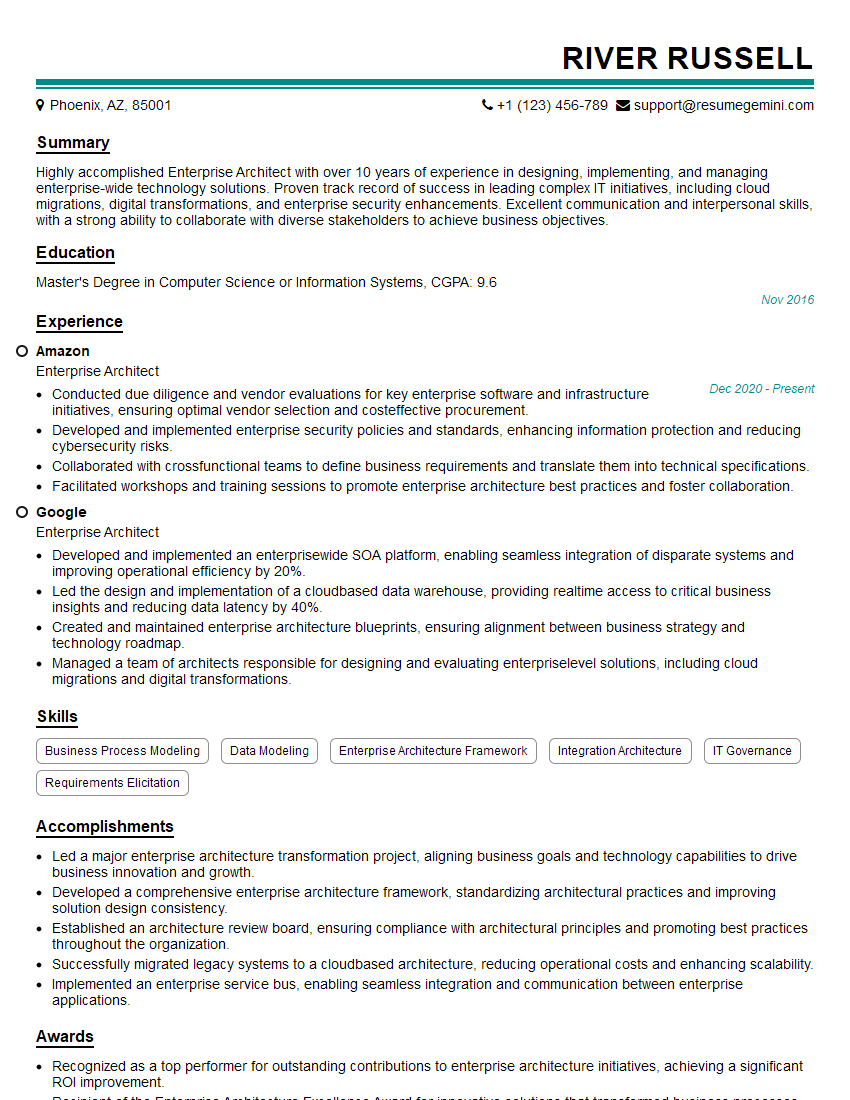
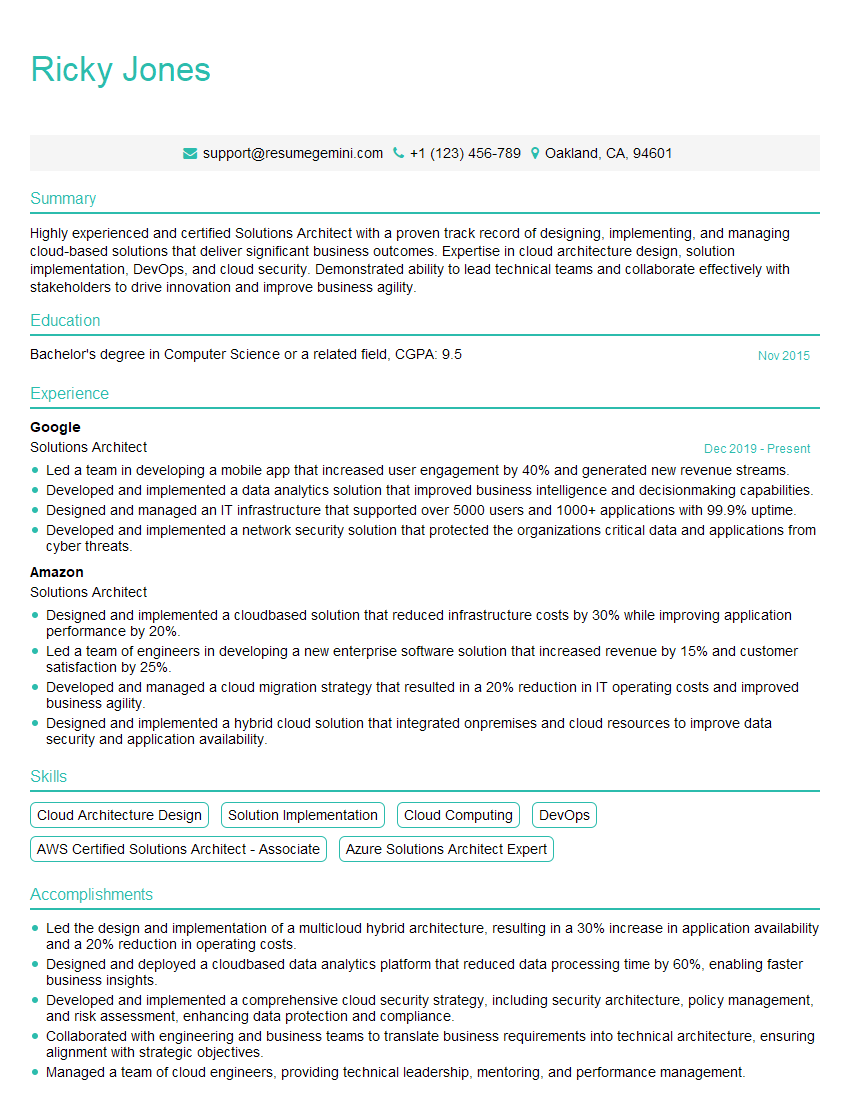
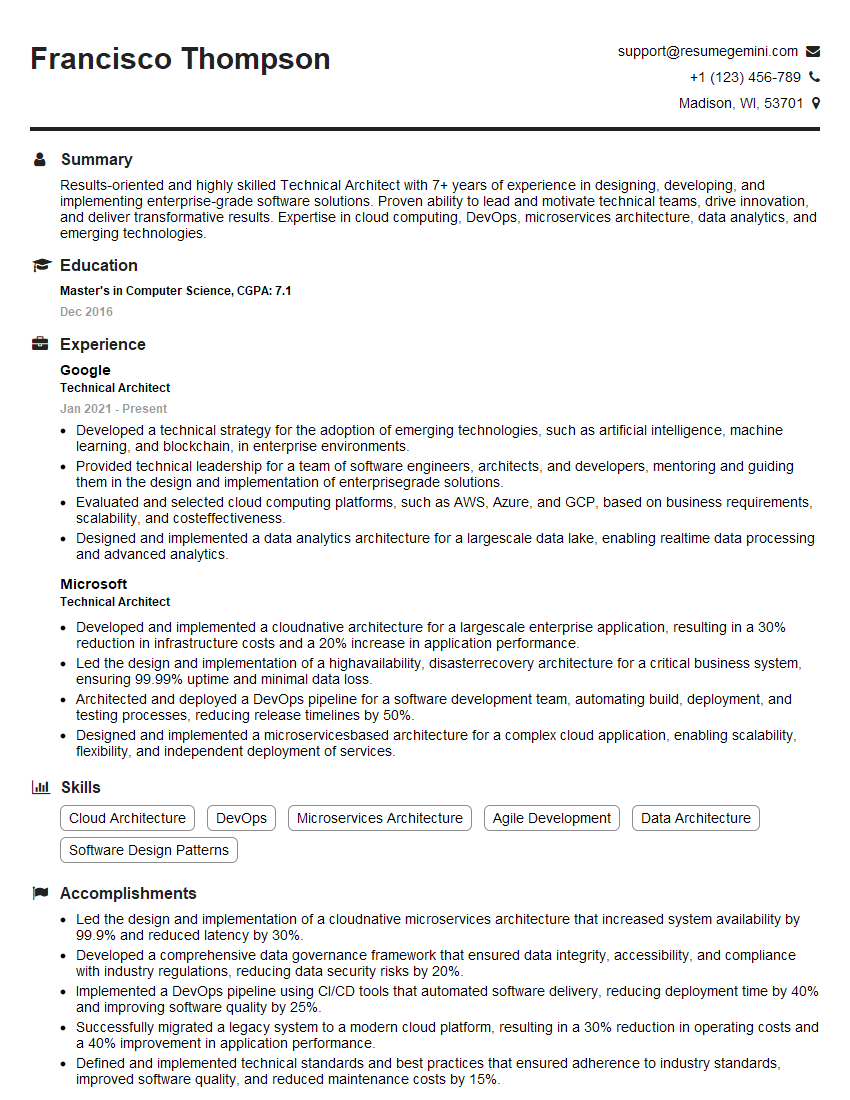
Mastering System Integration and Design opens doors to exciting and high-demand roles, offering significant career growth potential. A strong understanding of these concepts showcases your ability to solve complex problems and deliver robust, scalable solutions. To maximize your job prospects, crafting an ATS-friendly resume is essential. This ensures your application gets noticed by recruiters and hiring managers. We recommend using ResumeGemini, a trusted resource for building professional and effective resumes. ResumeGemini provides examples of resumes tailored to System Integration and Design to help you create a compelling application that highlights your skills and experience. Take the next step in your career journey – build a resume that makes a statement.
Explore more articles
Users Rating of Our Blogs
Share Your Experience
We value your feedback! Please rate our content and share your thoughts (optional).
What Readers Say About Our Blog
Amazing blog
hello,
Our consultant firm based in the USA and our client are interested in your products.
Could you provide your company brochure and respond from your official email id (if different from the current in use), so i can send you the client’s requirement.
Payment before production.
I await your answer.
Regards,
MrSmith
hello,
Our consultant firm based in the USA and our client are interested in your products.
Could you provide your company brochure and respond from your official email id (if different from the current in use), so i can send you the client’s requirement.
Payment before production.
I await your answer.
Regards,
MrSmith
These apartments are so amazing, posting them online would break the algorithm.
https://bit.ly/Lovely2BedsApartmentHudsonYards
Reach out at BENSON@LONDONFOSTER.COM and let’s get started!
Take a look at this stunning 2-bedroom apartment perfectly situated NYC’s coveted Hudson Yards!
https://bit.ly/Lovely2BedsApartmentHudsonYards
Live Rent Free!
https://bit.ly/LiveRentFREE
Interesting Article, I liked the depth of knowledge you’ve shared.
Helpful, thanks for sharing.
Hi, I represent a social media marketing agency and liked your blog
Hi, I represent an SEO company that specialises in getting you AI citations and higher rankings on Google. I’d like to offer you a 100% free SEO audit for your website. Would you be interested?