Cracking a skill-specific interview, like one for Terrazzo Furniture, requires understanding the nuances of the role. In this blog, we present the questions you’re most likely to encounter, along with insights into how to answer them effectively. Let’s ensure you’re ready to make a strong impression.
Questions Asked in Terrazzo Furniture Interview
Q 1. Describe the process of creating a terrazzo countertop.
Creating a terrazzo countertop is a multi-step process requiring precision and skill. It begins with preparing a sturdy base, often a plywood or concrete substrate, ensuring it’s level and clean. Next, we lay down a layer of epoxy resin, the binder that holds everything together. This is crucial for the structural integrity of the countertop. Then comes the exciting part – incorporating the aggregates. These are the colorful chips of marble, granite, quartz, glass, or recycled materials that give terrazzo its unique look. We carefully distribute these aggregates within the epoxy resin, ensuring even distribution and preventing voids. Once the desired aggregate mix is achieved, we use a trowel to level the surface, creating a smooth, even layer. Finally, after the epoxy has cured according to the manufacturer’s specifications, the surface is ground and polished to reveal the beauty of the embedded aggregates. Think of it like creating a mosaic embedded in a durable, resinous matrix.
For example, in one project, I used a mix of recycled glass and white Carrara marble to achieve a stunning, eco-friendly countertop with a subtle shimmer.
Q 2. What are the different types of aggregates used in terrazzo?
The choice of aggregates is what truly personalizes a terrazzo countertop. The possibilities are vast and depend on the desired aesthetic and budget. Common aggregates include:
- Marble: Offers a classic look, available in various colors and veining.
- Granite: Provides durability and a sophisticated feel. Its inherent strength enhances the overall resilience of the finished piece.
- Quartz: A hard and durable aggregate resulting in a long-lasting countertop.
- Glass: Adds a modern twist with its reflective qualities; recycled glass is a sustainable option.
- Recycled materials: Offers a unique, eco-friendly approach; think porcelain shards or even colored plastics.
The size, shape, and color of the aggregates determine the final appearance of the terrazzo. A larger aggregate creates a bolder look, while smaller aggregates yield a more subtle design. Blending different aggregates adds depth and visual interest.
Q 3. Explain the importance of proper curing in terrazzo production.
Proper curing is paramount to the strength and durability of the terrazzo. The epoxy resin needs sufficient time to fully polymerize, achieving its designed strength and chemical resistance. Insufficient curing leads to a weak, brittle surface prone to cracking and chipping. Factors influencing curing time include ambient temperature and humidity; hotter temperatures generally speed up the curing process, while higher humidity can slow it down. The manufacturer’s instructions must always be followed precisely. We typically ensure a controlled environment during the curing process, maintaining stable temperature and humidity for optimal results. Imagine baking a cake – you can’t rush the process or you compromise the final result. It’s the same with terrazzo.
For instance, I once encountered a job where the curing time was rushed due to tight deadlines. The resulting countertop showed signs of weakness within months, requiring extensive repairs.
Q 4. How do you achieve a polished finish on a terrazzo surface?
Achieving a polished finish involves a multi-stage grinding and polishing process. This starts with coarse-grit diamond grinding wheels to remove any surface irregularities and level the terrazzo. As we progress, we gradually use finer and finer grits, eliminating scratches from the previous stages and achieving a smoother surface with each step. The final stage involves high-gloss polishing pads to achieve a mirror-like sheen. This process requires specialized equipment and expertise to ensure an even, flawless finish. Think of it as sanding wood – you start with rough sandpaper and gradually move to finer grits for a smooth, polished result.
The final polish is often enhanced with specialized sealers to protect against staining and wear, further enhancing the beauty and longevity of the surface.
Q 5. What are the common problems encountered during terrazzo installation?
Common problems during terrazzo installation include:
- Improper substrate preparation: Uneven or unclean substrates can lead to voids and cracking.
- Uneven aggregate distribution: Creates an aesthetically unpleasing surface and compromises structural integrity.
- Incorrect epoxy mixing ratios: Weakens the bond and reduces durability.
- Insufficient curing time: Results in a weak, easily damaged surface.
- Improper grinding and polishing: Leads to uneven surfaces and burnishing marks.
Careful planning, meticulous attention to detail throughout the process, and adherence to best practices are crucial to avoiding these problems.
Q 6. How do you repair chips and cracks in terrazzo?
Repairing chips and cracks in terrazzo requires careful matching of the aggregate and epoxy resin. Minor chips can often be filled with a matching epoxy putty and then ground and polished to blend seamlessly with the surrounding surface. Larger cracks require more extensive repair, potentially involving the removal and replacement of a section of the terrazzo. This involves carefully cutting out the damaged area, applying a new epoxy mix with matching aggregates, allowing it to cure, and then grinding and polishing to match the existing surface. The goal is to make the repair virtually invisible. It’s like a precise puzzle, ensuring a flawless restoration.
In one instance, I successfully repaired a significant crack in a vintage terrazzo floor by using a special epoxy resin matched to the existing color and then meticulously blending the repaired area with the surrounding surface.
Q 7. Describe your experience with different terrazzo grinding and polishing techniques.
My experience encompasses various grinding and polishing techniques, including both manual and automated methods. Manual grinding, while requiring more skill and time, offers greater control and precision, especially for intricate designs and repairs. Automated methods, such as using specialized grinding and polishing machines, are more efficient for large-scale projects, ensuring consistency and a high-quality finish. Different types of diamond grinding wheels and polishing pads are used to achieve specific results, varying the grit size based on the desired level of smoothness and sheen. I’ve worked with everything from hand-held grinders for detailed work to large planetary grinders for flat surfaces. Each technique offers unique advantages, and the choice depends on the project’s scope and specific requirements.
I’ve also experimented with innovative techniques such as laser scanning to create precise digital models for complex terrazzo installations, ensuring perfect alignment and minimal waste.
Q 8. What safety precautions are necessary when working with terrazzo?
Working with terrazzo, while rewarding, requires meticulous attention to safety. The primary concern revolves around the materials used. Cement, aggregates (like marble chips or glass), and resins are all potential hazards.
- Respiratory Protection: Always wear a respirator, especially when mixing dry materials or working with epoxy resins. These can release dust and fumes harmful to the lungs.
- Eye Protection: Safety glasses are essential to protect against flying debris during grinding, polishing, and cutting.
- Hand Protection: Wear heavy-duty gloves to prevent cuts and chemical burns from resins.
- Skin Protection: Long sleeves and pants are advisable to minimize skin exposure to chemicals and dust. If resin gets on your skin, immediately wash thoroughly with soap and water.
- Proper Ventilation: Ensure adequate ventilation in your workspace to minimize the inhalation of dust and fumes. Working outdoors or in a well-ventilated area is preferable, especially when using epoxy resins.
- Disposal of Waste: Dispose of waste materials responsibly according to local regulations. Epoxy resins and certain aggregates may require special handling.
For example, on a recent project involving a large terrazzo countertop, we had a dedicated safety officer ensuring everyone followed the protocols. One team member neglected to wear his respirator properly, and we immediately stopped work to reinforce the importance of safety measures. It’s better to be cautious than to regret a preventable injury.
Q 9. How do you calculate the material requirements for a terrazzo project?
Calculating material requirements for a terrazzo project is a multi-step process. Accuracy is paramount to avoid waste and ensure a successful outcome. Here’s a breakdown:
- Determine the Project’s Dimensions: Accurately measure the length, width, and thickness of the terrazzo surface. For complex shapes, break the project into smaller, manageable sections.
- Calculate the Volume: Multiply the length, width, and thickness to determine the total cubic volume (in cubic feet or cubic meters) of the terrazzo needed.
- Determine the Aggregate-to-Binder Ratio: This ratio varies based on the desired strength, finish, and appearance of the terrazzo. Consult the resin manufacturer’s instructions or established industry standards for guidance. A common ratio is approximately 80% aggregate to 20% binder by volume.
- Calculate Aggregate Quantity: Multiply the total volume by the aggregate percentage (e.g., 80%). This gives the volume of aggregate needed.
- Calculate Binder Quantity: Multiply the total volume by the binder percentage (e.g., 20%). This gives the volume of binder needed. Remember to account for any shrinkage during the curing process.
- Factor in Waste: Add a 5-10% buffer to account for waste and spillage. This is crucial, especially for intricate designs or inexperienced installers.
- Convert to Weight: The above calculations are volume-based; you’ll typically purchase aggregates and binders by weight. Consult supplier specifications for conversions from volume to weight.
Imagine we’re creating a terrazzo floor for a 10ft x 10ft room, 1 inch thick. After conversions, we determine the volume is roughly 8.33 cubic feet. Using an 80/20 ratio, we’d need approximately 6.66 cubic feet of aggregate and 1.67 cubic feet of binder, plus the waste factor.
Q 10. What are the different types of resin binders used in terrazzo?
Resin binders are the heart of terrazzo, holding the aggregates together and providing strength and durability. The choice of resin significantly impacts the final product’s properties. Here are common types:
- Epoxy Resins: These are popular for their high strength, chemical resistance, and rapid curing time. They’re ideal for high-traffic areas or applications requiring durability. However, they can be more expensive and require careful handling due to their reactivity.
- Polyester Resins: A more economical option than epoxy, polyester resins offer good strength but are less resistant to chemicals and UV degradation. They’re suitable for interior applications where chemical resistance isn’t a primary concern.
- Cement-based Binders: Traditional terrazzo often uses Portland cement as a binder. This creates a very durable but less versatile material, sensitive to staining and moisture. It also requires longer curing times.
The choice of resin often depends on budgetary constraints and the intended application. For a high-end kitchen countertop, epoxy might be preferred, while for a less demanding patio, polyester might suffice. Cement is becoming less common in modern terrazzo applications.
Q 11. Explain the difference between traditional and contemporary terrazzo.
Traditional and contemporary terrazzo share the basic concept of embedded aggregates in a binder, but their aesthetics and manufacturing processes differ significantly.
- Traditional Terrazzo: Typically utilizes Portland cement as a binder, resulting in a thicker, more substantial final product. The designs tend to be less intricate, focusing on larger aggregate sizes and simpler patterns. It’s known for its rustic charm and inherent strength.
- Contemporary Terrazzo: Often incorporates epoxy or polyester resins, allowing for thinner applications, more vibrant colors, and intricate designs. It can even incorporate recycled materials, giving it a more sustainable profile. The finishes can range from highly polished to more textured appearances.
Think of it this way: traditional terrazzo is like a sturdy, classic oak table; it’s strong, durable, and timeless. Contemporary terrazzo is like a sleek, modern coffee table with intricate inlays – more versatile and visually diverse.
Q 12. How do you ensure the color consistency of a terrazzo project?
Ensuring color consistency is crucial for a visually appealing terrazzo project. This requires meticulous planning and execution:
- Precise Aggregate Selection: Choose aggregates of consistent color and size from a single batch or source. Variations in aggregate color can significantly affect the overall appearance.
- Careful Batch Mixing: When mixing multiple batches of terrazzo, carefully follow the same aggregate-to-binder ratio and mixing techniques to prevent variations in color and texture.
- Color Samples: Create and approve color samples before starting the actual project. This helps to ensure that the final product matches the client’s expectations.
- Consistent Application Techniques: Use consistent techniques during application to avoid variations in aggregate distribution and depth. Experienced installers understand how to manipulate the mixing process to achieve uniform color distribution.
- Control of Curing Conditions: Environmental factors such as temperature and humidity can influence the final color. Maintaining consistent curing conditions helps to achieve predictable results.
On one project, we encountered slight color discrepancies between batches of our chosen marble chips. By carefully grading and remixing the aggregates, paying close attention to achieving a perfect blend for each batch, we were able to maintain almost perfect consistency throughout the entire project.
Q 13. What are the advantages and disadvantages of using terrazzo?
Terrazzo offers numerous advantages but also has some limitations. A balanced perspective is essential when considering its use.
- Advantages:
- Durability: Terrazzo is incredibly strong and resistant to wear and tear, making it ideal for high-traffic areas.
- Customization: A wide range of colors and aggregates allows for highly customized designs.
- Low Maintenance: Properly sealed terrazzo requires minimal maintenance and cleaning.
- Sustainability: It can incorporate recycled materials, reducing environmental impact.
- Aesthetic Appeal: Its unique and elegant appearance adds value to any project.
- Disadvantages:
- Cost: Terrazzo can be more expensive than other flooring materials.
- Installation Time: Installation requires specialized skills and can be time-consuming.
- Weight: Terrazzo is heavy, requiring structural considerations for supporting the substrate.
- Sensitivity to Acids: Some resins are sensitive to strong acids and may require specialized sealants.
- Repair Challenges: Repairs can be challenging and may require professional expertise.
Q 14. Describe your experience with different types of terrazzo tools and equipment.
My experience with terrazzo tools and equipment spans a wide range of technologies, from traditional hand tools to modern power equipment. Here are some key tools and my experiences with them:
- Grinding Machines: From smaller hand-held grinders to large, industrial floor grinders, these are essential for achieving a smooth, polished surface. The choice depends on the project scale and the desired finish. I’ve worked with both, and the precision of a larger grinder for large projects is incomparable.
- Polishing Machines: These refine the surface after grinding, creating a glossy or matte finish. Diamond polishing pads of various grits are crucial for achieving the desired level of shine.
- Cutting Tools: Wet saws and specialized diamond blades are essential for cutting terrazzo into specific shapes and sizes. Precision is key here, and I’ve seen firsthand how a poorly executed cut can ruin a project.
- Mixing Equipment: Mortars, mixers, and even specialized terrazzo mixing equipment are used to prepare the terrazzo mix. Consistency in mixing is vital for uniform color and strength.
- Trowels and Floats: These are used for applying and leveling the terrazzo mixture during installation. Proper technique is crucial to prevent inconsistencies in the final product.
I’ve always emphasized the importance of using high-quality, well-maintained equipment. A dull blade or worn-out grinder can lead to uneven surfaces, potentially compromising the project’s aesthetic appeal and durability.
Q 15. How do you handle customer requests or complaints regarding terrazzo installations?
Handling customer requests and complaints regarding terrazzo installations involves a proactive and empathetic approach. First, I always listen carefully to understand the specific concern. This could range from minor aesthetic issues to more significant structural problems. Then, I document the complaint thoroughly, including photos and detailed descriptions.
Next, I investigate the issue, determining the root cause. Was there a problem with the installation process? A material defect? Or perhaps a misunderstanding of the specifications? Depending on the issue, I might consult with the installation team, material suppliers, or even independent inspectors.
Once I understand the issue, I develop a solution. This may involve repairs, replacements, adjustments to the design, or even a partial refund. Crucially, I keep the customer informed every step of the way, managing expectations and providing realistic timelines. Transparent and prompt communication is key to resolving conflicts successfully. For instance, if a client complains about inconsistent coloring in a terrazzo floor, I would investigate if the mix wasn’t properly controlled during installation or if there was a problem with the aggregate supply. I’d then offer solutions ranging from polishing and enhancing the current surface to replacing sections, depending on the severity and the client’s preferences.
Career Expert Tips:
- Ace those interviews! Prepare effectively by reviewing the Top 50 Most Common Interview Questions on ResumeGemini.
- Navigate your job search with confidence! Explore a wide range of Career Tips on ResumeGemini. Learn about common challenges and recommendations to overcome them.
- Craft the perfect resume! Master the Art of Resume Writing with ResumeGemini’s guide. Showcase your unique qualifications and achievements effectively.
- Don’t miss out on holiday savings! Build your dream resume with ResumeGemini’s ATS optimized templates.
Q 16. What are the different methods for sealing and protecting terrazzo surfaces?
Sealing and protecting terrazzo surfaces is crucial for maintaining their longevity and beauty. Different sealers offer varying levels of protection against staining, etching, and wear. The choice of sealer depends on the specific application and the desired level of protection.
Common methods include:
- Penetrating sealers: These sealers soak into the pores of the terrazzo, enhancing its durability and resistance to staining. They are generally preferred for high-traffic areas and offer excellent protection against moisture damage. They don’t create a film on the surface, preserving the natural look of the terrazzo.
- Topical sealers: These form a protective film on the surface of the terrazzo, providing a barrier against spills and scratches. They are easier to apply but may wear away over time and require more frequent reapplication. They provide a glossy or semi-gloss finish depending on the type.
- Epoxy sealers: These are very durable and chemically resistant, often used in commercial settings where the terrazzo is subject to heavy wear and aggressive chemicals. They offer superior protection but can be more expensive and require professional application.
Regular maintenance, such as sweeping and mopping with neutral cleaners, is also essential to prolong the life of the sealant and prevent damage to the terrazzo surface. The frequency of resealing depends on the type of sealer used, the traffic level, and the environment.
Q 17. Explain your experience working with CAD software for terrazzo design.
I have extensive experience using CAD software, primarily AutoCAD and Revit, for terrazzo design. I utilize these tools to create detailed drawings, accurate renderings, and precise specifications for terrazzo installations. This allows for a seamless transition from design to fabrication and installation.
In the design phase, I use CAD to model the terrazzo surface, incorporating the desired aggregate mix, color palette, and pattern. I also use CAD to generate precise cut lists and fabrication plans. This minimizes waste and ensures accurate fabrication. For instance, if a client wants an intricate geometric pattern, I use CAD to create a detailed vector graphic that is then translated into a template for the installers. This level of precision is particularly important for large-scale projects or those with complex designs. My experience with CAD software also helps in collaborating effectively with other design professionals and contractors involved in a project.
Q 18. How do you manage a terrazzo project’s budget and timeline?
Managing a terrazzo project’s budget and timeline involves careful planning and meticulous tracking. Before the project begins, I work with the client to establish a clear scope of work, including detailed specifications, material selections, and labor requirements. This allows for an accurate cost estimation. I then develop a detailed project schedule, breaking down the work into manageable phases with realistic deadlines.
Throughout the project, I monitor expenses closely, comparing actual costs against the budget. Any deviations are immediately addressed. I utilize project management software to track progress and identify potential delays. Regular meetings with the client and the project team keep everyone informed and engaged. For example, on a large restaurant renovation project, we anticipated a potential delay in material delivery. By proactively communicating with the client and adjusting the schedule accordingly, we were able to prevent significant cost overruns or project delays.
Q 19. Describe a challenging terrazzo project and how you overcame the difficulties.
One challenging project involved the restoration of a historic terrazzo floor in a century-old building. The floor was severely damaged, with cracks, chips, and significant staining. The client wanted to preserve the original design and character of the floor while ensuring its structural integrity. The biggest challenge was balancing the historical preservation aspect with the practical needs of a modern building.
To overcome these difficulties, I employed a multi-step approach. First, we conducted a thorough assessment of the damage, carefully documenting the condition of the floor. Next, we developed a restoration plan, involving careful removal of damaged sections, repair of cracks, and color matching for replacements. This required detailed research into historical methods and materials. We also used advanced technologies, such as diamond grinding and polishing, to restore the original luster of the terrazzo. The project required collaboration with historical preservation specialists and skilled artisans to ensure the preservation of the historical integrity while employing advanced restoration techniques. The final result was a beautifully restored floor that met the client’s expectations while preserving the building’s history.
Q 20. What are the common causes of staining in terrazzo?
Staining in terrazzo can occur due to several reasons. One common cause is spills of colored liquids, such as coffee, wine, or dyes. These can penetrate the surface and leave permanent stains if not cleaned up promptly. Another cause is the use of harsh chemicals or acidic cleaners, which can etch the surface and make it more susceptible to staining.
Poor-quality sealing or a lack of sealing can also contribute to staining, as it allows liquids to penetrate the porous terrazzo. In some cases, staining can originate from the aggregates themselves, if the raw materials contain impurities that leach out over time. Iron staining is a common example, often manifesting as reddish or brownish discoloration. Preventing staining involves careful cleaning practices, using appropriate sealers, and promptly addressing any spills. Regular maintenance, including periodic resealing, is vital in protecting the terrazzo from staining.
Q 21. How do you determine the appropriate thickness for a terrazzo slab?
Determining the appropriate thickness for a terrazzo slab depends on several factors, including the intended application, the size of the slab, and the desired level of durability. For residential applications, a thickness of 1.5 inches to 2 inches is typically sufficient. For commercial applications or areas with heavier traffic, a thicker slab (2 inches to 3 inches or more) is recommended to provide better structural support and resistance to cracking.
Larger slabs generally require greater thickness to prevent sagging or warping. The type of aggregate used also influences thickness; larger or denser aggregates might necessitate a thicker slab for stability. Detailed structural calculations, factoring in loads, spans, and support conditions, are crucial for determining the optimal thickness for each specific project. A structural engineer often collaborates on this aspect of the design to guarantee safety and durability.
Q 22. What are the environmental considerations in terrazzo production?
Environmental considerations in terrazzo production are multifaceted and increasingly important. The primary concern revolves around the sourcing of materials. Cement, a major component, has a significant carbon footprint due to its manufacturing process. The aggregates used – chips of marble, granite, quartz, glass, or recycled materials – also impact the environment depending on their origin and processing. Transportation of these materials adds to the overall carbon footprint. Furthermore, the manufacturing process itself generates dust and waste, requiring careful management to minimize environmental harm. Sustainable practices involve using recycled materials in the aggregate mix, opting for locally sourced ingredients to reduce transportation emissions, and implementing efficient waste management strategies to minimize landfill contributions and potentially reuse waste materials within the production process. For example, using recycled glass as an aggregate drastically reduces the environmental impact compared to using newly mined materials.
Q 23. How do you ensure the structural integrity of a terrazzo piece?
Ensuring the structural integrity of a terrazzo piece is paramount. It begins with the design phase, carefully considering the piece’s size, shape, and intended use. The mix design itself is crucial, involving the precise ratio of cement, aggregates, and pigments. The correct water-cement ratio is critical to achieve the desired strength and durability. Proper curing is essential, allowing the cement to fully hydrate and gain strength. This often involves controlled temperature and humidity for optimal results. Finally, the fabrication process must be precise, using appropriate techniques to avoid cracking or weakening the material. For instance, a large terrazzo table needs a reinforced substructure to withstand the load. This reinforcement can be achieved through a metal framework embedded within the terrazzo itself. Another example is using vibratory techniques during casting to eliminate air pockets and ensure a dense, strong final product. Regular inspections throughout the production process are vital to identify and rectify any potential issues before they compromise the structural integrity.
Q 24. Explain your experience with various terrazzo finishing techniques.
My experience encompasses a broad range of terrazzo finishing techniques, each contributing to the final aesthetic and durability of the piece. I’ve worked extensively with honed finishes, which provide a smooth, matte surface ideal for countertops and flooring. Polished finishes offer a high-gloss, reflective surface that enhances the beauty of the aggregates. I’m also proficient in creating textured finishes, using techniques to achieve various degrees of roughness, from subtle to highly pronounced. This can be achieved with acid etching or the use of specific aggregate types and grinding techniques. Furthermore, I’ve worked with specialized finishes, such as anti-slip treatments for high-traffic areas or specialized sealants to enhance stain and scratch resistance. In one project, a client requested a highly polished finish for a terrazzo coffee table, emphasizing the vibrancy of the multicolored aggregates. For another project, a slightly textured finish was applied to outdoor terrazzo steps for safety and to ensure they wouldn’t become slippery when wet. The choice of finishing technique significantly impacts not just the visual appeal but also the longevity and practicality of the terrazzo piece.
Q 25. What are the latest trends in terrazzo furniture design?
Current trends in terrazzo furniture design lean towards a more modern and minimalist aesthetic. Bold, contrasting color palettes are gaining popularity, moving away from more traditional, muted tones. Geometric patterns and custom aggregate mixes are also highly sought after, allowing for unique, bespoke pieces. The use of recycled and sustainable materials is another emerging trend, aligning with growing environmental consciousness. We’re seeing larger scale pieces such as substantial dining tables and statement sideboards. Integration of terrazzo with other materials like wood and metal is also a common trend, creating visually striking and dynamic pieces. For example, a recent trend is to incorporate metallic inlays into the terrazzo for a touch of luxury and visual interest. Another growing trend is the use of terrazzo in smaller items like planters, candle holders, and even jewelry, which expands the versatility of this material.
Q 26. Describe your experience working with different terrazzo color palettes.
My experience with terrazzo color palettes is extensive. I’ve worked with everything from classic neutral schemes using white cement and muted aggregates, to vibrant, contemporary palettes featuring bold colors and contrasting aggregates. I’ve had the opportunity to experiment with monochromatic schemes, using various shades of a single color for a sophisticated, understated look. I’ve also worked on multi-colored designs, using a variety of aggregates to create complex patterns and visual textures. The key is to achieve a balance and harmony, ensuring the colors complement each other and align with the overall design intent. One project involved a custom terrazzo bar top, using a mix of deep blues, greens, and whites to complement a nautical-themed home. Another project required a more minimalist approach, utilizing different shades of gray for a modern, understated look in a contemporary apartment.
Q 27. How do you maintain and clean terrazzo surfaces?
Maintaining and cleaning terrazzo surfaces is relatively straightforward but requires the right approach. Regular sweeping or vacuuming removes loose dirt and debris. For more thorough cleaning, a damp mop with a neutral pH cleaner is ideal. Avoid abrasive cleaners or scouring pads, as these can scratch the surface. For stubborn stains, a specialized terrazzo cleaner may be necessary. Periodic sealing is recommended to protect the terrazzo from stains and moisture damage. The frequency of sealing depends on the location and use of the terrazzo piece. In high-traffic areas, more frequent sealing might be needed. Proper sealing prevents staining and makes cleaning considerably easier in the long run. It’s important to follow the manufacturer’s instructions for the specific sealant used. For example, a kitchen countertop will require more frequent cleaning and sealing than a terrazzo coffee table placed in a less used area of the home.
Q 28. What are your salary expectations for this role?
My salary expectations for this role are commensurate with my experience and expertise in the field of terrazzo furniture design and fabrication. Considering my extensive knowledge of materials, techniques, and industry trends, along with my proven track record of delivering high-quality, bespoke pieces, I am seeking a salary in the range of [Insert Salary Range Here]. I am confident that my contributions will significantly benefit your company, and I am open to discussing this further.
Key Topics to Learn for Your Terrazzo Furniture Interview
- Understanding Terrazzo Material: Explore the composition, manufacturing process, and unique properties of terrazzo, including its durability, versatility, and aesthetic appeal.
- Design and Application: Learn about the diverse applications of terrazzo in furniture design, from flooring and countertops to decorative elements and bespoke pieces. Consider the design principles involved in integrating terrazzo effectively.
- Manufacturing Processes: Familiarize yourself with the different methods used in creating terrazzo furniture, including casting, polishing, and finishing techniques. Understand the intricacies of each process and its impact on the final product.
- Sustainability and Environmental Impact: Research the environmental considerations related to terrazzo production and disposal. Discuss sustainable practices within the industry.
- Maintenance and Care: Understand the proper techniques for maintaining and caring for terrazzo furniture to ensure its longevity and aesthetic appeal. This includes cleaning, repair, and restoration methods.
- Market Trends and Competition: Research current market trends in terrazzo furniture design and manufacturing. Analyze the competitive landscape and identify key players in the industry.
- Sales and Marketing Strategies: Explore effective sales and marketing strategies for terrazzo furniture, including target audience identification, pricing strategies, and distribution channels.
- Problem-solving in Production: Consider potential challenges in terrazzo furniture production, such as material sourcing, quality control, and logistical issues. Develop strategies for addressing these challenges effectively.
Next Steps
Mastering the intricacies of Terrazzo Furniture will significantly boost your career prospects, opening doors to exciting opportunities in design, manufacturing, and sales. To maximize your chances, create an ATS-friendly resume that highlights your relevant skills and experience. ResumeGemini is a trusted resource that can help you craft a professional and impactful resume. Use their tools to build a compelling document that showcases your expertise. Examples of resumes tailored to Terrazzo Furniture are available to guide you.
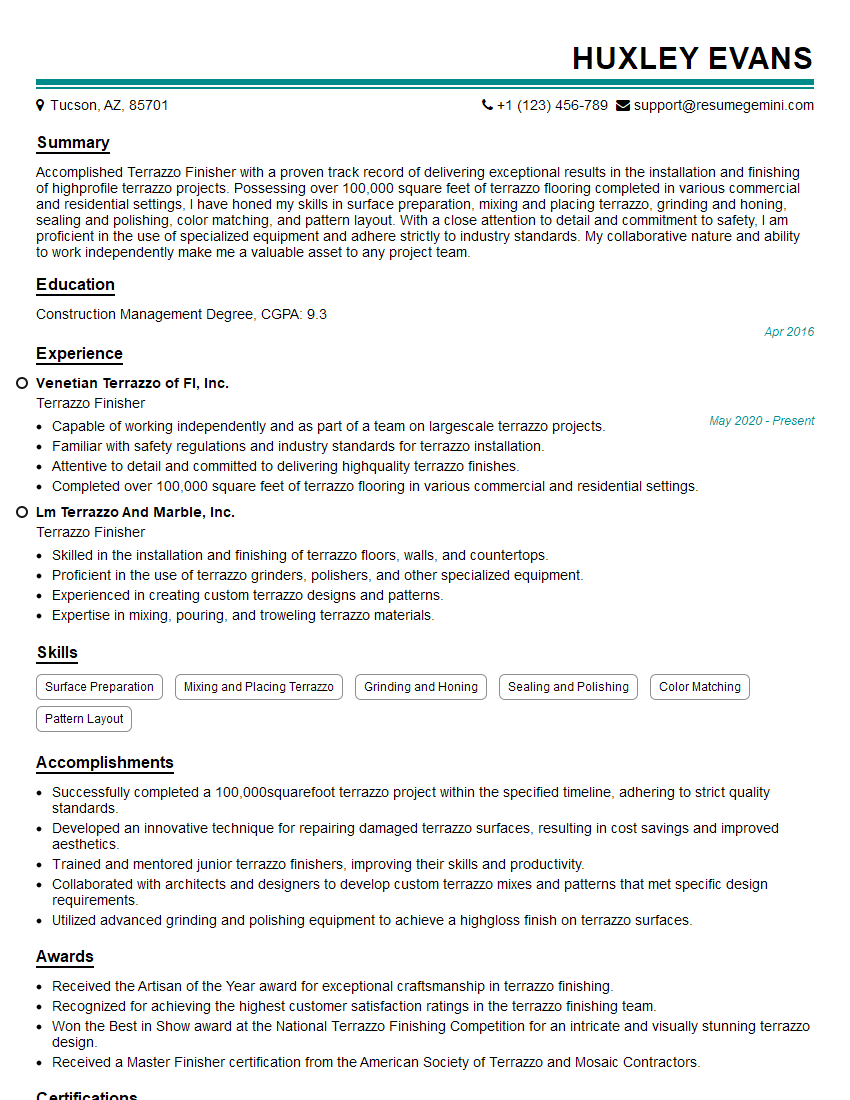

Explore more articles
Users Rating of Our Blogs
Share Your Experience
We value your feedback! Please rate our content and share your thoughts (optional).
What Readers Say About Our Blog
hello,
Our consultant firm based in the USA and our client are interested in your products.
Could you provide your company brochure and respond from your official email id (if different from the current in use), so i can send you the client’s requirement.
Payment before production.
I await your answer.
Regards,
MrSmith
hello,
Our consultant firm based in the USA and our client are interested in your products.
Could you provide your company brochure and respond from your official email id (if different from the current in use), so i can send you the client’s requirement.
Payment before production.
I await your answer.
Regards,
MrSmith
These apartments are so amazing, posting them online would break the algorithm.
https://bit.ly/Lovely2BedsApartmentHudsonYards
Reach out at [email protected] and let’s get started!
Take a look at this stunning 2-bedroom apartment perfectly situated NYC’s coveted Hudson Yards!
https://bit.ly/Lovely2BedsApartmentHudsonYards
Live Rent Free!
https://bit.ly/LiveRentFREE
Interesting Article, I liked the depth of knowledge you’ve shared.
Helpful, thanks for sharing.
Hi, I represent a social media marketing agency and liked your blog
Hi, I represent an SEO company that specialises in getting you AI citations and higher rankings on Google. I’d like to offer you a 100% free SEO audit for your website. Would you be interested?