Preparation is the key to success in any interview. In this post, we’ll explore crucial Thin-Set Mortar Installation interview questions and equip you with strategies to craft impactful answers. Whether you’re a beginner or a pro, these tips will elevate your preparation.
Questions Asked in Thin-Set Mortar Installation Interview
Q 1. What are the different types of thin-set mortar?
Thin-set mortars are categorized based on their intended use and the type of tile being installed. The primary classifications are:
- Type I: This is a general-purpose mortar suitable for most ceramic and porcelain tiles on interior walls and floors. Think of it as your all-around workhorse.
- Type II: Designed for heavier tiles, larger format tiles, and installations subject to more stress or movement. This is your go-to for floors in high-traffic areas or outdoor applications where you need extra strength.
- Modified Thin-Set Mortars: These contain polymers that enhance flexibility, bond strength, and water resistance. They’re ideal for installations prone to cracking or movement, such as installations over radiant heat or exterior applications. These often come in specific varieties for use with specific materials, like glass or stone.
- Rapid-Set Mortars: These cure faster than standard mortars, allowing for quicker turnaround times. Excellent for projects where time is a critical factor, but requires precise mixing and application to avoid premature setting.
Choosing the correct type is crucial for a successful installation. The wrong type can lead to cracking, delamination, and even tile failure.
Q 2. Explain the process of mixing thin-set mortar.
Mixing thin-set mortar is a critical step; consistency is key. You’ll typically need a clean mixing container (a wheelbarrow or large mixing tub works well), a mixing paddle (attached to a drill is best), and clean water.
- Add Water: First, add the recommended amount of clean water to the mixing container – always follow the manufacturer’s instructions on the bag. Don’t guess!
- Add Powder: Slowly add the thin-set powder to the water, while mixing continuously with your drill and paddle. This prevents clumping.
- Mix Thoroughly: Mix for a minimum of 3-5 minutes, scraping the sides and bottom of the container to ensure all the powder is fully hydrated and incorporated. You want a smooth, creamy consistency, free of lumps.
- Rest (if needed): Some manufacturers recommend letting the mixed mortar sit for a few minutes (typically 5-10) before use to allow the polymers to fully hydrate. This improves bond strength. Again, always follow the manufacturer’s guidelines.
- Check Consistency: The consistency should be like thick peanut butter; it should hold its shape when you scoop some up and turn the paddle over, but it shouldn’t be too stiff or watery.
Improper mixing leads to weak bonds, inconsistent coverage, and tile failure. Think of it like baking a cake – you wouldn’t just throw the ingredients together, would you?
Q 3. What are the appropriate ratios of water to powder for different thin-set mortars?
There’s no single ratio for all thin-set mortars. The water-to-powder ratio is always specified by the manufacturer on the product packaging. It typically ranges from around 4 to 6 pints of water per 50 lb bag of powder. However, environmental factors (temperature and humidity) can slightly affect this.
Never deviate from the manufacturer’s instructions. Using too much water will result in a weak mix prone to cracking, while using too little will create a mix that’s too stiff to work with, hindering proper coverage.
Always check the bag! It’s the most reliable source of information for a particular batch of thin-set.
Q 4. How do you determine the correct thin-set mortar for a specific tile and substrate?
Selecting the appropriate thin-set depends on several factors:
- Type of Tile: Porcelain, ceramic, glass, stone, etc., each require a mortar formulated to meet its specific properties. Porcelain is dense and requires a strong mortar. Glass tiles, for instance, are more sensitive and require a modified thin-set to prevent cracking.
- Substrate: What are you installing the tiles onto? Concrete, backer board, drywall, plywood? Each substrate necessitates a different level of adhesion and flexibility in the mortar. For example, you would want a flexible modified thin-set for radiant heat applications to accommodate the expansion and contraction of the floor.
- Application Location: Interior walls? Exterior floors? The environmental conditions (moisture, temperature fluctuations) greatly influence the mortar selection. Exterior applications require water-resistant modified thin-set.
- Traffic Conditions: Is it a high-traffic area or a low-traffic area? High-traffic areas necessitate a strong, durable mortar, often a Type II.
Consulting the manufacturer’s recommendations for both the tile and the substrate is critical to ensure a long-lasting and successful installation.
Q 5. Describe the proper techniques for applying thin-set mortar to tiles.
Applying thin-set mortar effectively requires precision and the right technique:
- Prepare the Substrate: Ensure the substrate is clean, level, dry, and free of dust or debris. This is arguably the most important step for good adhesion.
- Apply Mortar: Use a notched trowel to spread a consistent layer of mortar onto the substrate, covering only an area you can tile within the mortar’s open time (the time before it starts to set up). The size of the notch affects the amount of mortar, and the notch size will be selected according to the manufacturer’s instructions.
- Comb the Mortar: The notches create grooves that ensure even coverage and good contact between the tile and the mortar.
- Set the Tile: Firmly press the tile into the mortar, ensuring full contact. Use spacers to maintain consistent grout lines.
- Clean Excess Mortar: Immediately remove any excess mortar that squeezes out from between the tiles using a damp sponge or rag.
Imagine the mortar as glue. You want to distribute it evenly and make sure the tile makes full contact with the mortar bed to ensure a strong bond. Think of using just enough force – pressing too hard can fracture a tile, while pressing too gently won’t guarantee full contact.
Q 6. What are the signs of improper thin-set mortar mixing?
Signs of improper thin-set mixing include:
- Lumpy Consistency: A lumpy mix indicates incomplete hydration of the powder, resulting in weak spots and inconsistent coverage.
- Too Runny/Watery: Excessive water weakens the bond strength and can lead to cracking or tile slippage.
- Too Stiff/Dry: Insufficient water makes the mortar difficult to work with, resulting in inadequate coverage and poor adhesion. The mortar won’t spread evenly.
- Rapid Setting: If the mortar sets up too quickly, it indicates a problem with the mixing, the water temperature, or the environment.
Always remember, if the mix doesn’t look right, don’t use it. It’s better to start over with fresh mix than risk a failed installation.
Q 7. How do you ensure proper coverage and adhesion of thin-set mortar?
Proper coverage and adhesion are paramount. Here’s how to ensure both:
- Use the Correct Trowel Notch Size: This is crucial for distributing the correct amount of mortar for the tile size. The manufacturer’s instructions on the thin-set bag should provide this information.
- Fully Embed the Tile: Press the tile firmly and evenly into the mortar bed to ensure complete contact. The entire back of the tile needs to be covered with mortar.
- Maintain Consistent Mortar Bed Thickness: Avoid variations in the mortar bed thickness as this can lead to uneven surfaces and potential problems.
- Use the Correct Mortar Type: Select the proper mortar for both the tile and the substrate. The correct mortar ensures the best adhesion.
- Clean the Substrate: Thorough substrate preparation prevents the thin-set from bonding to dust or debris.
Think of it like painting a wall. You wouldn’t expect a good result if you didn’t prepare the surface properly, right? The same applies to thin-set mortar and tile installation.
Q 8. What are the common causes of tile lippage?
Tile lippage, that annoying unevenness where one tile sits higher than its neighbor, is a common frustration in tile installation. It’s usually caused by inconsistent mortar bed thickness. Think of it like trying to build a perfectly level wall with uneven bricks – it’s impossible!
- Uneven substrate: An unlevel surface is the biggest culprit. If your floor or wall isn’t perfectly flat, the tiles will follow suit, creating lippage.
- Inconsistent mortar application: Applying too much or too little thin-set mortar in different areas leads to uneven tile heights. This often happens when the notched trowel isn’t used correctly or consistently.
- Improper tile setting: Forcing tiles into place instead of gently pressing them down can cause them to settle unevenly.
- Poorly mixed thin-set: If the thin-set isn’t mixed according to manufacturer instructions, it might not have the right consistency, resulting in uneven application.
- Flexible tiles on inflexible surfaces: Some tiles, especially large format porcelain, are flexible. Laying them on a rigid substrate can cause them to deform unevenly.
Imagine trying to lay a perfectly flat tile on a bumpy road! The result will be unevenness. That’s essentially what lippage is – the tile is following the contours of the uneven substrate or mortar bed.
Q 9. How do you prevent hollow tiles?
Hollow tiles are a serious issue as they can crack or pop off easily. It’s all about ensuring complete contact between the tile and the mortar. Think of it like gluing a picture to a wall – you need full contact for it to stick!
- Properly mixed thin-set: Follow the manufacturer’s instructions precisely to ensure the right consistency. Too thick, and it’ll be difficult to get full coverage; too thin, and it lacks the necessary strength.
- Sufficient thin-set application: Use the correct notched trowel to achieve a consistent bed of mortar. The trowel notches should be appropriate for both the tile size and type. Larger tiles need more mortar coverage.
- Firmly but gently seat each tile: Press down firmly and evenly on each tile to ensure complete contact with the mortar bed. Avoid sliding the tiles once they’re in place; this can disrupt the mortar bond.
- Use a tapping method: After setting a tile, use a tapping block and rubber mallet to tap gently to release any trapped air and guarantee full contact with the mortar.
- Check for hollows: After installation, use a rubber mallet or tapping block to check for hollow-sounding tiles. If you hear a hollow sound, carefully remove and reset the tile with fresh mortar.
Preventing hollow tiles is crucial for the longevity and structural integrity of your tile installation. Regularly checking for hollows throughout the installation will prevent issues later on.
Q 10. What are the best practices for cleaning up excess thin-set mortar?
Cleaning up excess thin-set mortar is crucial for a professional finish and to prevent future issues. The key is to act quickly before it hardens. Think of it as cleaning up spilled paint – the faster you clean, the easier it is!
- Sponge and water: While the mortar is still wet, use a damp sponge to gently wipe away excess material. Rinse the sponge frequently to avoid spreading the hardened mortar.
- Grout removal tools: For more hardened mortar, use a grout removal tool. These tools are designed to scrape away the hardened mortar without damaging the tiles.
- Acidic cleaners (with caution): For tough stains, consider using a suitable acidic cleaner. Always test in an inconspicuous area first to check for reactions with the tile or grout. Follow manufacturer instructions carefully.
- Avoid steel wool or abrasive pads: These can scratch the tiles.
- Regular cleaning: Clean as you go to prevent buildup. Don’t wait until the whole job is finished to clean up the excess mortar.
Remember that preventing excess mortar application in the first place is the best approach. A skilled tile setter aims for precision in application, minimizing the need for extensive cleanup.
Q 11. What are the safety precautions when working with thin-set mortar?
Thin-set mortar, while essential for tile installation, presents some safety hazards that require careful attention. It’s not just about the finished product – your safety is paramount!
- Eye protection: Always wear safety glasses or goggles to protect your eyes from dust and splashes.
- Respiratory protection: Use a dust mask or respirator, especially in poorly ventilated areas, to prevent inhaling the fine dust created during mixing and installation.
- Gloves: Wear gloves to protect your hands from irritation and chemical exposure.
- Skin protection: If prolonged contact is expected, use long sleeves and pants to protect exposed skin. Thin-set mortar can cause skin irritation.
- Proper ventilation: Ensure adequate ventilation in the work area to minimize dust and fumes.
- Follow safety data sheets (SDS): Always read and understand the SDS provided by the manufacturer of your thin-set mortar. It contains information on potential hazards and safety precautions.
Remember: Safety first! Taking these precautions isn’t just about following rules; it’s about protecting your health and well-being.
Q 12. How do you handle different tile sizes and shapes when applying thin-set mortar?
Handling diverse tile sizes and shapes requires adapting your technique and ensuring consistent mortar application. Think of it like baking – different recipes require different methods.
- Appropriate notched trowel: Use a notched trowel with the appropriate size and type of notches for the specific tile size. Larger tiles typically require larger notches, ensuring sufficient mortar coverage.
- Mortar thickness consistency: Maintain consistent mortar thickness regardless of the tile size or shape.
- Cutting and shaping: For irregular tile shapes, carefully apply the thin-set to ensure complete coverage and avoid gaps. This might require more meticulous application.
- Support for large tiles: Large format tiles can be more challenging to manage. Extra support might be necessary during installation.
- Pre-planning: Plan your layout carefully to minimize cutting and maximize the use of full tiles, especially for complex designs.
Adaptability and precision are key to handling various tile formats effectively. Mastering these techniques ensures a cohesive and professional-looking outcome.
Q 13. What are the effects of using too much or too little water in the thin-set mix?
The water content in thin-set mortar is crucial for achieving the correct consistency and performance. It’s like making cake batter – too much liquid makes it runny, too little makes it crumbly!
- Too much water: A thin-set mix with excessive water will be weak, making the bond between the tiles and substrate weaker, resulting in potential cracking and hollow tiles. It will also have a shorter open time.
- Too little water: A mix with insufficient water will be too stiff, difficult to spread, and can lead to uneven mortar beds, resulting in lippage and poor tile adhesion.
Always adhere strictly to the manufacturer’s instructions for water content. Using the correct amount ensures optimal workability, bond strength, and overall tile installation quality.
Q 14. Explain the importance of using the correct notched trowel.
The notched trowel is not just a tool; it’s the key to controlling the amount and distribution of thin-set mortar. Imagine trying to paint a wall without a brush! The notched trowel ensures consistent mortar thickness and a strong bond.
- Consistent mortar bed: The notches on the trowel create a consistent thickness of mortar, preventing lippage and ensuring uniform adhesion.
- Suitable notch size: The notch size must be appropriate for the tile size and material. Using an incorrectly sized trowel can lead to insufficient mortar for larger tiles or excessive mortar for smaller tiles.
- Mortar distribution: The notches help distribute the mortar evenly, ensuring complete contact between the tile and the substrate.
- Different notches for different tiles: Different tile materials and sizes may require different notched trowels. Porcelain tiles, for example, typically require larger notches compared to ceramic tiles.
Choosing and using the correct notched trowel is fundamental to a successful tile installation, impacting both aesthetics and longevity.
Q 15. How do you prepare the substrate before applying thin-set mortar?
Substrate preparation is paramount for successful thin-set mortar installation. Think of it like building a house – you wouldn’t start constructing without a solid foundation. A properly prepared substrate ensures optimal adhesion and prevents future problems like tile cracking or delamination.
- Cleaning: Thoroughly clean the surface to remove all dust, dirt, grease, loose debris, and any existing coatings that might interfere with adhesion. A wire brush, vacuum cleaner, and appropriate cleaning solutions are your best friends here. For particularly stubborn residues, consider a pressure washer (used cautiously to avoid damage).
- Priming: Priming acts as a bonding agent, improving the adhesion between the substrate and the thin-set mortar. The type of primer will depend on the substrate material (concrete, gypsum board, etc.). Always follow the manufacturer’s instructions for primer application and drying time.
- Moisture Testing: Before applying any thin-set, check for excessive moisture. High moisture content can weaken the bond and lead to tile failure. Use a moisture meter to ensure the substrate meets the requirements specified by the thin-set manufacturer and the tile manufacturer. In cases of high moisture, consider using a moisture barrier or a suitable moisture-tolerant thin-set.
- Repairing: Address any imperfections like cracks, holes, or unevenness in the substrate. Use appropriate patching compounds or leveling compounds to create a smooth, consistent surface before tiling. Allow ample drying time before proceeding.
Career Expert Tips:
- Ace those interviews! Prepare effectively by reviewing the Top 50 Most Common Interview Questions on ResumeGemini.
- Navigate your job search with confidence! Explore a wide range of Career Tips on ResumeGemini. Learn about common challenges and recommendations to overcome them.
- Craft the perfect resume! Master the Art of Resume Writing with ResumeGemini’s guide. Showcase your unique qualifications and achievements effectively.
- Don’t miss out on holiday savings! Build your dream resume with ResumeGemini’s ATS optimized templates.
Q 16. How do you account for substrate variations (uneven surfaces)?
Uneven surfaces are a common challenge in tile installations. Ignoring them can lead to uneven tile surfaces, cracked tiles, and an overall unprofessional look. Addressing substrate variations involves using self-leveling compounds or back-buttering techniques.
- Self-Leveling Compounds: These are liquid compounds that flow and self-level to create a perfectly smooth surface. They’re ideal for larger areas with significant undulations. Follow the manufacturer’s instructions for mixing and application. Ensure the compound is completely dry before applying the thin-set mortar.
- Back-Buttering: This involves applying a thin layer of thin-set mortar to the back of each tile, allowing for adjustments to compensate for minor irregularities. This method is more time-consuming but suitable for smaller areas or less severe undulations. You still need a reasonably level base; back-buttering doesn’t replace a properly prepared substrate.
In both cases, remember to always follow manufacturer’s instructions on drying time. Premature tiling leads to adhesion issues.
Q 17. Describe the process for setting large format tiles.
Large format tiles present unique challenges due to their weight and size. Improper installation can lead to cracking, lippage (uneven tile heights), and hollow sounds. Careful planning and technique are crucial.
- Enhanced Substrate Preparation: Ensure the substrate is exceptionally flat and stable to support the weight of the large tiles. Thorough cleaning and priming are even more critical.
- Modified Thin-Set Mortar: Use a high-performance modified thin-set mortar specifically designed for large format tiles. These mortars often have improved flexibility and bonding strength to accommodate the increased stress.
- Full-Surface Coverage: Apply a generous amount of thin-set mortar to the back of each tile, ensuring full coverage to prevent hollow spots. This is essential for distributing weight evenly. Consider using a notched trowel with larger notches.
- Proper Support: Use spacers to maintain consistent grout lines and prevent uneven settling. Support the tiles from underneath while the mortar sets to prevent sagging.
- Careful Placement: Move slowly and carefully when placing large format tiles to avoid shifting or slippage. Make any adjustments immediately to avoid having to lift and reposition the tile, which can compromise adhesion.
Q 18. How do you manage the curing process of thin-set mortar?
Curing is the process where the thin-set mortar gains its full strength and durability. Proper curing is vital to the long-term success of your installation. Think of it as allowing the mortar to ‘harden’ properly. Interfering with the process can cause weakness.
- Maintain Moisture: Keep the freshly installed tiles moist to prevent rapid drying and cracking. Cover the surface with plastic sheeting or damp burlap for the recommended curing time specified by the thin-set manufacturer.
- Temperature Control: Avoid extreme temperature fluctuations during the curing period. High heat can cause rapid drying and cracking, while freezing temperatures can damage the mortar.
- Avoid Foot Traffic: Prevent any foot traffic or heavy weight on the freshly installed tiles until the curing process is complete. The manufacturer will specify the minimum time before load-bearing.
- Grouting Time: Allow sufficient time for the thin-set to cure before grouting. Premature grouting can compromise the bond and weaken the overall installation.
Q 19. What are the signs of thin-set mortar failure?
Signs of thin-set mortar failure can manifest in various ways, often indicating a problem with the installation process or substrate preparation.
- Cracked Tiles: Cracking tiles are a clear sign of stress within the installation, often due to poor substrate preparation, insufficient mortar, or improper curing.
- Hollow Sound: Tapping on a tile that produces a hollow sound indicates a lack of proper adhesion between the tile and the substrate. This is a serious issue and often requires removal and reinstallation.
- Tile Detachment: Tiles popping off the substrate clearly show failure of the thin-set bond. This is often caused by moisture problems or insufficient substrate preparation.
- Grout Cracking: While not directly a thin-set failure, grout cracking can sometimes indicate underlying issues with the thin-set bond.
- Lippage: Uneven tile heights (lippage) suggest poor substrate preparation or inconsistent thin-set application.
Identifying these signs early allows for prompt remediation to prevent widespread damage.
Q 20. What tools and equipment are essential for thin-set mortar installation?
The right tools are essential for a successful thin-set installation. Using the wrong tools or improper techniques can greatly impact the outcome.
- Notched Trowel: The choice of trowel depends on the tile size and thin-set type. The notches create grooves in the thin-set to enhance adhesion and ensure proper coverage.
- Mixing Container & Paddle Mixer (or Drill): For consistent thin-set mixing. A slow-speed drill with a paddle mixer is ideal to avoid air bubbles.
- Measuring Tools: Accurate measurements are crucial for proper mixing ratios of thin-set and water.
- Spacers: Maintaining consistent grout lines. Their size should be appropriate for the tile size.
- Level: Ensures a flat, even tile surface.
- Rubber Float: For smoothing out the thin-set and removing excess.
- Grout Float: Application and finishing of grout.
- Safety Gear: Safety glasses, gloves, and a dust mask are essential to protect yourself from dust and other irritants.
Q 21. How do you deal with challenging substrate conditions (e.g., moisture)?
Challenging substrate conditions, particularly moisture, can significantly affect the success of thin-set mortar installations. Moisture is the enemy of adhesion.
- Moisture Testing: Always test the substrate for moisture content before installation. Use a moisture meter to determine if it meets the manufacturer’s requirements for the chosen thin-set and tile.
- Moisture Barriers: If moisture levels are high, use a moisture barrier such as a vapor retarder or a specialized membrane to prevent moisture from migrating into the thin-set.
- Moisture-Tolerant Thin-Set: Use a thin-set formulated to handle higher moisture levels. These products are specifically designed to withstand some level of moisture within the substrate.
- Dehumidification: For very damp substrates, you may need to use dehumidifiers to lower the moisture content before proceeding with the installation.
- Proper Ventilation: Ensure adequate ventilation during and after the installation to help the substrate dry out and to prevent condensation.
Ignoring moisture can lead to tile failure, so thorough assessment and appropriate measures are crucial.
Q 22. How do you troubleshoot common problems encountered during thin-set installation?
Troubleshooting thin-set installation problems requires a systematic approach. I start by identifying the visible issue – is it hollow tiles, cracked tiles, uneven surfaces, or poor adhesion?
Hollow Tiles: This often indicates insufficient thin-set mortar or improper trowel application. I’d check for air pockets and ensure proper coverage, potentially using a tapping test to identify hollow areas. Re-grouting might be needed in some cases.
Cracked Tiles: This could be due to poor tile quality, improper substrate preparation (unlevel or cracked substrate), or excessive stress during the setting process. I’d investigate the substrate and tile for flaws. If the substrate is at fault, it might require repair before re-tiling.
Uneven Surfaces: This indicates inconsistent thin-set application or an uneven substrate. I use a level to check the surface and, if necessary, I might use self-leveling compound to address substrate imperfections before tiling.
Poor Adhesion: This could result from a dirty or unclean substrate, incorrect thin-set selection for the substrate and tile type, or improper curing conditions. Always ensure the substrate is clean, dry, and primed if necessary. The correct thin-set for the job is crucial.
In all cases, thorough documentation and investigation are key. I carefully examine each step of the process to pinpoint the root cause of the problem before proceeding with a solution.
Q 23. What are the different types of backer boards used with thin-set mortar?
Several backer boards are suitable for thin-set mortar applications, each with its own advantages and disadvantages.
- Cement backer board (CBU): This is a common choice, providing good strength and moisture resistance. It’s relatively inexpensive but can be heavy and requires careful handling to avoid breakage. I often use this for floor installations in areas prone to moisture.
- Water-resistant gypsum board: A lighter alternative to CBU, offering good dimensional stability. However, it’s less moisture resistant, making it unsuitable for wet areas like showers. I might use this for wall installations in dry areas.
- Modified gypsum board: These are specifically designed for wet areas and offer improved moisture resistance compared to standard gypsum board. It still isn’t as durable or water-resistant as CBU for truly wet environments.
- Exterior-grade plywood: This might be used in specific scenarios, such as tiling over existing wood subfloors, but requires proper sealing and preparation to prevent moisture damage. Proper sealing is vital to prevent moisture issues.
The choice depends entirely on the application and the level of moisture exposure. My selection always aligns with the project’s specific requirements and building codes.
Q 24. Describe your experience with different types of tiles (ceramic, porcelain, natural stone).
My experience encompasses a wide range of tile types, each requiring a slightly different approach during installation:
- Ceramic Tiles: These are generally easy to work with, relatively lightweight, and come in various sizes and finishes. I pay attention to the water absorption rate when selecting the appropriate thin-set.
- Porcelain Tiles: Known for their durability and low water absorption, porcelain tiles require a thin-set that is compatible with their low porosity. They are denser and can be harder to cut and handle, so extra care is needed during the installation process. I have experience using high-strength thin-sets for large-format porcelain tiles.
- Natural Stone Tiles (marble, granite, travertine, etc.): These are beautiful but often more delicate and require specialized handling and thin-set selection. I take extra care to avoid staining or scratching the tiles, and I use a thin-set specifically designed for natural stone to ensure good adhesion and prevent issues. Proper sealing is also crucial after installation.
Understanding the specific properties of each tile type – its porosity, fragility, and water absorption – is crucial for selecting the right thin-set and installation method.
Q 25. How do you ensure proper ventilation during and after thin-set installation?
Proper ventilation is critical for the successful curing of thin-set mortar and to prevent issues like mold and mildew growth. During installation, I ensure adequate fresh air circulation in the work area, especially in enclosed spaces. This might involve opening windows and using fans.
After installation, continued ventilation is essential, especially in bathrooms and other areas with high humidity. I usually advise clients to keep the area well-ventilated for several days, allowing the thin-set to cure properly and preventing moisture build-up. In bathrooms, exhaust fans should be used during and after the installation process.
In some cases, dehumidifiers might be necessary in high-humidity environments to speed up the drying process and prevent problems. My aim is to create an environment that allows the thin-set to cure optimally without being compromised by excessive moisture.
Q 26. What is your experience with different types of substrates (concrete, plywood, drywall)?
I’ve worked with various substrates, each demanding a different approach:
- Concrete: A common and generally suitable substrate, but it needs to be clean, dry, and sound. Any cracks or imperfections must be repaired before tiling. I typically use a primer on concrete to improve adhesion.
- Plywood: Needs to be exterior-grade and properly sealed to prevent moisture absorption. I verify that the plywood is securely fastened and level before applying the thin-set.
- Drywall: Generally not ideal for floor tile installations unless specifically designed for it (e.g., cement backer board). However, it can be used for wall tiles in dry areas provided the drywall is secure and properly primed for enhanced adhesion.
Substrate preparation is paramount. I always assess the substrate’s condition, ensuring it is suitable for tiling and taking appropriate steps to prepare it for optimal adhesion. Ignoring this can lead to tile failure.
Q 27. What are the different methods of applying thin-set mortar (e.g., buttering, back-buttering)?
Thin-set mortar can be applied using several methods, each with its own advantages and disadvantages:
- Buttering the Back of the Tile (Back-buttering): A small amount of thin-set is applied directly to the back of the tile. This method is suitable for smaller tiles and allows for better control over the amount of mortar used. It’s less efficient for larger tiles.
- Buttering the Substrate: Thin-set is applied to the substrate using a notched trowel. The tile is then pressed onto the mortar. This is generally the most efficient method, especially for larger tiles, ensuring complete coverage of the back of the tile. The correct trowel size is critical for tile size and type.
- Combination Method: This combines both back-buttering and substrate buttering for optimal coverage and adhesion. This method is useful for larger tiles and ensures a complete bond.
The best method depends on the tile size, type, and the substrate. My selection is always based on achieving optimal adhesion and coverage while ensuring efficiency and minimizing waste.
Q 28. Describe your experience with using various thin-set mortar additives
Thin-set mortar additives can significantly affect the final result. My experience includes working with several:
- Polymer-modified thin-set: This enhances the flexibility, bond strength, and water resistance of the mortar. I often use these for larger tiles, in areas prone to movement or moisture, or when using difficult-to-bond materials.
- Latex Additives: These improve the workability and open time of the thin-set, making it easier to work with. They also can enhance the flexibility and bond strength of the mortar.
- Anti-microbial additives: These are used to inhibit mold and mildew growth, particularly crucial in bathrooms and other moisture-prone areas. I often incorporate these as an added layer of protection.
The choice of additive depends on the project’s specific requirements. I carefully review the manufacturer’s recommendations and select additives based on the tile type, substrate, and environmental conditions to optimize performance.
Key Topics to Learn for Thin-Set Mortar Installation Interview
- Understanding Thin-Set Mortars: Types of thin-set mortars (modified, unmodified), their properties, and appropriate applications based on substrate and tile type.
- Surface Preparation: Importance of proper substrate preparation, including cleaning, priming, and ensuring proper leveling for optimal adhesion and preventing issues like cracking or delamination.
- Mixing and Application Techniques: Correct mixing ratios, achieving the right consistency, and various application methods (back-buttering, notched trowel techniques) for different tile sizes and types.
- Tile Selection and Layout: Understanding the role of tile selection in the success of the installation. Knowing how to plan tile layout to minimize cuts and waste, and considerations for expansion joints.
- Grouting and Finishing: Proper grouting techniques, cleaning excess grout, and achieving a professional, finished look. Understanding the importance of grout selection based on the application.
- Troubleshooting Common Issues: Identifying and resolving problems like hollow tiles, lippage, cracking, and efflorescence. Understanding preventative measures.
- Safety Procedures and Regulations: Adherence to safety protocols, including proper personal protective equipment (PPE) use and awareness of relevant building codes and regulations.
- Tools and Equipment: Familiarity with the tools and equipment commonly used in thin-set mortar installation, including trowels, mixers, and safety gear.
- Estimating and Project Management: Basic skills in estimating material quantities, project timelines, and managing a project effectively within budget and time constraints.
Next Steps
Mastering thin-set mortar installation opens doors to diverse and rewarding career opportunities in the construction and tiling industries. A strong understanding of these techniques showcases your practical skills and attention to detail, making you a highly valuable asset to any team. To further enhance your job prospects, creating a professional and ATS-friendly resume is crucial. ResumeGemini is a trusted resource that can help you craft a compelling resume that highlights your expertise. We provide examples of resumes tailored to Thin-Set Mortar Installation to guide you in creating a document that showcases your skills effectively and increases your chances of landing your dream job.
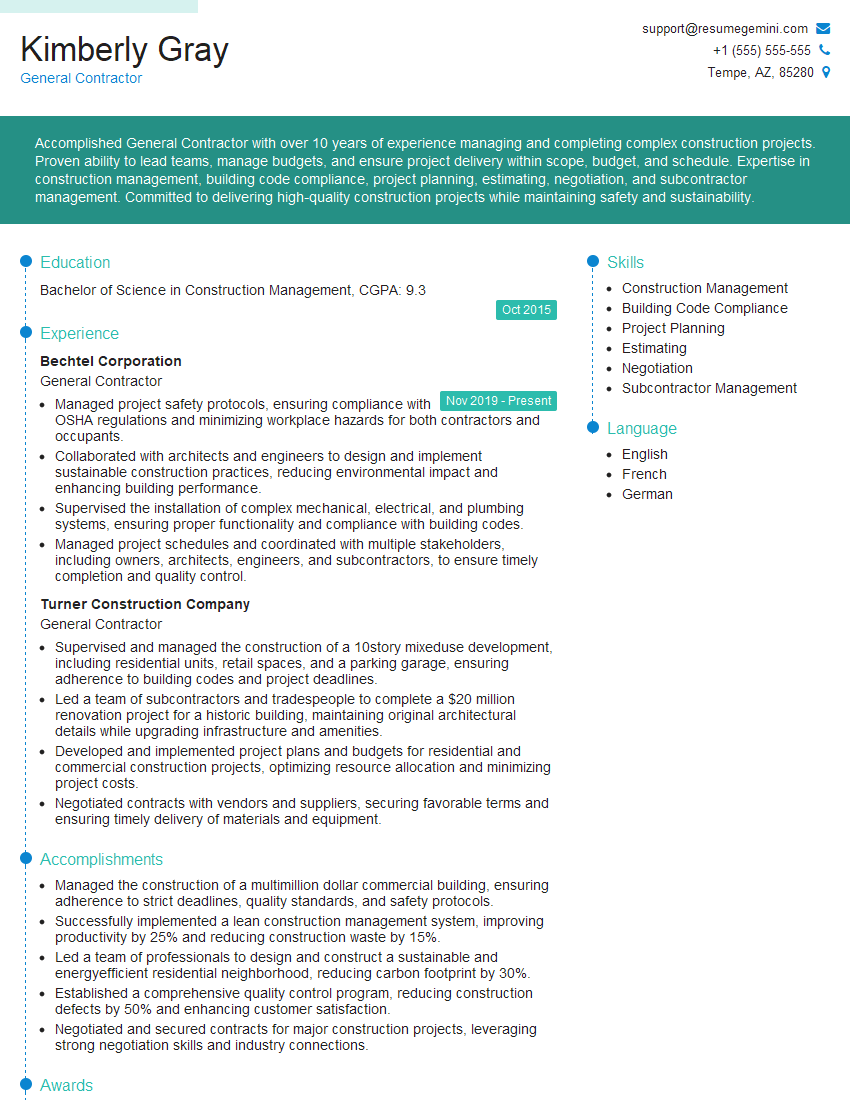
General Contractor Resume Sample
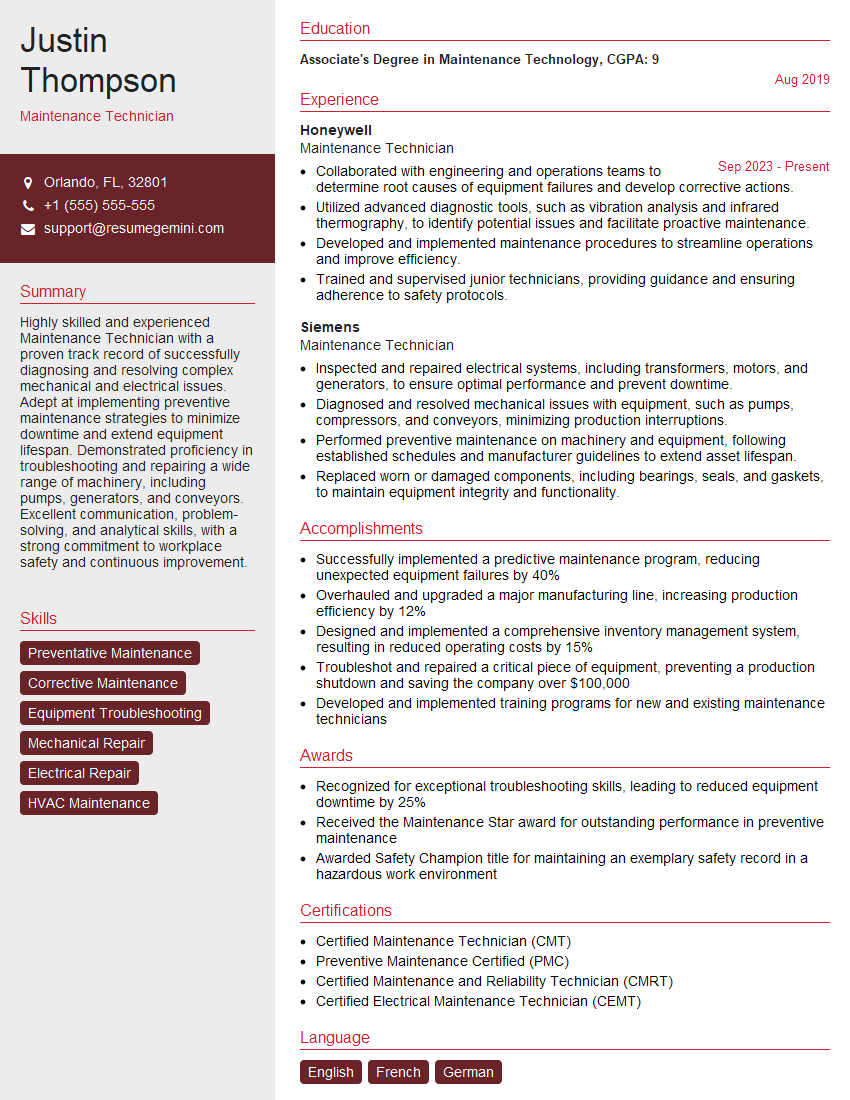
Maintenance Technician Resume Sample
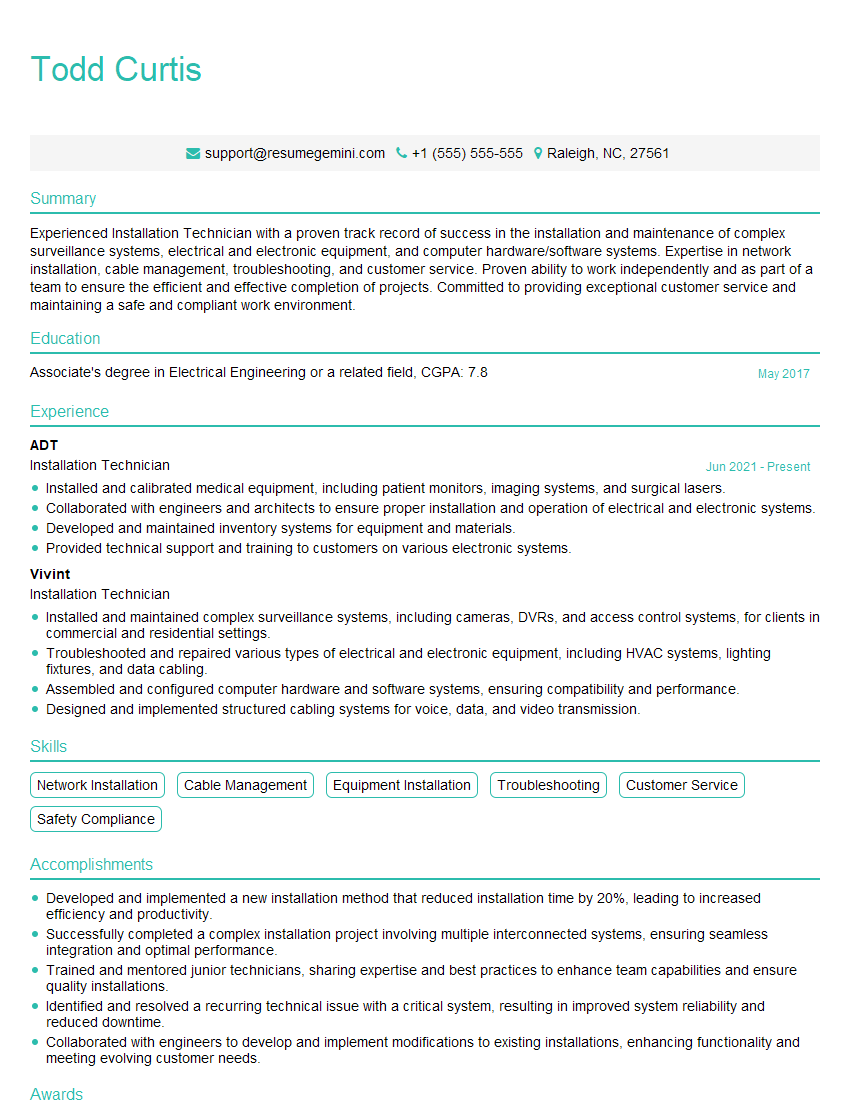
Installation Technician Resume Sample
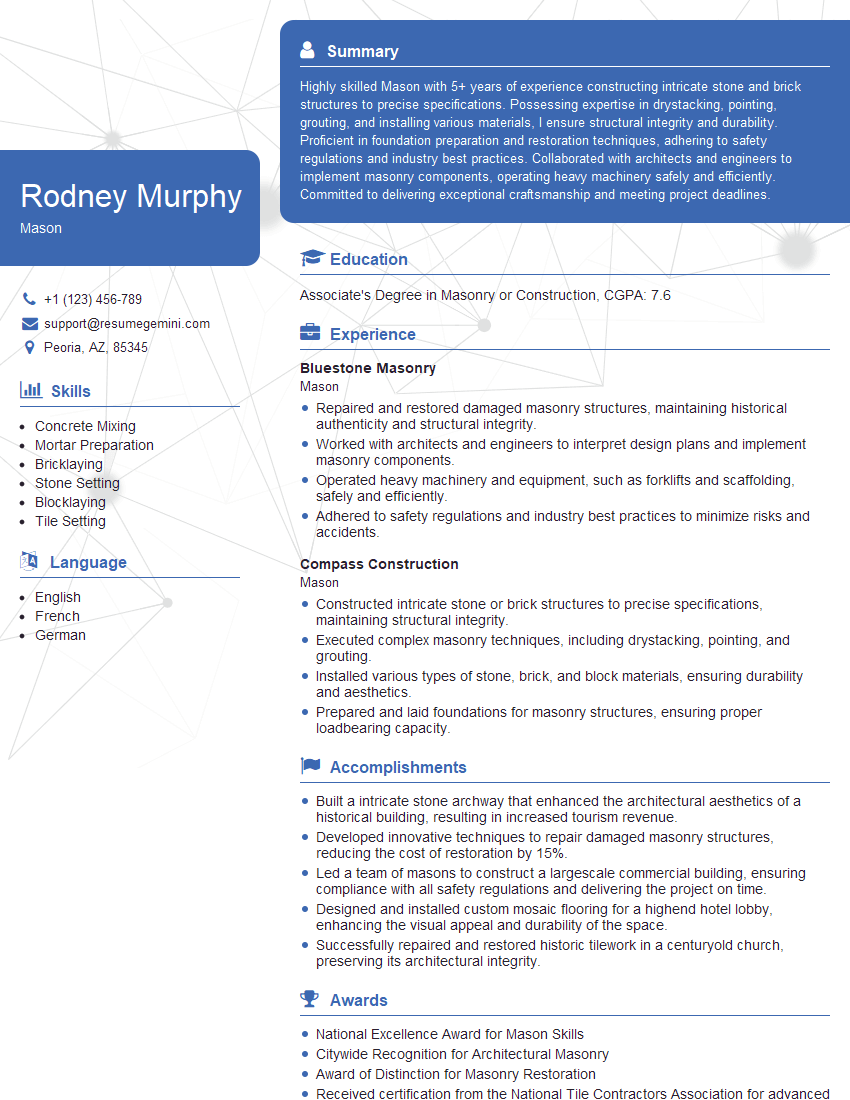
Mason Resume Sample
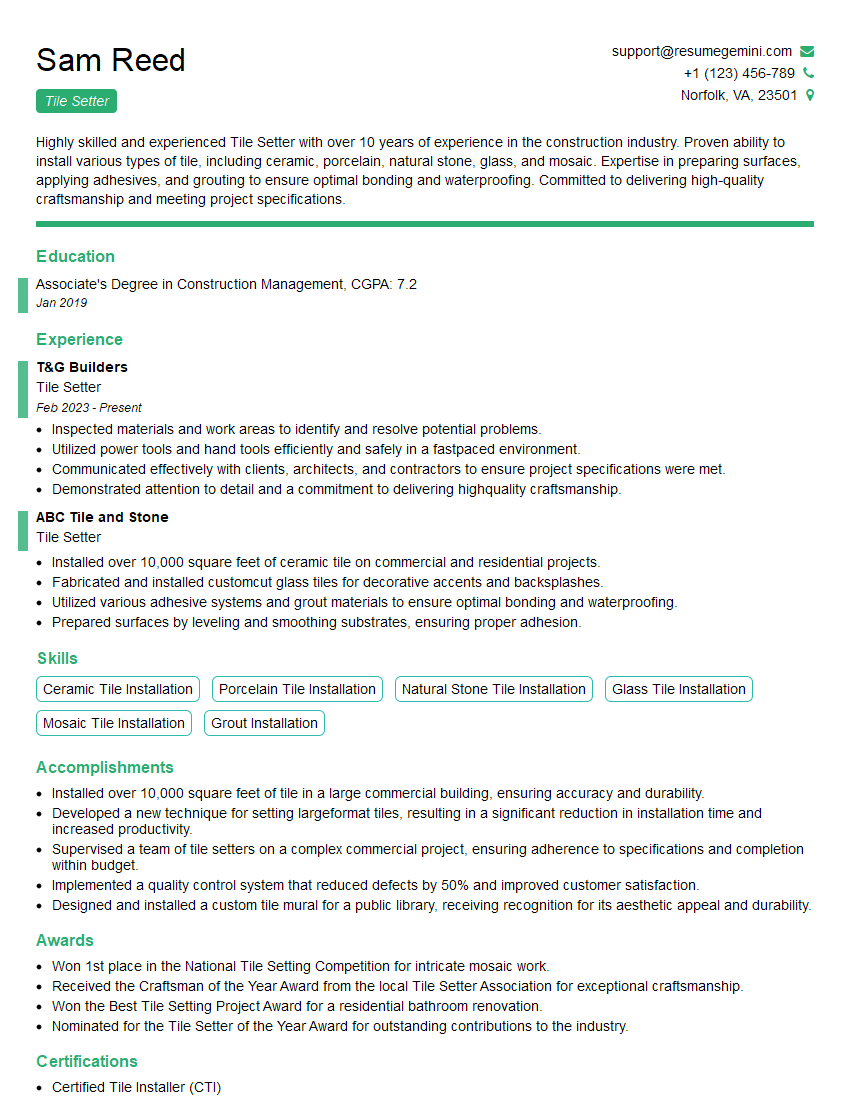
Tile Setter Resume Sample

Finish Carpenter Resume Sample

Construction Worker Resume Sample
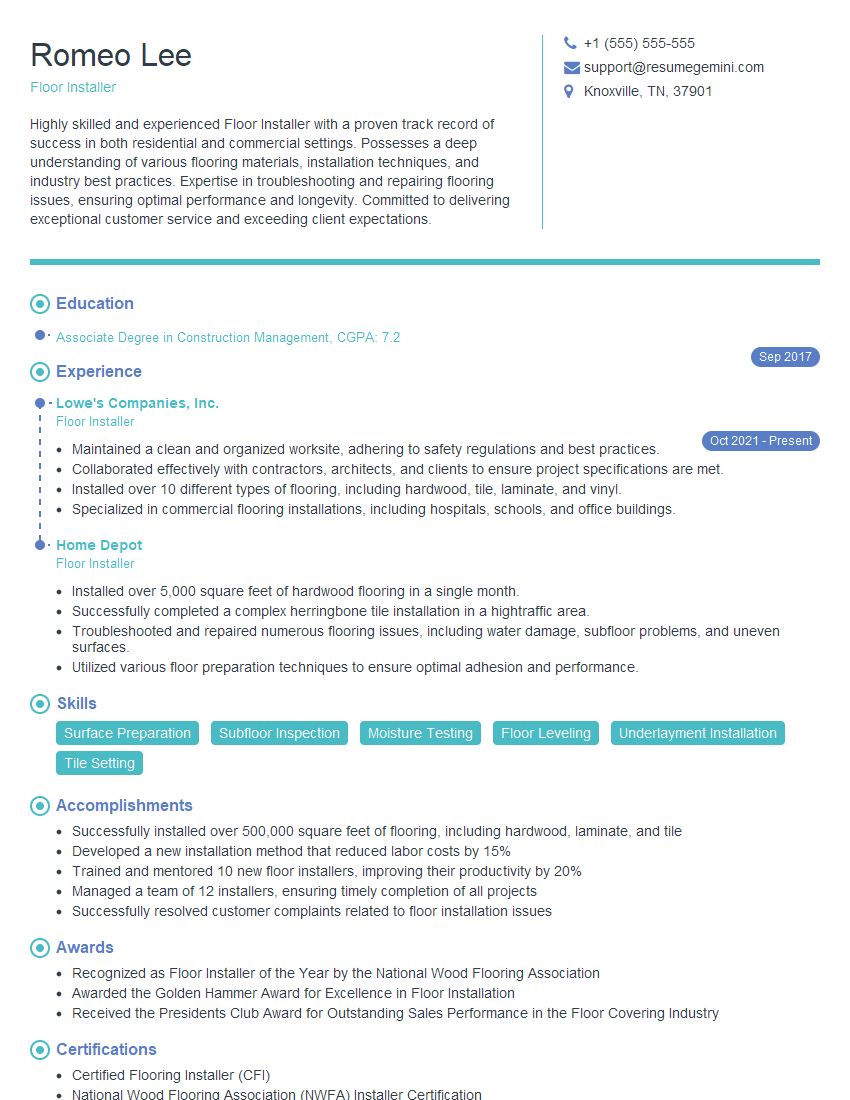
Floor Installer Resume Sample
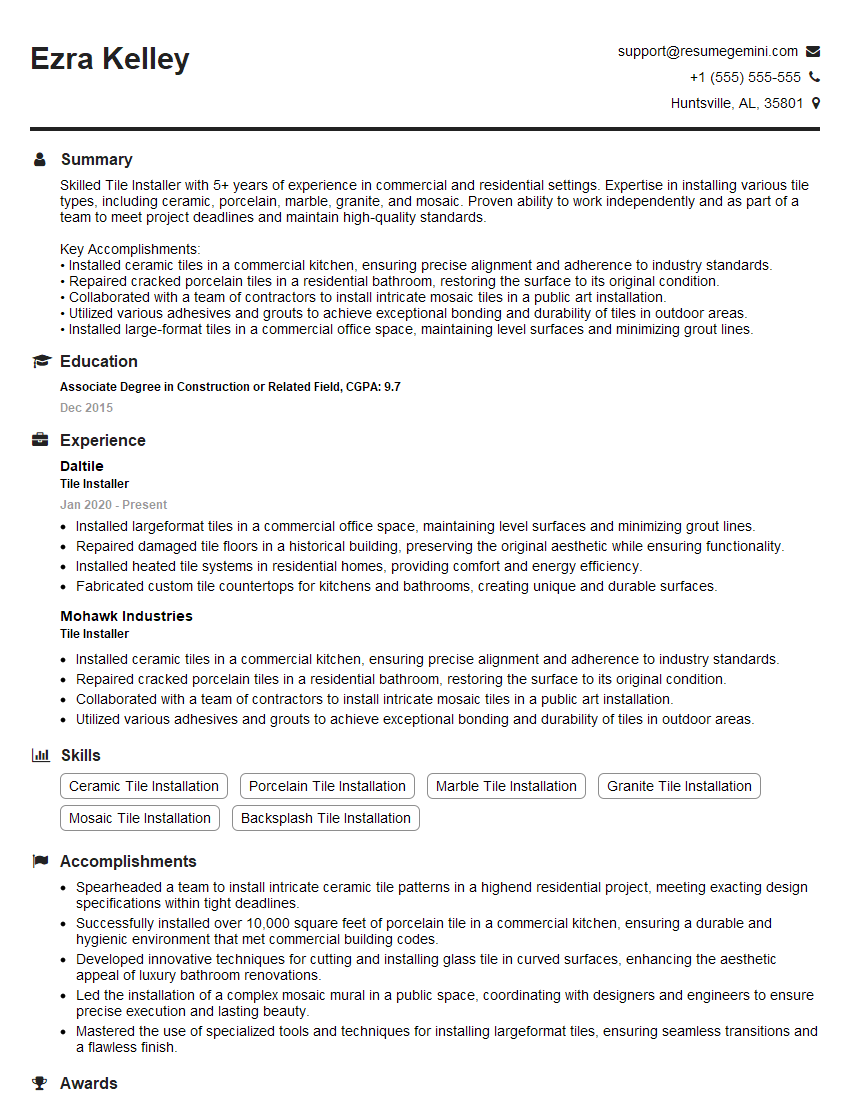
Tile Installer Resume Sample
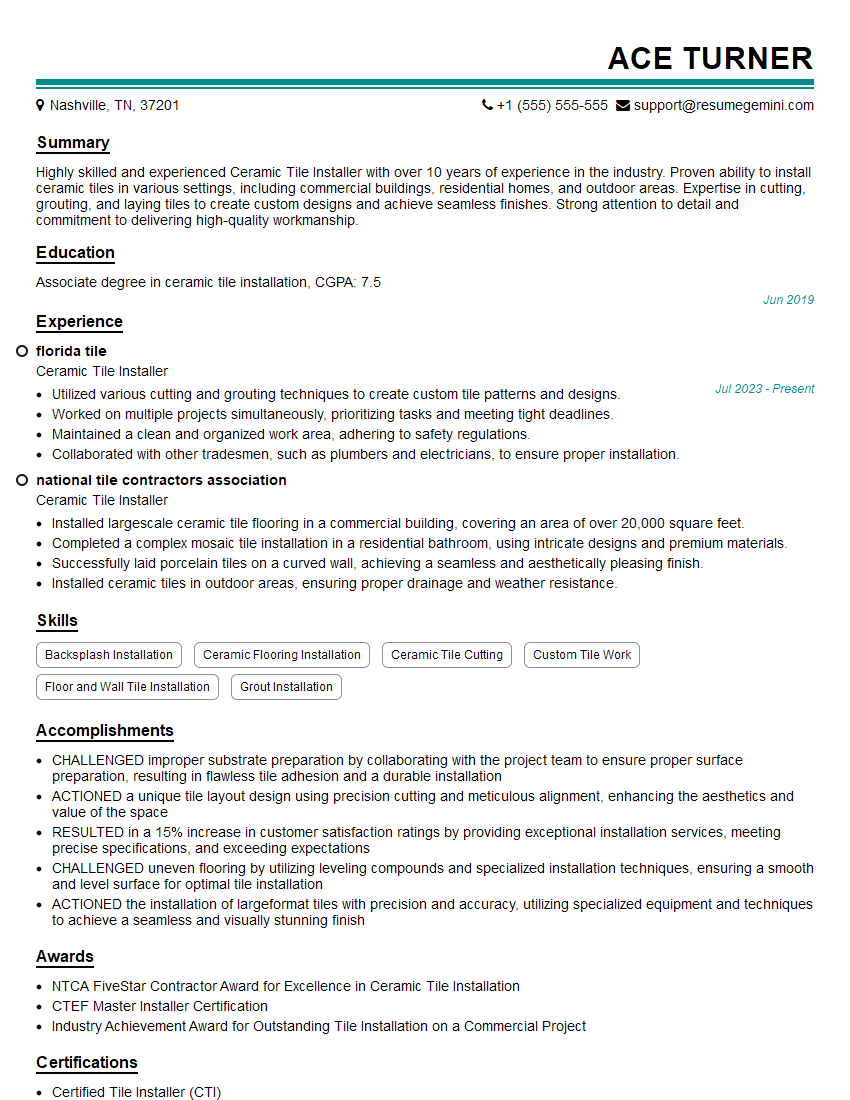
Ceramic Tile Installer Resume Sample
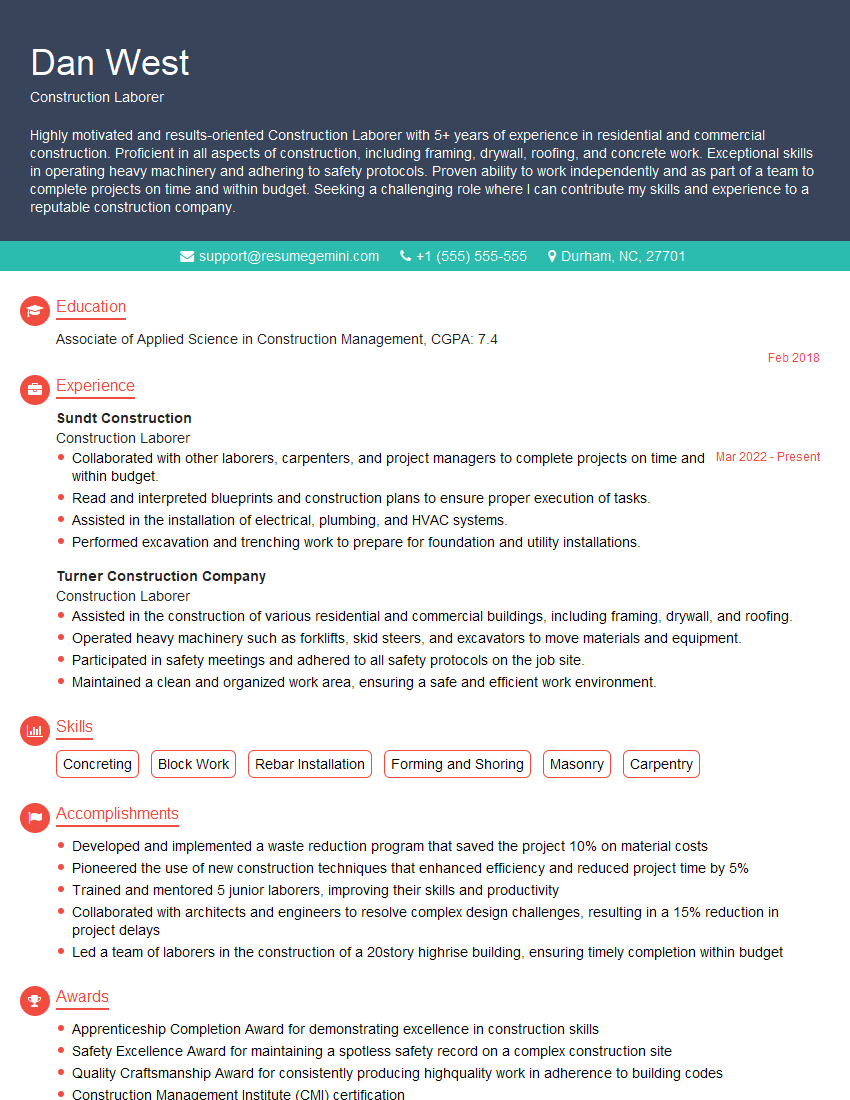
Construction Laborer Resume Sample
Explore more articles
Users Rating of Our Blogs
Share Your Experience
We value your feedback! Please rate our content and share your thoughts (optional).
What Readers Say About Our Blog
hello,
Our consultant firm based in the USA and our client are interested in your products.
Could you provide your company brochure and respond from your official email id (if different from the current in use), so i can send you the client’s requirement.
Payment before production.
I await your answer.
Regards,
MrSmith
hello,
Our consultant firm based in the USA and our client are interested in your products.
Could you provide your company brochure and respond from your official email id (if different from the current in use), so i can send you the client’s requirement.
Payment before production.
I await your answer.
Regards,
MrSmith
These apartments are so amazing, posting them online would break the algorithm.
https://bit.ly/Lovely2BedsApartmentHudsonYards
Reach out at [email protected] and let’s get started!
Take a look at this stunning 2-bedroom apartment perfectly situated NYC’s coveted Hudson Yards!
https://bit.ly/Lovely2BedsApartmentHudsonYards
Live Rent Free!
https://bit.ly/LiveRentFREE
Interesting Article, I liked the depth of knowledge you’ve shared.
Helpful, thanks for sharing.
Hi, I represent a social media marketing agency and liked your blog
Hi, I represent an SEO company that specialises in getting you AI citations and higher rankings on Google. I’d like to offer you a 100% free SEO audit for your website. Would you be interested?