Unlock your full potential by mastering the most common truss construction interview questions. This blog offers a deep dive into the critical topics, ensuring you’re not only prepared to answer but to excel. With these insights, you’ll approach your interview with clarity and confidence.
Questions Asked in truss construction Interview
Q 1. Explain the different types of trusses and their applications.
Trusses are structural elements composed of interconnected triangular units, forming a lightweight yet incredibly strong framework. Different truss types are categorized based on their geometry and arrangement of members. Here are some common examples:
- Simple Trusses: These are the most basic types, featuring a single triangle or a series of interconnected triangles. They are easy to analyze and construct, often used in simple roof structures or small bridges.
- Compound Trusses: Created by combining multiple simple trusses, these offer increased span and load-bearing capacity. They’re commonly seen in larger bridges and industrial buildings.
- Complex Trusses: Exhibit more intricate geometries, with multiple interconnected triangles arranged in a less regular pattern. These are typically used in situations demanding unique structural solutions, such as long-span bridges or specialized architectural designs.
- Parallel Chord Trusses: These have top and bottom chords that run parallel to each other, offering simplicity in design and construction, commonly found in buildings where parallel supports are desired.
- K-Trusses: Named for their distinctive K-shaped configuration in the web members, these are efficient for longer spans and are often used for bridges and roofs.
- Warren Trusses: With their characteristic equilateral triangle pattern, these are remarkably strong and visually appealing, sometimes used in bridges and roof systems requiring high aesthetic appeal.
The choice of truss type is dictated by factors like span, loading conditions, material properties, and aesthetic considerations. For instance, a simple truss might suffice for a small shed, while a complex truss would be necessary for a large bridge needing to withstand significant loads.
Q 2. Describe the process of designing a truss for a specific load.
Designing a truss for a specific load involves a systematic approach. First, we need to determine the loads acting on the structure – dead loads (weight of the truss itself and any permanent fixtures), live loads (temporary loads such as people, snow, or equipment), and environmental loads (wind, seismic activity). These are often expressed as forces in kN (kilonewtons).
Next, we define the geometry of the truss, establishing the number of members, their lengths, and connections. The geometry must align with the loading to ensure stability. Then, using methods like the Method of Joints or Method of Sections (detailed in the next answer), we analyze the truss to determine the internal forces in each member under the defined loads. These forces dictate the member’s size and material properties.
Finally, we select appropriate materials based on the calculated forces and the desired safety factor. This involves looking at material strength properties, cost and availability. This entire process is often iterated, adjusting the geometry or materials to optimize the design based on cost and functionality. The aim is to produce a safe and cost-effective solution that meets all design requirements.
Q 3. How do you calculate the forces in members of a truss?
Calculating member forces in a truss involves employing either the Method of Joints or the Method of Sections. Both methods leverage equilibrium equations (ΣFx = 0, ΣFy = 0, and ΣM = 0) based on static equilibrium principles.
Method of Joints: This approach considers each joint (node) individually. By isolating a joint, we apply the equilibrium equations to find the unknown forces in the members connected to that joint. The process involves solving a series of simultaneous equations for each joint, proceeding systematically through the truss.
Method of Sections: This technique cuts through the truss with a section line isolating a part of the structure and then applies equilibrium equations to find the forces in the cut members. This is particularly useful when needing to find the forces in a few specific members, without having to analyze the whole truss.
For both methods, it’s crucial to carefully define the direction of forces (tension or compression). A positive force indicates tension; a negative force indicates compression. Software tools and programs can automate these calculations, especially for complex trusses.
Example (Method of Joints): Consider a simple truss with a vertical load. By analyzing joint A, we’d sum the forces in the x and y directions to solve for the forces in members AB and AC.
Q 4. What are the common methods for analyzing truss structures?
Common methods for analyzing truss structures include:
- Method of Joints: As described previously, this focuses on equilibrium at each joint.
- Method of Sections: This involves sectioning the truss to isolate a portion, simplifying analysis by only focusing on a subset of members.
- Matrix Methods: For large or complex trusses, matrix methods offer a systematic and efficient approach to solving for member forces. These methods rely on representing the truss’s structure and load conditions as matrices and solving the resulting equations through computer programs.
- Influence Lines: These are used to determine the variation of forces in truss members due to moving loads, as is common in bridge design.
The choice of method depends on the complexity of the truss and the specific information needed. Simple trusses can often be solved manually using the Method of Joints or Sections. However, for large, intricate trusses, matrix methods are almost always necessary due to their superior efficiency and accuracy.
Q 5. Explain the importance of bracing and stability in truss design.
Bracing and stability are paramount in truss design; they prevent instability, lateral buckling and ensure the overall integrity of the structure. A truss, while strong in compression and tension along its members, is susceptible to instability if not properly braced.
Bracing adds lateral stability to the truss by preventing sway or buckling under wind or seismic loads. Common bracing techniques include:
- Diagonal Bracing: Adding diagonal members within the truss plane to provide lateral support.
- Lateral Bracing: Providing external supports, often in the form of beams and columns to resist lateral forces.
- K-bracing: A specific type of diagonal bracing that enhances both vertical and lateral stability.
Insufficient bracing can lead to structural failure, even under relatively modest loads. Therefore, the design must incorporate appropriate bracing elements to ensure the safety and longevity of the structure. The level of bracing required is determined by factors such as the size and type of truss, loading conditions, and environmental factors.
Q 6. What are the different materials used in truss construction, and their advantages/disadvantages?
Various materials find use in truss construction, each with its own advantages and disadvantages:
- Steel: Offers high strength-to-weight ratio, excellent ductility (ability to deform before failure), and readily available in various shapes and sizes. However, steel is susceptible to corrosion and can be expensive.
- Aluminum: Lighter than steel and highly resistant to corrosion, making it suitable for applications where weight is a major concern. However, aluminum has lower strength compared to steel, limiting its use in high-load scenarios.
- Wood: A cost-effective and readily renewable material. Wood is strong in compression but weaker in tension, requiring careful design considerations. It’s susceptible to rot, insect infestation, and fire damage.
- Composite Materials: Combining different materials (e.g., fiber-reinforced polymers) to leverage the strengths of each. These materials can offer high strength-to-weight ratios and excellent durability but are often more expensive.
Material selection depends on cost, strength requirements, environmental conditions, and aesthetic considerations. Steel remains a popular choice for its strength and versatility, while aluminum is preferred when weight reduction is critical. Wood is common in smaller structures where cost is a primary factor.
Q 7. Describe your experience with truss detailing and documentation.
My experience with truss detailing and documentation encompasses all stages, from conceptual design to final fabrication drawings. I’m proficient in creating detailed shop drawings that include member sizes, connections, bracing details, and material specifications. My documentation ensures clear communication with fabricators and contractors, minimizing the risk of errors during construction.
I’ve worked on various projects, ranging from simple residential roof trusses to complex industrial structures. My detailing includes utilizing CAD software to create precise models and drawings, incorporating specific connection details considering factors like bolt size, welding specifications, and bearing capacities. I’m adept at generating documentation that conforms to relevant building codes and industry standards.
I am also experienced with generating accurate bills of materials (BOMs) and creating comprehensive assembly drawings to aid in seamless construction. I take pride in producing high-quality, unambiguous documentation that ensures the project’s successful completion.
Q 8. How do you ensure the accuracy of truss fabrication drawings?
Accuracy in truss fabrication drawings is paramount for structural integrity. We achieve this through a multi-step process starting with meticulous design using sophisticated software. This involves careful consideration of loads, material properties, and connection details. Then, the digital model is thoroughly checked for errors using automated analysis tools which identify potential issues like member conflicts or unsupported nodes. Following this, detailed shop drawings are generated, clearly specifying dimensions, member types, and connection details. These drawings are then reviewed by a second engineer, often a peer review, for a fresh perspective on the design and fabrication details. Finally, before fabrication begins, we often conduct a mock-up of critical connections to verify that the design translates seamlessly into reality. This helps us catch any discrepancies early on, preventing costly rework later. Think of it like a recipe – a meticulous recipe ensures a delicious cake, and similarly, detailed drawings ensure a structurally sound truss.
Q 9. What are the common failure modes of trusses and how to prevent them?
Truss failures typically stem from overloading, buckling of compression members, yielding of tension members, and connection failures. Let’s break these down:
- Overloading: This is the most straightforward failure mode – the truss is subjected to loads exceeding its design capacity. Prevention involves accurate load calculations, incorporating safety factors, and proper material selection.
- Buckling (Compression Members): Slender compression members can buckle under compressive loads. Prevention includes using higher strength materials, increasing the cross-sectional area of members, or using bracing to restrain lateral movement. Imagine a long, thin straw bending under pressure; a thicker straw would be more resistant.
- Yielding (Tension Members): Tension members can fail by exceeding their yield strength. Prevention involves selecting materials with sufficient tensile strength and appropriately sizing the members based on calculated stresses.
- Connection Failures: This is a critical area. Weak or improperly designed connections can cause the entire truss to fail even if the individual members are strong. Prevention involves using robust connection details, proper welding techniques, and thorough inspection of welds and bolted connections.
Regular inspection and maintenance are also crucial for preventing failures. Identifying and addressing potential problems early can prevent catastrophic failures.
Q 10. Explain your understanding of connection design in truss systems.
Connection design is the backbone of a truss system. It’s where individual members are joined to form the overall structure. A poorly designed connection is a recipe for disaster. The design must ensure adequate strength, stiffness, and stability to transmit forces effectively. Key considerations include:
- Connection Type: This could range from simple bolted connections to more complex welded or gusset plate connections. The choice depends on the load levels, material properties, and aesthetic considerations. Gusset plates, for example, are commonly used to distribute forces efficiently.
- Bolt/Weld Size and Spacing: These are critical for ensuring sufficient shear and tensile strength. We use engineering standards and software analysis to determine optimal sizing and spacing to avoid stress concentrations.
- Bearing Stress: The pressure between the connection elements needs to be controlled to prevent crushing. This is particularly important for high-load applications.
- Fatigue Considerations: Connections are subjected to repeated loading cycles, potentially leading to fatigue failure. Designing for fatigue life is essential, especially in dynamic applications.
In essence, connection design requires a thorough understanding of both the individual components and their interaction within the overall truss structure. Each connection is designed to be the ‘weakest link’ in a chain, the overall strength of this ‘weakest link’ must be sufficient to support the applied loads.
Q 11. How do you handle unexpected issues during truss installation?
Unexpected issues during truss installation are inevitable. My approach involves a combination of proactive measures and reactive problem-solving. Proactive measures include thorough site surveys to identify potential obstacles beforehand and detailed planning of the lifting and placement process. This minimizes surprises. During the installation, we have a dedicated quality control team that monitors the progress and immediately addresses any discrepancies.
For reactive problem-solving, a critical step is proper documentation. Any deviation from the plan, no matter how small, is meticulously recorded. If unexpected issues arise, we first assess the severity. Minor issues might be addressed through on-site adjustments, while more significant ones may require modifications to the design or fabrication plans. We maintain clear communication with the design team, the construction manager, and the client throughout the entire process. Open communication is key to finding solutions swiftly and safely.
Q 12. Describe your experience with different types of truss connections (e.g., gusset plates, welds).
I have extensive experience with various truss connection types. Gusset plates are a mainstay, offering excellent strength and versatility. They allow for efficient force distribution and are relatively easy to fabricate. Welded connections offer higher strength and stiffness compared to bolted ones, making them suitable for high-load situations. However, welding requires skilled labor and careful quality control to prevent defects. Bolted connections are often preferred for ease of assembly and disassembly, enabling easier maintenance or future modifications. Each type has its pros and cons. The selection depends on factors such as the load capacity requirements, material properties, cost considerations, and site conditions.
For instance, in a recent project involving a large-span roof truss, we opted for a combination of welded and bolted connections. Critical joints were welded for maximum strength, while less critical joints utilized high-strength bolted connections for ease of erection. This allowed for optimizing both strength and construction efficiency.
Q 13. What software are you proficient in for truss design and analysis?
I’m proficient in several software packages for truss design and analysis. My go-to software is RISA-3D, which offers robust capabilities for modeling, analysis, and design of various structural systems, including trusses. It allows for detailed load calculations, member sizing, and connection design. I also have experience with SAP2000, another industry-standard program that provides similar functionalities, and occasionally use AutoCAD for detailed drafting and detailing. Proficiency in these tools allows for efficient and accurate analysis and design.
Q 14. How do you ensure the quality control of truss fabrication and erection?
Quality control is integral throughout the entire process, from design to erection. During fabrication, we implement rigorous inspections at each stage. This includes verifying material properties, checking dimensions, and inspecting welds or bolted connections for defects. Regular site visits during erection ensure adherence to the approved plans and identification of any potential issues. We use checklists and documentation to ensure a systematic approach to quality control. Regular training for our fabrication and installation teams keeps everyone updated on best practices and safety procedures. Finally, independent inspections by third-party agencies are often incorporated to ensure an unbiased assessment of the completed structure. A well-defined quality control program is a vital safeguard against failures and ensures a durable and safe structure.
Q 15. Explain your understanding of building codes and standards related to trusses.
Building codes and standards for trusses are crucial for ensuring structural safety and compliance. They dictate the design, materials, and construction methods to withstand anticipated loads and environmental factors. Key codes and standards I frequently consult include the International Building Code (IBC), the American Society of Civil Engineers (ASCE) 7 standard for minimum design loads, and the American Wood Council (AWC) publications for wood truss design. These documents provide detailed specifications for allowable stresses of different materials, connection details, and load calculations, ensuring the stability and longevity of the truss structure. For example, the IBC specifies minimum spacing requirements for trusses based on their span and load capacity, while ASCE 7 guides me in determining the correct snow and wind loads for a specific geographic location. Failure to adhere to these standards can lead to structural failure and legal ramifications.
Career Expert Tips:
- Ace those interviews! Prepare effectively by reviewing the Top 50 Most Common Interview Questions on ResumeGemini.
- Navigate your job search with confidence! Explore a wide range of Career Tips on ResumeGemini. Learn about common challenges and recommendations to overcome them.
- Craft the perfect resume! Master the Art of Resume Writing with ResumeGemini’s guide. Showcase your unique qualifications and achievements effectively.
- Don’t miss out on holiday savings! Build your dream resume with ResumeGemini’s ATS optimized templates.
Q 16. Describe a challenging truss project you worked on and how you overcame the challenges.
One challenging project involved a large-scale residential development requiring unusually long-span trusses in a high-wind zone. The challenge was to design trusses that met the structural requirements while keeping them cost-effective and aesthetically pleasing, as exposed trusses were a design element. We initially faced difficulties in balancing the weight of the materials needed for wind resistance with the overall span requirements. To overcome this, we employed advanced Finite Element Analysis (FEA) software to optimize the truss design, exploring various configurations and member sizes. We also experimented with different engineered lumber products to achieve the desired strength-to-weight ratio. This iterative process of analysis and refinement allowed us to reduce material costs while ensuring the trusses met or exceeded all code requirements and load expectations. The project’s success highlighted the importance of leveraging advanced computational tools and material science in challenging truss designs.
Q 17. How do you estimate the cost of a truss project?
Estimating the cost of a truss project involves a multi-step process. First, I carefully review the architectural and engineering plans to determine the number, size, and type of trusses needed. Then, I obtain pricing for materials from different suppliers, considering factors like lumber grade, steel type, and connector hardware. Labor costs are estimated based on the complexity of the design and the anticipated installation time. I also factor in transportation costs, potential waste, and a contingency for unforeseen issues. Finally, I add a markup for profit and overhead. The detailed breakdown typically includes a separate line item for each major cost component, allowing for clear transparency and ease of revision. For example, a simple spreadsheet can clearly outline material costs, labor hours at an hourly rate, and the profit margin to provide a detailed estimate to the client.
Q 18. What are your experience with different types of wood, steel, and engineered lumber used in trusses?
My experience encompasses a wide range of materials used in truss construction. In wood trusses, I frequently work with Southern Yellow Pine, Spruce-Pine-Fir (SPF), and engineered lumber such as Laminated Strand Lumber (LSL) and Parallel Strand Lumber (PSL). Each material offers different strength and stiffness properties, influencing the design and cost. Steel trusses utilize various grades of structural steel, chosen based on strength requirements and budget. The selection process often involves trade-offs between strength, weight, and cost. Engineered lumber provides excellent strength-to-weight ratios, making it a popular choice for long-span trusses. I consider factors like material availability, local code requirements, and the client’s budget when selecting the appropriate materials. For instance, PSL’s high strength allows for slimmer members, reducing overall weight and material costs in certain designs.
Q 19. Explain the difference between statically determinate and indeterminate trusses.
Statically determinate trusses can be analyzed using simple equilibrium equations. This means the reactions at the supports and the forces in each member can be calculated using only the equations of static equilibrium (∑Fx = 0, ∑Fy = 0, ∑M = 0). They are relatively straightforward to analyze and design. A simple example is a triangular truss. Statically indeterminate trusses have more members or supports than necessary to maintain stability, requiring more complex analysis methods beyond basic equilibrium equations. These usually involve solving simultaneous equations or using matrix methods. This added complexity increases the computational effort but can lead to more robust structures. A common example is a continuous beam supported at multiple points, where the reactions are interdependent and cannot be solved using simple statics alone.
Q 20. How do you incorporate wind and snow loads into your truss design?
Incorporating wind and snow loads is a crucial step in truss design to ensure structural integrity. I utilize ASCE 7 to determine the design wind and snow loads based on the building’s location, height, and exposure category. These loads are then applied to the truss model during analysis. Software like RISA-3D or similar FEA programs allows for the accurate simulation of load distribution within the truss. This ensures that each member is designed to withstand these loads without exceeding its allowable stress limits. The software output provides member forces which are then used to select appropriate sized members that can safely support the load combinations, including dead load, live load, wind load and snow load. For example, wind load is often applied as a lateral force, creating bending moments in the truss members. The design needs to account for these bending moments, shear forces, and axial loads in every member.
Q 21. How do you manage a team during truss construction?
Managing a team during truss construction involves clear communication, coordination, and safety. I start by establishing a clear project plan outlining timelines, responsibilities, and safety protocols. Regular meetings are essential for monitoring progress, addressing challenges, and ensuring everyone is on the same page. I foster a collaborative environment where team members feel comfortable voicing concerns or suggesting improvements. Safety is paramount; therefore, I maintain a zero-tolerance policy for unsafe practices and ensure all team members receive appropriate training and personal protective equipment. Effective communication, proactive problem-solving, and a strong emphasis on safety are vital for successful project completion. A well-defined communication structure – perhaps using daily or weekly logs to document progress, issues, and solutions – can streamline operations and minimize potential issues.
Q 22. Describe your experience with different types of foundations for truss structures.
The foundation for a truss structure is critical for its stability and longevity. The choice depends on several factors, including soil conditions, the size and load of the truss, and the overall project budget. I’ve worked with various foundation types, and my selection process always starts with a thorough soil investigation.
Shallow Foundations: These are suitable for smaller trusses and stable soil conditions. Examples include spread footings (individual concrete pads under each support point) and strip footings (continuous concrete strips supporting a wall or row of trusses). I remember a project where we used spread footings for a small greenhouse truss system – simple, effective, and cost-efficient.
Deep Foundations: For larger trusses or unstable soil, deep foundations are necessary. These include piles (driven or drilled into the ground to transfer loads to deeper, stronger soil layers) and caissons (large, cylindrical concrete structures sunk into the ground). A recent project involving a large industrial building utilized drilled piles to overcome soft soil conditions. The engineering calculations were complex, but the deep foundations ensured structural integrity.
Pier Foundations: These are intermediate solutions, often consisting of concrete piers extending from the ground to support the truss. They offer a balance between cost and stability. I’ve used these successfully for several residential projects where the soil conditions were moderately stable.
Ultimately, the foundation selection requires careful engineering analysis to ensure the structure’s safety and long-term performance. I always incorporate factors such as seismic considerations, frost heave potential, and potential ground water issues in my foundation design.
Q 23. What safety precautions do you follow during truss construction?
Safety is paramount in truss construction. My approach is proactive, encompassing pre-construction planning, on-site practices, and post-construction inspection. Here’s a summary of my key safety measures:
Proper Personal Protective Equipment (PPE): This includes hard hats, safety glasses, high-visibility clothing, steel-toed boots, and fall protection harnesses, depending on the task and height. I always emphasize the importance of wearing the appropriate PPE and regularly inspect it for damage.
Safe Lifting and Handling Techniques: Trusses can be heavy and awkward to handle. We utilize certified cranes and rigging equipment, adhering strictly to safe lifting procedures. Pre-lift plans are always developed, and regular checks are conducted to ensure equipment is in good working order.
Fall Protection: For elevated work, fall protection systems are crucial. We utilize safety harnesses, guardrails, and other appropriate measures to prevent falls from heights. Regular inspections of these systems are mandatory.
Regular Site Inspections: I conduct regular safety inspections to identify and address potential hazards promptly. This includes checking for proper housekeeping, secure scaffolding, and the correct use of tools and equipment.
Emergency Procedures: A comprehensive emergency response plan is always in place, with designated personnel trained in first aid and emergency evacuation procedures.
Training and Communication: All personnel involved are thoroughly trained on safe work practices, including hazard identification and risk mitigation. Open communication is encouraged to quickly identify and rectify potential safety concerns.
Ignoring safety protocols can have devastating consequences. My commitment to safety isn’t just a policy; it’s a deeply ingrained part of my work ethic.
Q 24. How do you interpret and apply engineering drawings related to trusses?
Engineering drawings for trusses are highly detailed documents that provide all the necessary information for construction. My ability to interpret these drawings accurately and efficiently is crucial. I approach this with a systematic process:
Understanding the Symbols and Conventions: I’m proficient in reading industry standard symbols and conventions used in truss drawings. This includes understanding details like member sizes, connection types, and support conditions.
Analyzing Member Sizes and Materials: The drawings clearly indicate the dimensions and material specifications for each truss member. This is essential for ordering the correct materials and ensuring proper construction.
Identifying Connection Details: Detailed connection designs are critical for the structural integrity of the truss. I carefully review the connection details to ensure they are accurately implemented during construction.
Checking Load and Support Conditions: The drawings specify the loads that the truss is designed to support and the locations of the supports. This information is fundamental for ensuring the stability of the structure.
Verifying Dimensions and Tolerances: Precise dimensions and tolerances are critical for the proper assembly of the truss. I carefully review these details to avoid any errors during the construction phase.
Interpreting these drawings isn’t just about understanding the lines and numbers; it’s about visualizing the completed structure and anticipating potential challenges. I’ve found that meticulously reviewing the drawings before starting construction significantly reduces the risk of errors and rework.
Q 25. What are the advantages and disadvantages of using pre-fabricated trusses?
Pre-fabricated trusses offer several advantages and disadvantages compared to on-site construction:
Advantages:
Faster Construction: Pre-fabricated trusses significantly reduce construction time, as they are assembled off-site and then simply lifted into place.
Increased Accuracy and Precision: Factory fabrication ensures higher accuracy and precision compared to on-site construction, leading to a stronger and more reliable structure.
Cost-Effectiveness (often): While initial material costs might be similar, the reduced labor and construction time often lead to overall cost savings.
Improved Quality Control: Factory environments allow for better quality control and standardized procedures, reducing errors.
Disadvantages:
Transportation and Handling Challenges: Transporting large pre-fabricated trusses to the construction site can be challenging and expensive, particularly in remote locations.
Limited Design Flexibility: While designs are becoming increasingly adaptable, some unique designs may be more difficult or impossible to prefabricate.
Potential for Damage during Transportation: There is a risk of damage to the trusses during transportation and handling, which needs to be mitigated with careful planning and execution.
Dependence on Suppliers: Delays or issues with the pre-fabrication supplier can significantly impact the project schedule.
The decision of whether to use pre-fabricated trusses is a project-specific choice based on a careful weighing of these advantages and disadvantages. For instance, I’d prioritize prefabrication for large-scale projects where speed and precision are critical, but might consider on-site construction for smaller, more unique designs.
Q 26. Explain your understanding of finite element analysis (FEA) as it relates to trusses.
Finite Element Analysis (FEA) is a powerful computational technique used to simulate the behavior of structures under various loads and conditions. In the context of trusses, FEA helps predict stresses, deformations, and overall structural integrity. It involves dividing the truss into many smaller elements (hence the name), each with its own properties and relationships, and then using mathematical equations to analyze the interaction of these elements under load.
My understanding of FEA allows me to:
Optimize Truss Designs: By running different FEA simulations with varying designs, I can optimize the truss geometry and member sizes for maximum strength and efficiency while minimizing material usage.
Assess Structural Integrity: FEA can identify potential weaknesses or areas of high stress concentration in a truss design, allowing for modifications to improve structural reliability.
Predict Deflections: FEA accurately predicts how much a truss will deflect under load, helping me ensure the design meets specified deflection limits.
Evaluate the Effects of Different Load Cases: FEA can be used to evaluate the truss’s behavior under different load conditions such as dead loads, live loads, wind loads, and seismic loads.
I utilize commercially available FEA software and have extensive experience interpreting the results to inform my design decisions. It’s a crucial tool for ensuring the safety and efficiency of the trusses I design.
Q 27. How do you ensure compliance with relevant health and safety regulations during truss construction?
Compliance with health and safety regulations is not an afterthought; it’s integrated into every stage of my work. I ensure compliance by:
Staying Updated on Regulations: I continually stay updated on all relevant occupational health and safety regulations, building codes, and industry best practices. This includes local, regional, and national regulations.
Risk Assessments: Before commencing any project, a thorough risk assessment is undertaken to identify potential hazards and develop mitigation strategies. This documentation is essential for demonstrating compliance.
Method Statements: Detailed method statements outline the safe work procedures for all aspects of the project, ensuring that all personnel understand and follow the safety protocols.
Site-Specific Safety Plans: Each project has a customized site-specific safety plan addressing the unique hazards present on that particular site.
Regular Safety Audits: Regular safety audits and inspections are conducted to ensure continuous compliance and identify any potential areas for improvement.
Record Keeping: Meticulous record-keeping of all safety-related activities, including training records, inspections, and incident reports, is maintained.
Collaboration with Authorities: I actively collaborate with relevant authorities and regulatory bodies to ensure full compliance and seek clarification on any ambiguities.
My commitment to safety isn’t just about avoiding fines; it’s about creating a safe and productive work environment for everyone involved. A culture of safety is essential.
Q 28. What are your skills in troubleshooting and resolving problems related to truss structures?
Troubleshooting and problem-solving are integral aspects of my work. My approach is systematic and data-driven:
Careful Observation and Data Collection: When faced with a problem, my first step is thorough observation and data collection. This involves identifying the nature of the problem, its location, and any contributing factors. I gather data from various sources, such as visual inspections, load measurements, and historical records.
Root Cause Analysis: I employ root cause analysis techniques to identify the underlying causes of the problem, rather than simply addressing the symptoms. This ensures a more permanent solution.
Engineering Analysis: Depending on the nature of the problem, I may utilize engineering analysis techniques, including FEA, to determine the extent of the damage and develop appropriate repair strategies.
Collaboration and Consultation: I believe in open communication and collaboration. If necessary, I consult with other experts, such as structural engineers or material scientists, to gain additional insights and perspectives.
Implementation of Corrective Measures: Based on my analysis, I develop and implement appropriate corrective measures. This may involve repairing damaged members, reinforcing the structure, or adjusting the load distribution.
Documentation and Lessons Learned: I carefully document the entire troubleshooting process, including the problem, the solution, and any lessons learned. This helps to prevent similar issues in the future.
For example, I once encountered a truss with unexpected deflections. By meticulously analyzing the design and site conditions, we discovered a soil settlement issue that hadn’t been accounted for in the initial design. Addressing this soil issue, along with minor truss reinforcement, successfully resolved the problem.
Key Topics to Learn for Your Truss Construction Interview
- Truss Geometry and Stability: Understanding different truss types (e.g., Pratt, Howe, Warren), analyzing their stability, and identifying critical members.
- Load Analysis and Distribution: Applying methods like the method of joints and the method of sections to determine forces in truss members under various loading conditions.
- Material Selection and Properties: Choosing appropriate materials (e.g., steel, wood, aluminum) based on strength, weight, and cost considerations; understanding material properties and their influence on truss design.
- Connection Design and Details: Analyzing different joint types and their strengths; understanding the importance of proper connections for overall truss integrity.
- Design Codes and Standards: Familiarity with relevant building codes and industry standards that govern truss design and construction.
- Practical Application: Analyzing real-world truss applications in bridges, roofs, and other structures; understanding the challenges and considerations involved in different projects.
- Software and Tools: Familiarity with common engineering software used for truss analysis and design (mentioning general categories is sufficient; avoid specific software names).
- Problem-Solving and Troubleshooting: Applying your knowledge to solve practical problems related to truss design, construction, and maintenance; thinking critically about potential failures and mitigation strategies.
Next Steps: Launch Your Truss Construction Career
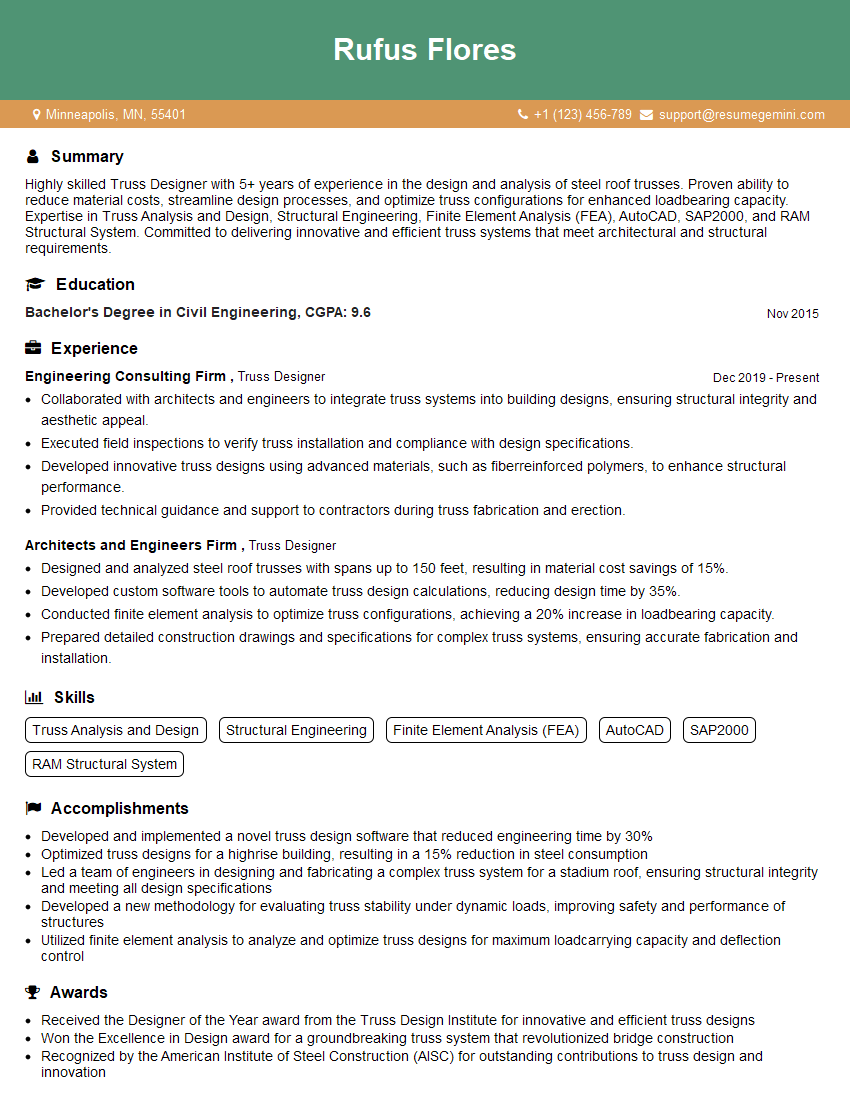
Mastering truss construction opens doors to exciting opportunities in structural engineering and construction. A strong understanding of these principles is highly sought after by employers, setting you apart in a competitive job market. To maximize your chances of landing your dream role, focus on creating an ATS-friendly resume that showcases your skills and experience effectively. ResumeGemini can be a valuable tool in this process, offering a streamlined way to build a professional resume that grabs attention. Examples of resumes tailored specifically for truss construction professionals are available to help you get started.
Explore more articles
Users Rating of Our Blogs
Share Your Experience
We value your feedback! Please rate our content and share your thoughts (optional).
What Readers Say About Our Blog
Amazing blog
hello,
Our consultant firm based in the USA and our client are interested in your products.
Could you provide your company brochure and respond from your official email id (if different from the current in use), so i can send you the client’s requirement.
Payment before production.
I await your answer.
Regards,
MrSmith
hello,
Our consultant firm based in the USA and our client are interested in your products.
Could you provide your company brochure and respond from your official email id (if different from the current in use), so i can send you the client’s requirement.
Payment before production.
I await your answer.
Regards,
MrSmith
These apartments are so amazing, posting them online would break the algorithm.
https://bit.ly/Lovely2BedsApartmentHudsonYards
Reach out at BENSON@LONDONFOSTER.COM and let’s get started!
Take a look at this stunning 2-bedroom apartment perfectly situated NYC’s coveted Hudson Yards!
https://bit.ly/Lovely2BedsApartmentHudsonYards
Live Rent Free!
https://bit.ly/LiveRentFREE
Interesting Article, I liked the depth of knowledge you’ve shared.
Helpful, thanks for sharing.
Hi, I represent a social media marketing agency and liked your blog
Hi, I represent an SEO company that specialises in getting you AI citations and higher rankings on Google. I’d like to offer you a 100% free SEO audit for your website. Would you be interested?