Feeling uncertain about what to expect in your upcoming interview? We’ve got you covered! This blog highlights the most important Understanding Sports Terminology interview questions and provides actionable advice to help you stand out as the ideal candidate. Let’s pave the way for your success.
Questions Asked in Understanding Sports Terminology Interview
Q 1. Define ‘offside’ in soccer.
In soccer, being offside means a player is too close to the opposing team’s goal when the ball is played to them by a teammate. It’s a crucial rule designed to prevent attacking players from gaining an unfair advantage by camping near the goal and waiting for a pass.
Specifically, a player is in an offside position if they are in the opponent’s half of the field and closer to the opponent’s goal line than both the ball and the second-to-last defender (excluding the goalkeeper). However, simply being in an offside position isn’t a foul; it only becomes an offense if, at the moment the ball is played to them, they are involved in active play. This involvement includes interfering with play, interfering with an opponent, or gaining an advantage by being in that position.
Example: Imagine a forward is positioned just beyond the last defender, waiting for a pass. If the teammate passes the ball, and the forward receives it while in that position, it’s likely to be called offside. However, if the forward is just standing there passively and doesn’t affect the play, the referee may not call it.
Practical Application: Understanding the offside rule is crucial for both players and referees in soccer. It ensures fair play by preventing attackers from easily scoring by loitering near the goal.
Q 2. Explain the difference between a ‘strikeout’ and a ‘walk’ in baseball.
In baseball, a strikeout and a walk are two contrasting outcomes of a batter’s encounter with a pitcher. Both result in the batter being removed from the plate but under significantly different circumstances.
Strikeout: A strikeout occurs when a batter fails to hit three pitches called ‘strikes’ by the umpire. A strike is declared if the batter swings and misses, if the pitch is deemed to be within the strike zone (the area over home plate between the batter’s knees and armpits), and the batter doesn’t swing. Three strikes result in the batter being declared ‘out’.
Walk: A walk, also known as a ‘base on balls’, happens when a pitcher throws four pitches outside the strike zone, and the batter doesn’t swing at any of them. These four pitches are called ‘balls’, and after the fourth ball, the batter is automatically awarded first base. This strategy is often used if a pitcher has difficulty throwing strikes or if the batter is consistently refusing to swing at pitches outside the strike zone.
Key Difference: A strikeout signifies the batter’s inability to make contact with the pitch, whereas a walk reflects the pitcher’s inability to throw strikes. They are both crucial events in the game and demonstrate different aspects of hitting and pitching skills.
Q 3. What is a ‘triple crown’ in horse racing?
In horse racing, the Triple Crown is an extremely prestigious achievement. It’s not a single race but a series of three specific classic races, each with a very long and illustrious history, that must be won by the same horse in the same calendar year. The three races are:
- The Kentucky Derby
- The Preakness Stakes
- The Belmont Stakes
Winning all three races is incredibly difficult, requiring the horse to maintain peak performance over several months and to demonstrate exceptional stamina and versatility over varying distances. Only a select few horses have ever accomplished this feat, making it one of the most sought-after titles in horse racing.
Q 4. Describe the significance of a ‘hole-in-one’ in golf.
In golf, a hole-in-one, also known as an ‘ace’, is when a player hits the ball from the tee into the hole in a single stroke. It’s a highly impressive and rare feat, requiring a combination of skill, precision, and a bit of luck.
The significance lies not only in its rarity but also in its impact on the game. It’s a moment celebrated widely, often with great excitement and applause from fellow golfers and spectators. Achieving a hole-in-one is a testament to a player’s proficiency and control. Many golfers play their entire lives without ever accomplishing this.
Q 5. What is a ‘slam dunk’ in basketball?
In basketball, a slam dunk is a dramatic and highly-scoring shot where a player jumps above the rim of the basketball hoop and forcefully pushes the ball downwards through the net. It’s usually achieved by players with exceptional height and athleticism.
The significance of a slam dunk goes beyond its point value. It’s a visually spectacular play that energizes the crowd and often demonstrates dominance and skill. The power and athleticism involved make it a fan favorite.
Q 6. Explain the concept of ‘down’ in American football.
In American football, a ‘down’ represents one of four attempts a team has to advance the ball at least 10 yards from its starting point. These attempts are sequential, and each begins after the previous down ends.
Each team’s offense gets four chances to achieve a ‘first down’, meaning advancing the ball at least 10 yards. If they succeed before the fourth down, the next set of four downs begin from their new position. If they don’t succeed by the fourth down, possession switches to the other team.
Practical Application: The concept of ‘downs’ is integral to the game’s strategy. Teams must decide whether to attempt to gain yards aggressively or employ more conservative plays depending on how many downs are remaining, the game situation, and their distance to the first down marker.
Q 7. What constitutes a ‘fault’ in tennis?
In tennis, a fault occurs when a player’s serve doesn’t land within the correct service box diagonally opposite them on the court. There are two types of faults in tennis. A player has two serves in each point.
First Fault: If a player’s first serve is a fault (lands outside the service box, hits the net, or is otherwise deemed invalid), they are allowed a second serve.
Second Fault: If the second serve is also a fault, the player loses the point. It signifies a failure to execute a proper serve.
Faults are crucial in tennis because they impact scoring and game strategy. Players strive for accurate serves to avoid faults and gain a tactical advantage during the match.
Q 8. What is meant by ‘love’ in tennis scoring?
In tennis scoring, ‘love’ doesn’t refer to romantic affection; instead, it signifies zero points. It’s a term that’s been around since the 16th century, possibly deriving from the French word ‘l’oeuf,’ meaning ‘egg,’ because a zero looks like an egg. So, when the scoreboard shows ‘love-15,’ it means one player has zero points and the other has 15 points. Think of it as a quirky historical quirk in the elegant world of tennis.
Q 9. What is a ‘penalty’ in hockey?
A penalty in hockey is a punishment imposed on a player for violating the rules. These violations range from minor infractions like tripping or slashing (using your stick to hit an opponent) to more serious offenses like fighting or checking from behind. The penalty results in the offending player being sent to the penalty box for a predetermined amount of time, during which their team plays shorthanded. The severity of the penalty (minor, major, or misconduct) determines the length of the penalty, impacting the team’s ability to score and defend.
For example, a minor penalty might be two minutes, while a major penalty could be five minutes or more. A misconduct penalty can result in ejection from the game. The penalized team’s performance during this shorthanded situation often significantly influences the game’s outcome.
Q 10. Explain the difference between a ‘grand slam’ and a ‘home run’ in baseball.
These are distinct achievements in different sports: a ‘grand slam’ in tennis and a ‘home run’ in baseball.
- Grand Slam (Tennis): Winning all four major tennis tournaments—the Australian Open, French Open, Wimbledon, and US Open—in a single calendar year is a grand slam. It’s considered the pinnacle of achievement in professional tennis, demanding exceptional skill, stamina, and consistency throughout the entire year. Think of it as the ultimate four-peat.
- Home Run (Baseball): A home run occurs in baseball when a batter hits the ball so far that it completely clears the outfield fence without touching the ground. It automatically scores the batter and any baserunners, rewarding a powerful hit with immediate points. The distance and power needed to achieve a home run is something baseball fans always celebrate.
Q 11. What is a ‘touchdown’ in American football?
In American football, a touchdown is scored when a player successfully advances the ball into the opposing team’s end zone. This is the most valuable scoring play in the game, worth six points. A touchdown can be achieved in several ways: running with the ball, catching a pass, or recovering a fumble in the end zone. The excitement surrounding a touchdown is palpable, marking a significant milestone towards victory.
Q 12. Explain the term ‘icing’ in hockey.
‘Icing’ in hockey occurs when a team deliberately shoots the puck down the ice from their own zone when their team has a clear offensive advantage, intending to stop play and essentially give their own team a break. Referees can call icing if they believe the puck reaches the opposing team’s goal line before any opposing player touches it. This is often seen as a way to manage the pace of the game and gives the opposing team a face-off in their offensive zone.
Q 13. What constitutes a ‘forward pass’ in American football?
In American football, a forward pass is a throw of the ball that travels toward the opposing team’s end zone. Unlike a lateral pass (thrown parallel or backward), a forward pass can only be thrown by the quarterback or a player behind the line of scrimmage. Only eligible receivers can catch a forward pass (these are typically wide receivers, tight ends, and running backs, depending on the play design). Forward passes are a cornerstone of offensive strategies, offering a dynamic way to gain significant yardage down the field.
Q 14. What is a ‘bye week’ in the NFL?
A ‘bye week’ in the NFL is a week during the regular season where a team does not play a game. Teams get one bye week each season, providing time for rest, injury recovery, practice, and strategic preparation for upcoming opponents. This break helps teams maintain physical and mental well-being, improving their performance and reducing the risk of injuries later in the season. Think of it as a planned rest stop during a marathon, ensuring teams are well-positioned for the final push to the playoffs.
Q 15. Explain the term ‘roster’ in a team context.
A roster, in the context of a team sport, is a list of all the players officially registered to play for that team during a specific period, typically a season. Think of it as the team’s official lineup, detailing who is eligible to participate in games. This list might include active players, who regularly feature in games, as well as inactive players who are part of the team but may not participate in every match. The roster is crucial for managing player eligibility, adhering to league regulations (regarding the number of players allowed), and tracking player statistics throughout the season.
For example, a basketball team’s roster might list 12 players, but only 5 can be on the court at any given time. Similarly, an NFL football team might have a much larger roster, including active and inactive players, to manage injuries and strategic player rotations throughout the long season. The size and composition of a roster often vary depending on the sport and league regulations.
Career Expert Tips:
- Ace those interviews! Prepare effectively by reviewing the Top 50 Most Common Interview Questions on ResumeGemini.
- Navigate your job search with confidence! Explore a wide range of Career Tips on ResumeGemini. Learn about common challenges and recommendations to overcome them.
- Craft the perfect resume! Master the Art of Resume Writing with ResumeGemini’s guide. Showcase your unique qualifications and achievements effectively.
- Don’t miss out on holiday savings! Build your dream resume with ResumeGemini’s ATS optimized templates.
Q 16. What is a ‘free throw’ in basketball?
In basketball, a free throw is an unopposed shot taken from the free-throw line. It’s awarded to a player after a foul is committed against them. The player attempts the shot from approximately 15 feet (4.6 meters) away from the basket. A successful free throw is worth one point. These shots are a crucial aspect of the game, offering a way to score points without the pressure of defending players. Imagine a player driving to the basket; if they are fouled, they are granted free throws. The number of free throws awarded depends on the type of foul and its location on the court.
For instance, if a player is fouled while shooting and misses the shot, they’re typically awarded two free throws. If they make the shot, they’re only given one additional free throw. Free throw proficiency is a highly valued skill in basketball, as it can significantly impact a team’s scoring ability and game outcome.
Q 17. Define ‘goal line’ in soccer and rugby.
The goal line is the line that marks the boundary of the playing field at the end where a goal is scored. While the term is used in both soccer and rugby, the context and implications differ slightly.
- Soccer (Football): In soccer, the goal line is the line across the width of the field directly behind the goalposts. A goal is scored when the entire ball crosses the goal line between the goalposts and below the crossbar. If the ball crosses the goal line but is outside the posts, it’s not a goal.
- Rugby: In rugby, the goal line similarly signifies the back boundary of the field, but the scoring implications are more nuanced. A try is scored when a player grounds the ball behind the opponent’s goal line. Unlike soccer where only a goal counts, in rugby, a try is then followed by a conversion attempt (a kick at goal) from a designated point on the field.
In both sports, the goal line plays a pivotal role in determining whether a score is valid and thus influences the flow and outcome of the game.
Q 18. What is a ‘sudden death’ overtime in sports?
Sudden death overtime is an extra period of play used to resolve a tie score in a game. The key feature is that the first team to score wins the game, regardless of the score at any other point during the overtime period. This means there’s no set time limit; the period continues until a team scores. Think of it as a knockout round; once one team scores, the game is over. It adds a dramatic and exciting element to the end of a closely contested match.
For example, in many playoff basketball or hockey games, if the score is tied at the end of regulation, they’ll play a sudden-death overtime. The first team to score a basket or goal wins. The sudden death format adds a high-stakes element, often leading to intense gameplay and memorable moments.
Q 19. What is the significance of the ‘shot clock’ in basketball?
The shot clock in basketball is a timer that limits the amount of time a team has to attempt a shot at the basket once it gains possession of the ball. The time limit varies by league (e.g., 24 seconds in the NBA) but fundamentally serves to prevent teams from holding the ball indefinitely and slowing down the pace of the game. The shot clock encourages teams to take shots and maintain a faster, more engaging pace.
Without a shot clock, a team could potentially run down the clock and score very few points. It encourages offensive strategies and prevents stalling tactics which would make the game less exciting for fans. If a team fails to attempt a shot before the shot clock expires, it results in a turnover, giving possession to the opposing team.
Q 20. Explain the concept of a ‘power play’ in hockey.
In hockey, a power play is a situation where one team has a numerical advantage. This typically occurs when a player on the opposing team commits a penalty, resulting in their temporary removal from the ice (penalty box). This means the team that has the player removed from the ice plays with one fewer player for a specified time. The team with the numerical advantage (often called ‘on the power play’) has a greater opportunity to score a goal due to more open ice and more offensive players on the ice.
Power plays are strategically important aspects of the game. Teams practice special power play strategies and often use their most skilled players during these times to capitalize on the offensive opportunity. Successfully capitalizing on power plays often determines game outcomes, making skillful power play execution a highly valued team capability.
Q 21. What does ‘VAR’ stand for and how does it work in soccer?
VAR stands for Video Assistant Referee. In soccer, it’s a system that uses video technology to help match officials make correct decisions during a game. The VAR reviews footage of potentially controversial incidents, such as goals, penalties, and red cards, providing the on-field referee with information to aid their decisions.
The VAR system works by having a team of video officials who review match footage. They communicate with the on-field referee via headset to recommend a decision, or confirm the on-field referee’s decision. The on-field referee makes the final decision, but the VAR’s assessment heavily influences the outcome of these situations. This helps ensure fairness and accuracy by providing a means to review decisions that may have been missed or made incorrectly in real-time.
Q 22. What is a ‘perfect game’ in baseball?
A perfect game in baseball is a feat of extraordinary pitching prowess. It’s achieved when a pitcher pitches a complete game (nine innings) without allowing any runners to reach base – no hits, no walks, no errors leading to a runner reaching base. Think of it as the ultimate shutout, taking the game to an unblemished level.
Imagine a pitcher who’s completely on their game, consistently throwing strikes and baffling batters. Every pitch is a masterclass, a testament to precision and skill. The batter doesn’t even get close to hitting the ball, let alone reach a base. That’s a perfect game in a nutshell.
This incredible achievement is incredibly rare, highlighting the immense skill required to execute it. It’s a moment etched into baseball history, a testament to both individual dominance and team support.
Q 23. Explain the difference between a ‘penalty kick’ and a ‘free kick’ in soccer.
While both penalty kicks and free kicks in soccer result in a direct shot at the goal, they differ significantly in their circumstances and implications.
- Free Kick: Awarded for various fouls, such as tripping, pushing, or handling the ball outside the penalty area. The opposing team forms a defensive wall, typically at least 10 yards from the ball, giving the attacker a chance at a goal but with a degree of defensive obstruction. Think of a free kick like a given opportunity to attack, but with some defensive hurdles to overcome.
- Penalty Kick: A direct shot at the goal awarded for a foul committed inside the penalty area (typically a last resort foul to prevent a certain goal). Only the goalkeeper defends, creating a one-on-one situation with high stakes. Imagine it as a crucial moment, a sudden-death scenario where precision and composure reign supreme.
The key difference is the location of the foul (inside vs. outside the penalty area) and the level of defense allowed. A penalty kick offers a far clearer path to the goal, presenting a highly advantageous scoring opportunity.
Q 24. What is a ‘no-hitter’ in baseball?
A no-hitter in baseball is a game where a pitcher (or pitchers) prevents the opposing team from getting a single hit throughout the entire game. While runners can reach base via walks, errors, or hit batsmen, the key is that no balls are legally hit into fair territory. It’s a remarkable display of pitching dominance, showcasing precision, control, and the ability to keep batters off-balance.
Think of it as a masterful puzzle – the pitcher out-smarts every batter, avoiding any hit balls. It’s a less stringent feat than a perfect game, as runners can still reach base, but still a rare and impressive accomplishment.
Although less rare than a perfect game, a no-hitter is still an exceptional achievement, demanding a high level of pitching skill and unwavering focus throughout the entire game. It’s a testament to the pitcher’s talent and often the team’s defensive support.
Q 25. Define ‘red card’ and ‘yellow card’ in soccer.
In soccer, yellow and red cards are disciplinary actions issued by the referee to penalize players for unsportsmanlike conduct or fouls.
- Yellow Card: A warning for a minor offense, such as dissent, unsporting behavior, or a tactical foul. Receiving a second yellow card results in an automatic red card and ejection from the game. Think of it as a ‘strike’ – one warning, and you’re on thin ice.
- Red Card: Issued for serious fouls, violent conduct, or persistent misconduct. A red card results in immediate ejection from the game, leaving the player’s team to continue playing with one fewer member. This signifies a significant infraction, a serious breach of the rules that jeopardizes fair play and can alter the game’s outcome.
These cards ensure fair play by deterring unsporting conduct and maintaining order on the field. They’re an integral part of the game’s rules and directly impact the flow and outcome of the match.
Q 26. What is meant by ‘linebacker’ in American football?
In American football, a linebacker is a defensive player who lines up behind the defensive line. They are crucial for stopping the run game and providing coverage on short passes. They’re like the ‘middle men’ of the defense – bridging the gap between the defensive line and the secondary (cornerbacks and safeties).
Think of a linebacker as the quarterback of the defense. They often read the offense’s formations, anticipate plays, and make crucial decisions on tackling, blitzing (rushing the quarterback), or dropping back into coverage. They’re responsible for reading and reacting to a wide range of offensive plays, making them key players in a team’s defensive strategy.
Their versatility and crucial role in both run defense and pass coverage make them integral members of any successful American football defense.
Q 27. Explain the function of a ‘goalkeeper’ in soccer.
The goalkeeper, also known as the goalie, is the only player on a soccer team allowed to use their hands (within their own penalty area) to stop the ball. Their primary function is to prevent the opposing team from scoring goals. They are the last line of defense, the ultimate guardian of the goal.
Imagine the goalkeeper as the team’s final fortress. They must be agile, quick-thinking, and possess exceptional reflexes to anticipate shots and make saves. Beyond just stopping shots, they also play a vital role in organizing the defense and distributing the ball to their teammates.
Their role is pivotal, as a single lapse in concentration or skill can lead directly to a goal, significantly impacting the game’s outcome.
Q 28. What is a ‘catch’ in American football?
In American football, a catch is considered complete when a receiver, after securing possession of a pass, maintains control of the ball long enough to perform a football-related act. This means they have to maintain control of the ball after the initial catch to make a clear football-related act such as advancing the ball or running out of bounds. This is a crucial aspect of the game, distinguishing a successful catch from an incomplete pass.
This isn’t just about simply grabbing the ball; it’s about gaining control and showing the ability to maintain possession while completing a football play. Factors such as maintaining possession and having control of the ball in an immediate moment after the catch while making a football move determines whether the referee will validate the catch. In essence, a catch involves both securing possession and exhibiting control to continue a football action after the catch.
The determination of a catch is often subject to the referee’s judgement and interpretation of the rules. Consequently, the specifics of the rules defining a catch should be considered while watching American football matches.
Key Topics to Learn for Understanding Sports Terminology Interview
- Fundamental Sports Terminology: Mastering common terms across various sports (e.g., “strike,” “offside,” “penalty,” “touchdown”). Understanding the context and nuances of these terms is crucial.
- Specialized Terminology by Sport: Develop a strong grasp of specific terminology within your chosen sport(s) of expertise. This demonstrates focused knowledge and passion.
- Interpreting Game Statistics and Analytics: Learn to analyze and interpret key performance indicators (KPIs) and statistical data common in sports. Be prepared to discuss trends and draw conclusions.
- Understanding Rules and Regulations: Demonstrate a thorough understanding of the rules and regulations governing your area of sports expertise. This shows attention to detail and a comprehensive knowledge base.
- Applying Terminology in Context: Practice using sports terminology accurately and effectively in different communication scenarios, such as analysis, commentary, or reporting.
- Common Sporting Injuries and Terminology: Familiarize yourself with common injuries and the terminology used to describe them. This is particularly important for roles involving athletic training or sports medicine.
- The History and Evolution of Sports Terminology: Understanding the historical context of terminology can provide deeper insight and demonstrate a broader understanding of the field.
Next Steps
Mastering sports terminology is vital for career advancement in sports journalism, coaching, analysis, management, and many other related fields. A strong understanding showcases your expertise and professionalism. To maximize your job prospects, creating an ATS-friendly resume is essential. ResumeGemini is a trusted resource to help you build a compelling and effective resume that highlights your skills and experience. We provide examples of resumes tailored to Understanding Sports Terminology to guide you in crafting the perfect application. Take the next step towards your dream career – build your resume with ResumeGemini today!

Sports Agent Resume Sample
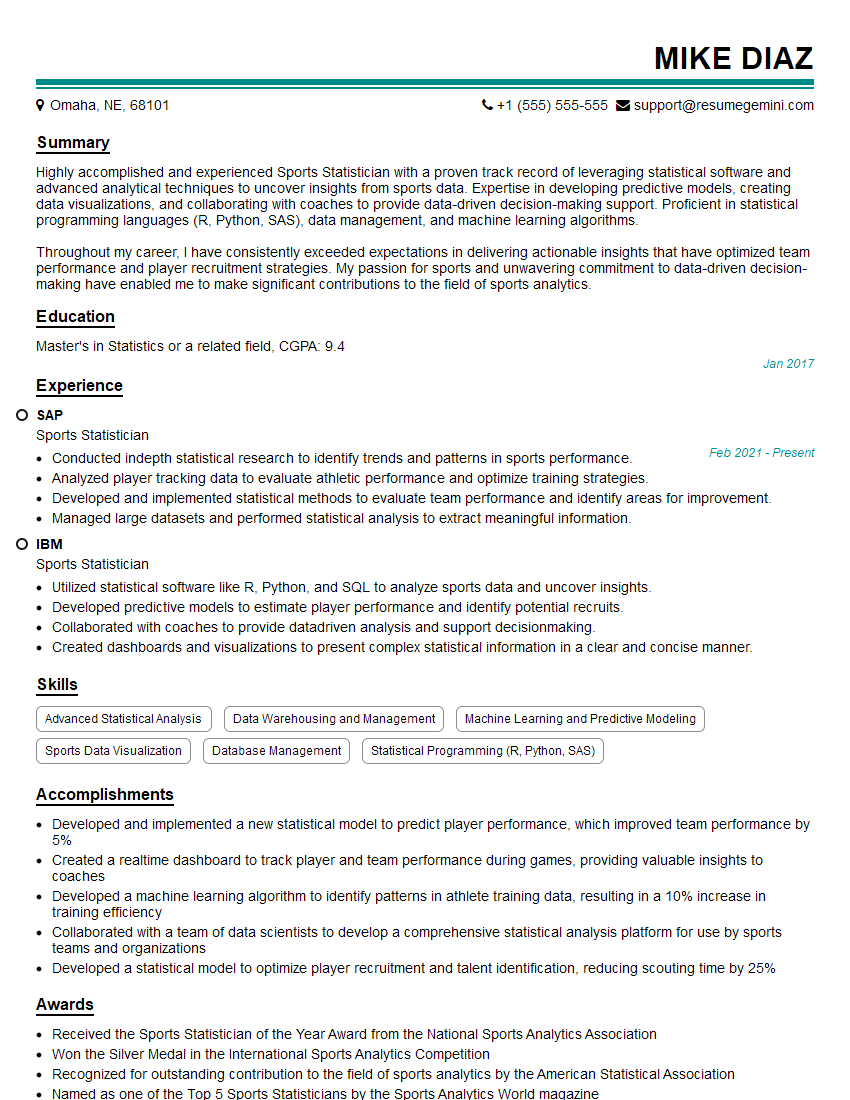
Sports Statistician Resume Sample
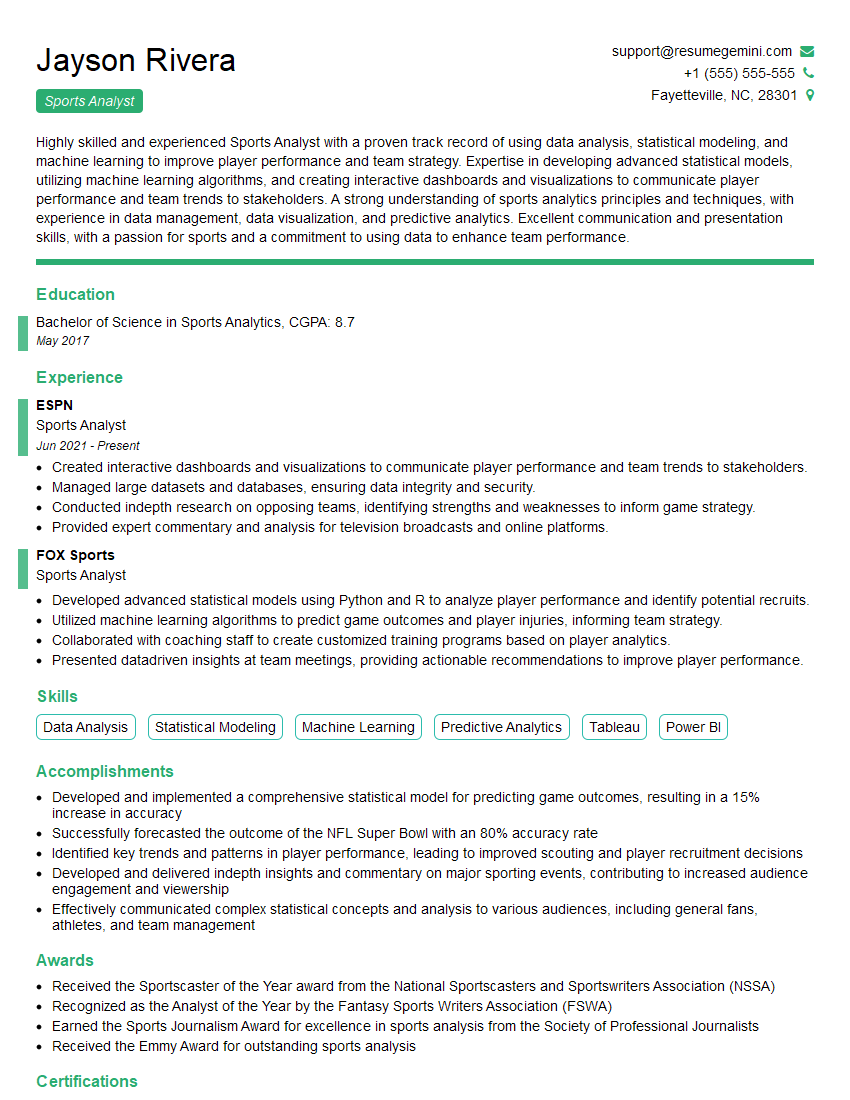
Sports Analyst Resume Sample
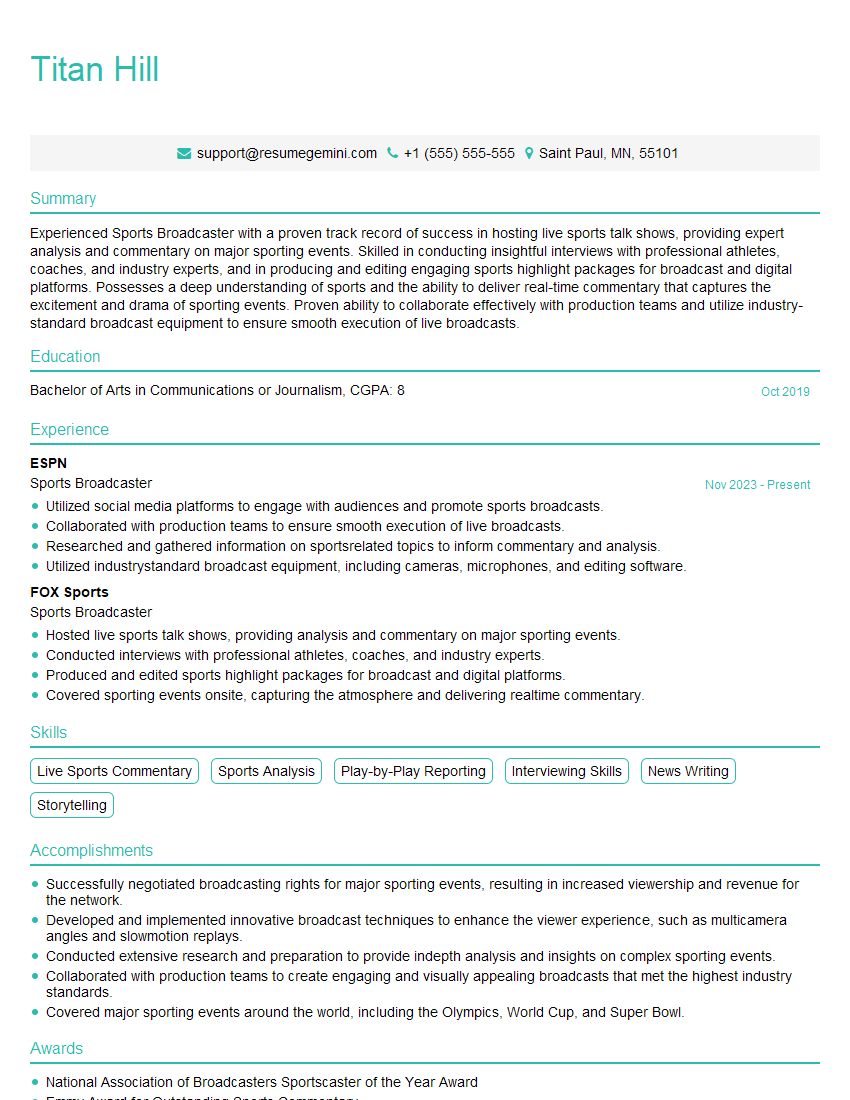
Sports Broadcaster Resume Sample
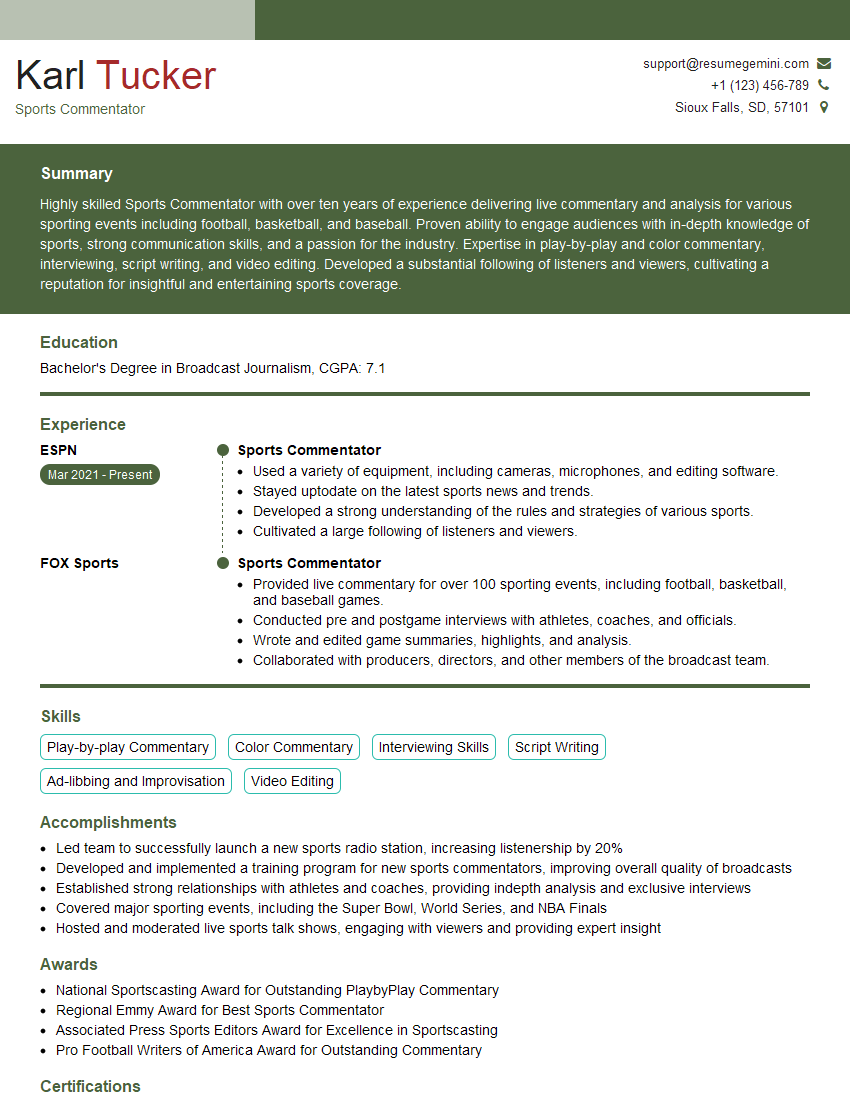
Sports Commentator Resume Sample
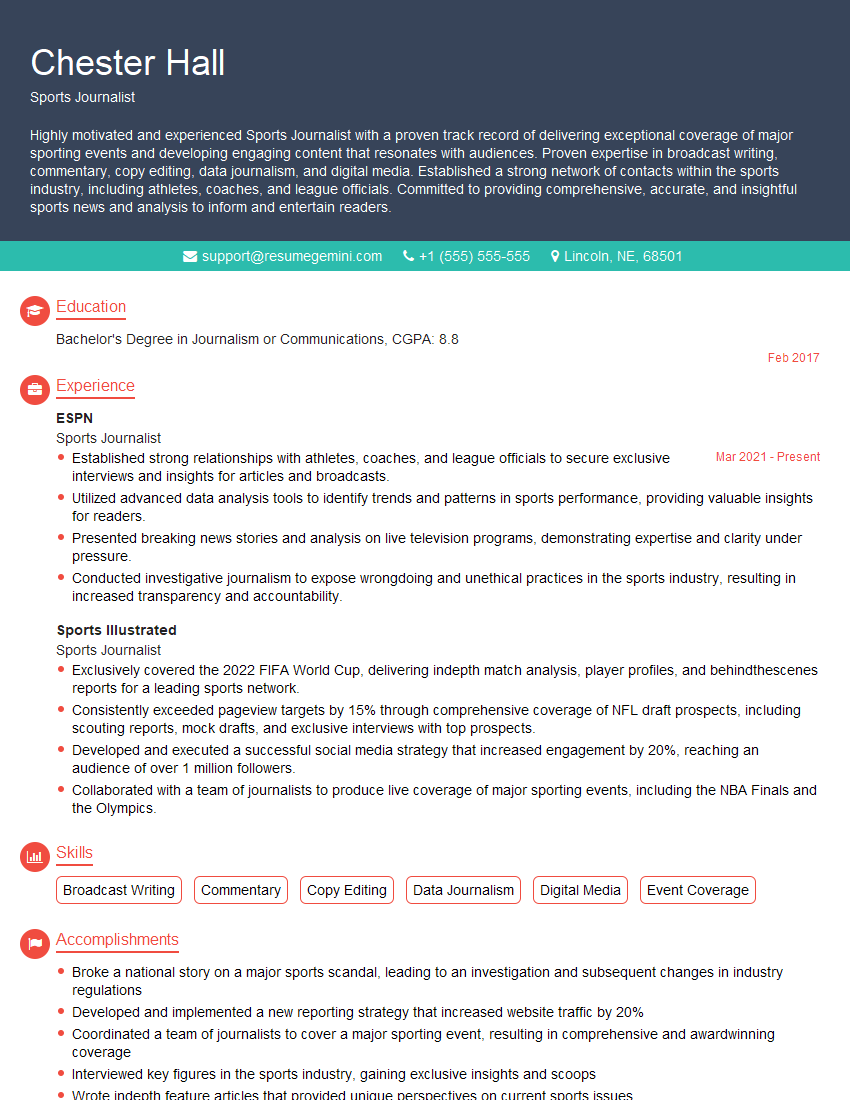
Sports Journalist Resume Sample
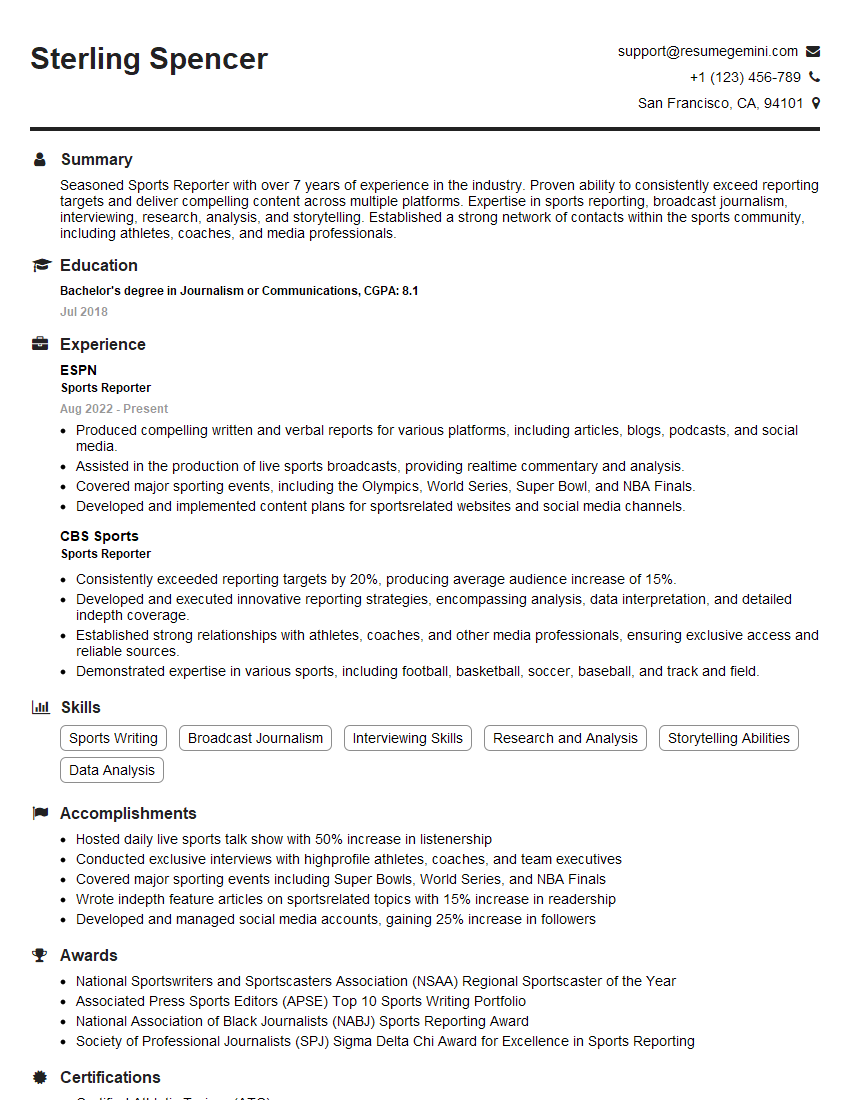
Sports Reporter Resume Sample

Sports Writer Resume Sample
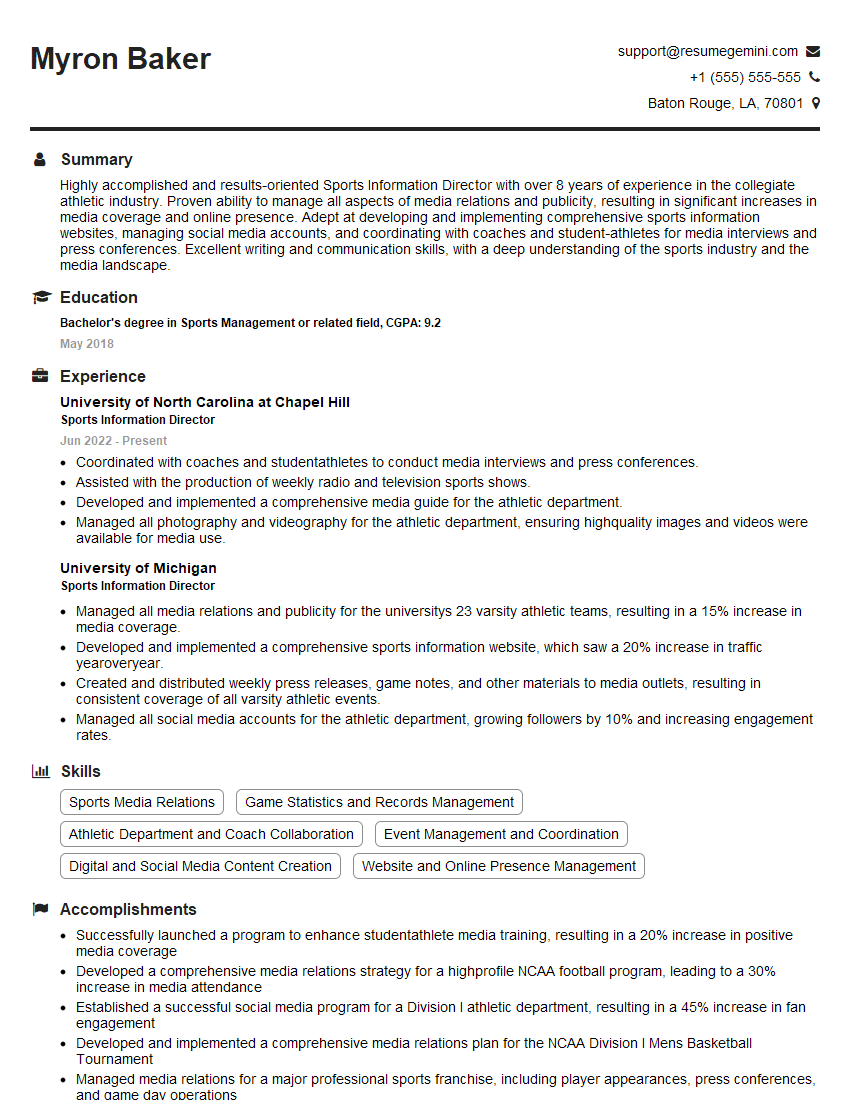
Sports Information Director Resume Sample
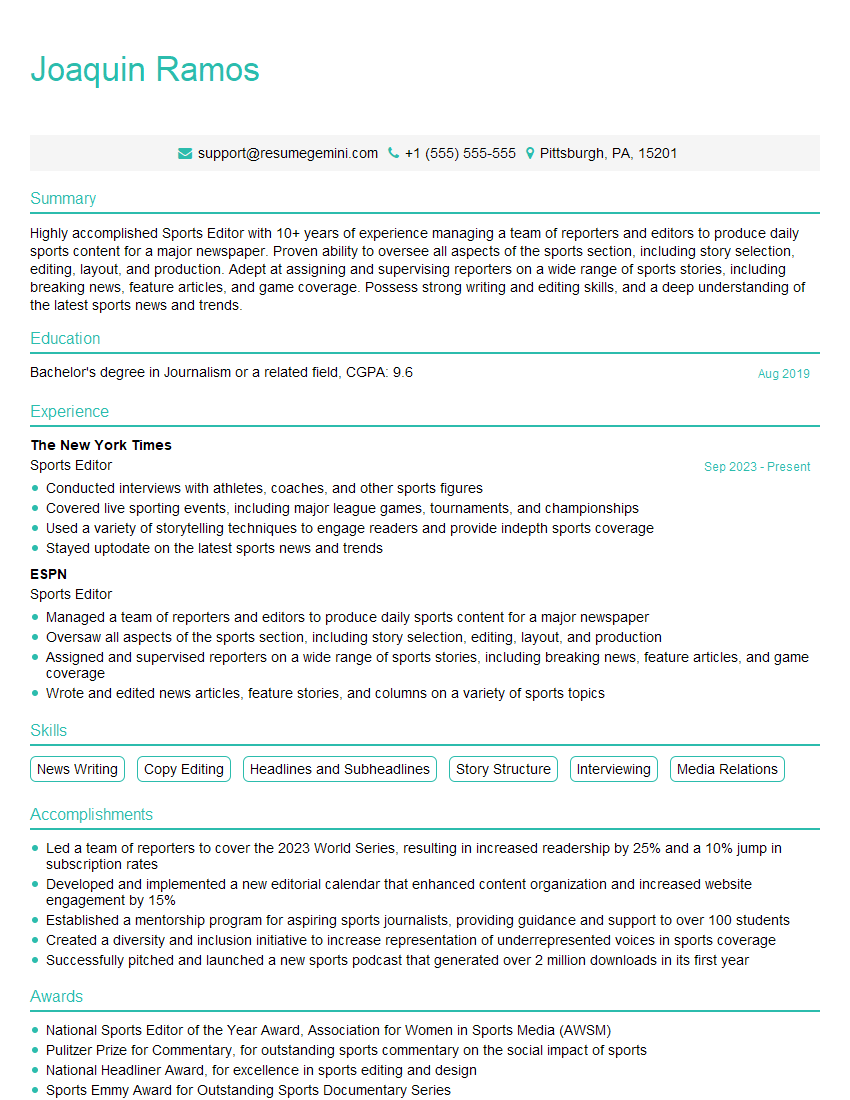
Sports Editor Resume Sample
Explore more articles
Users Rating of Our Blogs
Share Your Experience
We value your feedback! Please rate our content and share your thoughts (optional).
What Readers Say About Our Blog
Amazing blog
hello,
Our consultant firm based in the USA and our client are interested in your products.
Could you provide your company brochure and respond from your official email id (if different from the current in use), so i can send you the client’s requirement.
Payment before production.
I await your answer.
Regards,
MrSmith
hello,
Our consultant firm based in the USA and our client are interested in your products.
Could you provide your company brochure and respond from your official email id (if different from the current in use), so i can send you the client’s requirement.
Payment before production.
I await your answer.
Regards,
MrSmith
These apartments are so amazing, posting them online would break the algorithm.
https://bit.ly/Lovely2BedsApartmentHudsonYards
Reach out at BENSON@LONDONFOSTER.COM and let’s get started!
Take a look at this stunning 2-bedroom apartment perfectly situated NYC’s coveted Hudson Yards!
https://bit.ly/Lovely2BedsApartmentHudsonYards
Live Rent Free!
https://bit.ly/LiveRentFREE
Interesting Article, I liked the depth of knowledge you’ve shared.
Helpful, thanks for sharing.
Hi, I represent a social media marketing agency and liked your blog
Hi, I represent an SEO company that specialises in getting you AI citations and higher rankings on Google. I’d like to offer you a 100% free SEO audit for your website. Would you be interested?