Every successful interview starts with knowing what to expect. In this blog, we’ll take you through the top User Interface Prototypes interview questions, breaking them down with expert tips to help you deliver impactful answers. Step into your next interview fully prepared and ready to succeed.
Questions Asked in User Interface Prototypes Interview
Q 1. Explain the difference between low-fidelity and high-fidelity prototypes.
The fidelity of a prototype refers to its level of detail and resemblance to the final product. Low-fidelity prototypes prioritize speed and exploration of core concepts, while high-fidelity prototypes aim for a near-perfect representation of the final design.
- Low-fidelity prototypes: These are quick and dirty representations often using paper sketches, wireframes, or basic digital tools. They focus on the structure and flow of the UI, not the visual polish. Think of them as a rough blueprint. A simple paper sketch mapping out the screens of a mobile app is a low-fidelity prototype. They are great for early-stage testing and iteration because changes are easy and inexpensive.
- High-fidelity prototypes: These mimic the final product closely, including visual details, interactive elements, and animations. They provide a much more realistic user experience and are useful for usability testing and gathering detailed feedback before development begins. A prototype built in Figma or Adobe XD with interactive elements and realistic visuals is a high-fidelity prototype. They are beneficial for showcasing a polished vision to stakeholders.
In essence, low-fidelity is about getting the core ideas down quickly, while high-fidelity is about refining and polishing those ideas into a realistic representation.
Q 2. What prototyping tools are you most familiar with? Compare and contrast two.
I’m proficient in several prototyping tools, but my most frequent choices are Figma and Adobe XD. Both are powerful, but they cater to different preferences and workflows.
- Figma: A browser-based tool, Figma excels in collaborative design. Its real-time collaboration features allow multiple designers to work simultaneously on the same prototype. It also has a strong community and vast library of plugins. I find its vector-based design capabilities particularly useful for creating crisp and scalable UI elements. However, Figma’s prototyping capabilities, while strong, may feel less intuitive to those transitioning from other desktop applications.
- Adobe XD: This desktop application (available for both Windows and macOS) is known for its user-friendly interface and robust prototyping features. Its timeline-based animations and interactions are easily implemented, leading to highly polished prototypes. However, its collaborative features aren’t as seamless as Figma’s, particularly for teams working remotely. While it offers powerful prototyping tools, some might find the learning curve to be slightly steeper than Figma, especially for complex interactions.
Ultimately, the best choice depends on project needs and team preferences. For collaborative projects with a focus on scalability, Figma shines. For projects needing a polished, high-fidelity prototype quickly, Adobe XD might be a better fit.
Q 3. Describe your process for creating a user interface prototype.
My prototyping process is iterative and user-centric. It generally follows these steps:
- Research and Planning: I begin by thoroughly understanding user needs, business goals, and project requirements through user research methods like interviews and surveys. This stage includes creating user personas and defining user flows.
- Low-fidelity Prototyping: I create a low-fidelity prototype (often using paper or basic wireframing tools) to quickly sketch out the UI structure and functionality. This allows me to iterate and test basic navigation and information architecture easily.
- Usability Testing (Iteration 1): I conduct initial usability testing with representative users to identify major usability issues early on. Feedback informs the next iteration.
- Mid-fidelity Prototyping: I refine the design based on feedback, transitioning to a mid-fidelity prototype. This stage introduces more visual details and basic interactive elements, while still maintaining flexibility for changes.
- Usability Testing (Iteration 2): Another round of usability testing with a new group of users helps refine the interactions and visual design.
- High-fidelity Prototyping: Based on testing results, I create a high-fidelity prototype incorporating visual polish, animations, and advanced interactive elements.
- Final Usability Testing: A final round of testing ensures that the prototype is polished and meets the user needs.
- Handoff: Once testing is complete, I prepare the assets and documentation for the development team.
This iterative process ensures that the final prototype reflects user needs and aligns with project goals.
Q 4. How do you incorporate user feedback into your prototyping process?
Incorporating user feedback is crucial. I actively seek user feedback at multiple stages of the process, using various methods:
- Usability testing: I conduct moderated and unmoderated usability tests to observe users interacting with the prototype and gather feedback on their experience.
- Surveys and questionnaires: These allow for collecting quantitative and qualitative data on user preferences and opinions.
- Feedback forms: Simple forms embedded within the prototype itself allow for quick and easy feedback during testing.
- A/B testing: When applicable, I use A/B testing to compare different design options and determine which performs better.
I meticulously document all feedback, categorize it (e.g., navigation issues, visual design problems, content clarity), and prioritize fixes based on severity and impact. I use this feedback to iterate and refine the prototype, ensuring it addresses user concerns and aligns with usability best practices.
Q 5. How do you handle design constraints during prototyping?
Design constraints are inevitable. My approach is to proactively identify and address them early in the process:
- Understanding Constraints: I thoroughly discuss and document all constraints, including technical limitations, budget restrictions, brand guidelines, and timeframes.
- Creative Problem-Solving: When faced with constraints, I explore creative solutions to mitigate their impact. For example, if there’s a limitation on animations, I might focus on enhancing micro-interactions instead.
- Prioritization: I prioritize features based on their importance and feasibility, ensuring that essential elements are addressed even with limited resources.
- Communication: I maintain open communication with stakeholders about the impact of constraints on the design. This ensures transparency and allows for collaborative decision-making.
By acknowledging and creatively addressing constraints upfront, I ensure the prototype remains realistic and achievable, minimizing frustrations later in the development process.
Q 6. What are some common usability testing methods used with prototypes?
Several usability testing methods are useful with prototypes:
- Think-aloud protocol: Users verbalize their thoughts and actions as they interact with the prototype, providing insights into their cognitive processes.
- Eye-tracking: This method tracks users’ eye movements to understand where their attention is focused and to identify areas that might be confusing or difficult to understand.
- A/B testing: Comparing two different versions of the prototype (A and B) helps determine which version is more effective based on user performance and feedback.
- Heuristic evaluation: Experts in usability evaluate the prototype based on established usability principles (heuristics) to identify potential usability problems.
- Cognitive walkthrough: This method simulates a user’s interaction with the prototype, step by step, to identify potential usability problems.
The choice of method depends on the project’s goals, resources, and the stage of the prototyping process. Often, a combination of methods provides a more comprehensive understanding of the user experience.
Q 7. How do you ensure accessibility in your UI prototypes?
Accessibility is paramount. I incorporate accessibility considerations throughout the prototyping process:
- WCAG guidelines: I adhere to Web Content Accessibility Guidelines (WCAG) throughout the design process, ensuring that the prototype meets accessibility standards.
- Color contrast: I use sufficient color contrast between text and background colors to ensure readability for users with visual impairments.
- Keyboard navigation: I ensure that all interactive elements are accessible using only a keyboard, allowing users with motor impairments to navigate easily.
- Alternative text for images: I provide descriptive alternative text for all images so screen readers can convey the image’s meaning to visually impaired users.
- ARIA attributes: When necessary, I use ARIA attributes to enhance the accessibility of interactive elements and provide more context for assistive technologies.
Regular accessibility audits and testing with assistive technologies throughout the design process are crucial to ensure the UI prototype is inclusive and usable for everyone.
Q 8. Explain the importance of iterative prototyping.
Iterative prototyping is crucial for successful UI design because it allows for continuous improvement and refinement based on feedback and testing. Instead of building a final product immediately, iterative prototyping involves creating a series of prototypes, each building upon the previous one. This approach is akin to sculpting – you start with a rough form and gradually refine it until you achieve the desired result.
Importance:
- Reduced Risk: Early and frequent testing minimizes the chance of investing heavily in a design that ultimately fails to meet user needs.
- Improved User Experience: Iterations based on user feedback directly enhance usability and user satisfaction.
- Enhanced Collaboration: The iterative process encourages better communication and collaboration amongst designers, developers, and stakeholders.
- Cost-Effectiveness: Identifying and fixing problems early in the process is significantly cheaper than making changes later in development.
Example: Imagine designing a mobile banking app. The first iteration might focus solely on the login and account balance screens. After testing, you might discover users struggle with the login flow. In the next iteration, you could simplify the login process based on this feedback. This continues until you’ve addressed key pain points and optimized the user journey.
Q 9. Describe your experience with A/B testing prototypes.
A/B testing prototypes is a powerful method for comparing different design solutions and determining which performs better. I’ve extensively used A/B testing tools like Optimizely and VWO (Visual Website Optimizer) to test variations in button placement, color schemes, navigation menus, and overall layout. This involves creating two (or more) versions of a prototype with specific variations and then presenting them to different user groups.
My Experience: In a recent project designing an e-commerce website, we A/B tested two versions of the product page. Version A featured prominent product images and concise descriptions, while Version B highlighted customer reviews and social proof. By tracking metrics like click-through rates, conversion rates, and average session duration, we determined that Version B, focusing on social proof, significantly outperformed Version A in driving sales.
Process: The process typically involves clearly defining hypotheses, creating controlled variations, deploying the tests, monitoring results, and analyzing the data to draw conclusions and inform future iterations. It’s important to ensure that only one variable is changed between versions to isolate the effect of that specific change.
Q 10. How do you balance speed and fidelity when creating prototypes?
Balancing speed and fidelity in prototyping is a constant juggling act. High-fidelity prototypes, which closely resemble the final product, are excellent for detailed user testing, but they are time-consuming to create. Low-fidelity prototypes, which are simpler and quicker to produce, are beneficial for early-stage exploration and rapid iteration. The key is to use the appropriate fidelity for the stage of the design process.
Strategy: I typically start with low-fidelity prototypes (e.g., paper prototypes, wireframes) to quickly test core concepts and gather early feedback. As the design progresses and key interactions are refined, I gradually increase fidelity (e.g., interactive prototypes using Figma, Adobe XD, or Axure). This allows for rapid iteration in the early stages and more detailed testing as the design matures. It’s like building a house – you wouldn’t start with intricate interior design before you have the foundation and walls in place.
Q 11. What are some common pitfalls to avoid when creating UI prototypes?
Several common pitfalls can hinder the effectiveness of UI prototypes:
- Overly focusing on aesthetics before functionality: Prioritize usability and core functionality over visual polish in early iterations. A beautiful prototype with poor usability is misleading.
- Neglecting user testing: Prototypes should be tested with real users to gain valuable insights and identify potential issues.
- Creating prototypes that are too complex or realistic: This can be unnecessarily time-consuming and may obscure crucial usability problems.
- Ignoring accessibility: Ensuring the prototype adheres to accessibility guidelines is critical for inclusivity.
- Failing to iterate based on feedback: User feedback should inform design decisions and lead to iterative improvements.
- Not clearly defining the prototype’s purpose: Every prototype should have a specific goal to ensure that testing remains focused and effective.
Q 12. How do you measure the success of a UI prototype?
Measuring the success of a UI prototype depends on its intended purpose. However, several key metrics can be employed:
- Task Completion Rate: How effectively do users complete their intended tasks within the prototype?
- Time on Task: How long does it take users to complete tasks? Shorter times suggest better usability.
- Error Rate: How frequently do users make errors or encounter problems while interacting with the prototype?
- User Satisfaction: Surveys and feedback sessions can gauge overall user satisfaction with the prototype’s design and functionality (e.g., using System Usability Scale (SUS)).
- Qualitative Feedback: Open-ended questions and observations during user testing provide valuable qualitative insights into user experiences and pain points.
The combination of quantitative (e.g., completion rates) and qualitative (e.g., user comments) data gives a holistic understanding of the prototype’s success.
Q 13. Describe a time you had to iterate significantly on a prototype. What caused the need for iteration, and how did you address it?
During a project for a new e-learning platform, the initial prototype’s navigation was overly complex and confusing for users. The information architecture was flawed, leading to users struggling to find specific courses and resources. Initial user testing revealed extremely low task completion rates and high frustration levels.
Addressing the Issue: We addressed this by significantly iterating on the information architecture. We employed card sorting exercises with users to understand how they naturally categorize learning materials. We then simplified the navigation structure, using a more intuitive hierarchical system. We also implemented clearer labeling and visual cues to guide users.
Results: Subsequent iterations and user testing showed a dramatic improvement in task completion rates and user satisfaction. The revised navigation significantly enhanced the overall user experience and streamlined the learning process.
Q 14. How do you present your prototypes to stakeholders?
Presenting prototypes to stakeholders requires a clear and structured approach. I typically begin with a concise overview of the project’s goals and the prototype’s purpose. I then guide stakeholders through a walkthrough, highlighting key features and interactions. This is usually accompanied by a presentation showcasing the design rationale and decisions made.
Methods:
- Interactive Demonstration: A live walkthrough allows stakeholders to interact with the prototype and experience the design firsthand.
- Visual Aids: Use screenshots, videos, and annotated wireframes to illustrate design decisions and user flows.
- Data-Driven Insights: If available, share user testing data and analytics to support design choices and highlight areas of improvement.
- Facilitated Discussion: Encourage questions and feedback throughout the presentation to foster collaboration and address concerns.
- Follow-up Documentation: Provide a written summary of the presentation, including key takeaways, next steps, and action items.
The goal is to facilitate constructive feedback and alignment on the design direction.
Q 15. How do you handle conflicting feedback from stakeholders?
Conflicting stakeholder feedback is inevitable in design. My approach is to prioritize a collaborative and data-driven resolution. I start by carefully documenting all feedback, noting the source and rationale behind each suggestion. This creates a comprehensive overview, allowing me to identify common themes and potential areas of compromise.
Next, I organize the feedback into categories – perhaps features, usability concerns, and aesthetic preferences. This allows for a more structured analysis. I then schedule a follow-up meeting with the stakeholders. I present my organized findings, highlighting areas of agreement and disagreement. Using a visual aid like a prioritization matrix (ranking features by importance and feasibility), I facilitate a discussion to reach consensus. If compromises are still difficult, I might propose A/B testing on specific features in later prototype iterations to validate which approach works best.
For example, if one stakeholder wants a complex data visualization while another prefers simplicity, we might agree to test both versions with users to determine the most effective and user-friendly option.
Career Expert Tips:
- Ace those interviews! Prepare effectively by reviewing the Top 50 Most Common Interview Questions on ResumeGemini.
- Navigate your job search with confidence! Explore a wide range of Career Tips on ResumeGemini. Learn about common challenges and recommendations to overcome them.
- Craft the perfect resume! Master the Art of Resume Writing with ResumeGemini’s guide. Showcase your unique qualifications and achievements effectively.
- Don’t miss out on holiday savings! Build your dream resume with ResumeGemini’s ATS optimized templates.
Q 16. What are your preferred methods for documenting design decisions related to prototypes?
I leverage a combination of methods for documenting design decisions. First, I maintain a detailed design document outlining the overall goals, target audience, and key features. Within the document, each design decision is explained, including rationale, alternatives considered, and the final choice. This ensures clarity and traceability.
Secondly, I use version control systems like Git to track changes to the prototypes themselves. This allows for easy rollback to previous versions if needed and enables collaborative design amongst team members. Commit messages are crucial; I ensure each one clearly describes the change made and its reasoning.
Finally, I use annotated screenshots or screen recordings to visually communicate design choices. These are especially helpful for explaining the functionality and user flow of interactive elements. A shared online document, like a Google Doc or Confluence page, serves as the central repository for all documentation, ensuring everyone is on the same page.
Q 17. How familiar are you with responsive design principles and their application in prototyping?
Responsive design is fundamental to my prototyping workflow. I’m highly familiar with its principles – adaptability to different screen sizes and devices, fluid layouts, and flexible images. I apply these principles throughout the prototyping process. This involves using prototyping tools capable of simulating various screen sizes and orientations, using flexible grids, and designing scalable interfaces.
For example, in Figma or Adobe XD, I use auto-layout features to ensure that elements respond smoothly to changes in screen size. I use media queries (though not directly coded in low-fidelity prototypes, the concept is vital to design) to visualize how layouts should shift based on device context. This ensures that the prototype accurately reflects the expected user experience across devices.
I also consider accessibility best practices while designing responsive prototypes, as this improves inclusive design for users with disabilities, ensuring that the interface remains usable and accessible across all devices.
Q 18. Explain your experience using version control for prototypes.
Version control is essential for managing prototype iterations. I primarily use Git, often integrating it with platforms like GitHub or Bitbucket. This allows for collaborative prototyping, where multiple designers can work simultaneously without overwriting each other’s changes. Moreover, it provides a history of every modification, allowing for easy review, comparison, and rollback if needed.
My workflow typically involves creating branches for individual features or iterations, committing changes with descriptive messages, and merging the branches back into the main branch once approved. This organized approach prevents confusion and ensures that the development process is transparent and accountable. Regularly pushing changes to the remote repository safeguards against data loss.
For example, if a significant design flaw is discovered in a later version, I can easily revert to an earlier, stable version.
Q 19. How do you handle the transition from prototype to final design?
The transition from prototype to final design is a crucial stage requiring careful planning. It’s not just about increasing fidelity; it involves ensuring consistency, incorporating feedback, and validating designs with real users. I approach this transition iteratively.
I begin by reviewing the prototype with stakeholders, identifying areas that need refinement based on user feedback and technical feasibility. The fidelity of the prototype is then increased gradually. For example, we’d start by fleshing out the UI details, adding realistic imagery, and implementing micro-interactions. This allows for continuous evaluation and refinement throughout the process.
Once the design achieves a sufficient level of fidelity, I perform rigorous user testing to identify any usability issues. This often involves A/B testing and usability studies to make data-driven decisions about final design elements. Finally, the design undergoes development and implementation into the actual product, with parallel QA testing to ensure that the finished product aligns with the final approved prototype.
Q 20. Describe your experience with creating interactive prototypes.
I have extensive experience in creating interactive prototypes. I’m proficient in using tools like Figma, Adobe XD, Axure RP, and InVision Studio to build prototypes with varying levels of interactivity. My experience spans from simple click-through prototypes to highly complex ones with animations, transitions, and data integration.
For instance, I’ve used Figma’s prototyping features to create interactive forms with dynamic data validation, simulating real-world user input and feedback. In other projects, I’ve used Axure RP to develop more intricate prototypes incorporating conditional logic, where the user’s actions influence the subsequent screen or element displayed. The choice of tool often depends on the project’s complexity and specific requirements.
When developing interactive prototypes, I prioritize user experience and focus on mimicking realistic user interactions to provide a more accurate representation of the final product. This includes incorporating realistic animations and transitions to enhance user engagement and understanding.
Q 21. How do you test the usability of your prototypes on different devices?
Testing prototypes across various devices is critical for ensuring a consistent user experience. I employ a multi-pronged approach. Firstly, I leverage the responsive design features of my prototyping tool (as discussed earlier) to simulate different screen sizes and resolutions. This provides a quick overview of how the design adapts across various devices.
Secondly, I conduct in-person testing using a variety of devices – smartphones, tablets, and laptops with different operating systems and browsers. This allows for more accurate identification of device-specific issues.
Thirdly, I utilize tools like BrowserStack or Sauce Labs, which allow for remote testing on numerous device and browser combinations. This expands the testing coverage considerably, enabling the detection of compatibility issues and performance problems. The results are systematically documented, and any identified issues are prioritized and addressed to enhance the user experience across different devices.
Q 22. What are some key considerations for prototyping for mobile devices versus desktop?
Prototyping for mobile versus desktop requires a shift in thinking due to fundamental differences in screen size, input methods, and user context. On mobile, the smaller screen necessitates prioritizing core functionalities and simplifying navigation. Gestures, such as swiping and tapping, become primary interaction methods, unlike the mouse and keyboard commonly used on desktops. Context also plays a huge role: mobile users often interact with apps on the go, requiring designs optimized for quick, one-handed use. For example, a desktop e-commerce website might display numerous product categories at once. A mobile version would likely use a hamburger menu to conserve screen real estate, showing categories only when needed. Desktop prototypes allow for more detailed layouts and complex interactions, benefiting from larger screen sizes. Consider how much space your interactive elements need. On mobile, the need for visual clarity and intuitive navigation is even more critical because of smaller screen sizes and the potential for distractions.
- Screen Size and Resolution: Mobile prototypes must adapt to various screen sizes and resolutions, while desktop prototypes often target a smaller range.
- Input Methods: Mobile relies heavily on touch input, while desktop utilizes mice and keyboards, impacting interaction design.
- Context of Use: Mobile usage is often brief and task-oriented, demanding streamlined designs.
Q 23. How do you incorporate animations and micro-interactions in your prototypes?
Incorporating animations and micro-interactions significantly enhances the user experience, making prototypes feel more polished and intuitive. I use tools like Adobe XD, Figma, and Axure RP which offer robust animation capabilities. Micro-interactions, such as subtle button feedback (e.g., a change in color or a slight bounce on click) and loading indicators, add a layer of responsiveness that keeps users engaged. Animations guide users through the interface, providing visual cues and feedback, improving the overall usability. For example, a smooth transition between screens can be more appealing than a jarring jump. I also use them to communicate system status. For example, a loading spinner visually indicates that data is being fetched, providing timely feedback and managing user expectations.
For instance, I might create a subtle animation showing the progression of a data upload by using a progress bar that fills as the data uploads, providing real-time feedback to the user. The key is to keep animations purposeful and not overly distracting. Overuse can negatively impact the overall user experience.
Q 24. What are your thoughts on the role of prototyping in agile development?
Prototyping is absolutely vital in agile development. It allows for iterative design and testing, enabling continuous feedback and adaptation throughout the development lifecycle. In an agile environment, prototypes serve as tangible representations of features, facilitating communication between designers, developers, and stakeholders. Early prototypes reveal usability issues quickly, preventing costly rework later in the development process. Prototypes reduce the risk of costly development by allowing for continuous feedback and early detection of issues. Early and often feedback is key. The iterative nature of agile development makes prototyping an essential tool for adapting to evolving requirements and customer needs.
For example, in a sprint, we might create a low-fidelity prototype to test core functionalities early on. As the sprint progresses, we can refine it into a higher-fidelity prototype before development begins. This allows for constant validation and improvement before significant resources are committed.
Q 25. How do you ensure your prototypes are consistent with brand guidelines?
Maintaining brand consistency in prototypes is crucial for creating a cohesive and professional user experience. I begin by thoroughly reviewing the brand style guide, paying close attention to color palettes, typography, imagery, and logo usage. I then incorporate these elements into my prototypes, using the defined assets and adhering to the specified guidelines meticulously. For example, I would use the brand’s primary color in buttons and highlight elements, and maintain consistency in typography using the company’s preferred font. Tools like Figma and Adobe XD allow me to create style guides within the design software itself, ensuring consistency across multiple screens and ensuring that I maintain consistency across all assets.
Tools like brand management systems or design systems are very helpful in this regard. They consolidate all brand assets and guidelines in one place, making it easy to access and use the correct assets.
Q 26. Describe your experience with creating prototypes for different platforms (e.g., iOS, Android, Web).
I have extensive experience creating prototypes for various platforms, including iOS, Android, and web. Each platform has its unique design considerations, and I adapt my approach accordingly. For iOS, I adhere to Apple’s Human Interface Guidelines, focusing on clean aesthetics, intuitive navigation, and platform-specific interaction patterns. For Android, I follow Google’s Material Design principles, emphasizing visual consistency and adaptive layouts. Web prototypes require cross-browser compatibility testing and a focus on responsive design to ensure optimal functionality across different devices and screen sizes. My approach always involves considering platform-specific conventions and constraints, and I thoroughly test prototypes on target devices to ensure smooth user interactions.
I recently created a prototype for a new mobile banking app. For the iOS version, I used a more minimalist design with subtle animations, while the Android version incorporated bolder colors and more pronounced animations in line with Material Design guidelines.
Q 27. How do you use data analytics to inform your prototyping process?
Data analytics plays a crucial role in informing my prototyping process. By analyzing user data from existing products or conducting usability testing on prototypes, I gain valuable insights into user behavior and preferences. This data helps me identify areas of friction, optimize workflows, and refine design decisions. For example, heatmaps from usability tests can reveal which parts of the screen users interact with most frequently, guiding design choices. A/B testing on different prototype versions helps determine which design elements are most effective. Quantitative data provides objective evidence to support design decisions, while qualitative data (e.g., user feedback) adds valuable context.
In a recent project, heatmap analysis showed that users were struggling to find a particular feature. This informed a redesign where we made the feature more prominent and accessible, significantly improving user experience based on data-driven decision making.
Q 28. Explain your understanding of user-centered design principles and how they apply to prototyping.
User-centered design (UCD) principles are fundamental to my prototyping approach. UCD prioritizes understanding and meeting the needs of users. This involves conducting thorough user research, creating personas to represent target users, and employing iterative testing methods. In prototyping, UCD manifests in several ways. I conduct usability testing throughout the prototyping process to identify and address usability issues early on. I create user flows to map out user journeys, ensuring a seamless and intuitive user experience. Personas guide my design decisions, helping me to create prototypes that resonate with the target audience. I always keep user needs and goals at the forefront, iteratively refining the design based on feedback.
For example, before designing a prototype for a healthcare app, I interviewed healthcare professionals and patients to understand their needs and pain points. This informed the design of the app’s user interface, ensuring it was intuitive, accessible, and met the specific needs of its users. Iterative testing then helped to further refine the design.
Key Topics to Learn for User Interface Prototypes Interview
- Understanding User Flows and Information Architecture: Learn how to design intuitive navigation and organize information effectively for optimal user experience. Consider practical applications like card sorting and tree testing.
- Wireframing and Low-Fidelity Prototyping: Master the art of creating basic wireframes and low-fidelity prototypes to quickly iterate on designs and test core functionality. Explore different wireframing tools and their strengths.
- High-Fidelity Prototyping and Interaction Design: Develop skills in creating realistic prototypes that simulate the final product’s look and feel. Understand the importance of micro-interactions and transitions for a polished user experience.
- Prototyping Tools and Technologies: Gain proficiency in popular prototyping tools like Figma, Adobe XD, Axure RP, or InVision. Understand the strengths and weaknesses of each tool and when to use them.
- User Research and Testing: Learn how to conduct user research to inform design decisions and use prototype testing to identify usability issues and areas for improvement. Familiarize yourself with different testing methodologies.
- Accessibility and Inclusive Design: Understand accessibility guidelines (WCAG) and how to design prototypes that are inclusive and usable by people with disabilities.
- Responsive Design and Cross-Platform Compatibility: Learn how to design prototypes that adapt seamlessly to different screen sizes and devices. Consider the challenges of cross-platform consistency.
- Design Principles and Best Practices: Familiarize yourself with key design principles like consistency, clarity, and efficiency. Understand how these principles translate into effective prototype design.
- Iteration and Feedback: Understand the iterative nature of design and the importance of incorporating feedback throughout the prototyping process.
Next Steps
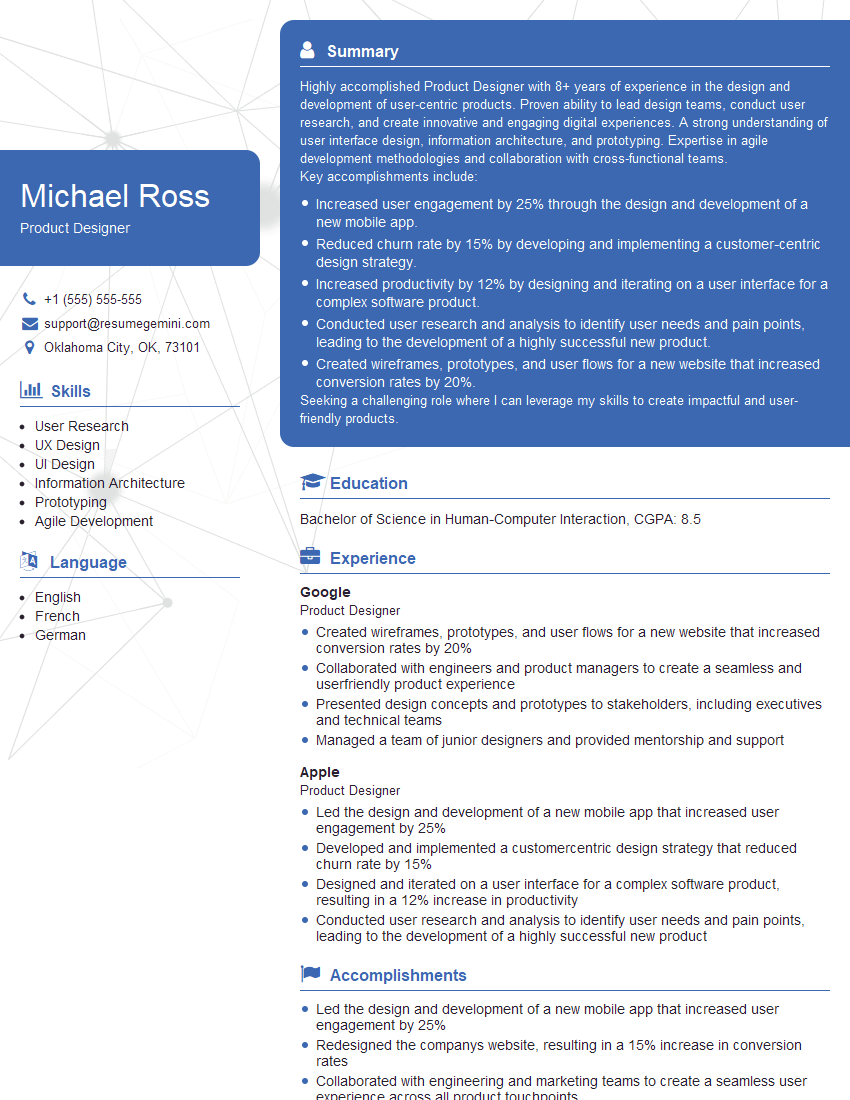
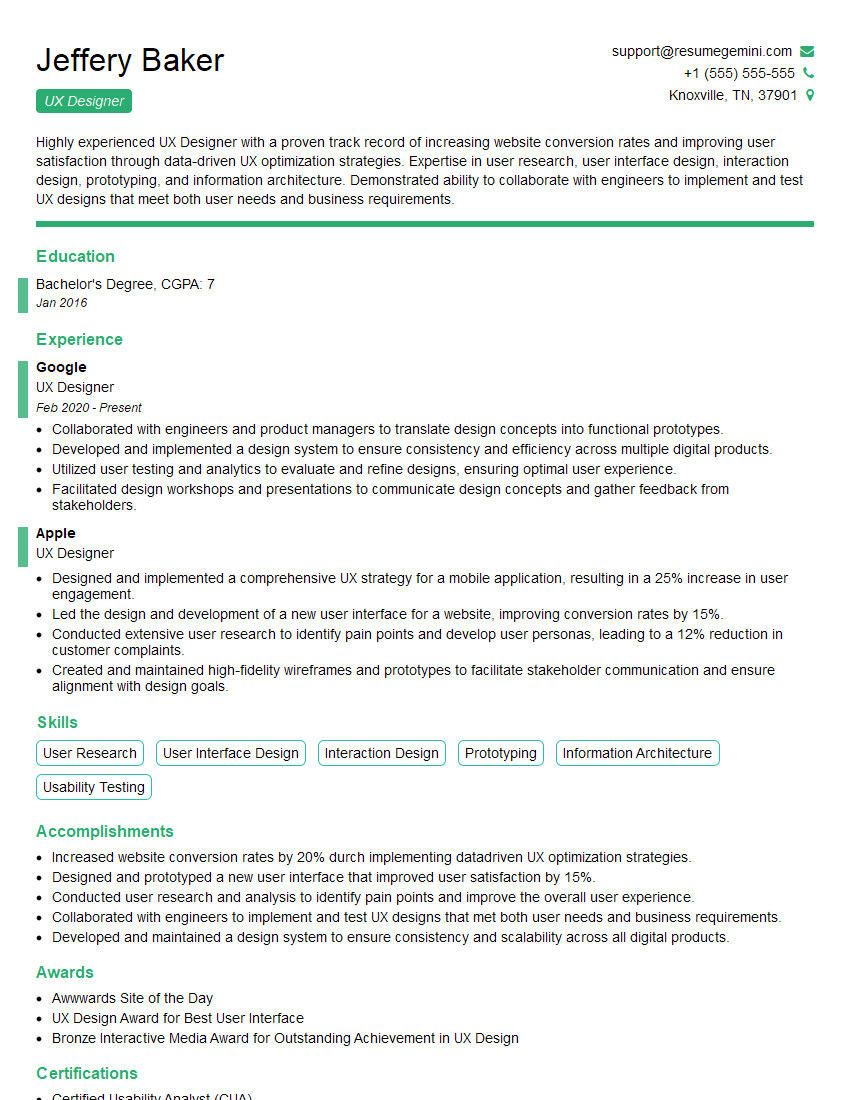
Mastering UI Prototyping significantly enhances your value as a designer, opening doors to diverse and challenging roles. A strong portfolio showcasing your skills is crucial, but equally important is a well-crafted resume that effectively communicates your expertise to recruiters and hiring managers. Building an ATS-friendly resume is key to maximizing your job prospects. ResumeGemini is a trusted resource to help you create a professional and impactful resume that stands out from the competition. Examples of resumes tailored to User Interface Prototyping roles are available to help guide you.

Explore more articles
Users Rating of Our Blogs
Share Your Experience
We value your feedback! Please rate our content and share your thoughts (optional).
What Readers Say About Our Blog
hello,
Our consultant firm based in the USA and our client are interested in your products.
Could you provide your company brochure and respond from your official email id (if different from the current in use), so i can send you the client’s requirement.
Payment before production.
I await your answer.
Regards,
MrSmith
hello,
Our consultant firm based in the USA and our client are interested in your products.
Could you provide your company brochure and respond from your official email id (if different from the current in use), so i can send you the client’s requirement.
Payment before production.
I await your answer.
Regards,
MrSmith
These apartments are so amazing, posting them online would break the algorithm.
https://bit.ly/Lovely2BedsApartmentHudsonYards
Reach out at [email protected] and let’s get started!
Take a look at this stunning 2-bedroom apartment perfectly situated NYC’s coveted Hudson Yards!
https://bit.ly/Lovely2BedsApartmentHudsonYards
Live Rent Free!
https://bit.ly/LiveRentFREE
Interesting Article, I liked the depth of knowledge you’ve shared.
Helpful, thanks for sharing.
Hi, I represent a social media marketing agency and liked your blog
Hi, I represent an SEO company that specialises in getting you AI citations and higher rankings on Google. I’d like to offer you a 100% free SEO audit for your website. Would you be interested?