Preparation is the key to success in any interview. In this post, we’ll explore crucial Woodfinishing interview questions and equip you with strategies to craft impactful answers. Whether you’re a beginner or a pro, these tips will elevate your preparation.
Questions Asked in Woodfinishing Interview
Q 1. What are the different types of wood finishes and their respective properties?
Wood finishes are broadly categorized into several types, each with unique properties affecting durability, appearance, and application. Understanding these differences is crucial for selecting the right finish for a project.
- Oil-based finishes: These offer excellent durability and water resistance, often producing a warm, rich look. Examples include linseed oil, tung oil, and varnish. They’re great for furniture that will see heavy use. However, they require longer drying times and can be more challenging to clean up.
- Water-based finishes: These are environmentally friendly, low-odor, and often dry faster than oil-based finishes. They include water-based polyurethane and acrylic finishes. They are easier to clean up but may not offer the same level of durability as oil-based options in high-traffic areas.
- Lacquer: This dries very quickly, offering a hard, durable surface with excellent clarity. It’s often sprayed on, making it ideal for large projects or achieving a perfectly smooth finish. However, it can be sensitive to solvents and requires careful application to avoid runs or imperfections.
- Shellac: A natural resin finish, shellac produces a warm, amber tone and is easily applied. While durable, it’s less water-resistant than other finishes and requires more maintenance over time. It’s excellent for showcasing the wood’s natural beauty.
- Wax: A soft finish that offers minimal protection but enhances the wood’s luster. It’s often used as a final coat over other finishes to provide a smooth, tactile surface. It’s best suited for less-demanding applications.
The choice of finish depends on the type of wood, the intended use of the finished piece, and the desired aesthetic.
Q 2. Explain the process of preparing wood for finishing.
Preparing wood for finishing is a critical step that directly impacts the final result. Proper preparation ensures a smooth, even finish and prevents problems like blotchiness or poor adhesion.
- Sanding: This is essential for creating a smooth surface. Start with coarser grit sandpaper (e.g., 80-grit) to remove major imperfections, gradually progressing to finer grits (e.g., 120, 180, 220) to achieve a flawless surface. Always sand in the direction of the wood grain to avoid scratches.
- Cleaning: After sanding, remove all dust particles using a tack cloth or vacuum cleaner. Any remaining dust can interfere with the finish’s adhesion. A clean, dust-free surface is key.
- Wood filler (optional): If there are any significant gaps, cracks, or knots, use a wood filler to level the surface. Allow the filler to dry completely before sanding it flush.
- Conditioning (optional): For porous woods like pine, a wood conditioner can help ensure even stain absorption, preventing blotchiness. This step is particularly important when applying stain.
Careful preparation significantly improves the final finish and reduces the need for extensive rework later on. Think of it as building a strong foundation for a house – if the foundation is weak, the house will be unstable. Similarly, inadequate preparation leads to uneven, unsatisfactory wood finishes.
Q 3. Describe your experience with various staining techniques.
My experience encompasses a wide range of staining techniques, each offering unique effects. I’ve worked with everything from traditional brush application to more advanced techniques like wiping and glazing.
- Brush application: This is the most common method, allowing for good control and even coverage. It’s perfect for detailed work or smaller projects.
- Wiping stain: This technique produces a more subtle, transparent color, allowing the wood grain to show through. Excess stain is wiped off after application, resulting in a naturally toned finish.
- Glazing: This involves applying thin layers of translucent stain, building color gradually. It’s useful for creating depth and dimension, highlighting wood grain features, or achieving a distressed or antique look. This allows for great creative control over the color outcome.
- Spray application: This method is ideal for achieving an even finish, especially on large surfaces. It requires specialized equipment and a controlled environment to prevent overspray.
In one project, I used a combination of wiping stain and glazing to achieve a custom, aged-oak look for a client’s antique reproduction dining table. The result beautifully showcased the wood’s character while providing the desired color depth.
Q 4. How do you ensure proper color matching in your work?
Accurate color matching is paramount in wood finishing. It requires a keen eye for detail and a methodical approach.
- Test samples: Before applying stain to the main piece, always create test samples on scrap wood of the same species and finish. This allows you to experiment with different stain colors and techniques, ensuring the final result meets client expectations.
- Natural light: Evaluate the color under natural light, as lighting conditions significantly affect color perception. Avoid making crucial color decisions under artificial light.
- Mixing stains: Sometimes, achieving the exact desired color requires mixing different stains. Maintain careful records of stain ratios to ensure consistency if you need to match additional pieces later.
- Client consultation: Clearly discuss color expectations with the client before starting the project. Show them color samples, providing realistic depictions of what the finished project will look like.
On a recent project, a client wanted a specific shade of cherry. By preparing multiple test samples and fine-tuning the stain mix, we achieved a perfect color match that completely satisfied the client.
Q 5. What safety precautions do you take when using wood finishing products?
Safety is paramount when working with wood finishing products. Many contain volatile organic compounds (VOCs) that are harmful if inhaled or contacted with skin.
- Ventilation: Always work in a well-ventilated area, preferably outdoors or with proper ventilation equipment. This minimizes exposure to harmful fumes.
- Personal Protective Equipment (PPE): Use appropriate PPE, including respirators, safety glasses, gloves, and long sleeves to protect your skin and respiratory system.
- Proper storage: Store finishing products in a cool, dry place away from ignition sources and out of reach of children and pets.
- Disposal: Dispose of finishing products and waste materials responsibly, according to local regulations.
- Read labels: Always read and understand the safety data sheets (SDS) provided with each product before use. This information provides vital details about handling, safety precautions, and first aid procedures.
Ignoring safety precautions can lead to serious health problems. Prioritizing safety ensures both your well-being and the success of your projects.
Q 6. Explain the importance of proper ventilation when applying finishes.
Proper ventilation is critical when applying wood finishes because many contain volatile organic compounds (VOCs). These VOCs are released as gases during application and drying, and inhaling them can lead to health problems ranging from headaches and dizziness to more serious long-term effects.
Adequate ventilation removes these harmful fumes from the work area, creating a safe environment. This can be achieved by:
- Working outdoors: If possible, the ideal solution is to work outdoors, where natural air currents disperse the fumes.
- Using fans: In indoor settings, powerful exhaust fans can effectively remove fumes, ensuring proper ventilation.
- Open windows and doors: Maximize natural ventilation by opening windows and doors, creating airflow to move the fumes away.
- Respirator: Even with good ventilation, a respirator is highly recommended to protect the respiratory system from any remaining fumes.
Ignoring ventilation can result in serious health issues and compromise the quality of the work itself. Adequate ventilation is not merely a safety precaution; it’s essential for a healthy and productive work environment.
Q 7. How do you handle different types of wood grain?
Different wood grains present unique challenges and opportunities in finishing. Understanding these variations is key to achieving a consistent and aesthetically pleasing result.
- Open-grained woods (e.g., oak, ash): These woods have prominent pores that can absorb more finish. Often a wood conditioner is used before staining to promote even absorption. Fillers may be used to level the surface before the final finish is applied.
- Closed-grained woods (e.g., maple, birch): These have smaller pores and are generally easier to finish, requiring less preparation. However, even stain absorption might still be a concern depending on the wood’s moisture content.
- Figured woods (e.g., curly maple, burl): The unique grain patterns of figured woods require careful attention to highlight their beauty. Selecting finishes that enhance the grain’s characteristics is crucial.
For example, when finishing a piece of oak, I would carefully apply a wood conditioner to even out the stain absorption, followed by a sanding sealer to fill the grain before applying the final topcoat. For a closed-grained wood like maple, the process might be simpler, but still require careful sanding and attention to detail.
Adapting techniques to the specific wood grain ensures a professional and visually appealing result, maximizing the unique characteristics of each wood type.
Q 8. Describe your experience with various application methods (brush, spray, rag)?
Applying finishes involves mastering several techniques, each with its own advantages and disadvantages. Brush application offers excellent control and is ideal for detailed work or reaching hard-to-access areas. Think of painting intricate moldings – a brush allows precision. Spray application, on the other hand, provides a smooth, even coat, perfect for large surfaces like tabletops or cabinet doors. However, it requires careful preparation and a well-ventilated area to avoid overspray and inhalation of fumes. Finally, rag application is best for applying thin coats of wiping varnishes or stains, offering a more natural, subtle finish – like achieving a beautiful antique look on furniture. I’ve extensively used all three methods throughout my career, adapting my approach based on the project’s scale, the type of finish, and the desired aesthetic.
- Brush: Excellent control, good for detail work, requires more time and effort.
- Spray: Fast, even coats, requires proper ventilation and safety equipment.
- Rag: Suitable for thin coats, natural finish, can be challenging to achieve uniformity.
Q 9. How do you troubleshoot common finishing problems, such as runs, drips, or bubbles?
Troubleshooting finishing problems is a critical skill. Runs and drips usually result from applying too much finish at once. The solution is to apply thinner coats, allowing each coat to dry fully before applying the next. To prevent bubbles, ensure the finish is properly mixed and free of contaminants. Using a slow, steady application avoids trapping air. For already existing problems, carefully sand the affected area with fine-grit sandpaper (e.g., 320-400 grit), feathering the edges to blend them seamlessly with the surrounding area. Then, reapply a thin coat of finish to that section only. Patience and attention to detail are key – rushing often exacerbates the issue. In my experience, addressing issues promptly is crucial to avoid extensive rework. One time, I had to deal with a severe run in a high-gloss finish on a custom-made entertainment center. Using a sharp blade, I carefully removed the excess finish, followed by careful sanding and re-application. The result was flawless.
Q 10. What is your experience with different types of sealers and their application?
Sealers are the foundation of any successful finish, protecting the wood and providing a uniform base for subsequent coats. I’m experienced with various sealers, including shellac, oil-based sealers, and water-based sealers. Shellac is a natural resin sealer that provides excellent adhesion and is easy to use, albeit slightly more delicate. Oil-based sealers provide deep penetration and are known for their durability, suitable for high-traffic areas. Water-based sealers are low-odor, environmentally friendly, and are easier to clean up, however, they might require more coats for complete coverage. Application methods vary depending on the sealer, but generally involve brushing, spraying, or wiping, ensuring even coverage and avoiding pooling. The choice of sealer depends on the wood type, desired finish, and environmental considerations.
Q 11. How do you maintain the quality and consistency of your finishes?
Maintaining quality and consistency involves meticulous attention to detail throughout the entire finishing process. This begins with proper wood preparation, including sanding to the correct grit and cleaning the surface thoroughly before applying any finish. Consistent application techniques are paramount – whether brushing, spraying, or wiping, the method should be the same for each coat. Using the same finish from the same batch for the entire project ensures consistent color and sheen. Working in a controlled environment, maintaining consistent temperature and humidity, is also crucial. Regularly cleaning application tools prevents contamination, as I once had a project where a dried bit of finish in the brush caused a noticeable imperfection. It’s important to note that even the best woodworkers will occasionally have inconsistencies, but the goal is to minimize them to deliver the highest quality.
Q 12. Explain the process of sanding between coats of finish.
Sanding between coats is essential for achieving a smooth, flawless finish. It removes any imperfections from the previous coat, allowing subsequent coats to adhere better and creating a level surface. The sanding process involves using progressively finer grits of sandpaper, starting with a slightly coarser grit to level out any imperfections (around 220 grit), and then moving to finer grits (320, 400, and even higher) to achieve a perfectly smooth surface. Sanding should be done lightly and evenly, avoiding excessive pressure that could create scratches or gouges. It’s crucial to remove all sanding dust before applying the next coat; I often use a tack cloth or compressed air for a thorough cleaning. Sanding between coats is like preparing a canvas for a new layer of paint, ensuring the final artwork is breathtakingly smooth.
Q 13. What are the different types of sanding tools and abrasives you are familiar with?
I’m proficient in using a variety of sanding tools and abrasives. Hand sanding offers the greatest control, particularly for delicate areas, and I usually use sanding blocks for a more even finish. Power sanders, like random orbital sanders, are efficient for larger surfaces, minimizing the effort involved in achieving a smooth finish. I also use specialized tools like sanding sponges and flexible sanding pads for curved surfaces. My abrasive selection ranges from coarse grits (80-120 grit) for initial shaping to fine grits (320-600 grit) for final polishing. Choosing the right abrasive depends heavily on the wood and the desired outcome. For example, a harder wood might require a slightly more aggressive grit than a softer wood.
Q 14. How do you determine the appropriate level of sheen for a project?
Determining the appropriate sheen depends on the project’s aesthetic goals and the type of wood. High-gloss finishes accentuate the wood’s grain and color, creating a dramatic look suitable for formal settings. Satin finishes offer a more subtle sheen, blending elegance with practicality, perfect for both contemporary and traditional styles. Matte or low-sheen finishes highlight the wood’s texture, providing a more rustic or understated appearance. The choice of sheen is often a client-driven decision. I always discuss the different options with clients, showing them samples of different sheens on similar wood types. This ensures they understand the visual impact of their choice before committing to a specific finish. On one project, a client initially wanted a high gloss, but after seeing samples, opted for a satin sheen which complemented the rustic charm of the reclaimed wood they selected.
Q 15. How do you clean and maintain your finishing equipment?
Maintaining finishing equipment is crucial for consistent, high-quality results. My cleaning routine varies depending on the type of equipment, but the core principles remain the same: thorough cleaning and proper storage. For spray guns, I immediately clean them after each use, following the manufacturer’s instructions. This typically involves disassembling the gun, rinsing with the appropriate solvent (e.g., mineral spirits for oil-based finishes, water for water-based finishes), and then cleaning with a brush and specialized gun cleaner. I ensure all components are completely dry before reassembly and storage. For brushes, I clean them thoroughly with the appropriate solvent, working the solvent into the bristles, then rinsing with soap and water. I reshape the bristles and hang them to dry. Finally, I clean and organize my work area, making sure all rags and containers are properly disposed of according to safety regulations. Regular maintenance, such as lubricating moving parts and replacing worn parts, is also essential to extending the lifespan of my equipment.
For example, neglecting to clean a spray gun properly can lead to clogged nozzles, inconsistent finish application, and ultimately, ruined projects. Similarly, poorly maintained brushes can lead to uneven application and a compromised finish.
Career Expert Tips:
- Ace those interviews! Prepare effectively by reviewing the Top 50 Most Common Interview Questions on ResumeGemini.
- Navigate your job search with confidence! Explore a wide range of Career Tips on ResumeGemini. Learn about common challenges and recommendations to overcome them.
- Craft the perfect resume! Master the Art of Resume Writing with ResumeGemini’s guide. Showcase your unique qualifications and achievements effectively.
- Don’t miss out on holiday savings! Build your dream resume with ResumeGemini’s ATS optimized templates.
Q 16. Describe your experience with finishing different types of wood (hardwood, softwood).
Finishing hardwoods and softwoods requires different approaches due to their inherent properties. Hardwoods, like oak and maple, are denser and more resistant to wear, allowing for a wider variety of finishes. I often use oil-based or catalyzed lacquers on hardwoods for their durability and rich depth of color. The grain structure of hardwoods also lends itself well to showcasing intricate details with the proper finish. Softwoods, such as pine and fir, are generally more porous and require more careful preparation to prevent the finish from sinking too deeply into the wood. For softwoods, I often opt for water-based finishes or shellacs, which raise the grain less than oil-based products and allow for easier sanding between coats. A good example is finishing a pine tabletop versus an oak dining table. The pine might require multiple sanding steps between coats of water-based polyurethane to achieve a smooth surface whereas the oak table would possibly only need one or two. In both cases, proper preparation – sanding to the appropriate grit, filling any imperfections, and applying a good quality primer when necessary – is key to success.
Q 17. How do you deal with repairing finish damage on existing pieces?
Repairing finish damage depends heavily on the type of damage and the existing finish. Minor scratches or scuffs can often be addressed with a touch-up using a wax stick or a carefully applied layer of the original finish. Deeper scratches or gouges might require more extensive repair, involving sanding the damaged area, filling it with wood filler, and then refinishing the entire affected area. For example, a small scratch on a lacquered table might simply require rubbing compound, careful polishing, and a wax to restore the shine. A more severe gouge might necessitate sanding the area, applying wood filler, carefully blending it, re-sanding, and then applying multiple coats of lacquer to match the existing finish.
Sometimes, when significant damage exists or the existing finish is in poor condition, a complete refinishing might be the best option. This involves stripping the existing finish, sanding the wood, and then applying a new finish according to the chosen method (e.g., oil-based, water-based, lacquer).
Q 18. Explain the process of applying a high-gloss finish.
Achieving a high-gloss finish requires meticulous preparation and application. The process begins with preparing the wood surface with fine sanding (e.g., 320-grit or higher) to create a perfectly smooth base. Then, I apply multiple thin coats of a high-gloss finish, such as polyurethane varnish, lacquer, or shellac, allowing each coat to dry completely before applying the next. The key here is thin coats to prevent runs and sags. I typically spray the finish to achieve a perfectly even coat with minimal brushstrokes. Between coats, I lightly sand with very fine sandpaper (e.g., 400-grit) to smooth out any imperfections and remove any dust particles. I finish with a final sanding and polishing using a rubbing compound and polishing compound for a glass-like shine. It is important to maintain a consistent application temperature and humidity throughout the process. Patience and attention to detail are crucial in achieving a truly high-gloss finish. In some cases, final polishing techniques, such as using automotive-grade polishing compounds, can significantly enhance the final gloss.
Q 19. What types of finishes are suitable for outdoor use?
Finishes suitable for outdoor use must withstand harsh weather conditions, including UV exposure, moisture, and temperature fluctuations. Exterior-grade polyurethane is a popular choice due to its durability and UV resistance. Marine-grade varnish and spar varnish are also excellent options, providing exceptional water resistance. Oil-based finishes, while offering some protection, tend to require more frequent maintenance and reapplication compared to polyurethane or varnish. It’s crucial to choose a finish specifically labeled for outdoor use, as these are formulated to resist weathering. The specific choice often depends on factors such as the type of wood, the climate, and the level of protection needed.
Q 20. What is your experience with water-based vs. solvent-based finishes?
Both water-based and solvent-based finishes have their advantages and disadvantages. Water-based finishes are generally considered more environmentally friendly, have lower VOCs (volatile organic compounds), and clean up easily with soap and water. However, they may require more coats to achieve the same level of durability as solvent-based finishes, and they can sometimes raise the grain of the wood more. Solvent-based finishes, such as oil-based polyurethane or lacquers, offer excellent durability and water resistance, but they often have strong odors, require solvents for cleanup, and have higher VOCs. My choice depends heavily on the project requirements and my clients’ preferences. For example, in a client’s home with small children, I might opt for a low-VOC water-based finish; whereas for a high-traffic outdoor structure, I might use an oil-based finish for its superior weather resistance. The application techniques also vary slightly between the two types; solvent-based often requires a different spray gun setup and application approach.
Q 21. How do you select the appropriate finish for a specific project?
Selecting the appropriate finish involves considering several factors: the type of wood, the intended use of the project, the desired aesthetic, and environmental concerns. For example, a highly durable, water-resistant finish is needed for outdoor furniture, while a more delicate finish might be suitable for indoor furniture. The type of wood influences the choice as well; denser hardwoods might handle more robust finishes than porous softwoods. The desired level of sheen (gloss, satin, matte) is another crucial aspect. I always discuss these considerations with my clients to ensure their needs and expectations are met. Finally, I carefully consider environmental impact, often choosing low-VOC finishes whenever possible to minimize harmful emissions. In short, it’s a collaborative process involving careful consideration of all relevant factors to ensure a successful outcome.
Q 22. How do you ensure proper drying time for each coat of finish?
Ensuring proper drying time is crucial for a durable and beautiful finish. It’s not just about waiting a certain number of hours; it’s about understanding the factors that influence drying, such as temperature, humidity, film thickness, and the type of finish itself. Think of it like baking a cake – you need the right temperature and time for it to cook perfectly.
I always refer to the manufacturer’s recommendations for drying times as a starting point, but I also consider the ambient conditions. A hot, dry environment will speed up drying, while a cool, humid one will significantly slow it down. For example, a polyurethane finish in a humid workshop might require 24 hours between coats, whereas in a dry, heated room, 12 hours might suffice. I use a hygrometer to monitor humidity levels and a thermometer to check the temperature.
To prevent issues like dust nibs (small dust particles embedding in the wet finish), I often create a dust-free environment by using a clean, well-ventilated area or even temporarily setting up a makeshift clean room using plastic sheeting. I also avoid working in direct sunlight which can accelerate drying too quickly and cause imperfections. For thicker coats, I allow more drying time. A thin, even coat is always better than a thick, uneven one that will take much longer to cure.
Q 23. Explain your experience with finishing techniques on various surfaces (flat, curved, intricate).
My experience spans a wide range of finishing techniques on diverse surfaces. I’ve worked with everything from large, flat tabletops to intricately carved furniture and curved chair backs. Each surface presents unique challenges and demands a tailored approach.
Flat Surfaces: These are relatively straightforward. I can efficiently use spray application for a uniform finish, achieving a smooth, even coat. For larger pieces, I might use a gravity-feed spray gun, while for smaller items, an airless sprayer or even a brush might be appropriate. Proper surface preparation – sanding and cleaning – is crucial.
Curved Surfaces: These require careful application to avoid runs and sags. I often prefer using a brush for better control, especially with thicker finishes. I employ multiple thin coats, allowing each to dry completely before applying the next, ensuring complete coverage. The technique is all about even pressure and controlled movement. I’ve developed a deft touch that allows me to smoothly apply finish to even the most pronounced curves.
Intricate Surfaces: This is where precision is paramount. I often rely on brushes or specialty tools like small foam applicators to reach tight corners and crevices. I might even use a combination of techniques, such as spraying a first coat for even coverage, followed by careful brushing to reach intricate details.
For example, I recently completed a project involving a highly ornate Victorian-style desk. The intricate carvings required multiple applications using fine brushes to ensure all the details were perfectly highlighted. The entire finishing process involved approximately six coats of different finishes to achieve a beautiful, long-lasting result.
Q 24. Describe your knowledge of different types of wood defects and how to address them during finishing.
Understanding wood defects is essential for successful finishing. These imperfections can significantly impact the final look and the durability of the finish. My knowledge encompasses a wide variety of defects and how to mitigate their effects.
Knots: These can cause issues with finish adhesion and bleeding. I usually address this by sealing knots with a knotting solution or shellac before applying the main finish. This prevents resin bleeding through the finish later.
Open Grain: Woods with open grain (like oak) require filling to create a smooth surface for finishing. I use wood filler appropriate for the wood type and carefully level it before sanding.
Mineral Streaks: These can show up as dark lines and affect the evenness of the finish. I might use a wood bleach carefully and judiciously to lighten these areas, followed by sanding to ensure an even surface. If bleaching is not feasible, I may utilize a tinted finish to match and blend the finish for a cohesive look.
Splits and Cracks: These are more structural defects and require careful repair before finishing. I use wood glue and clamps to repair smaller splits and may need to fill larger gaps with wood filler and patching techniques.
My approach always involves careful assessment of the defects and choosing the most appropriate strategy for each situation. Ignoring defects can lead to finishing issues later on that are far more time-consuming to correct.
Q 25. How do you handle challenging projects with tight deadlines?
Handling challenging projects with tight deadlines requires a structured approach. My strategy centers on careful planning, efficient execution, and proactive communication.
Thorough Planning: I begin by breaking down the project into manageable tasks, estimating the time required for each. This allows for a realistic timeline, even with the inherent variables in wood finishing.
Prioritization: I prioritize tasks based on their urgency and impact on the final product. Crucial steps, like proper preparation and the application of base coats, are tackled first.
Efficient Execution: I optimize my workflow, using efficient techniques and tools to save time without compromising quality. I stay organized and keep the work area clean to minimize delays.
Proactive Communication: I maintain open communication with clients, keeping them informed of the progress and any potential delays. This allows for collaborative solutions and prevents misunderstandings.
For example, I once had a rush order for a set of dining chairs that needed to be delivered within a week. By using a fast-drying finish and working long but focused hours, I delivered the project on time to a satisfied customer.
Q 26. How do you prioritize tasks and manage your time effectively in a finishing shop?
Effective task prioritization and time management are critical in a busy finishing shop. I employ several strategies to ensure efficiency and minimize bottlenecks.
Project Scheduling: I use a digital calendar to schedule projects based on their deadlines and complexity. This creates a visual representation of my workload, allowing me to allocate time effectively.
Batching Similar Tasks: I group similar tasks together. For instance, I’ll complete all the sanding for multiple projects before moving on to applying the first coat of finish. This reduces wasted time switching between different tools and techniques.
Delegation (where applicable): If I manage a team, I delegate tasks based on individual skills and expertise to distribute the workload and optimize productivity. This is often critical for larger, more demanding jobs.
Regular Review and Adjustment: I regularly review my schedule, making adjustments as necessary. Unexpected issues may arise, and being flexible allows me to adapt without significant disruption.
Think of it like an orchestra – each musician plays their part in harmony, creating a beautiful whole. Similarly, in my shop, each task is a part of the larger project, requiring coordination and efficiency.
Q 27. What is your experience with using finishing equipment such as spray guns and HVLP systems?
I have extensive experience with various finishing equipment, including spray guns and HVLP (High-Volume, Low-Pressure) systems. Each has its advantages and disadvantages, and choosing the right tool depends on the project and the desired finish.
Spray Guns: I’m proficient with both airless and conventional spray guns. Airless systems provide excellent coverage for large surfaces quickly, but require careful control to avoid overspray and runs. Conventional spray guns offer more control and are better suited for intricate work.
HVLP Systems: These systems offer superior atomization and reduced overspray, making them environmentally friendly and efficient. They’re excellent for applying even coats on delicate surfaces. I find that HVLP sprayers are better for delicate projects where preserving the integrity of wood grain is critical.
Beyond the spray equipment, I also have experience with different types of brushes, rollers and specialized applicators, selecting the right tool for the material and technique required.
My experience allows me to choose the best method for each project, balancing speed, efficiency, and finish quality.
Q 28. How do you stay up-to-date with the latest advancements in wood finishing techniques and products?
Staying current in the dynamic world of wood finishing is crucial. I actively pursue knowledge through various avenues.
Industry Publications: I regularly read trade magazines and journals to stay informed about new products, techniques, and best practices.
Workshops and Seminars: I attend industry workshops and seminars to learn from leading experts and network with peers. Hands-on training is invaluable for honing skills and discovering new techniques.
Online Resources: I utilize reputable online resources, forums, and websites to access the latest information, compare products and find solutions to challenges.
Manufacturer Training: I take advantage of manufacturer training programs to gain in-depth knowledge of their products and best application methods. This provides first-hand experience and helps to troubleshoot potential problems early on.
Continuous learning ensures I’m always at the forefront of the field, equipped to deliver the highest quality results using the most effective and sustainable methods.
Key Topics to Learn for Your Woodfinishing Interview
- Wood Species and Properties: Understanding the characteristics of different wood types (hardwoods vs. softwoods, grain patterns, density) and how these influence finishing techniques.
- Surface Preparation: Mastering sanding techniques, selecting appropriate grits, and addressing imperfections for a flawless finish. Practical application includes identifying and rectifying common surface defects.
- Stain Application and Selection: Choosing the right stain type (oil-based, water-based, etc.) for desired color and finish, and understanding proper application methods to achieve even color and avoid blotching.
- Finish Types and Application: Knowledge of various finishes (lacquer, varnish, shellac, polyurethane) and their properties, including application methods (spraying, brushing, wiping), drying times, and durability.
- Troubleshooting and Problem Solving: Diagnosing common finishing problems (e.g., runs, drips, uneven color, dust nibs) and implementing corrective actions. This includes understanding the causes of these problems and preventative measures.
- Safety Procedures and Regulations: Familiarity with safe handling of finishing materials (solvents, stains, etc.), proper ventilation, and disposal methods. Understanding relevant safety regulations is crucial.
- Tools and Equipment: Knowledge of various tools used in wood finishing (sanders, spray guns, brushes, etc.) and their proper use and maintenance.
- Finishing Techniques: Understanding different finishing techniques such as glazing, distressing, and antiquing, and their applications in achieving specific aesthetic effects.
Next Steps
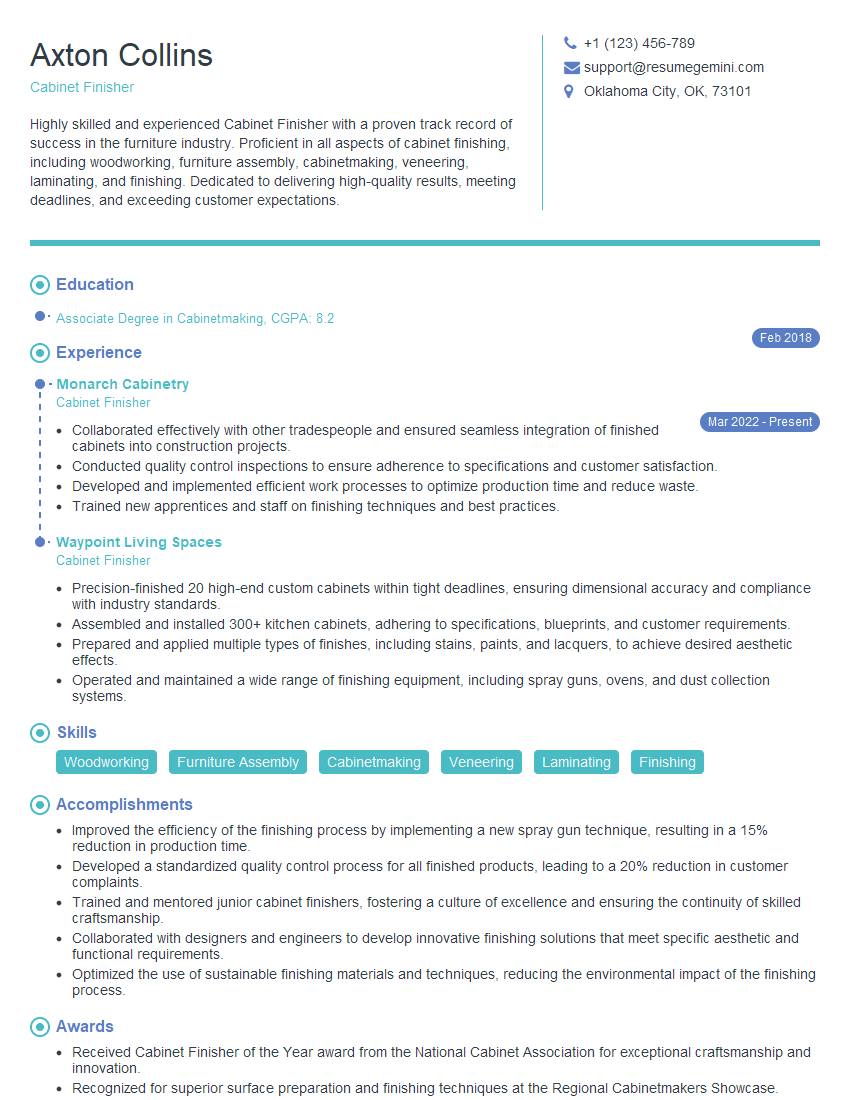
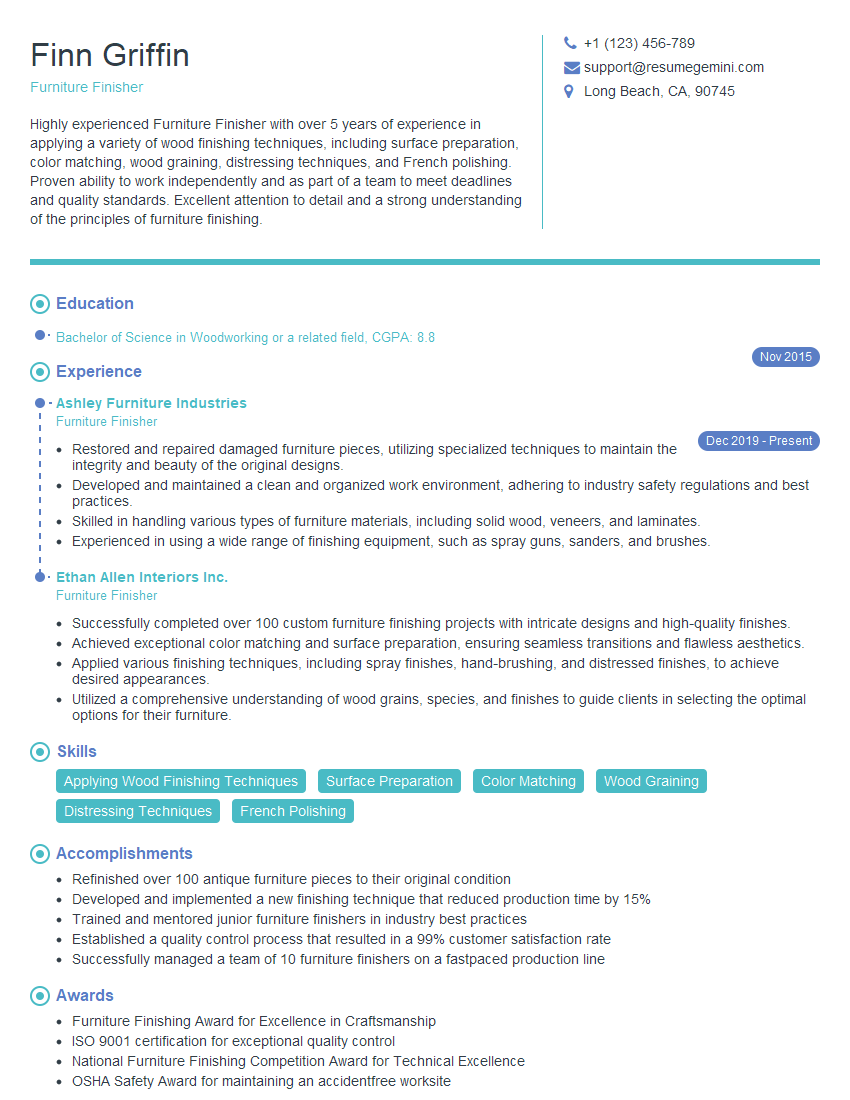
Mastering wood finishing opens doors to exciting career opportunities and allows you to showcase your craftsmanship and attention to detail. To maximize your chances of landing your dream job, it’s crucial to present yourself professionally. Creating an ATS-friendly resume is key to getting noticed by recruiters and employers. We highly recommend using ResumeGemini to build a strong, impactful resume that highlights your skills and experience effectively. ResumeGemini offers examples of resumes tailored to the wood finishing industry to help you get started. Invest the time to craft a compelling resume – it’s an investment in your future.
Explore more articles
Users Rating of Our Blogs
Share Your Experience
We value your feedback! Please rate our content and share your thoughts (optional).
What Readers Say About Our Blog
Amazing blog
hello,
Our consultant firm based in the USA and our client are interested in your products.
Could you provide your company brochure and respond from your official email id (if different from the current in use), so i can send you the client’s requirement.
Payment before production.
I await your answer.
Regards,
MrSmith
hello,
Our consultant firm based in the USA and our client are interested in your products.
Could you provide your company brochure and respond from your official email id (if different from the current in use), so i can send you the client’s requirement.
Payment before production.
I await your answer.
Regards,
MrSmith
These apartments are so amazing, posting them online would break the algorithm.
https://bit.ly/Lovely2BedsApartmentHudsonYards
Reach out at BENSON@LONDONFOSTER.COM and let’s get started!
Take a look at this stunning 2-bedroom apartment perfectly situated NYC’s coveted Hudson Yards!
https://bit.ly/Lovely2BedsApartmentHudsonYards
Live Rent Free!
https://bit.ly/LiveRentFREE
Interesting Article, I liked the depth of knowledge you’ve shared.
Helpful, thanks for sharing.
Hi, I represent a social media marketing agency and liked your blog
Hi, I represent an SEO company that specialises in getting you AI citations and higher rankings on Google. I’d like to offer you a 100% free SEO audit for your website. Would you be interested?